Tuesday, October 10, 2006

Site Contents

Star Trek 40th: The Seattle Convention (Sept. 2006)

WhoView: Christmas New Earth Werewolf Invasion

A Passion for the Future: The Soul of Star Trek
Countdown to 40: The Many Hands Theory of Star Trek

Trekcheck: The Continuing Adventures

Countdown to 40: Star Trek as Sci-Fi Redefined


Trekcheck: Of Rumor, Roast and SOST in Seattle
Countdown to 40: From the New to the Final Frontier

News Update
Countdown to 40: On the Final Frontier

The Trekkersphere

Trekcheck: The Future Beyond Trek XI

Action! Star Trek: Of Gods and Men filming begins

Inner Light, Outer Darkness

Who's First? First new Dr. Who season and Trek lessons

Trekcheck: Another Impossible Mission?

The Shape of Trek to Come (Trek XI)

Trek Who?

Trek XI Latest & Star Trek: The Nature of Evil

Star Trek: The Accidental Arcs

How to Know When Maybe You've Seen Too Much Star Trek

A Star Trek Carol

Light for a Cloudy Star Trek Future?

Legacy: R.I.P. Michael Piller

Looking for Star Trek, High and Low

On the Lost Star Trek Anniversary Book

Star Trek: The Inner Ape and the Enemy Within

John DeLancie Gets A Hand

Star Trek and New Orleans: Bettering Ourselves

Star Trek and New Orleans: You'd Do the Same For Me

On the Threshold

Star Trek: Dramatic Conclusions
Star Trek: A Mythology of the Future

Star Trek: Its Story and Its Soul

Star Trek: A Passion for the Future

R.I.P. James Doohan

Spielberg's War of the Worlds Reviewed

Wells and War of the Worlds Week

Cold War Cinema

Wells, Star Trek and Roddenberry
War of the Wells

The Star Trek 60s Part 1


Star Trek: Alternative Futures

Birth of An Empire (Lucas' Revenge of the Sith)

Douglas Adams Doesn't Panic
Hitchhikers Guide to the Galaxy Movie

Of Sharks and Whales: The Battle for Star Trek's Soul

Not For Boys Only
Star Trek and the Culture Wars

The Heroes of Trek

An Evening with Dan Curry, on Visual Effect and more

TrekCheck: What Was Once Imagined
TrekCheck: All Bad Things II
TrekCheck:
Mirrors
TrekCheck: All Bad Things
Trek XI News
TrekCheck:
Enterprise Home Stretch
TrekCheck: Enterprise Envoi
TrekCheck: The Trek Future
TrekCheck: The first 9 of Enterprise Season 4: starts December 14, 2004

A Vist to the Enterprise set: November 14, 2004
Snapshots from the Farewell Scotty Convention: October 16, 2004

New York Times article on Future of Star Trek: September 1, 2004

The Trekalog:
Star Trek: The Motion Picture June 27, 2004

Star Trek II: The Wrath of Khan: May 27, 2004

Star Trek III: The Search for Spock: April 27,2004

Star Trek IV: The Voyage Home March 27,2004

Star Trek V: The Final Frontier

Star Trek VI: The Undiscovered Country

note: dates of non- TrekCheck posts are locations, not always date of first posting.


Other blogs

portal: Dreaming Up Daily

the 60s: Boomer Hall of Fame

for 60s: 60's Now

on books: Books In Heat
fiction/fan fiction: Morgan Dash Unbound
political: Scorched Mirth
personal: Blue Voice

Saturday, October 07, 2006


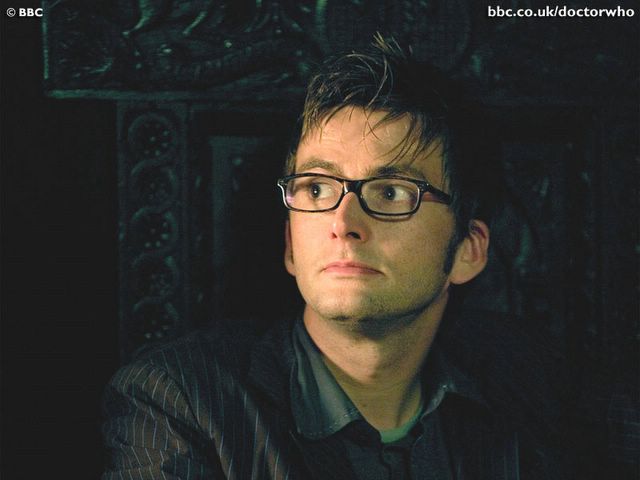
The new Doctor and Rose Posted by Picasa

for the planet. There's even a Luke moment. Posted by Picasa
WhoView: Christmas New Earth Werewolf Invasion

We’ve had the first three of the David Tennant Doctor Who episodes on the Sci-Fi Channel here in the U.S.-- the second season of the revived series, the first with Tennant as the tenth Doctor.

Tennant appeared for about 10 seconds at the end of the final first season episode, as the Doctor regenerated from Christopher Eccleston’s ninth doctor. It was immediately clear they were going to be different, and they are.

In his first episode, the 90 minute “Christmas Invasion,” somehow the only partly regenerated Doctor gets the TARDIS to Rose’s neighborhood for Christmas. This is the first time we’ve seen a regeneration in the new Who, and some of the traditional effects of regeneration, especially the Doctor’s disorientation and loss of identity, are not only repeated but extended and made into a suspenseful part of the narrative.

In the classic Whos, the new Doctor would act a little weird, but after selecting a new wardrobe, would settle down soon enough to begin the adventure. This time, the Doctor’s weakness (he’s unconscious for a lot of the story) and Rose’s uncertainty about whether he is going to come out of it, and if he is the real (or “proper”) Doctor at all, is the B story. It leads to a couple of neat scenes where the Doctor becomes the instant hero.

Tennant’s Doctor is more clearly heroic, as well as more the madcap Tom Baker-style, though he retains the 9th Doctor’s northern or working class accent rather than adopting the stage English that Tom Baker made famous in the role. But Tennant does have Baker’s background in Shakespeare (or more), which shows, and he is more fluid and mercurial than Eccelston. (We’re getting another major Tennant performance in the U.S. just now, when PBS begins broadcasting the acclaimed BBC “Casanova,” with Tennant and Peter O’Toole sharing the title role.)

Eccleston really grounded the new Doctor Who, and gave the character depth and mystery and melancholy as well as quirkiness and heroism. Tennant's first episodes have the Doctor flying again, but there are also echoes of the ninth Doctor in this tenth one. This is not to say one actor or one Doctor is better than the other. Eccelston's Doctor worked. So far, Tennant is off to a good start, and I look forward to more.

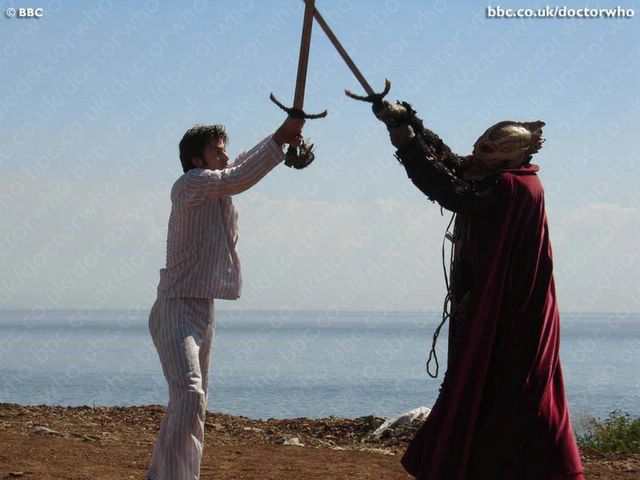
This first story involves an interstellar invasion of England at Christmas by some blustering space pirates in a very impressive space ship--Independence Day size, though looking more like enormous clumps of rock. The episode brings back Harriet Jones from the first season, now Prime Minister. In the climactic scene, the Doctor makes a dramatic entrance from the TARDIS, and champions the planet in a sword duel. The episode is full of wit, with a running joke (Jones showing her ID card and brightly announcing, “Harriet Jones, Prime Minister” after which everyone, including the space monster, replies, “Yes, I know.”) I didn’t catch a Trek reference but the Doctor—who does his derring-do in pjs and a bathrobe—mentions the similarly attired Arthur Dent, from Douglas Adams’ “Hitchhiker’s Guide to the Galaxy.” (True Whovians will recall that Adams was writing a Tom Baker Doctor Who story at the same time he was writing the original Hitchhiker script for radio.)

The story is a romp with thrills and wit, and then just as it seems to end happily, it takes a strange dark turn when Jones decides to use the secret weapon she’d had activated to destroy the defeated and retreating spaceship. This act turns the Doctor on a dime, from champion of the human race to accuser—it’s aliens that should fear humans, he says, they are the monsters. Despite the PMs sensible reasons, the Doctor uses a power unseen before in quite this way: he whispers a few words to Jones’ aide that soon results in a rumor that apparently forces her from office. It's a fairly stunning and potentially troubling display of power--arguably arbitrary, as it places the Doctor's judgment above the people who presumably should elect their leaders.

This odd mixture of stagey adventure and dark drama is physicalized when Rose, her family and the Doctor leaves a happy Christmas dinner to go outside in the falling snow, with a skyrocket-like meteor show above. But it isn’t that innocent: the meteors are pieces of the spaceship Jones destroyed, falling back to Earth, and the snow is the ash of the spaceship, and presumably of the bodies of the invaders. They were played as grotesques and somewhat comical and primitive. The Prime Minister saw them as a danger to Earth, especially if they returned to the stars to spread the word of the Earth’s riches. But the Doctor saw them as persons, as life, and his response was quick, uncompromising, and in the role of the reigning authority.

The echoes of recent geopolitics were there. At first in Jones’ refusal to cede power to the President of the U.S. (“Tell him he’s not my boss and he’s not going to start a war”) when the aliens are overhead. But then in her own behavior, versus the aliens—strange-looking, uncompromising, somewhat comical but also deadly. Not like us. Like terrorists perhaps.

The episode ends with Rose’s doubts resolved and ready to resume her journey with the Doctor. The joy of the journey is more powerful than anything else, it seems, which is its attraction and its danger.

In this final scene, the Doctor keeps referring to being a new man, wanting to see the universe with his new eyes. He had told Harriet Jones that the Earth was in a new time—they knew that aliens exist, and aliens know that earth exists. It’s a new world, he said, and then said it again with scorn after Jones destroyed the spaceship. The "new" theme will carry over to the next story.

(continued after photo)

Overlooking New New York. Really. Posted by Picasa
Everything New is Old Again?

In the next story, the first regular one-hour episode, the Doctor and Rose travel into the far future to the literal “New Earth.” It’s a period shortly after the time Rose visited in her first TARDIS journey with the 9th Doctor. Earth had been abandoned and was destroyed as the sun went nova in that story, and in this one, the far-flung human race decides to build a New Earth in a distant galaxy. (There is something of a Trek reference here, although it is really repeating a line from the old “Tom Corbett, Space Cadet” TV show, when the Doctor says they are “going further than we’ve ever gone before.” “Farther” might be the correct word, but since they are traveling in both space and time, maybe not.)

But they are soon reunited with some characters from that story, and some similar characters—instead of human-type beings speaking perfect English but evolved from trees and made of wood, here there are nurse-nuns evolved from cats. Not an extrapolation I'd make from the cats I've known, although cats are often kept in hospices and give great comfort to the dying. They seem to know who needs them, so maybe there's the potential for nursing. For nuns, is a stretch. Anyway, the great cat makeup is excuse enough.

There is an ethical dilemma at the heart of this story that should be familiar to Trek fans--artificial beings, clones in this case I believe, who are treated as experimental animals to benefit humans--the Treklike question of means and ends and what constitutes inviolable life.

There's also a chance for this Doctor to repeat the joy of the 9th when he brings people back to life (“Everybody lives!”),or in this case, cures them: he really is the Doctor this time. There’s the “last human” from that first season episode, still just eyes and a mouth on stretched skin, but this time with the ability to transfer herself into other bodies. She moves from Rose to the Doctor and back again, providing Tennant the opportunity to camp it up as having a female inside (something it’s hard to imagine Eccelston doing); before that, when Rose is possessed, she and the Doctor share a steamy kiss—though of course it doesn’t quite count as it isn’t really Rose. (Tennant is 34, about a decade younger than Eccelston, and looks even younger, so it seems the producers thought they could get away with a more sexually charged relationship between the Doctor and his companion.)

It’s an elegant episode, with the same mood of a romp and an adventure. We see some change in Rose—she’s more assured, more experienced and capable. (And so is Billie Piper, not only in some fine acting moments, but in how she plays her expressions to the camera.) But apart from personality differences and Tennant’s acting and physical presence, the writing is emphasizing a new authority for the Doctor. In this episode, reference is made to a legend about “a lonely god” who is obviously the Doctor. And the Doctor tells the errant nurses not to appeal to a higher authority than him, because there is none. Those are very striking assertions, and may indicate a new interpretation of who the Doctor is and what his role is; a new meaning for what "Time Lord" means, maybe. All in all, these new stories show that the new Doctor Who can be very entertaining and also quite edgy and a little dangerous.

[continued after photo]

Are we going for a Harry Potter look, possibly? Posted by Picasa

Sir Doctor of Tardis. Now we are not amused. Posted by Picasa
Empire of the Wolf

“Tooth and Claw” is an odd episode indeed. It starts out like a Kung Fu movie, but it’s in Scotland at the end of the 19th century. It’s a werewolf story, but it stars Queen Victoria.

As the last time the Doctor and Rose visited 19th century Earth (when they met Charles Dickens), the TARDIS is there by mistake. (They think they are going to 1979 and wind up in 1879. But Rose's description of the Doctor as a punk rocker with a touch of rockabilly is right on, especially if she means the 9th and 10th Doctors together.)

Besides the Crouching Hidden monks, there are the Queen’s guards in their red regalia, who soon keel over like the Queen’s guards in the Beatles movie, “Help!” Such topics as werewolves are sources of comedy as much as horror these days, and in this story there’s both. A very good looking CGI werewolf, too.

Tennant gets to use his Scottish accent, which is his own regular accent, and there is lots of running around and up and down in a big house. The werewolf is a bit of an alien, of course, and there are the anachronisms we’ve become accustomed to in tales of Victorian times ( Twenty Thousand Leagues Under the Sea, The League of Extraordinary Gentlemen, etc.)-- turns out, Victoria’s Albert has apparently helped construct a werewolf-destroying laser, powered partially by full moonlight. (It was a full moon here the night I saw this, actually.)

At one point when it is still in human form, the werewolf/alien tells Rose he likes this planet because it has lots of war and industry, and his goal is to seize the throne and make this the Empire of the Wolf. No one mentions it in this episode, but in the first season, the Doctor and Rose were dogged by repetition of a phrase that including the word "wolf.” (Though there is some cryptic dialogue from the werewolf man who recognizes some familiarity with wolfishness in Rose.) I thought for sure this episode would relate to that.

Eventually it might, because the implication is that Victoria might have been bitten, and the werewolf within her might emerge in the early 21st century to work on that rapacious, predatory Empire of the Wolf. (The Doctor and Rose discuss this in a lighthearted manner—the royal family as werewolves—but it also has a sinister potential.) But it turns out that this episode relates most directly to the first, the Christmas Invasion.

Like that story, there is a running gag—Rose trying to get Queen Victoria to say she is not amused. (When she finally does, she says “I” rather than the royal “we,” which is what makes the well-known expression funny and unique: “We are not amused.”) And just as the first story, everything seems happily resolved in the end, until the leader of England does something hostile. After knighting Sir Doctor of Tardis and honoring Dame Rose, she banishes them both. She considers them aliens on the side of evil, not part of “my world.” She castigates them for cavorting with stars and magic, and “think it fun.” Though she has previously spoken in favor of "imagination" she sees alien threats as beyond imagination.

At the very end, after the Doctor and Rose have gone, Victoria decides to start an institute to investigate and defend against aliens, and specifically against the Doctor. She names it after the house where the story took place, called Torchwood.

When more than a century later Harriet Jones unleashed the weapon against the aliens in the Christmas Invasion, it came from the Torchwood Institute.

The writing, the characters, the stories, the language, everything about this series is keeping me fascinated as I haven’t been since the first run of the Next Generation. I’m planning to see the first season again on DVD, and only wish I could see the second season that way now, not only for the quality and the minutes we don’t get, but to avoid the incessant promos for “Battlestar Gallactica.” They come directly after scenes so not even the fastest fast-forward move can obliterate them. And the only thing worse than hearing the same tag lines repeated so many times that they become clichés, is when they are war movie/TV clichés to begin with.

Coming Soon: this coming week (I hope), my account of the 40th anniversary Star Trek celebration in Seattle.

TARDIS in Scotland Posted by Picasa

Wednesday, September 27, 2006


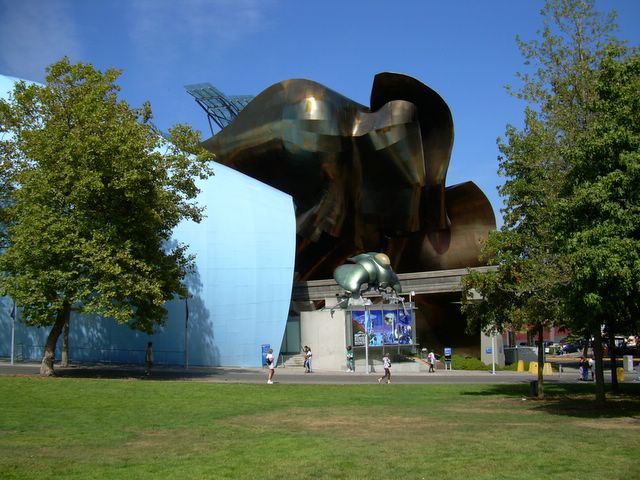
Famed architect Frank Gehry's Science Fiction Museum in Seattle. Photo: CF. Posted by Picasa
Non-Progress Report

Since I returned from the Star Trek 40th Anniversary Celebration in Seattle I've been overwhelmed with work, but that's how I hope to eventually pay for the trip. So I haven't had a chance to write about that amazing weekend, or to post anything here--but I will.

Things may lighten up for me towards mid October, though I might sneak a post in before then. Thanks to those of you who have been checking back, and catching up on old posts. I did post a lot in a short time before the 40th anniversary. So keep checking back for new posts--they're coming.

As for news, there doesn't seem to be much. This Jules Verne film festival event in Los Angeles on October 5 sounds pretty neat. I can't get too excited about the remastered TOS episodes, though it does seem from the conventions, etc. that there is still a lot of enthusiasm out there for Star Trek. But what I'm excited about is the second season of the new Dr. Who, which begins on the Sci-Fi channel Friday. I've seen clips from the UK on YouTube so I'm really looking forward to it. The new Doctor looks like he's going to be terrific.

Friday, September 08, 2006


Posted by Picasa

Posted by Picasa
A Passion for the Future: the Soul of Star Trek

By William S. Kowinski

It’s 40 years later, and it’s pretty much the same. When Star Trek’s first episode aired on September 8, 1966 (after Daniel Boone and before The Dean Martin Show on NBC), the country was in turmoil over a long and unpopular war characterized by deception, there were racial tensions in American cities, environmental doom and nuclear destruction were common fears, and television tried to ignore it all. With the patina of prosperity on the fast-paced present, most people either dismissed the future, or viewed it with fatalism.

With hundreds of hours of stories over the past 40 years, Star Trek became the planet’s best-known saga of the future. Its earnestness inspired both devotion and ridicule, but perhaps that was a risk worth taking. While most responses to its anniversary consist of sentimental fauning over phasers and Klingons, warp speed and holodecks, its lasting achievement lies in a vision of the future with guiding ideals and cautions for our real world future, that are as valid and needed now as they ever were. A few of these precepts might be summarized as follows:


1. For a better future, we must become better people. Star Trek brought together believable future technology with identifiable human behavior, but it also modeled a vision of the future where standards were higher, and struggling with ethical issues was central. "To be good," novelist Iris Murdoch suggests, "it may be necessary to imagine oneself good." Bigger challenges require that we fulfill more of our potential, or we may never get to that future.

2. The journey out is the journey in. Because Star Trek's humans had to see themselves through the eyes of the aliens they encountered, they learned to value self-examination on all levels—as individuals, groups and as humanity as a whole. Star Trek also presented technology in human terms, another crucial connection, for the importance of technology is in how it is used, and technology follows psychology. The roles of art, mortality and human relationships all became central to the voyage. "...space is not the final frontier," wrote Star Trek and science fiction writer David Gerrold. "The final frontier is the human soul."

3. Respect all life. Its conscious championing of diversity became a commitment to respecting all forms of life and civilizations, and its grappling with these ideals in specific situations became its drama. “The continuing mission of the starship Enterprise has been to take us out of the smog of fear and hate into an open space where difference is opportunity, and justice matters, and you can still see the stars," wrote Ursula LeGuin. "Violence on the Next Generation is shown as a problem, or the failure to solve a problem, never as the true solution."

4. We are not invaders-- we are explorers. When Captain Picard said these words (defining the essential meaning of what Star Trek fans know as the Prime Directive), he was announcing a profound change from most of human history, in which exploration led directly to exploitation and conquest. Science fiction writers like Ray Bradbury dramatized the repetition of this pattern on other planets, but Star Trek portrayed the implications of its reversal--and the temptations to revert. This purifies and exalts the human drive to explore and to learn, and through the exuberance of Captain Kirk, portrays exploration without exploitation as joyful fulfillment.

5. Making money is not humanity's prime directive. A future without money was sometimes played for laughs, but it is one of Star Trek's most subversive ideas: people will work to "better themselves and the rest of humanity" (in Picard's words) without being paid. Even though everyone's material needs are met (some have argued since the 60s this is entirely possible now, even without Star Trek’s technological magic), it doesn't lead to laziness but to liberation. "When you take away the need to make a living, a lot of other things are possible," said Star Trek producer Jeri Taylor. Our myth of money, which Lewis Mumford calls "the most dangerous of modern man's hallucinogens," was not present in all of our past. Sociologist Max Weber argued that the acquisition of wealth as an ethically superior motivation didn't appear until the 17th century. It doesn't need to be--and perhaps cannot be--in our future.

6. It takes many hands to make a future. How do you evoke participation, creativity necessary for change, and yet keep focus on the future? Gene Roddenberry insisted on a plausible and self-consistent imaginary Trek future, but equally important, he inspired others to creatively participate in giving life to this future. There were bruised egos and some bad behavior along the way, but also dedication, collaboration and focus on the highest common denominator.

Star Trek saw diversity as strength, and our relationship to the Other as the key to our social evolution, our new sense of ourselves necessitated by the realization that we are not alone in the universe, and the key to the efforts needed to create the future.

7. The future is an adventure. This is perhaps Star Trek's primary vision. The future isn't something to fear or to desire. It is not predetermined by fate or selfish genes. It is something we go out to meet, with heart, soul and wonder. This has always been the key to Star Trek's appeal. "Back in the 60s, most science fiction was about people who weren't on earth because they were escaping it, it was so overpopulated and polluted that people couldn't live on it, or it was a charred cinder because we'd screwed ourselves over," explained Michael Malotte, president of an international Star Trek fan organization. "Gene's Star Trek was really the first science fiction of its time to show a future where we actually learn from our mistakes. We bettered ourselves and we banded together, and we headed out for the stars. "

"What is now proved," wrote William Blake, "was once only imagin'd." For those with a passion for the future, acts of the imagination constitute the present adventure on the final frontier. If our civilization gets through the next century or so, it may be because we remembered to boldly go.

From "Amok Time" via trekcore.com. Posted by Picasa

Shatner and Nimoy at the 2006 Las Vegas con. Photo: ABC Australia. Posted by Picasa

Wednesday, September 06, 2006


Majel Barrett Roddenberry as Nurse Chapel in "Amok Time" via trekcore.com. Posted by Picasa

Like Greek drama: from "The Man Trap," first aired
September 8, 1966. Via trekcore.com Posted by Picasa
Countdown to 40: The Many Hands Theory of Star Trek

by William S. Kowinski

It is August 1966, and lost in the universe on Gene Roddenberry’s desk is a desperate memo from Bob Justman, one of Star Trek’s two associate producers. “It is important that you compose, without delay, our Standard Opening Narration for Bill Shatner to record.”

It was one of the last elements still to be finished before the first episode hit the airwaves. They had the music. When no respectable composer was interested in scoring this upstart series for a tiny, ill-equipped studio paying very little money, a musical arranger for a movie studio was hired to compose the Star Trek pilot music and, incidentally, it’s opening theme. Roddenberry worked with Alexander Courage, who adapted a Hebredean tune from the outer islands of Scotland. His opening fanfare would recur in every episode.

Then recently he and Justman had just dealt with a looming crisis concerning the visuals for this opening sequence. Namely, that after a special effects company had been promising these images for months, there weren’t any.

When he couldn’t wait any longer, Gene grabbed Justman and they stormed into the small company’s screening room and demanded to see all the shots of the starship Enterprise in action completed so far. They needed 20 just for the opening sequence.

They saw six. And those weren’t very good.

When the lights came up, they witnessed another shocking sight. The man who was in charge of creating these shots was sitting next to them, crying. “You’ll never make your air date!” he screamed, as he jumped up and ran out of the building. Like Roddenberry, Justman and everybody else connected with Trek, he had been working day and night. But the studio hadn’t allowed him the budget to hire the people he needed to complete this difficult work, which in 1966 had never even been attempted for television before.

Robert Justman was stunned, but Roddenberry just became very calm and quiet. After they sent the hysterical effects supervisor home (he wound up taking a long vacation), Roddenberry took Justman into an editing room with film of all the shots of the Enterprise they could find. There had been some created for the pilot episode that only studio executives had seen, in addition to the few new ones and fragments of others still incomplete. After several hours of splicing, assembling and refining, Justman was amazed: Roddenberry had pieced together an exciting opening sequence, right there on the Movieola machine.

Now Roddenberry had to put words to the music and the images. They would be important words. Star Trek was unlike anything audiences had seen before in prime time. Many viewers—and many television executives—thought science fiction was crazy, that space ships and aliens were kids’ stuff and would be laughed off the screen. How could you tell people what Star Trek was really all about, in under fifteen seconds?

Roddenberry’s roughed out a draft. “This is the story of the United Space Ship Enterprise,” the first began, “assigned a five year patrol of our galaxy.” But it sounded as stilted as the preamble to the U.S. Constitution. It even had the phrase “regulate commerce.” But it did contain the words, “explores strange new worlds and civilizations.”

John D. F. Black, Star Trek’s other associate producer, read it. “Think the narration needs more drama,” he suggested in his memo, and then added “an example of what I mean.” His draft began: “Space…the final frontier…endless, silent, waiting.” He then incorporate elements of Gene’s draft, adding, “to seek out and contact all alien life.” And he included the title of Sam Peeple’s script for the second pilot story, “Where No Man Has Gone Before.” “…to travel the vast galaxy where no man has gone before…a STAR TREK.”

Robert Justman tried a draft. His began, “This is the story of the Starship Enterprise” and went on to define its mission. He put together Roddenberry’s “to explore strange new worlds” with “where no man has gone before.” Then he sent all the drafts back to Roddenberry with a memo begging him to write the final script.

Gene started scribbling on Justman’s draft, then let a week go by. Justman was frantic---they were going on the air in a month, there was no more time. Roddenberry hurriedly did another draft---the final draft, since Justman grabbed it and ran across the street to the dubbing stage. He called Bill Shatner to rush over from the sound stage where he was filming Star Trek’s ninth episode. Shatner, in uniform as Captain Kirk, read through the narration a few times and recorded a take.

Justman liked his delivery but there seemed to be something missing. He asked the sound mixer to add a touch of reverberation, and Shatner declaimed it again. It was the final take. It had to be: they couldn’t afford to hold up the day’s shooting.

It is August 10, 1966. On September 8, those images and music would be seen and heard across the country, and these words:

“Space…the final frontier. These are the voyages of the Starship Enterprise. Its five year mission: to explore strange new worlds…to seek out new life and new civilizations…to boldly go where no man has gone before!.”

It would become one of the best known poems of the twentieth century.


Gene Roddenberry started it all, but Star Trek was created by many hands, not just for that first night, but for the next several decades.

In fact, GR’s greatest talent may have been as a catalyst, a synthesizer, as well as the guide. All drama is collaborative; most television is derivative, and science fiction is a kind of folk art that builds on what came before. But the Many Hands Theory of Star Trek is important also for its application to the future. We won’t get there without working together.

Star Trek’s history is replete with bruised egos and bad behavior. But creativity is often that way, especially when it is combined with business, like the big business of Hollywood. So it is even more of an achievement, and seems even more to have been fated in the stars, that Star Trek was able to model a better future, and bring America along with it.

continued after illustrations