Showing posts with label Neil Armstrong. Show all posts

Saturday, July 20, 2019

The First Step

Fifty years ago today, a human being first set foot on another world for the first time. Some 600 million people on Earth were watching and listening as Neil Armstrong descended to the surface of the Moon from the Apollo 11 lunar lander, saying (in words slightly obscured by static) "That's one small step for a man, one giant leap for mankind."

 Those of us who were alive and old enough usually remember where we were. I was visiting Colorado, and had spent the afternoon in a car winding through the dry bare mountains near Denver, which seemed to me as desolate as a moonscape. Kathi, the driver, and my girlfriend Joni were from Denver and we were seeing the sights, but I remember this landscape (and possibly the thin air that I wasn't used to) just made me despondent. A few hours later we were in the basement rec room of Kathi's parents' house as we watched the ghostly image of Armstrong on the Moon.

 I felt it--that I was watching in real time an extraordinary moment in human history. At the same time, that indistinct black and white image was a little like watching Captain Video on an early black and white television set when I was five or six.

Nichelle Nichols, Neil Armstrong and Majel Roddenberry
Years later the worlds of science fiction and factual history collided again for me at a Star Trek convention dinner. I stopped to speak to Nichelle Nichols at a table in the darkened ballroom when she said she wanted to introduce me to someone. From the seat next to her up popped a man in a suit holding out his hand--it was Neil Armstrong. I shook the hand of the first human to really touch another world.

  Well into the 1950s the prevailing public view was that the idea of rocketing humans into space was childish fantasy, which no sane adult could afford to believe and remain reputable.  Then when it began to happen in 1961, all kinds of vistas seemed to open, along with all sorts of fears.  In the US, the manned space program really caught the public imagination.

The Apollo program to deliver humans to the moon was perhaps the last great public enterprise to engage government, private businesses and the public in a large common endeavor, although it was still fairly limited.  There was a feeling of common purpose that permeated the program and extended to the media.  The story of humans in space, of humanity on the Moon, was so powerful and inspiring that it often overrode selfishness and spin.  The Star Trek dream of a united states of Earth exploring the galaxy seemed a natural ideal.

 Between 1962 and 1972 there were a lot of manned space flights, and a lot of firsts--the first American in space, the first American to orbit, the first woman in space (Russian), the first two-person mission, first spacewalk, etc.  Then the first manned spaceship to orbit the moon, which focused immense global attention.  Finally the first landing and the first humans to step onto the Moon's surface.  (Parenthetically, this is why those who say that Star Trek would have done better in the ratings if the Moon landing had happened sooner are wrong.  There was huge public attention to a number of manned space shots during Star Trek's run.)

The last human on the Moon, so far...
There were more moon landings over the next three years after Armstrong, while the public gradually stopped paying much attention.  Eugene Cernan climbed back aboard his moon lander in December 1972.  He is until this day, more than 46 years later, the last human to walk on another world.

  When asked what surprised him about the space program, eminent science fiction writer and futurist Arthur C. Clarke said that it was that humans would get into space, and then stop.

 This year, science fiction novelist Kim Stanley Robinson published Red Moon, which posits that humans are going regularly to the Moon in 2047, and most of them are Chinese.  Despite noise out of Washington, that seems the most likely possibility.

He uses the decades-old experiences to describe what being on the Moon might actually be like.  He's especially good on the persistent complications of lower gravity, and on the intensity of the deeply black-and- brightly white contrasts of the surface.

 Much of the action of the book, however, is driven by political developments on Earth, which also seems likely. The US and Soviet space programs were driven financially by Cold War politics.  But then, many if not most scientific discoveries and endeavors in history were driven either by military ambitions or commercial interests.  Apollo was not untainted, but it was as close to furthering an ideal of a united humankind and a common enterprise as any so far.

 In interviews as well as his fictions, Robinson suggests that the possibilities for humans in space needs major revisions from the hopes of the 1960s, or even the dreams of some present day promoters. Yes, humans will return to the Moon and probably get to Mars, he suggests, but their habitation will remain on a small scale, basically like scientific outposts in Antarctica.  The chances of large settlements, let alone "terraforming" other planets are remote at best.


As for exoplanets beyond our solar system, even if humans were to develop the means to reach them, they would face what essentially is the reversal of what H.G. Wells Martians experienced when they tried to invade Earth in The War of the Worlds, and Terran microbes killed them.  If another world is lifeless, humans can't survive there long enough to create conditions for life, and get it started.  If another world has life, it is likely to be lethal to humans on the microbial level.  Not to mention the likelihood that the environment of the Earth is the only one that will sustain the collection of organisms we call the human body.  Or as KSR (among others) repeats: There is no Planet B.  Humans will have to unite their efforts on their own world, or not at all.

 The enduring images from the Apollo program are not of the Moon but of Earth--the images known as Earthrise and The Blue Marble. Humans have continued to go into space in low Earth orbit, and have recorded visible increases in pollution, witnessed huge storms and fires. Many have felt humbled by the beauty, fragility and rarity of our planet seen from space.  Star Trek and other fictions help stretch our imaginations, and nurture our sense of wonder, while providing stories that help us in other ways.  But perhaps this inward look from space is the most important.

Sunday, July 20, 2014

One Giant Leap

Forty-five years ago today, a human being first set foot on another world. Some 600 million people on Earth were watching and listening as Neil Armstrong descended to the surface of the Moon from the Apollo 11 lunar lander, saying (in words slightly obscured by static) "That's one small step for a man, one giant leap for mankind."

 Those of us who were alive and old enough usually remember where we were. I was visiting Colorado, and had spent the afternoon in a car winding through the dry bare mountains near Denver, which seemed to me as desolate as a moonscape. Kathi, the driver, and my girlfriend Joni were from Denver and we were seeing the sights, but I remember that landscape (and possibly the thin air that I wasn't used to) just made me despondent.

 A few hours later we were in the basement rec room of Kathi's parents' house as we watched the ghostly image of Armstrong on the Moon. I felt it--that I was watching in real time an extraordinary moment in human history. At the same time, that indistinct black and white image was a little like watching Captain Video on an early black and white television set when I was five or six.

 Years later the worlds of science fiction and factual history collided again at a Star Trek convention dinner. I stopped to speak to Nichelle Nichols at a table in the darkened ballroom when she said she wanted to introduce me to someone. From the seat next to her up popped a man in a suit holding out his hand--it was Neil Armstrong. I shook the hand of the first human to really touch another world. 

Earlier in this 45th anniversary year, MIT Press published Marketing the Moon: The Selling of the Apollo Lunar Program by David Meerman Scott and Richard Jurek, which I mentioned in an earlier post.  I've posted a review of this book and further observations of this day on other sites.

As I wrote in that earlier post, humans rocketing into space was considered childish fantasy even as late as the 1950s.  Just a few years after Apollo 11, the  Apollo 17 astronauts left the Moon, and no human has returned.

Today we know that many things went wrong with technologies that we'd find laughably primitive in 2014 as the Eagle was trying to land on July 20, 1969. But somehow it did land, and that moment inspires awe even today. Perhaps even more so, since such a voyage has returned to the realm of fantasy, only with better visual effects.

Sunday, August 26, 2012

R.I.P. Neil Armstrong


He was the first human to step onto another world.  There's really not a lot more to say.

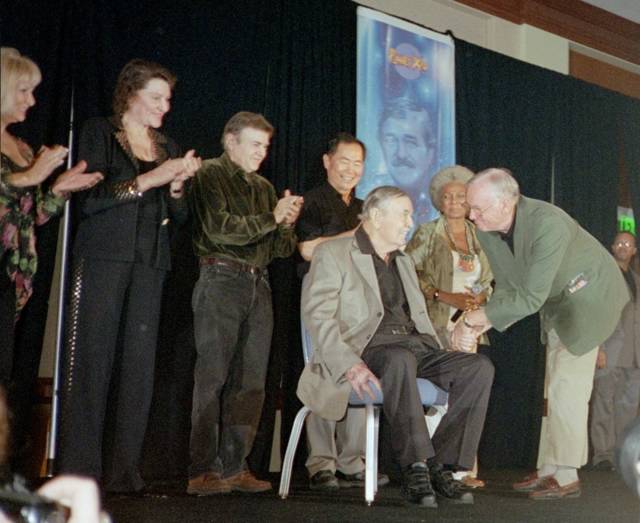
Neil Armstrong was also a Star Trek fan.  He was the main speaker at the dinner honoring James Doohan at the Scotty convention in Los Angeles in 2004.  He said he hoped his next command would be a Federation starship.

I remember the strange sensation of entering that banquet room.  Outside getting photographed were various stars associated with Star Trek.  Inside people were looking for their assigned tables.  All of them were dressed up for a special occasion.  Among the suits and dresses were Starfleet uniforms, mostly of the original cast movies, but also from the TV series, and the 24th century.  It was one of those moments when it seemed the normal world included the existence of Starfleet.


Later when the dinner had begun and the room was darkened, I spotted Nichelle Nichols a few tables in front of me.  I was there on assignment--one of the few if not the only member of the press present--and I knew I wanted to interview Nichelle at some point during the convention.  So I walked over just to introduce myself, and tell her I'd be looking for an opportunity to talk to her the next day.  She listened, and then said she wanted to introduce me to somebody-- the man next to her.

Out of the semi-darkness, up popped Neil Armstrong.  Nichelle, who had just heard my name for the first time, used it to introduce us.  I was speechless.  I was shaking hands with the first human to step onto another world.  Really.

One of the wonders of Star Trek is this relationship to the wonders of the real world.  A man who had traveled through space, piloted a vehicle down to the moon's surface, and walked on the moon, was honoring an actor who pretended to be a starship engineer on television and in the movies.  Both of them had inspired wonder in many others.  Neil Armstrong went up on that stage and said to Doohan, "from one engineer to another, thanks, mate."

So it's time to say a final thanks to Neil Armstrong, and may he rest in peace.  (Here's one of many stories about him around the web today. Below is my photo of that convention's closing ceremony, with Neil Armstrong shaking the hand of James Doohan.)

Monday, July 20, 2009


One small step...40 years ago today, Neil Armstrong became the first human to set foot on ground not of this Earth. In July 1969, Armstrong, Buzz Aldrin and Michael Collins blasted off to the moon in the powerful Saturn rocket (second photo). Today, those three met with President Obama, who appears to be not quite giving the Vulcan salute. He'd just shaken hands with Neil Armstrong, and as I never tire of telling, I met Armstrong when he spoke at the Farewell to James Doohan convention in 2004. Nichelle Nichols introduced me to him.
If few outside of science fiction fans believed humans would walk on the moon by 1969, few science fiction fans or writers imagined that the Apollo program would be the last voyage beyond Earth orbit in more than three decades. NASA has plans for a return to the moon and then on to Mars, and the astronauts today talked about it, but got no commitment from the President--although the administration is studying it, and with all the other spending priorities, they are unlikely to announce anything for at least a couple of years. But the new NASA director Obama appointed seems determined to get to Mars, and beyond.
As for the moon landing, William Shatner wrote about it in one of his books. Star Trek had been cancelled and he was out of work, a divorce left him broke and essentially homeless, so he watched Neil Armstrong while lying on his back in his makeshift camper and residence in the parking lot of a dinner theatre where he was appearing, on a tiny TV balanced on his chest, pulling in the signal with a small antennae augmented by aluminum foil. But as it turned out, even if NASA wasn't going where no one had gone before in the next few decades, Captain Kirk--and several captains after him--would be.

Wednesday, October 18, 2006

THE STARS

I had met (and interviewed) Nichelle Nichols and Walter Koenig at the Farewell Scotty convention in Hollywood in 2004, which I attended as a freelance reporter on assignment to the New York Times. Nichelle had endeared herself to me forever by spontaneously introducing me to Neil Armstrong, about ten seconds after I introduced myself to her. This time I saw her only for a minute in the Blue Room just before my panel started on Friday, but I got a hug and a Hollywood kiss. Nichelle held the Sky Church stage on Sunday, with amazing energy and grace. I was in the Blue Room as she started, and on the monitor the strong planes of her face reminded me of carvings of African or Egyptian goddesses. She also showed a partial rough-cut of her forthcoming movie, “Lady Magdalene,” which presented some earthy, humorous and musical aspects.

I talked briefly with Walter Koenig on Friday afternoon, as we stood waiting for the elevator to the Blue Room. He introduced me to his wife, Judy. I guess I’m not telling tales out of school to mention that he’s read this Soul of Star Trek blog on occasion, and we talked about one entry he particularly liked. One of the writers in attendance commented later that Walter looked relaxed, elegant, European. He wore a tweed jacket and jeans. I hardly ever see anyone in a tweed jacket anymore, and that’s a shame, partly because I like to wear them myself.

Walter had his Sky Church solo on Saturday afternoon. He is soft spoken and articulate, and had a good rapport with the audience, even when fielding the millionth request to repeat his “nuclear wessels” line from Star Trek IV. When so requested, he said something about feeling like a trained monkey—and his accompanying gesture, of an organ-grinder’s monkey turning, was small and fleeting but perfect, reminding me of how many skills these actors have that we seldom get to see—and then he did the line with good-natured grace. We did get to see more of his acting skills than usual in the New Voyages episode and the extended trailer for “Star Trek: Of Gods and Men” shown on Friday evening—I’ll say more about those in the section below.

I should mention what the Sky Church itself did for these appearances. The huge cathedral-like room was always dark, for behind the stage and extending far beyond it was a high wall of images: usually a moving star field, plus huge photos of whichever star was on stage, from various episodes and/or movies. Films and video were also projected onto a screen on that back wall. It’s quite an impressive venue.

George Takei was the first of the original cast to take the stage. I’d heard him speak solo at the Scotty convention but hadn’t met him. This time he spoke in more detail about his experiences as a child in an internment camp where many families of Japanese ancestry, especially from the West Coast were held during World War II. The most vivid detail I recall was his memory of going to the latrine in the middle of the night with a spotlight and a machine gun following him from a tower above. I did meet him in the Blue Room afterwards, and told him that even though I’d read similar comments he’d made about this, hearing him talk about it was so much more powerful. “I think it’s important,” he said, and he had related his experiences to the xenophobia, racial profiling and demonization of entire peoples and faiths that has been a recurring temptation and sometimes close to official policy in recent years in the U.S. Guantanamo was clearly on his mind.

On a later panel, George countered the idea that Star Trek was too optimistic. It’s not true that Gene Roddenberry created a future where there wasn’t conflict, but one where people dealt with conflict and its underlying causes. Yet the attitude of optimism was important. “I think optimism is a necessity to make progress.”

On Sunday I happened to be in the Blue Room just after he’d been given a unique scrapbook—it was a meticulously preserved set of photographs and drawings of a play he had done as a UCLA theatre student in the late 1950s. He’d played the lead. Apparently the scrapbook had been created by a UCLA film student, as an assignment to document the theatre production and create storyboards. George said that he’d felt guilty accepting it, but I gathered that it had belonged to the woman lead of the play who had recently passed away, and whoever had given it to George felt he should have it.

Saturday, October 16, 2004


The first man to walk on the moon, astronaut Neil Armstrong, greets James Doohan onstage at the convention finale. Posted by Hello