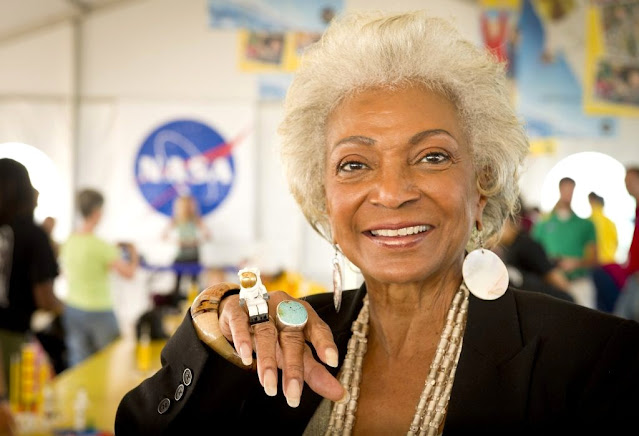
I first met Nichelle Nichols at what’s become known as the
Farewell Scotty convention in Los Angeles in 2004, when I was writing a story
about Star Trek for the New York Times. I believe I was the only reporter at
the Saturday night formal dinner, seated with several Star Trek fans at a table
near the front, and the area in front of the dais where distinguished guests
would dine. The lighting in that area
was dim, so I could not distinguish all the figures whose backs were to us, but
I did see Nichelle Nichols arrive and sit at one end of the table nearest to
me.
So in a lull before serving began, I approached that side of
the table. I quietly introduced myself
to her, so she might recognize me in the hubbub of the convention when I would
seek to briefly interview her. I was
ready to duck back to my table when she said, “Let me introduce you to
someone.” That someone was Neil
Armstrong, the main speaker that night. I hadn’t even seen him when he popped
up out of the darkness near the other end of the table, and suddenly I was
shaking hands with the first human being to touch another world.
I’ve often wondered why she did this, what prompted her to
instantly, spontaneously perform this act of grace that included introducing me
by name, even though she had only heard it once. It was a moment of singular generosity and thoughtfulness. It was the act of a singular lady.
She was Uhura, and (as asserted in the title of her
autobiography), she was beyond Uhura.
Her story as she told it in her book is a very American story. The heritage within her included African
American, European White (a grandfather) and Native American (her mother was
half Cherokee.) She grew up in
Robbins, Illinois, a town founded in the late 19
th century by Henry
E. Robbins, who purchased land some 30 miles from Chicago from disappointed
speculators, and began selling lots and homes to Black and mixed race families,
otherwise shut out of home ownership solely because they weren’t White (Robbins
was himself a White southerner.) That’s
why from that day to this, Robbins has always had a Black mayor.
In the 1930s, that mayor was Nichelle’s father. It was in the era that Al Capone and other
mobsters fought and ruled in Chicago over the liquor trade that Prohibition
made illegal, and gave Chicago an international image that lasted well beyond
that decade. This led to a situation
that begins Beyond Uhura, in which, just months before Nichelle’s birth,
her mother held a gun on Capone’s brother in her parlor.
But mostly her childhood was idyllic, full of art and books,
though her mother was troubled by a psychic gift for precognition. Nichelle loved to sing and dance, and after
rigorous local training in early adolescence, she became the first Black dancer
to be accepted into the Chicago Ballet academy. But after two years of training to become a ballerina, she
wandered into a class of Afro-Cuban dancers, and quickly converted. This soon led to her first professional
appearances.
But there were difficult times. A failed early marriage left her a single mother with a young son
to support. She became a popular night spot singer and entertainer, which at
times involved her with organized crime figures who for decades either owned or
controlled many clubs. Once on tour in
the 1950s she was brutally refused a hotel room because of her race (not in the
deep South but in Utah.) In another incident, a prominent citizen in the town
where she performed sexually assaulted her, and left her alone overnight in an
isolated cabin in the woods. But she
was not intimidated: she reported him to the police and returned to testify at
his trial, where he was convicted and sentenced to prison.
The brief summaries of her life and career that have
appeared since her death often leave out important details. She not only sang with the Duke Ellington
band—Duke himself commissioned her to choreograph and perform in an Ellington
dance suite, in addition to later featuring her as a singer. Years later, she not only acted in a
triumphant Los Angeles premiere production of James Baldwin’s first play, she
essentially produced it for the theatre company she started with her partner,
actor and director Frank Silvera. That production went on to succeed on
Broadway.
When more years
later, she created a one-woman show in which she sang new songs in the style of
past greats, she didn’t have to research them through old records and film
clips. She’d known many of them and
heard them perform, including Josephine Baker, Sarah Vaughan, Ella Fitzgerald
and Lena Horne.
A small part in the movie of Porgy and Bess made her
known to Sammy Davis, Jr. (with whom she had a sort of romance), Sidney
Poitier, Dorothy Dandridge and her dancing partner, Maya Angelou, whose fame
was to come later as one of the great writers of the age.
She costarred in an ill-fated Broadway show with Burgess
Meredith, and was a hit in her debut as a singer at New York’s Blue Angel.
Through Frank’s theatre and film work, Nichelle came to know many other
luminaries, including Marlon Brando, Jane Fonda and Tony Bennett. But hobnobbing with the stars didn’t stop
racism from being a fact of life and occasionally surfaced in a blatant way, as
when she and Frank were refused residence in a house they had rented in
Manhattan when the caretaker saw Nichelle.
Sexism of the most Hollywood sort also came into play, when she lost a
lucrative contract with MGM because sleeping with an executive was required.
Then in 1963, Frank asked her to do an acting scene with one
of his students, Don Marshall. Another
student named Joe D’Agosta was so impressed that he told his employers at a
television production company about them. The executives watched Nichelle and
Marshall do the scene (from Arthur Miller’s
A View From the Bridge—a
title that would soon take on different meaning), and hired them both. It was for an episode of the TV series
The
Lieutenant, produced by Gene Roddenberry.
D’Agosta would become the casting director for
Star Trek.
With Star Trek, she would become probably only the third
Black woman featured in a continuing non-stereotyped dramatic role in series television.
(The first two played the same social worker-- a very young Cicely Tyson, with
Diana Sands substituting for one episode-- in the short-lived but significant
social drama East Side West Side in 1963, starring George C. Scott.)
Nichelle Nichols’ presence was more prominent, but still…
With prodigious talents expressed on stage and screen,
Nichelle Nichols lasting fame results mostly from what must be described as a
relatively small role. For three years she had to get up in the middle of the
night to appear on set, where typically she would sit in one place, and say and
do very little. Given her skills and
experience, it is reasonable to wonder why she bothered.
The answers begin with expectations: she had reason to hope
her part at Lieutenant Uhura would be larger.
She saw scripts in which she had better scenes, more lines and more to
do. Her book makes it clear that in Star
Trek’s first year, her part was diminished due primarily to network and
studio demands, which involved fears of audience reaction, but in the end
reflected race and gender bias. How
deep that went is indicated by her assertion that executives kept most of the
fan mail she was getting (almost equal to that of stars Shatner and Nimoy) from
being delivered to her. In other words, she’d proven them wrong—she was accepted and she was popular. But they had to deny it.
By then she was ambivalent about her role (a feeling
played in a different way by Celia Rose Gooding as the younger Uhura on the Strange
New World series, which also seems to be dramatizing aspects of Uhura’s
backstory that Nichols and Roddenberry invented, but never could portray.)

So it wasn’t surprising that she was leaving the series
after that first season, until her now famous encounter with Martin Luther
King, Jr., who talked to her about the power of her presence on television, and in the 23rd century. Her status as a role model
for Black and minority viewers, especially children, and most especially girls;
the ground she was breaking in television for other Black and minority
performers, and the simple fact that she embodied a Black presence in the
future, were all reasons to stay, even knowing that she was missing other
opportunities, and possibly typecasting herself indefinitely. And even when her role was further
undermined in the second season and thereafter by William Shatner’s insisting
(with the connivance of the Suits) that scripts focus heavily on Captain Kirk,
and then Mr. Spock and Dr. McCoy.
But an equally compelling reason that she stayed seems to
have been that she believed deeply in Gene Roddenberry’s vision of the Star
Trek future. Her book describes the
vagaries of their personal relationship, but her devotion to his vision never
wavered. Her absolute conviction is
expressed in this extraordinary sentence in her book: “Every time I sat down at
my console on the bridge of the Enterprise, I felt that I was in the
twenty-third century, that I was Uhura.”
It was this conviction that resonated with fans and made her
a convention favorite. It was this
nobility as well as her intelligence, experience and cultural depth that made
her an eminence as her hair turned silver.
By accounts and observation, she was energetic, thoughtful,
kind and at times mercurial, with a wicked sense of humor. Her book makes clear
that she was a proudly passionate person, as also suggested in person by her
occasional naughty references and raucous laugh. But from the start, and especially as she grew older, she
radiated and embodied a confident dignity.
Before her final years and the conflicts surrounding them,
she valued her prodigious memory. She put it to work in Beyond Uhura.
Those who wish to honor her life can do so by learning more about it—by reading
her autobiography. Our lives and what
we experienced and learned ultimately are our legacy.
She was always more than what was obvious. It’s become
widely known that in the period between the Star Trek TV series and the movies,
she helped recruit minority and women to NASA, especially candidates for Space
Shuttle astronauts. But this achievement
has also been slighted in some quarters.
In fact, this inclusion was a need she saw, and a proposal she made,
carried out as one of a number of contracts by the company she ran. She was astute at business and organization
as well as artistically multi-talented.
Her efforts were among the principal reasons that the world
of fictional space exploration and real space exploration intermingled in
public, leading to among other things, the first human to step foot on the moon
speaking at the Scotty Farewell Star Trek convention of his wish to pilot the
Enterprise.
I did interview her on the Sunday at the end of that
convention. She was direct and articulate. “Because the fans are loyal to
Gene’s dream,” she told me, “we are loyal to the fans.” But she also wasn’t
abject before them. When a fan tried to
talk to her during our interview, there was iron in her voice when she
prevented the interruption.
When my story appeared on the New York Times arts section
cover Monday morning, she was the one who held it up to the crowd gathered to
witness the ceremony marking the installation of James Doohan’s star on the
Hollywood Walk of Fame.
I saw her again two years later at the 40th anniversary
convention in Seattle, where I led a panel on the soul of Star Trek. I was one
of several people greeting her as she entered “the blue room,” where
participants gathered, and wondered if she would recognize me. Perhaps she
didn’t, but in any case she greeted me with an embrace and the brush of a
kiss.
May she rest in peace. Her work and her legacy live on.