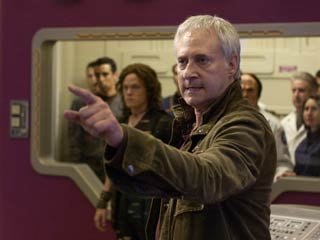
Showing posts with label Brannon Braga. Show all posts

Thursday, August 21, 2014

Captain's Log: Braga, Geekie and the New Doctor Who

Welcome to the Captain's Log at Soul of Star Trek, where your vision will never be blocked by a popup ad that you can never shake, so for better or for worse, you can actually read what's on this site.  Is that science fiction or what?

Readers of this past post at this site will not be surprised that at a convention appearance, former Star Trek producer/writer and producer of the Cosmos series Brannon Braga reportedly said of his work on Cosmos: "I did bring a lot of my Star Trek sensibilities to the show. The ‘Ship of the Imagination’ might as well be the Starship Enterprise."  (I suggested it looked like the Enterprise D before they put the stuff in, except for the captain's chair.) Check out the Trek Movie story that reports on some of what he said about the Star Treks he worked on. (That's Neil deGrasse Tyson on Cosmos--can't you just hear him? "Engage!")

Speaking of the Trek Movie site, I was genuinely surprised to see (in several comments sections) that such a negative tone towards Star Trek Into Darkness has developed.  I've made my own caveats and qualms known here, but the trekgeist seems to have turned against it definitively.  I don't know what that means for the next JJverse movie, unofficially as yet to be directed by a writer on the past two who is a writer on this one, Roberto Orci.  Word there is that the script is complete, and 2016 is still the release year.

Congratulations to Star Trek Continues for winning as Best Web Series at the 2014 Geekie Awards.  Also to Geek of the Year LeVar Burton.  His successful Kickstarter campaign for Reading Rainbow apparently was the clincher.

 Doctor Who did not fare as well at the Hugo Awards.  Despite having four entries among the nominees for short form TV, it lost to an ep of that other Brit global hit, Game of Thrones.  I really, really dislike that series.

However the world is being prepared for the new season of Doctor Who, a series now of global reach.  The actors playing the new Doctor (Peter Capaldi) and the current companion (Jenna Coleman) participated in a tour that touched down on five continents.  Cities included Mexico City, Sydney, Rio de Janeiro and Seoul, South Korea.  Each stop included screening of the premiere episode, "Deep Breath."

The episode will be aired in the UK, US, Canada, South America and Germany (though in undubbed English) on August 23, as well as in at least four other countries the next day or the next week.  Thanks to the successful theatrical screenings of the 50th anniversary show, "Day of the Doctor," this episode (70 minutes plus) will also be shown in theatres in a number of countries.

The BBC publicity machine hit a snag however when scripts of the first five episodes were leaked on the Internet.  But from my point of view, this was not all bad since one of the online "reviewers" of the scripts suggested that the new Doctor, while definitely darker than the previous, will have humorous moments, and that the scripts include humor as well as drama.  That would be in keeping with past Doctors but the official publicity shows Capaldi glowering all the time.  I began to wonder if the series is taking itself too seriously.


But then I've only recently been catching up with the last Matt Smith episodes on dvd, lacking a couple of the Christmas specials and the final regeneration story.  I loved "The Day of the Doctor" 50th anniversary story. John Hurt and especially Billie Piper were superb.  David Tennant and Matt Smith work very well together, as do their Doctors.  Though I've come to appreciate Matt Smith's Doctor more, I still feel partial to the Tennant/ Russell T Davies years.  Davies' East Enders Meet the Time Machine approach grounded the stories better for me. Tennant did comedy and drama, the big gestures and subtle moments, all so well.  Matt Smith had unique strengths as the Doctor but he didn't quite have all those colors, and neither did the stories.  Capaldi has done drama and comedy well in the past.   So we'll see.  Although you'll probably see first.

Friday, July 11, 2014

The Pale Blue Dot


This is about three minutes from the final episode of Cosmos: A Spacetime Odyssey, which (along with one of the producers, Brannon Braga) has just been nominated for several Emmys.  It's the voice of Carl Sagan, who hosted and co-wrote the first Cosmos series, reading from his book The Pale Blue Dot.  The visual is an animation ending with the view of Earth that Voyager 1 got as it passed Neptune on its way to interstellar space (where, by the way, it was further confirmed this week, Voyager definitely is.)

As one of the comments on YouTube suggests, the views Sagan expresses so eloquently in this clip are basic to Gene Roddenberry's vision for Star Trek.  That's one reason I'm posting it.  Another is that the episode this clip comes from can be seen for free on the Internet, but (at least at this site) only for a few more days.  Some earlier episodes will be available there longer. The whole series is available in other ways, including DVD.  I wrote about it here at the beginning, and since then, my admiration for it has grown.  It really is a stellar series.

Wednesday, March 12, 2014

Cosmos Trek


One of the many articles about the new Cosmos series (Cosmos: A Space Time Odyssey) quotes a professor of science communications at Cornell (where Carl Sagan taught) saying that when he asks scientists between 30 and 60 years old to name something that made them want to become scientists, a "huge number" name the original Carl Sagan Cosmos series that first aired in 1980.  But I suspect a huge number also name one Star Trek series or another, especially if you widen the discussion beyond the hard scientists to engineering, computers, etc.  Or science fiction writers, like Carl's son Nick Sagan ,who wrote for a couple of 1990s Star Trek series.

So it shouldn't be too surprising that the new Cosmos project unites Carl Sagan's widow and collaborator on the original Cosmos, Ann Druyan, with Star Trek television veteran Brannon Braga.  He's executive producer of the series, and directed the first episode, seen recently on various Fox channels and available to view online  for the next month or so.

Most of the ink has been going to series host, astronomer Neil deGrasse Tyson and The Family Guy's Seth McFarland, who spearheaded the project and took it to Fox.  Not even the usual Star Trek sites have noticed Braga.  (For Nubies, Braga was a writer and producer on Star Trek: The Next Generation, Voyager and Enterprise.  He also co-wrote two features, Generations and First Contact.)

But it's hard to miss the influence of Braga's Star Trek years, or at the very least, the plain old influence of Star Trek.  It's pretty obvious in what amounts to the title sequence, a zip through planets and cosmic dust that resembles especially the opening to Voyager, to music by Alan Silvestri (Captain America, Back to the Future) with strong hints of the Voyager theme, plus touches that remind me of the Insurrection soundtrack as well as other science fiction films.

Tyson begins the series by describing the scientific method that opens the cosmos to us all.  But his "spaceship of the imagination" obeys the non-scientific Trek standard of making plenty of whooshing sounds as it flies by.  The interior resembles the Enterprise D bridge, but before most of the stuff was installed.  The exterior reminds me of a flying Norelco shaver, but it's pretty cool anyway.

The visuals are mostly pretty spectacular (and suggest what a truly contemporary Trek TV show might look like) though the animation seemed comparatively crude, reminding me of the 1950s Disney Man in Space science shows.

I haven't seen the original Cosmos in awhile but I have the book.  There obviously is a lot of Sagan still in the series (he even gets a writing credit) and there's one of his classic lines in this first episode: "We are made of star stuff."  I still remember the way he said it, and it still sends chills down my spine.  I don't envy Tyson trying to figure out how he should say it.  Must have been quite a few sessions in front of the mirror on that one.

With only the book to go by, I notice that Sagan didn't make a big deal about Giordano Bruno as this episode did (he was the star of the long animation sequence.)  Bruno was the 16th century monk who had a vision of the universe (the earth revolving around the sun, our sun a star, one of countless stars with planets orbiting them) that was far ahead of his time.  The 2014 Cosmos goes into great detail about all the religions that persecuted and imprisoned him.  His burning at the stake by the Catholic Church is fully animated.  I'm not sure what the point was here, except to provoke the right wing Fox audience.  According to the ratings, they mostly weren't watching it.


Still, as long as I can stomach sitting through the same four commercials (for cars and high fashion cosmetics--who do they think is watching?) shown with increasing frequency online, I'll watch the rest.

Update: Here's James Downie at the Washington Post with a different interpretation of the Bruno sequence.  His point is well taken, but somehow the animation of Bruno being burned at the stake seems the more likely takeaway.

Thursday, September 19, 2013

Captain's Log: Trouble in Trekdom

It's been more than a little weird over at the Trek Movie site.  A post designated an "editorial" by Joseph Dickerson entitled "Star Trek is Broken: Here's How to Fix It" elicited a blizzard of responses, including several intemperate ones from Roberto Orci, one of the principal writers of the Star Trek JJA movies. 

Apart from any judgment on the validity of his assertions, Dickerson's piece was calm, respectful and reasonably written.  I thought it was pretty tame for an indictment, sincere and quickly positive in the "Trek is dead but I know how to bring it back" tradition that goes back at least to the later Rick Berman era, and probably for some folks back to the first motion picture and the first post-TOS series.

But Orci was outraged.  He called the author "akin to a child acting out against its parents" and concludes this opening salvo with "There is a reason why I get to write the movies, and you don't."  He later responded to a commenter but telling him to F-off.  His responses were so extreme that several commenters questioned whether it was really Orci.  The moderator assured them it was.

 Later Orci returned to say "don't take me too seriously" and explained that twice a year he explodes at "morons."  But by then a commenter asserted that Orci was also on Twitter "dropping all kinds of F bombs" and asked "why can't we have writers with class?  Even Brannon Braga had more."  I could almost hear Braga laughing--he had endured far worse and more personal criticism for a much longer time without (to my knowledge) lashing out in such a public way.

Some commenters agreed with Dickerson at least in part, others didn't.  Some suggested that the polls he cited naming Star Trek Into Darkness among the least favorite Trek movies were a very small and informal sample. (This is what we had editors for in the print world.)

Now there's a new "editorial" up, predictably titled "Star Trek is Not Broken" which ironically and unfortunately is much more negative about most of Star Trek, in a series of opinions and assertions with more profanity and ideology than substantive argument.  But it has its adherents, and I doubt that many of the creators of TNG etc. will be on the board trying to muscle this guy out.

I think what bothers me about all this isn't the mud-wrestling that some fans routinely engage in, at least on the Internet.  It's that the original Dickerson piece was not an opinion slung out in the heat of online wrangling or the deliberate provocation that some take such delight in producing.  It was a considered critique--that I didn't entirely agree with, either in analysis or in prescription, a bit naive maybe, but a reasonable point of view pretty cleanly expressed.  It bothers me that the author of a legitimate editorial article was demeaned by a much more powerful person,  by a principal Star Trek movie writer, with a kind of attempted humiliation that smacks of intimidation.  (Though it must be said that Dickerson's first comment in this thread indicated a cool and even generous response.)

I simply can't imagine Trek principals of any earlier time responding as Orci did to such a critique.  It may be one of the many things that have changed, as ginning up Internet interest becomes so crucial to the first-weekend success of these explosively budgeted movies.  But what I don't want to see happen is this becoming acceptable behavior.  It may be that critiques are going to be made on the Internet rather than in print, but those that make respectable arguments in a legitimate form should be respected as legitimate.  No writers should be shamed as spoiled children, or told their ideas are worthless because they are not millionaire screenwriters.  It's unbecoming and ultimately dangerous.

I am also reminded that a lot of people thought Star Trek was broken back in 2004, as Enterprise entered its final season.  I wrote a New York Times article in which I interviewed fans and Star Trek actors and producers, to confront this question.  The article began: "Could Star Trek be dying?  It's enough to make Spock laugh."  Several quotes from Leonard Nimoy followed, to the effect that Star Trek has been declared dead many times but always came back.  (He really was laughing as he talked about it.)

I have no evidence for this, but I suspect this article and those quotes had something to do with the momentum that resulted in the first JJA film, and particularly in Nimoy's involvement.  Whether or not this is so, criticism of Star Trek has a long tradition, and while some of it has been toxic and had unfortunate consequences, much of it has been thoughtful, sincerely felt, and evidence of the deep involvement many people have in their Star Trek.  And without some of this criticism of a decade ago, Roberto Orci probably would not have gotten to write Star Trek movies.

Elsewhere in the universe....

Scientists are now really sure this time that Voyager 1 is the first space probe, and probably the first  human-made package of technology to reach interstellar space.  And it did so about a year ago when it breached the solar bubble at the far edge of the solar system.

Meanwhile this AP article about "space tycoons" like Paul Allen says they are enacting their Star Trek dreams.

This article about Disney's frantic attempts to make sure there will be some kind of Star Wars feature in movie houses every year for the foreseeable future prompts thoughts about these so-called "tentpoles" as being beyond the realms of fanaticism, entertainment and avarice.  In some ways, the worlds and characters of Star Wars, Star Trek, the Marvel superheroes, the DC superheroes, Warner's Harry Potter, etc. are the locations and figures of our predominant mythologies, substituting for the tales of Greek gods and Greek heroes, etc.  In other ways, they are in danger of being exploited into meaningless repetitions, variations and inflated cliches.  I suppose it is up to those who love them and what they mean to defend them against the monsters that consume everything, eventually including themselves.

[Both images here are from that exemplary site, Trekcore.

Wednesday, October 05, 2005


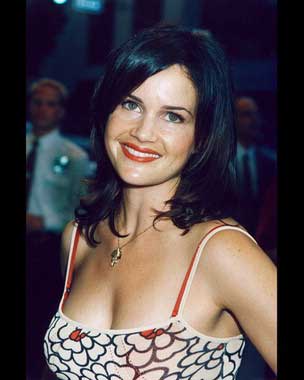
Carla Gugino, star of "Threshold" Posted by Picasa
On the Threshold of---?


He started out on a trek and now he’s on the threshold. But of what?

The 1950s? Maybe. That was the last time that alien invasions were so popular. Kicked off by the very profitable second movie version of the very first space invasion tale—H.G. Wells’ “War of the Worlds,” first published more than a century ago---all three commercial broadcast networks have stories about mysterious aliens. “Threshold” on CBS seems to be getting the best reviews, and of course it’s of interest to Star Trek fans because former Star Trek producer-writer Brannon Braga is one of the executive producers, and Brent Spiner (Data) is one of the on-screen regulars.

(Those aren’t the only Star Trek connections, by the way. Longtime Trekker Michael Sussman is a supervising producer, David Gautreaux—who was slated to be the new Vulcan, the Mr. Spock replacement on the original cast’s second Star Trek TV series, and got a small consolation part in TMP instead—has a recurring role.)

The threat of terrorism supposedly inspired this throwback genre, previously popular in movies in the early Cold War 1950s (see Cold War Cinema for details), when it was the threat of Communism and instant nuclear annihilation. Then the correspondence was more precise: bombers and missiles come without warning to destroy from the sky; so do space aliens. Nuclear bombs cause weird biological mutations; so you get movies about giant ants, locusts, spiders, etc—the land of the bug-eyed monster movie.

Now it’s more amorphous, but the fear is out there. If terrorism has faded a little, there’s hurricanes and the climate: Revenge of the Earth. (Even Spielberg’s space alien machines came up out of the ground this time.)

Certainly “Threshold” is different stylistically from those fifties films. The best of them may have had a fairly lengthy “reveal” (the process of realizing there’s a monster or aliens, then actually seeing it/them) but the main event was the battle or attempt to destroy them. Usually the first several tries fail and all seems lost until they hit on the thing that works (“Water! It doesn’t like water!”—which would be funnier if that wasn’t the solution in one of the more recent alien invasion films, M. Night Shyamalan’s “Signs”. Suggesting, I thought at the time, that the tagline for “Signs II” should be “They’re Back---With Raincoats!”).

But a television series is a different sort of beast, and as pioneered by such recent miniseries as “Taken” and “The 4400,” the reveal can be extended forever, maybe even 100 episodes. “The X Files” did it for its entire run, although it meandered a lot into side issues.

Like the dynamic duo of “X-Files,” the stars are investigators (A New York Times story on Threshold by Dave Itzkoff said “with its emphasis on forensic investigations and the interpersonal dynamics of its cast,[it] could pass for another spinoff of CSI,” but you could also see CSI as a variation on X-Files which preceded it.)

Judging from the episode I saw (last week’s, the third episode; I forgot when the first was on, then taped the second but somehow taped over it before I saw it.), this group at least doesn’t have to deal with hostile employers. It’s also more like a CSI in the number of main characters, making it also…well, more like a Star Trek series. (With the mystery being where the romance(s) will be?)

While “Enterprise” had to strain to include the apparently mandatory sexiness, “Threshold” has gone the classy big network route: cast a woman lead who nobody will dare say is too beautiful for her job, and put her in—shall we say flattering?---clothes that women with her job might be unlikely to wear. And then add tasteful details, like the kidnap victim who just happens to be an attractive young woman, caught in her underwear. And so while we wonder about what sinister alien force is causing these weird men to dig a hole in her floor, she is always in the frame, writhing in her ropes. And so we are back in the fifties monster films---or at least, the posters for them.

But the story was credible, the writing (as well as the writhing) seemed pretty good, with some terrific touches that the acting ran with, like the guy who had been locked away in a mental institution for most of his life, wondering aloud what had happened to the bike he had as a boy—“they probably threw it away.” A startling human moment in all the alien police procedural plotting.

There already appear to be elements of the uncanny, of magic (technological or otherwise) in "Threshold" that a space alien story in the past probably couldn’t have gotten away with and still maintained enough dramatic credibility. All kinds of shows in the past decade or so---from the brazen anachronisms of the Hercules and Xenia shows, to the recent fashion in psychic detectives and intervening angels, as well as the aforementioned M. Night and his quasi-religious occultism—contribute to audience expectations that no longer depend on plausibility based on orthodox science.

Arguably, Star Trek prepared the way by providing the scientific plausibility that was necessary for its audience and the 1960s general audience, while introducing other elements: aliens with inexplicable powers, and for humanoids certain psychic abilities as natural, and finally accepted by science. So the technobabble that Braga disses, probably contributed to the fact that Threshold can seem to depend on contemporary science, but can also throw in some fantastic elements, and get away with them.

Brent Spiner, seen here in "Enterprise," is one of the regulars on Braga's "Threshold." Posted by Picasa
So in the coming weeks and---the producers hope—years, the nature of the aliens, their invasion (already known to have traces in the past) and their intentions will be slowly, oh so slowly revealed. But you can pretty much bet they won’t turn out to be good guys. And though Braga tells reporters how Threshold will be different from Star Trek, it’s not the techno-babble vs. understandable science, or freedom from the restrictions of the Roddenberry ethic---it’s this basic element: the aliens will be evildoers who hate our freedom.

Star Trek started at the height of the Cold War, but at the threshold of the period that came to be known as the Thaw, when Americans and Russians began to acknowledge each other’s humanity. After several dangerous confrontations, particularly the Cuban Missile Crisis of 1962, President Kennedy made serious efforts to lessen tensions. He got Soviet Premier Khrushchev to agree to the first nuclear test ban treaty, and the thaw in the Cold War began. It didn’t last; by the 80s President Reagan was demonizing the Soviets again as the Evil Empire. But the Thaw had prepared the way: when the walls fell, Americans and Russians were more able and willing to overcome the last stereotypes and, among other things, go into space together.

One of Star Trek’s well-known contributions to the culture as well as the science fiction genre was to propose the somewhat novel notion that aliens weren’t necessarily evil invaders, that their mission might not be to exterminate people. (It wasn’t completely new, of course---even the aliens in a few of those space invader 50s movies turned out to be good guys, or at least Misunderstood.)

This insight (insisted on by men like Roddenberry and Gene Coon who had seen combat against the Enemy, and learned as soldiers often do that the actual people they are fighting are not so different) in turn helped Star Trek portray and communicate a hopeful view of future possibilities.

How Threshold will avoid contributing to a harmful xenophobia, in an America that is in many ways alienated from the rest of the world, remains to be seen. I just hope we aren’t on the threshold of another war and torture movie, with no point but to raise blood pressure and hence ratings. The real thing is bad enough.

Monday, March 07, 2005

TrekCheck: All bad things?...

As the Enterprise season and officially its existence as an ongoing series come to an end, there is more than the usual conflict in Trekdom.

On the one side there are the people associated with Enterprise who speak only in terms of finality. It's striking how many of them use the same word to describe the prevailing attitude: "bittersweet." Jonathan Frakes used it, and Brannon Braga at his college speech; I heard Dan Curry at his college speech use it twice.

Within this group, though not totally unanimous, is the sentiment that the cancellation of Enterprise is a necessary thing, because Trek needs a rest, a pause, a period of "gestation" (to use Braga's word) before the next try. As noted before, Rick Berman has settled on the "franchise fatigue " description, which justifies not only the cancellation but the idea to abandon established Trek characters (and presumably actors) for the next feature.

On the other side is the Coto Counteroffensive, and the fan attempts to save Enterprise. Manny Coto hasn't backed off his belief, stated to me and anybody else who would listen before the season started, that what the world needs now is more Trek, not less, and certainly not none. He talked recently of his 5th season stories for Enterprise, though he also agreed that the next Trek series should go farther into the future, into the 25th century perhaps.

When fans showed up to demonstrate their support at Paramount, Coto and the writing team came out to greet them, as did members of the cast. While Coto doesn't say a word against Rick Berman, he is clearly on the other side of this question. Scott Bacula seems to have a foot in each camp---he says he'd like the series to continue, but he talks realistically about its chances. His pessimism sounds the most realistic, based on his knowledge of the people involved who are making these decisions. (There was also the $3 million pledged to save Enterprise, a startling but probably risk-free assertion of faith in Trek, as paying the actual money probably depends on raising the full $38 million goal, which is highly unlikely.)

So even as faint hope at least keeps our ears perked up for surprises, most fans seemed resigned to cocooning quietly one last time, to watch the farewell episode, and wave a fond goodbye.

But a new element was added last week when a couple of long-time BBS posters, believed to be close to the Enterprise production team if not part of it, went public with a scathing critique of the script of the final episode, said to be titled, "These Are the Voyages."

BBS fans going nuclear is hardly news, but these "sources" claimed that there was widespread dissatisfaction on the set with this script, which is now in production. Perhaps coincidentally, a previously scheduled press event with Berman, Coto and Scott Bacula, among others, was cancelled, and the Enterprise set was abruptly closed.

Then over the weekend, Jolene Blalock called the script "appalling." She's made negative comments about scripts before, but "appalling" is very strong language, particularly as she was praising this season's scripts.

So now should fans be expecting an even greater disappointment: not just the loss of Enterprise, and with it the loss of new TV Trek stories for the indefinite future, but a final farewell to Star Trek episode that's "appalling?"

There is a certain symmetry to the possibility. A bad end to a troubled series would not be unexpected. But a bad end to "Trek as we know it," coming to us in an interrupted but unbroken line from Roddenberry to today, especially with many of the same people involved for decades, would leave us with worse than a bittersweet taste.

It does suggest that while all good things may come to a good end, a less than happy situation sometimes cannot transcend itself, and the bad end seems inevitable.

There are conspicuous examples of both in Star Trek. The miracle and the love fest that was TNG, came to a great end with "All Good Things..." Even the ignominious cessation of the original cast's TV run was vastly overshadowed by their movies, and a magnificent Star Trek VI with a wonderful ending.

But when things don't go over well, the differences seem to matter more, and things get bent out of shape. They don't quite mesh, and bad decisions instead of magically right ones seem to emerge. It seems everyone involved was shocked, and in a way still are, by the box office failure of Star Trek Nemesis. Without analyzing details, it seems that somehow things got out of synch. The cast was clearly surprised by the ad campaign of a generation's last voyage. Perhaps the most telling detail was how the movie itself ended. The DVD contains a perfectly good Star Trek ending, full of humor and feeling, and with the kind of "conclusion" we anticipate and need: the Enterprise warping off to its next adventure.

Unfortunately that ending wasn't used. Instead the Enterprise is static, not even whole, still in drydock being repaired. That was only one aspect of an unsatisfying ending, but an important one. It's the feeling people leave the theatre with that counts. The movie felt abandoned, and perhaps so did we.

This kind of contrast of endings happens in sports sometimes as well. Remember Michael Jordan, at the apex of his fame, in the final game of his stellar career with the Chicago Bulls, hitting the shot that won Chicago's last championship? It was a perfect ending to an incredible career.

But it turned out not to be Jordan's last game. That was several years later, when he was playing for a Washington team that never even made the playoffs. Jordan had become increasingly critical of his younger teammates, and in his actual final game, they simply ignored him. The dissension was obvious, as the crowd begged for Jordan to take a final shot, but his teammates, fed up with his criticism and celebrity, showed only disdain. In exasperation, Jordan took himself out of the game. It turned out that management as well as players had enough of Jordan. He was essentially fired from the team he’d once owned.

And just a few years ago, when the Los Angeles Lakers were playing well, playing together and winning, they overcame their differences. But who knows what happened first: the egos and differences erupted, or the quality of play fell off, or the winning luck just wasn't with them for the big moments? But it all fell apart last season, and now that team doesn't even exist anymore.

What's happening with Enterprise, and what may happen with its ending, may be attributable to exactly what Rick Berman says: franchise fatigue, too many ideas used up, and not enough creative energy left. Whether or not others could have done better is debatable, given all the circumstances. If the fourth season had come in the second season? Who knows? But there was enough good coming out of this season to produce the hope that if this was going to be the end of what for almost four decades had been a very good thing, it would be a worthy ending.

Trek has been going through a stormy period, but there was---and in fact, there still is---the possibility of one last return to the qualities that made Star Trek legendary. We can still hope that this final episode will emerge as a fitting end, that down at Paramount dissatisfaction becomes creative rescue. For hope, after all, is what this franchise has always been about.

One thing for sure: we'll be looking for that last shot of one Enterprise or another heading into the stars, taking our hopes into the future.