Showing posts with label Star Trek IV: Voyage Home. Show all posts

Saturday, December 16, 2017

Oumuamua and This Ocean Earth


Here in December 2017 Terran scientists are watching an unusual celestial object from outside the solar system just cruising past Jupiter.  They're calling it Oumuamua.  Part of what has them fascinated is its strange and yet somehow familiar shape.

Some are studying it as an asteroid but others, especially at the Breakthrough Listen Initiative, are checking it out as a possible alien probe.

So far they're frustrated because they aren't hearing anything.  My answer to that is (quoting Spock to Doctor McCoy): "There are other forms on intelligence on Earth, Doctor. Only human arrogance would assume the message must be meant for man."

If this probe is an earlier version of the one that appears in the 23rd century, it may be in the neighborhood to chat with old friends, the humpback whales.

As you recall from Star Trek IV: The Voyage Home, a similar alien probe threatened Earth when it could not contact any humpbacks, because they'd gone extinct by the 23rd century.

 Because of global heating and other large scale problems, it is still likely the whales will disappear from the oceans in the next century, along with most species on land larger than rats. But right now the humpback whale population is in pretty good shape.

Thanks in part to whaling bans and the awareness represented by that popular 1987 Star Trek feature, the humpback population has slowly recovered. Most species of humpbacks were removed from the endangered species lists about a year ago.

So a probe would have no difficulty contacting some.  And after their conversation, the probe might simply continue on its way, silent to our ears.

Saturday, December 01, 2012

Captain's Log: The Wrong Planet


It turns out that the big news on Mars is...never mind.

It's being billed as a "misunderstanding" by the NPR report that started it all. The scientist involved wasn't really teasing even a possible imminent announcement of life on Mars.  After a few stories suggested it might not be so, NASA more or less officially confirmed that the Curiosity rover had not--repeat, not--found any organic compounds on Mars so far.  (It also hasn't yet explored the most likely places.)

However, what Curiosity has not found, the Messenger spacecraft has (sort of)---on Mercury.  At least scientists believe so, on the basis of some long-distance data and highly educated inferences.  On the planet closest to the sun, they found evidence of a lot of water near the poles, and of "organic material."  That's not exactly the same as organic compounds or life, and they theorize it isn't indigenous--both water and organic matter probably arrived through comet impacts, as (it is now believed) they did to the Earth.

Update to the Mars story (12/2/12): Officially now, NASA scientists said today (in the words of the LA Times story) that Curiosity picked up "intriguing signs" of organic compounds on Mars, but they can't be sure. The story is headlined "Mars rover may have picked up signs of organic compounds." So it turns out the NPR story wasn't completely a "misunderstanding"--just that the initial indications didn't turn out to be definitive enough.  That the soil analysis worked, the scientists said, is in itself historic.  Curiosity will keep looking, but no results are expected for...some time. 

Meanwhile, astronomers looking outside the solar system--about 100 light years away--have identified a rogue planet: a planet that is not orbitting a star.  That's the artist's rendition of it above.  Free-floating planets have been theorized recently, but this is the best and closet actual candidate.  Some scientists believe however that they are not rare--there may be as many rogue planets as stars.

Other scientists are reconsidering what makes life likely on other planets--in such a way as to add substantially to the potential number of such planets in the galaxy.

In the ongoing interface of Star Trek and reality, there's this story suggesting that one of the big barriers to warp drive has at least theoretically been broken--and that NASA is working on testing the theory.  The idea is based on the 1994 theory of warping space around a starship (which in the illustration looks very much like the Enterprise), using a vocabulary familiar to viewers of The Next Generation and subsequent series.  The problem was the vast amount of energy necessary.  Now a scientist has figured out the math to reduce that energy load significantly--enough to make warp drive feasible. 

Of course this is warp that a Trek novel or two has tried to describe accurately, but which Star Trek on screen never really did.  Warp drive was depicted as just a super-fast way to travel, rather than a way to warp space around a starship.  But that way, you wouldn't get that whoosh, or the rainbow trail. 

Perhaps in the nearer term, the SpaceX pioneer with the Star Trek alien name, Elon Musk, is describing in some detail his plans for the colonization of Mars, and the spacecraft necessary to begin it--soon.

As for the phenomenon of Star Trek, it' still alive and it's still Star Trek GR.  When Ezra Klein, self-proclaimed economic and political numbers geek, filled-in for a regular MSNBC host, on two successive evenings he showed clips from TNG, DS9 and Voyager.  Once just to have Worf laugh and say "impossible," but the second time to illustrate the number of times that the number "47" was often repeated in those Trek series (instigated by Trek writer Joe Menosky).  That number became legendary in the 2012 political campaign as 47%--first in the notorious Mitt Romney hidden camera video, and (on the day Klein referenced it) as the percentage of the popular vote that Romney wound up winning in the presidential election.  It was Obama 51% to Romney 47%.

Finally, there's this blog post in which someone watching an episode of The Original Series Star Trek with his children freaks out over what he basically misunderstands in the classic episode "The Enemy Within."  Despite suggesting the perils of watching episodes out of order (and not realizing the prior relationship of Captain Kirk and Yeoman Rand), what caught my interest was that there was this guy who in 2012 was watching TOS with his kids.  And I was pointed to this post by a post on another blog, by a very respected political scientist, who noted a different episode that he had recently watched with his youngest child.  Further evidence that Star Trek GR is alive and well as an intergenerational entertainment and educational experience.

And a late-breaking story: One of the iconic moments in Star Trek IV: The Voyage Home is when Chekov has finally located the "nuclear wessel" and reports to Kirk: "And keptin--it is the Enterprise."  The nuclear aircraft carrier Enterprise was commissioned in 1961, and this week it was officially decommissioned in Norfolk.  Here's a story about it and its place in the line of U.S. Navy vessels--sorry, wessels--called Enterprise.  This Enterprise, maybe surprisingly, isn't going to be turned into a museum but simply scrapped.  However (this story promises) another Enterprise is on the way.

Thursday, December 17, 2009

A new book casts unexpected light on Star Trek's approach to exploration, in the post below. Image is from TNG episode "Galaxy's Child," courtesy of Trek Core.
To Boldly Go...

"Can anybody remember when we used to be explorers?" Captain Picard asks at the beginning of Star Trek: Insurrection. Exploration is officially the main purpose of Starfleet. Even though Star Trek stories of exploration focus mostly on "new life and new civilizations" rather than science, the Starfleet ethos of exploration has inspired scientists of today. I came across impressive and specific evidence of this accidentally, when reading a new book about the impact of computer simulations.

After the main text by Sherry Turkle, there are several case studies by other authors in Simulations and Its Discontents (The MIT Press 2009.) The chapter by William J. Clancey is about the team in charge of the two Mars Rovers, as they explore the surface of Mars. Though they come from different scientific backgrounds with different areas of expertise, several describe themselves as explorers. One is even more specific: "I've often said that I do space science because I couldn't join Starfleet."

The following chapter, by Stefan Helmreich, is about the scientists aboard a deep sea research vessel. The ship Point Lobos and its remotely operated diving vehicle Ventana explore an extreme environment with lifeforms as alien as anything in science fiction. Again, the scientists aboard are from various disciplines, and they consider themselves explorers. And again, a connection is explicit: marine biologist Rob Haldane, the chief scientist on the mission, "told me that as a child he was riveted by Star Trek...As an adolescent, he studied the migration of large animals and particularly liked the movie Star Trek IV, in which the crew of the Enterprise returns to twentieth-century earth to save the whales..."

Star Trek is the latest saga to impart a sense of adventure and mystery to exploration, to discovery, confronting the unknown, being the first to see or learn something, or more broadly, the quest for knowledge. All of that is significant, for it inspires imagination and feeds the soul.

But there are more specific correspondences between Star Trek and the situations described in these chapters. Most obviously, Point Lobos is a ship, and like the Enterprise, it has particular characteristics, opportunities and limitations. A group of people are in a confined space, dependent on the ship and each other. Their relationships are in some sense dictated by being on a ship. While not a military vessel, even a research vessel can operate only through a delicate balance of authority and cooperation. A ship must have a captain, and a crew with particular expertise and responsibilities.

But this is a research ship, and the common task--the common motivation--of exploring also requires teamwork and shared knowledge and tasks that transcend each area of expertise. This is also true of the Mars Rover team--and while they aren't aboard a ship, they work to the same small facility, apart from the outside world. In both cases, geologists must know some biology, and biologists must learn something about the machinery they use. They must learn give and take in each other's research goals, and how to pursue knowledge that transcends one field.

Like the crew of the flagship Enterprise, these scientists are among the best. This is especially true of the Mars team--they were selected from many applicants. But even though they are used to standing out, they must learn to subsume their egoes to the mission, to the exploration.

Another close similarity is their dependence on technology to do their exploring. The Mars explorers are on Earth, and do their exploring through the Rovers. They talk about the Rovers almost as beings, and as extensions of themselves. The Point Lobos is actually in the environment it explores, but it explores with the remote sensing vehicle, the equivalent of "probes" sent out from the Enterprise. There is a more specific resemblance, according to the writer: "The similarity between the view-screens on the starship Enterprise and the screen through which we look at the video feed from the Ventana makes the comparison with Star Trek seem natural."

But unlike the crew on the Enterprise, the crew of Point Lobos spent a fair amount of time being seasick. Nevertheless, they want to be there. This speaks to the most important difference between Star Trek and how space exploration is now conducted--by unmanned vehicles. It also seems to be where space exploration is heading. Similarly, the Point Lobos may be one of the last ships to take scientists on the sea. "In the future, scientists might explore the ocean by surfing the Web."

But despite the discomforts, the scientists aboard the Point Lobos want to actually be on the ship. "The scientists I study want to be immersed in the sea. In some sense, they want to lose themselves in the place they study."

The practicalities aside, this has to be one of the attractions of space travel: to be immersed in the alien grandeur, the ultimate in beauty and terror, of space. It's a call of the soul.

Sunday, January 20, 2008

Captain's Log: New Trek Movie Trailer, Doctorless? Aliens Among Us

J.J. Abrams production of Cloverfield is breaking box office records this weekend, which is providing a big audience for what's called a preview trailer (which I guess means it gets you coming and going) for his Paramount Star Trek movie, currently in production.

The trailer, which you can see via TrekMovie (where you can also peruse detailed review and response) does a clever riff on the film being "under construction" with a view of the starship Enterprise under construction. The size it suggests hints at the scope of the movie's visuals--not too surprising given the film's budget which is much larger than for previous Trek features. I got a laugh out of the tag line, though: The Future Begins. I used that slogan some years ago to promote an arts endowment. I've got the low-budget booklets I put together to prove it. So of course I think it's brilliant.

Apparently the trailer doesn't name the film it is previewing, which seems to mimic the advertising for Cloverfield, that got publicity out of misdirection and secrecy. That movie is said to be innovative in that it spent little on unknown actors and filmmaking but a great deal on visual effects. Is that something like the Trek plan? On the publicity front, script writer Roberto Orci has established a presence, and has some interesting things to say about the trailer--including a sophisticated theory on warp drive. As for the film itself, well...unknown actors certainly. But it's only "under construction," so we'll see.

It occurs to me we are at an odd moment in Trek history. It used to be that the actors who created the Trek characters we know were making studio feature films and television shows, while unknown young actors played those characters in low budget fan films. Now many of those actors who created Trek characters are making low budget fan films, while unknown young actors are playing those same characters in a big budget studio feature.

In his dialogue with Orci, TrekMovie's Anthony Pascale asks him about the use of JFK's voice in the trailer--whether this was a reflection of the theory that Gene Roddenberry based Captain Kirk's character partly on JFK. I've written at length (as usual) about the many connections between GR, JFK (for starters, they were stationed near each other in the South Pacific when JFK's PT boat was sunk and planes were sent from Roddenberry's base to search for him) and Star Trek (beginning with GR's first proposal, weeks after JFK's assassination.) I've got back and labelled the pertinent posts on this site, so they're all accessible under JFK. There's not very much that's original in covering Trek history these days, but I believe this is.

Doctorless?

While searching for something else entirely, I ran across a TV column (somewhere, I didn't bookmark it) that said the Sci-Fi Channel has yet to make a deal to show the fourth season of Dr. Who. Apparently the BBC may want it to go to their BBC America cable channel.

Unfortunately or not, I don't get that channel. I don't much like watching the Doctor on the Sci-Fi channel, with its cutting out bits for its infinitely repeating promos and other obnoxious practices. Checking out the eps on You Tube is almost better. I just hope it's going to be possible.

Aliens Among Us

I've always maintained that the aliens and creatures from other worlds portrayed on Star Trek and other sci-fi aren't nearly as strange as some creatures here on Earth. Even without the limitations of actors portraying them, human imagination doesn't seem to be equal to making up anything nearly as weird as what some of the animals are like that share our planet.

And that's just the creatures we know about. We may wonder about life in outer space, but it turns out we know almost nothing about life on nine-tenths of our own planet.

I got a tutorial in this when I read a review of two new books about discoveries in the deep (really deep) blue sea. I learned the following:"Only the uppermost part of the oceans—the top two hundred meters—bears any resemblance to the sunlit waters we are familiar with, yet below that zone lies the largest habitat on Earth. Ninety percent of all the ocean's water lies below two hundred meters, and its volume is eleven times greater than that of all of the land above the sea."

How deep is it? The Marianas Trench off the Phillipines goes down 11,000 meters. Just what does that mean? "Ships plying the waters over the trench glide as far above Earth's surface as do jet aircraft crossing the face of America."

Scientists know that "the most common backboned creature on our planet is a fish known as the benttooth bristlemouth, and it is only found in the deep sea." But we don't know a lot more--because less than one percent of the ocean deep has been mapped. By our standards, there are very strange creatures down there--some of them, in the deeper of the deep, are wispy, transparent animals barely different from the water around them, whose metabolisms are incredibly slow.

But there are also large animals about which we know next to nothing. And by large, they mean: very large. In this elegantly written review, Tim Flannery notes: "It says much of our ignorance that the very largest denizens of the deep have never been captured or seen alive."

The deepest of the deep is so far from sunlight that literally no light penetrates it. Yet the deep is not completely dark: bioluminicent creatures, who supply their own light, are far more common there than on land. We know so little about the deep, and we aren't learning much more now, because there was only one vehicle capable of reaching the deepest ocean, and this robotic craft was lost at sea in 2003. There is no other.

But our persisting ignorance doesn't prevent us from destroying what we know not of. Dumping of nuclear and industrial waste and chemical weapons, oceanic pollution, industrial fishing and the climate crisis are killing the environment that sustains these beings. Flannery concludes:"The ocean depths are not some hellish and distant zone, but are an element of our living planet which is connected in very intimate and immediate ways to ourselves. They are also our last frontier, where wonders innumerable await the next generation of brave bathynauts who choose to journey there. Let us hope that we do not destroy this amazing place before they get their chance. "

One of the pioneers of deep sea exploration, by the way, was Jacques Piccard, who has gone where noone has gone before or since--deeper into the deep. An ancestor no doubt of the 24th century explorer we all know and love.

There Be Whales

Speaking of the sea and Star Trek, after years of relative quiet, the Japanese attempted to resume whaling this year, including the pursuit of humpback whales like those that were the subject of Star Trek IV: The Voyage Home. As I noted in my review here and over at TrekMovie, one of the inspirations for that film was the anti-whaling efforts of Greenpeace. One of that organization's founders decided to take a more activist role in stopping whaling ships through a new organization called Sea Shepherd. Recently one of its ships has been harrassing Japanese whalers, and one of the Japanese whaling boats has apparently made off with two of the protestors.

By the way, I've sent a new review of Star Trek V over to TrekMovie, where presumably it will appear soon, possibly when the latest spate of new movie news dies down.

Saturday, March 27, 2004


Leonard Nimoy in Star Trek IV: The Voyage Home Posted by Hello
'>STAR TREK IV: THE VOYAGE HOME

essay by William S. Kowinski

"If you should write a fable for little fishes, you would make them speak like great whales." Goldsmith to Johnson, as quoted by Herman Melville in Moby Dick


"The high point of my experience with Star Trek was the making of '>Star Trek IV," Leonard Nimoy told me, in a telephone conversation last summer [2004]. " There was not a single shot fired that had any impact in the story. A girl slapped a guy---that was the violence in the film." He laughed. "There was a harpoon shot at a whale and it didn't hit its mark, it was blocked by a starship...It was an entirely different kind of sensibility. That to me was my Star Trek statement."

Leonard Nimoy was born on March 26, 1931, in Boston, just four days after William Shatner's birth in Montreal. Growing up during the Depression in a Jewish family living in a largely Italian neighborhood, he began acting in local theatres when he was eight years old, and committed himself to an acting career over the strenuous objections of his parents when he was 17. Both of his parents had employed subterfuge and risked their lives to escape from Russia (his father stole through the darkness across the Polish border, his mother hid in a hay wagon) but they didn't want their American son to rely on make-believe. They wanted him to become an educated professional with an assured future.

In fact, Leonard Nimoy didn't make a living entirely by acting until he was 35, and a regular on Star Trek. Though he'd gotten his first low-budget movie lead in 1951, his subsequent acting jobs never lasted more than two weeks. His name on his dressing room door would be written in chalk, he recalled. He often did other work to support his young family, including driving a cab in the Los Angeles neighborhood where he now lives. (This and other information comes from his "Mind Meld" DVD conversation with William Shatner, and Nimoy's books and various published interviews. I'll quote again later from our brief on-the-record conversation.)

The theatre had been a refuge in his youth. "I was screwed up," he told an interviewer, shortly before the release of Star Trek IV. "Lost. The only place, the only thing that seemed to be giving me any sense of satisfaction were these plays. I should have been living in the theatre. I felt so totally right there."

But the Star Trek series did not end the insecurity. His name was permanently affixed to his door, but the studio denied his simplest requests (for a telephone, a fan to cool the room) if they weren't explicitly designated in his contract. And the series itself almost didn't make it to a second year, then was set to be cancelled after the second season, and saved for one more year on a much reduced budget.

In his 1975 book,'> I Am Not Spock, he wrote about his anger and alienation, though much less so in his 1995 book, '>I Am Spock. In "Mind Meld," he seldom used the word "anger" until prompted by Shatner. But his conflicts with Paramount, with Star Trek and for awhile even with fans continued. Eventually he agreed to reprise Spock in the first Star Trek movie, and was initially even more reluctant to appear in the second.

But as subsequent events proved, his difficulties weren't with Star Trek itself or the Spock character. Though playing Spock caused some problems by requiring him to suppress emotion, it also helped him to come to terms with his alienation and anger. Developing Spock as not only rational and conscious, but the essence of a civilized gentleman---one of many elements he created for the character---helped transform his whole life.

Success also helped. Star Trek became a major cultural and financial force, and Nimoy was essential to it. When he directed Star Trek III, the studio and producer Harve Bennett kept a close eye on his work. But when that film was a great critical, fan and financial success, Nimoy was in position to come into his own, and he was ready.

"I moved into a new and rather grand suite of offices on the Paramount lot," he wrote. "I had good tables in the studio dining room, a terrific parking spot, and a spring in my step." He was told to make Star Trek IV his movie: his vision of Star Trek. But this was also a personal and artistic opportunity for completion. In his book he likened it to the Vulcan ordeal preceding Kolinar, the ultimate achievement. "When done, one is in unity, at home in oneself...An attempt at integration."

essay continues after photos. Thanks to Trek Connection and The Warp Core for photos.

The Bird of Prey's cloaking device made this adventure possible Posted by Hello
Though in his "Movie Memories" book, Shatner reports some conflict between Nimoy and producer Harve Bennett over whose movie this was going to be, at the beginning of the process the two came to a series of conclusions in fairly short order. Nimoy wanted a lighter tone; after the death and destruction of the previous two movies, it was time for a grand adventure. He believed that many of the best Star Trek episodes did not involve the good guys confronting the bad guys, so they agreed on a film without villain or violence.

It doesn't appear they considered simply starting a new story at a time well after the events in III, so they made at least a de facto decision to complete the trilogy begun in Trek II, making the action continuous with the events in the previous two films. They also agreed on the basic device of time travel, and they soon became enamored with the idea of bringing the 23rd century crew back to earth in the 1980s.

The story question then became, why? The returning crew could be dispatched through time against their will, and then they either discover some problem to solve in that past, or simply struggle to return to the 23rd century without damaging the time line. Or they could go back intentionally---if they had a reason. What would that reason entail in a Star Trek story? In the DVD commentary, Nimoy puts it this way: "What would be lost in the 23rd century as a result of the unconsciousness of the 20th?"

This kind of reason alone reflected Nimoy's vision of Star Trek, which despite some personal and professional conflict, kept faith with Gene Roddenberry's basic vision.

The direction towards an answer came from "Biophilia," a book by biologist Edward O. Wilson that Nimoy was reading. "Biophilia" as Wilson defines it, means the innate "emotional affiliation of human beings to other living organisms." It is both a hypothesis about the natural disposition of humans to feel deeply and intrinsically a part of the natural world, even when alienated from it by the cement and smog of modern life, and an ethic, promoting the possibility of that relationship by giving priority to making sure than other species of living beings have what they need to live.

But as Wilson noted, human civilization is mindlessly obliterating other life on this planet, and forcing the greatest era of mass extinctions in 65 million years. Wilson goes beyond typical environmentalism to ask whether other life has an innate right to exist that is equal to the moral rights of humanity. Answering this question in the affirmative was an implied foundation of Star Trek's approach to life in the universe, which became more and more explicit in the 1980s, especially in Star Trek: The Next Generation. Still, the basic insight of ecology pertains here: humanity is embedded in the life of the planet, and cannot survive without it. By destroying other life now, humanity is destroying itself in the future.

Greenpeace and its Save the Whales campaign was an inspiration. Posted by Hello
Now Nimoy had the general idea: some form of life that human unconsciousness causes to disappear in the 20th century is suddenly crucial to human life in the 23rd century. At first he considered plants. There are millions of species that humans haven't even catalogued, and many of these will be forced into extinction before we know they exist. Among them could very well be plants that can serve as sources for pharmaceuticals that treat or cure currently intractable diseases and conditions. What if 23rd century earth were stricken with a plague, and the only cure comes from a flower that no longer exists?

But traveling three centuries through time and overcoming other obstacles to rescue a medicinal plant would be hard to dramatize and visualize effectively---the proportions seemed skewed. Besides, the idea of thousands of people suffering and dying from a plague didn't suggest a light-hearted movie.

Then Nimoy's conversation with a friend about endangered whales inspired the basic solution. Whales had the dramatic proportions, and a long, complex relationship with the human species. Celebrated as "King of the boundless sea" (from one of some eighty quotations Herman Melville recorded at the beginning of Moby Dick), they were now becoming known as mammals with formidable intelligence who seemed to communicate.

The eerie songs of the Humpback whales caught the public imagination when they were first recorded in the 1960s, though experts could not agree on what the songs signified or even how they were sung (these whales have no vocal chords.) The songs were complex, and seemed to change over time and be communicated---even learned--- over distance, all of which deepened the mystery of these beings.

And though humans weren't fully conscious of the consequences of eradicating them, deliberate and aggressive action was responsible for taking them to the brink. Over more than a century, humans hunted whales to the extent that several species, including the humpbacks, were nearly extinct. (Even though killing them has now been illegal for decades, there are still only a few thousand blue whales and some 30,000 humpback whales in the world.)

In the early stages of its development William Shatner was not yet officially on board for Star Trek IV because he was negotiating with Paramount. But he was being consulted and kept informed. He wasn't in favor of the time travel device, but he loved the whales. Several years before, Shatner had toured a one-man show in which he used recorded whale song juxtaposed with his live reading of D. H. Lawrence's "Whales Weep Not" (which as Captain Kirk he would eventually quote in Star Trek IV.)

Shatner did this show in conjunction with Greenpeace, the activist organization based in Canada. Its name symbolizes its two principal activities: the "green" denotes its efforts on behalf of endangered species, particularly whales; the "peace" signaled the activism with which it started, opposing nuclear bomb testing, which also is an environmental issue.

The organization's first campaign was to stop an underground nuclear test on Amchitka island in Alaska in 1971. One test had been accomplished, even though it took some skullduggery by President Richard Nixon to keep the U.S. Supreme Court from preventing it. Greenpeace chartered a boat and headed for the site of the second test in its heavily publicized attempt to stop it. Though the boat was intercepted and prevented from returning, protests had erupted across Canada, and the U.S. postponed and eventually canceled this test.

With that one act, Greenpeace may have done more for the environment than it knew. The first Amchitka blast not only killed thousands of animals and birds, it ruptured the earth's crust, sending radioactive elements into the fresh water supply for Aleuts living nearby. Cancers there increased markedly, and even in 1996, radioactive tritium and cesium-137 were still leaking into the Bering Sea. A second bomb explosion in the same area might have been led to even greater catastrophe.

Greenpeace became so active in disrupting French nuclear tests that their boat was rammed, then boarded and the people aboard beaten, and finally a team of French operatives actually blew up their boat, killing a photographer. But the French tests eventually stopped.

In the early 70s, Greenpeace inaugurated the very visible "Save the Whales" campaign. Then they decided to put activism where their images were. In 1974 a Greenpeace boat confronted Soviet whalers off the California coast for the first time. On Zodiac inflatables, volunteers placed themselves between the whaling ship's harpoons and the target whales.

It was this act, repeated throughout the 1970s and into the 80s (targeting Icelandic and other whaling fleets as well) that Leonard Nimoy says was the specific inspiration for one of Star Trek IV's best remembered scenes: the whaling trawler's harpoon bouncing off the Klingon Bird of Prey, hovering above to protect the whales. It was also this activism that inspired William Shatner to engage his skills and celebrity for the Greenpeace efforts to save the whales.

"...the sea holds the hottest blood of all." ILM whale models Posted by Hello
Now Nimoy and Bennett knew that their story would involve going back in time to retrieve humpback whales. But why? How would the whales be crucial to the future, at least in a metaphorical, science fiction way---that is, how would their absence create jeopardy?

The whale songs suggested that communication could be the key. Nimoy discussed extraterrestrial communication with scientists including physicist Philip Morrison and Frank Drake (whose Drake equation, suggesting the probability of intelligent life on other planets, was used in garbled form by Gene Roddenberry as evidence that the original Star Trek series wouldn't run out of new life and new civilizations to explore.) Morrison told him that space aliens would probably be so different that they couldn't physically speak our languages, and their modes of thought might be so different that there would be no common basis for communication.

Taken literally, that insight would end the Star Trek universe instantly. But the idea of radically different forms of communication suggested the possibility that extraterrestrials might find it easier to communicate with species on earth other than humans. Like whales, who had populated the oceans and presumably were singing their songs long before humanity existed, let alone learned to talk.

Then another element suddenly became central to Star Trek IV: Eddie Murphy, then Paramount's biggest box office star. He was a Star Trek fan and wanted to be in this movie. Using the basic elements of time travel and the whales, a script was written with Murphy as an oddball professor who helps bring Kirk's crew and the whales together, and winds up returning to the 23rd century with them, where he gets to don a Star Trek uniform. But Nimoy wasn't happy with the script, Murphy was interested in other projects, and Paramount may have thought twice about the idea as well. However it didn't happen, Eddie Murphy was gone from Star Trek IV, along with a lot of precious time.

Now the project was falling behind schedule. Nicholas Meyer, director of Star Trek II who had written the script for that film based on successful ideas in earlier rejects, and done it in record time, was asked to ride to the rescue as a writer. He agreed. Harve Bennett (who had written the script for III) would write the beginning and the end (the first and fourth acts), and Meyer would write the middle two acts, which took place in San Francisco. Nimoy also contributed dialogue.

Now the process of making the story real began: casting new roles, scouting and deciding on locations, designing and building sets, and designing and building...whales. Some existing footage shot by scientific expeditions of the normally camera-shy humpback whales was used, but all the rest of the whale footage was done with miniature models and larger replicas of the parts of the whale needed for shots in scenes with human actors. The models had to move naturally and a nearly life-sized piece of the whale had to mimic the motion of a whale's tail breaking the surface.

Industrial Light and Magic was assigned the task of creating the moving models, but got some unexpected assistance from...a humpback whale. The two whales in the story had wandered into San Francisco Bay and were being kept at the fictional Cetacean Institute in Sausalito. But as ILM began their task, a real humpback whale did wander into San Francisco Bay. He stayed around long enough for a camera crew to get some film footage. It wasn't good enough to include in the movie, but the ILM team was grateful nonetheless. There was so little reference footage of these whales in action that they studied it and found it useful for designing their models.

The miniatures and larger models, together with how they moved, and were painted, lit and filmed, were so convincing that after the movie came out, some environmentalists called Paramount to protest that the filmmakers must have harassed the whales to get that close. It was the rare situation of filmmakers ecstatic about getting complaints.

He'd done a lot of work already before filming started, but when it did, Leonard Nimoy knew he'd been successful so far: he had something. Paramount executive Ned Tanen met with him after reading the shooting script. "This script is wonderful," he told Nimoy. "It's so wonderful, even if this wasn't Star Trek, we would make this picture."

"I said 'thank you very much,' I tucked it under my arm," Nimoy recalled, "and went off to work to shoot it...Shooting it was a joy."

Uhura (Nichelle Nichols) makes whale music Posted by Hello
The theme of this movie, Nimoy said, is communication. Various problems and barriers to communication are in every early scene. We see the Klingon ambassador making his case for Kirk's villainy before the Federation President and Council, reciting the basic facts---which constitute much of what occurred in Star Trek III--- with just enough distortion and skewed interpretation to change their meaning completely. It's an object lesson in point of view and ideological warp that's just as relevant in the Red States/Blue States USA of today as it was in the Cold War 80s.

On Vulcan, while Scotty and crew struggle to translate Klingon symbols and adapt the foreign language of an alien spacecraft's operation, the reborn Spock is testing his memory, which is as sharp as ever. It's his communication skills that are lagging. He can answer complex mathematical questions but not "How are you?" His mother suggests his human emotions aren't communicating with his Vulcan mind, but they will need to if he is to communicate with his human shipmates. In essence, she sends Spock on the journey he will take in this film: assimilating his humanity.

Though Leonard Nimoy says he had trouble acting and directing in the same movie and feels his Spock characterization suffers as a consequence, his performance perfectly serves a character arc. This Spock is emotionally innocent, free of the internal conflicts of his alienating personal history that he fought to control, suppress and eventually transmute before his "death." Now he is a reborn innocent, and Nimoy plays his personal journey with eloquent economy.

After the Enterpriseless crew heads back to earth in the captured Klingon Bird of Prey to stand trial for disobeying orders so they could save the Federation---an extreme difference in interpretation if not utter miscommunication---they confront the key problem in communication that will drive the subsequent action. The earth is about to be destroyed by a very powerful probe, that looks a little like the one that threatened earth in Star Trek: The Motion Picture (by the shape and color, like V'ger indeed), and also kind of like a whale (yes, very like a whale).

By listening to the sounds it emits, Spock is somehow able to ascertain that this probe represents an unknown form of energy of great power and intelligence that is attempting communicate. Though not hostile, it is somehow unaware of the havoc it is causing on the planet below. How does he know this? Simple logic. Or from reading the script. Spock knows these things, and his analysis often includes the word "unknown," which is one of those signals that this is Star Trek.

"Oh, really?" McCoy the skeptic says. "You think this is its way of saying 'hi, there' to the people of the earth?"

"There are other intelligent forms of life on earth, doctor," Spock replies with Vulcan acidity. "Only human arrogance would assume the message must be meant for man."

Before Star Trek II, DeForest Kelley had to explain to Harve Bennett exactly how the Kirk-Spock-McCoy relationships work, and how central they are to Star Trek storytelling. By this time Bennett had learned the lesson well. At this point in the story, McCoy and Spock have already had a memorable and elegantly written exchange on the subject of death. McCoy expressed disbelief when Spock declined to discuss his experience of dying because McCoy hadn't died himself so they had no common frame of reference, but saw that he was serious. Their conversation was interrupted by messages Spock was monitoring. "Forgive me, Doctor, I'm receiving a number of distress calls," Spock said. "I don't doubt it," McCoy replied.

McCoy has been openly skeptical of Spock's fitness so soon after his ordeal. But what came off as scowling and rasping alarmism in the first film as in some TV episodes, is played here perfectly as waspish, sardonic critique. Earlier, Kelley delivered a line that harkened back to the old Saturday morning space operas while still being perfectly McCoy. Referring to Spock, McCoy stage-whispered to Kirk, "I don't know if you've got the whole picture or not but he's not exactly working on all thrusters."

But Spock has now quickly gotten to the heart of the dilemma. The humans below cannot respond to the message because they can't understand it, and they can't understand it because it's not meant for them. Spock notes that the alien transmission is aimed at the oceans. In one of those quasi-scientific sleights of hand that Star Trek at its best can do so well, Uhura fiddles with some dials and reproduces the alien's song as it would sound underwater. It sounds very like a whale.

But it's the 23rd century, and because of human unconsciousness---or stupidity allied with cupidity---in the 20th century, there are no humpback whales to answer. Since 20th or 21st century humans didn't manage to translate the whale's song, or didn't try to, before extinguishing it forever, they will have to find some actual whales, where and when they are. McCoy's delayed reaction when he realizes that Spock's suggested course of action implies time travel is another priceless comic moment. Lacking a better alternative, Kirk propels them forward, into the past.

The probe that tests human arrogance in Star Trek IV Posted by Hello

The newly reconstituted Spock is receiving distress calls. McCoy doesn't doubt it/ Posted by Hello
Time travel was still a much bigger deal than it would become in the Next Generation era. Nimoy the director wanted to portray it, not as people moving through the externals of time (as was done, for example, in the original George Pal production of H.G. Wells' The Time Machine, and Nick Meyer's movie about H.G. Wells and Jack the Ripper in late 1970s San Francisco, "Time After Time") but as an internal experience. On the DVD commentary he expresses disappointment with the result, while Shatner praises the creativity of the art department expressed in the sequence. They both might be right. The sequence has a nice eerie charm, and a certain amazement factor in this early suggestion of morphing, but it doesn't really signify much that seems specific to time travel.

When they come out of their trances, Kirk sees the earth: the question is when. "Judging from the pollution content of the atmosphere," Spock says, "I believe we have arrived at the latter half of the twentieth century." Harve Bennett has left the building, temporarily. Nick Meyer is in the house.

So far we have the makings of that grand but not grim adventure Nimoy wanted. On the DVD he describes it as following the Joseph Campbell monomyth pattern: the hero's journey common to many cultures. Their homeland is in peril (but only potentially; so far all we've seen are some lights going out, some bad weather and broken windows. Nothing like, say, people dying horribly of disease.) Our heroes have begun their journey into the unknown by going back in time, to save their earth "if we can," as Kirk says in his brief but stirring pep talk that launches them into the dangerous world of...1980s earth. He tells the crew they are in "terra incognita," a neat choice of words considering the circumstances.

The danger is signaled in Meyer's first laconic Spock line about pollution, and Kirk's warning in his pep talk that they are about to enter a "primitive, paranoid culture." Though Gene Roddenberry again had little to do with this film---Harve Bennett said he made some small changes based on Roddenberry's memos---this is consistent with his view of contemporary humanity, which he would soon make most explicit in the opening episode of Next Generation. But in this section of this film, the words and the point of view are Nick Meyer's, who ironically or not had some distasteful run-ins with Roddenberry during Star Trek II, which Meyer wrote and directed.

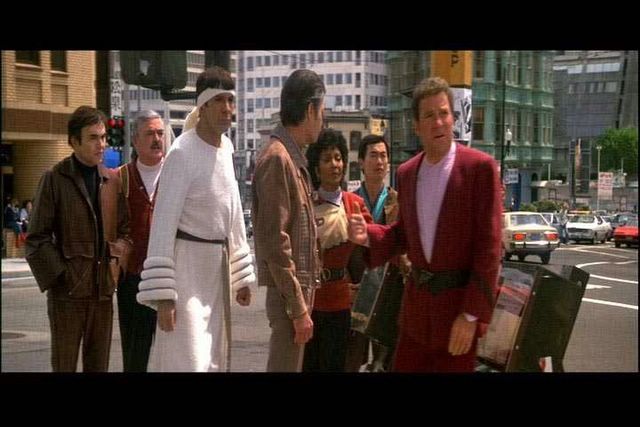
Of course, it was a point of view generally shared by the other principals on this film. Opportunity for another political comment came as the Enterpriseless crew ventured onto the streets of San Francisco. They gathered on a busy streetcorner, peering at the daily newspaper in its transparent box. Nimoy had to devise a headline that would be topical and yet perennial. He chose "Nuclear Arms Talks Stalled," which coincidentally referred to the other Greenpeace issue.

"It's a miracle these people ever got out of the twentieth century," Dr. McCoy observes.

We did, but as for getting out of the twenty-first century, that could be even tougher. Consider this: as I write this in 2005 (20 years later, and the Soviet Union long gone), nations of the world are about to send representatives to New York to discuss updates to the nuclear weapons non-proliferation treaty of 1970. Just days before its scheduled start, the participants cannot even agree on an agenda. An appropriate headline might very well be: Nuclear Arms Talks Stalled.

There is social and cultural comment as well. Kirk and Spock are discussing "colorful metaphors." Kirk says they appear in the literature of the day, such as "the collected works of Jacqueline Susann, the novels of Harold Robbins."

"Ah," Spock says, "the giants."

Take that, Philip Roth, Thomas Pynchon, Don DeLillo, Margaret Atwood, Gabriel Garcia Marquez. It's the literary equivalent of the future people in Woody Allen's "Sleepers" saying that they've discovered that smoking and eating fat is good for you.

By now, the high adventure with hints of humor ("Everybody remember where we parked") has become full-blown funny. At first it's situational: the "fish out of water" humor enabled by time travel. Star Trek made its mark with comment on current day issues displaced into the future. Now it was bringing the future home to create comment on today, and have some fun doing it.

traveling through time to 1980s San Francisco Posted by Hello

even before Homeland Security,asking about nuclear wessels in this primitive paranoid culture could be a problem Posted by Hello