Tuesday, March 25, 2014
Star Trek Wars
There is a story within the movie Star Trek Into Darkness that goes something like this: in the alternate Trek 23rd century (the JJverse?)--in the year 2259--Starfleet is in danger of being militarized. A terrorist attack prompts a rogue admiral into setting up conditions to cause a war he has already decided he wants to wage, and for which he has been aggressively preparing.
Because this terrorist attack cost the lives of citizens and valued Starfleet officers, there was no initial resistance to organizing a mission of revenge. When Spock, Scotty and finally Kirk object and decide to capture the fugitive for trial, the admiral's plan goes awry. He is forced to show his cards, and his plans to sacrifice the Enterprise and its crew in order to force his pet war.
As an allegory, this story tracks pretty well with events after 9/11/2001 and the American invasion of Iraq. Members of the Bush administration claim that the Bush White House was intent on waging war on Iraq even before 9/11. They were looking for an excuse. In the movie there is a further suggestion of 9/11 when the rogue starship crashes in San Francisco, toppling towers.
Ultimately the rogue admiral is defeated. We hear Captain Kirk's voice, and then see him addressing a Starfleet audience. He says these words: "There will always be those who mean to do us harm. To stop them we risk awakening the same evil within ourselves. Our first instinct is to seek revenge when those we love are taken from us, but that's not who we are."
"We are here today to re-christen the USS Enterprise, and to honor those who lost their lives nearly one year ago. When Christopher Pike gave me his ship, he had me recite the captain's oath--words I didn't appreciate at the time. Now I see them as a call for us to remember who we once were and who we must be again. And those words..."
And then Kirk recites the standard opening to Star Trek, one of the most famous poems of the 20th century that begins "These are the voyages..." The Enterprise then sets off on its five year mission, the one that in the GR universe commenced in 2264.
This central story was obscured by the unfortunate choice of melding it with the Khan story, and specific echoes of Star Trek II. Upon seeing this film again, the central story seems clearer, and the Khan story--though it would make sense within this story if it wasn't familiar from another setting--takes us way out of this story, and the echoes are mostly unfortunate, however well done.
But by the end of the film there is a sense that this is an attempt to move into the exploratory mission and away from a militarily aggressive Starfleet. And there are hints that this military tendency is not just one rogue admiral. Starfleet uniforms are more military than any seen before, especially with the hats which I identify with Nazi uniforms, and others suggest are more like Soviet uniforms. I also noticed that the architecture of San Francisco is uncharacteristically monumental, suggesting a sense of empire. And Kirk's speech pretty much says that the rogue admiral was only an extreme example. Why else would he say that they needed to "remember who we once were and who we must be again."
These are words that might be applied not only to the JJverse but to almost all of Star Trek of the past 20 years. Since the 1990s, Star Trek has been fighting wars--in the 24th and 22nd centuries. An entire generation of Star Trek left behind its origins in GR's Star Trek in the 1960s. In the original series, Earth had fought and won a war with Romulus without becoming war crazy. True, there was a Cold War quality to the rivalry with the Klingons, and there were certainly mixed messages about Vietnam in the 60s, but Starfleet was meant to be a model of peaceful exploration, and a mature attitude towards difference and violence. These themes were deepened and extended in Star Trek: The Next Generation.
But in the 90s, the Federation in Deep Space Nine went to war in the 24th century--briefly with the Klingons, and more comprehensively with the Dominion. In the real world of the 1990s, the Soviet Union had crumbled, and some were declaring an "end to history" and complete victory to western capitalism. In this historical context, the Dominion War might be viewed as analogous to H.G. Wells' The War of the Worlds as an attack on complacency and a smug belief in superiority.
Then a new Star Trek series began, set in the 22nd century, before the time of the original series. Enterprise began with stories about the first steps into space exploration. But then in the real world came 9/11, and an analogous attack on the Earth began the Xindi war that dominated the rest of the series. Terrorism also became a more prominent theme, and torture as interrogation technique was notoriously shown.
All of this echoed real world attitudes and events. After 9/11 there was fear of terrorism, support for military action which resulted in military incursions into Afghanistan. The existence of covert warfare and violence perpetrated by "intelligence" agencies became common knowledge. The U.S. invaded Iraq and began a war that became the longest in U.S. history, though the weapons of mass destruction that served as the pretext for the invasion did not exist. Eventually it became public knowledge that the U.S. engaged in torture. Suspected terrorists were held at Guantanamo and unknown other sites without trial or definite sentence or even charges. Laws were passed with near unanimity that restricted the civil liberties of U.S. citizens and gave new powers to intelligence agencies and law enforcement.
Many of these subjects became themes that dominated Star Trek fiction long after there was no Star Trek on television. It is only now in 2014 that the themes of war, insurrection, covert warfare (the "Section 31" of many 24th century novels that is mentioned as existing in the JJverse 23rd century) may be coming to an end--or at least that's the suggestion by a Trek Core writer, reviewing the latest batch of Star Trek novels in "The Fall" series.
All of this means that an entire generation has grown up with Star Trek at war, at least in almost every new story (and lots of games.) What began in the 1960s as an alternative to the primitive emotions, the ongoing violence and threat of even greater consequences of open warfare in that era, has reverted and succumbed to those emotions as well as the temptations of easy dramatics in storytelling.
So even more than a decade after 9/11, when the people of the western world are manifestly tired of war, Star Trek is still mired in its themes. This is not to say that these emotions and issues of self-defense or aggression aren't pertinent or real. Kirk's speech in Star Trek Into Darkness is eloquent on these matters.
But in concentrating on this--as well as easy emotional themes such as revenge--almost obsessively, and getting caught up in the politics of a constructed universe so deeply in Star Trek fictions, Star Trek has lost its edge. It is no longer in the vanguard of zeroing in on new important issues in a new way, of revelations and of modeling a better future where problems are understood and addressed. Even an even bigger-budget superhero epic like Man of Steel dealt metaphorically or allegorically with the transcendent issue of this age, that is truly threatening the survival of human civilization: the climate crisis.
Star Trek should be about the present and the future, but lately it seems to have become mired in the past, including its own.
Saturday, January 12, 2013
Captain's Log: DS9 at 20, Doctor Who at 50, Plus Billions and Billions
Speaking of Captain Sisko, I've just seen the very entertaining and enlightening William Shatner docu "The Captains." Shatner is amazing--his self-revelation and showmanship really get the other captains (or some of them anyway) to reveal themselves. Some especially great moments with Kate Mulgrew and Patrick Stewart, and some unforgettable moments with Avery Brooks.
Billions and billions of planets? That's what a new NASA report says--at least 100 billion planets in our galaxy. (If you're old enough to get the joke, Johnny Carson used to imitate his frequent guest, Carl Sagan, in saying "billions and billions of stars." Although Sagan didn't really say that--at least not until Carson made it his trademark--Johnny was making affectionate fun of how Carl emphasized the "b" sound in "billions.")
This study also suggests that one in six stars hosts an Earth-sized planet. So there should be like billions and billions of them.
The White House hosts a number of petitions which citizens can post and sign--once there's a certain number of signatures, the White House must officially respond. So apparently a petition for the United States to finance and build a Death Star got those signatures, because the White House did respond.
The answer from the Chief of the Science and Space Branch at the White House Office of Management and Budget was no, partly because "Why would we spend countless taxpayer dollars on a Death Star with a fundamental flaw that can be exploited by a one-man starship?" But he does point out all that the U.S. and U.S.-based corporations are doing in space and space travel. The response is full of Star Wars references (including its title, "This is not the petition response you were looking for") but it concludes: "We are living in the future! Enjoy it!" Star Trek fans can identify with that, too.
I'm not going to repeat all the news (or what passes for news) on the forthcoming Star Trek JJA2 movie--there's plenty at Trek Movie (although the post claiming that Benedict Cumberbatch "contrasts" his role with Malcolm McDowell's Sorin in Generations is just wrong--he is saying how his portrayal is similar to McDowell's in that he is a villain who doesn't leer like one.)
But I will pass on a bit of news concerning this year's Doctor Who 50th anniversary. There's to be a Five Doctors radio/audio drama, starring the five surviving Doctors of the "classic" era (Tom Baker, Peter Davison, Colin Baker, Sylvester McCoy and Paul McGann.) The story also mentions the 50th anniversary documentary that's written by Who writer/actor and current Sherlock co-producer Mark Gatiss. (It misspells his name, though--should be a source of fun around the BBC for awhile.) By the by, just saw Gatiss in an old Midsomers Murders playing a freaked-out parson, and he was quite convincing.
But still no word on what the TV series itself will do to mark the anniversary. I just re-watched the 1983 Five Doctors special, produced for the 20th anniversary. It's full of in-jokes and has a decent story, but you can see the problems of trying to crowd everybody (and their companions) in. It also skimps on the interaction between the Doctors that's the real reason to do such a show. As for the 50th, word at Doctor Who News is that Christopher Eccleston won't appear as the Doctor again, but that David Tennant is being coy about it. Meanwhile, the Christmas special, Snowmen, based on a story by Douglas Adams, got good reviews in the UK. I haven't even seen the 2011 Christmas special yet. So much for news on Doctor Who.
Sunday, July 03, 2005

A Working Class Hero is something to be--Dakota Fanning
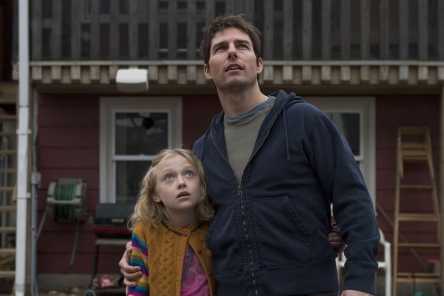
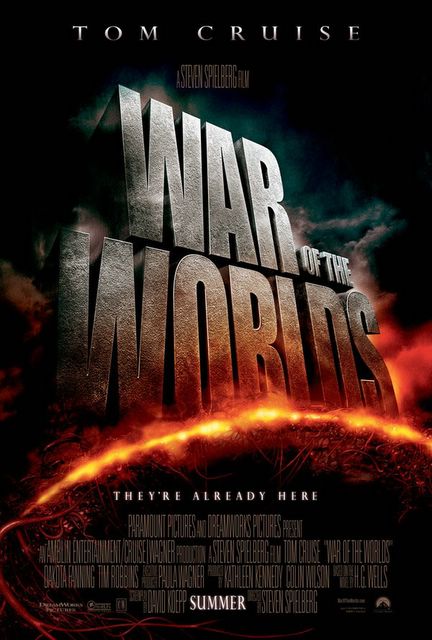
and Tom Cruise in Spielberg's "War of the Worlds"
The Spielberg Spectacle: War of the Worlds Movie Reviewed
by William S. Kowinski
Steven Spielberg grew up in the 1950s: the era of Cold War cinema, bug-eyed monster movies and the first golden age of science fiction film. If he saw George Pal's "'>The War of the Worlds" when it first came out, he would have been no older than the little girl played by Dakota Fanning in his version, with the title shortened to "'>War of the Worlds." Or he might have seen it a little later, at a Saturday afternoon matinee, where generations-from Gene Roddenberry's childhood through Leonard Nimoy's to Spielberg's---first fell in love with the movies.
Some suggest that Spielberg wanted to make an alien invasion film in the 1970s but took it in a different direction in "'>Close Encounters of the Third Kind." Then he thought about it again, but decided to make his alien angelic for '>"E.T." and save the demons for "'>Poltergeist," which hit theatres the same year.
This time there's no question: the aliens are bad, and bent on destruction and domination. We know it must be true, because the lowest register Morgan Freeman can reach has told us this.
The central human relationship in the novel was a man alone trying to get back to his generic wife. In the film it was the love story, that paradigm of 50's sci-fi films, the Scientist and the Girl (sometimes the Beautiful Daughter of the Elder Scientist, sometimes a scientist herself, but in this case the preacher's daughter.)
But Spielberg already used a variation on this relationship for "Close Encounters," and virtually stole from the Pal film the key scene where the lovers (Richard Dreyfus and Melinda Dillon) fight through a crowd to reunite. This time the key relationship is a father and his children, principally his young daughter. The arc of the film is less about aliens than a man becoming a good father. He isn't actually any less lonely at the end (even though he's watched by his ex-wife's father, played by the scientist-hero of the Pal film, Gene Barry) but he's proven himself.
That seems to be the chief reason the aliens invaded. None other is really given. The Wells book is dripping with evolutionary and political metaphors and explanations. In the 50s it wasn't necessary: the aliens were the Soviets and Godless Communism, and everybody knew they were out to destroy and dominate us. In this film, we are supposed to believe that aliens from an unnamed place---but given the realities of the early 21st century, somewhere way outside our solar system---had planned this invasion for millions of years, had deliberately buried their fighting machines (I can almost hear the crewcut astronaut types in "'>2001" chuckling over their sandwiches on the moon, checking out the monoliths: "Deliberately buried, eh?") and shown up to be delivered into them in lightning bolts.
These aliens are shown to be insect-like beings who look a lot like, well, "'>Alien" aliens, but where is Ridley when you need her? They don't seem to talk to each other (telepathy perhaps), and they don't appear very bright. Still, they've managed to build these fantastic machines and travel interstellar space. And somehow they knew millions of years ago that they would need this planet. Maybe they could figure out that they were going to pollute their planet completely but couldn't figure out how to prevent it, which I suppose makes them a lot like us.
And having mastered space travel they neglected their studies in fundamental biology (yes, after months of hot air about how this one wasn't going to end the same old way, with the aliens killed by earth bacteria, the little things "which God in his wisdom put upon the earth," that's exactly the ending, with the crowding around the dying fighting machines very similar to the 1953 movie.) They made the mistakes timid tourists to Mexico avoid: they drank the water.
(The additional writing for the final Freeman voiceover was excellent, though.)
This being a Spielberg movie, the effects are terrific and the action is completely believable. You don't want to think too hard about the Tripods, how those long tentacle-like legs actually work (or why other aspects of them seem very machine-like but the tentacles don't), but they are great to look at. They, and especially the viewing devices, pay equal homage to the 1953 movie and to Wells. And the specific disasters have never quite been done like this---even the cars popping into the air, a la '>Superman and '>Independence Day, etc.--- seem a fresh well-integrated part of the action.
Besides the Wellsian tripods (although had Wells believed heavier-than-air flight was possible---he only let his Martians experiment with it---he probably would have made them fly), this movie conflates two minor characters in Wells' novel, and merges them in Tim Robbins. In the novel, the narrator shares a harrowing confinement surrounded by Martians, as in the film, with a semi-hysterical clergyman, and has a separate encounter with a character called the Artilleryman, who talks about resistance and rebellion but doesn't especially want to do anything about it. In a strong performance, Robbins combines them, and comes across predictably schizoid.
As for the politics of this movie, there are a couple of references to terrorists (both by children) and Robbins comment that occupiers never win (but he's crazy), so if you're keeping score on pro-Bush or anti-Bush it's kind of a wash. The scene in which people captured in giant scoops, to be turned apparently into fertilizer (Wells' Martians literally drank human blood; he had a thing about cannibalism), form a human chain to prevent Tom Cruise from being sucked up, was deftly done, with an understated "working together" message. But maybe it was all too understated. The screenwriter has earnestly announces he wrote an anti-war film, and specifically an anti-Iraq war film, but, well...
The Pal film had a lot of religious symbolism, which is part of what made it frightening to people in the 50s: at first it seemed not even God could stop the Martians. Churches were prominent in the final sequence. But in this film, the first machine erupts from under the street, and the first building it topples appears to be a church, but that's about it.
The Pal film showed us real people endangered, even if they happened to be scientists, but more of the bigger picture: governments, military strategies, etc. Wells' novel follows two fairly interchangeable narrators (brothers in different places) but his narrator thinks in scientific terms, so he has theories about what he's seeing. This movie is about a working class guy who loves cars more than people, going through an ordeal, pursued by monsters that keep reminding him of his internal and behavioral inadequacies, i.e. he was a lousy parent, and probably a lousy husband (although his ex-wife clearly married up, jumping from a crane operator to what looks like Old Money, and lots of it.)
It was a nice ironic touch, though, to have the hot-rodding Cruise character mock his wife's new husband's SUV as looking "safe," and then have him steal a similar vehicle for his escape.
Some viewers and reviewers felt that deaths were more realistic and meaningful in this film than in most. Maybe they get to know people faster than I do, but I didn't see it. You saw people disintegrate a touch more clearly than in similar films, but the early scenes of Tom Cruise running untouched while almost everyone around him is killed, and every building seems to immediately blow up or fall down just after he passes it, his invulnerability is emphasized. You know he's going to survive to the end.
One of the more frightening scenes in the Pal film is the riot in the streets of LA that stops the scientists from getting to safety, where they could work on a way to stop the Martians. There was a similar scene in this film, but the stakes were only personal. And that's really the difference, it seems to me: the monsters are just special effects, they could be any persistent, horrific danger that tests the Tom Cruise character. There are a few shots with that hallucinatory look of the celebrated D-Day landing in '>Saving Private Ryan, but the horror is so focused on Cruise and his forward momentum that the general slaughter seems less important.
After seeing this movie, I couldn't help thinking about its younger audience---kids the age I was when I saw the Pal film. Although I was a pre-teen when I saw that first version (being almost exactly Spielberg's age), I identified with the hero-scientist and carefully watched his relationship with the Girl, how they acted, how they treated each other, etc. When they were separated I felt the personal merging with the larger disaster, and with doom seemingly certain, it seemed right for people to try to be with someone they loved.
In this film, I wonder who young viewers are going to identify with. Will they really identify with the daughter, the son? Can they possibly identify with the father? I would love to know the answer to this. Maybe the emotions in this film are more authentic, and people can put themselves in the place of these ordinary people on the run.
Then again, maybe kids weaned on video games don't need to identify with any characters to enjoy the action; maybe that's Saturday Matinee era thinking.
It was suggested that this would be a more faithful adaptation of Wells' novel, and in some respects it is. But like many movie versions, it loses the meaning and the elegance of the concepts worked out in action and images. Wells basic point was that the Martians were what humans could very well evolve into---huge-brained beings totally dependent on their machines---if evolution proceded on strictly Darwinian lines, without intervention by human ethical or other higher order feelings and thinking. In behavior, the Martians were what Europeans were to Indigenous peoples in America, Africa and other places they invaded and colonized, in the name of progress. All of that is lost. This movie seldom strays from the level of sensation.
In recent interviews, Spielberg kept emphasizing that all he was trying to do was make an exciting movie for the 4th of July weekend. His first idea for The War of the Worlds was as a thrill ride at an amusement park. Maybe we should take him at his word. I'm not sure I'd even call this a science fiction movie. Maybe a kind of domestic disaster film. In any case, a great spectacle.
Wednesday, June 29, 2005
by William S. Kowinski
An earlier essay described the text and subtexts of H.G. Wells' '>novel, The War of the Worlds. After a few additional tidbits on the novel, a brief rundown of previous versions on film and on radio follows.
First, the novel...
"The War of the Worlds," first published in 1898, transformed two popular topics that had been building interest throughout the decade: Mars and invasions.
Observations of Mars with new telescopes led to sensational speculations, including the fabled canals that American astronomer Percival Lowell was sure would prove the existence of Martian civilization. In 1894, the astronomer M. Javelle of Nice reported "strange lights" on the Martian surface which might be signals. This prompted eminent inventors, including Marconi and Edison, to try to devise a way to signal back. Mars seized the popular imagination--- more than 50 novels concerning Mars and Martians were published during the 1890s.
At the same time, the ominous build-up of armies and the leaden threat of new forms of mechanized warfare inspired another series of popular novels, depicting one European nation invading another, beginning with Germany invading England in "'>The Battle of Dorking." Few of the Mars novels or the invasion novels have lasted, but Wells saw the potential of putting the ideas together, and creating something greater than the sum of its parts.
text continues after illustrations
The novel (serialized in magazines, printed in inexpensive books) was the most popular storytelling medium of the 1890s, as it had been for more than a century. Everyone from those in the upper classes, the educated middle class, to shop clerks in the increasingly literate lower middle class, read novels. Novelists like Charles Dickens were the 19th century equivalent of rock stars.
But by the 1930s, especially in America, radio was fast supplanting print as the most popular storytelling medium.
Radio stories were somewhat like stories in print, because the listener, like the reader, had to imagine the faces and the sights of the action. However, they heard the voices, and some of the sounds.
Radio stories had another special quality: millions of people heard them, all at the same time.
Radio was also becoming an important medium of news, especially breaking news. Elaborate conventions helped identify entertainment, often taken from the theatre (if not a live audience, then the sound of crowds applauding, for instance), and also borrowed from the movies (music in the background of the dialogue and action). Certain sounds and tones of voice identified the news.
The dramatic possibilities inherent in adopting the conventions of news reporting to tell a fictional story may have occurred to others before Orson Welles and his Mercury Theatre on the Air, but nobody had done it quite so effectively as they did on '>Halloween night of 1938.
People tuned into their favorite program, which might be Mercury Theatre on the Air, or they turned the dial until they found something they liked (music, for instance, which was interspersed with the fake news in the first part of the Welles broadcast.)
Those who caught the first minute of the Mercury broadcast were told they were going to be listening to a dramatization. Those who listened carefully to Orson Welles intoning the introduction, replete with phrases from HG's novel, may also have noted that he referred to the story beginning on October 30, 1939 (not what it was, 1938), and also described this fictional reality: " Business was better. The war scare was over..."
Business wasn't particularly better in 1938; though FDR's New Deal had engendered hope and was establishing a social safety net, it was still the ninth year of the Great Depression. And "the war scare" was not over. Hitler had appointed himself War Minister, and marched German armies into Austria. Japan invaded and occupied areas of China. The appeasement policy of Chamberlain in England led to a government crisis. By the end of the year, the U.S. and Germany had cut off diplomatic relations.
And a year and a half earlier, the Germans in support of Franco in Spain bombed and devastated the Spanish city of Guernica, the first such bombing of civilian populations in Europe, quickly made famous worldwide by Pablo Picasso's mural painting, exhibited at the Paris World Exhibition.
The war scare was definitely not over.
The '>radio play, written by Mercury member Howard Koch (who later went on to a screenwriting career that included Casablanca) moved the scene of the invasion to New Jersey. The first Martian capsule landed on a farm at Grover's Mills, a conveniently remote location, also conveniently located near Princeton (not yet home of Albert Einstein, but of other scientists including the fictional Professor Pierson, who also sounded a lot like Orson Welles.)
Koch later wrote a book about the whole affair ('>The Panic Broadcast), which includes the script (and some inaccuracies in the introduction---the play was announced on the air as a presentation of H.G. Wells' War of the Worlds, not Howard Koch's play.) He claims early on that HG's story supplied him with the basic invasion plot, and what the fighting machines looked like, and little else. That's not exactly accurate either. Koch borrowed a lot more, including characters, situations and entire chunks of dialogue.
But, following Orson's instructions, Koch wrote it as a series of news bulletins. And since network news reporters don't interview many ordinary people (except to make fun of them, as a reporter does of a farmer early in this play), the story is told through various authority figures: first the scientist, then police and military authorities. HG's "everyman" (who was more of a unassuming, suburban, well-educated essayist with a scientific bent) disappeared from the story.
Koch's book reproduces some news stories and columns commenting on the "panic" the broadcast caused when listeners believed, or acted as if they believed, that an invasion was underway---by Martians, Germans or the Four Horsemen of the Apocalypse. Some columnists deplored the Orson Welles tactics of presentation, others thought it was good practice for a real war emergency.
But later historians dispute the actual numbers of panicked people involved, their estimates varying from hundreds to tens of thousands. That some people believed they were listening to news broadcasts of an actual ongoing invasion is indisputable. '>Steve Allen, the late comedian and writer, vividly remembered being a child in the care of a relative who really did panic, and tried to take him to safety.
It did become a case study in the insidious persuasiveness of mass electronic media. Even after it was exposed as a "hoax," tourists visited the supposed site of the Martian invasion in Grover's Mill. (Of course, fans of '>The Adventures of Buckaroo Banzai know that the invasion was real after all, but not by Martians---by Lectoids from the Eighth Dimension.)
I can personally testify to the effectiveness of Welles’ fake newscast technique. I was in junior high when I first heard of the Orson Welles panic broadcast, and I immediately wrote a script describing a Martian invasion, also told in news bulletins, but using the names of prominent television anchors and reporters of the time, like Walter Cronkite, Chet Huntley and David Brinkley. I got some friends to act it out for my father’s clunky reel-to-reel tape recorder, complete with homemade sound effects. I later played it for my junior high class, and after a smattering of laughter as they recognized voices---of course we sounded nothing like the reporters we were saying we were---they listened in something like stunned silence. I was amazed at the effect---despite everything, they were on the edge of their seats.
One person who had no doubt as to the effect of the Mercury broadcast is said to be FDR. Five years later, when some people refused to believe the reports of Pearl Harbor, he called Orson and blamed their skepticism on him and his phony invasion.
Another person who was initially upset was H.G. Wells himself. He was angry about his story apparently being misused as a Halloween prank simply to scare people in times that were scary enough.
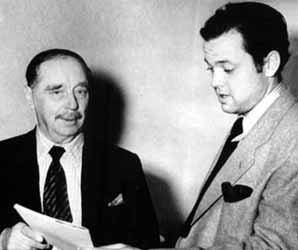
But his anger at Orson Welles, like a lot of his enmities, didn't last long. On his last trip to America in 1940, HG Wells and Orson Welles met for the first time, and were interviewed together---on the radio. HG gave Orson the opportunity to plug the movie he was working on, called '>Citizen Kane. After that movie came out, Wells cabled Welles to express his admiration of that film.
In a sense, this is also a version of The War of the Worlds, though relatively few people know about it, and it came about in an odd way.
By 1938, HG had finished his only two film projects, one of which was the futuristic "'>Things to Come." By then he must have realized that his early "scientific romances"---now called science fiction--- were enjoying a second wave of popularity, and might well be his most lasting works. He'd written a preface for a '>collection of seven of them, explaining his method, which was first published by Knopf in 1934.
Around this time he also met Olaf Stapledon, his most ardent admirer and the author of the stunning science fiction epic, '>Last and First Men. So it happened that for the first time in decades, HG wrote another science fiction novel, and it would be his last.
'>Star Begotten, published in 1937, is described by critic Frank McConnell as "The War of the Worlds rewritten from the vantage point of forty years later and with a startingly different conclusion."
It tells the story of a popular historian, author of books extolling the deeds of heroes, who suddenly realizes that earth is being invaded by aliens---not in spaceships or fighting machines, but by means of cosmic rays that subtly alter the characteristics of babies in the womb, so they are born different. He believes that his wife is one of those affected, as is his son.
The novel details his growing conviction---and that of others he confides in---that this invasion is taking place, and that it is the perfect way to invade a planet. Aliens don't have to conquer the planet, but simply become the inhabitants. Wells builds up the creepiness that subsequent generations would get from films like '>Invasion of the Body Snatchers.
But then the historian confronts his wife, who misunderstands him and believes he is claiming that he is one of the invaded people, the "star-begotten." And suddenly he realizes that he is. He realizes as well that it is a beneficent invasion, and the only way that humanity will go forward to its proper destiny. It is in a sense a natural mutation to a better being. So "Body Snatchers" suddenly becomes more like "'>Childhood's End" with more than a flavor of Olaf Stapledon. The new species they are becoming, as McConnell writes, "is not really a new species at all, but the human race, in process of becoming, exactly, human."
This book was Wells' last science fiction novel, and probably his least known. Yet it may have been his last word in and on the genre, in more ways than one.
Until this year, there was only one film adaptation of "The War of the Worlds," in 1953. A version from England made recently, and released direct to DVD, retains the period and location of Wells' story. But I haven't yet seen it. This '>"H. G. Wells' The War of the Worlds" is available on DVD, as are a couple of documentaries, '>this one and '>this one, on Wells, the novel and other versions, and I haven't seen them either.
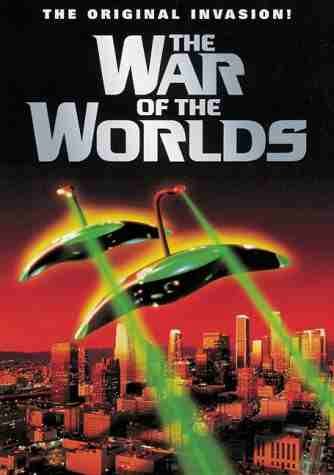
'>The 1953 movie, produced by George Pal and directed by Byron Haskin, took a few additional aspects of the Wells' novel, but basically it updated and remade the Howard Koch/ Orson Welles radio version. It had HG's details of military tactics, but like the radio version it concentrated on scientists and authority figures. It even had a radio reporter narrating the first appearance of the Martians' machines, and at the last attempt to stop them by means of the atomic bomb.
Though the story follows a young scientist and his budding romance with a preacher's daughter as the Martians in their flying machines wreak havoc on the California countryside, the mood of this version is heavily influenced by the atomic age and the Cold War.
The Bomb is present in odd details: the scientist comfortably fitting in at a country square dance, much as the Manhattan Project scientists did at Los Alamos; the invasion heralded by a sudden, distant flash of light, as accompanied the Bomb test in New Mexico just eight years earlier. In fact, one of the cover stories the military used to keep the test secret was that a meteorite had crashed into the New Mexico desert, which is how the Martians arrive in all the War of the Worlds versions until Spielberg’s.
But mostly it is the Bomb's nature as the ultimate weapon, capable of wiping out human civilization---destroying everything and everyone, wherever and whoever they are. Ordinary people are as helpless against the impersonal Bomb as they would be against alien invaders.
Of course, the Russians were rapidly being cast in the part of alien invaders. The Godlessness of Communism was often emphasized, and that's a theme here: the man of the cloth, greeting the invader with a crucifix held high, is mercilessly vaporized. As the machines destroy the cities, those who haven't fled gather in churches, where they are still helpless, although the defeat of the Martians is linked with answered prayers, and the microbes that "God in his wisdom" created.
As someone of almost exactly Steven Spielberg's age, I can testify that on an emotional level, this movie accurately reflects the early Cold War mixture of fear, bewilderment and something like helpless resignation.
The movie's effect was heightened by the almost hallucinatory brilliance of the Technicolor. From a kid's perspective, the Martian machines were convincing and neat-looking, even if they did resemble reassembled parts of new cars, and the sound they made was especially chilling. That's a first impression that's lasted.
The film starts slowly by today's standards, with a strange sort of lecture about the relative merits of the planets in the solar system as places hospitable for life. All the planets are mentioned except Venus, and no reason is given for the omission, but it might have something to do with Wells' novel, in which he speculates that having been repulsed from earth, the Martians happily settled on their second choice, Venus. Apparently HG wasn't interested in sequels.
By locating this version in 1950s California, and showing rather than telling or describing, this movie was very effective at portraying with modern weapons the possibility of a civilization-ending war. Though American soldiers had seen European and Japanese cities reduced to rubble, Americans at home had not yet seen this simulated in their own country. Though it wasn’t elaborate,it had the same sobering and frightening effect as Wells' novel did in its time.
The climax of the film wasn't actually the Martian's defeat but the use of the atomic bomb against them---and its uselessness in stopping them. This was the ultimate admission of human frailty in this age. Everyone was afraid of the Bomb, but the Bomb might not be enough to head off destruction.
Some science fiction buffs don't much like this movie. They complain about seeing the wires holding up the Martian's machines. I'm afraid I still see it with the same eyes as I first did. This isn't true of all scifi movies I first saw as a child---even Pal's '>When Worlds Collide, which I loved, no longer convinces. (That awful painting at the end that had amazed me as the landscape of a new world!) But I'm still a sucker for this film. The scary parts are scary. The Girl is a bit hysterical for my tastes but I still want to protect her, and I still identify with the scientist played by Gene Barry.
The sudden appearance of the Martian still startles me, and I recall another moment that scared me in a cautionary way---it was the rioting crowd in the city, that overturns the scientists' truck and injures several of them, preventing them from finding the solution that would defeat the Martians. That was a cautionary moment for me: it said that ignorance and fear (specifically in the person of loudmouthed idiots) could defeat us as effectively than any unearthly enemy.
Lots of people steal liberally from one version or another of The War of the Worlds. George Lucas derived his Imperial Walkers from the Martian machines in the novel, and Steven Spielberg virtually stole the scene of the separated lovers fighting through the crowd to find each other in the church in the George Pal version for a similar scene in which Richard Dreyfus finds Melinda Dillon in '>Close Encounters.
But nobody has adapted or adopted or stolen as much as the makers of Independence Day (which, by the way, they freely admit---as they do about the other dozen scifi films they "paid homage" to). So when I heard that Steven Spielberg was planning a remake of The War of the Worlds I could only laugh---isn't that exactly what '>Independence Day did?
According to the DVD commentary, the filmmakers (Roland Emmerich and Dean Devlin) were attempting to graft the 1970s disaster film conventions (many characters, all drawn inexorably to the same scene of disaster) onto the 1950s alien invasion movie. In the process they gleefully appropriate ideas and images from science fiction films of the 50s, 60s, 70s, 80s, and 90s. They point out some references themselves on the commentary track: an opening shot reminiscent of Star Wars, a SETI scene out of "Contact," and a television playing "The Day The Earth Stood Still"-all in just the few couple of minutes. There are obvious visual and verbal references to "Close Encounters," "Star Wars," E.T.," "Planet of the Apes," and "Star Trek." Other more subtle motifs suggest "Superman" and the old Flash Gordon serials.
All of this supports the unique mood of this movie: somehow it gets away with not taking itself entirely seriously, and yet getting viewers involved in characters and the basic story. Even the casting adds to this with references, by featuring actors we identify with other science fiction movies and TV, where they'd played characters who displayed some humor: Will Smith would do a couple of "Men in Black" flicks, Bill Pullman had already done "'>Spaceballs;" Jeff Goldblum had played a similar off-kilter scientist in "Jurassic Park," a scary off-kilter scientist in "The Fly," and played a cowboy surgeon in the comedy science fiction adventure," Buckaroo Banzai." And of course the casting coup was Brent Spiner, Star Trek's '>Data, as a wide-eyed, wild-haired, too-much LDS--in-the-60s scientist.
But the basic story was the same: the alien invaders, resisting communication, wanting nothing but the death of humanity. It was as if several decades of Star Trek hadn't existed! Aliens were back to being mindless things, monsters that travel light years to rage and destroy.
And they were big. Really big. As big as multinational corporations, and with all their warm human feeling. But just as in Wells, they could be defeated by a virus. A computer virus this time, but still...
There's one scene that is so directly ripped off from the Pal movie that the art director had to leave a secret signal that he knew it was. Just as in the Pal movie, the last ditch effort is dropping nuclear bombs on the aliens. It doesn't work, which is revealed in a scene that's lifted from Pal, as the dust clears and a forward observer in a tank sees the alien machines rising out of the Bomb's destruction. If you look closely, you'll see in the background some twisted lampposts that look exactly like the bent necks of the Martian machines in Pal's War of the Worlds.
But while Wells' novel was consciously making a political point, and the Orson Welles and George Pal versions made theirs unconsciously, this one---the only one in which the president is a lead character-seems to have no particular point at all. Sure, the president in the fighter-pilot getup may remind us today of a certain 'you're with us or you're a dirty alien' guy, but that's life imitating art.
Independence Day seems instead a fairly daring attempt to orchestrate grand, obvious and at times absurd movie themes to create real human emotion. It's as if Shakespeare had grown up on Hollywood movies. There's movie romance, movie adventure, movie spectacle and movie comedy. And there's classic structure, almost mythic themes, heroes, villains and clowns. There is one couple ended by death, and two couples brought together in peril, with a perfectly Shakespearian double wedding, just before the President King goes out and make his Henry V speech.
When this movie overcomes the predictability of its character moves and the cringe-worthy aspects of the story, it's usually because of the good rhythm and the blessing of good and well-matched actors (some of the best lines were apparently improvised.) All the pairs that needed chemistry (including Will Smith and Jeff Goldblum, and Goldblum and Judd Hirsch as his father) had it.
It is worth pointing out as well that a point made in the Pal movie of "War of the Worlds" and made more concretely in this film is that when facing a common threat, humanity sees its common identity and works together. It's interesting in that regard that this is the first science fiction adventure movie I can think of with a black hero; moreover, that he is black is never mentioned. Of course, some boundaries remain: the two couples are racially unmixed.
I'm not sure what we are to make of the idea, though, that after defeating the alien invader, the fourth of July becomes humanity's Independence Day. Shouldn't it be interdependence day? Or do we always need aliens to define us? And do they always have to be hostile? Must they always represent pure evil so we don't have to face our own complex mix of good and bad within us? Just what are we independent of? We will determine our own destiny when we face up to what and who we really are.
But I guess we all know what America will be doing this Independence Day.
Monday, June 06, 2005
Spielberg's Wells Preview: We have met the Aliens...Are they Us?
By William S. Kowinski
This is the full version of an article that appeared in the San Francisco Chronicle "Insight" section on Sunday, June 5. More here on Wells etc. next week.
Now that George Lucas has shattered box office records with a cautionary space opera tale of a democracy transforming itself into the dark side of empire with a war fought on false pretenses, that other reliable colossus of the summer blockbuster, Steven Spielberg, follows with the mother of all space invasion stories. This time the empire is contemporary America, and it is being attacked by its own future.
At least those were subtexts to H.G. Wells novel, '>The War of the Worlds, published at the apex of British power at the end of the nineteenth century. Spielberg's movie reportedly diverges in several important respects: besides the change of time and place, the alien invaders are no longer Martians and they don't arrive in capsules which the population mistakes for meteors.
The central character is not a scientist/philosopher separated from his wife and on his own, as the invaders lay waste to the English countryside and then destroy London. Instead it's Tom Cruise as a previously indifferent urban working class father who must save his children from the pitiless power of the highly advanced, voracious and invulnerable invaders. But in other respects, the film appears to follow Wells' story at least as faithfully as earlier adaptations.
Spielberg's 1970s and 1980s cuddly aliens in "Close Encounters of the Third Kind" and "E.T.: The Extraterrestrial" were in striking contrast to the usual cinematic monsters from space. Though his filmmaking skills will likely still inspire wonder, this movie's intent is to scare the popcorn into the audience.
Wells' story has been reliably scary in previous adaptations, notably the '>1938 Orson Welles Mercury Theatre radio version which transferred the action to New Jersey and caused newsworthy panic in several American cities, when the format of fake newscasts convinced some listeners a real invasion was underway.
The previous big screen version was a Technicolor attack in 1953, effective enough to scare at least the nine year olds (like George Lucas) and seven year olds (like Spielberg and me) who saw it then, or more likely a few years later at a Saturday matinee.
H.G. Wells died in 1946 (the year Spielberg was born) so he was very much alive to hear about the panic caused by the Orson Welles version, and he was furious. He didn't like his work turned into a Halloween prank to scare people (the broadcast was on October 30.) That was not the message he had in mind.
Of course he was still out to scare people--- but for a purpose. He was incensed by the complacency of Edwardian England in a world he knew was about to change radically, and he tried to shock his "The War of the Worlds" readers with intimations of a type of warfare---arriving from the sky, and attacking not just armies but civilian cities---they would start to see in the Great War, but would not fully experience until World War II.
But "The War of the Worlds" was more than a prescient and brilliantly told tale that launched a thousand bug-eyed monster movies. The terrors that Wells imagined resonated with the unconscious foreboding in his readers, already anxious about the ominous arms build-up in Europe. (Later incarnations would do likewise--the 1938 war worries fulfilled at Pearl Harbor, the 1953 Cold War fears.) But Wells elegantly weaved several other related concerns into his novel, which also pertain to our time.
The first is empire. Wells recounted the genesis of his story several times: he was walking with his brother Frank in the peaceful Surrey countryside, when the conversation turned to the native inhabitants of Tasmania, an island south of Australia, who were eradicated when the English transformed the island into a prison colony. What if some beings from another planet suddenly dropped out the sky, his brother wondered, and did the same to England?
Wells' chief narrator refers to the Tasmanians, who "in spite of their human likeness, were entirely swept out of existence in a war of extermination waged by European immigrants in the space of fifty years. Are we such apostles of mercy as to complain if the Martians warred in the same spirit?"
It is a passage heavily laden with Biblical imagery, hinting at the religious fervor that hypocritically accompanied such genocides. Wells extends the analogy to American Indians (even quoting Chief Joseph's famous "we will fight no more forever" as the Martian invaders lie dying from earth's bacteria, the opposite of the fate suffered by American Indians, nearly wiped out just by the diseases European invaders brought with them.)
But while Wells (along with his friend, Joseph Conrad) was opposed to the rampant European colonialism of their time and its ongoing slaughters in Africa and elsewhere, anti-imperialism wasn't entirely Wells' point.
H.G. Wells was a firm believer in Darwin's theory of evolution by natural selection, as interpreted by Darwin's friend and Wells' most important teacher, T. H. Huxley. They believed that competitions for dominance will be won by the creatures fittest to dominate in that environment at that specific time. But present dominance does not guarantee future superiority.
Though his complacent countrymen (and their counterparts in America) believed they were naturally superior and would always be, Wells didn't see the evidence in nature for such confidence. "In the case of every other predominant animal the world has ever seen," Wells wrote in an essay, "the hour of its complete ascendancy has been the eve of its entire overthrow." So even though technologically superior England and the West conquered indigenous peoples, they could just as well be conquered by beings technologically superior to them.
There is yet another irony in Wells story. He portrays the aliens as an older and more advanced race, whose planet has turned inhospitable. Their technology is imposing and unconquerable, but when his narrator glimpses an actual Martian, he is as surprised as he is repulsed. The Martians are physically weak, with huge brains and almost no bodies.
In fact, they look very much like what humans will evolve into, the narrator says, at least according to a distant relative of his, named H.G. Wells. This is the fate of humanity when it becomes dependent on technology. Humanity is being conquered by its own future. But only temporarily (although the nature of the aliens' demise is rumored to diverge from Wells.)
Though in his novel Wells several times suggests that we consider the point of view of peoples that Europeans conquered, he never creates sympathy directly for the Martians. We see nothing from their point of view. They always remain utterly and inscrutably alien, with no trace of humanity. They are relentless, coldly efficient, highly coordinated, and utterly rapacious. They collect humans only for their food. Everything on earth is simply for their use.
Some would say this is already a portrait of the present. We have built mighty technologies and ignored the consequences to the physical world that ultimately nourishes us, and is as much a part of our bodies as our individual brains and lungs. Not heeding this will be our undoing, as physical weakness was for the Martians.
The imagery of Spielberg's film may tap into today's fears of terrorism, of aliens with technologies of mass destruction, but ultimately it should show us the shadow of our own complacency, particularly in terms of where our thoughtless dependence on our dominant technologies may lead us.
If we think of these aliens as simply the Other, a throwback to 1950s space monsters or stand-ins for whichever foreigners we fear threaten us, then Wells' point is lost. He is asking us to face ourselves.
Like Huxley, Wells believed that humans could step outside natural evolution by engaging consciousness, ethics and morality. The process of imagining ourselves the victim of our own blind actions is a step that this novel helps us take. Perhaps Spielberg's film will as well.