Showing posts with label Enterprise. Show all posts

Tuesday, March 25, 2014

Star Trek Wars


There is a story within the movie Star Trek Into Darkness that goes something like this: in the alternate Trek 23rd century (the JJverse?)--in the year 2259--Starfleet is in danger of being militarized.  A terrorist attack prompts a rogue admiral into setting up conditions to cause a war he has already decided he wants to wage, and for which he has been aggressively preparing.

Because this terrorist attack cost the lives of citizens and valued Starfleet officers, there was no initial resistance to organizing a mission of revenge.  When Spock, Scotty and finally Kirk object and decide to capture the fugitive for trial, the admiral's plan goes awry.  He is forced to show his cards, and his plans to sacrifice the Enterprise and its crew in order to force his pet war.

As an allegory, this story tracks pretty well with events after 9/11/2001 and the American invasion of Iraq.  Members of the Bush administration claim that the Bush White House was intent on waging war on Iraq even before 9/11. They were looking for an excuse.  In the movie there is a further suggestion of 9/11 when the rogue starship crashes in San Francisco, toppling towers.

Ultimately the rogue admiral is defeated. We hear Captain Kirk's voice, and then see him addressing a Starfleet audience.  He says these words: "There will always be those who mean to do us harm.  To stop them we risk awakening the same evil within ourselves.  Our first instinct is to seek revenge when those we love are taken from us, but that's not who we are."

"We are here today to re-christen the USS Enterprise, and to honor those who lost their lives nearly one year ago.  When Christopher Pike gave me his ship, he had me recite the captain's oath--words I didn't appreciate at the time.  Now I see them as a call for us to remember who we once were and who we must be again.  And those words..."

And then Kirk recites the standard opening to Star Trek, one of the most famous poems of the 20th century that begins "These are the voyages..."  The Enterprise then sets off on its five year mission, the one that in the GR universe commenced in 2264.

This central story was obscured by the unfortunate choice of melding it with the Khan story, and specific echoes of Star Trek II.  Upon seeing this film again, the central story seems clearer, and the Khan story--though it would make sense within this story if it wasn't familiar from another setting--takes us way out of this story, and the echoes are mostly unfortunate, however well done.

But by the end of the film there is a sense that this is an attempt to move into the exploratory mission and away from a militarily aggressive Starfleet.  And there are hints that this military tendency is not just one rogue admiral.  Starfleet uniforms are more military than any seen before, especially with the hats which I identify with Nazi uniforms, and others suggest are more like Soviet uniforms.  I also noticed that the architecture of San Francisco is uncharacteristically monumental, suggesting a sense of empire.  And Kirk's speech pretty much says that the rogue admiral was only an extreme example.  Why else would he say that they needed to "remember who we once were and who we must be again."

These are words that might be applied not only to the JJverse but to almost all of Star Trek of the past 20 years.  Since the 1990s, Star Trek has been fighting wars--in the 24th and 22nd centuries.  An entire generation of Star Trek left behind its origins in GR's Star Trek in the 1960s. In the original series, Earth had fought and won a war with Romulus without becoming war crazy.  True, there was a Cold War quality to the rivalry with the Klingons, and there were certainly mixed messages about Vietnam in the 60s, but Starfleet was meant to be a model of peaceful exploration, and a mature attitude towards difference and violence.  These themes were deepened and extended in Star Trek: The Next Generation.

But in the 90s, the Federation in Deep Space Nine went to war in the 24th century--briefly with the Klingons, and more comprehensively with the Dominion.  In the real world of the 1990s, the Soviet Union had crumbled, and some were declaring an "end to history" and complete victory to western capitalism.  In this historical context, the Dominion War might be viewed as analogous to H.G. Wells' The War of the Worlds as an attack on complacency and a smug belief in superiority.

Then a new Star Trek series began, set in the 22nd century, before the time of the original series.  Enterprise began with stories about the first steps into space exploration.  But then in the real world came 9/11, and an analogous attack on the Earth began the Xindi war that dominated the rest of the series.  Terrorism also became a more prominent theme, and torture as interrogation technique was notoriously shown.

  All of this echoed real world attitudes and events.  After 9/11 there was fear of terrorism, support for military action which resulted in military incursions into Afghanistan.  The existence of covert warfare and violence perpetrated by "intelligence" agencies became common knowledge. The U.S. invaded Iraq and began a war that became the longest in U.S. history, though the weapons of mass destruction that served as the pretext for the invasion did not exist.  Eventually it became public knowledge that the U.S. engaged in torture.  Suspected terrorists were held at Guantanamo and unknown other sites without trial or definite sentence or even charges.  Laws were passed with near unanimity that restricted the civil liberties of U.S. citizens and gave new powers to intelligence agencies and law enforcement.

Many of these subjects became themes that dominated Star Trek fiction long after there was no Star Trek on television.  It is only now in 2014 that the themes of war, insurrection, covert warfare (the "Section 31" of many 24th century novels that is mentioned as existing in the JJverse 23rd century) may be coming to an end--or at least that's the suggestion by a Trek Core writer, reviewing the latest batch of Star Trek novels in "The Fall" series.

All of this means that an entire generation has grown up with Star Trek at war, at least in almost every new story (and lots of games.) What began in the 1960s as an alternative to the primitive emotions, the ongoing violence and threat of even greater consequences of open warfare in that era, has reverted and succumbed to those emotions as well as the temptations of easy dramatics in storytelling.

So even more than a decade after 9/11, when the people of the western world are manifestly tired of war, Star Trek is still mired in its themes.  This is not to say that these emotions and issues of self-defense or aggression aren't pertinent or real.  Kirk's speech in Star Trek Into Darkness is eloquent on these matters.

 But in concentrating on this--as well as easy emotional themes such as revenge--almost obsessively, and getting caught up in the politics of a constructed universe so deeply in Star Trek fictions,  Star Trek has lost its edge.  It is no longer in the vanguard of zeroing in on new important issues in a new way, of revelations and of modeling a better future where problems are understood and addressed.  Even an even bigger-budget superhero epic like Man of Steel dealt metaphorically or allegorically with the transcendent issue of this age, that is truly threatening the survival of human civilization: the climate crisis.

Star Trek should be about the present and the future, but lately it seems to have become mired in the past, including its own.

Saturday, December 28, 2013

R.I.P. 2013


Among those Star Trek lost in 2013 were several actors in the original series: Katherine Woodville (Natira in “For the World is Hollow and I Have Touched the Sky”), Jay Robinson (Petri, ambassador from Troyius in “Elaan of Troylius”) and Peter Duryea (Lt. Jose Tyler in “The Cage.”)


 The Klingon Empire lost actors Michael Ansara (Kang in three TOS episodes,) Victor Lunden (a Klingon in “Errand of Mercy” who costarred in the cult s/f film Robinson Crusoe on Mars and who insisted that Star Trek was really his idea) and Tom Deishley (who played Motog at Star Trek: The Experience.)

 Malachi Throne appeared as Pardek in both TNG Spock “Unification” episodes as well as “The Cage.” Ed Lauter appeared in TNG “The First Duty,” Robin Sachs in Voyager, and Mary Carver in Enterprise.

David Richard Ellis was a stunt player on the feature Star Trek V; Susan Rossitto on Voyager. Legendary stunt player Hal Needham doubled Gary Lockwood on “Where No Man Has Gone Before.” Dick Butler was stunt coordinator on TNG’s “Encounter at Farpoint” and stunt double for Brian Keith on the DS9 first season episode “Progress.”

Richard Matheson
 Behind the camera, Richard Matheson was a legendary s/f writer who wrote the classic episode “The Enemy Within” for Star Trek. Mike Gray, an Oscar-winning writer for The China Syndrome, was a TNG producer for 13 episodes of its second season, and wrote “Unnatural Selection.”

 James Mees was the Emmy-winning set director for TNG, VOY and Enterprise. Marvin Paige was the casting director for Star Trek: The Motion Picture. A.C. Crispin was a Star Trek novelist.


 The science fiction world lost the prominent writer and s/f historian Frederik Pohl, possibly the only Nobel Prize for Literature winner to publish several volumes of science fiction, Doris Lessing, and s/f authors Andrew J. Offutt, Patricia Anthony, Jack Vance and Steven Utley. Jacques Sadoul was the French literary critic whose 1973 history of science fiction jump-started the academic study of s/f.

 May they rest in peace. Their work lives on.

Thursday, December 20, 2012

Captain's Log: Of Rainbows and New Earths

Just a couple of quick notes before the world ends.  An addendum to my post of the Reading Rainbow Remix with LeVar Burton--the San Francisco Chronicle published an article about the rebirth of Reading Rainbow as the most popular education ap on iTunes.  The Chron interviewed LB at a recent Star Trek convention in San Francisco, and also posted a q & a from that interview.  This post also includes Jimmy Fallon performing the Reading Rainbow song as if it were done by Jim Morrison and the Doors.  Maybe you have to be of a certain age to appreciate this one, but it's great.  So is the article, and so is what LB is doing.

Another day, another new candidate for a habitable "Earth-like" planet in another solar system.  This one is one of several planets orbitting Tau Ceti, a planetary system that figured in several Star Trek episodes (TOS, TNG and VGR.) [The inevitable artist's conception is left.]  Though Tau Ceti is 12 light years away, it qualifies as comparatively close.  But Trek fans can tremble at quotes like these at the end of the Guardian article on this find:

Professor Steve Vogt, another team member, from the University of California at Santa Cruz, said: "This discovery is in keeping with our emerging view that virtually every star has planets, and that the galaxy must have many such potentially habitable Earth-sized planets. They are everywhere, even right next door."

Professor Chris Tinney, an Australian member from the University of New South Wales, said: "As we stare at the night sky, it is worth contemplating that there may well be more planets out there than there are stars, some fraction of which may well be habitable."

Back to television: we've been watching the first 3 seasons of The Mentalist on DVD (they've also been running on cable, bunched in several ep packages.)  Simon Baker plays a kind of trickster Sherlock Holmes--Sherlock crossed with Harpo, sort of. Maybe it's a coincidence that Peter Lauritson, a producer on TNG, DS9 and VGER  is an associate producer of this show, but I've spotted a number of Trek alumni in various episodes, mostly from Enterprise: Connor Trinneer, John Billingsley (playing a fake psychic who sounded a good deal like Dr. Phlox) and Linda Park (she was especially fine in a major guest role,) but also Armin Shimerman from DS9.  Maybe others?  Anyway, always nice to see alums in a new light.  Update: Saw an ep directed by Voyager's Roxanne Dawson (she's done 3), and appearance by DS9's Robert Picardo on the very next ep.

Tuesday, June 29, 2010


Captain's Log: Sherlock Holmes in 2012

Instead of reporting on outward events as in previous entries, I thought I’d make this an inward-looking log. I’ve recently been viewing DVDs of Jeremy Brett’s Sherlock Holmes series, originally from Granada TV, particularly the second Return of Sherlock Holmes series of stories. The restored video of these DVDs certainly helps reveal the sumptuous visuals and the subtle expressions as well as flamboyant gestures Brett employs in his striking interpretation of Holmes. I’ve written elsewhere in more detail about Brett, but here I wanted to mention a few elements pertinent to sci-fi TV and film.

As noted in DVD commentaries etc., the role of Doctor Watson, especially as played in this second series by Edward Hardwicke, is the everyman figure who is the stand-in for the viewer—the way viewers participate in Holmes’ world. This is also how the companion’s role is typically viewed in Doctor Who, as former exec producer Russell K. Davies often said. There in fact is a lot of Holmes in the Doctor Who character--the man who is so far ahead of anyone else in solving the mystery. Perhaps some portrayals of the Doctor make a stronger connection than others: Tom Baker certainly (and he went on to play Sherlock Holmes in a TV version of “The Hound of the Baskervilles”). And David Tennant, including his long Brett-like coat, and with Brett's way of being more excited by the mysteries he must solve than is quite seemly, when murder is involved, or the fate of the universe.

This role of the companion is harder to isolate in Star Trek. Probably the Wesley Crusher character in Next Gen was meant to be the young viewer’s representative, although it didn’t seem to play out that way. It may be that the Outsider role (Spock, Data, etc.) was the closest, which may be partly why viewers identified with these characters so strongly.

Speaking of Next Gen, a pre-Counsellor Troi Marina Sirtis has a small role in one of the Holmes’ stories—she plays a Sicilian in London, and most of her dialogue is in Italian. The Sicilian characters are emotionally all over the top, nearly a stereotyped portrayal. But she does her part well. I recognized her immediately but then wasn’t sure—the eye color was wrong. Then I realized that she wore darkening contact lenses for TNG. This episode was directed by David Carson (as were others in the series), who directed Sirtis and the other TNG actors as well as William Shatner etc. in Star Trek: Generations. (Another casting note: Jude Law, who plays Doctor Watson in the recent Robert Downey movie, was actually in one of the later Brett-Holmes stories as a very young man.)


I also finally saw the DVD of the film 2012. Roland Emmerich is a unique filmmaker, combining these epic disasters with character portrayals, both with remarkable specificity. (Though the payoff for one element of the little girl’s story was silly, her insistence on hats as her security blanket was just right.)

But for all the scientific theory and the milking of suspense about the fates of specific characters, the disaster element was played for fun more than reality. In the central special effects sequence—of the family escaping the total destruction of Californa by car and then by plane—the series of extremely narrow escapes was so relentless that it was purely comic. And anyone playing a drinking game focused on the line “Oh my God” might wind up needing medical assistance.

But there were intriguing features. I was especially interested in the story because some of its elements were present in a novel I wrote in the 1980s (never published), specifically the President’s daughter’s involvement in unraveling a plot by the rich and powerful to escape the apocalypse. Even the ethics of the ending is similar. I suppose if I ever publish it I’ll be accused of stealing from this movie.

On the characters and their relationships: I’ve noticed that in contrast to 1950s space invaders and end-of-the-world movies which emphasized a romantic relationship between a man and a woman, the 21st century versions favor a father (usually divorced) fighting to save his children. That contrast is clearest in the 1953 George Pal version of H.G. Wells’ War of the Worlds versus the 2005 Spielberg version. It was an estranged father's quest to save his son in Emmerich's The Day After Tomorrow. And it’s true in this movie, as John Cusack is the previously neglectful father fighting to save his children.

There is a secondary romantic relationship in 2012, and credit Emmerich—his casting of Will Smith as the romantic hero in Independence Day was no fluke. Not only are his romantic leads African American (though both played by Brit actors, while an apparently Brit scientist is played by Seattle and Star Trek: Enterprise actor John Billingsley), but he follows characters of several nationalities (Indian, Tibetan as well as Russian) of all ages and in many kinds of relationships: father-son, brothers, etc.) However, that the President of the U.S. is played by a black actor (Danny Glover) was becoming a screen convention even before President Obama’s election.

In the end, however, I was most interested in the ethical aspects, in which the old (but never referenced) idea of Lifeboat Ethics is made literal. The movie is bold enough to show what feels likely—that the wealthy will buy the best seats on the next Noah’s Ark. A lot of people necessarily must be left behind, and in an almost shocking way, we naturally assume it will be those too poor to pay for passage. Contrast this with the lottery from among young candidates best able to perpetuate the species in the 1950s film When Worlds Collide (again, by George Pal.)

2012 wrings some hope out of the deaths of billions and the destruction of much of the planet (the special effects folks got to destroy most of the major landmarks and icons they missed in previous Emmerich epics), and that the poor continent of Africa is the only one to survive intact has some poetic justice. But in dealing with the Lifeboat Ethics question it’s not entirely honest: those big, energy-eating arks showed no apparent strain caused by opening their gates to the huddled masses they were going to leave behind.

Saturday, April 11, 2009


Major publicity and first reviews of the new Star Trek movie this weekend, while in England the new Doctor Who special airs--and news of a Trek/Who crossover that wasn't to be. More in the post below.

Monday, January 28, 2008

Captain's Log: New Look Enterprise, Trekkies Against Torture, Patrick is Back

There's been lots of news about the Paramount Star Trek feature, though how significant it is depends on your particular interests. One element that will be significant to a lot of Trek fans is the impression that while the new Trek film is retaining the original series characters and at least the basic contours of the original Enterprise, the technology on the Enterprise bridge is going to be quite different. I'm getting the idea that it's not going to be the retro 60s look, but updated and futuristic by today's standards. Among other things, I guess that means lots of new toys!

Just a couple of other notes this weekend: I've just learned via Trek Today of an organization called Trekkies Against Torture, which has an online petition addressed to the Star Trek feature's producer/director J.J. Abrams, asking "for your guarantee that you will respect the vision of Gene Roddenberry and your film will contain no apologetic or justified scenes of torture or other human rights violations by any of the characters representing Star Fleet. "

This organization is concerned because of other shows Abrams is associated with that "have often depicted the use of torture in a manner that justifies its use or feature 'heroic' characters employing torture."

This reminds me of posts I wrote about an episode of Star Trek Enterprise that I felt crossed the line in depicting torture as a useful interrogation technique. I even speculated that it was showrunner Manny Coto's audition for "24," which Brannon Braga (an exec producer of Enterprise) also writes for. Since then, "24" itself has become the poster child for torture, not only in the media but in the real world. Torturers working for the U.S. have actually used it not only as an example of successful torture (whereas virtually all experts agree that torture does not work as an interrogation technique) but as a template for how to torture their victims.

I then posted an essay comparing the pernicious influence of "24" and similar torture porn to the Star Trek: The Next Generation two-parter, "Chain of Command," which does depict torture, but reveals it for what it is--a cruel and ineffective procedure. It was also one of Patrick Stewart's best performances--every Trek fan remembers "There are four lights!"

I ended this piece with these words:

The last thing I want to see is a Star Trek movie that embraces this reflex manipulation in the guise of drama, and these phony cliches about torture, or that being "gritty and dark" is actually more real, rather than just an easier way to excite an audience. And those who propose this act like it's some big insight, instead of something that people like Gene Roddenberry knew was the easier way, and rejected. Because it's less interesting, less real, and less human. And it's as sure a dead end for the future as can be imagined.I hope the Star Trek movie can transcend this. I hope that the fact that "Lost" and "Alias" are on the list of TV shows that feature torture isn't predicting the Star Trek future.

So it should come as no surprise that I am delighted there is such an organization as Trekkies Against Torture, and I fully support their petition.

Something Profoundly Good

Speaking of Patrick Stewart and his acting, he is the subject of a fine profile in the New York Times, on the occasion of his starring role in Macbeth. After earning the greatest praise of his career in England, it is "[n]ow scheduled to open next month at the Brooklyn Academy of Music’s Harvey Theater, the production inspired several British newspaper critics to pronounce it the “Macbeth” of a lifetime, the best they have ever seen. (And they see a lot of Shakespeare.) Mr. de Jongh called Mr. Stewart “one of our finest Shakespearean actors”; Charles Spencer in The Daily Telegraph said he had turned in “a truly great performance.'"

His role as Captain Picard is mentioned several times, and he talked about it in affectionate terms with his interviewer. "In a recent interview Mr. Stewart spoke happily, even sentimentally, about his Enterprise-commanding days, which left him with a castful of close friends and an unexpected appreciation for the importance of “Star Trek” in American culture. He found the 1999 film “Galaxy Quest,’’ a satire that gently mocks the actors and fans of a “Star Trek”-like series, hilarious, but also moving, he said, in its recognition that “there was something profoundly serious and good” about the series."

The story quotes Stewart's director in Macbeth comparing his character in this production to Captain Picard's situation in Star Trek: “The world around him is incredibly, vividly surreal, with cyborgs and strange creatures, and he’s the human heart of it.” But be forewarned: this production is reputedly quite graphic, and Macbeth is no Captain Picard--he's a murderer and a tyrant, so Trek fans who want to see the play should be prepared for that.

Stewart, who has been back in England for several years, relishes returning to New York for awhile. “It would irritate my father so much — because he was a military man, and both my brothers did military service, and I didn’t — that I walk around New York and I hear, ‘Hey, Captain, how are you?’ ” he said.

Tuesday, January 16, 2007


Klingons in the White House? And are they friend or faux?
Posted by Picasa
TrekCheck: Of Vulcans and Klingons and Life on Mars

Trek references are so normal they aren't often noted. But in my continuing mission to note just how normal they've become--and how deeply the often maligned Star Trek saga is embedded in the common psyche--I have two pretty remarkable references, both on Keith Olbermann's MSNBC program, "Countdown," which is rapidly becoming one of the most watched cable news shows.

Last Monday, Olbermann discussed the news that a scientist had theorized the 1970s Mars mission may have unknowingly killed Martian life, and he did so within the context of the Prime Directive. Don't believe me? From the show's transcript:

OLBERMANN: United Federation of Planets starship captain James Tiberius Kirk could tell you that the prime directive prohibits any interference in primitive cultures, the ones that have not achieved warp drive yet. But Captain Kirk was not above violating the prime directive when circumstances or a blue skin the female in a fir bikini warranted. In our number three story on the COUNTDOWN tonight, it turns out that, as you can see in this computerized simulation we prepared, NASA may have accidentally violated the prime directive big time during its landings on Mars in the 1970‘s. In layman‘s terms, the NASA lander may have made it all the way to mars, might have actually found life on the surface, and then smashed it.

He then introduced his guest to discuss this by saying, Beaming in via satellite transmission right now Derrick Pitts, chief astronomer of the Franklin Institute, in Philadelphia, one of our favorite guides through the final frontier.

Trek references like those in the introduction of the astronomer (who made a few of his own) are common enough when dealing with anything about outer space, although they do tend to show that Trek remains the predominant reference point in terms of space mythos. But the context of the Prime Directive was quite apt--which shows the influence of Star Trek on how we think about some of the important moral, ethical, value questions regarding the universe.

But the Trek reference of the week had to be from a speech on the floor of the U.S. House of Representatives by Rep. David Wu, who used Vulcan and Klingon analogies to talk about the latest Bush proposal to escalate the Iraq war. He refers to the neocons who call themselves the Vulcans--or at least according to a book about them. Their Vulcan analogy is to the Roman god of fire, but Rep. Wu's is to Trek. Again, it was Countdown that broadcast this excerpt on Friday:

REP. DAVID WU, HOUSE MEMBER: This president has listened to some people, the so called Vulcans in the White House, the ideologues. But, you know, unlike the Vulcans of Star Trek, who made their decisions based on logic and fact, these guys make it on ideology. These aren‘t Vulcans. They are our Klingons in the White House. But unlike the real Klingons of Star Trek, these Klingons have never fought a battle of their own. Don‘t let faux Klingons send real Americans to war. It‘s wrong.

I love the "real Klingons" line.

Update: John Stewart used this very clip on Tuesday's Daily Show, with on-air comments from Leonard Nimoy and George Takei. It was pretty funny. I'm sure it'll be on YouTube any minute now, and on the Daily Show/ Comedy Central site.

In Trek news...

Star Trek Enterprise has begun its run on the Sci-Fi Channel, which inspires two observations. First, the Sci-Fi Channel has already done a better job of promoting the series than UPN ever did in 4 years. And second, it was the Sci-Fi Channel's counterprogramming of Battlestar Galactica and the other programs in its "Sci-Fi Friday" lineup that helped to doom Enterprise in its last year, despite the first half of its last season was probably its strongest and most promising period.

Trek XI news and/or gossip is that a script draft is complete, William Shatner has been asked to appear in the film, he says it concerns Kirk and Spock in younger days, and the exec producer suggests that those who aren't familiar with Trek might be a better audience for the film that those who are, because they will come to it with an "open mind."

That seems to signal some noticeable changes in the Trek universe--or in what fans have come to call "continuity." (The term is partially from the dictionary definition, and partly from the more specialized film term. There's a position on movie sets that used to be called "script girl," then "continuity" and now "script supervisor." But it doesn't mean what "continuity" means in Trektalk. Continuity within a film is a matter of managing scenes which are shot out of sequence, to make sure everything is consistent in terms of one thing following another in the script's world of time--the costumes are the same when they're supposed to be, script changes don't violate the logic of the script, etc. Trektalk continuity is more like consistency with the established Trek universe in the "canon" of previous TV and movies.)

On the other hand, the script is also said to jump around in time, capable of including Shatner's Kirk and Nimoy's Spock, so continuity in that sense is embraced. So will Trek XI satisfy the keepers of canon? (Another borrowed term, originating from canon law, as in the Catholic Church, and these days debated as constituting the indispensible works of literature, the canon.) Or will there be changes in Roddenberry's Star Trek universe, to the extent that Trek becomes a mythos more like Superman and Batman--told and retold in different ways? No one knows yet, but that second possibility is a big change, if it happens.

And in site non-news, yeah, I promised the Trekalog essay on Generations by now. I'm working on it. Soon.

Monday, May 16, 2005


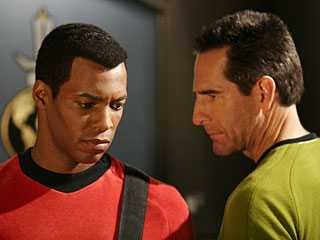
sorry, red shirts were all that was left Posted by Hello
All Bad Things, Part II

Are we maybe actually in the Mirror Universe?

I get no pleasure from bashing anything about Star Trek. I don't like being in the company of writers who have used the demise of Trek to show off their superior disdain. I wish I could say that those who talk about fatigue were proven wrong by the last episodes of Enterprise. But they seemed to me to be evidence of fatigue, though not necessarily in the audience.

Because unless it's just me, the last six episodes were a mélange of bad ideas, good ideas badly executed, not well-thought out stories and no real direction to characterization. So many plot threads never tied, so many themes never matched or explored very far; so many anomalies unexplained; so much pointless motion as a substitute for real story action... Put them together and you have an unpalatable menu of ways that a series can go wrong: a flatfooted joke with a flatfooted twist ("Bound"), giddy obsession with nostalgic production values for two hours of pointless violence and histrionics (the Mirror Twins), two hours of a decent idea with another excellent guest star, but slack and undramatic storytelling (Demons, Terra Prime) and a finale with no center, no edge and no thanks.

The best that anyone has said for "Bound" and the mirror episodes is that they were "entertained," whatever that means. Personally I'd like some solid storytelling with intriguing themes and characterization with my 23rd and 24th century aliens, starships and uniforms. (Oddly enough, the originals are all readily available in several different media of TOS and TNG episodes.)

The mirror universe episodes began by trashing one of the most important moments in Star Trek history (and certainly one of the most memorable during the tenure of Berman and Braga): the first contact in First Contact. If Star Trek represents hope to many people, then this moment embodied that hope.

But instead of a handshake, the inventor of the warp drive whips out a machine gun, kills an unarmed alien, and leads his fellow earthlings to pillage the Vulcan science ship. It is shocking and heart-breaking, and as I watched it the first time I thought: it's going to be hard to see this moment in First Contact now without thinking of this version, so this had better be worth it.

For two hours I waited for it to be worth it, and it never was. I don't blame fans who managed to see this as an illustration of how the Star Trek future could go bad, because they really want Star Trek to mean something. But for the people responsible for this episode, this excuse can only be classified as cynical rationalization. These episodes were execrable exercises in pointless game-playing, laden with relentless violence and cheap villainy.

Was the premise of this mirror universe even credible? War-ravaged 21st century earthlings pillage one small ship of its technology and rule the galaxy, turning the Vulcans into slaves? That leaves a lot up to the imagination, especially considering what we see of the Enterprise earthlings. Empress Sato indeed. That great twist of the apparently subservient sex slave being the real master was so brilliant, why not use it twice in a row?

Peter Weller's presence and subtle acting, and Levar Burton's direction, made "Demons" the best of a bad lot, but as reviewers have pointed out, not a whole lot makes sense (Trip and T'Pol going "undercover" etc.). Both this and "Terra Prime" failed to either explore or explicate the worthy theme of xenophobia.

For example, the Terra Prime earth-firsters were of various races and nationalities. Wasn't that an opportunity for an Enterprise character to point out the analogy? Why else have a mixed race set of xenophobes? But with nothing said, the image sends a mixed message: like, these people can't really be serious. What is so threatening about the half-alien baby? We're supposed to know. Nobody shows us why they feel threatened. (Maybe Weller's performance here was too subtle.)

Michelle Erica Green makes a similar point about the series, that too much was told and not enough happened. This is bad storytelling, from people who have been involved in good storytelling in the past. I can't say I understand it.

Trinneer, Blalock and guest star Peter Weller on "Terra Prime"  Posted by Hello
"These are the Voyages" was fitting in its aspiration and sentiment as the apparent finale for Star Trek As We Know It, and in its chaotic attempt to tell at least 3 stories in 42 minutes, with the inexplicable rubbing up against the brilliant, and isolated moments of real feeling following the cringe-worthy, an unfortunately fitting finale, if not for this series, then for this part of the season.

As Steve Krutzler pointed out, the central event is very weak: Enterprise must rush back to earth so that Archer can...save the planet from an alien probe? Battle the Borg for earth's future? No, no, nothing that...well, dramatic. It's to give a speech. Which he hasn't written. But which he absolutely can't be late for---why, getting him to the podium on time is worth dying for! I don't know about audience fatigue, but this is a prime illustration of creative fatigue.

I pretty much expected to enjoy the TNG parts, but even though Jonathan Frakes and Marina Sirtis gave fine performances, it was a jarring and unconvincing element. Riker hanging around watching like a ghost took the reality out of the Enterprise crew scenes, which otherwise were well acted, befitting a finale. Riker interacting with the crew was much better---in talking about each other, we got some sense of how they'd changed over the years and became a crew--- but it was never clear to me exactly what he was looking for, or in fact, what he found that enabled him to make his decision.

I'm afraid I don't see the relevance of Trip's self-sacrifice to Riker's choosing to violate one of two pledges, to his old captain and to his current captain. Riker had plenty of instances in his own experience concerning following or not following orders. Data disobeyed an order in his first command in TNG's Redemption II, and Picard commended him for his initiative, saying "Starfleet doesn't want officers who follow orders blindly." As far as that goes, Kirk and his crew disobeyed orders to search for Spock---why wouldn't he view that simulation? I would---it's a much better movie.

The TNG actors were badly served by the premise. They were clearly older than their TV TNG selves. The writers could have made this credible if they had been on the Enterprise E just before Nemesis or on the Titan; if they had come up with a good thread connecting the two eras, these actors---of both casts--- would have given them a truly memorable episode. Sirtis and especially Frakes were excellent, but having them masquerade as their younger selves was infuriating: please honor who they have become. The lines under Riker's eyes mean something, and there are stories there.

The Shran subplot is a rushed, undramatic excuse for action sequences. T'Pol has a nice moment sniffing Trip's clothes, but then how many times have we seen this move since E.T.? Soon she gets to deliver one of the lamest lines in memory, telling Archer "You look very heroic." Which is immediately followed by perhaps the best moment of the entire episode, when Archer/Bacula turns and embraces T'Pol/Blalock---it's one of those moments that seems to be simultaneously about the characters and the actors, and it even looks spontaneous. This is followed by another nice moment, a Phlox grin reminiscent of the computer-enhanced exaggerated alien grin of the very first episode.

from These are the Voyages Posted by Hello
This fourth season started strong. The three-episode arc looked like a solution to the problem of the decreased amount of time available to tell a story dramatically. Enterprise episodes are close to ten minutes shorter than TOS. Many of the first nine episodes were strong, the others were promising.

Coming back from the first break, there was a stumble (Daedalus), then a triumph (Observer Effect). The Andorian arc was solid, " The Aenar" had moments of beauty. On balance, the Klingon arc worked: it made clever and meaningful connections both to the Arik Soong arc earlier in the season, and to the TOS-to-feature film Klingon forehead conundrum. Things were looking promising for what we knew, by the time the next set were in production, would be the last episodes.

But these last six exposed all of the weaknesses even in the better episodes: the loose ends and inexplicable events that could have been easily been tied up but weren't, the story threads that dangled, and especially the lack of character definition in the most important characters: T'Pol and especially Archer.

I could give you a character arc for each of them, much as the characters themselves did in their discussions with Riker the Chef in "Voyages." But within episodes, and from one episode to another, I couldn't tell you what motivated Archer, why he did what he did, what he thought: basically, who was he?

There were times I thought I was starting to understand T'Pol and her "journey" but it turns out, not really. By the end, I have no idea, except that she's still a scold with emotional problems. Blalock gave her an endearing vulnerabilty, but in the end this wasn't a satisfying character.

I could be wrong, but this was my experience. I don't blame the actors, either: they both had moments that displayed their skills, and they seemed fully committed to their roles. (Although there is a ring of rueful truth in Zeke Hyman's description of Archer's range "from slightly pissed off to very pissed off.") I just don't think they were given what they needed---or maybe just what I needed, to feel that I know who these characters are. Or were.

Linda Park, Anthony Montgomery and Dominic Keating got the best out of the moments they were given, and as the kind of midpoint between minor and major characters, John Billingsley as Dr. Phlox was the solid anchor of the series, with never a false moment or bad performance, and adding colors and meaning when given the opportunity.

But for me the revelation was Connor Trinneer as the character I was all set to despise, the cracker buddy of the Cap'n, "Trip" Tucker. Written as a throwback to World War II movie clichés, Tucker was the first indication of questionable choices for this series. Yet Trinneer took this character through a discernable journey, and came out a more complex person, pretty close to an enlightened being. The lightness and sweetness he brought to Trip in that last scene with Riker was terrific. His tears over his infant daughter in Terra Prime, though hardly prepared for in this rushed story, were effective and moving anyway. That's acting.

Trinneer was also generous in his scenes with other actors. There was no internal logic to the Trip-T'Pol relationship, though again, the actors seized what moments they were given by writers/producers/executives who couldn't make up their minds, or didn't care all that much about it.

Except for one unconvincing shot of the assembly on earth in "These are the voyages," visual effects maintained their high quality through these episodes, with the comet in "Terra Prime" and of course the final parade of Enterprises as the very last images of the series being especially memorable. I really admired and enjoyed the music in "Voyages" as well, with all the quotes of themes from past series, including Voyager and DS9.

Enterprise had the opportunity to really explore how earth got from the scarred remnants of World War III to the stars, and from there to the Federation. There were so many possibilities for thoughtful drama. But Enterprise wound up being neither very thoughtful nor very dramatic. These last episodes suggest that even given another few years, that potential likely would have remained unrealized.

So where does Star Trek go from here? Let's talk about that a little later.

Tuesday, April 26, 2005

TrekCheck: Mirrors

After its last hiatus from broadcasting, and well after it's last day of shooting, and near the last days that visual effects and post-production staff would be putting the finishing touches on the final episodes, Star Trek: Enterprise returned with its final set of new stories.

While some viewers had recently been alerted to the show's demise and therefore its existence, those of us who had followed the corporate drama that climaxed in its cancellation, were preparing to savor these last hours. It was looking more and more that they would be the last hours of new Star Trek for quite awhile-variously estimated at 3, 5, 10, 20 years for a new TV series---and considering how some were talking, and the fact that the production staff was disbanding for the first time in 18 years, these could very well be the last new episodes of Star Trek As We Know It, ever.

There are four episodes left as I write this, and I hope to write about all six a group after I've had the chance to see them together on tape. But the experience of seeing the first two on their initial broadcast was jarring. "Bound" may have been Manny Coto's attempt to do a comedy episode; when I visited the Star Trek set last August, he mentioned that Enterprise hadn't done one yet and he seemed to want to try it. If this was that attempt, it wasn't funny. If it was not, it was worse.

Still, I was prepared to think of it as an aberration, another back-from-hiatus back luck failure, like "Daedalus", hopefully to be followed by a memorable success, like "Observer Effect." So again I had high hopes for "In A Mirror, Darkly, Part I." And personally, on first viewing, I found it an even greater and more depressing disappointment.

Rather than analyze it now, before the second part and before I've seen it again, I'll offer one comment on my first experience, and some thoughts about how Mirror Universe stories work.

The comment is that there was so much gratuitous violence, particularly torture, that I would recommend that children be kept away from this episode, and I personally was offended by it. My first impression of the episode was that it did not justify its excesses, not just in the violence on screen, but the violence it did to itself and to Star Trek.

The idea of a Mirror Universe (or MU in Internet shorthand) first appeared in the original series episode, "Mirror, Mirror." There were three episodes of DS9 that visited later versions of this universe. Apparently we are seeing earlier days of this universe. The basic difference is that the Federation of the Star Trek universe is the Empire in the MU; what was good is evil.

The difference between this story and all the other MU episodes is that we are entirely in the company of people who belong in the MU. That presents a difficulty that this Enterprise episode didn't transcend.

In the original series "Mirror, Mirror," the device that made it work dramatically, was the point of view. Kirk, McCoy, Uhura and Scotty found themselves in this MU, and they had to figure out how it worked. We saw what the mirror showed, through their eyes. We saw our Captain Kirk discover each element of this opposite place; we saw him learn its rules, and go along with them at times in order to survive, yet he risks bending or opposing them when he can.

But in the Enterprise MU we see only the characters that belong in that universe. We have no point of view to help us sort things out, and the script doesn't help much. At times, certain characters seem to feel trapped by circumstances. But others seem to revel in evil to a cartoonish degree.

If the intention was to create a nightmare world, it succeeded. But it also looked as if all the money for this episode was spent on the opening scene and opening credits, leaving the rest of the hour to a string of violent shipboard scenes. The initial effect on me was to produce disgust and impatience rather than horror. These characters aren't actually scary, as the cardboard evil characters of the original series episode still managed to be, because we have no "normal" characters to be scared for or to identify with.

I'm tempted to see this on an entirely different level. Back when he was a writer instead of a TV game show host and pitchman, Ben Stein hypothesized that at some level every Hollywood movie is about Hollywood. Maybe I'm reading too much into this, but there seemed a lot of subtext on view in this episode. The hostilities expressed so fulsomely make more sense if you consider them expressions of a cast and writing staff that has been under the gun for at least a year, and is finding out that they've been cancelled. Short of being able to get a few UPN and Paramount executives into the agonizer, they have to make do by pretending to torture each other. Maybe the cries of pain are liberating for them, since it seemed one or another of them was emitting them for most of the hour.

Maybe it was therapy. Some of the actors appear to be relishing these reversals---there were a couple of times that I was sure several of the actors were on the verge of breaking up. And maybe this was Manny Coto's audition for "24."

As Star Trek, it was troubling. Although I thought "Mirror, Mirror" worked well, I'm not a fan of the Mirror Universe concept. Breaking us into all good and all evil works if you use the allegory for insight on our own universe, where we are both. But the temptations of the MU are often too strong: everybody gets to play against type, and it's easy to get carried away.

We'll see if it makes better sense in Part II, which is the episode many fans are waiting for, when the Enterprise crew is on the bridge of a Kirk era starship, wearing those Kirk era uniforms. In the first part, some fans apparently learned more about what the pre-Federation Trek universe would have been like had humans been ruled by fear and violence, as arguably we are now. Others are satisfied with action and seeing bits of Trek lore. While critical reaction to "Bound" was almost uniformly negative, the fan reaction to this episode on the Trek Today bbs was generally either an A or a D. Apart from an intriguing title sequence, on first viewing I felt the episode was implausible, incoherent, and laced with unjustified brutality. I hope that somehow Part II will change my conclusion, but I'm less enthusiastic about watching it than I was a week ago.

Monday, March 07, 2005

TrekCheck: All bad things?...

As the Enterprise season and officially its existence as an ongoing series come to an end, there is more than the usual conflict in Trekdom.

On the one side there are the people associated with Enterprise who speak only in terms of finality. It's striking how many of them use the same word to describe the prevailing attitude: "bittersweet." Jonathan Frakes used it, and Brannon Braga at his college speech; I heard Dan Curry at his college speech use it twice.

Within this group, though not totally unanimous, is the sentiment that the cancellation of Enterprise is a necessary thing, because Trek needs a rest, a pause, a period of "gestation" (to use Braga's word) before the next try. As noted before, Rick Berman has settled on the "franchise fatigue " description, which justifies not only the cancellation but the idea to abandon established Trek characters (and presumably actors) for the next feature.

On the other side is the Coto Counteroffensive, and the fan attempts to save Enterprise. Manny Coto hasn't backed off his belief, stated to me and anybody else who would listen before the season started, that what the world needs now is more Trek, not less, and certainly not none. He talked recently of his 5th season stories for Enterprise, though he also agreed that the next Trek series should go farther into the future, into the 25th century perhaps.

When fans showed up to demonstrate their support at Paramount, Coto and the writing team came out to greet them, as did members of the cast. While Coto doesn't say a word against Rick Berman, he is clearly on the other side of this question. Scott Bacula seems to have a foot in each camp---he says he'd like the series to continue, but he talks realistically about its chances. His pessimism sounds the most realistic, based on his knowledge of the people involved who are making these decisions. (There was also the $3 million pledged to save Enterprise, a startling but probably risk-free assertion of faith in Trek, as paying the actual money probably depends on raising the full $38 million goal, which is highly unlikely.)

So even as faint hope at least keeps our ears perked up for surprises, most fans seemed resigned to cocooning quietly one last time, to watch the farewell episode, and wave a fond goodbye.

But a new element was added last week when a couple of long-time BBS posters, believed to be close to the Enterprise production team if not part of it, went public with a scathing critique of the script of the final episode, said to be titled, "These Are the Voyages."

BBS fans going nuclear is hardly news, but these "sources" claimed that there was widespread dissatisfaction on the set with this script, which is now in production. Perhaps coincidentally, a previously scheduled press event with Berman, Coto and Scott Bacula, among others, was cancelled, and the Enterprise set was abruptly closed.

Then over the weekend, Jolene Blalock called the script "appalling." She's made negative comments about scripts before, but "appalling" is very strong language, particularly as she was praising this season's scripts.

So now should fans be expecting an even greater disappointment: not just the loss of Enterprise, and with it the loss of new TV Trek stories for the indefinite future, but a final farewell to Star Trek episode that's "appalling?"

There is a certain symmetry to the possibility. A bad end to a troubled series would not be unexpected. But a bad end to "Trek as we know it," coming to us in an interrupted but unbroken line from Roddenberry to today, especially with many of the same people involved for decades, would leave us with worse than a bittersweet taste.

It does suggest that while all good things may come to a good end, a less than happy situation sometimes cannot transcend itself, and the bad end seems inevitable.

There are conspicuous examples of both in Star Trek. The miracle and the love fest that was TNG, came to a great end with "All Good Things..." Even the ignominious cessation of the original cast's TV run was vastly overshadowed by their movies, and a magnificent Star Trek VI with a wonderful ending.

But when things don't go over well, the differences seem to matter more, and things get bent out of shape. They don't quite mesh, and bad decisions instead of magically right ones seem to emerge. It seems everyone involved was shocked, and in a way still are, by the box office failure of Star Trek Nemesis. Without analyzing details, it seems that somehow things got out of synch. The cast was clearly surprised by the ad campaign of a generation's last voyage. Perhaps the most telling detail was how the movie itself ended. The DVD contains a perfectly good Star Trek ending, full of humor and feeling, and with the kind of "conclusion" we anticipate and need: the Enterprise warping off to its next adventure.

Unfortunately that ending wasn't used. Instead the Enterprise is static, not even whole, still in drydock being repaired. That was only one aspect of an unsatisfying ending, but an important one. It's the feeling people leave the theatre with that counts. The movie felt abandoned, and perhaps so did we.

This kind of contrast of endings happens in sports sometimes as well. Remember Michael Jordan, at the apex of his fame, in the final game of his stellar career with the Chicago Bulls, hitting the shot that won Chicago's last championship? It was a perfect ending to an incredible career.

But it turned out not to be Jordan's last game. That was several years later, when he was playing for a Washington team that never even made the playoffs. Jordan had become increasingly critical of his younger teammates, and in his actual final game, they simply ignored him. The dissension was obvious, as the crowd begged for Jordan to take a final shot, but his teammates, fed up with his criticism and celebrity, showed only disdain. In exasperation, Jordan took himself out of the game. It turned out that management as well as players had enough of Jordan. He was essentially fired from the team he’d once owned.

And just a few years ago, when the Los Angeles Lakers were playing well, playing together and winning, they overcame their differences. But who knows what happened first: the egos and differences erupted, or the quality of play fell off, or the winning luck just wasn't with them for the big moments? But it all fell apart last season, and now that team doesn't even exist anymore.

What's happening with Enterprise, and what may happen with its ending, may be attributable to exactly what Rick Berman says: franchise fatigue, too many ideas used up, and not enough creative energy left. Whether or not others could have done better is debatable, given all the circumstances. If the fourth season had come in the second season? Who knows? But there was enough good coming out of this season to produce the hope that if this was going to be the end of what for almost four decades had been a very good thing, it would be a worthy ending.

Trek has been going through a stormy period, but there was---and in fact, there still is---the possibility of one last return to the qualities that made Star Trek legendary. We can still hope that this final episode will emerge as a fitting end, that down at Paramount dissatisfaction becomes creative rescue. For hope, after all, is what this franchise has always been about.

One thing for sure: we'll be looking for that last shot of one Enterprise or another heading into the stars, taking our hopes into the future.

Wednesday, February 16, 2005


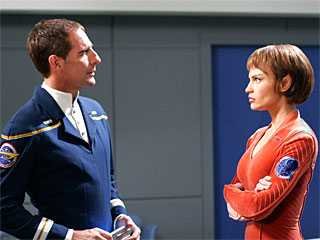
from Star Trek: Enterprise (Startrek.com) Posted by Hello

from "United" on Star Trek: Enterprise Posted by Hello
Trekcheck: The Home Stretch

After two stand-alone episodes, Enterprise completed the first of its last multi-episode arcs of the season, and of its life as a series on UPN. While fan efforts to save the series accelerate, and rumors circulate about a possible new home for another season of new stories (Spike TV, with the former head of Comedy Central as its new chief, is currently the most credible possibility), those involved in making Enterprise seem less hopeful. As reported on TrekWeb and Trek Today, during his short-lived attempt to gather support for a new Trek series with himself at the helm, J. Michael Straczynski (creator of Babylon 5) got word from "a trusted source" at Paramount that any new Star Trek series wouldn't begin for a year or two. (Rick Berman had said publicly perhaps three years.)

While episodes will air into May, production on Enterprise will cease on March 8. Paramount is hosting selected national press and other guests for the last few shooting days, both recognizing the end of an era and using the occasion to celebrate Star Trek's almost four decades of success (as well as the upcoming start of Enterprise on DVD.)

Speculation now centers on the concluding episode. At a recent convention Jonathan Frakes confirmed that he and Marina Sirtis will appear in the final episode as their TNG characters, Riker and Troi, which a Paramount spokesperson isn't disputing. TV Guide is repeating the rumor, and that magazine is likely to be as close to an authorized source as there will be for future news concerning the final episodes.

But what no one is saying yet is who else might also appear. Since Rick Berman has described the last episode as "a Valentine" to Star Trek, perhaps the story will allow for appearances by other Trek characters, from other series, including the ever-elusive appearance by William Shatner. This is sheer speculation, with no inside tip or confirmation. But remember that just because negotiations seemed to go nowhere doesn't mean he won't actually appear. After all, he's the guy who hoodwinked a town into believing he was shooting a Star Trek movie when he wasn't, for a "reality" show on Spike TV. It would seem fitting that he might appear in a Star Trek episode he's hoodwinked us into thinking he won't.

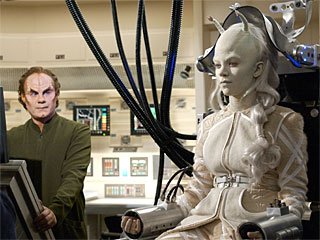
After a shaky start with "Daedelus" and the brilliance of "Observer Effect," the Andorian-Tellurite arc ("Babel One," "United" and "The Aenar") gave us some connecting Trek history, some affecting moments, good acting and character development, and a lot new about an old species, the Andorians. We see a beautiful ice planet, and meet a beautiful new sub-species, the Aenar. It seems obvious that the prominence of the Andorians in Enterprise is largely due to the character of Shran created by Jeffrey Combs (and maybe to the articulated antennae, too.) But "The Aenar" in particular opened possibilities that Enterprise might have explored further in the future, but sadly won't get the chance. However, I can picture a dozen hungry Star Trek novelists devouring this arc for future books. There was even something of a science fiction premise, the linking of virtual reality with telepathy.

After the imminent Klingon arc and Mirror universe stories, the final episodes, set on and around Earth, will deal directly with xenophobia (reacting to the foreign or alien with fear and prejudice) a theme discussed here at Soul of Star Trek as central to the first half of the season as well. In fact, xenophobia is also what will divide Trek's 21st century history into the Mirror Universe opposite of the TNG timeline in the upcoming two-part arc. (This prior post also correctly predicted that the discrepancy in Klingon appearance problem would be addressed in the Klingon arc, but now I'm not sure whether this was informed intuition or something I absorbed from Manny Coto's stream of consciousness conversation on the Paramount lot last summer.)

That xenophobia is the last theme Star Trek Enterprise will address is fitting, given Star Trek's cultural history in the forefront of proposing the astonishing idea that aliens aren't necessary evil monsters automatically bent on conquest and destruction. That whole theme started in the 1890s with H.G. Wells' novel, The War of the Worlds. But Wells tale was complex and cautionary, meant to show western civilization in the inferior position it routinely inflicted on "primitive" cultures it conquered, like the Tasmanians and the American Indians. Moreover, Wells gave the Martians a reason for their attempted conquest: their planet was growing cold and would soon be unable to support life.

But the rash of space invasion stories that followed over the next half century or so---especially on screens---quickly dispensed with complexity and rationale, and space visitors were rarely anything but grotesque marauding monsters (even if they looked more like men in ape suits wearing diving helmets) who bellowed, screeched and killed, when they weren't shooting lethal rays from their foreheads. At first, humans were shown to be good-natured but naïve in trying to make friends, but that formality was soon dispensed with, and the appearance of an alien was automatically followed by concerted attempts to kill it, as sheer common sense reflex.

Star Trek fans all know the story of the Horta, and how in one episode of the original series, the stereotype was broken. A very alien species was portrayed as acting rationally based on a value shared with humans, protecting its young and the species' future. Once understanding was achieved, a mutually beneficial solution followed.

It was an approach that Star Trek cultivated in ever more complex variations in later TV and film stories, resulting eventually in examining our prejudices concerning other species on earth (the whales in Star Trek IV: The Voyage Home) and each other (the Russians, in the guise of Klingons in Star Trek VI: The Undiscovered Country.)

This helped to open up the possibilities further explored in particular by Stanley Kubrick in 2001 and Steven Speilberg in Close Encounters of the Third Kind and E.T. The monstrous aliens soon returned of course (in the Alien series, for example), occasionally balanced by other examples of foreign wonder and alien possibility (The Abyss, Contact, Mission to Mars.)

Lately it seems the alien monster has dominated, beginning even before fear became the official response to actual violation on 9-11, and Cold Warriors morphed into neocon chicken-hawks, while waves of racism returned in more elusive, coded disguises. With two new versions of Wells' War of the Worlds about to flood movie theatres this year---the more prominent being a blockbuster by Steven Speilberg-- the cycle may even reach new heights of artificial hysteria before the circle is closed.

While these new movies shouldn't be pre-judged (for they may revive and expand on Wells' themes lost in prior adaptations), it's safe to say that it's been a rather long time since anybody, in science fiction or out, has taken a popular culture stand against xenophobia. It looks like once again it's up to Star Trek, and meeting that challenge is a fitting end.

from "The Aenar" Posted by Hello