Showing posts with label Star Trek VI: Undiscovered Country. Show all posts

Sunday, December 11, 2022

R.I.P. 2022 Star Trek Family


Star Trek lost one of its brightest stars in 2022.  I wrote about Nichelle Nichols here.


In a stellar career, British actor David Warner appeared on screen in two Star Trek movies (notably as Chancellor Gorkon in Star Trek VI) and one memorable episode of TNG.  He also appeared in a 2013 episode of Doctor Who, and as a voice actor, played roles in various Star Trek, Doctor Who (playing the Doctor) and Star Wars audio productions and games, and numerous other franchise, as well as other science fiction (especially playing Jack the Ripper in Nicholas Meyer's Time After Time) and dramatic roles.  He was an accomplished stage actor, and his 1965 Hamlet is still considered the definitive Hamlet of his generation.  

Sally Kellerman was a guest star in the second Star Trek pilot, which then became an episode in its first season, "Where No Man Has Gone Before."  She was nominated for an Academy Award for her performance in the film M*A*S*H.


Kirstie Alley played Vulcan Lt. Saavik in Star Trek II: The Wrath of Khan.  She had an Emmy-winning career on television as well as roles in feature films.


Louise Fletcher played Bajoran religious leader Kai Winn Adani in a number of later episodes of Deep Space Nine.  She won an Academy Award for her performance in One Flew Over the Cuckoo's Nest, and was nominated for two Emmy awards for her work in the TV series Picket Fences. 


Prominent movie actor and award-winning stage actor Paul Sorvino appeared in a 7th season episode of TNG, "Homeward" as Worf's brother Nikolai.


At the age of 104, Marsha Hunt was the oldest of the Star Trek actors to pass away in 2022.  After a Hollywood career beginning in the late 1930s, and a period sidelined by the Hollywood Blacklist in the 1950s, she appeared in one episode of TNG, "Too Short A Season."   

Douglas Trumbull was a pioneer genius in visual effects, adding Star Trek: The Motion Picture to his innovative work on 2001: A Space Odyssey and Close Encounters of the Third Kind, and many more.  He also directed movies, including the cult classic Silent Running.

Harold Livingston was the credited screenwriter for ST: TMP.  He had previously worked on the Star Trek: Phase Two series that was never made, in favor of the Motion Picture. Tony Dow, famous for portraying Wally Cleaver on TV, directed an episode of DS9.  Esteemed science fiction writer Greg Bear wrote a series of Star Trek novels.  Among his many novels is the s/f classic Darwin's Radio.  Veteran and multiple Emmy Award-winning director Marvin Chomsky directed a Star Trek episode.  Although he never acted in Star Trek, Ray Boyle appeared in the 1952 movie serial Zombies of the Stratosphere with Leonard Nimoy.  His many subsequent TV roles included parts in Captain Video and numerous westerns.  He was 98.
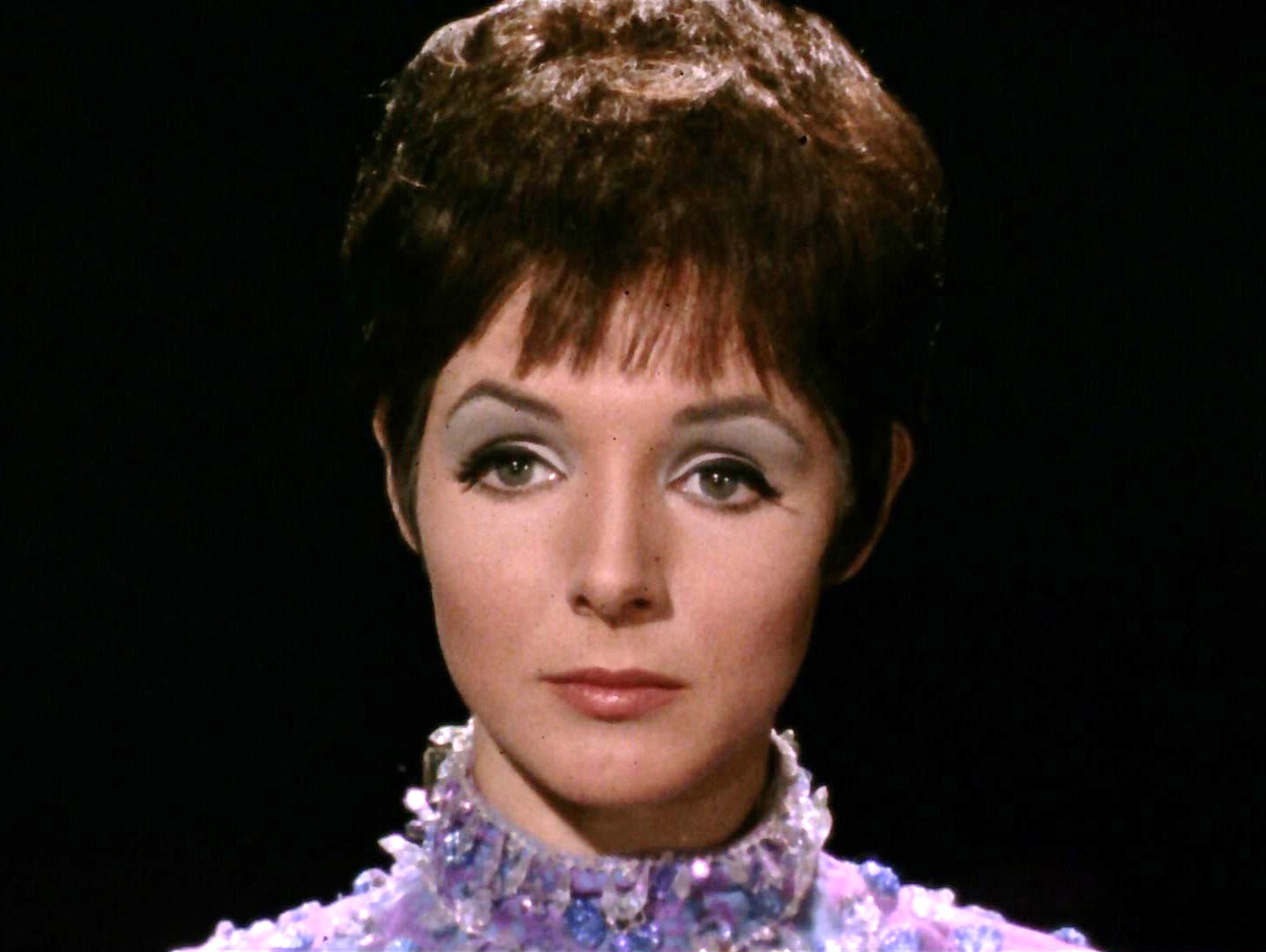
Kathyrn Hayes as "The Empath" TOS 
Among the actors and others from the Star Trek family who died in 2022: Brad William Henke, Tim McCormack, Ralph Maurer, Eric Whitmore, Laurel Goodwin, Kirk Bailey, Michael Ryan, Kathyrn Hayes, Valora Noland, Estelle Harris, Nehemiah Persoff, James Bama, David Birney, Neal Adams, Michael G. Hagerty, Marvin Hicks, Robert Brown, Fabio Passaro, Leslie Jordan, Andrew Prine, William Knight, John Aniston, Maggie Thrett,


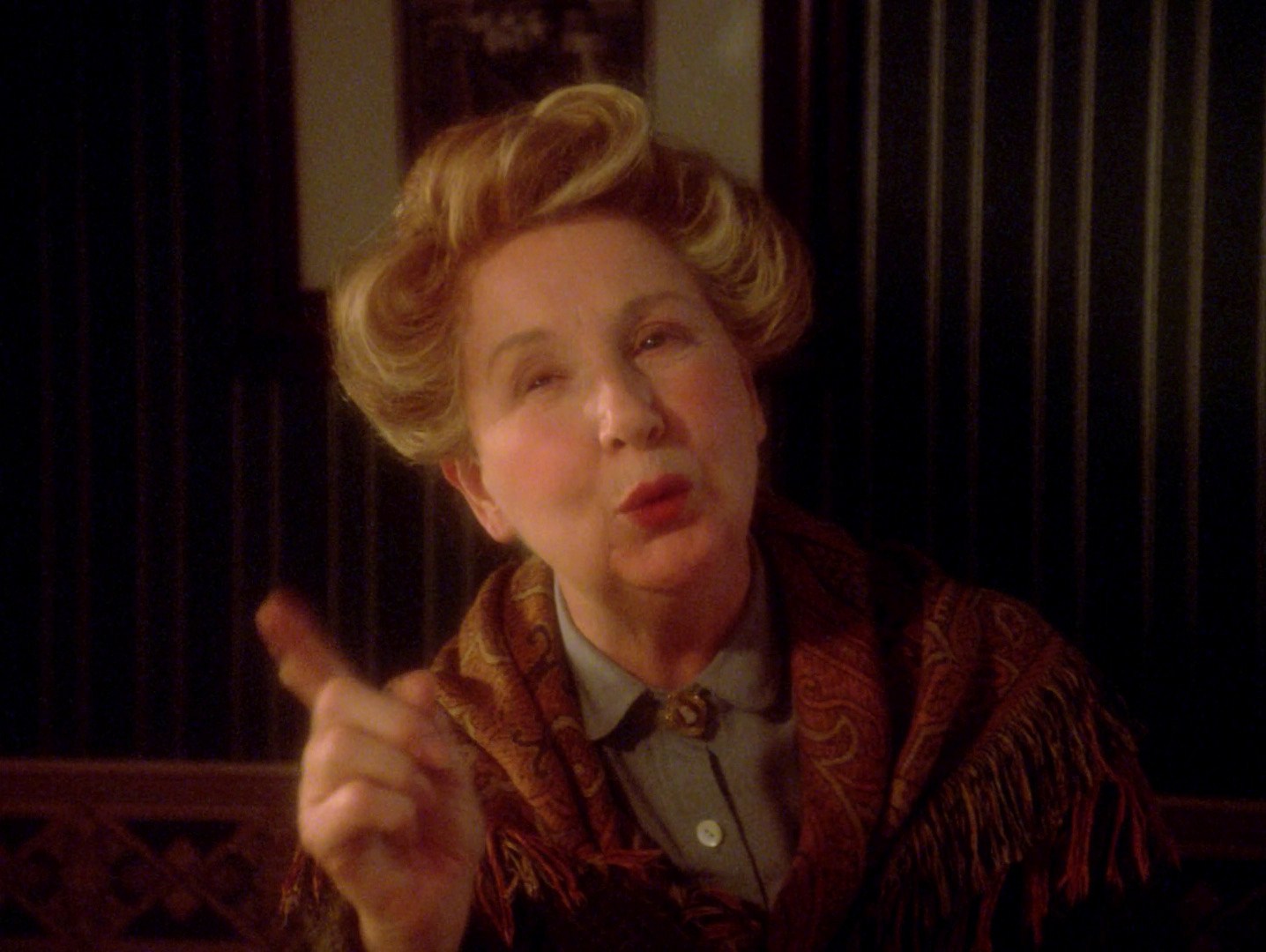
Pamela Kosh TNG
Pamela Kosh, Gary Bullock, Kenneth Welsh, George Perez, Jack Kehler, Gregory Jein, Michael Braveheart, Leon Harris, Webster Whitney, Walter Soo Hoo, Dorothy Duden, Mary Mara, Mike Reynolds, Gregory Itzin, Neil Vipond, Gene Le Bell, Wayne Grace, Amanda Mackey Johnson, visual effects artist Richard Miller.


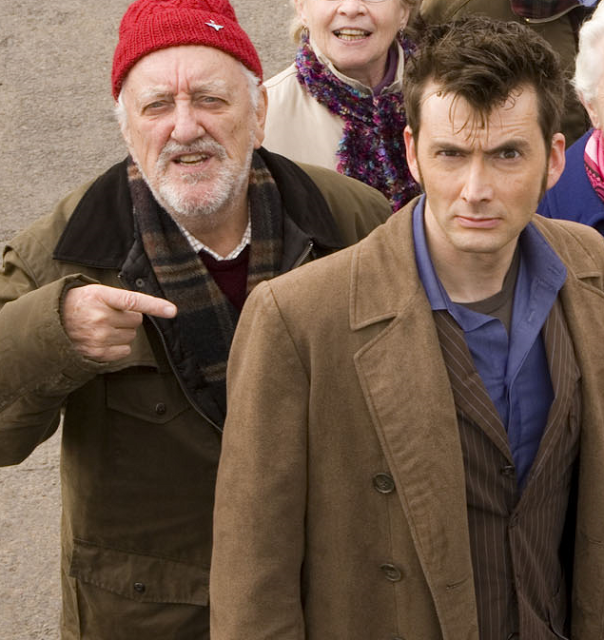
Bernard Cribbins with David Tenant

The Doctor Who family lost veteran and much beloved comic actor Bernard Cribbins, who had a featured role opposite David Tenant and Catherine Tate in series 4 and the Tenant specials, recently voted by fans as the best season of revived (21st century) Doctor Who.  Cribbins apparently reprised the part for next year's 60th anniversary season, though it's not known if his performance will appear.  He was 93.

Other members of the Doctor Who family who died in 2022 included writer Henry Lincoln (the last surviving writer of the 1960s seasons), designer Spencer Chapman, and BBC vision mixer Shirley Coward who devised the original regeneration effect.  Also actors David Warner (who not only appeared in a Matt Smith TV episode but played the Doctor in audio dramas), Jeremy Young, Ann Davies, Sonny Caldinez, June Brown, Lynda Baron, Jane Sherwin and Stewart Bevan. 

May they rest in peace.  Their work lives on.

Thursday, January 22, 2004


The final voyage of the original crew and original cast. Posted by Picasa
Star Trek VI: The Undiscovered Country

by William S. Kowinski

I’ve been slow to complete this essay on Star Trek VI: The Undiscovered Country,” because it means saying goodbye to the original crew, the original cast. Of course, movies are forever, more or less, and owning the DVD means I can revisit them at any time. But I still have to write the goodbye part, and move on.

Even though I feel great kinship with the Next Gen crew, it’s not primarily through their movies. The television episodes of the original series are indispensable--the characters were established on TV-- but for me, the original crew really blossomed in their six features plus. They acknowledged change and the aging process, and they did change. They ripened, deepened, and became legends. The way they were in the series is unforgettable, but as they are in the movies is how I remember them.

Spock announces the Klingon initiative in Star Trek VI. Posted by Picasa
“Is Star Trek dying? It’s enough to make Spock laugh.”

That how my New York Times story began in August 2004, just before what would turn out to be the last season for Enterprise. It’s in fact how my telephone interview with Leonard Nimoy began. The question my editor wanted my story to ask was precisely that: is Star Trek dying? And Nimoy not only laughed---he kept on laughing. This is his complete response to that question:

“(Laughs) This is so funny…well, Star Trek has died several times, and (laugh) and come back stronger than ever. It’s hilarious. Let me go through the history very briefly, very quickly, in a nutshell. At the end of the second season we were cancelled. There was a big letter writing campaign, asking NBC to keep the show, so NBC kept the show on for one more season. Then it was cancelled again, right? Eleven years later we made a movie, and everybody said that’s the end of Star Trek. Star Trek THE Motion Picture—it’s over. Couple years later it was revived and something like ten more movies were made. [laughs] Spock died, Spock came back [laughs] It goes on and on. [laughs] I think Star Trek is ready for another reincarnation. It’s hilarious, I can’t help but laugh.”

I was reminded of this as I reviewed the history of Star Trek VI, because not only were there uncertainties between many of the movies, within the process of this one there were several births, deaths and resurrections. It almost never happened, then almost didn’t happen, then was definitively cancelled. And at the last moment, reborn. Hilarious now---hysterical then. Even for Hollywood.

The doubt started when Star Trek V: The Final Frontier became the first Trek feature to not show a profit in its first run. So Paramount, already beset with a string of expensive failures (though Star Trek V wasn’t one of the expensive ones), dawdled until it was almost too late.

But Star Trek’s 25th anniversary was coming up in 1992, and on television TNG was sparking renewed interest in all things Star Trek. At first, executive producer Harv Bennett tried to cut costs in salaries by using new actors, and at the same time play to a younger market with a movie about Kirk and Spock in their Starfleet Academy days. Everybody in the original crew plus Gene Roddenberry were against it. (Ironically, William Shatner said he proposed such a story for the next Trek TV series after Enterprise, and in 2006 it's rumored to be the premise of Star Trek XI. )

Roddenberry knew something that Bennett apparently did not appreciate: part of the magic was in the casting, and was proven in the original cast. It was one of Roddenberry’s chief talents, and in both of the shows he cast, he found an uncommon on-screen chemistry with relatively unknown actors. (There was plenty of off-screen chemistry as well, among all the TNG crew, and two factions of the original cast: the Kirk/Spock/McCoy triumverate, and the rest of the regulars.) Of all of Roddenberry’s talents, this was the spookiest. Even actors he wasn’t crazy about at first (like Patrick Stewart) turned out to be perfect.

Besides, what was the point of celebrating a quarter century of Star Trek if you ignore the people who carried it for all that time? For whatever reason, Paramount decided to gamble on one more show for the original cast, and Harv Bennett separated himself from Star Trek for the first time since Star Trek II.

With Bennett gone, Paramount went to Leonard Nimoy (the two had problems over IV, and it could be argued that Bennett did not serve Shatner’s V well as executive producer.) Nimoy came up with the basic idea for the story. The Paramount executive in charge insisted on a particular new writing team that Nimoy found to be useless, and he went to Nicholas Meyer, the writer-director of II and co-writer (with Bennett) of IV.

Together they worked out the story, and agreed that Meyer would direct and Nimoy would executive produce. But even though time was getting short to have the picture ready for the 25th anniversary, Paramount went back to the ineffectual writing team until it was clear to everyone they had nothing. Finally the writing job was given to Nick Meyer, who was under contract to Paramount already, and his assistant, Denny Martin Flinn. There was apparently further intrigue, creating tensions between Meyer and Nimoy. But finally, there was a script, just in the nick of time (all puns intended.)

And then in an amazingly short time, the film was cancelled.

Negotiations over the budget had come down to a difference of $2.5 million, but Paramount wouldn’t budge. Nick Meyer believed in the art of working with limitations, but he also knew what he absolutely needed for a Trek picture. So Paramount decided to kill the project. But then with all hope lost, something budged Paramount: the head of the studio was replaced (with the father of the Trek movie’s co-producer and second unit director!) and apparently with one phone call, Meyer got the budget he needed. So on a very short schedule, the filming of Star Trek VI began.

The rush of the schedule may have led to more mistakes in details than usual, and the budget decreed eliminating an opening sequence, of the already retired crew being rounded up for one more mission, leading to some uncertainty at the film’s beginning about how much time had elapsed between adventures (although it may also have been killed due to objections from Gene Roddenberry and Nichelle Nichols to portraying the legendary crew as bored losers in retirement in a 23rd century society as clueless and corrupt as ours.) But it could have been much worse.

This combination of a tight budget and tight schedule could have ruined the movie but it seemed to have had the opposite effect. Stylistically Star Trek VI is the most economical of the Trek films. It moves briskly and efficiently, not a moment is wasted, yet due to skillful directing and editing, the pace is not rushed and scenes are not truncated. The acting by the guest stars is excellent: bold yet also economical.

The dialogue sounds fresh and except for the quotes from Cold War and other history (not to mention Shakespeare), even improvised. Even the stagier moments towards the end of the film (the crew carefully posing around the Federation president, the final “yearbook portrait” on the bridge) work perfectly in that spirit. There were few new sets or costumes, yet the visual effects weren’t neglected, as some were on Trek V. The original crew film series went out on a winner.

Captain Sulu: "are you kidding?" Posted by Picasa
The film opens on the starship Excelsior, Captain Sulu commanding. After years of lobbying for his character’s promotion, and even with a scene indicating it shot (by Nick Meyer) but not used for Star Trek II, George Takei wrote in his autobiography that he didn’t know about Sulu’s new status until first reading the Star Trek VI script. (He also suggests that Harv Bennett got him to sign for Star Trek V with a deal that included a raise for VI, believing that his Starfleet Academy idea would make this an empty promise. But Takei took his case to the conventions---12 in a row in three months-- and may have been instrumental in stopping Bennett’s plan. )

Excelsior is returning from a three year mission, the first indication of how much time has passed since the last adventure (based on other internal evidence, the Okudas’ timeline has it as six years later, while J.M. Dillard's novelization says ten years past.) The Excelsior is hit with an energy wave created by a mammoth explosion that has destroyed the Klingon moon Praxis, an overmined moon supplying energy to the Klingon empire. The Klingons at first deny the incident is serious and refuse Sulu’s help.

The only other familiar face on the Excelsior is Janice Rand, played by Grace Lee Whitney, now a communications officer. She and Sulu have the final exchange of the scene. “Should I report this?” she asks him. “Are you kidding?” Captain Sulu says, as only George Takei can. At last his commanding voice is given command.

Chancellor Gorkon, played by David Warner. Dinosaur
exoskeleton meets Abraham Lincoln. Posted by Picasa
Next we see the rest of the Enterprise crew (except Spock) assemble around a conference table at Starfleet headquarters. With no Paramount sound stages available, this scene was shot at a nearby church with a not very elaborate set: just the table and an opaque screen behind the dais, surrounded by darkness. But the darkness focused the tension on the table and the emotions expressed around it, and the almost abstract quality of the set placed the story in the land of otherworldly metaphor, the Star Trek equivalent of the simple and symbolic Greek stage.

It is here that the central metaphors of the movie are introduced. Gene Coon introduced the Klingons in the original series as a stand-in for the Soviets to the Federation’s U.S. and western allies, at least as far as serving the function of setting up metaphors for the ongoing Cold War, and at times, for the ongoing Vietnam war.

In the real world of 1985, Soviet Premier Gorbachev introduced various political reforms for greater openness (known as “Glasnost”), economic reforms (“Perestroika.”) and a more conciliatory foreign policy which resulted in détente with the West.

But in the late 1980s, small nations that had been absorbed into the Soviet Union some 70 years before were clamoring for independence, and satellite nations in Eastern Europe threw out Soviet occupiers and re-established their independence. This included East Germany, which then began the process of re-uniting with West Germany. They had been divided since Germany’s defeat in World War II (accomplished by the U.S. western European allies and the allied Soviet Union), but most dramatically separated by the Berlin Wall, raised in 1961 to stop the increasing flow of refugees from East to West. In 1989, even more dramatically, the Wall came down.

It was about this time that Leonard Nimoy was asked for an approach to Star Trek VI, and knowing the original series parallel of the Klingons and the Russians, he came up with a simple but dramatic concept: the Wall comes down in outer space.

This was the idea he took to Nick Meyers, and in a celebrated and, by now, much mythologized walk on the beach, they came up with the major elements of the story. The Soviet Union’s openness to the outside world was facilitated and necessitated by the world’s worst accident in a nuclear power plant ever, at Chernobyl in 1986. Refusing to acknowledge the scope of the disaster, the Soviet leadership kept outsiders out, as had been their usual practice. But radiation began showing up in the air of nearby European countries, and combined with the monumental decontamination tasks that exceeded their resources, the Soviets finally admitted the catastrophe and invited the help of other nations, including the U.S.

So that’s how Star Trek VI begins: with the explosion on Praxis that was contaminating the Klingon home world. Like the Soviets, the Klingons had bankrupted their economy on military expenditures, and needed help to survive. The Enterprise crew listens to Captain Spock, the Federation special envoy (who opened a dialogue with the Klingon chancellor Gorkon, clearly modeled after Gorbachev, at the behest of the Vulcan ambassador: his father, Sarek, who makes a brief appearance in the film.) Spock tells them that because of the Praxis radiation, the Klingons have fifty years of life left. They need Federation help to restore their planet to livable condition.

Though two Starfleet officers speak against helping the Klingons (including Captain Kirk), Starfleet’s Commander in Chief informs them that Spock has volunteered the Enterprise to escort Gorkon’s flagship to a peace conference, because Klingons who also oppose this détente will think twice about attacking the Enterprise under Kirk’s command.

After this brief meeting, Kirk and Spock are alone. Upon reflection, this scene indicates that they have not seen each other in some time. Spock had pursued the Gorkon initiative independently, and apparently had assumed he could count on Kirk’s assent. Kirk is somewhat shocked that Spock acted---and even involved him---without talking to him about it.

It is in this scene that Spock utters the first of a number of Cold War quotes, as a reason that Kirk is the right person to carry the olive branch to the Klingons. “There is an old Vulcan proverb,” Spock says. “’Only Nixon could go to China.’” This was in fact a saying inspired by President Richard Nixon’s visits to China, which established relations between the U.S. and the Communist Chinese government for the first time. Because Nixon had been such an ardent anti-Communist (resorting to smearing his opponent as “soft on Communism” to win his first political office) and Cold War supporter, it was said that his willingness to pursue the relationship gave the gesture particular credibility. (Of course, the opposite could also be argued.)

That Spock refers to this as a Vulcan proverb was the first of a series of droll jokes, playing off the penchant of the Germans and then the Russians to claim that they had really invented whatever other countries were credited with inventing. So Chancellor Gorkon refers to reading Shakespeare in the original Klingon; Spock quotes “an ancestor of mine” stating a famous premise of Sherlock Holmes--one which Data would repeat in TNG. However, some credibility for the Vulcan proverb comment was suggested by the later Trek film, Star Trek: First Contact, and the later TV series Enterprise, which established that Vulcans were present on earth from the 22nd century. It would be possible for Vulcans to take this as a proverb for themselves, though let's face it, it's still a joke.

It is also the first of a series of quotes from contemporary and historical Cold War politics: Kirk refers to “the end of history,” which was the title of a 1989 essay (later expanded into a book) that theorized that the end of the Cold War would end history itself because one side—western liberal democracy—had triumphed. (Another dubious conclusion, but a well-known one when this movie was made.) When the Federation President says “This President is not above the law" it’s a clear reference to Nixon and Watergate of the 1970s, and even when General Chang (Christopher Plummer), acting as prosecutor in the trial of Kirk and McCoy, says “don’t wait for the translation,” it’s a reference to Adlai Stevenson saying the same thing to the Soviet UN ambassador during the Cuban Missile Crisis in 1962.

General Chang played by Christopher Plummer. As an understudy,Shatner had gone on for him in a Shakespearian role in Canada. Posted by Picasa
The film also includes another set of references not belonging to the Cold War but to the internal history of the U.S., reflecting a nearly universal problem on our earth: racial prejudice. These were references to attitudes and actual popular sayings (the two Enterprise crewmen exchanged several about the Klingons in a few seconds: they all look alike, they smell, and most are mentally inferior;) that white Americans applied to African Americans.

It is a striking and daring parallel to add, characteristic of Star Trek at its best in raising issues of contemporary significance with a bit more depth. At first, racial prejudice doesn’t seem to apply to the Russians, although the country is so vast that it blurs the distinctions between white European bloodlines and Asian. (Hitler considered the Slavic peoples to be inferior to his idea of Aryans; they were to be the ultimate targets of his genocide, after he worked out the mechanics against the Jews in the Holocaust.)

But its equivalent was definitely present, even as late as the 1980s, when a television commercial purporting to show a Soviet fashion show presented old, overweight women modeling baggy military garb. This was in line with Soviet stereotypes going back to the 1950s. (Of course now, sleek Russian women are among the most fashionable icons of beauty in the world.)

Relating stereotypes of Klingons to racial prejudice is fitting, not only because Klingons were always portrayed as dark-skinned, and beginning with Michael Dorn in TNG, they would often be played by African Americans) but in terms of Star Trek’s classic treatment of aliens.

The tendency to stereotype unfamiliar and “different” peoples has been present in the U.S. since Europeans confronted Native peoples, and debated whether they had souls. Part of this tendency is motivated by fear—not only fear of the unknown, but fear of a potential or actual enemy. This is clear in the stereotyping of the Russians: they were portrayed on the one hand as backward and inferior, and on the other as inhumanly strong and powerful, men with the souls and power of robots who would kill with single-minded devotion to an ideology, completely without remorse.

When Scotty says that the Klingons don't value life "the same as we do," it's a common stereotype used for Asians, particularly in the World War II/ Korea/Vietnam era, though we hear it more now regarding Arabs.

That’s pretty much how aliens were portrayed in science fiction, especially when they were clear stand-ins for the Soviet threat in the 1950s. But even before then, space aliens were differentiated from humans by portraying them as unfamiliar ethnicities and supposed inferiors. Asian aliens were particularly popular: Emperor Ming the Merciless in Flash Gordon was low-budget obvious, but pretty much the template.

Even Leonard Nimoy was cast an alien because of his “exotic” looks, i.e. his dark hair and less than leading man features. For years he joined the other dark-haired Jews playing Italian hoodlums and dark-haired Italians playing American Indian villains. That’s how far Hollywood and “popular taste” was from infinite diversity well into the 1960s.

Eventually Star Trek would add elements of Asian architectures and cultures to the Klingons, but in a much more positive fashion. In Star Trek VI, Klingon garb (at least the costumes not leftovers from the first movies) was a bit more Asian, while Michael Westmore added beards cut in English Elizabethan style, a subtle visual support to all the Shakespearian references.

"Guess who's coming to dinner?" Posted by Picasa
Racial prejudice and stereotyping became a major theme of Star Trek VI, and now that Star Trek had a 24th century model of the future, those in the Federation who were prejudiced prefigured an arc of development to Picard’s time, when the Federation and the Klingons would be allies.

The script emphasized the universal possibility of hidden prejudices in a series of ironies in comparison to our time: racism against Klingons was first expressed in this movie by Admiral Cartwright, played by an African American actor, Brock Peters, probably best known for his portrayal of the innocent man defended by Gregory Peck in To Kill A Mockingbird, who was nevertheless convicted by a racist jury. As he says in a DVD interview, director Nick Meyer intended this resonance. (Peters, who later played Captain Sisko’s father in Deep Space Nine, had also appeared in the Preminger film version of Porgy and Bess, along with a young chorus dancer, Nichelle Nichols.)

Meyer wanted to reinforce this by having Uhura respond to Kirk’s dinner invitation to the Klingons with the title of another Hollywood film, this one about an interracial couple, “Guess who’s coming to dinner.” When Nichelle Nichols refused to say it, the line was given to Chekhov, producing a different irony---a Russian prejudiced against the Star Trek stand-ins for the Russians.

It is a worthy theme and it all works for the story, but it was seriously out of character for the Enterprise crew, as Roddenberry, Nichols and William Shatner insisted. They had gotten past this in the original series. Even after the Klingon violence in Star Trek III, at the end of V, Kirk had been rescued by a Klingon ship, and they were all drinking together. Even Kirk’s bitterness over the Klingon execution of his son seems a bit much, a decade after it happened, especially since Kirk had only known he had a son for a few weeks.

But there is some attempt at internal justification: Kirk’s prejudice against Klingons, as well as Spock’s prejudice in favor of a Vulcan, are linked to their aging, to becoming rigid, and to a weariness as their careers come to their end. In the headquarters scene, the Enterprise crew enters talking about retirement. At the end of his one-on-one with Spock afterwards, Kirk complains that the crew is scheduled to stand down in three months, and that they’ve done their bit “for king and country.” One could argue that this film replaces racism with ageism, but this is a legitimate theme, and it does pay off later.

There is another factor. When Kirk says “the Klingons have never been trustworthy,” he is speaking from experience which they’ve all shared. It’s a fact of Star Trek history that Klingons have done bad things to the Federation. This is a consequence of conflict, which inspires anger, fear and suspicion, which precipitates more conflict, until two sides are locked into an automated and apparently inescapable dynamic. Eventually each side demonizes the other, and the longer the enmity, the more extreme the demonic stereotypes.

So aliens become not just unknown, they become automatically hostile and dangerous. The ultimate prejudice is expressed by Captain Kirk: “they’re animals.” Indeed, animals were the first aliens, and the relationship of the humans to animals is a rich story too complex to reference here. But what Kirk means is animals as not human—without the kind of reason, ethical feelings and soul, that define humans. It's what some Europeans said about the Native Americans they encountered. That’s the essence of prejudice and racism among humans: it denies the Others their humanity.

Valeris is puzzled by the Chagall in Spock's quarters, depicting
the expulsion from Paradise. "All things must come to an end." Posted by Picasa
The bridge crew arrive aboard the Enterprise to begin their mission, and they meet Valeris, the young Vulcan protégé of Spock (played by Kim Catrall.)

Every Star Trek movie truly begins when the Enterprise (or its temporary substitute) gets underway, and properly ends when the Enterprise warps off on its next adventure. It’s a challenge to vary that inaugural scene, and this time there’s a variation on the first mission of the Enterprise D, when Picard tests his new first officer with a manual saucer separation. This time, Kirk tests Valeris as a helmsman with a half-impulse speed rush for the slowly opening doors inside the space dock.

It’s a short but terrific piece of film (although Valeris pilots with what is obviously a bit of audio mixing board), with a nice rush for viewers as we speed towards the doors with the swelling “Enterprise theme” of the soundtrack score, and it’s capped by an unexpected shot: Scotty looking out from engineering, wearing a big smile. It’s a memorable send-off.

Valeris appears next in two short scenes, the first in Captain Kirk’s cabin as he dictates his personal log, venting his inability to trust and forgive the Klingons, and expressing his doubts about the mission, yet already with a degree of self-awareness: “Spock says this could be an historic occasion. I’d like to believe he is right…but how can history get past people like me?”

We see Valeris standing in the doorway, kept from closing by one of Kirk’s travel bags, as one would prop open a door with one suitcase to carry in others. Her purpose there is unclear; all she does is flatter the Captain.

Then she is in Spock’s quarters, examining a Marc Chagall painting, “The Expulsion from Paradise,” a reminder to Spock that “all things end.” She begins to express an uneasiness with the proposed treaty with the Klingons, appearing to Spock’s logic as “a kindred intellect” (though from the look she gives him on the bridge to elements of this scene, there seems to be something else going on between them, even if neither admits it.) She invokes logic but Spock unexpectedly dismisses it. In fact, he succinctly expresses the outcome of his journey from the first movie forward: “Logic is the beginning of wisdom,” he insists, “not the end.”

Then Spock names her his successor on the Enterprise. Both of these scenes advance the story slightly, but their full import will come later.

Then the Klingon dignitaries come aboard, two crewmen express their prejudices, and then the famous dinner scene, where Chancellor Gorkon (David Warner) toasts to “the undiscovered country---the future,” and General Chang (Christopher Plummer) quotes Shakespeare.

We’ve seen the Federation problem with the proposed peace as prejudice at worst and suspicion at best, like the Russian proverb, “Trust, but verify,” that President Reagan loved to quote in his meetings with Gorbachev. But what about the Klingons?

Their anxiety is they will lose their identity—not only as warriors, but as a culture. It is not an unreasonable fear--ask an American Indian, or any minority, or for that matter, a Canadian subjected to the power of American popular culture and commerce. It also has a racial component, expressed by Gorkon’s daughter who snaps at Chekov’s invocation of “inalienable human rights” with mockery: “In-alien-able? If you could hear yourselves—human rights. The very name is racist. The Federation is nothing more than a Homo Sapiens-only club.” The words combine the charge of racism with the rhetoric of feminism (“men only clubs”), spoken by a Latina actor (Rosanna DeSoto) with a Canadian accent.

Kirk and Spock watch as another torpedo hits the Klingon Chancellor's ship. Posted by Picasa
Identity is a major science fiction theme. It’s in every story of characters “taken over” by an alien presence, of every society fighting for its life against alien invasion, from the first (Wells’ The War of the Worlds) to the current TV series, Brannon Braga’s “Threshold,” where the threat is to genetically alter humans to become aliens.

Ethnic, religious, cultural and racial identity are sources of wars on earth, as part of the more obvious battles over political power, land and resources and economic dominance. Technology is a source of anxiety because it threatens human and individual identity, which is perhaps sci-fi’s earliest defining theme, in Mary Shelley’s Frankenstein. It’s the ultimate threat of the Borg: “you will be assimilated.” You will lose your identity, your power of decision, your self, your soul.

Yet life is change, and lifeforms incorporate change. How they do so or fail to do so is the through-line of evolution. In our world we constantly adapt to changes wrought by technology, and now some combinations of how the powers that be and the critical mass of people decide to use it. We are subject to wrenching changes caused by economic and political shifts, wars and natural disasters, or personal illnesses and accidents, economic misfortunes or fortunes, psychological and spiritual transformation.

How we negotiate change and retain identity is one of the great dramas of life. It’s like our own bodies---every cell (or nearly every cell) dies and is replaced within a seven year span. We start as babies and our size, weight and age changes throughout life. Our experiences and what we see and hear, read and create, all change us. Yet we are the same person. Or are we? Each change outside of us may suggest this doubt about what is happening inside of us.

The subject of identity is raised at the dinner and is a theme throughout this film. But the irony is that the conspiracy that’s revealed at the end, but which is shaping the events of the whole movie, unites people with different anxieties and desires into a common identity. In opposing the peace treaty, they have made their peace with each other.

Yet the identity they have forged reflects their fears rather than their hopes. When President John Kennedy made a case for peace between the U.S. and the Soviets in 1963 (in his speech at American University---a powerful document that is as relevant today) he said, “For in the final analysis our most basic common link is that we all inhabit this planet. We all breathe the same air. We all cherish our children’s future. And we are all mortal.” (In yet another Hollywood irony, these words were given to the Russian president in the movie of Tom Clancy’s The Sum of All Fears.)

This is the common identity of peace (elements expressed in the late 1980s by Sting’s world-famous song, “Russians.”) But the Starfleet officers, Klingons and Romulans who engage in their conspiracy have in common the practice and psychology of war. Their identity depends on these conflicts.

In the Star Trek universe, the question of Klingon identity becomes a major theme in stories involving Worf, mostly in TNG but also in Deep Space 9. How Worf (played by Michael Dorn) negotiates his identity---what elements of Klingon culture he accepts, and which he rejects---takes this theme further. So it’s appropriate that Michael Dorn appears in Star Trek VI as Worf’s grandfather, defending Kirk and McCoy in their trial for the murder of Gorkon.

McCoy and Martia, played by Iman. Posted by Picasa
Two new elements were entering visual effects at the time of Star Trek VI: the beginning of computer generated imagery (CGI) and “morphing” to show transformation. This movie made good use of both. The most impressive visual effects scene—and the one that took up most of that budget---was the assassination sequence. After the disastrous dinner party, Spock calls Kirk back to the bridge because of unusual radiation outside the Enterprise, just in time to see torpedoes hit the undefended Klingon ship, apparently launched by the Enterprise.

When artificial gravity is disrupted on the Klingon ship, Star Trek’s first zero gravity scene begins. Two assassins in spacesuits and wearing gravity boots beam in, shoot phasers and draw globules of Klingon CGI blood. It’s probably the most impressive and effective action sequences using visual effects in all the Trek movies.

The assassination horrifies Kirk. He and McCoy beam over to the Klingon ship, but not before Spock claps a conspicuous black patch on his back. It turns out to be a homing device that apparently nobody else notices. Gorkon’s last words are a plea to Kirk, “don’t let it end this way, Captain.” Chang arrests Kirk and Spock and they are placed on trial on the most elaborate set made for the movie although not much of it shows up in the film.

Before the trial, there are a couple of scenes with the Federation president that make their point, but are otherwise fairly slipshod in terms of credibility and continuity. The trial itself unleashes Christopher Plummer, and both Shatner and DeForrest Kelley also acquit themselves well (although Kirk and McCoy couldn’t possibly get acquitted.)

Kirk and Bones are taken to the penal mining colony on the ice and snow planet of Rura Penthe, where they are greeted by the warden. On the DVD commentary, Nick Meyer admits that the device of the warden getting up on a box to make his speech was stolen from the 1957 David Lean classic, “The Bridge on the River Kwai.” What he doesn’t reveal is that much of the speech itself is taken directly from the Japanese warden’s “welcome” in that film.

As Kirk and Bones meet up with a helpful alien named Martia (played beautifully by the beautiful Somali model Iman, who turned in a perfect performance in this film), Spock is busy in command of the Enterprise trying to discover how Gorkon was actually assassinated.

Spock had taken command before, but never as energetically. Leonard Nimoy often says that he was able to define Spock’s character in contrast to Shatner’s Captain Kirk. As Kirk did everything with breezy speed and energy, Nimoy could give Spock a contrasting stillness and deliberateness. But both Spock and Nimoy had had difficulty when he had to command in Kirk/Shatner’s absence. However, after his five-film journey, especially his death, rebirth and second life, he was in this film both more confident and more vulnerable. The confidence showed in his command scenes. He was frequently in motion, and his words were unhesitating. This forward momentum kept this element of the story moving at the same accelerating pace as the rest of the film.

Back in the mines, Kirk articulates his own change which began at Gorkon’s assassination. It is one of those moments of self-revelation that characterize Star Trek. Kirk has realized he is prejudiced, that he denied every individual Klingon a possibility of being judged by their own actions and qualities. “It never even occurred to me to take Gorkon at his word,” he says.

But admitting his own prejudice has revealed something else to him. He understands that it involves a fear of a future different from the reigning assumptions he knows and has learned to live by. It was his own fear of the future that gave him insight into the assassins. “Don’t be too hard on yourself,’” McCoy tells him. “We all felt exactly the same way.” “No,” Kirk. “Somebody felt a lot worse.” Some of those who feared the future even more.” They are the conspirators, and Kirk is convinced they will assassinate someone else, at the peace conference.

Ecape across the ice, as the music swells Posted by Picasa