Wednesday, October 18, 2006


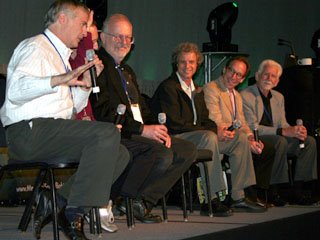
The "Show That Changed the World" panel: Drs Seth Shostak, Marc Rayman (barely visible), authors Greg Bear, Jeff Greenwald; Drs. L. Krauss, Martin Cooper. Photo from startrek.com. Posted by Picasa
THE PANELS

Just before the radio play, there was a brief montage on the screen covering the events of the Celebration. All of them featured the Star Trek stars. Though there was nothing of the many panels, they were a major part of the weekend, and I hope there were recordings of them and that they were kept, because they were often fascinating.

My panel was one of the first. Discussing “The Soul of Star Trek: The Prime Directive and Beyond” were Jeff Greenwald, author of Future Perfect: How Star Trek Conquered Planet Earth; Dave Marinaccio, author of All I really need to know I learned from watching Star Trek ; TNG writer Tracy Torme, and the aforementioned Star Trek novelists and Enterprise writers, Garfield and Judith Reeves-Stevens. (They've got several new projects and reprints--check their site at Reeves-Stevens.com.)

I frankly don’t remember much of what we all said, partly because my attention was divided by my moderator duties, and partly because I heard my fellow panelists on several other panels, and what they said on each has all blended together. I do remember we had a spirited discussion on war and peace in the Trek universe, in response to an audience question on whether Gene Roddenberry would have approved of some of the galactic war storylines, like the Dominion War in DS9.

If memory serves, Tracy Torme (who actually knew GR) thought he would have. I (who met him briefly once and was so tongue-tied by Majel Roddenberry's beauty that I barely could talk) didn’t think so. I believe that while Roddenberry accepted that there would be circumstances that required force, he knew the realities and the effects of war were so extreme and lasting that it was worth every possible effort to avoid it, and especially to find alternatives to warmaking. He knew that war was a barrier to a better future. I mentioned that in contrast to later writers, he and Gene Coon and other writers and producers for the original series had experienced the horrors of war first hand.

I think it was Jeff Greenwald who added that they had real war as a reference, but later writers had war movies---and that confirms a point I’ve made here before, and probably will again. On the other hand, Jeff noted on another panel that these same writers in their twenties and thirties had invented negotiating tactics for TNG and DS9 that the world’s politicians still haven’t figured out how to use as well. (I think it was in his book that U.S. Secretary of State Madeline Albright is quoted as praising TNG as the world’s most acclaimed model for conflict resolution.)

Jeff’s book, we both agreed, is just about the only book-length work of actual journalism on Star Trek and its impact in the world at large. These days he is the Executive Director of Ethical Traveler in Berkeley, working on human rights and environmental protection around the world. He’s a travel writer, and plays one on stage occasionally, and he looks like one. He’s got charm as well as shrewdness and intelligence, and had the knack for being in the right place at the right time during the Seattle weekend—all good qualities for a journalist to have.

He was on several panels discussing science and technology, Star Trek’s popular impact and other issues, but I was most taken with something he said about the interview he did with the Dalai Lama (A TNG fan) that seemed to have profoundly affected him. He told a story that wasn't in the chapter in his book about the encounter: in preparation for the interview, he had placed his tape recorder and notebook on a table near where the Dalai Lama would be sitting, but when the Dalai Lama entered he accidentally knocked the tape recorder to the floor. Before Jeff could move the Dalai Lama was on his hands and knees to retrieve it. Jeff tried to say he would get it but the Dalai Lama said, “No, no. Is my responsibility.”

I could see how a moment like that could change your life.

Jeff was a TNG man all the way—he did his book at the height of the Next Generation’s popularity. Dave Marinaccio is an all-out Original Series guy. He’s senior VP and Creative Director of an advertising agency in Arlington, Virginia, though there’s still a lot of Chicago in his voice and outlook. There’s a story he told I’ll get to in a minute.

Gar and Judith Reeves-Stevens were pretty much the first people I met, and by chance they were also the last—I ran into them at the airport as I was leaving, and we had a relaxing lunch there to cap the weekend. Especially for writers of such prominence they were very friendly and generous, and I enjoyed their insights and their company.

I also enjoyed meeting Greg Bear, the science fiction writer who lives in Seattle. Since returning, I’ve read his exceptional novel, Darwin’s Radio, and although I’m a little embarrassed about not having read it until now, in another way I’m glad I didn’t see it when it came out. Some of my reading since then—about evolutionary theory, the work of Lynn Margulis and others, as well as books with insights about the politics within the sciences—gave me a greater appreciation for the realism in this remarkable story.

I didn’t get to spend much time with the scientists in attendance, but again, Amy did, so her account is a good reference. I also took note that while there seemed to be an increased presence of very right wing fans on Star Trek boards over the past few years, they wouldn’t have found much support from the panels at this convention. And some discussion was overtly political, but the line was drawn from Star Trek to support for human and civil rights, environment and support for science and life-saving technology.

As for my own participation, I figure I did a fairly decent job as moderator of my one panel. On the plus side I kept about equal time for our discussion and audience questions, and I had us finish on time. The big minus was I forgot to give everyone an opportunity to mention their books or projects. I had originally planned to do that during my introduction of the panel, but it turned out we were all introduced by the Master of Ceremonies, Marc B. Lee. And then I just forgot.

As for what I said, I tried to suggest areas of discussion with my opening remarks, which were taken from my 40th anniversary essay here—they may have been the only prepared remarks for any panel. Judith later complimented me on elevating the discussion, and I immediately said, “Too much?” She gallantly said, no, but I’m not so sure. Not that I’m going to stop using the shared language of Star Trek to take me as far as it can into useful ideas for a better future. But at the Celebration, I saw again why Star Trek has been so important to many people, in very basic and very real ways.

For example, Dave Marinaccio told the story of a woman who had been abused by her stepfather, and Star Trek became her refuge. On Star Trek, people treated each other with dignity and care, which she had not experienced in real life. It was the kind of life she wanted. She met another Star Trek fan, who felt the same way. They married and had children. Star Trek gave them the model of a life, and in doing so, gave them a life. That’s a story repeated over and over.

Or the comment posted on this very blog by a reader called Brandon: “I'm a racially mixed individual--part Puerto Rican Part Irish, and I think that's part of the reason why I've developed suc a liking for Mister Spock. Moreover I've been using STAR TREK reruns as my safety valve for the last six years, escaping into a world where human beings have finally dealt with issues of racial hatred, economic inequality, and war as a first choice to every problem.”

Amy wrote about a panel moment that I also felt was mind-blowing—one to remember. There was a lively interchange on the Friday panel, “The Show That Changed the World,” but one panelist was conspicuously silent. He spoke perhaps only once, and the discussion went on, but what he said stood out like a beacon when I heard it. It was Dr. Martin Cooper, a communications technology pioneer and the father of the communicator—sorry, the cell phone. Here’s what he said, as Amy recorded it: "When I was young, the concept of being a dreamer was a very negative one. If you were a dreamer, you were useless. You didn't contribute anything to society. But Star Trek made dreaming legitimate, and I think that was a huge, huge contribution."

Most people still think dreamers are useless, and Star Trek fans even more so. So perhaps Star Trek fans dress up like aliens because they feel like aliens. They put on the Star Trek uniform because they wear it in their hearts. Star Trek may lead us to many profound insights and even to important commitments in our lives, but it is as support, model, an inspiration to creativity and even a kind of community that constitutes Star Trek’s continuing life, forty years on.

As for the future, I'll end the way I ended my opening remarks for my panel. John and Robert Kennedy adapted a line from a George Bernard Shaw play for their speeches--Robert Kennedy in particular used it to end his campaign speeches for the presidency in 1968. I adapt it once again for Star Trek's 40th anniversary: "Some see things as they are, and ask why. I see things as they may never be, and ask: why not?"
Tuesday, October 10, 2006

Site Contents

Star Trek 40th: The Seattle Convention (Sept. 2006)

WhoView: Christmas New Earth Werewolf Invasion

A Passion for the Future: The Soul of Star Trek
Countdown to 40: The Many Hands Theory of Star Trek

Trekcheck: The Continuing Adventures

Countdown to 40: Star Trek as Sci-Fi Redefined


Trekcheck: Of Rumor, Roast and SOST in Seattle
Countdown to 40: From the New to the Final Frontier

News Update
Countdown to 40: On the Final Frontier

The Trekkersphere

Trekcheck: The Future Beyond Trek XI

Action! Star Trek: Of Gods and Men filming begins

Inner Light, Outer Darkness

Who's First? First new Dr. Who season and Trek lessons

Trekcheck: Another Impossible Mission?

The Shape of Trek to Come (Trek XI)

Trek Who?

Trek XI Latest & Star Trek: The Nature of Evil

Star Trek: The Accidental Arcs

How to Know When Maybe You've Seen Too Much Star Trek

A Star Trek Carol

Light for a Cloudy Star Trek Future?

Legacy: R.I.P. Michael Piller

Looking for Star Trek, High and Low

On the Lost Star Trek Anniversary Book

Star Trek: The Inner Ape and the Enemy Within

John DeLancie Gets A Hand

Star Trek and New Orleans: Bettering Ourselves

Star Trek and New Orleans: You'd Do the Same For Me

On the Threshold

Star Trek: Dramatic Conclusions
Star Trek: A Mythology of the Future

Star Trek: Its Story and Its Soul

Star Trek: A Passion for the Future

R.I.P. James Doohan

Spielberg's War of the Worlds Reviewed

Wells and War of the Worlds Week

Cold War Cinema

Wells, Star Trek and Roddenberry
War of the Wells

The Star Trek 60s Part 1


Star Trek: Alternative Futures

Birth of An Empire (Lucas' Revenge of the Sith)

Douglas Adams Doesn't Panic
Hitchhikers Guide to the Galaxy Movie

Of Sharks and Whales: The Battle for Star Trek's Soul

Not For Boys Only
Star Trek and the Culture Wars

The Heroes of Trek

An Evening with Dan Curry, on Visual Effect and more

TrekCheck: What Was Once Imagined
TrekCheck: All Bad Things II
TrekCheck:
Mirrors
TrekCheck: All Bad Things
Trek XI News
TrekCheck:
Enterprise Home Stretch
TrekCheck: Enterprise Envoi
TrekCheck: The Trek Future
TrekCheck: The first 9 of Enterprise Season 4: starts December 14, 2004

A Vist to the Enterprise set: November 14, 2004
Snapshots from the Farewell Scotty Convention: October 16, 2004

New York Times article on Future of Star Trek: September 1, 2004

The Trekalog:
Star Trek: The Motion Picture June 27, 2004

Star Trek II: The Wrath of Khan: May 27, 2004

Star Trek III: The Search for Spock: April 27,2004

Star Trek IV: The Voyage Home March 27,2004

Star Trek V: The Final Frontier

Star Trek VI: The Undiscovered Country

note: dates of non- TrekCheck posts are locations, not always date of first posting.


Other blogs

portal: Dreaming Up Daily

the 60s: Boomer Hall of Fame

for 60s: 60's Now

on books: Books In Heat
fiction/fan fiction: Morgan Dash Unbound
political: Scorched Mirth
personal: Blue Voice

Saturday, October 07, 2006


The new Doctor and Rose Posted by Picasa

for the planet. There's even a Luke moment. Posted by Picasa
WhoView: Christmas New Earth Werewolf Invasion

We’ve had the first three of the David Tennant Doctor Who episodes on the Sci-Fi Channel here in the U.S.-- the second season of the revived series, the first with Tennant as the tenth Doctor.

Tennant appeared for about 10 seconds at the end of the final first season episode, as the Doctor regenerated from Christopher Eccleston’s ninth doctor. It was immediately clear they were going to be different, and they are.

In his first episode, the 90 minute “Christmas Invasion,” somehow the only partly regenerated Doctor gets the TARDIS to Rose’s neighborhood for Christmas. This is the first time we’ve seen a regeneration in the new Who, and some of the traditional effects of regeneration, especially the Doctor’s disorientation and loss of identity, are not only repeated but extended and made into a suspenseful part of the narrative.

In the classic Whos, the new Doctor would act a little weird, but after selecting a new wardrobe, would settle down soon enough to begin the adventure. This time, the Doctor’s weakness (he’s unconscious for a lot of the story) and Rose’s uncertainty about whether he is going to come out of it, and if he is the real (or “proper”) Doctor at all, is the B story. It leads to a couple of neat scenes where the Doctor becomes the instant hero.

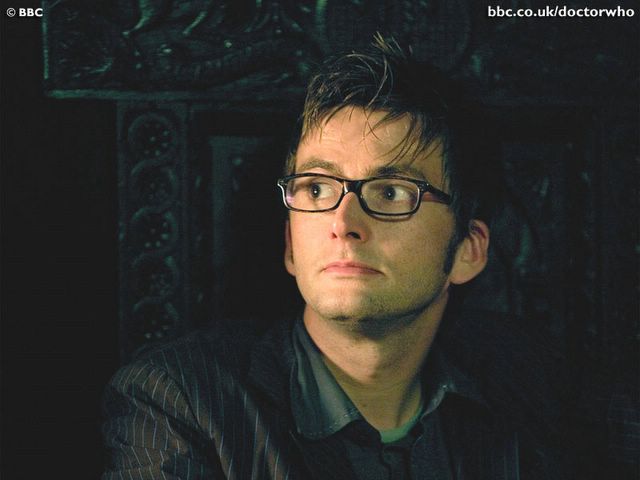
Tennant’s Doctor is more clearly heroic, as well as more the madcap Tom Baker-style, though he retains the 9th Doctor’s northern or working class accent rather than adopting the stage English that Tom Baker made famous in the role. But Tennant does have Baker’s background in Shakespeare (or more), which shows, and he is more fluid and mercurial than Eccelston. (We’re getting another major Tennant performance in the U.S. just now, when PBS begins broadcasting the acclaimed BBC “Casanova,” with Tennant and Peter O’Toole sharing the title role.)

Eccleston really grounded the new Doctor Who, and gave the character depth and mystery and melancholy as well as quirkiness and heroism. Tennant's first episodes have the Doctor flying again, but there are also echoes of the ninth Doctor in this tenth one. This is not to say one actor or one Doctor is better than the other. Eccelston's Doctor worked. So far, Tennant is off to a good start, and I look forward to more.

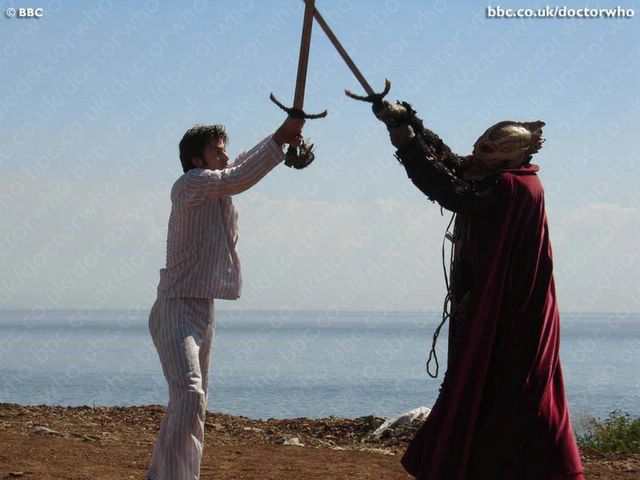
This first story involves an interstellar invasion of England at Christmas by some blustering space pirates in a very impressive space ship--Independence Day size, though looking more like enormous clumps of rock. The episode brings back Harriet Jones from the first season, now Prime Minister. In the climactic scene, the Doctor makes a dramatic entrance from the TARDIS, and champions the planet in a sword duel. The episode is full of wit, with a running joke (Jones showing her ID card and brightly announcing, “Harriet Jones, Prime Minister” after which everyone, including the space monster, replies, “Yes, I know.”) I didn’t catch a Trek reference but the Doctor—who does his derring-do in pjs and a bathrobe—mentions the similarly attired Arthur Dent, from Douglas Adams’ “Hitchhiker’s Guide to the Galaxy.” (True Whovians will recall that Adams was writing a Tom Baker Doctor Who story at the same time he was writing the original Hitchhiker script for radio.)

The story is a romp with thrills and wit, and then just as it seems to end happily, it takes a strange dark turn when Jones decides to use the secret weapon she’d had activated to destroy the defeated and retreating spaceship. This act turns the Doctor on a dime, from champion of the human race to accuser—it’s aliens that should fear humans, he says, they are the monsters. Despite the PMs sensible reasons, the Doctor uses a power unseen before in quite this way: he whispers a few words to Jones’ aide that soon results in a rumor that apparently forces her from office. It's a fairly stunning and potentially troubling display of power--arguably arbitrary, as it places the Doctor's judgment above the people who presumably should elect their leaders.

This odd mixture of stagey adventure and dark drama is physicalized when Rose, her family and the Doctor leaves a happy Christmas dinner to go outside in the falling snow, with a skyrocket-like meteor show above. But it isn’t that innocent: the meteors are pieces of the spaceship Jones destroyed, falling back to Earth, and the snow is the ash of the spaceship, and presumably of the bodies of the invaders. They were played as grotesques and somewhat comical and primitive. The Prime Minister saw them as a danger to Earth, especially if they returned to the stars to spread the word of the Earth’s riches. But the Doctor saw them as persons, as life, and his response was quick, uncompromising, and in the role of the reigning authority.

The echoes of recent geopolitics were there. At first in Jones’ refusal to cede power to the President of the U.S. (“Tell him he’s not my boss and he’s not going to start a war”) when the aliens are overhead. But then in her own behavior, versus the aliens—strange-looking, uncompromising, somewhat comical but also deadly. Not like us. Like terrorists perhaps.

The episode ends with Rose’s doubts resolved and ready to resume her journey with the Doctor. The joy of the journey is more powerful than anything else, it seems, which is its attraction and its danger.

In this final scene, the Doctor keeps referring to being a new man, wanting to see the universe with his new eyes. He had told Harriet Jones that the Earth was in a new time—they knew that aliens exist, and aliens know that earth exists. It’s a new world, he said, and then said it again with scorn after Jones destroyed the spaceship. The "new" theme will carry over to the next story.

(continued after photo)

Overlooking New New York. Really. Posted by Picasa
Everything New is Old Again?

In the next story, the first regular one-hour episode, the Doctor and Rose travel into the far future to the literal “New Earth.” It’s a period shortly after the time Rose visited in her first TARDIS journey with the 9th Doctor. Earth had been abandoned and was destroyed as the sun went nova in that story, and in this one, the far-flung human race decides to build a New Earth in a distant galaxy. (There is something of a Trek reference here, although it is really repeating a line from the old “Tom Corbett, Space Cadet” TV show, when the Doctor says they are “going further than we’ve ever gone before.” “Farther” might be the correct word, but since they are traveling in both space and time, maybe not.)

But they are soon reunited with some characters from that story, and some similar characters—instead of human-type beings speaking perfect English but evolved from trees and made of wood, here there are nurse-nuns evolved from cats. Not an extrapolation I'd make from the cats I've known, although cats are often kept in hospices and give great comfort to the dying. They seem to know who needs them, so maybe there's the potential for nursing. For nuns, is a stretch. Anyway, the great cat makeup is excuse enough.

There is an ethical dilemma at the heart of this story that should be familiar to Trek fans--artificial beings, clones in this case I believe, who are treated as experimental animals to benefit humans--the Treklike question of means and ends and what constitutes inviolable life.

There's also a chance for this Doctor to repeat the joy of the 9th when he brings people back to life (“Everybody lives!”),or in this case, cures them: he really is the Doctor this time. There’s the “last human” from that first season episode, still just eyes and a mouth on stretched skin, but this time with the ability to transfer herself into other bodies. She moves from Rose to the Doctor and back again, providing Tennant the opportunity to camp it up as having a female inside (something it’s hard to imagine Eccelston doing); before that, when Rose is possessed, she and the Doctor share a steamy kiss—though of course it doesn’t quite count as it isn’t really Rose. (Tennant is 34, about a decade younger than Eccelston, and looks even younger, so it seems the producers thought they could get away with a more sexually charged relationship between the Doctor and his companion.)

It’s an elegant episode, with the same mood of a romp and an adventure. We see some change in Rose—she’s more assured, more experienced and capable. (And so is Billie Piper, not only in some fine acting moments, but in how she plays her expressions to the camera.) But apart from personality differences and Tennant’s acting and physical presence, the writing is emphasizing a new authority for the Doctor. In this episode, reference is made to a legend about “a lonely god” who is obviously the Doctor. And the Doctor tells the errant nurses not to appeal to a higher authority than him, because there is none. Those are very striking assertions, and may indicate a new interpretation of who the Doctor is and what his role is; a new meaning for what "Time Lord" means, maybe. All in all, these new stories show that the new Doctor Who can be very entertaining and also quite edgy and a little dangerous.

[continued after photo]

Are we going for a Harry Potter look, possibly? Posted by Picasa

Sir Doctor of Tardis. Now we are not amused. Posted by Picasa
Empire of the Wolf

“Tooth and Claw” is an odd episode indeed. It starts out like a Kung Fu movie, but it’s in Scotland at the end of the 19th century. It’s a werewolf story, but it stars Queen Victoria.

As the last time the Doctor and Rose visited 19th century Earth (when they met Charles Dickens), the TARDIS is there by mistake. (They think they are going to 1979 and wind up in 1879. But Rose's description of the Doctor as a punk rocker with a touch of rockabilly is right on, especially if she means the 9th and 10th Doctors together.)

Besides the Crouching Hidden monks, there are the Queen’s guards in their red regalia, who soon keel over like the Queen’s guards in the Beatles movie, “Help!” Such topics as werewolves are sources of comedy as much as horror these days, and in this story there’s both. A very good looking CGI werewolf, too.

Tennant gets to use his Scottish accent, which is his own regular accent, and there is lots of running around and up and down in a big house. The werewolf is a bit of an alien, of course, and there are the anachronisms we’ve become accustomed to in tales of Victorian times ( Twenty Thousand Leagues Under the Sea, The League of Extraordinary Gentlemen, etc.)-- turns out, Victoria’s Albert has apparently helped construct a werewolf-destroying laser, powered partially by full moonlight. (It was a full moon here the night I saw this, actually.)

At one point when it is still in human form, the werewolf/alien tells Rose he likes this planet because it has lots of war and industry, and his goal is to seize the throne and make this the Empire of the Wolf. No one mentions it in this episode, but in the first season, the Doctor and Rose were dogged by repetition of a phrase that including the word "wolf.” (Though there is some cryptic dialogue from the werewolf man who recognizes some familiarity with wolfishness in Rose.) I thought for sure this episode would relate to that.

Eventually it might, because the implication is that Victoria might have been bitten, and the werewolf within her might emerge in the early 21st century to work on that rapacious, predatory Empire of the Wolf. (The Doctor and Rose discuss this in a lighthearted manner—the royal family as werewolves—but it also has a sinister potential.) But it turns out that this episode relates most directly to the first, the Christmas Invasion.

Like that story, there is a running gag—Rose trying to get Queen Victoria to say she is not amused. (When she finally does, she says “I” rather than the royal “we,” which is what makes the well-known expression funny and unique: “We are not amused.”) And just as the first story, everything seems happily resolved in the end, until the leader of England does something hostile. After knighting Sir Doctor of Tardis and honoring Dame Rose, she banishes them both. She considers them aliens on the side of evil, not part of “my world.” She castigates them for cavorting with stars and magic, and “think it fun.” Though she has previously spoken in favor of "imagination" she sees alien threats as beyond imagination.

At the very end, after the Doctor and Rose have gone, Victoria decides to start an institute to investigate and defend against aliens, and specifically against the Doctor. She names it after the house where the story took place, called Torchwood.

When more than a century later Harriet Jones unleashed the weapon against the aliens in the Christmas Invasion, it came from the Torchwood Institute.

The writing, the characters, the stories, the language, everything about this series is keeping me fascinated as I haven’t been since the first run of the Next Generation. I’m planning to see the first season again on DVD, and only wish I could see the second season that way now, not only for the quality and the minutes we don’t get, but to avoid the incessant promos for “Battlestar Gallactica.” They come directly after scenes so not even the fastest fast-forward move can obliterate them. And the only thing worse than hearing the same tag lines repeated so many times that they become clichés, is when they are war movie/TV clichés to begin with.

Coming Soon: this coming week (I hope), my account of the 40th anniversary Star Trek celebration in Seattle.

TARDIS in Scotland Posted by Picasa

Wednesday, September 27, 2006


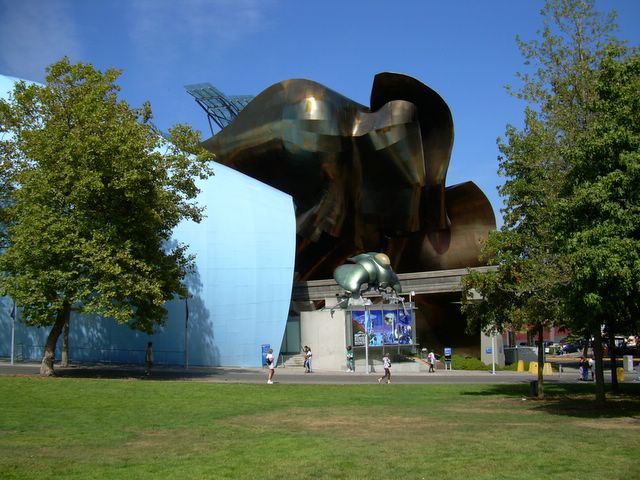
Famed architect Frank Gehry's Science Fiction Museum in Seattle. Photo: CF. Posted by Picasa
Non-Progress Report

Since I returned from the Star Trek 40th Anniversary Celebration in Seattle I've been overwhelmed with work, but that's how I hope to eventually pay for the trip. So I haven't had a chance to write about that amazing weekend, or to post anything here--but I will.

Things may lighten up for me towards mid October, though I might sneak a post in before then. Thanks to those of you who have been checking back, and catching up on old posts. I did post a lot in a short time before the 40th anniversary. So keep checking back for new posts--they're coming.

As for news, there doesn't seem to be much. This Jules Verne film festival event in Los Angeles on October 5 sounds pretty neat. I can't get too excited about the remastered TOS episodes, though it does seem from the conventions, etc. that there is still a lot of enthusiasm out there for Star Trek. But what I'm excited about is the second season of the new Dr. Who, which begins on the Sci-Fi channel Friday. I've seen clips from the UK on YouTube so I'm really looking forward to it. The new Doctor looks like he's going to be terrific.

Friday, September 08, 2006


Posted by Picasa

Posted by Picasa
A Passion for the Future: the Soul of Star Trek

By William S. Kowinski

It’s 40 years later, and it’s pretty much the same. When Star Trek’s first episode aired on September 8, 1966 (after Daniel Boone and before The Dean Martin Show on NBC), the country was in turmoil over a long and unpopular war characterized by deception, there were racial tensions in American cities, environmental doom and nuclear destruction were common fears, and television tried to ignore it all. With the patina of prosperity on the fast-paced present, most people either dismissed the future, or viewed it with fatalism.

With hundreds of hours of stories over the past 40 years, Star Trek became the planet’s best-known saga of the future. Its earnestness inspired both devotion and ridicule, but perhaps that was a risk worth taking. While most responses to its anniversary consist of sentimental fauning over phasers and Klingons, warp speed and holodecks, its lasting achievement lies in a vision of the future with guiding ideals and cautions for our real world future, that are as valid and needed now as they ever were. A few of these precepts might be summarized as follows:


1. For a better future, we must become better people. Star Trek brought together believable future technology with identifiable human behavior, but it also modeled a vision of the future where standards were higher, and struggling with ethical issues was central. "To be good," novelist Iris Murdoch suggests, "it may be necessary to imagine oneself good." Bigger challenges require that we fulfill more of our potential, or we may never get to that future.

2. The journey out is the journey in. Because Star Trek's humans had to see themselves through the eyes of the aliens they encountered, they learned to value self-examination on all levels—as individuals, groups and as humanity as a whole. Star Trek also presented technology in human terms, another crucial connection, for the importance of technology is in how it is used, and technology follows psychology. The roles of art, mortality and human relationships all became central to the voyage. "...space is not the final frontier," wrote Star Trek and science fiction writer David Gerrold. "The final frontier is the human soul."

3. Respect all life. Its conscious championing of diversity became a commitment to respecting all forms of life and civilizations, and its grappling with these ideals in specific situations became its drama. “The continuing mission of the starship Enterprise has been to take us out of the smog of fear and hate into an open space where difference is opportunity, and justice matters, and you can still see the stars," wrote Ursula LeGuin. "Violence on the Next Generation is shown as a problem, or the failure to solve a problem, never as the true solution."

4. We are not invaders-- we are explorers. When Captain Picard said these words (defining the essential meaning of what Star Trek fans know as the Prime Directive), he was announcing a profound change from most of human history, in which exploration led directly to exploitation and conquest. Science fiction writers like Ray Bradbury dramatized the repetition of this pattern on other planets, but Star Trek portrayed the implications of its reversal--and the temptations to revert. This purifies and exalts the human drive to explore and to learn, and through the exuberance of Captain Kirk, portrays exploration without exploitation as joyful fulfillment.

5. Making money is not humanity's prime directive. A future without money was sometimes played for laughs, but it is one of Star Trek's most subversive ideas: people will work to "better themselves and the rest of humanity" (in Picard's words) without being paid. Even though everyone's material needs are met (some have argued since the 60s this is entirely possible now, even without Star Trek’s technological magic), it doesn't lead to laziness but to liberation. "When you take away the need to make a living, a lot of other things are possible," said Star Trek producer Jeri Taylor. Our myth of money, which Lewis Mumford calls "the most dangerous of modern man's hallucinogens," was not present in all of our past. Sociologist Max Weber argued that the acquisition of wealth as an ethically superior motivation didn't appear until the 17th century. It doesn't need to be--and perhaps cannot be--in our future.

6. It takes many hands to make a future. How do you evoke participation, creativity necessary for change, and yet keep focus on the future? Gene Roddenberry insisted on a plausible and self-consistent imaginary Trek future, but equally important, he inspired others to creatively participate in giving life to this future. There were bruised egos and some bad behavior along the way, but also dedication, collaboration and focus on the highest common denominator.

Star Trek saw diversity as strength, and our relationship to the Other as the key to our social evolution, our new sense of ourselves necessitated by the realization that we are not alone in the universe, and the key to the efforts needed to create the future.

7. The future is an adventure. This is perhaps Star Trek's primary vision. The future isn't something to fear or to desire. It is not predetermined by fate or selfish genes. It is something we go out to meet, with heart, soul and wonder. This has always been the key to Star Trek's appeal. "Back in the 60s, most science fiction was about people who weren't on earth because they were escaping it, it was so overpopulated and polluted that people couldn't live on it, or it was a charred cinder because we'd screwed ourselves over," explained Michael Malotte, president of an international Star Trek fan organization. "Gene's Star Trek was really the first science fiction of its time to show a future where we actually learn from our mistakes. We bettered ourselves and we banded together, and we headed out for the stars. "

"What is now proved," wrote William Blake, "was once only imagin'd." For those with a passion for the future, acts of the imagination constitute the present adventure on the final frontier. If our civilization gets through the next century or so, it may be because we remembered to boldly go.

From "Amok Time" via trekcore.com. Posted by Picasa

Shatner and Nimoy at the 2006 Las Vegas con. Photo: ABC Australia. Posted by Picasa

Wednesday, September 06, 2006


Majel Barrett Roddenberry as Nurse Chapel in "Amok Time" via trekcore.com. Posted by Picasa

Like Greek drama: from "The Man Trap," first aired
September 8, 1966. Via trekcore.com Posted by Picasa
Countdown to 40: The Many Hands Theory of Star Trek

by William S. Kowinski

It is August 1966, and lost in the universe on Gene Roddenberry’s desk is a desperate memo from Bob Justman, one of Star Trek’s two associate producers. “It is important that you compose, without delay, our Standard Opening Narration for Bill Shatner to record.”

It was one of the last elements still to be finished before the first episode hit the airwaves. They had the music. When no respectable composer was interested in scoring this upstart series for a tiny, ill-equipped studio paying very little money, a musical arranger for a movie studio was hired to compose the Star Trek pilot music and, incidentally, it’s opening theme. Roddenberry worked with Alexander Courage, who adapted a Hebredean tune from the outer islands of Scotland. His opening fanfare would recur in every episode.

Then recently he and Justman had just dealt with a looming crisis concerning the visuals for this opening sequence. Namely, that after a special effects company had been promising these images for months, there weren’t any.

When he couldn’t wait any longer, Gene grabbed Justman and they stormed into the small company’s screening room and demanded to see all the shots of the starship Enterprise in action completed so far. They needed 20 just for the opening sequence.

They saw six. And those weren’t very good.

When the lights came up, they witnessed another shocking sight. The man who was in charge of creating these shots was sitting next to them, crying. “You’ll never make your air date!” he screamed, as he jumped up and ran out of the building. Like Roddenberry, Justman and everybody else connected with Trek, he had been working day and night. But the studio hadn’t allowed him the budget to hire the people he needed to complete this difficult work, which in 1966 had never even been attempted for television before.

Robert Justman was stunned, but Roddenberry just became very calm and quiet. After they sent the hysterical effects supervisor home (he wound up taking a long vacation), Roddenberry took Justman into an editing room with film of all the shots of the Enterprise they could find. There had been some created for the pilot episode that only studio executives had seen, in addition to the few new ones and fragments of others still incomplete. After several hours of splicing, assembling and refining, Justman was amazed: Roddenberry had pieced together an exciting opening sequence, right there on the Movieola machine.

Now Roddenberry had to put words to the music and the images. They would be important words. Star Trek was unlike anything audiences had seen before in prime time. Many viewers—and many television executives—thought science fiction was crazy, that space ships and aliens were kids’ stuff and would be laughed off the screen. How could you tell people what Star Trek was really all about, in under fifteen seconds?

Roddenberry’s roughed out a draft. “This is the story of the United Space Ship Enterprise,” the first began, “assigned a five year patrol of our galaxy.” But it sounded as stilted as the preamble to the U.S. Constitution. It even had the phrase “regulate commerce.” But it did contain the words, “explores strange new worlds and civilizations.”

John D. F. Black, Star Trek’s other associate producer, read it. “Think the narration needs more drama,” he suggested in his memo, and then added “an example of what I mean.” His draft began: “Space…the final frontier…endless, silent, waiting.” He then incorporate elements of Gene’s draft, adding, “to seek out and contact all alien life.” And he included the title of Sam Peeple’s script for the second pilot story, “Where No Man Has Gone Before.” “…to travel the vast galaxy where no man has gone before…a STAR TREK.”

Robert Justman tried a draft. His began, “This is the story of the Starship Enterprise” and went on to define its mission. He put together Roddenberry’s “to explore strange new worlds” with “where no man has gone before.” Then he sent all the drafts back to Roddenberry with a memo begging him to write the final script.

Gene started scribbling on Justman’s draft, then let a week go by. Justman was frantic---they were going on the air in a month, there was no more time. Roddenberry hurriedly did another draft---the final draft, since Justman grabbed it and ran across the street to the dubbing stage. He called Bill Shatner to rush over from the sound stage where he was filming Star Trek’s ninth episode. Shatner, in uniform as Captain Kirk, read through the narration a few times and recorded a take.

Justman liked his delivery but there seemed to be something missing. He asked the sound mixer to add a touch of reverberation, and Shatner declaimed it again. It was the final take. It had to be: they couldn’t afford to hold up the day’s shooting.

It is August 10, 1966. On September 8, those images and music would be seen and heard across the country, and these words:

“Space…the final frontier. These are the voyages of the Starship Enterprise. Its five year mission: to explore strange new worlds…to seek out new life and new civilizations…to boldly go where no man has gone before!.”

It would become one of the best known poems of the twentieth century.


Gene Roddenberry started it all, but Star Trek was created by many hands, not just for that first night, but for the next several decades.

In fact, GR’s greatest talent may have been as a catalyst, a synthesizer, as well as the guide. All drama is collaborative; most television is derivative, and science fiction is a kind of folk art that builds on what came before. But the Many Hands Theory of Star Trek is important also for its application to the future. We won’t get there without working together.

Star Trek’s history is replete with bruised egos and bad behavior. But creativity is often that way, especially when it is combined with business, like the big business of Hollywood. So it is even more of an achievement, and seems even more to have been fated in the stars, that Star Trek was able to model a better future, and bring America along with it.

continued after illustrations

from "Amok Time" via Trekcore.com Posted by Picasa
Infinite Diversity

The crew on the Enterprise bridge was meant to illustrate a principle about the future, and simultaneously about the present. There was the all-American Captain Kirk (played by Canadian William Shatner), and in true war movie fashion, an engineer with a Scottish brogue (James Doohan as Mongomery Scott.) But at the communications console was a young lieutenant played by Nichelle Nichols, who was becoming the first black woman with a continuing role on an American network drama series. Or as one young viewer cried to her mother, “There’s a black woman on TV and she ain’t no maid!” As both an African American and a woman, she represented two minorities most viewers would not expect to see in her position.

There was as well an Asian officer who, in contrast to most Asian men on television, wasn’t a servant or an inscrutable villain. Lieutenant Sulu (played by George Takei) was the helmsman of the starship. He didn’t speak in broken English, but in strong, rich, confident tones.

This was the future enacted on a starship, and on 1960s TV screens. Forty years later, the shock of it has to be explained.

“The show dealt with mankind’s attempt to better mankind, to be better than we were before,” said Robert Justman, associate producer. “Why should we even be here on earth if we don’t try to make things better for the next people who come along, so they can make things better.”

Symbolizing the meaning of these presences (and that of a Russian navigator later in the series) was the Enterprise science officer, called simply Mr. Spock (Leonard Nimoy.) Viewers would expect there to be weird looking space aliens on this show, but as threats and enemies that the good guys would battle and destroy. But here was a weird looking yellow-green alien with big pointy ears—second in command!

Aliens are included in this future, and suddenly on TV screens across America, in this present. This is the present of Civil Rights demonstrations, assassinations of black leaders, and riots in African American sectors of major cities during several summers, including what Henry Ford called “the greatest internal violence since the Civil War” in Detroit and Newark in 1967, with even worse rioting in Washington and other cities following the assassination of Martin Luther King, Jr., winner of the Nobel Peace Prize, in 1968. This is the present of the rise of Black Power and then of the Silent Majority, and “playing the race card” became an undercurrent in U.S. politics.

This is the present of increasing numbers of American young men sent to fight Asians and die in Vietnam and other parts of southeast Asia, bombers destroying 50 square miles of Asian land, and photos on the evening news of Asian children burned by napalm and screaming.

Star Trek’s enactment of a diverse future, as well as its eventual, powerful statements for tolerance and against reflexive violence and warfare, were not abstractions. The violence of war and intolerance was also on television throughout these years.

Nor was it an abstraction for those who brought these stories to life on Star Trek. Producer-writer Gene Roddenberry and producer-writer Gene Coon (who wrote many of Star Trek’s most important stories) were combat veterans with anti-war convictions forged in personal experience and authentic observation. James Doohan was seriously wounded on D-Day, and had to keep his disfigured hand away from the cameras.

Nichelle Nichols had been denied lodging and suffered other discrimination because of her race, and had been raped. George Takei had spent several years of his childhood in a World War II internment camp for Japanese-Americans. He was so adamant in refusing to play a servant--the usual role he and other Asian actors were offered-- that he had to support himself for awhile by actually being a servant.

Their earned conviction informed and deepened their commitment to a television show that had certain personal advantages (at this point, regular employment being the primary one) but also required great sacrifice.

There was another aspect to this diversity on display. While echoes of racial and ethnic conflict were part of the overall tension between the human crew and the alien Spock, the crew of different races and nationalities worked together smoothly, without ethnic rancor. This was unlike many previous dramas with mixed casts. The future of working together for common cause was demonstrated rather than preached.

In reality, the Star Trek cast, staff and crew had to work together to produce this unique program, which was more difficult and more necessary because of very tight budgets and therefore very little time. There was conflict (and books written about it) but in particular the actors displayed the chemistry their characters also had.

Chekhov and Sulu from "Amok Time" Trekcore.com Posted by Picasa
Intensely Human

Gene Roddenberry was the primary person involved in selecting the Star Trek team. His methods were different from what most involved had been used to in the TV industry.

“My way of casting is different,” Roddenberry said in an interview. “Actors come prepared to answer the questions they are typically asked at casting calls. Suddenly, with me, they find themselves discussing topsoil and a whole range of subjects that have nothing to do with being cast. The reason for this questioning is that I am interested in getting a feel for them as people. The way I cast is to try to learn who this actor, this person, really is. I try to find out if they fit in with my idea of the character. The answer to that may come out of anything they say — a reminiscence of their childhood, for example… What I want to know is: who is this soul I am dealing with?”

George Takei recalled enjoying his conversation with Roddenberry but since they hadn’t talked about his acting resume, he assumed he wasn’t being seriously considered for a role. Roddenberry did talk to him about the concept of the series he wanted to make, and Takei realized that he desperately wanted to be part of it.

The process of putting together his production team was much the same. Robert Justman, who began as an assistant director on the first Star Trek pilot, recounts a similar experience. “He asked me what I wanted to do with my life,” and he talked about his vision for Star Trek and the future.

Some people came away from these meetings believing Roddenberry was a genius, and most found him very warm and likeable. There’s little doubt that one of his great abilities---and accomplishments—was in bringing together the Star Trek team. Out of necessity he chose from relative unknowns---the young, the overlooked, those whose talents had been misused, or not used to their full potential. From this pool he brought together people he believed were very talented, but also those he believed would work well together, and who seemed to understand and be in sympathy with his vision. He earned their gratitude for giving them a chance---for some, it was the chance of a lifetime. But to a remarkable degree, he also inspired them.

“It was a marvellous place to work.” said music editor Robert Raff. “We worked long, hard schedules on that show…During some long nights we would pop in on Gene to have a drink with him. He had a living room suite where he stayed, writing in his office. He kept his office open to all of us.”

“I never had a problem,” recalled Al Francis, Star Trek’s director of photography. “I would go in and talk to Gene, and it was a big family. That’s the way I saw it. It was the closest relationship that I ever had while making a picture, from the producers right down to the crafts servicemen.”

“There was a very good team feeling,” said Dorothy Fontana, the script-writing secretary who later became a full time writer. “I don’t think I’ve ever encountered such a great team spirit on any other show I’ve ever worked on…The whole unity of everybody, from the top to the least important production person, was right there.”

It wasn’t all sweetness and light, but it was intensely human. The atmosphere was created partly by mutual respect and shared creativity. A good idea could come from anywhere, from a story idea to a suggestion for a shot, a single image that could convey an idea in its fullness of emotion and place in the plot, succinctly and memorably. “We were very free creatively,” said veteran director Ralph Senesky. “Everybody worked together.”

If they were to succeed in this enterprise, they almost had to. For together they were creating a universe, out of Styrofoam and baling wire, and imagination. A shiny rock John Black’s children brought home became the Dilithium Crystal that powered a starship. The budget was so tight for the third season that set and prop builders were literally sorting through the garbage for usable items from the more prosperous “Mission Impossible,” series filming next door.

Nevertheless, they transformed television. Roddenberry was creatively obsessed with the look and especially the sound on the series. Everyone was involved. Oscar Katz, a Desilu executive when the original series was being developed, said later that he attributed Star Trek’s success to its attention to detail.

No TV show had even attempted the number and complexity of Star Trek’s special effects, as old-fashioned as they may look now. The unique use of color was groundbreaking, especially since Star Trek was one of the first series to be broadcast in color—and for awhile, the most popular color show on NBC, despite its otherwise low ratings.

No TV show has generated more original music. Star Trek commissioned orchestral scores for each episode, ending the reflexive spooky sounds on weird instruments that had characterized science fiction soundtracks, and making the world safe for John Williams. Except perhaps for some early 60s movie- jazz instrumentation for part of the theme, many of these compositions have not dated and remain effective musically and dramatically.

But even the unique visual style remains striking. Some of it looks goofy, like the very obvious stunt men. But film buffs and TV pros admired the orchestration of camera shots and movements that emphasized clarity: wide establishing shots to allow the viewer’s eye to wander around among the wonders of an increasingly familiar bridge, an environment for their own fantasy lives; followed by medium shots that dramatized interaction, and close-ups for the actions and reactions that revealed character. Elegant close-ups and creative positioning of characters on the bridge in tight two and especially three shots, remain remarkable for their taste, efficiency and drama.

Since so much of Star Trek hadn’t been done before, or had to be done in new ways, creativity was part of most jobs every day. Though Roddenberry is often mentioned by name, all the producers had close and friendly contact with this relatively small group of Star Trek staff and regular contributors.

from "Doomsday Machine" via trekcore.com Posted by Picasa
A Quite Wonderful Adventure

It sometimes had odd and marvelous results. A member of the costume design staff showed producer Gene Coon a lumpy little creature he’d created with no particular purpose in mind. Coon loved it, and immediately wrote a story for it. The script was about human miners who didn’t realize the round rocks they were destroying were actually the eggs of these lumpy creatures, the Horta. It was called “Devil in the Dark” and became a landmark episode, a prime illustration of Roddenberry’s credo that “to be different is not to be ugly. To be different is not to be wrong.”

Another likely factor in this productive buzz was a shared understanding and commitment to what Star Trek represented and what it was trying to do. Not everyone could be as eloquent as music composer Gerald Fried, who said of Star Trek, “It touches something mythic, a combination of mythic values and human values, in a way that I don’t think anybody else did.” But many knew that they were part of something different, and a TV series with the unusual ambition of exploring dramatically a point of view about the human soul and its future.

A bonded, adrenalin driven creative group can work wonders when it is committed to the same enterprise, and perhaps that’s why even accidents can turn out fortuitously.

Still, the mystery remains…mysterious. Few stories in the Star Trek saga are more fantastic than the saga of how Star Trek was made, how its universe got off the page, out of the brain, and into flesh and blood, concrete and plywood, and finally, onto film. In finite time and with finite resources (and not ever enough of either), it would, over the years, climb hundreds of times onto that stage between dream and reality that is the halfway house of drama. Even if this grand vision was set into motion because two comics, Lucille O’Ball and Desi Arnaz, needed a way to channeling the overflow of revenue from I Love Lucy, and despite the fact that Lucy seemed to think that Star Trek was going to be a series about celebrities and their glamorous travels.

The mystery remains mysterious but clearly the vision and the magic are the product of many hands, working together like body and spirit, emotions and intelligence combine (according to Thomas Moore) to make soul.

In preparing their book, Inside Star Trek, Herb Solow and Robert Justman talked with many of the people who worked on Star Trek from 1964 to 1969. “ There was one overriding emotion, one common thread present in our conversations,” Solow wrote. “Even with the disappointments of impossible schedules and frazzled relationships, every one of us believed—every one of us insisted---that it was, absolutely, the best time of our lives.”

Or as film editor Fabien Tordjmann said years later, “I must say it was all quite a wonderful adventure. “

It was an adventure that drove people to distraction, and a strain that sent some to the hospital. Producers juggling scripts in process and in production, writers miffed at being rewritten, visual effects artists trying to invent strange new sights on no money, set and prop designers haunting hardware stores, sound designers spending countless hours trying to get just the right “whoosh” for a passing spaceship. And there at the center of the storm, the only people the viewers would see: the actors.

from "The Naked Time" via trekcore.com Posted by Picasa
Co-Creation

If you conceive of the Many Hands as a series of concentric circles, the innermost circle would be the principal creators: producers GR and Gene Coon, Robert Justman, along with those present in the beginning like Herb Solow and Sam Peeples; then the writers and actors, the artists and composers, the people who literally built Star Trek and kept it running.

The actors had a special place in the co-creation. Most of them in the original series and in TNG had extensive theatre experience. William Shatner’s career began when he was spotted at the Ontario Shakespeare Festival and offered a Hollywood contract. He studied and worked in New York theatre, as did George Takei. Leonard Nimoy had learned his craft in Boston and New York theatre, and studied with Jeff Corey in L.A. before teaching acting himself. James Doohan and Walter Koenig came out of Sandy Meisner’s revered Neighborhood Playhouse program. (Famed actor Joanne Woodward once publicly praised Doohan, an acting instructor at the Neighborhood Playhouse for a time, as the man who taught her everything she knows.) Nichelle Nichols had extensive stage experience in dramatic and musical theatre as well as singing and dancing (her first break in show business was dancing with the Duke Ellington Orchestra.)

This helped Star Trek tell its stories, which at times (as William Shatner said) resembled Greek drama. While this was largely the product of small budgets that didn’t allow for a lot of visual effects and action sequences, it was also the kind of story Star Trek wanted to tell.

Actors are a much maligned and misunderstood bunch, even if some are overpaid and a pain. First of all, actors in Hollywood struggle for work, and when they get it they are typecast. Since Star Trek couldn’t afford stars, and since the roles weren’t of the usual types, it took a lot of discernment and luck to find the right actors, who responded with skills their previous work may not have revealed.

For example, Leonard Nimoy, who as Spock became the stone-faced alien exemplar of logic and a paragon of quiet virtue for millions, appeared on an episode of Roddenberry’s previous series, The Lieutenant, playing an ebullient mogul, all back-slapping and big toothy smiles. Many of his earlier parts were of tough guy villains.

DeForest Kelley also had played mostly villains---some of them pretty nasty and despicable--- almost always in westerns. After casting him as a lawyer in a failed pilot, Roddenberry gave him the role that matched his childhood ambition: a doctor.

Shatner’s leading man casting was more standard, as was the later casting of young Walter Koenig as Chekov ---he’d just played a defecting Russian student in the high school series, Mr. Novak.
As a form, the TV drama series is unique. Like movies, it is the product of a complex process of activities that can seem chaotic until they are all assembled in the final product, on film. Then when combined and edited, all the scenery, props, camera angles, special and visual effects and music as well as the performances for the camera become a whole, a story that has not existed in this form before.

In television, however, there is a new movie every week, one episode after another, all year, as the series simultaneously creates, defines and responds to its identity. Like movies, the actor’s performances are shot in pieces, only more quickly, with fewer takes. So given the fragmented nature of the process, and the partial reality of effects and music that are slotted in later, for most of the time the story exists only in the heads of the participants, with guidance from what’s on the page.

The potential for confusion and entropy is compounded by how television production is organized. Producers are the executives generating and overseeing the elements of the stories. Once the script is written and the physical requirements of the story are ready, it is up to the directors, actors and technicians, and then the editors and those who add the postproduction music and effects, to bring the stories to life.

But between the functions of producers and the director, there is an odd gap. Directors in television have nothing like the power they do in feature films. Typically directors don’t even stick around for the editing. Star Trek employed some directors regularly, but at most they did a few shows a season. They had a brief preparation time and then were required to shoot to an exacting schedule that the studio enforced to the minute.

Producers had the power to make the important decisions, but they did so before and after the actual shooting. They were rarely present while the actors worked. But with directors and writers coming and going, some not entirely familiar with the show to begin with, and even producers and staff members changing suddenly, the most permanent members of the Star Trek creative team happened to be the only ones that the audience saw week after week: the actors. (Which actually wouldn’t surprise the people who still believe that actors make up the stories as they go along.)

from "Amok Time" via trekcore.com. Posted by Picasa
Creating in Action

It is one of the more fascinating characteristics of series television that the actors who play the regular cast of characters become powerfully involved in creating not just their own roles but the series itself. The power of the major stars to get the producers’ attention is not the only reason. The actors become the caretakers of their characters and ultimately of the series because they are the ones who are always there.

It’s since become expected that writers will adapt to what the actors have done with their characters, and even use elements of an actor’s own biography in the stories. But Star Trek’s actors were among the pioneers of this process. As the ones being seen, they see themselves as the most accountable and responsible. Star Trek was blessed with actors who cared deeply about their work and the integrity of Star Trek, and their contributions went far beyond saying the lines.

As it turned out, they were aided in this by their theatre training. Good theatre training involves not only the intricacies of acting but awareness of the elements of production and storytelling. It gives actors the means to analyze stories and their roles—not only for the good of their characters but for the good of the show. This is crucial in the chaos of television drama, and also in the series form, when the actors are often in the best position to see both the patterns and possibilities of character arcs and interactions, as well as the flow and pattern of the stories they are required to bring to life.

The relative power of ego versus art is debatable in the long run, but clearly both William Shatner and Leonard Nimoy thought a great deal about their characters and how the stories they were making could best be told. Shatner knew that Roddenberry had conceived of Captain Kirk as a Horatio Hornblower hero —a man of action but with flaws, and with a touch of Hamlet’s complex morality and self-doubt. He saw his function as the hero of Greek drama who is the center of the story, and therefore a focus for the audience: through identifying with him, they experience the story.

Shatner projected Captain Kirk’s exuberance and wonder, and his swagger and façade of self-confidence. From the beginning, Shatner’s performance had great energy, assurance and humor. He would say later that some other aspects of Kirk, including his occasionally odd way of speaking, were the result of fatigue.

While Shatner was a physical actor, Leonard Nimoy was more deliberative in his process, which was also most appropriate for his character. With only a few models to guide him physically (he admired the way the singer Harry Belefonte could hold an audience with his stillness, and small gestures that became significant by contrast) he thought deeply about a character that had no precedent. He had long discussions with Roddenberry about Spock (as did Nichelle Nichols about Uhura.) He toned down his portrayal in response to Shatner’s faster energy. He came up with both the Vulcan greeting and Vulcan neck pinch, as well as some key moments in defining Spock.

Shatner insisted on a table near the set where the actors could discuss that day's work, which whatever its practical value, showed a commitment to the strength of the stories. Nimoy also thought beyond his own character to the stories themselves. “Battling for dramatic integrity,” Herb Solow later wrote, “did not necessarily ingratiate him with those who were constantly rewriting scripts while fighting budgets, costs, delivery schedules, and studio policies. But Leonard performed a positive service, not only for his own character, but for the relationships of all the characters. He was the unbilled guardian of dramaturgy.”

from "Amok Time" via trekcore.com. Posted by Picasa
Participatory Dedication

But even character growth was the result of many factors and many hands. The key relationship of Kirk, Spock and McCoy had roots in a similar three-way relationship Roddenberry had created for an earlier series pilot, and he found it enabled him to replace the kind of internal dialogue a character might have in a novel with an external debate among thought, emotions and the impulse to act (or Spock, McCoy and Kirk.) But the actual relationships evolved from a few moments in an episode here and there---perhaps some business invented by a director--- that won approval from fans and producers, and that writers began emphasizing in subsequent scripts, and the actors ran with and elaborated in playing these scenes.

This kind of collaboration is not only possible in TV drama, it’s necessary. Theatre actors typically work with one character in one story for the length of a run, and move on. Television actors work their character through many stories. This changes their relationship with each other and with the other people involved in the production. Television drama requires a great deal of collaboration. Because it must be done quickly, week after week, it often rises or falls based on the quality of collaboration and the willingness of individuals to make creative contributions for the good of the whole.

This is where dedication is most important. It might be dedication to the craft, to the story, to the show (and one’s career). It might be dedication to each other, and even dedication to a vision.

When delving into achievements of power and significance it is easy enough to dwell on grand visions and great visionaries. But the shared creation and enacting of a vision is perhaps even more extraordinary, and difficult to describe. It’s much simpler to craft a story about a single artist. But not enough has been said or written about the magic and mystery of a process that blends the talents and dedication of many people over time. As co-creators of the soul of a series, they both serve and help construct the vision that they bring to life. Because they are together so intensively for so long, they often share important moments of their personal lives—the moments that shape and express their own souls. This sharing may then return to become part of the soul of their common project.

Star Trek is remarkable, if not unique, in the collaboration inspired by a vision of the future, and the sense that what the series was attempting was valuable for the world at large, as well as intriguing and interesting to do. Many participants expressed it at the time, and some who travel to conventions and write and do interviews, express it still. It is expressed also in a strange kind of transmutation. Leonard Nimoy and William Shatner admit to being changed by Star Trek, and for the better.

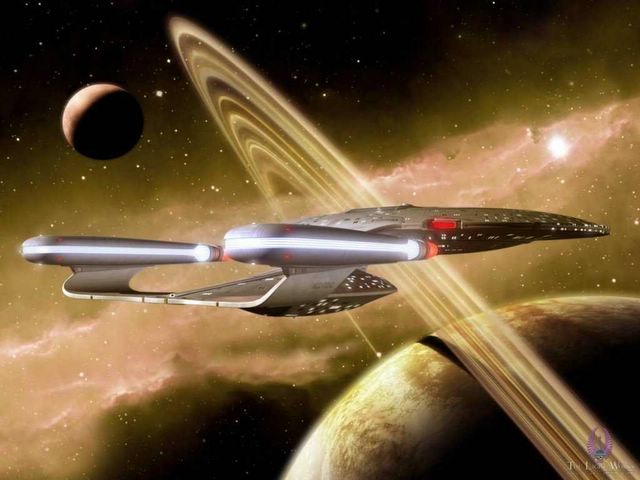
The Enterprise Posted by Picasa
Wonders That Work

There was a lot of luck involved over the years, or maybe it was “flow” or some other description of good things that happen, including coincidences, when there is creative intensity and a common dedication to an inspiring idea.

Sometimes it paid off in the inventions that necessity was the mother of, like the magical transporter, invented because it would be too expensive to land the visual and special effects Enterprise every week. So that one act of creativity (adapting an idea from earlier sci-fi) generated many others, starting with the magical lighting effects and the transporter sound, part machine-whine, part angelic music. It turned out to be the perfect combination of a plausible technology and a wondrous way to travel, akin to how we travel in dreams. Eventually the idea of patterned matter-energy transfer inspired many stories and became key to the whole Star Trek future.

Technology as magic is part of the enduring wonder of the saga, reinforced by the weekly incantation of names for these marvels that don’t exist but that you can see and hear anyway: phaser, transporter, warp, subspace, starship, as well as the non-tech but specific terms like Vulcan, Prime Directive, Federation. They are all partly tech talk and partly conjure-words. Abracadabra—energize! They are part of a self-consistent system of magic.

It was that combination that GR and associates were looking for in the look of things, especially the Enterprise. As early as 1964, Roddenberry was going through an extensive collection of pulp science fiction and fantasy magazines assembled by his friend and fellow TV writer and producer, Sam Peeples. While they chatted about the theory of relativity, quantum mechanics and the physics of space travel, Roddenberry set aside copies of Science Fiction Plus and Thrilling Wonder Stories so he could photograph their covers. Some went back to his childhood in 1931. (Bill Theis obviously got some of his ideas for draping female guest stars from these pulp covers, though his problem was less believability as wearability, an engineering problem that was likely the envy of the set.)

Eventually Roddenberry and Desilu executive Herb Solow would meet with assistant art director Matt Jeffries, who suddenly found himself no longer drafting operating tables for the medical drama Ben Casey, but was being called upon to design a 23rd century starship.
GR wanted flash but he also wanted believability. In the kind of coincidence that would recur often in Trek’s history, Matt Jeffries happened to collect material on space exploration as a hobby. He had photos and drawings from NASA and the major aircraft manufacturers. He used these as a baseline, and tried to imagine ten generations beyond them, while heading for the kind of look Roddenberry’s pulp magazine covers suggested. This starship was going to be a wonder that works.

Jeffries and his crew came up with more than 50 designs. Roddenberry would like something in one and something else in another. That would be the basis for the next set of designs. Finally Jeffries came up with the first crude model. Roddenberry turned it upside down and pronounced it the Enterprise.

from this year's Las Vegas con. photo: ABC Australia. Posted by Picasa
The Rings of Planet Star Trek

And the stories of creative dedication go on. “I’ll tell you one thing about Star Trek,” Nichelle Nichols said to writer David Gerrold. “ …everyone you worked with, the prop man, the sound men, the light men, they had a very personal attitude about that show, a very personal pride, a very personal sense of ownership. There were times when even a sound man wouldn’t let something go by---it may not have anything to do with sound---but he knew it didn’t belong on the Enterprise, so he spoke up.”

Those in that first ring of the Many Hands were principally responsible for all of those hours of Star Trek on TV and feature films. The second ring of the Many Hands planet might be the creators of Star Trek novels and games. The third ring is comprised of fans, the Trekkies and Trekkers, easily as maligned as any actor and nowhere near as well-paid, who supported Star Trek not only with their money and viewership but their enthusiasm, their feedback, their faith in what Star Trek meant to them and inspired in them, and their creativity in telling their own Star Trek stories in fan fictions, films, songs and artwork.

The outer ring is comprised of the Star Trek viewers, not as dedicated as the fans, but who sees the stories and appreciates them for what they are. At times, this circle includes millions of people, perhaps billions. They’ve been touched by Star Trek’s magic. It probably also includes those who create other stories, professionally or not, that are informed in some way by Star Trek. Its influence is so ubiquitous that most Trek references go by unconsciously.

It’s a commonplace to note how deeply Star Trek is established in popular culture, but it is not as often credited for expanding the minds of its viewers, nor for the sophisticated consciousness its viewers bring. For instance, a recent letter to the editor in the London Review of Books explained that viewers of Doctor Who and Star Trek “take convoluted plotting, metaphysical bricollage and intertextual playfulness for granted: they’re defining characteristics of the genre.” It’s not necessary here to define those advanced literary concepts, because if you watch Star Trek, you’re doing this: you’re understanding and appreciating the various levels and how they harmonize and link to each other.

Also among these Many Hands that make the Star Trek universe are the storytellers of the past who inform the Star Trek saga, and whose tales are retold and re-illuminated in its stories. Even in its first year, Star Trek took stories directly from classic novels, Hollywood films, Greek myth and Captain Video. Star Trek has done multiple versions of The Heart of Darkness and Moby Dick, including dead-on quotations from Melville in two of its best movies. Star Trek is a story of stories, a story universe. Its many hands reach across history and around the world, even as they reach out into the cosmos.

Happy birthday.