The Trekalog (so far): essays on all ten Star Trek feature films
Star Trek: The Motion Picture
Star Trek II: The Wrath of Khan
Tuesday, April 26, 2005


TrekCheck: Mirrors
After its last hiatus from broadcasting, and well after it's last day of shooting, and near the last days that visual effects and post-production staff would be putting the finishing touches on the final episodes, Star Trek: Enterprise returned with its final set of new stories.
While some viewers had recently been alerted to the show's demise and therefore its existence, those of us who had followed the corporate drama that climaxed in its cancellation, were preparing to savor these last hours. It was looking more and more that they would be the last hours of new Star Trek for quite awhile-variously estimated at 3, 5, 10, 20 years for a new TV series---and considering how some were talking, and the fact that the production staff was disbanding for the first time in 18 years, these could very well be the last new episodes of Star Trek As We Know It, ever.
There are four episodes left as I write this, and I hope to write about all six a group after I've had the chance to see them together on tape. But the experience of seeing the first two on their initial broadcast was jarring. "Bound" may have been Manny Coto's attempt to do a comedy episode; when I visited the Star Trek set last August, he mentioned that Enterprise hadn't done one yet and he seemed to want to try it. If this was that attempt, it wasn't funny. If it was not, it was worse.
Still, I was prepared to think of it as an aberration, another back-from-hiatus back luck failure, like "Daedalus", hopefully to be followed by a memorable success, like "Observer Effect." So again I had high hopes for "In A Mirror, Darkly, Part I." And personally, on first viewing, I found it an even greater and more depressing disappointment.
Rather than analyze it now, before the second part and before I've seen it again, I'll offer one comment on my first experience, and some thoughts about how Mirror Universe stories work.
The comment is that there was so much gratuitous violence, particularly torture, that I would recommend that children be kept away from this episode, and I personally was offended by it. My first impression of the episode was that it did not justify its excesses, not just in the violence on screen, but the violence it did to itself and to Star Trek.
The idea of a Mirror Universe (or MU in Internet shorthand) first appeared in the original series episode, "Mirror, Mirror." There were three episodes of DS9 that visited later versions of this universe. Apparently we are seeing earlier days of this universe. The basic difference is that the Federation of the Star Trek universe is the Empire in the MU; what was good is evil.
The difference between this story and all the other MU episodes is that we are entirely in the company of people who belong in the MU. That presents a difficulty that this Enterprise episode didn't transcend.
In the original series "Mirror, Mirror," the device that made it work dramatically, was the point of view. Kirk, McCoy, Uhura and Scotty found themselves in this MU, and they had to figure out how it worked. We saw what the mirror showed, through their eyes. We saw our Captain Kirk discover each element of this opposite place; we saw him learn its rules, and go along with them at times in order to survive, yet he risks bending or opposing them when he can.
But in the Enterprise MU we see only the characters that belong in that universe. We have no point of view to help us sort things out, and the script doesn't help much. At times, certain characters seem to feel trapped by circumstances. But others seem to revel in evil to a cartoonish degree.
If the intention was to create a nightmare world, it succeeded. But it also looked as if all the money for this episode was spent on the opening scene and opening credits, leaving the rest of the hour to a string of violent shipboard scenes. The initial effect on me was to produce disgust and impatience rather than horror. These characters aren't actually scary, as the cardboard evil characters of the original series episode still managed to be, because we have no "normal" characters to be scared for or to identify with.
I'm tempted to see this on an entirely different level. Back when he was a writer instead of a TV game show host and pitchman, Ben Stein hypothesized that at some level every Hollywood movie is about Hollywood. Maybe I'm reading too much into this, but there seemed a lot of subtext on view in this episode. The hostilities expressed so fulsomely make more sense if you consider them expressions of a cast and writing staff that has been under the gun for at least a year, and is finding out that they've been cancelled. Short of being able to get a few UPN and Paramount executives into the agonizer, they have to make do by pretending to torture each other. Maybe the cries of pain are liberating for them, since it seemed one or another of them was emitting them for most of the hour.
Maybe it was therapy. Some of the actors appear to be relishing these reversals---there were a couple of times that I was sure several of the actors were on the verge of breaking up. And maybe this was Manny Coto's audition for "24."
As Star Trek, it was troubling. Although I thought "Mirror, Mirror" worked well, I'm not a fan of the Mirror Universe concept. Breaking us into all good and all evil works if you use the allegory for insight on our own universe, where we are both. But the temptations of the MU are often too strong: everybody gets to play against type, and it's easy to get carried away.
We'll see if it makes better sense in Part II, which is the episode many fans are waiting for, when the Enterprise crew is on the bridge of a Kirk era starship, wearing those Kirk era uniforms. In the first part, some fans apparently learned more about what the pre-Federation Trek universe would have been like had humans been ruled by fear and violence, as arguably we are now. Others are satisfied with action and seeing bits of Trek lore. While critical reaction to "Bound" was almost uniformly negative, the fan reaction to this episode on the Trek Today bbs was generally either an A or a D. Apart from an intriguing title sequence, on first viewing I felt the episode was implausible, incoherent, and laced with unjustified brutality. I hope that somehow Part II will change my conclusion, but I'm less enthusiastic about watching it than I was a week ago.
After its last hiatus from broadcasting, and well after it's last day of shooting, and near the last days that visual effects and post-production staff would be putting the finishing touches on the final episodes, Star Trek: Enterprise returned with its final set of new stories.
While some viewers had recently been alerted to the show's demise and therefore its existence, those of us who had followed the corporate drama that climaxed in its cancellation, were preparing to savor these last hours. It was looking more and more that they would be the last hours of new Star Trek for quite awhile-variously estimated at 3, 5, 10, 20 years for a new TV series---and considering how some were talking, and the fact that the production staff was disbanding for the first time in 18 years, these could very well be the last new episodes of Star Trek As We Know It, ever.
There are four episodes left as I write this, and I hope to write about all six a group after I've had the chance to see them together on tape. But the experience of seeing the first two on their initial broadcast was jarring. "Bound" may have been Manny Coto's attempt to do a comedy episode; when I visited the Star Trek set last August, he mentioned that Enterprise hadn't done one yet and he seemed to want to try it. If this was that attempt, it wasn't funny. If it was not, it was worse.
Still, I was prepared to think of it as an aberration, another back-from-hiatus back luck failure, like "Daedalus", hopefully to be followed by a memorable success, like "Observer Effect." So again I had high hopes for "In A Mirror, Darkly, Part I." And personally, on first viewing, I found it an even greater and more depressing disappointment.
Rather than analyze it now, before the second part and before I've seen it again, I'll offer one comment on my first experience, and some thoughts about how Mirror Universe stories work.
The comment is that there was so much gratuitous violence, particularly torture, that I would recommend that children be kept away from this episode, and I personally was offended by it. My first impression of the episode was that it did not justify its excesses, not just in the violence on screen, but the violence it did to itself and to Star Trek.
The idea of a Mirror Universe (or MU in Internet shorthand) first appeared in the original series episode, "Mirror, Mirror." There were three episodes of DS9 that visited later versions of this universe. Apparently we are seeing earlier days of this universe. The basic difference is that the Federation of the Star Trek universe is the Empire in the MU; what was good is evil.
The difference between this story and all the other MU episodes is that we are entirely in the company of people who belong in the MU. That presents a difficulty that this Enterprise episode didn't transcend.
In the original series "Mirror, Mirror," the device that made it work dramatically, was the point of view. Kirk, McCoy, Uhura and Scotty found themselves in this MU, and they had to figure out how it worked. We saw what the mirror showed, through their eyes. We saw our Captain Kirk discover each element of this opposite place; we saw him learn its rules, and go along with them at times in order to survive, yet he risks bending or opposing them when he can.
But in the Enterprise MU we see only the characters that belong in that universe. We have no point of view to help us sort things out, and the script doesn't help much. At times, certain characters seem to feel trapped by circumstances. But others seem to revel in evil to a cartoonish degree.
If the intention was to create a nightmare world, it succeeded. But it also looked as if all the money for this episode was spent on the opening scene and opening credits, leaving the rest of the hour to a string of violent shipboard scenes. The initial effect on me was to produce disgust and impatience rather than horror. These characters aren't actually scary, as the cardboard evil characters of the original series episode still managed to be, because we have no "normal" characters to be scared for or to identify with.
I'm tempted to see this on an entirely different level. Back when he was a writer instead of a TV game show host and pitchman, Ben Stein hypothesized that at some level every Hollywood movie is about Hollywood. Maybe I'm reading too much into this, but there seemed a lot of subtext on view in this episode. The hostilities expressed so fulsomely make more sense if you consider them expressions of a cast and writing staff that has been under the gun for at least a year, and is finding out that they've been cancelled. Short of being able to get a few UPN and Paramount executives into the agonizer, they have to make do by pretending to torture each other. Maybe the cries of pain are liberating for them, since it seemed one or another of them was emitting them for most of the hour.
Maybe it was therapy. Some of the actors appear to be relishing these reversals---there were a couple of times that I was sure several of the actors were on the verge of breaking up. And maybe this was Manny Coto's audition for "24."
As Star Trek, it was troubling. Although I thought "Mirror, Mirror" worked well, I'm not a fan of the Mirror Universe concept. Breaking us into all good and all evil works if you use the allegory for insight on our own universe, where we are both. But the temptations of the MU are often too strong: everybody gets to play against type, and it's easy to get carried away.
We'll see if it makes better sense in Part II, which is the episode many fans are waiting for, when the Enterprise crew is on the bridge of a Kirk era starship, wearing those Kirk era uniforms. In the first part, some fans apparently learned more about what the pre-Federation Trek universe would have been like had humans been ruled by fear and violence, as arguably we are now. Others are satisfied with action and seeing bits of Trek lore. While critical reaction to "Bound" was almost uniformly negative, the fan reaction to this episode on the Trek Today bbs was generally either an A or a D. Apart from an intriguing title sequence, on first viewing I felt the episode was implausible, incoherent, and laced with unjustified brutality. I hope that somehow Part II will change my conclusion, but I'm less enthusiastic about watching it than I was a week ago.
Monday, April 18, 2005
Not for Boys Only
by William S. Kowinski
Apart from raw numbers, one of the reasons given for why UPN cancelled Star Trek: Enterprise was the network's desire to attract female viewers, while the audience for Enterprise was chiefly male. (This of course is after near-nudity and a new T'pol catsuit were added to attract young male viewers.) That Star Trek is a boy fan (or fanboy) thing seems to be the conventional wisdom. It's clearly the assumption made by the former Nashville Network reborn with Star Trek: The Next Generation reruns as TNN, but morphed into Spike TV, with a lineup heavy on wrestling and wrecking. Recently TNG episodes (as well as DS9) have been sliced and diced with commercials for shows featuring mayhem to satisfy the supposed need of young males for mindless violence. "We destroy, you enjoy," being the tagline. This is the latest agenda of TV: now that dumbing down everybody in general has been accomplished, the idea is to further dumb down specific demographics, until they're putty in the hands of advertisers.
Like many marketing conceits, this male-oriented Trek image is more copycat cant than science. The demographic breakdown for Enterprise was close to 60-40 male to female. Even if these numbers are vaguely accurate, that's a difference of about 10% short of equality. It hardly qualifies as a male- only dominion. Moreover the idea of a boys-only or male dominant fan base runs counter to the overall Star Trek viewership, and worst of all, it obscures how revolutionary Star Trek has been for nearly 40 years in attracting women.
The gender difference for the various Star Trek series at various times very probably amount to a wash: about as many females as males watched Star Trek. In many ways it was women fans and the original show's female audience that saved Star Trek in the first place. Star Trek was the first science fiction that attracted a sizeable female audience, and maintained it through TNG, DS9 and of course, Voyager, with Captain Kathryn Janeway.
In the beginning...
There's a great little book that's been published under several titles, one of which was "Star Trek Lives!," the "personal notes and anecdotes" of Jacqueline Lichtenberg, Sondra Marshak and Joan Winston. These three female authors never really make a point of women viewers or fans, which makes their reporting all that more convincing, for it's clear how involved women were in early Trek fandom.
It was three women (Joan Winston, Devra Langsam and Elyse Pines) who organized the first major Star Trek convention in New York City. They did it, Winston wrote, because they felt Star Trek fans were only tolerated at science fiction conventions, and if they met separately they would be no one else around to "sneer." What she doesn't say, but which is likely, is that part of the sneering might well have been because science fiction was at that point largely a male domain. Star Trek might have seemed silly to hardcore hard sci-fi fans partly because of the show, but partly because it seemed to attract girls.
But for years after those first conventions in the early 70s, Star Trek gatherings attracted more attendees than science fiction conventions. At least until Star Wars took off, Star Trek had more fans that all other science fiction combined.
Women were attracted to Star Trek, right from the start. Women may be interested in Star Trek for any or all of the same reasons that men are, and a science fiction drama series appearing on primetime TV every week made it that much more accessible. That it had continuing characters made other attractions possible, such as the sex appeal of its stars.
That this was science fiction on television with the same characters every week placed it in a more familiar TV mode than the sci-fi world. William Shatner was a classic Hollywood heartthrob, and he had his legions of female fans. But the apparent anomaly that said more about how Star Trek was different, was Spock. Women were enormously attracted to Spock. To Leonard Nimoy certainly, as he embodied Spock, but also to the character of Mr. Spock. The alien quality, the innocence of logic, the strength of principle and character, the redefinition of the classic gentleman that Nimoy consciously made essential to Spock, all redefined the masculine model, for males to emulate, and females to desire. (And vice versa, as the case may be.)
It was Star Trek's female fans that created the first fanzines and largely began the still thriving tradition of fan fiction, including homoerotic fantasies of Kirk and Spock. But sex appeal was only part of the attraction. Something else that's striking about the "Star Trek Lives!" book is how many of the most articulate fans it quotes were adult women in their 20s and 30s, educated, some in professional positions (and there weren't as many women in positions like that as there are now. For example, there were very few women television news reporters anywhere until the mid 70s.) Their interests were related to what they found attractive in Star Trek's male characters, but it went beyond that, to the essence of Star Trek's stories and universe.
The stories dealt with human emotions and behavior beyond the usual space opera or tech-heavy science fiction, while challenging conventional ideas and stimulating imagination. Star Trek portrayed a future made hopeful not only by new technologies but by new attitudes and commitments: the commitment to reason and communication, to equal opportunities, to empathetic understanding of even the weirdest-looking alien, and courage when it counted, but not reflexively expressed by violence. The presence of women on the 23rd century Enterprise bridge also provided some entry into this universe of stories that (quoting the book) "give us the experience of what it would be like to live in a world as it should and could be, among human beings as they should and could be."
These elements were even stronger in Star Trek: The Next Generation. "The continuing mission of the starship Enterprise has been to take us out of the smog of fear and hate into an open space where difference is opportunity, and justice matters, and you can still see the stars," wrote Ursula LeGuin. "Violence on the Next Generation is shown as a problem, or the failure to solve a problem, never as the true solution."
There was an even stronger female presence in the cast, reflecting in the portrayed future some changes made here since the 60s. It was with TNG that Star Trek really began establishing female role models for girls. Uhura inspired girls, especially African-American and minority girls, but it was the TNG first season presence of Denise Crosby as the security chief Tasha Yar, and especially the long-term presence of Gates McFadden as Dr. Beverly Crusher and Marina Sirtis as Counselor Deanna Troi that were so widely influential. Gates McFadden testifies to the enormous response she got from girls who wanted to be doctors and yet still be mothers, as well as women struggling with being single mothers.
DS9 provided two strong women characters with executive and otherwise equal responsibilities, and Voyager several more, including the first female engineer and female captain in the lead of a Star Trek series. TNG was criticized for its two main women characters both being in the "helping" or presumably female professions, but Marina Sirtis said something particularly interesting and apropos about that on the 7th TNG seventh season DVD. Girls get a lot of role models who are strong and aggressive, she said (and by now that's certainly true.) With Troi, she wanted to model a woman who is "strong and not aggressive," a kind of female Picard, who uses "diplomacy and tact." This is important not only for girls to see, but for boys. It was unfortunate that while women got more traditionally male roles on subsequent series, there was no male counselor on DS9 or Voyager. Psychology as an aid to self-awareness is more crucial to the Star Trek future than photon torpedoes.
Though Star Trek was largely produced, written and directed by men, several women, from Dorothy Fontana through Jeri Taylor, played key roles in each of those areas, and others. Many past and present Trek novelists are women; the novelizations of all the Trek films have been written by Vondra McIntyre and J. M. Dillard. Today two of the longest-running and best-known writers on the subject of Star Trek are Michelle Erica Green and Julia Houston. There have been and still are arguments about sexism and so on (which certain episodes, like the most recent Enterprise "Bound" especially invite) but in Trekdom there are arguments about everything. It's certainly hypocritical of UPN etc. to heavily promote Enterprise as male-oriented and even demand that the program do certain things to appeal to males, and then cancel the series because it succeeded. But what's worse about this reputation, this new conventional wisdom, and particularly the way that TNG is being positioned and promoted, is that it tends to make female viewers feel unwelcome. It distorts the nature of the saga, and devalues those qualities within all of us that are associated with the female archetype. When that happens, Star Trek loses part of its soul.
by William S. Kowinski
Apart from raw numbers, one of the reasons given for why UPN cancelled Star Trek: Enterprise was the network's desire to attract female viewers, while the audience for Enterprise was chiefly male. (This of course is after near-nudity and a new T'pol catsuit were added to attract young male viewers.) That Star Trek is a boy fan (or fanboy) thing seems to be the conventional wisdom. It's clearly the assumption made by the former Nashville Network reborn with Star Trek: The Next Generation reruns as TNN, but morphed into Spike TV, with a lineup heavy on wrestling and wrecking. Recently TNG episodes (as well as DS9) have been sliced and diced with commercials for shows featuring mayhem to satisfy the supposed need of young males for mindless violence. "We destroy, you enjoy," being the tagline. This is the latest agenda of TV: now that dumbing down everybody in general has been accomplished, the idea is to further dumb down specific demographics, until they're putty in the hands of advertisers.
Like many marketing conceits, this male-oriented Trek image is more copycat cant than science. The demographic breakdown for Enterprise was close to 60-40 male to female. Even if these numbers are vaguely accurate, that's a difference of about 10% short of equality. It hardly qualifies as a male- only dominion. Moreover the idea of a boys-only or male dominant fan base runs counter to the overall Star Trek viewership, and worst of all, it obscures how revolutionary Star Trek has been for nearly 40 years in attracting women.
The gender difference for the various Star Trek series at various times very probably amount to a wash: about as many females as males watched Star Trek. In many ways it was women fans and the original show's female audience that saved Star Trek in the first place. Star Trek was the first science fiction that attracted a sizeable female audience, and maintained it through TNG, DS9 and of course, Voyager, with Captain Kathryn Janeway.
In the beginning...
There's a great little book that's been published under several titles, one of which was "Star Trek Lives!," the "personal notes and anecdotes" of Jacqueline Lichtenberg, Sondra Marshak and Joan Winston. These three female authors never really make a point of women viewers or fans, which makes their reporting all that more convincing, for it's clear how involved women were in early Trek fandom.
It was three women (Joan Winston, Devra Langsam and Elyse Pines) who organized the first major Star Trek convention in New York City. They did it, Winston wrote, because they felt Star Trek fans were only tolerated at science fiction conventions, and if they met separately they would be no one else around to "sneer." What she doesn't say, but which is likely, is that part of the sneering might well have been because science fiction was at that point largely a male domain. Star Trek might have seemed silly to hardcore hard sci-fi fans partly because of the show, but partly because it seemed to attract girls.
But for years after those first conventions in the early 70s, Star Trek gatherings attracted more attendees than science fiction conventions. At least until Star Wars took off, Star Trek had more fans that all other science fiction combined.
Women were attracted to Star Trek, right from the start. Women may be interested in Star Trek for any or all of the same reasons that men are, and a science fiction drama series appearing on primetime TV every week made it that much more accessible. That it had continuing characters made other attractions possible, such as the sex appeal of its stars.
That this was science fiction on television with the same characters every week placed it in a more familiar TV mode than the sci-fi world. William Shatner was a classic Hollywood heartthrob, and he had his legions of female fans. But the apparent anomaly that said more about how Star Trek was different, was Spock. Women were enormously attracted to Spock. To Leonard Nimoy certainly, as he embodied Spock, but also to the character of Mr. Spock. The alien quality, the innocence of logic, the strength of principle and character, the redefinition of the classic gentleman that Nimoy consciously made essential to Spock, all redefined the masculine model, for males to emulate, and females to desire. (And vice versa, as the case may be.)
It was Star Trek's female fans that created the first fanzines and largely began the still thriving tradition of fan fiction, including homoerotic fantasies of Kirk and Spock. But sex appeal was only part of the attraction. Something else that's striking about the "Star Trek Lives!" book is how many of the most articulate fans it quotes were adult women in their 20s and 30s, educated, some in professional positions (and there weren't as many women in positions like that as there are now. For example, there were very few women television news reporters anywhere until the mid 70s.) Their interests were related to what they found attractive in Star Trek's male characters, but it went beyond that, to the essence of Star Trek's stories and universe.
The stories dealt with human emotions and behavior beyond the usual space opera or tech-heavy science fiction, while challenging conventional ideas and stimulating imagination. Star Trek portrayed a future made hopeful not only by new technologies but by new attitudes and commitments: the commitment to reason and communication, to equal opportunities, to empathetic understanding of even the weirdest-looking alien, and courage when it counted, but not reflexively expressed by violence. The presence of women on the 23rd century Enterprise bridge also provided some entry into this universe of stories that (quoting the book) "give us the experience of what it would be like to live in a world as it should and could be, among human beings as they should and could be."
These elements were even stronger in Star Trek: The Next Generation. "The continuing mission of the starship Enterprise has been to take us out of the smog of fear and hate into an open space where difference is opportunity, and justice matters, and you can still see the stars," wrote Ursula LeGuin. "Violence on the Next Generation is shown as a problem, or the failure to solve a problem, never as the true solution."
There was an even stronger female presence in the cast, reflecting in the portrayed future some changes made here since the 60s. It was with TNG that Star Trek really began establishing female role models for girls. Uhura inspired girls, especially African-American and minority girls, but it was the TNG first season presence of Denise Crosby as the security chief Tasha Yar, and especially the long-term presence of Gates McFadden as Dr. Beverly Crusher and Marina Sirtis as Counselor Deanna Troi that were so widely influential. Gates McFadden testifies to the enormous response she got from girls who wanted to be doctors and yet still be mothers, as well as women struggling with being single mothers.
DS9 provided two strong women characters with executive and otherwise equal responsibilities, and Voyager several more, including the first female engineer and female captain in the lead of a Star Trek series. TNG was criticized for its two main women characters both being in the "helping" or presumably female professions, but Marina Sirtis said something particularly interesting and apropos about that on the 7th TNG seventh season DVD. Girls get a lot of role models who are strong and aggressive, she said (and by now that's certainly true.) With Troi, she wanted to model a woman who is "strong and not aggressive," a kind of female Picard, who uses "diplomacy and tact." This is important not only for girls to see, but for boys. It was unfortunate that while women got more traditionally male roles on subsequent series, there was no male counselor on DS9 or Voyager. Psychology as an aid to self-awareness is more crucial to the Star Trek future than photon torpedoes.
Though Star Trek was largely produced, written and directed by men, several women, from Dorothy Fontana through Jeri Taylor, played key roles in each of those areas, and others. Many past and present Trek novelists are women; the novelizations of all the Trek films have been written by Vondra McIntyre and J. M. Dillard. Today two of the longest-running and best-known writers on the subject of Star Trek are Michelle Erica Green and Julia Houston. There have been and still are arguments about sexism and so on (which certain episodes, like the most recent Enterprise "Bound" especially invite) but in Trekdom there are arguments about everything. It's certainly hypocritical of UPN etc. to heavily promote Enterprise as male-oriented and even demand that the program do certain things to appeal to males, and then cancel the series because it succeeded. But what's worse about this reputation, this new conventional wisdom, and particularly the way that TNG is being positioned and promoted, is that it tends to make female viewers feel unwelcome. It distorts the nature of the saga, and devalues those qualities within all of us that are associated with the female archetype. When that happens, Star Trek loses part of its soul.
Monday, April 11, 2005


Of Sharks and Whales: The Battle for Star Trek's Soul
by William S. Kowinski
The blood is in the water, and the sharks are circling. Star Trek:Enterprise has been ignominiously cancelled, and Star Trek has been shut down.
But Sci Fi Channel's "Battlestar Galactica" is a hit, at least in cable terms, anchoring the Friday night lineup that contributed to sinking the rescheduled "Enterprise." So it's natural that some of the sharks come from those waters. Two former DS9 writers who few seem to have heard of before, Bradley Thompson and David Weddle, now write for BSG, and gave an interview about how much they learned from working on a Trek series, and how glad they aren't doing that anymore. Because now they can "bring sci fi back into the realm of a place that might actually exist, with people like us in it."
To be fair, this is just one line in a long interview. And others are saying similar things. Even Rick Berman expressed doubts in his February interview with TV Week: "We made a great effort to keep Roddenberry's vision of the future in mind. Has that attitude played itself out? It could very well be true." And it was this BSG's creator and former Trek writer, Ronald Moore who said in the same article that Trek doesn't need to become BSG, that it can remain a hopeful vision of the future.
But we are in dangerous waters right now. Everything about Star Trek is seemingly vulnerable. So this is the time to be as clear as possible about what we believe Star Trek is, so that its next incarnation is not simply as another space-based action series trading on the Star Trek name.
The line of attack represented by the Thompson & Weedle statements is familiar, and has been uttered in various ways by other former Trek writers and producers: the people in Roddenberry's future were too "perfect." They weren't like us.
It seemed to me that a lot of DS9 reflected this view. But it always puzzled me. Especially since this complaint seemed to come from people who understood that this is precisely what Star Trek is about, and in fact wrote great scenes illustrating it: It is about how people change, not just how technology changes. And about how the future cannot be better unless we do change.
As people with an interest in the future, who perhaps have or look forward to having children and grandchildren, I assume they are interested in promoting that future. But they are also TV writers.
So let's take a closer look at that sentence, because it reflects one particularly seductive line of thinking. The writers in question have been liberated to "bring sci fi back into the realm of a place that might actually exist, with people like us in it."
Who are these "people like us?" They are people with raw passions, who kill out of fear and hatred, who betray one another from jealousy and envy and greed. They lie, double-deal and double-cross, and seem to enjoy it. No doubt there are people like that, and that these are all human emotions and human behaviors. We are probably all pretty familiar with betrayal, and have seen or experienced some dirty deeds based on any number of the seven deadly sins.
But there are several relevant points here. And the first and most obvious to me is: mostly they aren't actually talking about "people like us." Most people don't behave that way, on that scale. They are talking about people like the people you usually see on television action shows, and in action movies. They are people who act violently whenever possible. And it is usually very possible, because somebody just dripping with evil is inevitably attacking somebody who is violently good. They're involved in non-stop violence on "24." People like us don't actually kill that many people before dinner.
And even among the good guys on most TV and in movies, there are violent arguments, violent jealousies, outsized greed and incomparable betrayal. All passions are uncontrollable, and all emotions and certainly all conflicts are acted out. The truth is, we aren't any more like these people than we are like Captain Picard or Dr. Phlox.
Moreover, the basic conflict is always a fight for survival, involving a fight to the death, and it is so intense that it couldn't possibly be slowed down for much in the way of variation, and certainly not evaluation or second thoughts, except the tortured kind, under incredible pressures that are stacked so they lead to the same conclusion: us or them.
Yes, it turns out that these kind of "people like us" are a lot easier to write for. They practically write themselves.
In fact these perfectly violent, often one-dimensional characters are no more real than the "perfect" crew of the starship Enterprise (and incidentally, they weren't ever really perfect, in any century.)
But even if the characters are more complicated, more dimensional, what's the point? Every war story is basically the same. How many repetitions of it do we need? Many of the emotions of war are endemic to the situation; the challenge is to not get into the situation, or to handle it differently, to handle yourself differently.
But war and violence are gripping. They go past our thinking brains to fight-or-flight responses, to visceral reactions. Sure, that's part of life, and storytelling. But it's not all of it. And more to the point, it's the easiest to write, and the easiest to evoke a guaranteed response. People will watch, because some survival instinct has been engaged. Glands call to glands.
I am not describing characters specifically in BSG, which I haven't yet seen much of. I am drawing a contrast that may be exaggerated but is quite functional.
These writers want to "bring sci-fi back to a place that might actually exist." A very interesting proposition. First, there's the apparent contradiction of sci-fi and realism. It's not really a contradiction, but this does suggest something that is true: a lot of sci-fi creates plausible worlds in order to test a proposition, an idea. It doesn't matter if H.G. Wells' time machine could exist in 1890; what matters is the story he told about a very unlikely future that made enormously rich metaphorical sense. So a place that might actually exist is not necessarily a virtue in science fiction. If it's too close to the present, what's the point? It's just a costume drama, where the costumes excuse the implausible.
But what constitutes a future that might actually exist? Is it necessarily a future in which everything changes except us? Hasn't anything about human thought, feeling and behavior changed? To believe it hasn't is to be enormously shortsighted. We have examples within our own lifetimes. To think that people of a hundred, five hundred, a thousand years ago are pretty much just like us, may be an understandable Hollywood convention, but it's more than just unlikely. If you believe it, you probably believe that ancient Romans all had British accents.
A little study of indigenous peoples, either from anthropological work or through living descendants today, will illuminate you: "people like us" then were very different in very important ways from "people like us" now. And that's just if you mean "people like us" in urban North America, or the cities of the West.
Of course, much human behavior seems stuck in the same repeating and often self-destructive patterns. It's depressing, and it makes people cynical. But those aren't the only possible reactions.
For a much more salient point is this: if people of that recognizable future are too much "just like us," we are unlikely to have a future at all. Which a lot of people were saying in particular in the 1960s, and one of them was Gene Roddenberry.
Star Trek began in the shadow of thermonuclear holocaust, and despite more novel problems, we aren't out of that shadow yet. Some experts believe we are more in danger of accidental nuclear attack now than in the Cold War. There are STILL more than enough nuclear warheads on working missiles to destroy civilization in a matter of hours.
And that isn't even our biggest threat anymore. Assuming we manage to not set off a nuclear Armageddon, we are in the very early stages of a climate crisis which will challenge human civilization for at least the next century, and especially if we continue ignoring it, it could end life as we know it on this planet.
All we have to do is keep on being "people like us."
The people like us many of these characters are like, are soldiers, in an exceedingly artificial (though all too common) situation called modern warfare. It was a situation a lot of us were supposed to naturally become part of in the Vietnam era, because (everything told us) we had no choice. Those were enemies and they were evil. But it was a situation that people involved in Star Trek, including actual veterans like Roddenberry, wanted to portray alternatives to.
I am continually impressed and inspired by how many people articulate the basic Star Trek vision with such clarity, variety and even poetry. An amazing proportion of the people who worked on Trek can do it, even if they wrote some music once or acted in a single movie. But fans often are eloquent on the subject, too. The most appropriate statement that comes to mind right now is something Mike Malotte, Commander of Starfleet (or president of the International Star Trek Fan Association) said to me in a phone interview last summer: "Gene's Star Trek was really the first science fiction show of its time that showed a future where we actually learn from our mistakes, and we bettered ourselves, and we banded together and we headed out for the stars..."
What Star Trek is largely about---what it embodies, what it models, what it is-- is the process of how we learn, how we become better.
[more text after photo]
by William S. Kowinski
The blood is in the water, and the sharks are circling. Star Trek:Enterprise has been ignominiously cancelled, and Star Trek has been shut down.
But Sci Fi Channel's "Battlestar Galactica" is a hit, at least in cable terms, anchoring the Friday night lineup that contributed to sinking the rescheduled "Enterprise." So it's natural that some of the sharks come from those waters. Two former DS9 writers who few seem to have heard of before, Bradley Thompson and David Weddle, now write for BSG, and gave an interview about how much they learned from working on a Trek series, and how glad they aren't doing that anymore. Because now they can "bring sci fi back into the realm of a place that might actually exist, with people like us in it."
To be fair, this is just one line in a long interview. And others are saying similar things. Even Rick Berman expressed doubts in his February interview with TV Week: "We made a great effort to keep Roddenberry's vision of the future in mind. Has that attitude played itself out? It could very well be true." And it was this BSG's creator and former Trek writer, Ronald Moore who said in the same article that Trek doesn't need to become BSG, that it can remain a hopeful vision of the future.
But we are in dangerous waters right now. Everything about Star Trek is seemingly vulnerable. So this is the time to be as clear as possible about what we believe Star Trek is, so that its next incarnation is not simply as another space-based action series trading on the Star Trek name.
The line of attack represented by the Thompson & Weedle statements is familiar, and has been uttered in various ways by other former Trek writers and producers: the people in Roddenberry's future were too "perfect." They weren't like us.
It seemed to me that a lot of DS9 reflected this view. But it always puzzled me. Especially since this complaint seemed to come from people who understood that this is precisely what Star Trek is about, and in fact wrote great scenes illustrating it: It is about how people change, not just how technology changes. And about how the future cannot be better unless we do change.
As people with an interest in the future, who perhaps have or look forward to having children and grandchildren, I assume they are interested in promoting that future. But they are also TV writers.
So let's take a closer look at that sentence, because it reflects one particularly seductive line of thinking. The writers in question have been liberated to "bring sci fi back into the realm of a place that might actually exist, with people like us in it."
Who are these "people like us?" They are people with raw passions, who kill out of fear and hatred, who betray one another from jealousy and envy and greed. They lie, double-deal and double-cross, and seem to enjoy it. No doubt there are people like that, and that these are all human emotions and human behaviors. We are probably all pretty familiar with betrayal, and have seen or experienced some dirty deeds based on any number of the seven deadly sins.
But there are several relevant points here. And the first and most obvious to me is: mostly they aren't actually talking about "people like us." Most people don't behave that way, on that scale. They are talking about people like the people you usually see on television action shows, and in action movies. They are people who act violently whenever possible. And it is usually very possible, because somebody just dripping with evil is inevitably attacking somebody who is violently good. They're involved in non-stop violence on "24." People like us don't actually kill that many people before dinner.
And even among the good guys on most TV and in movies, there are violent arguments, violent jealousies, outsized greed and incomparable betrayal. All passions are uncontrollable, and all emotions and certainly all conflicts are acted out. The truth is, we aren't any more like these people than we are like Captain Picard or Dr. Phlox.
Moreover, the basic conflict is always a fight for survival, involving a fight to the death, and it is so intense that it couldn't possibly be slowed down for much in the way of variation, and certainly not evaluation or second thoughts, except the tortured kind, under incredible pressures that are stacked so they lead to the same conclusion: us or them.
Yes, it turns out that these kind of "people like us" are a lot easier to write for. They practically write themselves.
In fact these perfectly violent, often one-dimensional characters are no more real than the "perfect" crew of the starship Enterprise (and incidentally, they weren't ever really perfect, in any century.)
But even if the characters are more complicated, more dimensional, what's the point? Every war story is basically the same. How many repetitions of it do we need? Many of the emotions of war are endemic to the situation; the challenge is to not get into the situation, or to handle it differently, to handle yourself differently.
But war and violence are gripping. They go past our thinking brains to fight-or-flight responses, to visceral reactions. Sure, that's part of life, and storytelling. But it's not all of it. And more to the point, it's the easiest to write, and the easiest to evoke a guaranteed response. People will watch, because some survival instinct has been engaged. Glands call to glands.
I am not describing characters specifically in BSG, which I haven't yet seen much of. I am drawing a contrast that may be exaggerated but is quite functional.
These writers want to "bring sci-fi back to a place that might actually exist." A very interesting proposition. First, there's the apparent contradiction of sci-fi and realism. It's not really a contradiction, but this does suggest something that is true: a lot of sci-fi creates plausible worlds in order to test a proposition, an idea. It doesn't matter if H.G. Wells' time machine could exist in 1890; what matters is the story he told about a very unlikely future that made enormously rich metaphorical sense. So a place that might actually exist is not necessarily a virtue in science fiction. If it's too close to the present, what's the point? It's just a costume drama, where the costumes excuse the implausible.
But what constitutes a future that might actually exist? Is it necessarily a future in which everything changes except us? Hasn't anything about human thought, feeling and behavior changed? To believe it hasn't is to be enormously shortsighted. We have examples within our own lifetimes. To think that people of a hundred, five hundred, a thousand years ago are pretty much just like us, may be an understandable Hollywood convention, but it's more than just unlikely. If you believe it, you probably believe that ancient Romans all had British accents.
A little study of indigenous peoples, either from anthropological work or through living descendants today, will illuminate you: "people like us" then were very different in very important ways from "people like us" now. And that's just if you mean "people like us" in urban North America, or the cities of the West.
Of course, much human behavior seems stuck in the same repeating and often self-destructive patterns. It's depressing, and it makes people cynical. But those aren't the only possible reactions.
For a much more salient point is this: if people of that recognizable future are too much "just like us," we are unlikely to have a future at all. Which a lot of people were saying in particular in the 1960s, and one of them was Gene Roddenberry.
Star Trek began in the shadow of thermonuclear holocaust, and despite more novel problems, we aren't out of that shadow yet. Some experts believe we are more in danger of accidental nuclear attack now than in the Cold War. There are STILL more than enough nuclear warheads on working missiles to destroy civilization in a matter of hours.
And that isn't even our biggest threat anymore. Assuming we manage to not set off a nuclear Armageddon, we are in the very early stages of a climate crisis which will challenge human civilization for at least the next century, and especially if we continue ignoring it, it could end life as we know it on this planet.
All we have to do is keep on being "people like us."
The people like us many of these characters are like, are soldiers, in an exceedingly artificial (though all too common) situation called modern warfare. It was a situation a lot of us were supposed to naturally become part of in the Vietnam era, because (everything told us) we had no choice. Those were enemies and they were evil. But it was a situation that people involved in Star Trek, including actual veterans like Roddenberry, wanted to portray alternatives to.
I am continually impressed and inspired by how many people articulate the basic Star Trek vision with such clarity, variety and even poetry. An amazing proportion of the people who worked on Trek can do it, even if they wrote some music once or acted in a single movie. But fans often are eloquent on the subject, too. The most appropriate statement that comes to mind right now is something Mike Malotte, Commander of Starfleet (or president of the International Star Trek Fan Association) said to me in a phone interview last summer: "Gene's Star Trek was really the first science fiction show of its time that showed a future where we actually learn from our mistakes, and we bettered ourselves, and we banded together and we headed out for the stars..."
What Star Trek is largely about---what it embodies, what it models, what it is-- is the process of how we learn, how we become better.
[more text after photo]
The Sci-Fi of Consciousness
"Much...that proves to be abysmally evil in its ultimate effects does not come from man's wickedness but from his stupidity and unconsciousness."
Jung, Psychology and Western Religion
Let me put it in these terms, which as far as I know I am making up as I go along, although it's so obvious that somebody must have thought of it this way before. There are currently two kinds of science fiction (and you can throw in two kinds of "space opera" as well, because I'm talking mostly about television and film.) There is the science fiction of consciousness. And there is the science fiction of unconsciousness.
The science fiction of unconsciousness is easier to describe. In our daily lives we proceed as if the future will be just like the present, only with new stuff. Our public lives proceed as if the future is going to be great, especially if we get another tax cut, because every new technology is great, the economy is always getting better, and our leaders are always looking out for us, they're telling us the truth and they really know what they are doing.
And our unconscious doesn't believe a word of it. Not that the emotions and anxieties we ignore, suppress and repress, are always any closer to being correct. But they are extreme, and they tend to be expressed in fantasies and stories, especially nightmarish ones, and in other ways that tend towards the extreme.
Mostly it is our repressed suspicions, our barely suppressed fears, our hatred reactions and violent responses, that get translated into stories of violent conflict. In the science fiction of unconsciousness, only technology changes, and gets more capable and complex. People don't change, or get more fully capable, or recognize their complexities; by some standards within civilized memory, they even revert.
The science fiction of consciousness also taps into the power and imagery of the unconscious, but it uses that material to produce stories that are partly, mostly or firstly about applying consciousness to situations. The story itself may demonstrate that application, or it may be something the characters themselves go through, or both.
A simple example might be: stories of space exploration are usually the science fiction of consciousness. Stories of space invaders are the science fiction of unconsciousness.
That's the idea, even if strictly speaking, it's not that simple.
But consciousness is the right word, because it's not just rationality, or the brain or the mind. It's also about emotion, but it deals with them consciously: what emotions do we value, what should we encourage? Who do we love, and why do we hate and fear? Is it unreasonable, destructive fear, or is it justified and useful fear? Is hate as a motivator ever justified? Do we value courage for its own sake over courage behind a behavior that serves a greater good even if it's not so popular, that ennobles us and shows us where we could go, what we could be?
Most of all it is about behavior, because, while we cannot always control our thoughts or emotions, we must be able to control our behavior. That's the definition of human freedom.
Right now we're falling deep into the science fiction as well as the fantasy (and the politics, the economics, the religion) of unconsciousness. Under the public cheerfulness and/or apathy, suppressed despair and repressed fears get expressed through the unconscious, telling us in coded entertainment that we are really afraid of where we're going, and what's happening around us.
Exploration stories---Star Trek stories---ask "what if" questions, they confront who we are through our reactions and our questions about what we find, and why we're going out there in the first place. So many Trek stories show humanity in the middle, with characters valuing our basic nature yet always refining our aspirations, refusing to say we cannot change for the better, individually and as a society.
Invasion movies---which almost always means we humans are being invaded--- are all visceral. You don't think about the humanity of the invader when you're trying to stay alive. That makes for a more exciting movie at a fight-or-flight level, and you must avoid dealing with those questions that slow the action down. You deal with pure push-button emotion, just like the commercials.
It's the very easiest thing to do in order to stimulate an audience, to keep their attention, because we're built to pay attention to what endangers us. So drama sets up an enemy who is all evil. This is not something we find in nature, it's all in the unconscious. Our enemies may be real. Evil may be real. But we seldom encounter enemies who are all evil...except in the fantasy of the unconscious.
Here's another example of what I mean. We've had movies (at least one famous one) and TV dramas (one particularly ridiculous recent one) that pit sharks against humans. The sharks are pure evil. They are pure unconsciousness, and they are met with pure unconsciousness. They don't behave much like real sharks, but that's not the point of these stories.
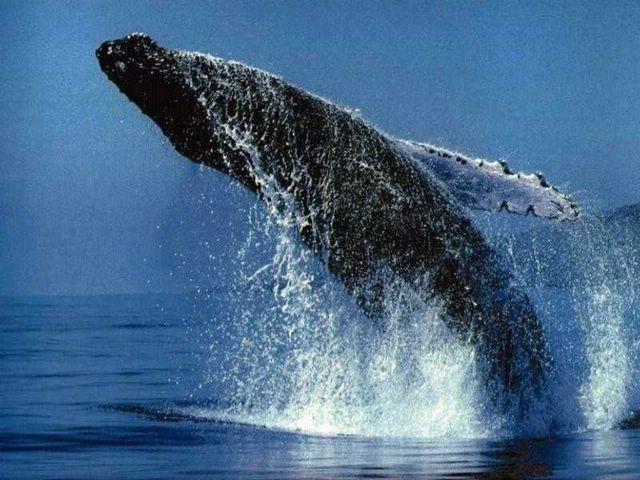
I can't think of a Star Trek story that involves sharks, but I can think of several that involve whales. A whale is among the most famous literary symbols, some would say of a relentless evil, in Melville's Moby Dick. In fact all but one of the Star Trek episodes and movies I'm thinking of don't deal with actual whales: they deal with the symbolism of Melville's singular giant white whale, and the man who hunted it. Usually an Ahab figure relentlessly pursues some being or force that caused that Ahab great harm. Khan is an Ahab figure in "Star Trek II: The Wrath of Khan." Kirk, and the white Enterprise, is his Moby Dick. Khan even had some of his lines written by Melville (although he lost screen credit in Guild arbitration.)
The symbolism of Moby Dick has been interpreted differently by different people at various times. Some have felt that Ahab's mission was divine, and the whale was the Beast (which it seemed to have been to some extent, to Ahab's deluded mind.) It is yet another version of man's dominion over the animal, even in himself. But even other characters in the novel don't believe that. They see the whale as natural. Simply by being an ambiguous "character," by being a symbol, this whale is an instrument of consciousness. You ask why.
The interpretation that Ahab is obsessively pursuing revenge is central to "Star Trek: First Contact," when Lily confronts Jean Luc Picard about his obsession with vengeance against the Borg. Picard denies it at first. (A more direct way of saying he is "in denial.") But because The Next Generation series established that Picard, while hardly perfect, does take literature very seriously, and because the series established that TNG Enterprise characters, while hardly perfect, are able to step back and evaluate their own motivations and actions (often with the help of Counselor Troi), Lily's Moby Dick references strikes a chord of memory, which strikes a nerve.
While quoting lines describing Ahab's unconscious hate poured on the wounded beast ("if his heart had been a cannon he would have shot his chest upon it"), Picard realizes what has been motivating him and telling him lies about why he is doing what he is doing (which is what the unconscious does best). And he becomes conscious. And changes his behavior.
It is possibly the clearest illustration of the science fiction of consciousness that is a constant in much of Trek, and very much in the Roddenberry vision.
Finally, we come to the Star Trek that has a real whale in it: in fact, two.
"Star Trek IV:The Voyage Home" (perhaps along with "First Contact") is the most popular of all Star Trek movies. Here the consciousness of the 23rd century and its fictional Captain Kirk and Mr. Spock, merges with the consciousness of several 20th century people, including Leonard Nimoy and William Shatner, both of whom believe passionately in the need to maintain a healthy natural environment, and respect the other creatures of the earth, recognizing that this is not without cost. That's what values are: priorities that guide choices.
Like the best of Star Trek, this movie grants other beings our conscious recognition of their consciousness, however different from ours it may be. And so the metaphorical whales which carry humans to consciousness and meaning on the voyage of exploration that is life, are joined by real whales, behaving as real whales do (except perhaps for communicating with extraterrestrial beings. But then again...) For instance, they don't eat people. It is the unconsciousness of people that threatens the whales, not just with needless death, but total extinction.
So this whales' tale is about how human unconsciousness threatens its future, and how consciousness can redeem it.
Star Trek is the richest, most accessible, and most conspicuous focus of the science fiction of consciousness we have. Let's not throw it away because it's hard to do.
As for its popularity, let's face it: except for a few times in its history, Star Trek has always a minority preoccupation. Roddenberry's Star Trek was just as out of synch with the prevailing mood of the 60s as Star Trek may be now. The difference is perhaps that a counterculture was growing more obviously then to challenge the establishment culture, which in many ways resembles today's dominant culture, except today's is more vulgar and more overtly violent, especially ideologically. But that's evidence, I believe, of the dire straits we're in. It may be evidence of how skewed the media is, in telling us about ourselves. It is certainly evidence of how much we need the science fiction of consciousness. Of how much we need the soul of Star Trek.
"Much...that proves to be abysmally evil in its ultimate effects does not come from man's wickedness but from his stupidity and unconsciousness."
Jung, Psychology and Western Religion
Let me put it in these terms, which as far as I know I am making up as I go along, although it's so obvious that somebody must have thought of it this way before. There are currently two kinds of science fiction (and you can throw in two kinds of "space opera" as well, because I'm talking mostly about television and film.) There is the science fiction of consciousness. And there is the science fiction of unconsciousness.
The science fiction of unconsciousness is easier to describe. In our daily lives we proceed as if the future will be just like the present, only with new stuff. Our public lives proceed as if the future is going to be great, especially if we get another tax cut, because every new technology is great, the economy is always getting better, and our leaders are always looking out for us, they're telling us the truth and they really know what they are doing.
And our unconscious doesn't believe a word of it. Not that the emotions and anxieties we ignore, suppress and repress, are always any closer to being correct. But they are extreme, and they tend to be expressed in fantasies and stories, especially nightmarish ones, and in other ways that tend towards the extreme.
Mostly it is our repressed suspicions, our barely suppressed fears, our hatred reactions and violent responses, that get translated into stories of violent conflict. In the science fiction of unconsciousness, only technology changes, and gets more capable and complex. People don't change, or get more fully capable, or recognize their complexities; by some standards within civilized memory, they even revert.
The science fiction of consciousness also taps into the power and imagery of the unconscious, but it uses that material to produce stories that are partly, mostly or firstly about applying consciousness to situations. The story itself may demonstrate that application, or it may be something the characters themselves go through, or both.
A simple example might be: stories of space exploration are usually the science fiction of consciousness. Stories of space invaders are the science fiction of unconsciousness.
That's the idea, even if strictly speaking, it's not that simple.
But consciousness is the right word, because it's not just rationality, or the brain or the mind. It's also about emotion, but it deals with them consciously: what emotions do we value, what should we encourage? Who do we love, and why do we hate and fear? Is it unreasonable, destructive fear, or is it justified and useful fear? Is hate as a motivator ever justified? Do we value courage for its own sake over courage behind a behavior that serves a greater good even if it's not so popular, that ennobles us and shows us where we could go, what we could be?
Most of all it is about behavior, because, while we cannot always control our thoughts or emotions, we must be able to control our behavior. That's the definition of human freedom.
Right now we're falling deep into the science fiction as well as the fantasy (and the politics, the economics, the religion) of unconsciousness. Under the public cheerfulness and/or apathy, suppressed despair and repressed fears get expressed through the unconscious, telling us in coded entertainment that we are really afraid of where we're going, and what's happening around us.
Exploration stories---Star Trek stories---ask "what if" questions, they confront who we are through our reactions and our questions about what we find, and why we're going out there in the first place. So many Trek stories show humanity in the middle, with characters valuing our basic nature yet always refining our aspirations, refusing to say we cannot change for the better, individually and as a society.
Invasion movies---which almost always means we humans are being invaded--- are all visceral. You don't think about the humanity of the invader when you're trying to stay alive. That makes for a more exciting movie at a fight-or-flight level, and you must avoid dealing with those questions that slow the action down. You deal with pure push-button emotion, just like the commercials.
It's the very easiest thing to do in order to stimulate an audience, to keep their attention, because we're built to pay attention to what endangers us. So drama sets up an enemy who is all evil. This is not something we find in nature, it's all in the unconscious. Our enemies may be real. Evil may be real. But we seldom encounter enemies who are all evil...except in the fantasy of the unconscious.
Here's another example of what I mean. We've had movies (at least one famous one) and TV dramas (one particularly ridiculous recent one) that pit sharks against humans. The sharks are pure evil. They are pure unconsciousness, and they are met with pure unconsciousness. They don't behave much like real sharks, but that's not the point of these stories.
I can't think of a Star Trek story that involves sharks, but I can think of several that involve whales. A whale is among the most famous literary symbols, some would say of a relentless evil, in Melville's Moby Dick. In fact all but one of the Star Trek episodes and movies I'm thinking of don't deal with actual whales: they deal with the symbolism of Melville's singular giant white whale, and the man who hunted it. Usually an Ahab figure relentlessly pursues some being or force that caused that Ahab great harm. Khan is an Ahab figure in "Star Trek II: The Wrath of Khan." Kirk, and the white Enterprise, is his Moby Dick. Khan even had some of his lines written by Melville (although he lost screen credit in Guild arbitration.)
The symbolism of Moby Dick has been interpreted differently by different people at various times. Some have felt that Ahab's mission was divine, and the whale was the Beast (which it seemed to have been to some extent, to Ahab's deluded mind.) It is yet another version of man's dominion over the animal, even in himself. But even other characters in the novel don't believe that. They see the whale as natural. Simply by being an ambiguous "character," by being a symbol, this whale is an instrument of consciousness. You ask why.
The interpretation that Ahab is obsessively pursuing revenge is central to "Star Trek: First Contact," when Lily confronts Jean Luc Picard about his obsession with vengeance against the Borg. Picard denies it at first. (A more direct way of saying he is "in denial.") But because The Next Generation series established that Picard, while hardly perfect, does take literature very seriously, and because the series established that TNG Enterprise characters, while hardly perfect, are able to step back and evaluate their own motivations and actions (often with the help of Counselor Troi), Lily's Moby Dick references strikes a chord of memory, which strikes a nerve.
While quoting lines describing Ahab's unconscious hate poured on the wounded beast ("if his heart had been a cannon he would have shot his chest upon it"), Picard realizes what has been motivating him and telling him lies about why he is doing what he is doing (which is what the unconscious does best). And he becomes conscious. And changes his behavior.
It is possibly the clearest illustration of the science fiction of consciousness that is a constant in much of Trek, and very much in the Roddenberry vision.
Finally, we come to the Star Trek that has a real whale in it: in fact, two.
"Star Trek IV:The Voyage Home" (perhaps along with "First Contact") is the most popular of all Star Trek movies. Here the consciousness of the 23rd century and its fictional Captain Kirk and Mr. Spock, merges with the consciousness of several 20th century people, including Leonard Nimoy and William Shatner, both of whom believe passionately in the need to maintain a healthy natural environment, and respect the other creatures of the earth, recognizing that this is not without cost. That's what values are: priorities that guide choices.
Like the best of Star Trek, this movie grants other beings our conscious recognition of their consciousness, however different from ours it may be. And so the metaphorical whales which carry humans to consciousness and meaning on the voyage of exploration that is life, are joined by real whales, behaving as real whales do (except perhaps for communicating with extraterrestrial beings. But then again...) For instance, they don't eat people. It is the unconsciousness of people that threatens the whales, not just with needless death, but total extinction.
So this whales' tale is about how human unconsciousness threatens its future, and how consciousness can redeem it.
Star Trek is the richest, most accessible, and most conspicuous focus of the science fiction of consciousness we have. Let's not throw it away because it's hard to do.
As for its popularity, let's face it: except for a few times in its history, Star Trek has always a minority preoccupation. Roddenberry's Star Trek was just as out of synch with the prevailing mood of the 60s as Star Trek may be now. The difference is perhaps that a counterculture was growing more obviously then to challenge the establishment culture, which in many ways resembles today's dominant culture, except today's is more vulgar and more overtly violent, especially ideologically. But that's evidence, I believe, of the dire straits we're in. It may be evidence of how skewed the media is, in telling us about ourselves. It is certainly evidence of how much we need the science fiction of consciousness. Of how much we need the soul of Star Trek.
Monday, April 04, 2005
Star Trek and the Culture Wars
The range of writings responding to the death of Pope John Paul II demonstrates the inaccurate limitation of our "us or them" habits, particularly in evaluating the complexity of beliefs, observations and principles that any one person or group of people might have.
Was Pope John Paul a conservative or a liberal? Was he a red states' Pontiff or a blue states Prelate? Conservative talk shows in America claim him for their own, but as others have shown, they weren't so certain a few years ago, when the Pope came out strongly against the war in Iraq. Some Vatican insiders have told reporters that not being able to stop the U.S. invasion was among his greatest disappointments of his papacy.
As various writers are now noting, Pope John Paul was passionately attentive to the needs of the poor and dispossessed; he was against birth control and considered abortion to be murder; he promoted diversity and ecumenical understanding, admired the devotion to prayer of Muslims and was the first Pope to enter a mosque; he thought homosexuality was wrong and condemned gay marriage; he was against capital punishment; he was against changing Church practices so that priests could marry or women become priests; he spoke out against rampant capitalism, environmental destruction, the culture of consumption, and the rich western countries ignoring the poor countries of Africa, Asia and Latin America. So what was he?
I don't know that the late Pope ever saw Star Trek, but it's very likely he would have approved of a lot of what he saw, and would not have damned the entire vision for what he disagreed with, or thought was missing. Star Trek stood for diversity, tolerance, social justice, and a respect for spirituality, even a belief in something transcendent to human knowledge at work in the universe.
Because Gene Roddenberry is characterized as a humanist, even a secular humanist, it is often proposed that he was against religion and religious values, even that he had no spiritual life. His own statements, along with the evidence of what he wrote or approved as part of Star Trek, don't add up to so simple a characterization, so black and white (or red or blue) a picture.
By that evidence, it seems to me that Roddenberry was suspicious of organized religions, and saw that many needless wars and much suffering were caused or encouraged by conflicting religions, each certain it was justified in killing people on the other side, because they were on the side of God and the other side therefore was in league with the devil.
But also by that evidence (for instance, the interview with Terrance Sweeney at the end of David Alexander's Roddenberry biography, Star Trek Creator) he had spiritual feelings and thoughts, and a faith in the divine, though his definition of God would not satisfy some adherents of some religions.
It seems to me that if it had been possible to put Roddenberry, Pope John Paul and the Dalai Lama in a room together for an hour, they would respectfully disagree on a few things, but would quickly find they had much more in common, and moreover, they would concentrate on those common beliefs and probably would spend most of the time talking about how they could work together to further those values, so they would indeed be part of the soul of the future.
While I believe it is important to strongly oppose what I find to be dangerous, and to engage in debate and dialogue on important questions of justice, morality and governance, I find today's automatic political typecasting, and all the laundry lists of absolutist positions, to be repugnant and themselves dangerous.
Not only are these lists harmful, they are often irrelevant and inaccurate. Star Trek is a very good example. Where does Star Trek stand in the so-called Culture Wars? In most respects, with the Blue States. But consider this statement by Michael Medved, a movie reviewer who now makes his living principally from Rush Limbaugh dittoheads and Christian conservatives, who castigated Star Trek V for being anti-God: in his book, Right Turns, he criticizes how much our culture is now willing to "accept the ability to shock as a replacement for the old ability to inspire."
That seems to me to be one of the major reasons that Star Trek is so singularly valuable. Take a look down the rows of video store shelves: it's all guns, muscles, t&a. We have replaced inspiration with shock, except for Star Trek, and a minority of other movies and TV shows. That Star Trek is family friendly (including the movies, though some include mild profanity and jokes about bodies, but pushing it with certain episodes of Enterprise) has been important to its character. "Apart from perhaps the Weather Channel," Marina Sirtis said, "Star Trek is the only show on television the whole family can watch together." And, I would add, enjoy, while they quite probably learn something, and may even talk about moral and values issues in the real world that the story inspired.
So on this I agree with what Medved wrote, and I am not happy that my belief in the right of free expression is confused with my support for mindless vulgarity and, incidentally, equally mindless violence. But Star Trek V as anti-God? Come on, Michael. That's sophistry or zealotry, and I don't accept either, or the idea that fundamentalist or conservative Christians get to define my morality and spirituality. And my values tell me that however I might agree with Medved on this observation, it's not nearly enough to get me to vote for G.W. Bush, not even at gunpoint.
Even worse that the oversimplified shock and commercialized vulgarity, is the impoverishment of our political, moral and spiritual dialogue. We seem to be hypnotically locking ourselves in rigid oversimplifications, perhaps in fear of the interrelated complexity now revealing itself to us. We need to be inspired to embrace the adventure of understanding this, which Star Trek can do.
The range of writings responding to the death of Pope John Paul II demonstrates the inaccurate limitation of our "us or them" habits, particularly in evaluating the complexity of beliefs, observations and principles that any one person or group of people might have.
Was Pope John Paul a conservative or a liberal? Was he a red states' Pontiff or a blue states Prelate? Conservative talk shows in America claim him for their own, but as others have shown, they weren't so certain a few years ago, when the Pope came out strongly against the war in Iraq. Some Vatican insiders have told reporters that not being able to stop the U.S. invasion was among his greatest disappointments of his papacy.
As various writers are now noting, Pope John Paul was passionately attentive to the needs of the poor and dispossessed; he was against birth control and considered abortion to be murder; he promoted diversity and ecumenical understanding, admired the devotion to prayer of Muslims and was the first Pope to enter a mosque; he thought homosexuality was wrong and condemned gay marriage; he was against capital punishment; he was against changing Church practices so that priests could marry or women become priests; he spoke out against rampant capitalism, environmental destruction, the culture of consumption, and the rich western countries ignoring the poor countries of Africa, Asia and Latin America. So what was he?
I don't know that the late Pope ever saw Star Trek, but it's very likely he would have approved of a lot of what he saw, and would not have damned the entire vision for what he disagreed with, or thought was missing. Star Trek stood for diversity, tolerance, social justice, and a respect for spirituality, even a belief in something transcendent to human knowledge at work in the universe.
Because Gene Roddenberry is characterized as a humanist, even a secular humanist, it is often proposed that he was against religion and religious values, even that he had no spiritual life. His own statements, along with the evidence of what he wrote or approved as part of Star Trek, don't add up to so simple a characterization, so black and white (or red or blue) a picture.
By that evidence, it seems to me that Roddenberry was suspicious of organized religions, and saw that many needless wars and much suffering were caused or encouraged by conflicting religions, each certain it was justified in killing people on the other side, because they were on the side of God and the other side therefore was in league with the devil.
But also by that evidence (for instance, the interview with Terrance Sweeney at the end of David Alexander's Roddenberry biography, Star Trek Creator) he had spiritual feelings and thoughts, and a faith in the divine, though his definition of God would not satisfy some adherents of some religions.
It seems to me that if it had been possible to put Roddenberry, Pope John Paul and the Dalai Lama in a room together for an hour, they would respectfully disagree on a few things, but would quickly find they had much more in common, and moreover, they would concentrate on those common beliefs and probably would spend most of the time talking about how they could work together to further those values, so they would indeed be part of the soul of the future.
While I believe it is important to strongly oppose what I find to be dangerous, and to engage in debate and dialogue on important questions of justice, morality and governance, I find today's automatic political typecasting, and all the laundry lists of absolutist positions, to be repugnant and themselves dangerous.
Not only are these lists harmful, they are often irrelevant and inaccurate. Star Trek is a very good example. Where does Star Trek stand in the so-called Culture Wars? In most respects, with the Blue States. But consider this statement by Michael Medved, a movie reviewer who now makes his living principally from Rush Limbaugh dittoheads and Christian conservatives, who castigated Star Trek V for being anti-God: in his book, Right Turns, he criticizes how much our culture is now willing to "accept the ability to shock as a replacement for the old ability to inspire."
That seems to me to be one of the major reasons that Star Trek is so singularly valuable. Take a look down the rows of video store shelves: it's all guns, muscles, t&a. We have replaced inspiration with shock, except for Star Trek, and a minority of other movies and TV shows. That Star Trek is family friendly (including the movies, though some include mild profanity and jokes about bodies, but pushing it with certain episodes of Enterprise) has been important to its character. "Apart from perhaps the Weather Channel," Marina Sirtis said, "Star Trek is the only show on television the whole family can watch together." And, I would add, enjoy, while they quite probably learn something, and may even talk about moral and values issues in the real world that the story inspired.
So on this I agree with what Medved wrote, and I am not happy that my belief in the right of free expression is confused with my support for mindless vulgarity and, incidentally, equally mindless violence. But Star Trek V as anti-God? Come on, Michael. That's sophistry or zealotry, and I don't accept either, or the idea that fundamentalist or conservative Christians get to define my morality and spirituality. And my values tell me that however I might agree with Medved on this observation, it's not nearly enough to get me to vote for G.W. Bush, not even at gunpoint.
Even worse that the oversimplified shock and commercialized vulgarity, is the impoverishment of our political, moral and spiritual dialogue. We seem to be hypnotically locking ourselves in rigid oversimplifications, perhaps in fear of the interrelated complexity now revealing itself to us. We need to be inspired to embrace the adventure of understanding this, which Star Trek can do.
Wednesday, March 16, 2005
The Heroes
They were the people who made it all work. From the producers who put in incredible hours (some of them, especially during the original series, wound up in the hospital because of it) to the effects people who made the future out of barrettes, plumbing supplies, recycled sound recordings and junk they found in the Mission Impossible dumpster next door, they made the Star Trek universe.
"I think the secret to Star Trek's success was its attention to details," said Oscar Katz, a Desilu executive as the original series was being developed. " ...its science-fiction truth not only in the big things that were spoken about, but also in the smallest details."
A lot of them worked on various Treks for decades. From the original series to Enterprise, everyone described them as a family. They were good at what they did, they were proud of it, and maybe above all, they cared about each other and they cared about Star Trek.
"I'll tell you one thing about Star Trek," Nichelle Nichols said to David Gerrold years ago. "...everyone you worked with, the prop man, the sound men, the light men, they had a very personal attitude about that show, a very personal pride, a personal sense of ownership. There were times when even a sound man wouldn't let something go by---it may not have had anything to do with sound---but he knew it didn't belong on the Enterprise, and he would speak up."
Speaking of his own fifteen years working on Star Trek, from Next Gen to directing episodes of every series since, Levar Burton observed (in an interview excerpted on the 7th TNG season 7 DVD) "Once you get past the overwhelming power of the sets, the thing that you will notice the most if you hang out for any length of time, is just how nice the people are, and how pleasant the working environment is. The amazing thing about Star Trek is, it's not just about the family of people that's on the screen. There's a family behind the scenes that is responsible on a day to day basis for getting this show done, day in, day out, these people show up every day and have done for the better part of the last fifteen years. It's extraordinary."
Last week Dan Curry spoke of Enterprise in particular as being a single family, the actors and crew and behind the scenes people. Another word that many use to describe everyone from Rick Berman to the directors of photography and Dan Curry as well-- is generosity. They were generous with their knowledge and their encouragement and their loyalty.
This, like just about everything else in Star Trek, seems to have started with Gene Roddenberry. I'm becoming convinced that even more that his visionary ideas, his genius was for people. Even the way he interviewed people for their jobs, asking more about them as people than about their experience, and talking to them about the real core of Star Trek (which it seems almost everyone who worked on it understood and remained loyal to for the rest of their lives) must have had something to do with how well this otherwise unlikely collection of talents---most of them previously obscure or untried--came together to create a storied universe unique in its impact and longevity.
Now the Enterprise set are silent, and it's likely this particular group of people will not work together again. Even if a new Star Trek series or movie begins in a few years, and possibly even if Enterprise somehow is resurrected in Vancouver before fall, many of them will no longer be part of Star Trek. Yet they are the heroes of Star Trek, and they deserve all the gratitude, admiration and honor they can receive.
They were the people who made it all work. From the producers who put in incredible hours (some of them, especially during the original series, wound up in the hospital because of it) to the effects people who made the future out of barrettes, plumbing supplies, recycled sound recordings and junk they found in the Mission Impossible dumpster next door, they made the Star Trek universe.
"I think the secret to Star Trek's success was its attention to details," said Oscar Katz, a Desilu executive as the original series was being developed. " ...its science-fiction truth not only in the big things that were spoken about, but also in the smallest details."
A lot of them worked on various Treks for decades. From the original series to Enterprise, everyone described them as a family. They were good at what they did, they were proud of it, and maybe above all, they cared about each other and they cared about Star Trek.
"I'll tell you one thing about Star Trek," Nichelle Nichols said to David Gerrold years ago. "...everyone you worked with, the prop man, the sound men, the light men, they had a very personal attitude about that show, a very personal pride, a personal sense of ownership. There were times when even a sound man wouldn't let something go by---it may not have had anything to do with sound---but he knew it didn't belong on the Enterprise, and he would speak up."
Speaking of his own fifteen years working on Star Trek, from Next Gen to directing episodes of every series since, Levar Burton observed (in an interview excerpted on the 7th TNG season 7 DVD) "Once you get past the overwhelming power of the sets, the thing that you will notice the most if you hang out for any length of time, is just how nice the people are, and how pleasant the working environment is. The amazing thing about Star Trek is, it's not just about the family of people that's on the screen. There's a family behind the scenes that is responsible on a day to day basis for getting this show done, day in, day out, these people show up every day and have done for the better part of the last fifteen years. It's extraordinary."
Last week Dan Curry spoke of Enterprise in particular as being a single family, the actors and crew and behind the scenes people. Another word that many use to describe everyone from Rick Berman to the directors of photography and Dan Curry as well-- is generosity. They were generous with their knowledge and their encouragement and their loyalty.
This, like just about everything else in Star Trek, seems to have started with Gene Roddenberry. I'm becoming convinced that even more that his visionary ideas, his genius was for people. Even the way he interviewed people for their jobs, asking more about them as people than about their experience, and talking to them about the real core of Star Trek (which it seems almost everyone who worked on it understood and remained loyal to for the rest of their lives) must have had something to do with how well this otherwise unlikely collection of talents---most of them previously obscure or untried--came together to create a storied universe unique in its impact and longevity.
Now the Enterprise set are silent, and it's likely this particular group of people will not work together again. Even if a new Star Trek series or movie begins in a few years, and possibly even if Enterprise somehow is resurrected in Vancouver before fall, many of them will no longer be part of Star Trek. Yet they are the heroes of Star Trek, and they deserve all the gratitude, admiration and honor they can receive.
Monday, March 07, 2005
TrekCheck: All bad things?...
As the Enterprise season and officially its existence as an ongoing series come to an end, there is more than the usual conflict in Trekdom.
On the one side there are the people associated with Enterprise who speak only in terms of finality. It's striking how many of them use the same word to describe the prevailing attitude: "bittersweet." Jonathan Frakes used it, and Brannon Braga at his college speech; I heard Dan Curry at his college speech use it twice.
Within this group, though not totally unanimous, is the sentiment that the cancellation of Enterprise is a necessary thing, because Trek needs a rest, a pause, a period of "gestation" (to use Braga's word) before the next try. As noted before, Rick Berman has settled on the "franchise fatigue " description, which justifies not only the cancellation but the idea to abandon established Trek characters (and presumably actors) for the next feature.
On the other side is the Coto Counteroffensive, and the fan attempts to save Enterprise. Manny Coto hasn't backed off his belief, stated to me and anybody else who would listen before the season started, that what the world needs now is more Trek, not less, and certainly not none. He talked recently of his 5th season stories for Enterprise, though he also agreed that the next Trek series should go farther into the future, into the 25th century perhaps.
When fans showed up to demonstrate their support at Paramount, Coto and the writing team came out to greet them, as did members of the cast. While Coto doesn't say a word against Rick Berman, he is clearly on the other side of this question. Scott Bacula seems to have a foot in each camp---he says he'd like the series to continue, but he talks realistically about its chances. His pessimism sounds the most realistic, based on his knowledge of the people involved who are making these decisions. (There was also the $3 million pledged to save Enterprise, a startling but probably risk-free assertion of faith in Trek, as paying the actual money probably depends on raising the full $38 million goal, which is highly unlikely.)
So even as faint hope at least keeps our ears perked up for surprises, most fans seemed resigned to cocooning quietly one last time, to watch the farewell episode, and wave a fond goodbye.
But a new element was added last week when a couple of long-time BBS posters, believed to be close to the Enterprise production team if not part of it, went public with a scathing critique of the script of the final episode, said to be titled, "These Are the Voyages."
BBS fans going nuclear is hardly news, but these "sources" claimed that there was widespread dissatisfaction on the set with this script, which is now in production. Perhaps coincidentally, a previously scheduled press event with Berman, Coto and Scott Bacula, among others, was cancelled, and the Enterprise set was abruptly closed.
Then over the weekend, Jolene Blalock called the script "appalling." She's made negative comments about scripts before, but "appalling" is very strong language, particularly as she was praising this season's scripts.
So now should fans be expecting an even greater disappointment: not just the loss of Enterprise, and with it the loss of new TV Trek stories for the indefinite future, but a final farewell to Star Trek episode that's "appalling?"
There is a certain symmetry to the possibility. A bad end to a troubled series would not be unexpected. But a bad end to "Trek as we know it," coming to us in an interrupted but unbroken line from Roddenberry to today, especially with many of the same people involved for decades, would leave us with worse than a bittersweet taste.
It does suggest that while all good things may come to a good end, a less than happy situation sometimes cannot transcend itself, and the bad end seems inevitable.
There are conspicuous examples of both in Star Trek. The miracle and the love fest that was TNG, came to a great end with "All Good Things..." Even the ignominious cessation of the original cast's TV run was vastly overshadowed by their movies, and a magnificent Star Trek VI with a wonderful ending.
But when things don't go over well, the differences seem to matter more, and things get bent out of shape. They don't quite mesh, and bad decisions instead of magically right ones seem to emerge. It seems everyone involved was shocked, and in a way still are, by the box office failure of Star Trek Nemesis. Without analyzing details, it seems that somehow things got out of synch. The cast was clearly surprised by the ad campaign of a generation's last voyage. Perhaps the most telling detail was how the movie itself ended. The DVD contains a perfectly good Star Trek ending, full of humor and feeling, and with the kind of "conclusion" we anticipate and need: the Enterprise warping off to its next adventure.
Unfortunately that ending wasn't used. Instead the Enterprise is static, not even whole, still in drydock being repaired. That was only one aspect of an unsatisfying ending, but an important one. It's the feeling people leave the theatre with that counts. The movie felt abandoned, and perhaps so did we.
This kind of contrast of endings happens in sports sometimes as well. Remember Michael Jordan, at the apex of his fame, in the final game of his stellar career with the Chicago Bulls, hitting the shot that won Chicago's last championship? It was a perfect ending to an incredible career.
But it turned out not to be Jordan's last game. That was several years later, when he was playing for a Washington team that never even made the playoffs. Jordan had become increasingly critical of his younger teammates, and in his actual final game, they simply ignored him. The dissension was obvious, as the crowd begged for Jordan to take a final shot, but his teammates, fed up with his criticism and celebrity, showed only disdain. In exasperation, Jordan took himself out of the game. It turned out that management as well as players had enough of Jordan. He was essentially fired from the team he’d once owned.
And just a few years ago, when the Los Angeles Lakers were playing well, playing together and winning, they overcame their differences. But who knows what happened first: the egos and differences erupted, or the quality of play fell off, or the winning luck just wasn't with them for the big moments? But it all fell apart last season, and now that team doesn't even exist anymore.
What's happening with Enterprise, and what may happen with its ending, may be attributable to exactly what Rick Berman says: franchise fatigue, too many ideas used up, and not enough creative energy left. Whether or not others could have done better is debatable, given all the circumstances. If the fourth season had come in the second season? Who knows? But there was enough good coming out of this season to produce the hope that if this was going to be the end of what for almost four decades had been a very good thing, it would be a worthy ending.
Trek has been going through a stormy period, but there was---and in fact, there still is---the possibility of one last return to the qualities that made Star Trek legendary. We can still hope that this final episode will emerge as a fitting end, that down at Paramount dissatisfaction becomes creative rescue. For hope, after all, is what this franchise has always been about.
One thing for sure: we'll be looking for that last shot of one Enterprise or another heading into the stars, taking our hopes into the future.
As the Enterprise season and officially its existence as an ongoing series come to an end, there is more than the usual conflict in Trekdom.
On the one side there are the people associated with Enterprise who speak only in terms of finality. It's striking how many of them use the same word to describe the prevailing attitude: "bittersweet." Jonathan Frakes used it, and Brannon Braga at his college speech; I heard Dan Curry at his college speech use it twice.
Within this group, though not totally unanimous, is the sentiment that the cancellation of Enterprise is a necessary thing, because Trek needs a rest, a pause, a period of "gestation" (to use Braga's word) before the next try. As noted before, Rick Berman has settled on the "franchise fatigue " description, which justifies not only the cancellation but the idea to abandon established Trek characters (and presumably actors) for the next feature.
On the other side is the Coto Counteroffensive, and the fan attempts to save Enterprise. Manny Coto hasn't backed off his belief, stated to me and anybody else who would listen before the season started, that what the world needs now is more Trek, not less, and certainly not none. He talked recently of his 5th season stories for Enterprise, though he also agreed that the next Trek series should go farther into the future, into the 25th century perhaps.
When fans showed up to demonstrate their support at Paramount, Coto and the writing team came out to greet them, as did members of the cast. While Coto doesn't say a word against Rick Berman, he is clearly on the other side of this question. Scott Bacula seems to have a foot in each camp---he says he'd like the series to continue, but he talks realistically about its chances. His pessimism sounds the most realistic, based on his knowledge of the people involved who are making these decisions. (There was also the $3 million pledged to save Enterprise, a startling but probably risk-free assertion of faith in Trek, as paying the actual money probably depends on raising the full $38 million goal, which is highly unlikely.)
So even as faint hope at least keeps our ears perked up for surprises, most fans seemed resigned to cocooning quietly one last time, to watch the farewell episode, and wave a fond goodbye.
But a new element was added last week when a couple of long-time BBS posters, believed to be close to the Enterprise production team if not part of it, went public with a scathing critique of the script of the final episode, said to be titled, "These Are the Voyages."
BBS fans going nuclear is hardly news, but these "sources" claimed that there was widespread dissatisfaction on the set with this script, which is now in production. Perhaps coincidentally, a previously scheduled press event with Berman, Coto and Scott Bacula, among others, was cancelled, and the Enterprise set was abruptly closed.
Then over the weekend, Jolene Blalock called the script "appalling." She's made negative comments about scripts before, but "appalling" is very strong language, particularly as she was praising this season's scripts.
So now should fans be expecting an even greater disappointment: not just the loss of Enterprise, and with it the loss of new TV Trek stories for the indefinite future, but a final farewell to Star Trek episode that's "appalling?"
There is a certain symmetry to the possibility. A bad end to a troubled series would not be unexpected. But a bad end to "Trek as we know it," coming to us in an interrupted but unbroken line from Roddenberry to today, especially with many of the same people involved for decades, would leave us with worse than a bittersweet taste.
It does suggest that while all good things may come to a good end, a less than happy situation sometimes cannot transcend itself, and the bad end seems inevitable.
There are conspicuous examples of both in Star Trek. The miracle and the love fest that was TNG, came to a great end with "All Good Things..." Even the ignominious cessation of the original cast's TV run was vastly overshadowed by their movies, and a magnificent Star Trek VI with a wonderful ending.
But when things don't go over well, the differences seem to matter more, and things get bent out of shape. They don't quite mesh, and bad decisions instead of magically right ones seem to emerge. It seems everyone involved was shocked, and in a way still are, by the box office failure of Star Trek Nemesis. Without analyzing details, it seems that somehow things got out of synch. The cast was clearly surprised by the ad campaign of a generation's last voyage. Perhaps the most telling detail was how the movie itself ended. The DVD contains a perfectly good Star Trek ending, full of humor and feeling, and with the kind of "conclusion" we anticipate and need: the Enterprise warping off to its next adventure.
Unfortunately that ending wasn't used. Instead the Enterprise is static, not even whole, still in drydock being repaired. That was only one aspect of an unsatisfying ending, but an important one. It's the feeling people leave the theatre with that counts. The movie felt abandoned, and perhaps so did we.
This kind of contrast of endings happens in sports sometimes as well. Remember Michael Jordan, at the apex of his fame, in the final game of his stellar career with the Chicago Bulls, hitting the shot that won Chicago's last championship? It was a perfect ending to an incredible career.
But it turned out not to be Jordan's last game. That was several years later, when he was playing for a Washington team that never even made the playoffs. Jordan had become increasingly critical of his younger teammates, and in his actual final game, they simply ignored him. The dissension was obvious, as the crowd begged for Jordan to take a final shot, but his teammates, fed up with his criticism and celebrity, showed only disdain. In exasperation, Jordan took himself out of the game. It turned out that management as well as players had enough of Jordan. He was essentially fired from the team he’d once owned.
And just a few years ago, when the Los Angeles Lakers were playing well, playing together and winning, they overcame their differences. But who knows what happened first: the egos and differences erupted, or the quality of play fell off, or the winning luck just wasn't with them for the big moments? But it all fell apart last season, and now that team doesn't even exist anymore.
What's happening with Enterprise, and what may happen with its ending, may be attributable to exactly what Rick Berman says: franchise fatigue, too many ideas used up, and not enough creative energy left. Whether or not others could have done better is debatable, given all the circumstances. If the fourth season had come in the second season? Who knows? But there was enough good coming out of this season to produce the hope that if this was going to be the end of what for almost four decades had been a very good thing, it would be a worthy ending.
Trek has been going through a stormy period, but there was---and in fact, there still is---the possibility of one last return to the qualities that made Star Trek legendary. We can still hope that this final episode will emerge as a fitting end, that down at Paramount dissatisfaction becomes creative rescue. For hope, after all, is what this franchise has always been about.
One thing for sure: we'll be looking for that last shot of one Enterprise or another heading into the stars, taking our hopes into the future.
Sunday, February 27, 2005
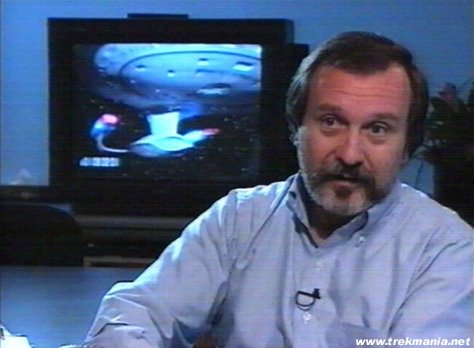
I'm Not A Hollywood Type, I Just Work There:
An Evening with Dan Curry
by William S. Kowinski
If Visual Effects Producer Dan Curry is holding out any hope of a reprieve for Star Trek:Enterprise, he was keeping it to himself when he spoke to a university audience on Friday night (February 25.)
At about the same time that its latest episode, " Divergence," was being seen locally, Curry was on a theatre stage describing how he had begun working on Star Trek's second incarnation---the pilot of "The Next Generation"-which he thought would be a four month job.
"And 18 years later, I'm working on the final episode of Star Trek," Curry said. "With the political machinations of studios and dwindling ratings, the saga of Star Trek for the moment is drawing to a close. So we're all going through a bittersweet period of facing the excitement of a new adventure, but kind of waving goodbye to a group of people that has become family for us over the years."
Later in his talk, Curry noted that the four seasons of Enterprise were "just enough to make it an attractive syndication package, so it will begin to bring negotiable currency to Paramount Pictures."
In a conversation we had after his presentation, Curry added that even though many were looking for their next jobs, they were all still determined to make the remaining episodes as good as they possibly can be.
Curry wouldn't tell me anything about the final episode, which he said was being kept super-secret, and had started shooting that day. He expected to be finished with his post-production work in late April. But he did suggest there would likely be a 40th anniversary Star Trek TV special, and perhaps another documentary that focuses on effects over the years.
As for his own feelings about Enterprise, when asked from the audience which of the Star Trek series was his favorite to work on (and he's worked on them all since TNG) he said, "I think Enterprise, for a number of reasons. It's set earlier in time so things are little more rough and tumble, it's really a fun cast to work with, and over time the relationship of the cast and the crew members has evolved to the point where we are like family. So it's the most emotionally satisfying just because of the quality of the people I work with."
[text continues after photos]
An Evening with Dan Curry
by William S. Kowinski
If Visual Effects Producer Dan Curry is holding out any hope of a reprieve for Star Trek:Enterprise, he was keeping it to himself when he spoke to a university audience on Friday night (February 25.)
At about the same time that its latest episode, " Divergence," was being seen locally, Curry was on a theatre stage describing how he had begun working on Star Trek's second incarnation---the pilot of "The Next Generation"-which he thought would be a four month job.
"And 18 years later, I'm working on the final episode of Star Trek," Curry said. "With the political machinations of studios and dwindling ratings, the saga of Star Trek for the moment is drawing to a close. So we're all going through a bittersweet period of facing the excitement of a new adventure, but kind of waving goodbye to a group of people that has become family for us over the years."
Later in his talk, Curry noted that the four seasons of Enterprise were "just enough to make it an attractive syndication package, so it will begin to bring negotiable currency to Paramount Pictures."
In a conversation we had after his presentation, Curry added that even though many were looking for their next jobs, they were all still determined to make the remaining episodes as good as they possibly can be.
Curry wouldn't tell me anything about the final episode, which he said was being kept super-secret, and had started shooting that day. He expected to be finished with his post-production work in late April. But he did suggest there would likely be a 40th anniversary Star Trek TV special, and perhaps another documentary that focuses on effects over the years.
As for his own feelings about Enterprise, when asked from the audience which of the Star Trek series was his favorite to work on (and he's worked on them all since TNG) he said, "I think Enterprise, for a number of reasons. It's set earlier in time so things are little more rough and tumble, it's really a fun cast to work with, and over time the relationship of the cast and the crew members has evolved to the point where we are like family. So it's the most emotionally satisfying just because of the quality of the people I work with."
[text continues after photos]
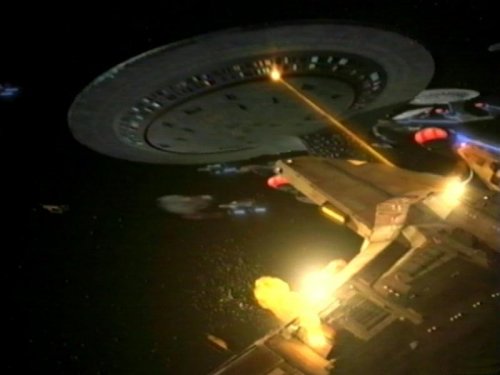
Curry spoke to a hundred or so students and faculty at Humboldt State University in far northern California, where he had been a graduate student and earned his Masters of Fine Arts degree in 1982. In the theatre building where he had spent many hours, he talked about his career, mostly on Star Trek but also on several features, and illustrated his stories with clips and before-and-after examples of specific visual effects.
The DVD and videotape footage projected on a screen beside him on the stage included his ten minute 2004 Emmy-winning reel from Enterprise (he's won 7 in all), a montage of Enterprise season 3 in 60 seconds, and the 18 minute profile included in the TNG season 6 DVD, which features him talking about various episodes, showing Klingon weapons he designed and their inspirations, and doing some Tai'chi on his lawn. ("They followed me around my house. After it was made and they sent me a copy, and it took me about eight months to have the courage to watch it. It's living proof why I am behind the camera.")
Curry began his two hour presentation with a montage of visual effects scenes from all the series he worked on, beginning it with the space battle of the Deep Space 9 finale. It looked really great projected on the big screen.
Here are some highlights from his talk, by category...
The DVD and videotape footage projected on a screen beside him on the stage included his ten minute 2004 Emmy-winning reel from Enterprise (he's won 7 in all), a montage of Enterprise season 3 in 60 seconds, and the 18 minute profile included in the TNG season 6 DVD, which features him talking about various episodes, showing Klingon weapons he designed and their inspirations, and doing some Tai'chi on his lawn. ("They followed me around my house. After it was made and they sent me a copy, and it took me about eight months to have the courage to watch it. It's living proof why I am behind the camera.")
Curry began his two hour presentation with a montage of visual effects scenes from all the series he worked on, beginning it with the space battle of the Deep Space 9 finale. It looked really great projected on the big screen.
Here are some highlights from his talk, by category...

How he got started
"My last year at HSU, my fellow students were kind enough to grant me a one man exhibition of painting, and during that time by a remarkable coincidence, Marcia Lucas, who was George Lucas' wife at the time, was visiting to give a series of talks on film editing. She happened to stroll by the little gallery and saw some of my paintings, and came and talked to me about them, and told me I should look into doing matte paintings.
So I was invited down to ILM, got a lot of advice and pointers on doing matte paintings, and they set up some meetings for me, so after school I went to Universal Studios and started on Buck Rogers and the original Battlestar Galactica"...
Then [many] features later working for various facilities, I was invited by Paramount Pictures to work on Star Trek. It sounded like a good idea, I thought it would be a four month project to help this little pilot get off the ground, and 18 years later I'm working on the final episode of Star Trek."
On the importance of the Peace Corps and his education in his work for Star Trek
After obtaining his undergraduate degree in art, Curry went into the Peace Corps. "It had a profound effect on my life. I learned something very important. In this country we say there's the First World and the Third World. But I really discovered that there is no Third World---there is only one world and we all live in it together. And that we should start making our international policies based on that fact."
"I had the rare opportunity to live in rural Thailand building small dams and bridges, but what I contributed to the people there was a small part of what they contributed to me. Since then I've become aware that everything you experience in life becomes part of your career, whether directly from the educational system or from some stuff that happens by surprise, and much of what I encountered in Thailand became part of Star Trek, especially the Klingons. They were much influenced by people in the Himalayas and Southeast Asia, and the protracted period of my misspent youth that I spent in sword schools."
After the Peace Corps and a few years teaching art at a community college on Cape Cod, Curry entered the graduate program at Humboldt State University, and "another profoundly influential period of my life." He thanked the faculty members by name (several of whom were present for his talk) and added that his relationship with fellow students were "just as influential in shaping my opinions about things, because of their dedication to the art of theatre and film, and their dedication to integrity."
"My last year at HSU, my fellow students were kind enough to grant me a one man exhibition of painting, and during that time by a remarkable coincidence, Marcia Lucas, who was George Lucas' wife at the time, was visiting to give a series of talks on film editing. She happened to stroll by the little gallery and saw some of my paintings, and came and talked to me about them, and told me I should look into doing matte paintings.
So I was invited down to ILM, got a lot of advice and pointers on doing matte paintings, and they set up some meetings for me, so after school I went to Universal Studios and started on Buck Rogers and the original Battlestar Galactica"...
Then [many] features later working for various facilities, I was invited by Paramount Pictures to work on Star Trek. It sounded like a good idea, I thought it would be a four month project to help this little pilot get off the ground, and 18 years later I'm working on the final episode of Star Trek."
On the importance of the Peace Corps and his education in his work for Star Trek
After obtaining his undergraduate degree in art, Curry went into the Peace Corps. "It had a profound effect on my life. I learned something very important. In this country we say there's the First World and the Third World. But I really discovered that there is no Third World---there is only one world and we all live in it together. And that we should start making our international policies based on that fact."
"I had the rare opportunity to live in rural Thailand building small dams and bridges, but what I contributed to the people there was a small part of what they contributed to me. Since then I've become aware that everything you experience in life becomes part of your career, whether directly from the educational system or from some stuff that happens by surprise, and much of what I encountered in Thailand became part of Star Trek, especially the Klingons. They were much influenced by people in the Himalayas and Southeast Asia, and the protracted period of my misspent youth that I spent in sword schools."
After the Peace Corps and a few years teaching art at a community college on Cape Cod, Curry entered the graduate program at Humboldt State University, and "another profoundly influential period of my life." He thanked the faculty members by name (several of whom were present for his talk) and added that his relationship with fellow students were "just as influential in shaping my opinions about things, because of their dedication to the art of theatre and film, and their dedication to integrity."

Evolution of Visual Effects
"The evolution of visual effects over my 18 years at Star Trek is really the evolution of visual effects. Because we worked in television we were able to use lower resolutions, so we pioneered a lot of things that became standard techniques in features. We were the very first visual effects show to have video tape as our final product rather than film. We started out doing 1 inch analogue and progressed to digital and now we're doing high definition digital technologies....My job has gone from director of photography and compositing supervisor, to sort of an orchestra conductor of a team of virtuoso digital artists."
Even today, Curry said, an average feature may have 200 to 500 visual effects shots, that take a year to produce. "We have 2 1/2 to 3 weeks [to do each show], and in the average television season we do 3500 visual effects shots."
Curry also explained the difference between visual and special effects.
"Visual effects basically are making a synthetic reality out of pieces that were photographed at different times and recombining them into something new, while special effects happen on the set, like making the doors open and close on the Enterprise." They often work together-for example, visual effects will enhance explosions created on the set by special effects. Visual effects also works with what the makeup and other departments do. "It's a very interactive process."
Working with Models
At first most visual effects were done with minatures. The Enterprise-D, Deep Space 9 and Voyager were 4-to-6 foot models. "Sometimes it took 60 to 80 hours a week trying to keep up with the miniature photography for the ships. Now most of it is done in the computer."
But Curry doesn't think that miniatures will completely disappear even in the digital age. He pointed out that the 2004 film "The Aviator" used airplane models. "There are certain things computers don't do very well, so I think that models will never completely go away...and with models, like with computer graphics and with actors, it's all about lighting. If you light it well it will look great. If you don't light it well, it will look artificial.
"Practical elements"
"In those [old]days, we had to use a lot of practical elements--- and I'd like to introduce you to the force field that was used on the Enterprise." Curry holds up a ball of silver tinsel.
"Sometimes we'd bounce laser beams off beer cans onto white cardboard, and depending on how we bent the beer can it would influence how the image would appear. We used these for force fields and tractor beams. It was fun--- a form of medieval alchemy."
The key to creating visual effects: "Teamwork, and the ability to perceive things not for what they are, but for what they might be."
Motion Control
"Doug Trumbull [special photographic effects pioneer on 2001,Close Encounters of the Third Kind and Star Trek: The Motion Picture among others) was visiting an airplane plant in the LA area and he saw these huge milling machines doing the same motions over and over again. [Before then] spaceship models were filmed on wires against blue screen, and with 'overcranking' (moving the ships at faster than 24 frames per second, the speed of the film).... you couldn't get any lights inside for windows or [vapor coming out]... When Doug saw the milling machines he had the inspiration that if you mounted a model in one place, and you had roll, pitch and yaw, he could build lights into it and photograph it slowly, one [frame] at a time, giving perfect exposure for each element of the shot. So Doug's great inspiration was the contribution that made visual effects possible not only for Star Trek but Blade Runner, Star Wars, all those early films---the value of his influence cannot be overstated."
Each time a motion control pass is made, new elements are added. "For the [TNG] Enterprise and Voyager fly-bys we had to do the same thing seven times. [It looks great when it's done, but] watching a motion control shot has all the visceral thrills of watching cattle graze."
Sometimes motion control is shot against an orange screen "for matte passes or silhouette passes, lighting with ultraviolet light. Orange screen gave us a very even field of light---it made it easier to pull out an accurate silhouette of a ship."
Computer Graphics
Then came computer graphic design. Curry demonstrated how computer animation shots evolve, from "a wire frame [of the object] to adjust motion, then a smooth shape that gives us a sense of the volume, then the final render[ing]. The wire frame and smooth shape are used because the final render can take a long time. For one series of shots, it was 17 hours per frame."
"The evolution of visual effects over my 18 years at Star Trek is really the evolution of visual effects. Because we worked in television we were able to use lower resolutions, so we pioneered a lot of things that became standard techniques in features. We were the very first visual effects show to have video tape as our final product rather than film. We started out doing 1 inch analogue and progressed to digital and now we're doing high definition digital technologies....My job has gone from director of photography and compositing supervisor, to sort of an orchestra conductor of a team of virtuoso digital artists."
Even today, Curry said, an average feature may have 200 to 500 visual effects shots, that take a year to produce. "We have 2 1/2 to 3 weeks [to do each show], and in the average television season we do 3500 visual effects shots."
Curry also explained the difference between visual and special effects.
"Visual effects basically are making a synthetic reality out of pieces that were photographed at different times and recombining them into something new, while special effects happen on the set, like making the doors open and close on the Enterprise." They often work together-for example, visual effects will enhance explosions created on the set by special effects. Visual effects also works with what the makeup and other departments do. "It's a very interactive process."
Working with Models
At first most visual effects were done with minatures. The Enterprise-D, Deep Space 9 and Voyager were 4-to-6 foot models. "Sometimes it took 60 to 80 hours a week trying to keep up with the miniature photography for the ships. Now most of it is done in the computer."
But Curry doesn't think that miniatures will completely disappear even in the digital age. He pointed out that the 2004 film "The Aviator" used airplane models. "There are certain things computers don't do very well, so I think that models will never completely go away...and with models, like with computer graphics and with actors, it's all about lighting. If you light it well it will look great. If you don't light it well, it will look artificial.
"Practical elements"
"In those [old]days, we had to use a lot of practical elements--- and I'd like to introduce you to the force field that was used on the Enterprise." Curry holds up a ball of silver tinsel.
"Sometimes we'd bounce laser beams off beer cans onto white cardboard, and depending on how we bent the beer can it would influence how the image would appear. We used these for force fields and tractor beams. It was fun--- a form of medieval alchemy."
The key to creating visual effects: "Teamwork, and the ability to perceive things not for what they are, but for what they might be."
Motion Control
"Doug Trumbull [special photographic effects pioneer on 2001,Close Encounters of the Third Kind and Star Trek: The Motion Picture among others) was visiting an airplane plant in the LA area and he saw these huge milling machines doing the same motions over and over again. [Before then] spaceship models were filmed on wires against blue screen, and with 'overcranking' (moving the ships at faster than 24 frames per second, the speed of the film).... you couldn't get any lights inside for windows or [vapor coming out]... When Doug saw the milling machines he had the inspiration that if you mounted a model in one place, and you had roll, pitch and yaw, he could build lights into it and photograph it slowly, one [frame] at a time, giving perfect exposure for each element of the shot. So Doug's great inspiration was the contribution that made visual effects possible not only for Star Trek but Blade Runner, Star Wars, all those early films---the value of his influence cannot be overstated."
Each time a motion control pass is made, new elements are added. "For the [TNG] Enterprise and Voyager fly-bys we had to do the same thing seven times. [It looks great when it's done, but] watching a motion control shot has all the visceral thrills of watching cattle graze."
Sometimes motion control is shot against an orange screen "for matte passes or silhouette passes, lighting with ultraviolet light. Orange screen gave us a very even field of light---it made it easier to pull out an accurate silhouette of a ship."
Computer Graphics
Then came computer graphic design. Curry demonstrated how computer animation shots evolve, from "a wire frame [of the object] to adjust motion, then a smooth shape that gives us a sense of the volume, then the final render[ing]. The wire frame and smooth shape are used because the final render can take a long time. For one series of shots, it was 17 hours per frame."


Subscribe to:
Posts (Atom)