Monday, June 13, 2005


Malcolm McDowell as HG in Time After Time Posted by Hello
Today Wells is himself almost mythical. The first feature film version of '>The Time Machine and especially Nicholas Meyer's movie, '>Time After Time (in which Wells, played by Malcolm MacDowell, invents and uses an actual time machine) suggest that H.G. Wells was a Victorian gentleman, living in a spacious, lavishly furnished house, with at least one servant. But the author of The Time Machine actually lived in crowded rented rooms, and finished that book by writing at night with his head hanging out of an open window to escape the stifling heat of his apartment, while his landlady was complaining loudly about him below.

Eventually he did live pretty luxuriously. H.G. Wells was an important world figure for most of the first half of the twentieth century. His friends included Albert Einstein and Charlie Chaplin, Winston Churchill and William James, Bertrand Russell and Margaret Sanger. He lunched with Franklin Roosevelt, spent stimulating afternoons with Freud and evenings with Jung, talked privately in the White House with President Teddy Roosevelt, and in the Kremlin with Lenin and Stalin.

When President Woodrow Wilson asked the U.S. Congress to declare war on Germany and its allies in World War I, he did so with words taken from Wells: "the war to end all wars." As Wells struggled through his final illnesses and despair during World War II, he roused his energies to campaign for a postwar declaration of human rights. His efforts, ideas and his words contributed to the United Nation's Universal Declaration of Human Rights, officially adopted two years after Wells' death. In between, he wrote one of the best-selling non-fiction books of all time, '>The Outline of History.
"The minds of all of us, and therefore the physical world, would be perceptibly different if Wells never existed," George Orwell wrote. Upon Wells' death in 1946, the New York Times called him "the greatest public teacher of his time."

But it all came very close to not happening. The son of servants in a provincial town outside London, he was lower middle class-a precarious step removed from the industrial working class of the time. His mother meant for him to follow his brothers into trade as a draper's assistant, which was as high as anyone of their circumstances would normally aspire. Failure could be disastrous.

But a boyhood accident that kept him in bed began a lifelong passion for reading and learning. The books he was given during his convalescence---particularly the illustrated natural histories and stories of explorers-changed his life. "I am alive today and writing this autobiography," he wrote in1934, "instead of being a worn-out, dismissed and already dead shop assistant, because my leg was broken."

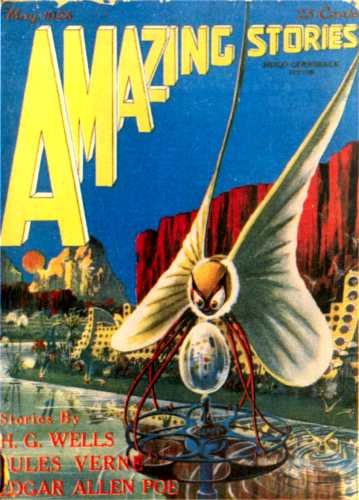
HG found a new audience in the American pulps---including GR Posted by Hello
It wasn't a specific injury that started GR as a voracious reader, but as he described it later, his uncertain health as a child played a defining role. He had a number of unexplained ailments: troubling breathing, weak and uncoordinated legs that made walking awkward, and even occasional seizures. So instead of sports and other physical activities, GR was more comfortable exploring through his imagination. He became an avid reader from the age of four.

When GR was born, his father was desperately looking for work. He left Texas, apparently riding the rails to Los Angeles, where his previous job as a railroad cop got him a job on the police force which was expanding in response to the fast-growing city. This job provided a steady but modest income and a home in a working class neighborhood. It was the Great Depression, and GR never forgot his father and mother's generosity towards neighbors and even strangers who weren't as lucky.

When he was old enough, GR took the streetcar to the public library to exchange one bundle of books for another. Back at home he might fortify himself with a stack of crackers held together with peanut butter, and go out on the front porch to sprawl on the old couch in the soft air of a southern California afternoon, and fall "into the dream world of books."

Like HG, GR took to reading with such fervor that his parents were worried he was overdoing it. "I have a terrible hunger for ideas," GR would say years later. " I've had it since my early years. In my youth, I realized I had this terrible hunger for knowledge-like an addict for knowledge. I remember that I just couldn't sit down without my mind working, without reading something, some experience. It seemed that this was more a flaw, this terrible hunger."

But it is common to intelligent children whose imaginations go beyond the boundaries of the expectations of their class. Though their childhoods were separated by 70 years, HG and GR read many of the same kinds of books---of exploration and adventure, both nonfiction and fiction---and read some of the very same books: tales of Robinson Crusoe and Huck Finn, D'Artagnan and Hawkeye, and Gulliver and his travels. This last in particular was to make a strong impression on both of them. And in later years, when they reached a critical point in their writing, they would both turn to the same author they recalled from childhood: Jonathan Swift.

HG and GR were also avid readers of cartoons and comic strips (HG wrote his own illustrated adventures.) But GR had a few sources of stories HG didn't: the movies (including the Flash '>Gordon serials) and the radio adventures of '>The Lone Ranger, '>The Shadow, and '>Buck Rogers of the Twenty-Fifth Century.
GR also had a type of reading that HG didn't: it was called science fiction, and one of its primary authors was H.G. Wells. This is where GR's ill health comes into play again. When GR was 11, there was a boy in his neighborhood who was witty and intelligent, but even more restricted by health problems and disabilities. GR knew what that was like, and befriended the boy, who introduced him to his own special avenue of escape and adventure: a treasure trove of magazines called Amazing, Astounding, and Science Wonder Stories.

These magazines had begun appearing in the late 1920s. It was only in 1929 (just three years before GR discovered them) that editor and writer Hugo Gernsback first used the term "science fiction" to describe the sort of story he was publishing in Amazing Stories.

Gernsback's pulps published new stories but also many of the classics, especially by Jules Verne, Edgar Allen Poe and H.G. Wells---six of his novels and 17 of his stories appeared in those Science Wonder Stories and Amazing Stories. These pulps not only created the sci-fi industry in America, they introduced Wells to new generations of readers, and writers.

So by the time he was working on ideas for his own science fiction television stories, GR probably absorbed much that came from Wells through other avenues, from other writers, from movies and TV shows that incorporated some Wellsian influence. Of course, GR had read Wells, and not just his scientific romances. Shortly before he completed his first Star Trek outline, Roddenberry had proposed a non-fiction TV series based on HG's The Outline of History.
But it all came very close to not happening. HG's discovery of the universe of stories, and his glimpses of another way of life, at first threatened to destroy him, just as his mother feared.

HG the writer almost didn't happen Posted by Hello
At the age of 17, Bert Wells was in his second year as an apprentice at a drapier shop. He had failed two previous apprenticeships, and was likely to fail this one. He lived in a dormitory above the shop with other boys similarly apprenticed---their parents had paid substantial sums for them to spend four years learning the trade. He worked thirteen hours a day, six days a week.

On Sundays he was free to stare into the blackness of the sea, determined that if he could not escape this life, he would end it.

Wells was in a provincial town called Southsea. (Ironically, the new doctor in the town was another future writer, Arthur Conan Doyle. Though the owner of the shop where Wells worked was his patient, Doyle and Wells did not meet and become friends until years later.) Wells' work there was petty and wearying, yet he was harried and harassed to move from task to task quickly, efficiently and cheerfully. "The unendurable thing about it was that I was never master of my own attention," he remembered later. The mind-bludgeoning tedium, the chatter and noise, the lack of anything to "touch my imagination and sustain my self-respect," the feelings of being a trapped alien with a foreordained future of more of the same, drove Wells to consider suicide.

To his mother, the apprenticeship was the key to his future. To HG, it was doom. He was a poor apprentice but even if he succeeded, his life would still be precarious.

Wells' son Anthony West outlined what was at stake. "It wasn't just a matter of wanting to have his own way, it was the much graver one of not wanting to be thrown aside and wasted...However liberal that vanished [19th century] order may have been in rewarding the successful, it had no pity on those who fell behind in the struggle to get on. My father was in real danger of being trapped in the worst of all social niches, that of the white-collar worker who had to keep up the appearances of gentility while earning a day-labourer's wage....He knew that he would be as good as finished before he'd begun if he gave way and accepted the role that had been assigned him."

But what was a 17 year old boy going to do to change his future? Wells thought about it all the time, and appealed to his few better-off relatives, with no success. As he thought desperately, he kept remembering his last happy time. Between failed apprenticeships, he had managed a few years of school. Just two years earlier, he'd been a stand-out student at Midhurst Middle School, where he'd begun learning science.

He found the moons of Jupiter through a telescope, and was amazed to stand on land that had once been at the bottom of a Cretaceous sea. He was a debater and ringleader of the imagination---he made up stories that his schoolmates helped him enact. He had a satirical eye in the comics he drew and a sardonic sense of humor in his writing. He was popular and successful. But he had to leave to begin his time at the drapier shop in another town.

So he decided to write to the headmaster at Midhurst and ask for a job. There was new funding from the national government for schools, and he proposed that he be a student teacher. At first the headmaster, who had no doubt about HG's brilliance, didn't think it could be done. Then he relented, but said he couldn't pay much more than room and board. Months later, when he found himself able to make a better offer, Wells was finally able to persuade his parents to let him go. It was the moment that changed his life.

The Time Machine was HG's first success Posted by Hello
For soon after he'd found his niche at Midhurst, happily contemplating a career as a teacher and perhaps one day a headmaster, he got a letter in the mail. The results of several national exams he had taken were forwarded to the Normal School of Science, a new university in London organized to train the scientists that growing industry needed. His high marks made him eligible for a scholarship. Wells applied, and was astonished when he got in. He was the first in his family to go to a university.

On the edge of the elegant Kensington Gardens, near the legendary Albert Hall and the great Gothic spire of the Albert Monument, the Normal School of Science campus was a fantasyland of red and yellow brick buildings glistening in the fog: its architecture of turrets and spires, domes and arcades were part Camelot, part Arabian Nights.

For young H.G. Wells, arriving with his "cheap shiny handbag", notebook and colored pencils, it was "one of the great days of my life."

That first year was his most important. For several months he took his first science course from one of the most eminent men in England, T.H. Huxley, a scientist, statesman, education reformer who is remembered most today for being a friend and defender of Charles Darwin.

Learning Darwin's theory of evolution by natural selection from Huxley himself would be HG's most important intellectual experience. It would shape and inform his writing for decades, particularly his scientific romances.

HG began making a name as a writer in his student days, when among other articles he published his first attempts at a time travel story in the student magazine he helped to establish. He found himself in London at the height of its power and influence, particularly in science and technology. The city was growing fast, and new newspapers and magazines were springing up. But HG didn't have it easy. His bad health and the effects of this new life took their toll. He tried to make a living as a writer, but was having a hard time.

Then he happened to read a passage in a book by J.M. Barrie (author of "Peter Pan") that suggested to him how he might write for a broader audience. He began getting more assignments, and started publishing a new version of his time travel story in serial installments. But that magazine was sold and his editor fired before the story was finished. Months later, when that editor got a new magazine, he asked Wells to write his time travel story again, and gave him some suggestions on how to make it more popular. The Time Machine was published successfully as a serial, and when it came out in book form, H.G. Wells was launched as an author. He was 29.

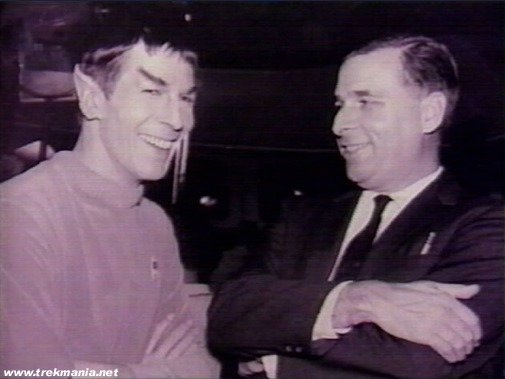
Who is not Spock? Posted by Hello
Los Angeles was not the nerve center of the world that London was in the 1890s, but it was a city of the future. And while London had been the center of the most popular storytelling forms of its day, particularly the novel, the Los Angeles of the 1950s was already the undisputed movie capital and was rapidly become the center of the most popular storytelling form of the near future, television.

Though GR was also the first in his family to earn a university degree, and though he took various writing courses over the years, he was not trained as a writer. There were no courses on television writing anyway, since it was still being invented. While working for the Los Angeles Police Department, GR sold stories to "Dragnet," and got scripts of the shows in advance of their airing, so he could read along as he watched. He turned down the sound to study the visual language, and turned his back on the screen to listen to the dialogue and sound effects.

He started selling stories and scripts to other shows but ran into some difficulty until some advice from the successful popular writer, Earle Stanley Gardner (creator of Perry Mason) helped him through some rough spots. But this kind of advice was useful in only a limited way. The important quality was imagination, and though GR was thoughtful, philosophical and an avid consumer of information, he also dreamed. "I turn on a kind of mental screening room," GR explained. "I watch whatever is on the screen. I watch their faces, their movements. I see their backgrounds. I listen to their voices."

This is pretty similar to what Wells said about writing his scientific romances. Ideas came to him, he said, as in a dream: he would think of a subject, and images would float before his eyes. "I would discover I was peering into remote and mysterious worlds ruled by an order logical indeed but other than our common sanity."

Then in the early 1960s, when he was becoming increasingly frustrated with what he was and wasn't allowed to write about as television drama, GR remembered someone he'd read in younger days. "I thought with science fiction I might do what Jonathan Swift did when he wrote Gulliver's Travels," Roddenberry told an interviewer. "He lived in a time when you could lose your head for making religious and political comments. I was working in a medium, television, which was heavily censored, and in contemporary shows I found I couldn't talk about sex, politics, religion and the other things I wanted to talk about. It seemed to me that if I had things happen to little polka-dotted people on a far-off planet, I might get past the network censors, as Swift did in his day."
GR is linked to HG by Swift, and the science fiction of consciousness. In a preface to a collection of his early science fiction novels, including The Time Machine, Wells wrote this: "My early, profound and lifelong admiration for Swift, appears again and again in this collection, and it is particularly evident in a predisposition to make the stories reflect upon contemporary political and social discussions."

The real HG Posted by Hello
When GR began putting together the Star Trek universe, he and the other principal participants followed rules that were new to television science fiction. But many of these rules for effective science fiction had become basic to the best sci-fi authors, and nearly all of them originated with H.G. Wells.

HG described them in the preface to the aforementioned collection of tales he had written mostly in the 1890s, in what could have been a prescription for Star Trek in 1965.

The first ingredient, Wells wrote, is the element of the fantastic: "the magic trick." The writer's job is to build the reader's belief. For science fiction, there must be some scientific basis or at least plausibility. If all else fails, "an ingenious use of scientific patter might with advantage be substituted." (We call it technobabble.)

To bolster believability, Wells said, there should be only one fantastic element, one basic "what if." Its credibility depends partly on surrounding the unexpected with lots of the expected. The writer must help the reader "in every possible unobtrusive way to domesticate" the fantastic element. The reader has to be drawn into the story-and too many things that go against known reality or common sense would likely destroy that suspension of disbelief. "Nothing remains interesting when anything may happen."

"The thing that makes such imaginations interesting is their translation into commonplace terms, and a rigid exclusion of other marvels from the story. Then it becomes human," Wells wrote. " 'How would you feel and what might not happen to you?' is the typical question... "

"As soon as the magic trick has been done the whole business of the fantasy writer is to keep everything else human and real," Wells concluded. "[T]he whole interest becomes the interest of looking a human feelings and human ways, from the new angle that has been acquired."

HG also comments on the role of his fictions in anticipating the future. Although for awhile in the early 20th century, he advocated a scientific study of future trends (and became the first modern futurist), Wells denies that is the intent of his fiction. "...these stories of mine collected here do not pretend to deal with possible things," he wrote. "...they are exercises of the imagination in a quite different field..." His intent often was "a broad criticism of human institutions and limitations, as in Gulliver's Travels."

But in creating plausible futures, Wells, like Star Trek, anticipated actual inventions and happenings. HG's most spectacular hit was imagining (and naming) the atomic bomb, decades in advance.

One more similarity is worth mentioning. GR is often criticized for taking too much credit for Star Trek and the ideas presented in it. Perhaps he did. But few ideas are original, and it is the synthesis and presentation of ideas that is important in storytelling. The same was true of HG.

"Wells was a brilliant man, but he was not an original thinker," writes Frank McConnell. "His gift was for imagining, for realizing firmly, almost visually, the implications of his age's philosophy and science, and for communicating those implications to his readers with the urgency of myth. The same may be said of Shakespeare."

The same may be said of GR, foremost among those individuals who, working together, created Star Treks.

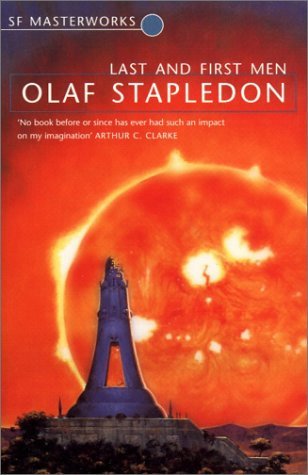
'>The mything link between HG and GR Posted by Hello
There is one final connection to make between HG and GR, and it is another writer. Although HG essentially created science fiction as we know it in the 1890s, it more or less languished until the pulps inspired its reemergence in America in the 1930s. But Wells had one prominent younger disciple: Olaf Stapledon. Not well known even by science fiction fans, he is highly praised by science fiction writers and critics, and a writer Roddenberry read and studied throughout his years working on Star Trek.

In novels like '>Last and First Men and Star Maker, Stapledon combined Darwin and Einstein in the first evolutionary histories and stories of galactic civilizations that became a staple of science fiction of all kinds. His visions were also highly spiritual and profoundly influenced by war, in ways that GR could appreciate. Like both HG and GR, Stapledon believed that humanity was still in an early stage of childhood or adolescence.

"His was the noblest and most civilized mind I have ever encountered," Arthur C. Clarke said of Stapledon. "His prose is as lucid as his imagination is huge and frightening," Brian Aldiss wrote. "Star Maker is really the one great grey holy book of science fiction." When Allan Asherman interviewed Gene Roddenberry as he was beginning production on Star Trek: The Next Generation, Roddenberry was re-reading Stapledon. Sam Peeples remembered lending a couple of Stapledon's hard-to-find novels to GR when he was conceiving Star Trek in the 1960s. Of Roddenberry's original concept for Star Trek, Sam Peeples told Asherman, "I think he] wanted to do a more realistic, a more earthy version of Olaf Stapledon's concepts that were so enormous and staggering."

Monday, June 06, 2005

"The Star Trek 60s" (first installments) follows this preview essay on H.G. Wells "The War of the Worlds" and the Spielberg movie opening this month. (More to be posted in coming weeks.) Click here to go directly to STAR TREK: ALTERNATIVE FUTURES.

The original Wells' alien fighting machines, which inspired the Star Wars' Imperial Walkers and the Spielberg version in "War of the Worlds" Posted by Hello

Spielberg's Wells Preview: We have met the Aliens...Are they Us?

By William S. Kowinski

This is the full version of an article that appeared in the San Francisco Chronicle "Insight" section on Sunday, June 5. More here on Wells etc. next week.


Now that George Lucas has shattered box office records with a cautionary space opera tale of a democracy transforming itself into the dark side of empire with a war fought on false pretenses, that other reliable colossus of the summer blockbuster, Steven Spielberg, follows with the mother of all space invasion stories. This time the empire is contemporary America, and it is being attacked by its own future.

At least those were subtexts to H.G. Wells novel, '>The War of the Worlds, published at the apex of British power at the end of the nineteenth century. Spielberg's movie reportedly diverges in several important respects: besides the change of time and place, the alien invaders are no longer Martians and they don't arrive in capsules which the population mistakes for meteors.

The central character is not a scientist/philosopher separated from his wife and on his own, as the invaders lay waste to the English countryside and then destroy London. Instead it's Tom Cruise as a previously indifferent urban working class father who must save his children from the pitiless power of the highly advanced, voracious and invulnerable invaders. But in other respects, the film appears to follow Wells' story at least as faithfully as earlier adaptations.

Spielberg's 1970s and 1980s cuddly aliens in "Close Encounters of the Third Kind" and "E.T.: The Extraterrestrial" were in striking contrast to the usual cinematic monsters from space. Though his filmmaking skills will likely still inspire wonder, this movie's intent is to scare the popcorn into the audience.

Wells' story has been reliably scary in previous adaptations, notably the '>1938 Orson Welles Mercury Theatre radio version which transferred the action to New Jersey and caused newsworthy panic in several American cities, when the format of fake newscasts convinced some listeners a real invasion was underway.

The previous big screen version was a Technicolor attack in 1953, effective enough to scare at least the nine year olds (like George Lucas) and seven year olds (like Spielberg and me) who saw it then, or more likely a few years later at a Saturday matinee.

H.G. Wells died in 1946 (the year Spielberg was born) so he was very much alive to hear about the panic caused by the Orson Welles version, and he was furious. He didn't like his work turned into a Halloween prank to scare people (the broadcast was on October 30.) That was not the message he had in mind.

Of course he was still out to scare people--- but for a purpose. He was incensed by the complacency of Edwardian England in a world he knew was about to change radically, and he tried to shock his "The War of the Worlds" readers with intimations of a type of warfare---arriving from the sky, and attacking not just armies but civilian cities---they would start to see in the Great War, but would not fully experience until World War II.

But "The War of the Worlds" was more than a prescient and brilliantly told tale that launched a thousand bug-eyed monster movies. The terrors that Wells imagined resonated with the unconscious foreboding in his readers, already anxious about the ominous arms build-up in Europe. (Later incarnations would do likewise--the 1938 war worries fulfilled at Pearl Harbor, the 1953 Cold War fears.) But Wells elegantly weaved several other related concerns into his novel, which also pertain to our time.

The first is empire. Wells recounted the genesis of his story several times: he was walking with his brother Frank in the peaceful Surrey countryside, when the conversation turned to the native inhabitants of Tasmania, an island south of Australia, who were eradicated when the English transformed the island into a prison colony. What if some beings from another planet suddenly dropped out the sky, his brother wondered, and did the same to England?

Wells' chief narrator refers to the Tasmanians, who "in spite of their human likeness, were entirely swept out of existence in a war of extermination waged by European immigrants in the space of fifty years. Are we such apostles of mercy as to complain if the Martians warred in the same spirit?"

It is a passage heavily laden with Biblical imagery, hinting at the religious fervor that hypocritically accompanied such genocides. Wells extends the analogy to American Indians (even quoting Chief Joseph's famous "we will fight no more forever" as the Martian invaders lie dying from earth's bacteria, the opposite of the fate suffered by American Indians, nearly wiped out just by the diseases European invaders brought with them.)

But while Wells (along with his friend, Joseph Conrad) was opposed to the rampant European colonialism of their time and its ongoing slaughters in Africa and elsewhere, anti-imperialism wasn't entirely Wells' point.

H.G. Wells was a firm believer in Darwin's theory of evolution by natural selection, as interpreted by Darwin's friend and Wells' most important teacher, T. H. Huxley. They believed that competitions for dominance will be won by the creatures fittest to dominate in that environment at that specific time. But present dominance does not guarantee future superiority.

Though his complacent countrymen (and their counterparts in America) believed they were naturally superior and would always be, Wells didn't see the evidence in nature for such confidence. "In the case of every other predominant animal the world has ever seen," Wells wrote in an essay, "the hour of its complete ascendancy has been the eve of its entire overthrow." So even though technologically superior England and the West conquered indigenous peoples, they could just as well be conquered by beings technologically superior to them.

There is yet another irony in Wells story. He portrays the aliens as an older and more advanced race, whose planet has turned inhospitable. Their technology is imposing and unconquerable, but when his narrator glimpses an actual Martian, he is as surprised as he is repulsed. The Martians are physically weak, with huge brains and almost no bodies.

In fact, they look very much like what humans will evolve into, the narrator says, at least according to a distant relative of his, named H.G. Wells. This is the fate of humanity when it becomes dependent on technology. Humanity is being conquered by its own future. But only temporarily (although the nature of the aliens' demise is rumored to diverge from Wells.)

Though in his novel Wells several times suggests that we consider the point of view of peoples that Europeans conquered, he never creates sympathy directly for the Martians. We see nothing from their point of view. They always remain utterly and inscrutably alien, with no trace of humanity. They are relentless, coldly efficient, highly coordinated, and utterly rapacious. They collect humans only for their food. Everything on earth is simply for their use.

Some would say this is already a portrait of the present. We have built mighty technologies and ignored the consequences to the physical world that ultimately nourishes us, and is as much a part of our bodies as our individual brains and lungs. Not heeding this will be our undoing, as physical weakness was for the Martians.

The imagery of Spielberg's film may tap into today's fears of terrorism, of aliens with technologies of mass destruction, but ultimately it should show us the shadow of our own complacency, particularly in terms of where our thoughtless dependence on our dominant technologies may lead us.

If we think of these aliens as simply the Other, a throwback to 1950s space monsters or stand-ins for whichever foreigners we fear threaten us, then Wells' point is lost. He is asking us to face ourselves.

Like Huxley, Wells believed that humans could step outside natural evolution by engaging consciousness, ethics and morality. The process of imagining ourselves the victim of our own blind actions is a step that this novel helps us take. Perhaps Spielberg's film will as well.

Sunday, June 05, 2005


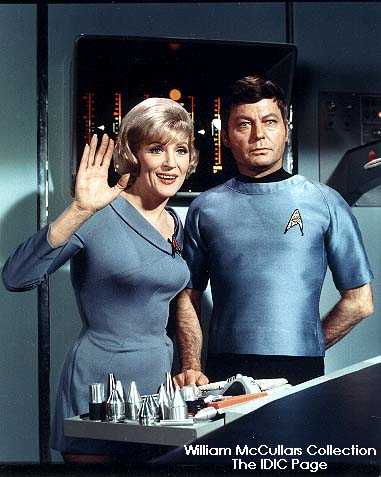
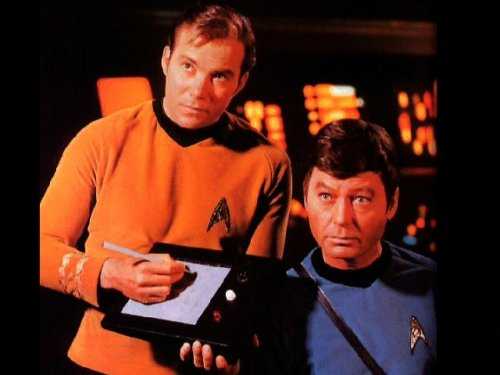
Majel Barrett and DeForest Kelley: You say goodbye, and I say hello Posted by Hello
The Star Trek 60s


Over at Trek Today, Michelle Erica Green has begun reviewing episodes of '>Star Trek, the original series (TOS) in the order they first aired on NBC beginning in September 1966.

I thought I would add a little external and historical context, eventually month-by-month, even week-by-week when events of the time warrant, as Michelle continues her reviews. This might help today's DVD and TV viewers understand a little more of what the creators of Star Trek and those first TOS viewers were seeing and hearing and experiencing in the wider world, which in 1966-69 influenced daily life to an extraordinary degree, and often had a major impact on how people felt and how they thought about the world, and the future.

I'll be doing this in a general way, but also with more specific reference to Star Trek creators and to the prime Star Trek audience: the early baby boomers, who were teenagers and young adults in those years.

First, some pre-1966 historical background.

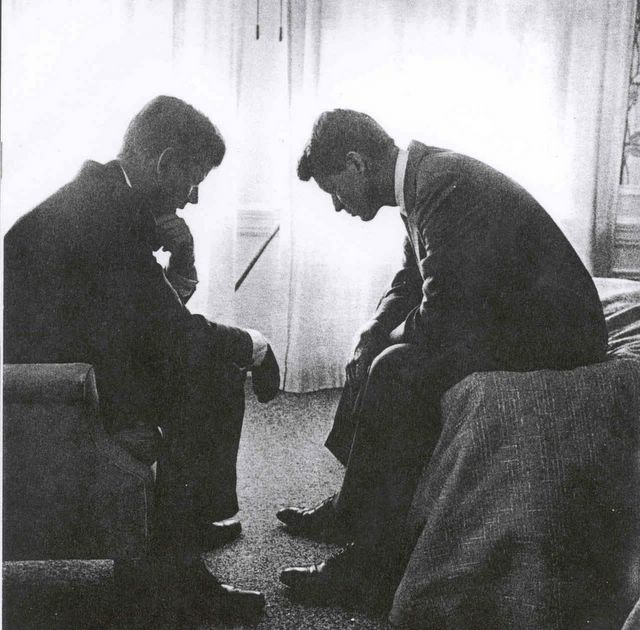
John and Robert Kennedy during the Cuban Missile Crisis 1962 Posted by Hello
Gene Roddenberry wrote the first known proposal for a Star Trek series in early 1964. This means that he started this version within months of one of the most important and devastating events of the 1960s.

A few years earlier, at the Democratic National Convention held in Los Angeles in 1960, Senator John F. Kennedy won the party's presidential nomination. He was 43 years old. Gene Roddenberry was 39. GR may have known about Kennedy from World War II, when they both served in the Pacific.

While Roddenberry was flying bombers from Guadalcanal, Kennedy was the skipper of a small PT boat patrolling the Solomon Islands. They were so close geographically that on the day Kennedy's PT boat was sliced in half by a Japanese destroyer, planes from Roddenberry's base were dispatched to search for survivors. If it hadn't been for an accident to his plane, GR probably would have been among them.

When his boat was destroyed, Kennedy swam three miles to a small island, towing an injured man with a rope held in his teeth, and leading two others. He kept them alive for six days until they were rescued.

Although GR was no longer in the Los Angeles Police Department in 1960, his friends on the force had their hands full with the convention that summer. GR was a Democrat, as his father had been, so it's likely he was paying attention when Kennedy made his acceptance speech on a hot July evening to 80,000 people in the Los Angeles Coliseum, and a nationwide TV audience. GR would have heard this leader of his own generation say:

"The world has been close to war before-but now man, who has survived all previous threats to his existence, has taken into his mortal hands the power to exterminate the entire species some seven times over."

"Here at home, the changing face of the future is equally revolutionary...A technological revolution...an urban-population revolution...a peaceful revolution for human rights-demanding an end to racial discrimination in all parts of our community life...a medical revolution...a revolution of automation..."

"Too many Americans have lost their way, their will and their sense of historic purpose. It is time, in short, for a new generation of leadership..."

"I stand tonight facing west on what was once the last frontier. From the lands that stretch 3000 miles behind me, the pioneers of old gave up their safety, their comfort and sometimes their lives to build a new world here in the West....Their motto was not 'Every man for himself,' but 'All for the common cause.'"

"...we stand today on the edge of a new frontier-the frontier of the 1960s, a frontier of unknown opportunities and paths, a frontier of unfulfilled hopes and threats..."

"The new frontier of which I speak is not a set of promises-it is a set of challenges...Beyond that frontier are uncharted areas of science and space, unsolved problems of peace and war, unconquered pockets of ignorance and prejudice, unanswered questions of poverty and surplus."

"My call is to the young at heart, regardless of age, to the stout in spirit, regardless of party."

"...I believe the times demand invention, innovation, imagination, decision. I am asking each of you to be new pioneers on that new frontier."


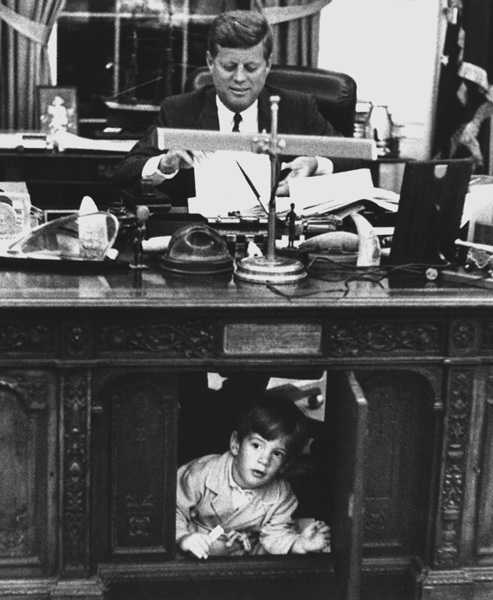
JFK and son John in the White House 1963 Posted by Hello
In November Kennedy won the presidency by a narrow margin, but the country seemed to change overnight. On a frigid day in Washington in January 1961, he delivered his Inaugural Address. People today might think that the entire speech consisted of the words "Ask not..." Even historians seem to emphasize only the warnings to the Soviet Union that America would be resolute. But at the time, there were many parts of the speech that were noticed.

"The world is very different now. For man holds in his mortal hands the power to abolish all forms of human poverty and all forms of human life."

"Let the word go forth from this time and place, to friend and foe alike, that the torch has been passed to a new generation of Americans--- born in this century, tempered by war, disciplined by a hard and bitter peace.."

"Let both sides seek to invoke the wonders of science instead of its terrors. Together let us explore the stars, conquer the deserts, eradicate disease, tap the ocean depths, and encourage the arts and commerce."

He pledged support to the United Nations, "our last best hope in an age where the instruments of war have far outpaced the instruments of peace..."

To the world's poor he pledged help, "not because the Communists may be doing it, not because we seek their votes, but because it is right. If a free society cannot help the many who are poor, it cannot save the few who are rich."

He asked his fellow citizens to join him in "a struggle against the common enemies of man: tyranny, poverty, disease, and war itself."

"All this will not be finished in the first 100 days. Nor will it be finished in the first 1,000 days, nor in the life of this administration, nor even perhaps in our lifetime on this planet. But let us begin."

And so it did begin: the Peace Corps, the Alliance for Progress in South America, raising the minimum wage, narrowly passing the first medical care for the aged funding (now known as Medicare.) There were terrible terrors along the way: the Bay of Pigs fiasco and the Berlin blockade in 1961, the Cuban Missile Crisis in 1962 when the world came as close to thermonuclear Armageddon as it ever had. But Kennedy learned quickly, and in the Cuban crisis he kept his cool, kept his options open, and managed to end the crisis with imagination and intelligence, and not a little craftiness and knowledge of human nature.

He brought imagination and intelligence into the public arena, and suddenly it was stylish to be smart. Kennedy's press conferences were a revelation of erudition and wit. The emphasis on brainpower in the Kennedy government provided a new legitimacy to the life of the mind. Suddenly the egghead was in, and the intellectual was sexy.

Kennedy was also the first President since Teddy Roosevelt to promote physical fitness, and the Kennedys were often photographed sailing (an avocation GR would share) and the Kennedy clans' touch football games became legendary.

Kennedy made perhaps his boldest move just months after his Inauguration. Since the Soviet Union shocked America by orbiting the first artificial satellite in 1957, it had remained ahead of U.S. efforts in space. In April 1961, Yuri Gagarin became the first human to orbit the earth. The U.S. succeeded in only a sub-orbital manned flight in May, when Alan Shepard became the first American in space. Nevertheless, that same month, President Kennedy pledged that the U.S. would land a man on the moon and return him safely to earth within the decade.

"Now it is time to take longer strides---time for a great new American enterprise," Kennedy said. He called for new funds and a new dedication, for the goal could only be met if "every scientist, every engineer, every serviceman, every technician, contractor, and civil servant gives his personal pledge that this nation will move forward, with the full speed of freedom, in the exciting adventure of space."

Jacqueline Kennedy, November 25, 1963 Posted by Hello
After the Cuban Missile Crisis, JFK made it his mission to slow down the arms race with a nuclear test ban treaty. When negotiations stalled, he made an impassioned speech at American University in June 1963. He spoke of the need for peace:

"I am talking about genuine peace, the kind of peace that makes life on earth worth living, the kind that enables men and nations to grow and to hope and to build a better life for their children," he continued. "Not merely peace for Americans, but peace for all men and women; not merely peace in our time, but peace for all time."

"Total war makes no sense," Kennedy said, repeating the phrase several times, emphasizing devastation so extensive it would be visited on "generations yet unborn." "I speak of peace, therefore, as the necessary rational end of rational men."

Though he acknowledged the value of dreams and hopes, he advocated an attainable peace "based not on a sudden revolution in human nature but on a gradual evolution in human institutions...Genuine peace must be the product of many nations, the sum of many acts...For peace is a process, a way of solving problems."

But he refused to believe peace is a hopeless dream. "Our problems are man-made; therefore they can be solved by man."

The most quoted---and plagiarized--- phrases of the speech are these: "For in the final analysis our most basic common link is that we all inhabit this planet. We all breathe the same air. We all cherish our children's future. And we are all mortal."

But other things were happening in June 1963. The day after this speech, Alabama Governor George Wallace announced he would personally bar the admission of the first two black students to be enrolled at the University of Alabama under federal court order. This followed weeks of violence in Birmingham.

The Civil Rights struggle had gone public in the mid 1950s, with numerous demonstrations, marches, clashes and acts of violence. The largest demonstration in U.S. history was the March on Washington for Jobs and Freedom, now known as the Civil Rights March of 1962, the occasion of Martin Luther King's most famous "I have a dream" speech.

Though Wallace's threat in 1963 was little more than an act for the TV cameras---when the federal marshal ordered him to stand aside, he did---Kennedy decided to address the nation that very night. With little in the way of prepared text, he delivered a speech on civil rights. Equality is a moral issue, he said, "as old as the scriptures and...as clear as the American Constitution....In short, every American ought to have the right to be treated as he would wish to be treated..." The day before he had urged empathy for the Soviet people; now he asked white Americans to imagine themselves in the place of black Americans. "Who among us then would be content with the counsels of patience and delay?"

Kennedy's civil rights legislation would not become law for a few years, but his American University speech had immediate impact around the world. Soviet Premier Khrushchev told an American representative in Moscow that it was the best speech by an American president since Roosevelt. Negotiations moved swiftly forward. Some six weeks after the American University address, the nuclear test ban treaty was signed.

As Kennedy traveled across America in late fall, he spoke often about the issue of peace, to increasingly enthusiastic response. This was the last image, and the lasting image, held by many Americans and certainly many people around the world.

Then came the unbelievable, horrifying, devastating moment on Friday, November 22. President Kennedy's assassination, the tumultuous events in Dallas that weekend while the nation stopped cold to watch the first televised funeral of a President. In between events, Kennedy's major speeches were re-aired, and the worldwide reaction shown.

Even in death, John F. Kennedy was an important presence in American public dialogue for several more years. For people of GR's generation, the loss of JFK and "the politics of hope" was immediate and devastating: it affected their present. The oldest of my generation, the early baby boomers, were 17 in 1963. Losing JFK was losing a vision of the future, and of our future.

Mary Quant, inventor of the miniskirt, 1964 Posted by Hello
Between the time GR submitted his first Star Trek proposal and (two pilots later) the fall of 1966 when the first episode aired, much of what would characterize the second half of the 60s was emerging.

As the decade of the 1960s began, many of the social mores of the 1950s and before held sway. Segregation and overt acts of racism were common throughout America. Though stereotypes based on ethnicity and "national origin" were fading, they were often still openly present. Women were expected to marry and be homemakers. If a woman over 21 even walked down a street alone with no department store in sight, she was in danger of being considered a "streetwalker" (a prostitute.)

Speaking of 21, that was the minimum voting and drinking age in most states. Men were eligible for the draft at 18, and required to register shortly after turning 18. There were deferements for college and graduate school but they weren't automatic; everything was up to the local draft boards, though policy was set by General Hershey, head of the Selective Service in Washington.

Men were expected to marry, buy a house in the suburbs, hold a steady job (working class, lower middle class) or do whatever was necessary to gain raises and promotions, preferably at a large corporation (middle and upper middle class.) Although sexual infidelity was not rare, divorce was. Except for a small percentage of wealthy urbanites, psychological or mental health treatment was unheard of. The sole test of sanity was holding down a job. If you couldn't, then you were crazy and fit for an institution.

It would be at least a decade before homosexuals could admit their preference without instantly endangering their jobs, a place in the community and perhaps their lives.

Some of this was changing by the mid-1960s. The sense of social and sexual liberation, and the dominance of youth culture was expressed in such phenomena as the Beatles and the British Invasion in pop music, and in fashion, Mary Quant's invention of the mini-skirt in 1964.

The Free Speech Movement at the University of California at Berkeley (which Captain Kirk would someday claim was where Mr. Spock took too much LDS) was in 1964, and together with earlier student demonstrations against the House Un-American Activities Committee hearings in San Francisco, signaled the beginning of what would be many student protests on a number of issues, not only in America but around the world.

Then in 1965, President Lyndon B. Johnson significantly "escalated" the Vietnam War with bombing and many more American troops, which would continue increasing for the rest of the decade. The first "teach-in" on Vietnam occurred at the University of Michigan in 1965, and quickly spread. By 1966, larger and more widespread protests had begun.

Movies and TV may leave the impression that protests were all emotion and noise. But much of the time was spent in talk, in all areas of protest but especially Vietnam. In discussions of books, of magazine and newspaper articles, of debate on political principles, moral standards and ethics, information on geopolitics and the clash of information on how the war was being conducted and why. There was plenty of emotion, but there also was a lot of logic.

The percentage of active student protestors was relatively small, especially at first, but because the Baby Boom generation was so large, their numbers were impressive. And even though many students agreed with the protestors even if they didn't protest themselves, these actions and issues caused controversy and conflict on campuses. The so-called "generation gap" was beginning between the boomers and their parents, but also within the young generation. From our generation came both the soldiers and the protestors, for the rest of the war. And our generation by and large was the first Star Trek audience.

So a little background on just what the Baby Boom was.

As the battleship Missouri was sailing for Tokyo Bay to accept the surrender of Japan in late August 1945, my parents were in church getting married. I was born the following June, when the number of births shot up significantly for the second straight month. Demographers foresaw something like this in the year after the war ended, but they didn't expect it to continue. They thought the birth rate would decline. The U.S. Census Bureau predicted the country's population would reach 163 million in the year 2000.

But it not only continued, it accelerated, until more than 4.3 million children were born in 1957. There would be around 4 million births per year until 1964, which demographers now mark as the end of the Baby Boom. The U.S. population reached 180 million in 1960.

We were the first generation to grow up with suburbia, television and the highway. Because there were so many of us, the culture seemed to change in response to us at every age. When we started school we overcrowded them, and started a national school-building trend. The consumer economy grew with us, and often because of us. And even though demographics hadn't yet come to the young medium of television, we were a prime audience.

Thanks in part to all the buying and selling these new families generated, America was more prosperous than ever in 1966. When the 1960s began, half the U.S. population was under 30 years old. By the end of the decade, half the population was under 25, with 40% younger than 18.

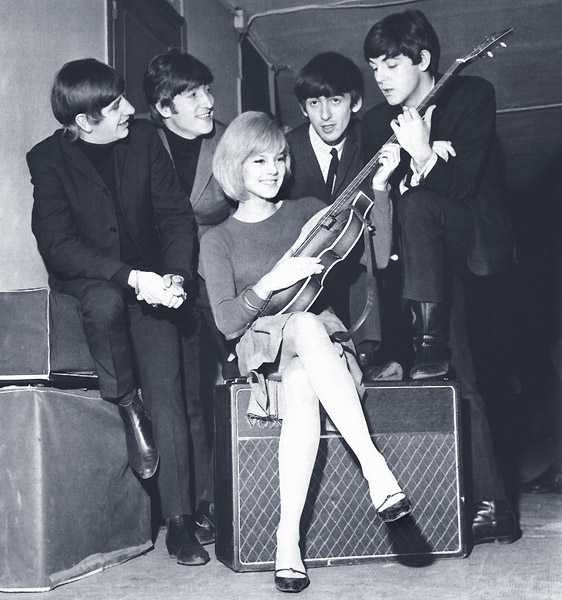
The Beatles and an early clue to the new direction Posted by Hello
1966

In January, the Director of the Selective Service (the Draft) announced that tests and class standings would again become criteria for deferment of college students from the draft.

Pope Paul VI appeals to the governments of North and South Vietnam, China and the Soviet Union, to come to a peaceful settlement in Vietnam.

In February, the U.S. announced its forces suffered more than 1200 casualties in Vietnam during January, an increase of 300 over December. They included 176 dead, 1049 wounded, 17 missing.

In March, astronauts Neil Armstrong and David Scott splashed down safely in an emergency landing of the Gemini 8 spacecraft, after it lost primary maneuvering power while docked in orbit with an Agena space vehicle.

Consumer prices rose sharply for the second month in a row.

In the week ending April 9, there were more U.S. soldiers killed than their South Vietnamese allies for the first time since the start of the war. More U.S. troops were killed in during the first 99 days of 1966 than in all of 1965---1361.

In May, California and Nevada passed the first state laws in the nation prohibiting possession of LSD. Ground fighting in Vietnam took the highest toll in American casualties in a single week since the war began.

In June, the Surveyor 1 spacecraft made a successful soft landing on the Moon, and sent back high quality photos. Gemini 9 's mission was partly successful. The U.S and Soviet Union agreed to meet in Geneva to review draft treaties on the peaceful use of outer space.

In July, Gemini 10 had a successful 3 day mission. Large demonstrations protesting the U.S. in the Vietnam war were held in England, France and Japan.

In July, race riots erupted in Chicago, San Francisco, Baltimore, Cleveland, Omaha and several other cities. None is as devastating as the Watts riots the previous summer, which began the pattern of looting and burning buildings. Some 15,000 law enforcement officials and 12,000 National Guard troops were called in. Thousands were arrested and 34 people were killed, most of them black, due (said an investigative commission later) predominately to inexperienced members of the Guard. In 1966, however, at least two violent disruptions began when gangs of whites attacked black citizens (in Baltimore) and Civil Rights demonstrators (in Chicago.)

In August, a 25 year old architecture student named Charles Whitman, took a small arsenal of weapons to the top of a tower at the University of Texas and opened fire on the campus below. He killed 14 people and wounded 33.

The Defense Department set the October draft quota at 46,200 men, the largest for a single month since Korean war. The Department said it was necessary because of a sharp drop in volunteer enlistment.

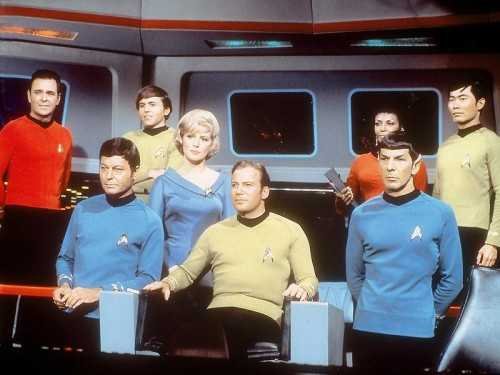
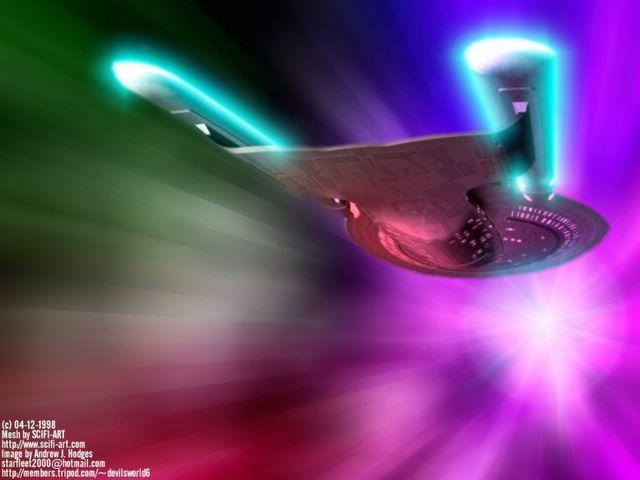
The original series Enterprise launches in September 1966
(Yes, I know Chekhov wasn't there yet!) Posted by Hello
On September 6: Prime Minister Verwoerd of the Republic of South Africa is stabbed to death by an assassin as he sits in the nation's parliament chambers. South Africa practices apartheid, which severely limits the rights of the black population. Both the Prime Minister and the assassin are white.

On September 8, 1966, Thursday at 8:30 pm, "Star Trek" airs its first episode on NBC, "The Man Trap." Its competition on ABC is "The Tammy Grimes Show" and "Bewitched." On CBS, "My Three Sons" and the CBS Thursday Night Movie. This season for the first time, nearly all prime time network TV shows are broadcast in color.

September 12: Gemini 11 lifts off from Cape Kennedy, Florida. During the three day mission, astronauts Richard F. Gordon, Jr. and Charles Conrad, Jr. pilot the craft to a record altitude for a manned vehicle. The mission ends on September 15 with splashdown in the Atlantic, just one and a half miles from the recovery ship. Millions of Americans watch the landing and recovery on live television.

Also on September 12: South Vietnamese go to the polls to elect a 117 member assembly to draft a new constitution. American supporters point to the 75% turnout as proof that democracy is working.

Also on September 12: A mob of whites armed with ax handles, chains and metal pipes attack black students attempting to integrate two neighborhood schools in Grenada, Mississippi. The violence continues on September 13, and several police officers will later be charged with willful dereliction of duty in allowing the attacks on blacks to continue, and 13 men will be prosecuted for violating the civil rights of the children. The mob also attacks TV reporters.

Tuesday, May 31, 2005


The Trek future? Posted by Hello
Star Trek: Alternative Futures

by William S. Kowinski

Now that '>Star Trek: Enterprise has come to its premature end and the infrastructure that supported Star Trek on television for the past 18 years has disbanded, the future of the Star Trek "franchise" is in doubt.

As Leonard Nimoy reminded me last summer, laughing the entire time, Star Trek has been dead before. The original series was nearly cancelled after the first season, just about cancelled after the second season, and declared dead after the third. Then a decade later it was resurrected for one and only one movie '>("Star Trek: THE Motion Picture as Nimoy says). When the actors gathered for each of the next four original cast movies, they never officially were told there would be another one. Then came their sixth, and by then, there was no question that Star Trek was alive: after all, it had reproduced, and was considered very fertile.

Now several years after its first real big screen financial failure (although when the DVD and other income gets factored it, it's doubtful even '>Nemesis will have lost money) and its first series since the first to be cancelled before the ideal (for moneymaking) seven year lifespan, Star Trek is dead again.

There are so many factors involved in whether there will be new Star Trek stories on TV or at the movies that predicting a single future is unrealistic. Some of those factors are: judgments of new management at Paramount, creative leadership, the pros and cons of the established fan base, potential audience in the next several years beyond that fan base.

How these factors play out can lead to several different outcomes. So let's play a game of alternative futures, and reverse engineer them to create a supporting scenario.

text continues after photos

Are you sure? Gone forever? Posted by Hello
Future # 1: It's dead, Jim.

There will be no more Star Trek stories on television or in the movies. Paramount believes the Star Trek name is toxic. The public at large considers it a nostalgic throwback, and won't support new stories, while the fan base has become more trouble than it's worth: Aggressive and impossible to satisfy, able to destroy projects well in advance based on rumors, they are nitpicking scholars who examine every story for heresy according to the holy writ of canon, and issue their edicts through the Inquisition of the Internet.

Today’s audience isn't interested in a hopeful model for the future; they want violence as the realistic solution, neocon empire building and high tech warfare. Basically reactionary and lazy, they don't have the patience to follow intelligent stories without video-game violence.

They aren't interested in how humanity gets better and preserves its soul in the face of technology and the unknown, they want revenge fantasies and variations of evil, fear, envy, hatred, etc---all the wonderful qualities on display in the world today-- and simplistic superheroes to save the day.

They don't want "What if?" stories that provoke thinking and examination of today's human behavior, or serious science fiction; they want good v. evil (meaning us v. them) fantasies with vampires, evil spirits, vast digital armies of insect aliens and other characters that are more visual effects eye candy than substantive or meaningful beings.

It's been a great run, but even in the story of the boy who cried wolf, the wolf finally came. It's over.

Of course, Paramount will want to continue making money from the franchise, so it will keep and enforce its licensing of the Star Trek name. They could simply copy the most successful warfare-in-space show and call it Star Trek. However, a slight variation on this leads to scenario # 2:

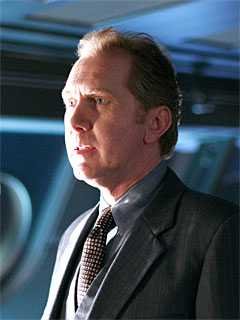
Trek Trivia: What previous Trek episode did Harry Groener appear, who played Nathan Samuels in Enterprise's "Demons" and "Terra Prime"? Posted by Hello
Future #2: Hand me the tricorder--maybe there's still a pulse.

Paramount has a lot on its plate and on its mind at the moment, so the prudent thing to do would be: nothing much. Just sit back and see how things unfold. Will the fan base wither? Will demand build? Will someone come forward who is interested in reviving Star Trek?

Somebody like... Steven Speilberg (currently awaiting the presumed blockbuster sci-fi movie, "War of the Worlds" he made for Paramount)? Or George Lucas who tried to acquire the Star Trek franchise before he made Star Wars?

Then of course Paramount would have to decide whether to make a deal that would probably mean they'd lose control of the franchise, or whether the fact that somebody like Speilberg or Lucas is interested in reviving it means they should take another look at it themselves.

Paramount could further test the waters, and maybe ascertain whether there is a future beyond conventional TV and feature films, by providing limited rights to outfits like New Voyages and Hidden Frontier to sell their movies on DVD. This would provide income to Paramount while giving them some idea of audience, and what might appeal to them. Sure, it's already embarrassing that some of these fan made movies are more popular than Enterprise was, which could be a problem if Paramount decides to make their own movies or TV shows again. But it could also be a low risk research tool, eventually a marketing tool, and a new way to bring in some cash for awhile longer.

Patrick Stewart and Gates McFadden from Star Trek Nemesis Posted by Hello
Future #3 The Next Next Generation (Feature Film Division)

There's a certain conspiracy theory around that says Paramount wasn't really unhappy with the failure of Star Trek Nemesis, the most recent Star Trek feature. The feature film business is changing, and only big event movies justify big budgets. With the cost of digital effects falling, the biggest expense is getting to be the salaries of star actors. Star Trek films no longer are the big events with the major first weekend receipts; Trek films, like most films, make an increasing percentage of their money from DVD.

But Paramount couldn't simply abandon the Next Generation cast without alienating the fans that provide a reliable base of ticket sales. Nor could they have counted on the Star Trek infrastructure (Rick Berman, etc.) to go along with a completely new cast and concept. So they deliberately released the film when it would get clobbered by the real event blockbusters of today.

Whether or not that much is true, Patrick Stewart has indicated that his negotiations to appear in this film were particularly difficult, and they nearly broke down. And it is indisputably true that Paramount marketed the film as if it was going to be the last Next Generation movie ("a generation's final journey begins"), which evidently took the cast by surprise.

There has been regime change at Paramount since then, which makes this scenario more problematic, but Rick Berman has been talking about the story in development which doesn't feature known Trek characters. That of course translates into not featuring known Trek actors.

Less money for established stars means more for effects and other parts of the budget. It also means you don't have the big names that draw people to the theatres. Therefore you are going for the long-term DVD market, while hoping for a theatrical release surprise.

This strategy might mean that Paramount will have to cater to the fan base. If so, then there are a couple of other elements likely to be part of this alternative. First, the timing has to be such that enough time elapses to whet fan appetite, but not too much that the fan base dies off.

Second, that there is some continuity. If the Age of Berman is over (see the next alternative) then somebody else identified with Star Trek might very well be involved. The likeliest candidates are from the Next Generation: Jonathan Frakes and/or Levar Burton. Frakes directed the most successful Next Generation film, he's been a good soldier for Trek (even appearing in Enterprise) and he's on good terms with the rest of the Next Generation cast and crew, as well as with at least some of the original series folks, and subsequent ones.

Burton has directed episodes of every Trek series except the first, is very articulate and clear on what Star Trek is about, and has established relationships with cast members and others from the subsequent series to TNG, as well as the kind of ties and experience Frakes has. Both are liked and respected by fans. Both were hired by Gene Roddenberry---a very important qualification for traditional Trek fans, and even for executives who want to recapture the magic of the 1970s through the early 1990s.

Rick Berman and Jolene Blalock Posted by Hello
Future Scenario #4 The Age of (Rick) Berman is Over

This is less a stand-alone scenario than a likely prelude to whatever Paramount decides to do.

There have been only two chief executives in Star Trek's history: Gene Roddenberry and Rick Berman. Rick Berman ran Star Trek during its most profitable times and its slow decline. He presided over more TV episodes and movies than Roddenberry did, and even wrote more Star Trek stories.

Many people who worked with and for Rick Berman praise him for his patience, his loyalty, generosity and judgment. But Berman was not an originator. He said consistently that his job was to enact Gene Roddenberry's vision. Though each of the series he oversaw after GR (DS9, Voyager, Enterprise) diverged more and more from GR's universe, and one can argue that Enterprise was his main assertion of independence (he wrote more scripts and stories for it, made certain changes in the template and didn't have Star Trek in its title at first), he still maintained he was continuing GR's concept, within the continuous Star Trek universe.

It's fascinating to contrast the two chiefs of Trek. GR was and remains a controversial figure, the subject of several book-length '>biographies, including one by a careful scholar who nevertheless was a personal friend and authorized biographer, and another by someone who sought out and included every nasty comment made by people with an ax to grind he could find.

There are no biographies of Rick Berman, and not even a major magazine profile. There have been many books written about Star Trek during Roddenberry's rule by other participants, including the entire original cast (except for DeForest Kelley), and few if any by participants during Berman's rule.

In short, we have a lot of information about GR (a lot of it contradictory) and his role in developing and running Star Trek, as well as about his ideas, friends, lovers, family, favorite recreations, childhood etc. In contrast we have almost no information on any of this about Rick Berman.

Maybe it's none of our business, but it does suggest a crucial difference that may in fact be obvious. GR orchestrated the creation of Star Trek, out of his own head and from the contributions of others he got involved and consulted. Rick Berman orchestrated the continuation of Star Trek.

This was not an uncreative enterprise. New takes on the Trek universe, new stories within it, and adapting to new business relationships and to changes in technology and so on, all required creativity. But it may well be that Trek was not creatively renewed at the level of ideas that were important to its creation.

For example, GR and his initial team consulted regularly with scientists and technicians at NASA, JPL and elsewhere. GR sought advice and ideas from major science fiction writers he befriended---Ray Bradbury, Issac Asimov and Arthur C. Clarke in particular. Ted Sturgeon, Harlan Ellison and other science fiction writers contributed key stories and scripts. (Even in the Berman regime, during TNG and later, new ideas came over the transom thanks to an open submissions policy that was lacking during Enterprise.)

However it worked, there seemed to be more contact with cutting edge ideas---in psychology and metaphysics as well as physics---in the Roddenberry era, plus the last 3 years of TNG. Maybe there just weren't that many new ideas around from the 90s to now, but I don't think so. I'd venture to suggest that there was even gradual retrenchment, with more interest in recapitulating the past but throwing it forward into the future.

The argument can be made that the science fiction basis withered under Berman, as well as the strong point of view on political and social matters that motivated GR and others early on. GR was invited to speak to assemblies of humanists, religious organizations, space technologists, futurists, Jungians and other groups at the frontier of various areas of knowledge and speculation. (And of course, he spoke often at Star Trek and science fiction conventions.) If Berman ever did this, the record is hard to find. We don't know the extent of his interest in current ideas in these fields, but it's likely that being involved in current knowledge, speculation and ideas is necessary to ongoing renewal of Star Trek.

Maybe it's a generational thing as well. GR's strong views on conflict and peace were tested in real war; he had actually flown aircraft, and been a cop on the street. Other producers and writers for the original series had real world backgrounds. Members of the original cast had experienced real prejudice (although members of subsequent casts likely did as well), and several were political activists who put their beliefs into practice. The producers and writers of the later series seem to have been in television their whole careers.

As Enterprise ended, Rick Berman made on the record statements, and applying a journalist's nose to certain newspaper articles, perhaps spoke off the record, about how limited his control over Star Trek really was. He spoke about "audience fatigue" as a major factor, but it's possible that fatigue was a more general problem.

At the moment, Rick Berman is under contract to Paramount but his only known assignment is his role in developing the story and script for the projected next Trek feature. He has refused to say what his future with Trek might be, suggesting that he will revisit that topic in six months or so. The various alternative futures of Trek will of course be influenced by whether Rick Berman continues as the chief of Trek. But with a new Paramount creative head from outside the company, Gail Berman (no relation), and the recent downswing in Trek's fortunes, it seems more likely than not that the Age of Rick Berman at Star Trek is over.

If this is so, it could pave the way for a new chief of the same Star Trek universe. Since the decision to maintain the Trek universe-the so-called canon---would indicate that Paramount wants to hold onto the fan base, it could be someone the fans trust, such as the aforementioned Jonathan Frakes and/or Levar Burton. Other figures popular in Trekdom include Nicholas Meyer, Leonard Nimoy and William Shatner. Some Trek fans would favor producer Manny Coto, but the last of Enterprise has made him a more controversial choice. Other popular former insiders, like producer Ronald Moore, are occupied elsewhere with ongoing science fiction shows and franchises.

But of course the end of the Age of Berman, if that happens, would also pave the way to something completely different.

into the unknown future... Posted by Hello
Future Scenario #5 Re-invention

Paramount might decide that Star Trek still has potential---that is, it can still inspire creative storytelling, and importantly to them, it can still make major money. But it might decide---or it might get an offer it can't refuse from the likes of Lucas or Speilberg with this demand---that the Star Trek canon universe is a dead issue, and can safely be abandoned.

Then the question becomes: will it be Star Trek in anything but name? And will the name be enough?

Some feel that a complete re-invention is possible, although only if the core integrity of Star Trek's ideals are preserved. Former Trek scribe and now science fiction novelist '>Nick Sagan suggested this to me, in an email response to questions I sent him while I was reporting last summer's New York Times story. Here's the operative quote:

"You don't have to tell stories about or even tip the hat to previous Trek characters. All you need is Gene Roddenberry's sense of hope and wonder. At its core, Star Trek is about the people of Earth optimistically uniting in purpose, sending explorers into the universe. What could be out there? That's the core of Gene's vision, and as long as you don't lose that, you can find a new voice, a new point of view about the future, and reimagine the show any of a thousand different ways."

Nick prefaced this by saying that such a reinvention would follow a period of silence, when there was no new Trek around, to give a new concept "breathing room."

It would also depend on the fan base quieting down, if not withering away. Right now Trek fandom is a chaotic concept. Internet fans seem quite different from convention-going fans, who in turn are different from casual fans who simply like watching Star Trek. Within at least the Internet activists are very different visions of what Trek is or should be.

Some of it is political and ideological, with some fans lambasting or simply dismissing GR's vision as the ravings of a naïve and deluded arcane liberal. There is a neocon and Christian fundamentalist fan presence on the net that support political and cultural agendas that GR and most of the Trek writers and actors would not---they'd probably find a lot of it horrifying. And of course, there are fans with unitary loyalty to one series, and disdain for all others, as well as those who simply like some series and movies better, and just don't care to see the others. And there is a vocal group, probably a minority though no one knows how large or small, that defends total Trek canon, including some who express contempt for some of it.

But what would re-invention look like? On the big screen, it could be a new cast of unknowns who either portray new characters or established Trek characters like Captain Kirk, but in both cases with selective or complete disregard for canon facts and stories. They would reinvent the Trek universe, and break continuity with the existing stories. Or it could be a more modest reinvention on that level, like the movies made about comic book heroes like Spiderman and Batman, with reference to certain key characters, characteristics and events, but disregard for others.

On the big screen, it could also be a total or partial reinvention with established movie stars, who wouldn't participate unless they could make the characters their own. It might be a little more like the "Lost in Space" movie versus the TV show. Would the draw of major stars compensate for the ire of old fans? Being able to answering that question "and bring in a whole new and larger audience" would be the calculation Paramount would have to make.

On TV, reinvention could be a trickier project. Even with the vaunted "audience fatigue," the Enterprise premiere attracted some 20 million viewers. Could a show that calls itself Star Trek but which fans believe isn't Star Trek overcome that resistance, and more importantly, could it hold onto the viewers made curious, if not absolutely attracted, by the Trek name?

Enterprise failed despite having an established TV sci-fi star as its lead, so casting alone won't guarantee success. Manny Coto suggested that Trek will be back on TV when a "show runner" for another hot TV series expresses interest in doing it. Maybe. But television professionalism isn't everything, as Enterprise suggests.

My instinct is that to revive and reinvent Trek, the next Trek chief will need to go back to the same process followed by GR and his team: look at the science and speculation, at the cutting edge stuff, and design a future that works, that is exciting and attractive, and has lots of room for stories.

This process is necessary not only to reimagine Trek altogether, but to take the Trek universe to where it hasn't gone before-into the 25th century perhaps, or even deeper into its earlier days.

There are other alternative scenarios, some suggested here before, like animated Trek. For now it’s all speculation. Still, this fallow period is an opportunity to hone in on what is most valuable about Star Trek, as a guide to its future.

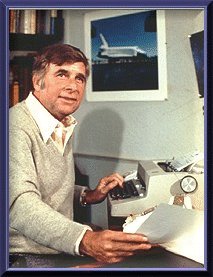
Gene Roddenberry Posted by Hello
GR did three things with Star Trek. First, he made an entertaining adventure series set in the new frontier of space: Wagon Train to the Stars. In doing so, he used some established sci-fi elements of what that future would be like, but he also added elements that hadn't been seen before.

Second, he used the Trek universe for allegories, metaphors, perspective and comment on today---not just political events but the way humans are now. He made Gulliver's Travels in Space.

Third, he realized that the opportunity to create a universe meant the opportunity to create the vision of a better one---a future people could admire, aspire to, be inspired by, and especially want to be part of, if only for an hour a week. If he made a universe we'd like to live in, people would come to it. The precedents for this would be the centuries of literary utopias, including those created by sci-fi authors. Those utopias weren't meant to be perfect societies, but they were acts of creative imagination that inspired hope for better possibilities in the future. Still, given the misunderstanding the term has today, let's just say that in this third instance, GR made...Star Trek.

My own feeling is that Star Trek still has the same basic mission, and that there is an audience for it. It would embody all three of the functions I've just described. It would offer stories in an imaginative universe that offers hope and direction for our future by partly fulfilling our current hopes, and testing them and others by means of story.

It would return the creative tension between intellectual and moral concerns and ideas, and the necessities of the form (TV series, movie) and business. It would deal with character, but also return to science fiction concepts. It would have action, but it would express adventure in ways that provide the hope that in the future, people will derive pleasure and meaning from doing good and creating as well as destroying, and that they will find challenge in intellectual and spiritual realms as well as the physical. It would have the humanity that GR professed, and it would deal with cosmic questions as well as what the people of the future would be doing in the cosmos, and how they might do it.

It would refrain from micro-managing its imagery to appeal to young men or young women or any particular "demographic," but would return to what made Star Trek successful with children, teenagers, young adults, parents and now grandparents: thought-provoking and surprising stories, told intelligently and well, classical at its core and built to last, with a minimum of graphic violence and a maximum of wonder.

When Star Trek started, nobody believed there was an audience for this kind of saga. Maybe nobody believes it now. But in the nearly forty years between, there was.
Coming Soon

What were things really like when Star Trek started in 1966? And several posts relating to the new War of the Worlds movie, including origins of the novel, the connections between H.G. Wells and Gene Roddenberry, and an essay on the new film.

Generally there are new posts once a week, appearing usually between Sunday and Wednesday.