Saturday, October 29, 2005


The evil but necessary Kirk. Posted by Picasa
Star Trek: The Inner Ape and The Enemy Within

by William S. Kowinski


“The Enemy Within” is one of the foundation episodes of Star Trek. It premiered early in the first season of the original series, the fifth to be broadcast. It’s the “two Kirks” episode, the good Kirk and the bad Kirk split off from each other. Its treatment of human nature, of accommodating the dark side rather than denying it, has become integral to the Star Trek definition of what it means to be human.

The insights of this episode were given a new twist recently by a thesis contained in Our Inner Ape, a recent book by primatologist Frans de Waal. He contends that we actually have two inner apes---the heritage of two ape species with very different ways of dealing with the world.

The story and script for “The Enemy Within” were created by Richard Matheson, already an important science fiction and fantasy author, and a consummate professional as a movie and television episode scriptwriter. In 1966 he was probably best known as the author of the novel and screenplay for one of the better “radiation mutation” science fiction films of the 1950s, “The Incredible Shrinking Man,” directed by Jack Arnold, among the most imaginative and literate filmmakers of the period working in s/f and fantasy.

In addition to his scripts for genre series television, Matheson wrote the classic “Duel” for Steven Spielberg, and adapted “The Martian Chronicles” as a miniseries (prompting author Ray Bradbury to call him “one of the most important authors of the 20th century.”) He wrote the book and script for the 1998 movie, “What Dreams May Come,” and the script for “The Omega Man,” the second film adaptation of his novel, I Am Legend. He’s done the third adaptation of it for a movie scheduled for next year, currently with the novel’s title.

So let’s review the episode. This isn’t the “Mirror, Mirror” mirror universe bad Kirk/good Kirk, where the underlying theme was choice between two paths of conduct (as it was in Star Trek Nemesis, when Captain Picard confronts his clone.) In “The Enemy Within,” a transporter malfunction splits the Captain into two Kirks: a good one (intelligent, compassionate and brave and a very bad one (violent, all appetite and action, and obsessed with survival.)

Shatner plays the bad Kirk as an animal, crouching like an ape, delighted with sensory life. As soon as he gets off the transporter pad he runs his hands over the surfaces of the controls. He’s ecstatic to feel, and he wants more. He is governed by his appetites—heading for Dr. McCoy’s brandy, and then he sexually assaults Yeoman Rand before punching out a young male technician to make his escape.

The good Kirk is puzzled, he is drawn to stillness and contemplation. He can barely understand the evil propelling his double. When they meet, he advances with the certainty of reason. His evil twin cowers, then strikes out. Only Spock’s Vulcan neck pinch prevents him from killing the good Kirk with a phaser blast. (Nimoy invented the neck pinch in this episode, enlisting Shatner to demonstrate it to director Leo Penn, who used some imaginative shots to set the mood for this story. The script called for Spock to knock out the bad Kirk with the butt of his phaser. Nimoy felt Spock would find a more elegant way to disable an enemy.)

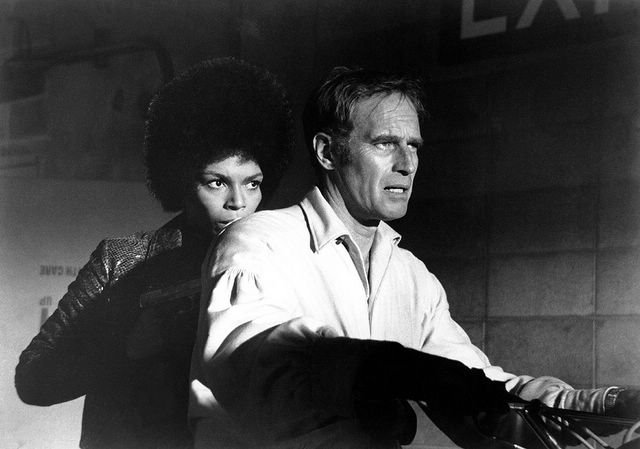
Rosalind Cash and Charleton Heston in Matheson's "Omega Man," to be remade for release in 2007. Posted by Picasa
Good Plus Evil

The simplistic idea of drama focuses on conflict, and the simplest as well as most comforting conflict is between the good guys and the bad guys, the good Force and the Dark Side. That all humans have both good and evil within them is often a theme or a subtext in more sophisticated dramatic storytelling. Critic Stephen Schiff sees it as the essential quality of Film Noir, for example. “No movie can rightly call itself noir unless it locates the nexus of weakness and evil in hero and villain alike,” he writes, “unless it convinces us that we are all capable of terrible deeds, that the fiend is merely the good guy turned inside out.”

If you’ve seen the new Sherlock Holmes TV movie, “ The Case of The Silk Stocking” (broadcast in the U.S. recently on PBS) Rupert Everett as Holmes has this noir flavor.

But this Star Trek episode extends the idea beyond this relationship of opposites. It begins to define how they relate, and how they need each other. As he observes the good Kirk becoming more indecisive, Spock proposes a theory with a barely controlled aggressiveness: Kirk is losing his force of will because his power of decision comes from his negative half.

Spock defines the bifurcation: “His negative side, which you call hostility, lust, violence, and his positive side, which earth people describe as compassion, love, tenderness.” Then he asks, “What is it makes one man an exceptional leader? We see indications that it is his negative side that makes him strong---that his evil side, if you will, properly controlled and disciplined, is vital to his strength.”

This is the apparently dispassionate analysis of the logical Vulcan. But he finishes with a cryptic comment that ends with a double meaning. “If I seem to be insensitive to what you’re going through,” Spock says to the good Kirk, “understand, it’s the way I am.”

Kirk faces losing his command unless his two sides can be reintegrated. Yet it sickens his good side to accept this. Later when he is alone with Dr. McCoy, he expresses it. “I have to take him back inside myself, I can’t survive without him. I don’t want to take him back! He’s a thoughtless, brutal animal! Yet it’s me! Me!”

Bones has brought them each a glass of brandy. “Jim, you’re no different than anyone else. We all have our darker side. We need it. It’s half of what we are. It’s not really ugly—it’s human. Yes, human. A lot of what he is makes you the man you are” McCoy is forced to agree with Spock, “Your strength of command lies mostly in him.”

“What do I have?” the good Kirk asks. “You have the goodness…” “Not enough!” “The intelligence, the logic---it appears your half has most of those, and perhaps that’s where man’s essential courage comes from. For, you see, he was afraid. You weren’t.”

This is another unusual and intriguing idea. We often think of courage as being physical, as “animal courage.” But McCoy suggests it is a product of consciousness.

Spock picks up this theme when he insists that the good Kirk must take the bad Kirk through the transporter, despite the risk that both may die. They learned of the splitting phenomenon when an animal beamed up from the surface also had a second, snarling self. When they tried to reintegrate them, the single animal returned dead. Spock insists the animal died of shock, frightened by the reintegration it couldn’t understand. “You have your intelligence controlling your fear.”

After McCoy insists this is only a theory, Spock pays off his earlier comment. When he said, “this is the way I am,” he meant his life dealing with two halves is "the way I am." “Being split in two is no theory with me, Doctor. I have a human half as well as an alien half, submerged, constantly at war with each other...I survive it because my intelligence wins out over both, makes them live together.”

The good Kirk takes the chance, and the transporter magic reintegrates the two halves into the single decisive but good captain, who saves Sulu and the other men who have been freezing to death on the planet below while all this was happening aboard the Enterprise.

The good Kirk: aghast at the truth of his dual nature. Posted by Picasa
The Thin Thread

One of the aspects of science fiction, and especially original series Star Trek, that makes its allegories so vivid is their innocence. The human encounter with strange new worlds is often an innocent encounter with a perennial human dilemma. In this case, our 23rd century spacefarers are reinventing insights of the early 20th century psychologists, particularly Carl Jung. (By the 24th century, Counselor Troi will have caught up on that reading.)

Jung adopted Freud’s theory of the relationship between the human consciousness and the human unconscious, though he modified it and made it a good deal richer. Jung’s idea of the unconscious included primitive ideas and feelings inherited from our animal natures, but a lot more than that.

Specifically he posited something he called the shadow, a part of the unconscious where the unwanted and unapproved parts of ourselves reside. They are usually what we’d call evil, but can also be good qualities that our society forces us to repress, like the impulse to give away all your money to a homeless person who somehow touches your heart at that moment.

As in this Star Trek episode, Jung suggests that our shadows are not only part of us, but necessary parts of us. (A good explanation of Jung’s ideas of the shadow, as well as suggestions for integrating it into our lives, is Robert A. Johnson’s short book --just over a hundred pages-- called Owning Your Own Shadow.)

What Spock and McCoy call “intelligence” in this episode, Jung calls “consciousness.” The human struggle is to integrate as much of the unconsciousness into consciousness as possible, while allowing the unconscious its integrity, and respecting its power. Many of the tools of consciousness Jung talked about—the concepts of projection, denial, and transference---are ways by which the individual monitors the often deceptive workings of the unconsciousness.

For Jung, this process is not just important to each individual---to understand the forces and workings of the unconscious is vital to our survival as societies and perhaps as a species. He was especially insistent about this in the 1950s, in the early atomic age. “The world hangs on a thin thread,” he said in a video interview. “That thread is the human psyche… We are the great danger. The psyche is the great danger.” But we know nothing about it, he added. Nobody gives credit to the idea that the psychic processes of the ordinary human have any importance. But, Jung maintained, the future of mankind depends very much on ordinary humans recognizing the shadow in themselves and in their societies.

Respecting the power of the unconscious and honoring its contribution while conscientiously applying consciousness and intelligence to guide behavior are central to Jung’s psychology and to this Star Trek episode. But recently a new perspective on these matters comes from another discipline---the study of fellow primates in the wild.

Kirk faces himself again, this time to comic effect, in Star Trek VI: The Undiscovered Country. Posted by Picasa
The Animal Within

I’ve only seen Temple Grandin’s New York Times review of The Inner Ape and some online description by the author, although I have read some of Frans de Waal’s other work. De Waal is one of those who have been studying primate and other animal behavior without the limiting prejudices of earlier science. Scientists need a theory to guide them, but they can be so entranced by that theory that their observations are incomplete or inaccurate. For example, it was an axiom that humans are the only species to use tools, and so for generations scientists missed the evidence in front of their noses of many other species using tools.

They also became captivated by a particular interpretation of Darwinian evolution and the individual organism’s struggle for survival, later even more restricted to the single-minded behavior of the “selfish gene.” They devalued the role that the group plays in the lives of social species, such as primates.

So they missed obvious if somewhat subtle kinds of behavior that ran counter to their theories, especially of struggle. They missed, in particular, examples of altruism, empathy and conciliatory behavior, and important rituals of conflict avoidance and resolution. These turn out to be very important for animals whose health, mental and emotional stability, and survival depends on being an individual with roles and relationships in the group.

De Waal and others wrote about this in a volume De Waal co-edited called Natural Conflict Resolution. In The Inner Ape, he writes specifically about two ape species, the familiar chimpanzees and a species studied only recently, the bonobos.

In the wild, chimp society is a male-dominated hierarchy. They hunt for meat and will kill members of rival chimp bands, even chimps they’ve known for a long time, if they become members of another group. Male chimps sometimes kill infants sired by other males.

This was the template for most ideas about primates, and therefore about “primitive” humans and basic human nature before the social controls of civilization and reason. But that’s partly because nobody knew much about the bonobos.

The bonobos are nearly opposite to chimp society: matrilineal and peace-loving, they make love, not war. They are also skilled at conciliation and have been known to exhibit compassion, even for other species (a bonobo in a zoo was seen tending to an injured starling.) Within their species, they take care of frail elders rather than let them die or kill them when they can’t keep up.

The old model of human nature attributes our violence and extreme passions to our instincts and animal natures, while our conciliatory or altruistic behavior or even self-controlled behavior to the education and moral instruction---and the police controls--- of manmade institutions.

But De Waal’s two species shows that both sides of human behavior are part of our natural heritage. We are as close genetically to the bonobos as we are to the chimpanzees.

De Waal’s research also suggests, as does Jung and “The Enemy Within,” that both lines of this heritage are useful if not crucial to us. When Berlin was bombed in World War II, all the gentle bonobos in the zoo died of heart failure. All the chimps survived.

There is another aspect to de Waal’s research that bears on the Star Trek view of human nature. While we have both sides within us, we all have a natural ability to learn a better way. He writes of an experiment involving two species of monkeys, the aggressive rhesus and the gentler stumptails. Young rhesus monkeys raised in stumptail society picked up their more peaceful ways of settling disputes. They continued to use these skills even when returned to rhesus society.

It’s important to add that chimps, like many other species, also have a gentler side. Much of their group activity is grooming each other, playing and learning from each other. Since chimps have been trainable and even domesticated to a degree, they aren’t only violent.

The message of "The Enemy Within" is the same as the message of Jungian psychology: our dark side is essential to who we are. The message of de Waal’s book is that our nature is not only dark, but also consists of natural goodness, compassion, and a kind of moral responsibility.

What all three have in common is the message of choice. De Waal’s book suggests that if chimps can be taught a different way of dealing with conflict, so can we. As conscious beings, we have the power of decision. Once we accept our darker side---the shadow, the great unknown of the unconscious--- and the power it has over us, then we can choose. It’s not always easy, and it’s not successful every time, but we can keep at it.

Kirk recognizes this in another original series episode when he concedes that “we are killers---but we aren’t going to kill…today.” He is more explicit about the dynamic at the end of Star Trek: The Motion Picture, when he talks about what V’ger took from the merging of machine and human it so desperately wanted and needed: "I think we gave it the ability to create its own sense of purpose," Kirk says, "out of our own human weaknesses, and the drive that compels us to overcome them."

It's also important for us to remember our dual natures when we feel compelled to divide the world into the virtuous and the evildoers. Apart from the human habit of projecting elements of ourselves we are ashamed or afraid of and attributing them to the Other, the alien, the enemy without, we must recognize that we all share the potential for evil and for good. Star Trek carried this approach forward in various ways--for example, by giving aliens their reasons for doing what they were doing, or feelings and reactions we can recognize in ourselves.

Yes, there are evil acts, and everyone has a right to defend themselves against violence and subjugation. But only those who stand to gain from violence will refuse to look for underlying causes that might be addressed. The great breakthrough in U.S. Soviet relations arguably occurred when President Kennedy recognized the similiarities, and that "we are all mortal."

We don't have to apologize for the negative side of ourselves, because even it has positive effects: our appetites are part of our drive to survive, and our aggressive energy is part of our ability and momentum to strive, explore, solve problems, to focus our intuitions and knowledge to make decisions, to experiment, and even to shake things up with pranks and audacity. It also helps us marshal our physical energies for a purpose.

Yet recognizing the capacity for evil in ourselves is also a step towards compassion, just as recognizing the good in ourselves is a step towards honoring that compassion.

Monday, October 17, 2005


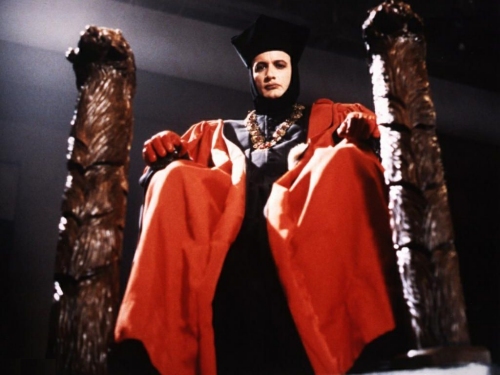
De Lancie as Q the prosecutor---now he's Darrow for the Defense... Posted by Picasa
John de Lancie Gets A Hand (A Qticle)

A Qticle, get it? What’s wrong---too Qte?

Okay, let’s get serious. John de Lancie appeared on stage in the L.A. Theatre Works production of The Great Tennessee Monkey Trial for the first time, to a capacity crowd here in Arcata, CA. He played legendary attorney Clarence Darrow, who defended John Scopes in the famous 1925 trial concerning the teaching of evolution in schools. His antagonist was the acclaimed orator and presidential candidate, William Jennings Bryan, played by Edward Asner.

L.A. Theatre Works produces plays for audio: for live radio in its “The Play’s the Thing” series, and other productions for schools and libraries, all available on tapes and CDs. These productions range from audio versions of contemporary and classic plays to adaptations of famous novels (including its first production, a 14-hour version of the Sinclair Lewis novel, Babbitt) and docudramas. The very impressive catalog of its offerings can be found at its website.

Not only is this a tremendous cultural resource, but the audio format makes it easier for hard-to-schedule Hollywood actors to do great parts. They get to play characters other than cops and criminals, and we get to hear familiar voices interpreting the best drama and literature, and dramatizing the great issues of our time.

Star Trek actors are among them: Rene Auberjonis is heard in Arthur Miller’s The Crucible, Armin Shimerman in Twelve Angry Men, Paul Winfield in Ruby McCollum, Alice Krige in Ronald Harwood's Another Time, and Gates McFadden in Neil Simon’s Chapter Two. Gates is also in the almost all-Star Trek production of H.G. Wells’ The War of the Worlds, along with Leonard Nimoy, Brent Spiner, Wil Wheaton, Dwight Schultz and Armin Shimerman.

John de Lancie, who co-founded “Alien Voices” with Leonard Nimoy, and acted, wrote and directed several of its audio productions based on classic science fiction stories (including several others by Wells) is also heard in several Theatre Works plays.

I first saw de Lancie's impressively tall form and calm but focused gaze in one of the corridors outside the studio theatre on the Humboldt State University campus, where some members of the traveling company were assembling for an informal workshop with theatre students on the afternoon before their first performance. He was signing a hardback copy of a Q novel for a teenage boy accompanied by his father. It turned out to be more than a fan---he was a local resident named Bo Banduci who would be performing in the play itself. But he certainly was a fan, judging from the big smile he wore as he left.

John de Lancie (2005) startrek.com Posted by Picasa
De Lancie didn’t actually take part in the workshop (he looked in occasionally, but mostly prowled the corridors with his cell phone.) But those who did---including director Gordon Hunt, narrator Alley Mills (a classically trained actor and currently a volunteer caseworker for disaster relief at the American Red Cross, best known as Norma Arnold on The Wonder Years)—explained how this particular production came about.

Because the L.A. Theatre Works does some of its radio plays before a live audience, there was interest in touring such a production, so people could see what a radio play looked like. They discovered that their most requested recording from high school teachers throughout the nation was “The Great Tennessee Monkey Trial,” written by Peter Goodchild using the actual Scopes Trial transcripts. So, on the 80th anniversary of the original trial, an 18-week tour of 23 locales was organized, which will take this production to Nashville, Omaha and Fayetteville, Arkansas as well as Los Angeles and suburban Washington.

Some actors would come and go, so some audiences would be seeing Marsha Mason, Mike Farrell and—replacing John de Lancie as Darrow, James Cromwell: Zephran Cochrane for Q.

It would also be seen on the Penn State campus at University Park, just a few hours up the highway from Dover, PA, where another trial involving the teaching of evolution in schools was going on as we gathered to discuss this production.

The assembled participants stressed that the production was not one-sided. Certainly the teaching of science, and keeping religious views separate from science education, was the core issue. But they talked about the principles and the fears that Bryan represented---the idea that to him and others, Darwinian evolution symbolized the threat of a soulless society, without human values. In some venues, the production would be followed by discussions involving experts and prominent voices in that community.

After the workshop I talked briefly with director Gordon Hunt about actors and voices. He said that with all the emphasis on the visual, younger actors were not getting enough vocal training. Even theatrically trained actors often lack the skills to act with their voices.

This is an often-overlooked element in Star Trek’s success: distinctive and powerful voices, and actors who used them well. It’s part of Star Trek’s debt to theatre and even to radio.

I also talked with actor Kevin Kilner, who hopes to produce a documentary about this tour. We continued our conversation as they all left the studio theatre. Outside, as the vans pulled up to take them away, I noticed John de Lancie and Edward Asner standing together. I knew I had only a few minutes before they left, so I had to make a painful choice: do I talk to Lou Grant (Mondays at 10 will always be sacred because of him) or to Q?

It was you, dear readers, who decided it for me.

Spock v. Q---don't expect a new one! Posted by Picasa
De Lancie said he had no further Q projects in the works—no novel or audio (as the two “Q and Spock” dialogues he did with Leonard Nimoy.) His opinion is that Star Trek is over, at least for the foreseeable future. He is of the “they went to the well too often” school, suggesting that three series done by the same people had perhaps been too much.

In the printed program for that evening’s performance, Star Trek is barely mentioned in de Lancie’s credits, sandwiched between “The Closer” and “Legend” in a list of “numerous television shows.” Instead his film and theatre work, and particularly his performances with symphony orchestras were emphasized. In addition to performing with the New York Philharmonic, Philadelphia Orchestra and Montreal Symphony, he has written and directed ten Symphonic Plays, and a concert series for the Los Angeles Philharmonic. He is scheduled to direct several operas in Atlanta. He has kept his hand in the science fiction field as well. In addition to Alien Voices, he’s produced television specials for the Sci-Fi Channel.

As for the opening performance itself, it was staged with simplicity and strength, and the script provided vivid historical context. The production was dramatic while still being fair and reasonably faithful to the actual events. The set was comprised of simple tables and chairs on two levels. The actors read from scripts in hand. There was a director onstage who cued sound and light effects. You know, Q de Lancie! (Sorry, couldn’t help it.)

On this particular night, the trial judge was played by another Star Trek actor, Jerry Hardin, who spoke with the same accent he used playing Samuel Clemens/Mark Twain in TNG’s “Time’s Arrow,” although he looked more as he did in TNG’s “”When the Bough Breaks.”

De Lancie’s authoritative Q voice served him well, although Darrow doesn’t have particularly brilliant speeches. His big moment is the cross-examination of Bryan towards the end of the play. (Our local talent, Bo Banduci, did very well as the 14 year old who testified as to what his teacher had said about evolution. Banduci’s strong voice and assured performance matched up very well with de Lancie, who questioned him.)

My strongest impression was that this production revealed the unique strengths of staging a radio drama (or, at least, this particular one), and exposed an area of potential weakness. The strength is in adding the visual dimension to riveting oratory. There were two transcendent examples of this, both in the first act. The first was a speech delivered with consummate skill by Edward Asner. He had captivated the audience immediately, with his theatrical pronunciation of “evil-lution”---no doubt something that the theatrical Bryan would have done. But he didn’t have a real speech until well into the first act, but when he did, it was a dandy.

Then the first act ended with the most powerful oratory of the trial, delivered by neither Bryan nor Darrow, but by Dudley Malone, a defense attorney who had said little to that point. It was delivered in this production with spellbinding intensity and consummate skill by Steppenwolf Theatre Company actor Francis Guinan (any relation? He didn’t look El-Aurian). Bryan himself called it the greatest speech he ever heard.

But after the long first act ended with these verbal fireworks, the shorter second act seemed to lack its energy. Darrow’s cross-examination of Bryan is the dramatic climax of the play and film version of “Inherit the Wind,” (also based on this trial, though with a stronger point of view) which emphasizes Bryan’s increasingly desperate defense of his belief in the more or less literal interpretation of the Bible as scientific fact. But on this night, in this production, it seemed to fall a little flat.

It may have been that de Lancie and Asner didn’t have their timing down yet. Maybe the writing wasn't as sharp, or maybe it was just me---I was tired. But it could also be a problem inherent in the form. Bryan’s breakdown, partly physical (he died a few days later) is more subtle than the oratory. Perhaps those in the first few rows who could see Asner’s face clearly, or hear the nuances in his soft tones, had a different experience. (I’m hoping to catch the radio broadcast of this performance on the campus station to hear this scene again, without trying to see it.) But this may be something that staged radio drama can’t do as well as either radio or fully produced stage or screen drama.

The issues of the Scopes trial and the continuing evolution debate touch upon concerns that are important in Star Trek, though in some sense Star Trek reconciles them: it represents science and soul.

But I suppose my greatest impression in experiencing this production and applying it to Star Trek is my gratitude that for most of its run on television and in film, Star Trek clearly came from this rich, complex, wondrous and profoundly human tradition of theatre and classic movie (and radio) storytelling, and not from video games.

Thursday, October 13, 2005


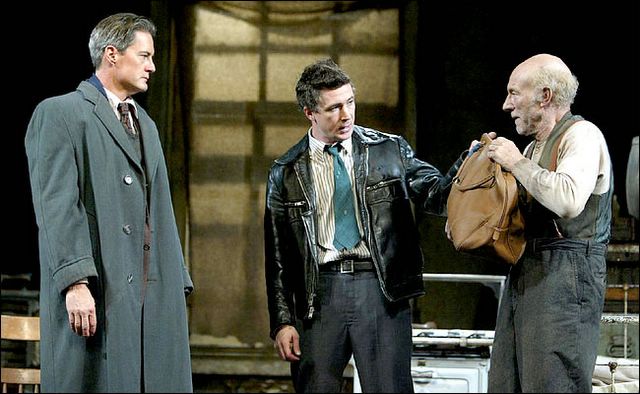
Congratulations to British playwright Harold Pinter for winning the 2005 Nobel Prize for Literature. Patrick Stewart pictured here in Pinter's "The Caretaker." Posted by Picasa

Wednesday, October 05, 2005


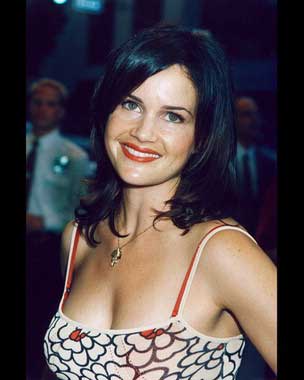
Carla Gugino, star of "Threshold" Posted by Picasa
On the Threshold of---?


He started out on a trek and now he’s on the threshold. But of what?

The 1950s? Maybe. That was the last time that alien invasions were so popular. Kicked off by the very profitable second movie version of the very first space invasion tale—H.G. Wells’ “War of the Worlds,” first published more than a century ago---all three commercial broadcast networks have stories about mysterious aliens. “Threshold” on CBS seems to be getting the best reviews, and of course it’s of interest to Star Trek fans because former Star Trek producer-writer Brannon Braga is one of the executive producers, and Brent Spiner (Data) is one of the on-screen regulars.

(Those aren’t the only Star Trek connections, by the way. Longtime Trekker Michael Sussman is a supervising producer, David Gautreaux—who was slated to be the new Vulcan, the Mr. Spock replacement on the original cast’s second Star Trek TV series, and got a small consolation part in TMP instead—has a recurring role.)

The threat of terrorism supposedly inspired this throwback genre, previously popular in movies in the early Cold War 1950s (see Cold War Cinema for details), when it was the threat of Communism and instant nuclear annihilation. Then the correspondence was more precise: bombers and missiles come without warning to destroy from the sky; so do space aliens. Nuclear bombs cause weird biological mutations; so you get movies about giant ants, locusts, spiders, etc—the land of the bug-eyed monster movie.

Now it’s more amorphous, but the fear is out there. If terrorism has faded a little, there’s hurricanes and the climate: Revenge of the Earth. (Even Spielberg’s space alien machines came up out of the ground this time.)

Certainly “Threshold” is different stylistically from those fifties films. The best of them may have had a fairly lengthy “reveal” (the process of realizing there’s a monster or aliens, then actually seeing it/them) but the main event was the battle or attempt to destroy them. Usually the first several tries fail and all seems lost until they hit on the thing that works (“Water! It doesn’t like water!”—which would be funnier if that wasn’t the solution in one of the more recent alien invasion films, M. Night Shyamalan’s “Signs”. Suggesting, I thought at the time, that the tagline for “Signs II” should be “They’re Back---With Raincoats!”).

But a television series is a different sort of beast, and as pioneered by such recent miniseries as “Taken” and “The 4400,” the reveal can be extended forever, maybe even 100 episodes. “The X Files” did it for its entire run, although it meandered a lot into side issues.

Like the dynamic duo of “X-Files,” the stars are investigators (A New York Times story on Threshold by Dave Itzkoff said “with its emphasis on forensic investigations and the interpersonal dynamics of its cast,[it] could pass for another spinoff of CSI,” but you could also see CSI as a variation on X-Files which preceded it.)

Judging from the episode I saw (last week’s, the third episode; I forgot when the first was on, then taped the second but somehow taped over it before I saw it.), this group at least doesn’t have to deal with hostile employers. It’s also more like a CSI in the number of main characters, making it also…well, more like a Star Trek series. (With the mystery being where the romance(s) will be?)

While “Enterprise” had to strain to include the apparently mandatory sexiness, “Threshold” has gone the classy big network route: cast a woman lead who nobody will dare say is too beautiful for her job, and put her in—shall we say flattering?---clothes that women with her job might be unlikely to wear. And then add tasteful details, like the kidnap victim who just happens to be an attractive young woman, caught in her underwear. And so while we wonder about what sinister alien force is causing these weird men to dig a hole in her floor, she is always in the frame, writhing in her ropes. And so we are back in the fifties monster films---or at least, the posters for them.

But the story was credible, the writing (as well as the writhing) seemed pretty good, with some terrific touches that the acting ran with, like the guy who had been locked away in a mental institution for most of his life, wondering aloud what had happened to the bike he had as a boy—“they probably threw it away.” A startling human moment in all the alien police procedural plotting.

There already appear to be elements of the uncanny, of magic (technological or otherwise) in "Threshold" that a space alien story in the past probably couldn’t have gotten away with and still maintained enough dramatic credibility. All kinds of shows in the past decade or so---from the brazen anachronisms of the Hercules and Xenia shows, to the recent fashion in psychic detectives and intervening angels, as well as the aforementioned M. Night and his quasi-religious occultism—contribute to audience expectations that no longer depend on plausibility based on orthodox science.

Arguably, Star Trek prepared the way by providing the scientific plausibility that was necessary for its audience and the 1960s general audience, while introducing other elements: aliens with inexplicable powers, and for humanoids certain psychic abilities as natural, and finally accepted by science. So the technobabble that Braga disses, probably contributed to the fact that Threshold can seem to depend on contemporary science, but can also throw in some fantastic elements, and get away with them.

Brent Spiner, seen here in "Enterprise," is one of the regulars on Braga's "Threshold." Posted by Picasa
So in the coming weeks and---the producers hope—years, the nature of the aliens, their invasion (already known to have traces in the past) and their intentions will be slowly, oh so slowly revealed. But you can pretty much bet they won’t turn out to be good guys. And though Braga tells reporters how Threshold will be different from Star Trek, it’s not the techno-babble vs. understandable science, or freedom from the restrictions of the Roddenberry ethic---it’s this basic element: the aliens will be evildoers who hate our freedom.

Star Trek started at the height of the Cold War, but at the threshold of the period that came to be known as the Thaw, when Americans and Russians began to acknowledge each other’s humanity. After several dangerous confrontations, particularly the Cuban Missile Crisis of 1962, President Kennedy made serious efforts to lessen tensions. He got Soviet Premier Khrushchev to agree to the first nuclear test ban treaty, and the thaw in the Cold War began. It didn’t last; by the 80s President Reagan was demonizing the Soviets again as the Evil Empire. But the Thaw had prepared the way: when the walls fell, Americans and Russians were more able and willing to overcome the last stereotypes and, among other things, go into space together.

One of Star Trek’s well-known contributions to the culture as well as the science fiction genre was to propose the somewhat novel notion that aliens weren’t necessarily evil invaders, that their mission might not be to exterminate people. (It wasn’t completely new, of course---even the aliens in a few of those space invader 50s movies turned out to be good guys, or at least Misunderstood.)

This insight (insisted on by men like Roddenberry and Gene Coon who had seen combat against the Enemy, and learned as soldiers often do that the actual people they are fighting are not so different) in turn helped Star Trek portray and communicate a hopeful view of future possibilities.

How Threshold will avoid contributing to a harmful xenophobia, in an America that is in many ways alienated from the rest of the world, remains to be seen. I just hope we aren’t on the threshold of another war and torture movie, with no point but to raise blood pressure and hence ratings. The real thing is bad enough.

Thursday, September 22, 2005


What happened to civilization at the New Orleans convention center? Posted by Picasa