Thursday, October 13, 2005


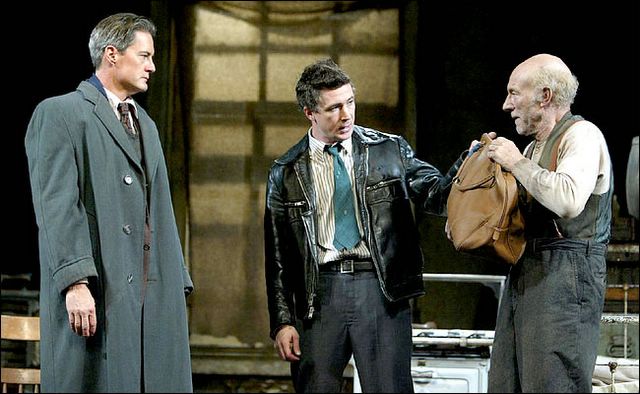
Congratulations to British playwright Harold Pinter for winning the 2005 Nobel Prize for Literature. Patrick Stewart pictured here in Pinter's "The Caretaker." Posted by Picasa

Wednesday, October 05, 2005


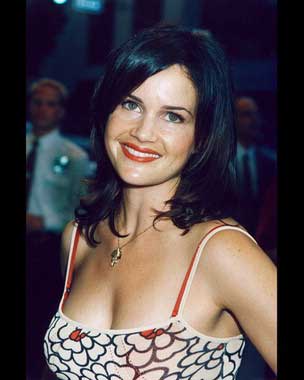
Carla Gugino, star of "Threshold" Posted by Picasa
On the Threshold of---?


He started out on a trek and now he’s on the threshold. But of what?

The 1950s? Maybe. That was the last time that alien invasions were so popular. Kicked off by the very profitable second movie version of the very first space invasion tale—H.G. Wells’ “War of the Worlds,” first published more than a century ago---all three commercial broadcast networks have stories about mysterious aliens. “Threshold” on CBS seems to be getting the best reviews, and of course it’s of interest to Star Trek fans because former Star Trek producer-writer Brannon Braga is one of the executive producers, and Brent Spiner (Data) is one of the on-screen regulars.

(Those aren’t the only Star Trek connections, by the way. Longtime Trekker Michael Sussman is a supervising producer, David Gautreaux—who was slated to be the new Vulcan, the Mr. Spock replacement on the original cast’s second Star Trek TV series, and got a small consolation part in TMP instead—has a recurring role.)

The threat of terrorism supposedly inspired this throwback genre, previously popular in movies in the early Cold War 1950s (see Cold War Cinema for details), when it was the threat of Communism and instant nuclear annihilation. Then the correspondence was more precise: bombers and missiles come without warning to destroy from the sky; so do space aliens. Nuclear bombs cause weird biological mutations; so you get movies about giant ants, locusts, spiders, etc—the land of the bug-eyed monster movie.

Now it’s more amorphous, but the fear is out there. If terrorism has faded a little, there’s hurricanes and the climate: Revenge of the Earth. (Even Spielberg’s space alien machines came up out of the ground this time.)

Certainly “Threshold” is different stylistically from those fifties films. The best of them may have had a fairly lengthy “reveal” (the process of realizing there’s a monster or aliens, then actually seeing it/them) but the main event was the battle or attempt to destroy them. Usually the first several tries fail and all seems lost until they hit on the thing that works (“Water! It doesn’t like water!”—which would be funnier if that wasn’t the solution in one of the more recent alien invasion films, M. Night Shyamalan’s “Signs”. Suggesting, I thought at the time, that the tagline for “Signs II” should be “They’re Back---With Raincoats!”).

But a television series is a different sort of beast, and as pioneered by such recent miniseries as “Taken” and “The 4400,” the reveal can be extended forever, maybe even 100 episodes. “The X Files” did it for its entire run, although it meandered a lot into side issues.

Like the dynamic duo of “X-Files,” the stars are investigators (A New York Times story on Threshold by Dave Itzkoff said “with its emphasis on forensic investigations and the interpersonal dynamics of its cast,[it] could pass for another spinoff of CSI,” but you could also see CSI as a variation on X-Files which preceded it.)

Judging from the episode I saw (last week’s, the third episode; I forgot when the first was on, then taped the second but somehow taped over it before I saw it.), this group at least doesn’t have to deal with hostile employers. It’s also more like a CSI in the number of main characters, making it also…well, more like a Star Trek series. (With the mystery being where the romance(s) will be?)

While “Enterprise” had to strain to include the apparently mandatory sexiness, “Threshold” has gone the classy big network route: cast a woman lead who nobody will dare say is too beautiful for her job, and put her in—shall we say flattering?---clothes that women with her job might be unlikely to wear. And then add tasteful details, like the kidnap victim who just happens to be an attractive young woman, caught in her underwear. And so while we wonder about what sinister alien force is causing these weird men to dig a hole in her floor, she is always in the frame, writhing in her ropes. And so we are back in the fifties monster films---or at least, the posters for them.

But the story was credible, the writing (as well as the writhing) seemed pretty good, with some terrific touches that the acting ran with, like the guy who had been locked away in a mental institution for most of his life, wondering aloud what had happened to the bike he had as a boy—“they probably threw it away.” A startling human moment in all the alien police procedural plotting.

There already appear to be elements of the uncanny, of magic (technological or otherwise) in "Threshold" that a space alien story in the past probably couldn’t have gotten away with and still maintained enough dramatic credibility. All kinds of shows in the past decade or so---from the brazen anachronisms of the Hercules and Xenia shows, to the recent fashion in psychic detectives and intervening angels, as well as the aforementioned M. Night and his quasi-religious occultism—contribute to audience expectations that no longer depend on plausibility based on orthodox science.

Arguably, Star Trek prepared the way by providing the scientific plausibility that was necessary for its audience and the 1960s general audience, while introducing other elements: aliens with inexplicable powers, and for humanoids certain psychic abilities as natural, and finally accepted by science. So the technobabble that Braga disses, probably contributed to the fact that Threshold can seem to depend on contemporary science, but can also throw in some fantastic elements, and get away with them.

Brent Spiner, seen here in "Enterprise," is one of the regulars on Braga's "Threshold." Posted by Picasa
So in the coming weeks and---the producers hope—years, the nature of the aliens, their invasion (already known to have traces in the past) and their intentions will be slowly, oh so slowly revealed. But you can pretty much bet they won’t turn out to be good guys. And though Braga tells reporters how Threshold will be different from Star Trek, it’s not the techno-babble vs. understandable science, or freedom from the restrictions of the Roddenberry ethic---it’s this basic element: the aliens will be evildoers who hate our freedom.

Star Trek started at the height of the Cold War, but at the threshold of the period that came to be known as the Thaw, when Americans and Russians began to acknowledge each other’s humanity. After several dangerous confrontations, particularly the Cuban Missile Crisis of 1962, President Kennedy made serious efforts to lessen tensions. He got Soviet Premier Khrushchev to agree to the first nuclear test ban treaty, and the thaw in the Cold War began. It didn’t last; by the 80s President Reagan was demonizing the Soviets again as the Evil Empire. But the Thaw had prepared the way: when the walls fell, Americans and Russians were more able and willing to overcome the last stereotypes and, among other things, go into space together.

One of Star Trek’s well-known contributions to the culture as well as the science fiction genre was to propose the somewhat novel notion that aliens weren’t necessarily evil invaders, that their mission might not be to exterminate people. (It wasn’t completely new, of course---even the aliens in a few of those space invader 50s movies turned out to be good guys, or at least Misunderstood.)

This insight (insisted on by men like Roddenberry and Gene Coon who had seen combat against the Enemy, and learned as soldiers often do that the actual people they are fighting are not so different) in turn helped Star Trek portray and communicate a hopeful view of future possibilities.

How Threshold will avoid contributing to a harmful xenophobia, in an America that is in many ways alienated from the rest of the world, remains to be seen. I just hope we aren’t on the threshold of another war and torture movie, with no point but to raise blood pressure and hence ratings. The real thing is bad enough.

Thursday, September 22, 2005


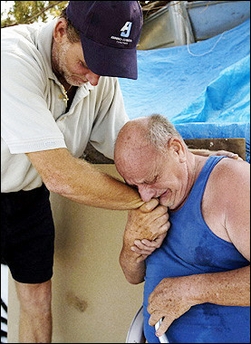
What happened to civilization at the New Orleans convention center? Posted by Picasa
You’d Do the Same For Me
Further Reflections on Star Trek and New Orleans

by William S. Kowinski

Thousands crowded in the sealed darkness of a gleaming domed enclosure, confined with little food or water, trapped in an extreme nightmare of violence, death, heat and excrement. Families marooned on baking slivers of interstate highway, or waving frantically from rooftops at blind helicopters passing by on fathomless missions. All surrounded by roiling waters of spilled oil, toxic chemicals, sewage, and decaying human remains.

Then even as rescue began, two- mile lines of ambulances waited to bring patients into the only working medical facility, in the passenger concourse of the New Orleans airport. There, as Dr. Mehmet Oz reported on a harrowing hour of Oprah, those who were too ill to be helped were moved to the makeshift morgue while still alive.

This cannot be America, everyone was saying. This cannot even be...civilization.

This was perhaps the most sobering of many shocking realizations. Beyond political responsibilities and human failings, beyond the truth or illusion of national self-image, even beyond the physical suffering and material deprivations, there was the sense that civilization itself had broken down.

If it had, whose fault would it be? The people who were improvising survival under unimaginable duress, some of whom interpreted the absence of rescuers and resources as attempts to ignore or even kill them? Or those who failed in their designated tasks as the representatives of civilization? Or perhaps even those who set the terms of this civilization?

When civilization breaks down, it's often said that we revert to a more primitive self, the implication being that savagery is our natural state. This is a view of humanity shared by some religions and certain interpreters of Darwinian evolution-two groups that don't believe much in each other, and who might be scandalized to think they share anything at all.

It's a curious paradox, that the nature of humanity and the nature of human civilization are considered so radically different, one hostile to the other. It is a view that supports and is supported by authoritarian rule: the king and court, those of noble blood, and the hierarchy of the church. Only they can define and enforce civilization; the rest is the savage mob.

Is human nature savage? It's a question that Star Trek addressed in many ways. We think of Captain Kirk, an authority figure and an anarchic troublemaker at the same time, who gloried in the human struggle, and yet also knew that part of the struggle was to bring instincts and consciousness into balance.

The Enterprise came up against aliens who were vastly more powerful than humans, and aliens who were much more primitive. At the far ends of this opposites were the advanced "energy beings"(spirits without bodies) and the primitive beings who were only physical, with undeveloped mental powers and apparently primitive spirituality. Humanity was a middle state, always struggling to keep the spirit and the body in balance. That balancing without denying the different parts results in a kind of harmony, music, a dance, which some believe defines what we mean by soul: that which harmonizes body and spirit, thought and emotion.

Star Trek had its own working definition of humanity, a statement of the soul in action, which was in its way a working definition of civilization.

continued after photo

Star Trek III: "You'd do the same for me." Posted by Picasa
The Cost of Soul

There's a phrase that's become very important to me. Although it's a common phrase, it struck me forcefully some years ago when someone said it to me. I've been thinking about it in connection with what's happened in New Orleans and the Katrina zone this past month, and not just the awful parts.

Because it's become important to me, I notice it when I hear others say it. In real life (right after 9/11, for instance) and in Star Trek.

The circumstances for me weren't very dramatic. I was in a booth at a neighborhood coffee bar, absorbed in reading and writing. I knocked a pen on the floor but kept reading for a minute. When I looked up, a man was handing the pen to me. He was a custodian for this place but he appeared to have been just passing by. I looked up at him, surprised, and thanked him. He was a black man, perhaps in his sixties. He just nodded and said quietly, "You'd do the same for me."

I think it was the way he said it, with a casual gravity, as though it was something he said regularly, but it also had the quality and weight of a personal mantra of some importance.

It wasn't the first time I'd heard it, of course, but this time it struck me immediately. And the more I thought about it, the more it's come to mean.

Now I see that it sums up entire philosophies and puts many book-length ethical treatises to shame. "You'd do the same for me" is nothing less than the basis of civil behavior, from courtesy to heroism. It is the basis of civilization, the impulse and ethic that speaks for the human soul.

It's a phrase of some importance in Star Trek, in at least two widely separated moments which nevertheless have a lot in common.

The first is towards the end of Star Trek III: The Search for Spock. Kirk and his crew have defied Starfleet, seen Kirk's son killed and the Enterprise destroyed, in their quest to rescue Spock from death, to literally put his soul back into his body. This has been accomplished, but the revived Spock is not yet whole, not yet "human."

Kirk has already faced Sarek, Spock's father. "Kirk, I thank you," Sarek says. "What you have done---"

"What I have done I had to do," Kirk says.

"But at what cost? Your ship, your son---"

"If I hadn't tried, the cost would have been my soul."

These were the stakes in this endeavor. Not the survival of earth or the population of some other planet, but one man's soul, the Captain's soul, and therefore, it was humanity defining itself through the hero.

Now Kirk faces Spock for the first time. He, too, asks why. "My father says you came back for me."

Kirk responds with a quick, almost throwaway phrase, yet Kirk is telling Spock something he once knew, what he once did (that got him killed in the first place), and who he once was. "You'd do the same for me," he says.

At that moment, it may not be true---Spock is not yet himself. Kirk is telling him who his friend Spock essentially is, who they are.

"You'd do the same for me" is a standard, and it is also a bargain, a contract. I felt this in my little encounter in the coffee bar. By saying it to me, that man was stating both his own moral standard and his faith that others share it in the delicate informal system of day-to-day civilization. In the simplicity of this statement, in its simple assumptions, he was educating me and challenging me to rise to this standard. It is in some ways an ultimate equality, and a testament of faith in human possibility and the human heart.

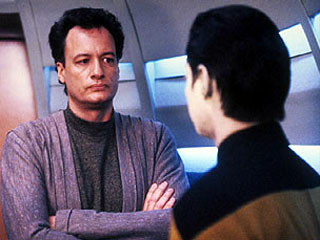
Deja Q: an android teaching a Q how to be human. Posted by Picasa
Q and You: the Social Contract

It arises in Star Trek again in the third season of The Next Generation, in the episode Deja Q. The immortal and omnipotent being Q has been stripped of his powers for tormenting other life forms, and one of those life forms pursues him aboard the Enterprise. At one point these tiny creatures have Q in a kind of energy field, and Data pulls him out of it, and is damaged in the process.

Like Spock, Q had been taken out of himself. He was in that state now, but unlike Spock, Q acted with the petulance rather than the innocence of a child. That drove the humor of the piece, but things aren't funny to Q while Data's existence is in question. "Data may have sacrificed himself for me. Why? Why would he risk his life for mine?"

"That is his special nature," Captain Picard replies. "He has learned the lessons of humanity well."

For Data, an android who has only his programming and intelligence to work with, this self-sacrificing behavior is the product of ethical thinking, translated into direct action. But Q is temporarily human, and he begins to reason ethically by engaging his imagination and his emotions.

"I ask myself if I would have done the same for him," Q says. "And I am forced to realize the answer is 'no.' I feel...I feel ashamed."

Of course, Q goes on to perform a selfless act, to sacrifice himself so that the Enterprise is spared, and is rewarded for it by having his powers returned. Immediately afterwards, he seems to revert to the same old Q---but in future stories, he's different. He helps Picard give up his regrets for his wild youth, and he helps Picard again when the Continuum tests humanity again in the series finale, "All Good Things."

Q is ashamed because he understands the essential human standard: that he should have been willing to do the same for Data.

Some see this as an attitude contrary to nature, that comes only with belief in a higher being, or only when punishment would result had he failed to act correctly. But humans as members of the animal "kingdom" are social animals. Our genes are not always so selfish. Our existence is so profoundly dependent on our group (family, tribe, culture, society) that the welfare of the whole is emotionally important.

Whether as part of this feeling or independently, we also have the ability to identify with others, to put ourselves in another's place, to have empathy. There are other feelings as well---feelings of tenderness based on a sense of beauty, for example---that contribute to what we call compassion (which means a passion or feeling for everything.)

It turns out that these sorts of feelings and behaviors are present in other animals as well as humans---it's just that, prejudiced by their theories to the contrary, human researchers failed to look for it. Animal societies are quite complex, yet science has insisted on experimenting with isolated individuals.

Yet "you'd do the same for me" is not exactly a statement of selflessness. While it reflects an ethic based on empathy and compassion, it doesn't require it. It combines a feeling of human kinship with a utilitarian deduction: we can't guarantee we will be helped in time of trouble, but if we support an ethic of helping others by our actions, our chances will be better.

a helping hand--bottled water from a stranger in the Katrina zone... Posted by Picasa
Expanding "We" Means More Help for "Me"

In a complex society, individual freedoms and opportunities depend on a shared sense that in the final analysis, we're all in this together. "You'd do the same for me" is the basic bargain of civilization, the confirmation of the faith in each other and in our institutions necessary to make it all work.

Civilization may be nothing more and nothing less than a society's commitment to particular values, reflected in its philosophies, institutions and actions, continually renewed and extended. It is finally expressed and confirmed by individual citizens and their associations.

The world saw our civilization break down in the Katrina zone, and we saw that, contrary to recent rhetoric, the failure of government can be catastrophic. But civilization reasserted itself, based on a principal civic value, which can't be expressed any better than in the phrase, "you'd do the same for me."

It turned out that people from all over the world were frantic to help the suffering strangers in New Orleans. They risked their lives rescuing people, they opened their homes to strangers. They sacrificed for others, as they worried about what might happen to them if disaster struck their city.

It is the basis for heroism, as in Star Trek, or as spoken by fireman in the aftermath of 9/11, explaining why he was starting a 24-hour shift digging through the rubble of the World Trade Center to search for fellow firefighters buried there. They were his brothers, he said, and "they'd do the same for me."

But in more modest, everyday ways it's the basis of hospitality and sharing in time of trouble that characterize traditional cultures all over the world. It is more subtle than the Golden Rule, for it carries expectation as well as personal responsibility. "You'd do the same for me" is a challenge in the form of a statement of faith.

We are challenged today in several ways by the ramifications of Katrina. As yet another horrific hurricane moved towards land, and cities with other dangers were reevaluating their preparations, the Mayor of San Francisco (vulnerable to an inevitable future earthquake) said that the lesson of Katrina was that we are all on our own.

Certainly we must all prepare to sustain ourselves in such circumstances, and certainly we have learned that the enormity of some disasters as well as the laxity of some officials, we can't trust entirely government or anyone else to come to our rescue. But surely the message of Katrina is also that we are all in this together. We will survive only if we help each other, not just in disasters that have happened, but in anticipating and preparing for them.

There is another, perhaps tougher lesson that some draw from what happened in New Orleans. Economist Paul Krugman reflected on the role of race in the disaster and in America generally. "Consider this: in the United States, unlike any other advanced country, many people fail to receive basic health care because they can't afford it. Lack of health insurance kills many more Americans each year than Katrina and 9/11 combined."

Why is that? What isn't access to health care a major political issue? "...one reason is that it isn't yet a crisis among middle-class, white Americans (although it's getting there.) Instead, the worst effects are falling on the poor and black..."

So why do Europeans extend universal healthcare to everyone in their country, and Americans do not? Krugman writes: "And who can honestly deny that race is a major reason America treats its poor more harshly than any other advanced country? To put it crudely: a middle-class European, thinking about the poor, says to himself, "There but for the grace of God go I." A middle-class American is all too likely to think, perhaps without admitting it to himself, "Why should I be taxed to support those people?"

The thrust of Krugman's column is simply that somewhere behind the consciousness of white America, the "we" in "we're all in this together" doesn't include people of color. This is the basic problem of the alien that is central to Star Trek. We define ourselves in contrast to those who aren't us. We're constituted to be aware of anything that might be a threat, which includes any change in our environment, from a sudden movement or an unfamiliar sound to a stranger. They all engage instinctual reactions that are glandular before they are conscious. Difference excites---sometimes in a good way, but often in fear.

But humans have consciousness as well as instincts. We learn and even educate our reactions. Not long ago, racial prejudice was expected to disappear when everybody becomes middle class; that is, in ways important to Americans now, everybody would be basically the same. To a certain extent, this has happened, and various races are excepted according to their income and conformity to the upper middle class standards. But considering black people and poor people as “them” seems still present.

Yet even within white America there is much more knowledge and appreciation of others for their beauty, intelligence and style---and an appreciation of how much we have in common, yet how much richer we are by being different.

As humans, besides being afraid of difference we also crave it. We have learned to value the different ways of approaching the world represented in different cultures, just as we value the different skills and perspectives of individuals. This is another impulse that's become a social one, a basis for society: we like to have some idea of what might happen and alternatives to cope with any threats, or to take advantage of any opportunities. This is a human survival strategy.

We're back at the practical benefits of diversity, and the fundamental identity of our species, even of life itself. We share so much with so many. The basis of being able to live long and prosper together is "you'd do the same for me." Our heroes can take it to the limit with the ultimate self-sacrifice. But the rest of us can be courteous and thoughtful, look for what we have in common and provide the help we can when it's needed. There are plenty of real threats to deal with or avoid without inventing and creating dangers, or creating unnecessary us/them situations. We especially must be on guard against being manipulated into false us/them perspectives that really benefit a small group that's trying to accrue power and profit.

Sooner or later we come to understand that by expanding a sense of "we," we are multiplying the number of people who might help us when we need it, because they know we'd do the same for them. It's quite practical, and as things become more complex and perhaps more dire, it becomes more necessary.

In the Star Trek 22nd century, the "us" has expanded to include all humanity on earth, and in the 23rd century the "us" is expanding to include alien species. In our time, we can't go on pretending to share the identity of a country, a species and especially a civilization unless and until we expand our concept of "us" or "we" to match our reality. It's especially meaningful to me because those word were etched into my soul by hearing them from a black man. "You'd do the same for me" is our faith in civilization and each other. It's a faith we ought to spread, and not limit to the Star Trek future.
Monday, September 19, 2005


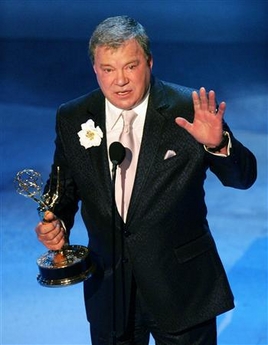
Live Long and Prosper! Congratulations
to William Shatner for best supporting
actor Emmy for Boston Legal. Posted by Picasa

Thursday, September 15, 2005


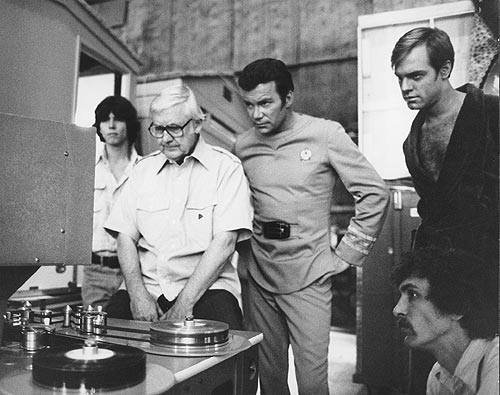
Robert Wise, while making TMP. Photo from LA Times.  Posted by Picasa
R.I.P. Robert Wise

Legendary film director Robert Wise died on September 14, a few days after celebrating his ninety-first birthday. Wise directed "West Side Story," "The Sound of Music," and edited "Citizen Kane." He directed the science fiction classic, "The Day the Earth Stood Still" and of course, "Star Trek: The Motion Picture."

When Wise was able to complete TMP for the Special Edition DVD, with new effects, sound mix and a new edit of the movie, it finally lived up to its potential as another classic. I've said it before, but I'll repeat: a special theatrical release would be a fitting way to celebrate Star Trek's 40th anniversary.

The Los Angeles Times obituary of Robert Wise can be found here.

Wednesday, September 14, 2005


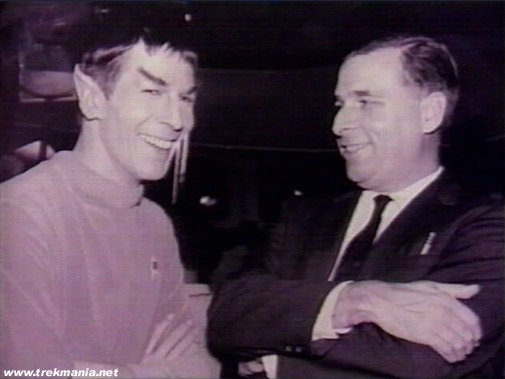
L. Nimoy and GR at the start of Star Trek as TV s/f drama. Posted by Picasa
Star Trek: Dramatic Conclusions

by William S. Kowinski

Previously on Soul of Star Trek: When we watch Star Trek, we experience all aspects of it simultaneously. But when we try to explain what Star Trek essentially is, we can try to define each element, so we can appreciate what that element contributes to the whole.

In this mini-series about the soul of Star Trek, we began with a statement about its nature and its importance: that Star Trek is the best known contemporary vision of the future.

We considered the importance of views and visions of the future, particularly in the industrial age and in recent American history, and then specifically in the years when the original Star Trek series was being created and became popular. Why did Star Trek succeed as a vision of the future, when so many other visions didn't?

We looked for our first set of answers in terms of structure. We looked at Star Trek as a more complete vision of the future because it employs the fullness, humanity and complexity of story. Star Trek brings us into its future by telling stories of adventure. We looked at Star Trek as mythology, and saw that allegory was a tool for relating the future to the present.

So as we proceed to other structural elements and descriptions---Star Trek as drama, as television, and as science fiction---we enrich each new element with what we carry with us from earlier explorations. How is this vision of the future expressed? As story. What kind of story? Adventure, extended and raised to a mythology of the future, employing allegory as a way of giving us a perspective on our present and simultaneously portraying a possible future we'd like to live in.

But in a very real way, for the minutes we are watching, we are living in the Star Trek future. How does that happen? Why do we want to live there, and return there, and make that future our own?

And now, the conclusion...

Opening credits for an episode of "Have Gun, Will Travel," one of the quintessential adult westerns. Posted by Picasa
The Star Trek West

Whatever visions Gene Roddenberry had of depicting a future, or of using allegory to comment on contemporary issues, he was first faced with a problem he knew very well. He had to come up with a premise for a very specific form of storytelling: the television drama series.

When GR was working on his proposal for Star Trek in early 1964, the television drama series was still young, but had established itself as pretty much what it is today.

Network television was only in its second decade then. It had begun by copying, borrowing and stealing formats (as well as characters, shows and stars) from radio, motion pictures and theatre, especially Vaudeville comedy.

Soap operas, comedies and adventure dramas were imported from radio. Drama consisted of plays that were written or adapted for the limitations of set and camera, and performed live. At first the movie studios would contribute only old cartoons and adventure serials, but eventually dramatic films of decent quality were regular features on network and local station schedules.

In the middle 1950s, there were anthology shows of mini-movie dramas, usually built around minor movie stars like Loretta Young or Dick Powell, but these series could also include comedy and even musical stories. Eventually television drama would define itself simply as not being comedy or musical.

As television technology got better, the measure of quality became how "real" the show looked. (In some sense, this meant how much TV looked like the movies, but since TV was also starting to broadcast news and actual events, it did begin to develop its own style of presenting "reality.")

Probably the breakthrough in the drama series was the so-called "adult western," which was the most popular primetime format in the late 1950s and early 1960s: Gunsmoke, Bonanza, Wagon Train; and the series GR wrote for the most--Have Gun, Will Travel. They were "adult" because they paid attention to character as well as shootouts, saloon brawls and long chases on horseback. Adults could identify with these characters: they had relationships and problems; they argued, worried and made mistakes. But of course, they were still larger than life heroes.

The stories were more believable, and more nuanced than good guys in white hats and bad guys in black. In other words, they were more like quality movie westerns-- more "High Noon" and "The Virginian" than Roy Rogers. This was really a new approach for TV westerns---even though we now think of early westerns like "The Lone Ranger" and "The Cisco Kid" as Saturday morning kid's shows, they had been on network evening schedules, even shown in prime time.

The adult westerns helped establish the format of one-hour filmed drama: continuing characters within a single premise, and usually set in one definite time and place. The characters and stories were now not very far from those in movies (which emptied out movie theatres for awhile) but it would soon become evident that the television drama series had some peculiar characteristics that made the form unique, not only in their time but in the history of drama.

Though Star Trek would exemplify some of these characteristics---and even help reveal the peculiar power of the TV drama series---this was not yet on the list of GR's concerns in 1964. At the proposal stage, he had to satisfy the new conventions of the format. Yet he was also going to do something daring---he was going to propose a new genre for the drama series to explore.