Monday, May 02, 2005


Marvin and the Message Posted by Hello
"Hitchhiker's Guide To the Galaxy" Opens in the U.S.

by William S. Kowinski

What can I tell you about "The Hitchhiker's Guide to the Galaxy" feature film that won't spoil it for those who haven't seen it yet? It opened the last weekend of April/first of May in the U.S. The look of it, beginning with the opening sequence, is glorious. Fans of the books and BBC TV series, etc. will find many of their favorite bits, and fantasize about how such lavish production will bring the other famous scenes to life in a possible sequel. And yes, you will be unable to get the dolphin's tune out of your head.

Fans of the TV series will be happy to know that there are generous excerpts from the Hitchhikers Guide, narrated by Stephen Fry who sounds very much like the TV (and radio) voice of Peter Jones. Simon Jones, who played Arthur Dent on TV and radio, has a funny cameo in the film. And the signature TV theme is also used at least once.

The film opened at #1 in its first weekend in the U.S., although the total audience was down from the same weekend last year. This is remarkable enough for a story that was at the height of its popularity some twenty years ago. Whether the film continues to draw big audience remains to be seen. At the Sunday matinee where I saw it, there were hardcore fans who stood outside the theatre afterwards and talked about it. There were lots of children with parents at this showing, as there would be on a Sunday afternoon. There were a few general laughs during the show, a scattering of individual laughs at different things, and one person who laughed a lot (me.)

I suspect the movie won't be a runaway hit here. (I'll be pleasantly surprised if it is.) U.S. moviegoers aren't used to this English verbal humor, which hasn't been heard in films here for awhile, probably not since Monty Python, and then sparingly. References to a series of books culminating in "Who is this God Person Anyway?" early in the movie is oddly shocking now, suggesting how much we've reverted to a kind of 1950s phony public reverence. The Guide excerpts, so important to the TV version, slow the film down in terms of what young audiences are used to.

But I suspect that some of those kids in the audience, too young to have read the books or seen the TV series, will be taken in by the wonder of the imagery and perhaps dazzled by the odd take on things. They will know that the movie they've experienced is not Star Wars or like any other space opera, and that will turn off some and stimulate others. It's the others I think about.

Text continues after photos

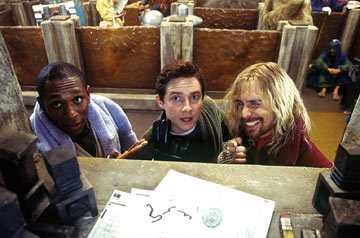
Ford, Arthur and Zaphod save the day Posted by Hello
Imagination feeds on imagination. It also feeds on frustration, absurdity and stupidity---that's pretty apparent in "Hitchhiker." But our imaginations need stimulus to get engaged, and there needs to be some friendly stimulus in the mix. Having creativity around you, and people receptive to it, open new possibilities of being creative, seeing the world more creatively, and giving you permission to see it differently. To see it perhaps as you really do see it, but can't admit to anyone, including yourself.

For example, I recall the bleakness of the early 1980s. I was back living in my small hometown, working on a book. I wanted the quiet but the isolation went far beyond that. The house where I was living had a large television set that didn't work, and a small one that did. One night around midnight I chanced to find on a public television station the opening episode of "The Hitchhiker's Guide to the Galaxy." They ran one episode a week, only late at night.

I may have read the title in the TV listings, but I knew nothing else about it; nothing about Douglas Adams or even Doctor Who (another BBC production, where Adams was story editor for a season.) But I was utterly transfixed. There were two things I found delightfully unbelievable: first, that someone had such imagination, and second, that he was allowed to use it, publicly. Watching the Guide every week, even on that tiny screen, utterly in suspense as to what Deep Thought would discover as the answer to Life, the Universe and Everything, was quite important to me.

I felt that again seeing the movie: the adrenalin of imagination, the giddy liberation, and the smirky delight that he'd gotten away with it.

Simon Jones as Arthur in the TV version Posted by Hello

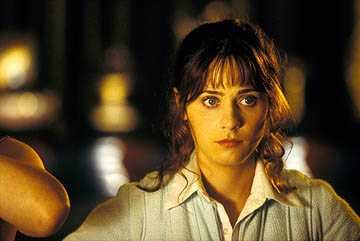
Zooey Deschanel as Trillian Posted by Hello
The movie is different, of course. There isn't that extended suspense, that sense of new discoveries each episode. In giving this a movie shape, the role of Ford Prefect (Mos Def in the movie) is diminished considerably. Alan Rickman is a terrific actor, so his voice for Marvin the paranoid android (more of depressed robot here) gets the requisite laughs, but I missed the machine-like gloomy moan of the TV voice. The creatures look much better, naturally (some done by Jim Henson, with whom Douglas Adams worked on a Muppets project that was never made) and the Vogons get off a Borg joke. I didn't care for the way they did the two heads of Zaphod, but it was certainly better than the goofy TV version. And the mice, I thought, came up short.

As for the other casting, I'm sure there will debate on the new Arthur (Martin Freeman) and the new Trillian (Zooey Deshanel), but they are very good in the roles as created for this movie. I loved Bill Nighy as Shartibarfast. Sam Rockwell plays galactic president Zaphod Beeblebrox as a cross between G.W. Bush and Elvis, an interesting choice. The 60s origins of this character dated it even in the 1980s, and the hippie drug lord qualities surface here and there, but it must work, or I'd be able to get rid of the image of his insidious smile.

Bill Nighy as Shartibarfast Posted by Hello
There are some fine additions: a new character, a new device (both technological and plot), possibly a new Question to the ultimate answer, and a rescue in the nick of time effected by turning in the proper request form. There is even a solution to the problem that bedeviled Douglas Adams from his first attempts to construct a film from this material: after you've destroyed the earth in the first act, what do you do for a climax? All this, plus the wonders that only a feature film can produce---the tour of earth under construction was amazing---are reasonable compensations. They stimulate the imagination in other ways.

Though Douglas Adams wrote several versions of the screenplay, this was twice removed from the original Hitchhiker---Adams always liked the radio version best. We get his voice in the books certainly. But I felt the Douglas Adams connection come alive in the film, too, so for me that's one thing that makes it a success. Even despite the Hollywood/Disney ending, which is quite different from the morose sort of acceptance and affirmation of life that ends the other versions.

The first "Hitchhiker" series was broadcast on the BBC in 1978. Douglas Adams was working on the screenplay in Los Angeles in 2001 when he died suddenly of a heart attack at age 49. The filmmakers (including director Garth Jennings and scriptwriter Karey Kirkpatrick) had to keep in mind the considerable existing fan base (as do all story "franchises" since Star Trek fans). But they also seemed to have a sincere affection and fascination for the Adams universe. The film dedication, to "Douglas" seemed true.
Next week: More on Douglas Adams and The Hitchhiker's Guide.

Douglas Posted by Hello

Sunday, May 01, 2005

Watch This Outer Space

for posts on Douglas Adams and The Hitchhikers Guide to the Galaxy, George Lucas and the Star Wars saga; H.G. Wells, Steven Speilberg and The War of the Worlds, and other future topics.

Tuesday, April 26, 2005

The Trekalog (so far): essays on all ten Star Trek feature films

Star Trek: The Motion Picture

Star Trek II: The Wrath of Khan

Star Trek III: The Search for Spock

Star Trek IV: The Voyage Home

TrekCheck: Mirrors

After its last hiatus from broadcasting, and well after it's last day of shooting, and near the last days that visual effects and post-production staff would be putting the finishing touches on the final episodes, Star Trek: Enterprise returned with its final set of new stories.

While some viewers had recently been alerted to the show's demise and therefore its existence, those of us who had followed the corporate drama that climaxed in its cancellation, were preparing to savor these last hours. It was looking more and more that they would be the last hours of new Star Trek for quite awhile-variously estimated at 3, 5, 10, 20 years for a new TV series---and considering how some were talking, and the fact that the production staff was disbanding for the first time in 18 years, these could very well be the last new episodes of Star Trek As We Know It, ever.

There are four episodes left as I write this, and I hope to write about all six a group after I've had the chance to see them together on tape. But the experience of seeing the first two on their initial broadcast was jarring. "Bound" may have been Manny Coto's attempt to do a comedy episode; when I visited the Star Trek set last August, he mentioned that Enterprise hadn't done one yet and he seemed to want to try it. If this was that attempt, it wasn't funny. If it was not, it was worse.

Still, I was prepared to think of it as an aberration, another back-from-hiatus back luck failure, like "Daedalus", hopefully to be followed by a memorable success, like "Observer Effect." So again I had high hopes for "In A Mirror, Darkly, Part I." And personally, on first viewing, I found it an even greater and more depressing disappointment.

Rather than analyze it now, before the second part and before I've seen it again, I'll offer one comment on my first experience, and some thoughts about how Mirror Universe stories work.

The comment is that there was so much gratuitous violence, particularly torture, that I would recommend that children be kept away from this episode, and I personally was offended by it. My first impression of the episode was that it did not justify its excesses, not just in the violence on screen, but the violence it did to itself and to Star Trek.

The idea of a Mirror Universe (or MU in Internet shorthand) first appeared in the original series episode, "Mirror, Mirror." There were three episodes of DS9 that visited later versions of this universe. Apparently we are seeing earlier days of this universe. The basic difference is that the Federation of the Star Trek universe is the Empire in the MU; what was good is evil.

The difference between this story and all the other MU episodes is that we are entirely in the company of people who belong in the MU. That presents a difficulty that this Enterprise episode didn't transcend.

In the original series "Mirror, Mirror," the device that made it work dramatically, was the point of view. Kirk, McCoy, Uhura and Scotty found themselves in this MU, and they had to figure out how it worked. We saw what the mirror showed, through their eyes. We saw our Captain Kirk discover each element of this opposite place; we saw him learn its rules, and go along with them at times in order to survive, yet he risks bending or opposing them when he can.

But in the Enterprise MU we see only the characters that belong in that universe. We have no point of view to help us sort things out, and the script doesn't help much. At times, certain characters seem to feel trapped by circumstances. But others seem to revel in evil to a cartoonish degree.

If the intention was to create a nightmare world, it succeeded. But it also looked as if all the money for this episode was spent on the opening scene and opening credits, leaving the rest of the hour to a string of violent shipboard scenes. The initial effect on me was to produce disgust and impatience rather than horror. These characters aren't actually scary, as the cardboard evil characters of the original series episode still managed to be, because we have no "normal" characters to be scared for or to identify with.

I'm tempted to see this on an entirely different level. Back when he was a writer instead of a TV game show host and pitchman, Ben Stein hypothesized that at some level every Hollywood movie is about Hollywood. Maybe I'm reading too much into this, but there seemed a lot of subtext on view in this episode. The hostilities expressed so fulsomely make more sense if you consider them expressions of a cast and writing staff that has been under the gun for at least a year, and is finding out that they've been cancelled. Short of being able to get a few UPN and Paramount executives into the agonizer, they have to make do by pretending to torture each other. Maybe the cries of pain are liberating for them, since it seemed one or another of them was emitting them for most of the hour.

Maybe it was therapy. Some of the actors appear to be relishing these reversals---there were a couple of times that I was sure several of the actors were on the verge of breaking up. And maybe this was Manny Coto's audition for "24."

As Star Trek, it was troubling. Although I thought "Mirror, Mirror" worked well, I'm not a fan of the Mirror Universe concept. Breaking us into all good and all evil works if you use the allegory for insight on our own universe, where we are both. But the temptations of the MU are often too strong: everybody gets to play against type, and it's easy to get carried away.

We'll see if it makes better sense in Part II, which is the episode many fans are waiting for, when the Enterprise crew is on the bridge of a Kirk era starship, wearing those Kirk era uniforms. In the first part, some fans apparently learned more about what the pre-Federation Trek universe would have been like had humans been ruled by fear and violence, as arguably we are now. Others are satisfied with action and seeing bits of Trek lore. While critical reaction to "Bound" was almost uniformly negative, the fan reaction to this episode on the Trek Today bbs was generally either an A or a D. Apart from an intriguing title sequence, on first viewing I felt the episode was implausible, incoherent, and laced with unjustified brutality. I hope that somehow Part II will change my conclusion, but I'm less enthusiastic about watching it than I was a week ago.

Monday, April 18, 2005

Not for Boys Only

by William S. Kowinski

Apart from raw numbers, one of the reasons given for why UPN cancelled Star Trek: Enterprise was the network's desire to attract female viewers, while the audience for Enterprise was chiefly male. (This of course is after near-nudity and a new T'pol catsuit were added to attract young male viewers.) That Star Trek is a boy fan (or fanboy) thing seems to be the conventional wisdom. It's clearly the assumption made by the former Nashville Network reborn with Star Trek: The Next Generation reruns as TNN, but morphed into Spike TV, with a lineup heavy on wrestling and wrecking. Recently TNG episodes (as well as DS9) have been sliced and diced with commercials for shows featuring mayhem to satisfy the supposed need of young males for mindless violence. "We destroy, you enjoy," being the tagline. This is the latest agenda of TV: now that dumbing down everybody in general has been accomplished, the idea is to further dumb down specific demographics, until they're putty in the hands of advertisers.

Like many marketing conceits, this male-oriented Trek image is more copycat cant than science. The demographic breakdown for Enterprise was close to 60-40 male to female. Even if these numbers are vaguely accurate, that's a difference of about 10% short of equality. It hardly qualifies as a male- only dominion. Moreover the idea of a boys-only or male dominant fan base runs counter to the overall Star Trek viewership, and worst of all, it obscures how revolutionary Star Trek has been for nearly 40 years in attracting women.

The gender difference for the various Star Trek series at various times very probably amount to a wash: about as many females as males watched Star Trek. In many ways it was women fans and the original show's female audience that saved Star Trek in the first place. Star Trek was the first science fiction that attracted a sizeable female audience, and maintained it through TNG, DS9 and of course, Voyager, with Captain Kathryn Janeway.

In the beginning...

There's a great little book that's been published under several titles, one of which was "Star Trek Lives!," the "personal notes and anecdotes" of Jacqueline Lichtenberg, Sondra Marshak and Joan Winston. These three female authors never really make a point of women viewers or fans, which makes their reporting all that more convincing, for it's clear how involved women were in early Trek fandom.

It was three women (Joan Winston, Devra Langsam and Elyse Pines) who organized the first major Star Trek convention in New York City. They did it, Winston wrote, because they felt Star Trek fans were only tolerated at science fiction conventions, and if they met separately they would be no one else around to "sneer." What she doesn't say, but which is likely, is that part of the sneering might well have been because science fiction was at that point largely a male domain. Star Trek might have seemed silly to hardcore hard sci-fi fans partly because of the show, but partly because it seemed to attract girls.

But for years after those first conventions in the early 70s, Star Trek gatherings attracted more attendees than science fiction conventions. At least until Star Wars took off, Star Trek had more fans that all other science fiction combined.

Women were attracted to Star Trek, right from the start. Women may be interested in Star Trek for any or all of the same reasons that men are, and a science fiction drama series appearing on primetime TV every week made it that much more accessible. That it had continuing characters made other attractions possible, such as the sex appeal of its stars.

That this was science fiction on television with the same characters every week placed it in a more familiar TV mode than the sci-fi world. William Shatner was a classic Hollywood heartthrob, and he had his legions of female fans. But the apparent anomaly that said more about how Star Trek was different, was Spock. Women were enormously attracted to Spock. To Leonard Nimoy certainly, as he embodied Spock, but also to the character of Mr. Spock. The alien quality, the innocence of logic, the strength of principle and character, the redefinition of the classic gentleman that Nimoy consciously made essential to Spock, all redefined the masculine model, for males to emulate, and females to desire. (And vice versa, as the case may be.)

It was Star Trek's female fans that created the first fanzines and largely began the still thriving tradition of fan fiction, including homoerotic fantasies of Kirk and Spock. But sex appeal was only part of the attraction. Something else that's striking about the "Star Trek Lives!" book is how many of the most articulate fans it quotes were adult women in their 20s and 30s, educated, some in professional positions (and there weren't as many women in positions like that as there are now. For example, there were very few women television news reporters anywhere until the mid 70s.) Their interests were related to what they found attractive in Star Trek's male characters, but it went beyond that, to the essence of Star Trek's stories and universe.

The stories dealt with human emotions and behavior beyond the usual space opera or tech-heavy science fiction, while challenging conventional ideas and stimulating imagination. Star Trek portrayed a future made hopeful not only by new technologies but by new attitudes and commitments: the commitment to reason and communication, to equal opportunities, to empathetic understanding of even the weirdest-looking alien, and courage when it counted, but not reflexively expressed by violence. The presence of women on the 23rd century Enterprise bridge also provided some entry into this universe of stories that (quoting the book) "give us the experience of what it would be like to live in a world as it should and could be, among human beings as they should and could be."

These elements were even stronger in Star Trek: The Next Generation. "The continuing mission of the starship Enterprise has been to take us out of the smog of fear and hate into an open space where difference is opportunity, and justice matters, and you can still see the stars," wrote Ursula LeGuin. "Violence on the Next Generation is shown as a problem, or the failure to solve a problem, never as the true solution."

There was an even stronger female presence in the cast, reflecting in the portrayed future some changes made here since the 60s. It was with TNG that Star Trek really began establishing female role models for girls. Uhura inspired girls, especially African-American and minority girls, but it was the TNG first season presence of Denise Crosby as the security chief Tasha Yar, and especially the long-term presence of Gates McFadden as Dr. Beverly Crusher and Marina Sirtis as Counselor Deanna Troi that were so widely influential. Gates McFadden testifies to the enormous response she got from girls who wanted to be doctors and yet still be mothers, as well as women struggling with being single mothers.

DS9 provided two strong women characters with executive and otherwise equal responsibilities, and Voyager several more, including the first female engineer and female captain in the lead of a Star Trek series. TNG was criticized for its two main women characters both being in the "helping" or presumably female professions, but Marina Sirtis said something particularly interesting and apropos about that on the 7th TNG seventh season DVD. Girls get a lot of role models who are strong and aggressive, she said (and by now that's certainly true.) With Troi, she wanted to model a woman who is "strong and not aggressive," a kind of female Picard, who uses "diplomacy and tact." This is important not only for girls to see, but for boys. It was unfortunate that while women got more traditionally male roles on subsequent series, there was no male counselor on DS9 or Voyager. Psychology as an aid to self-awareness is more crucial to the Star Trek future than photon torpedoes.

Though Star Trek was largely produced, written and directed by men, several women, from Dorothy Fontana through Jeri Taylor, played key roles in each of those areas, and others. Many past and present Trek novelists are women; the novelizations of all the Trek films have been written by Vondra McIntyre and J. M. Dillard. Today two of the longest-running and best-known writers on the subject of Star Trek are Michelle Erica Green and Julia Houston. There have been and still are arguments about sexism and so on (which certain episodes, like the most recent Enterprise "Bound" especially invite) but in Trekdom there are arguments about everything. It's certainly hypocritical of UPN etc. to heavily promote Enterprise as male-oriented and even demand that the program do certain things to appeal to males, and then cancel the series because it succeeded. But what's worse about this reputation, this new conventional wisdom, and particularly the way that TNG is being positioned and promoted, is that it tends to make female viewers feel unwelcome. It distorts the nature of the saga, and devalues those qualities within all of us that are associated with the female archetype. When that happens, Star Trek loses part of its soul.

Monday, April 11, 2005


now orbiting Star Trek Posted by Hello
Of Sharks and Whales: The Battle for Star Trek's Soul

by William S. Kowinski

The blood is in the water, and the sharks are circling. Star Trek:Enterprise has been ignominiously cancelled, and Star Trek has been shut down.

But Sci Fi Channel's "Battlestar Galactica" is a hit, at least in cable terms, anchoring the Friday night lineup that contributed to sinking the rescheduled "Enterprise." So it's natural that some of the sharks come from those waters. Two former DS9 writers who few seem to have heard of before, Bradley Thompson and David Weddle, now write for BSG, and gave an interview about how much they learned from working on a Trek series, and how glad they aren't doing that anymore. Because now they can "bring sci fi back into the realm of a place that might actually exist, with people like us in it."

To be fair, this is just one line in a long interview. And others are saying similar things. Even Rick Berman expressed doubts in his February interview with TV Week: "We made a great effort to keep Roddenberry's vision of the future in mind. Has that attitude played itself out? It could very well be true." And it was this BSG's creator and former Trek writer, Ronald Moore who said in the same article that Trek doesn't need to become BSG, that it can remain a hopeful vision of the future.

But we are in dangerous waters right now. Everything about Star Trek is seemingly vulnerable. So this is the time to be as clear as possible about what we believe Star Trek is, so that its next incarnation is not simply as another space-based action series trading on the Star Trek name.

The line of attack represented by the Thompson & Weedle statements is familiar, and has been uttered in various ways by other former Trek writers and producers: the people in Roddenberry's future were too "perfect." They weren't like us.

It seemed to me that a lot of DS9 reflected this view. But it always puzzled me. Especially since this complaint seemed to come from people who understood that this is precisely what Star Trek is about, and in fact wrote great scenes illustrating it: It is about how people change, not just how technology changes. And about how the future cannot be better unless we do change.

As people with an interest in the future, who perhaps have or look forward to having children and grandchildren, I assume they are interested in promoting that future. But they are also TV writers.

So let's take a closer look at that sentence, because it reflects one particularly seductive line of thinking. The writers in question have been liberated to "bring sci fi back into the realm of a place that might actually exist, with people like us in it."

Who are these "people like us?" They are people with raw passions, who kill out of fear and hatred, who betray one another from jealousy and envy and greed. They lie, double-deal and double-cross, and seem to enjoy it. No doubt there are people like that, and that these are all human emotions and human behaviors. We are probably all pretty familiar with betrayal, and have seen or experienced some dirty deeds based on any number of the seven deadly sins.

But there are several relevant points here. And the first and most obvious to me is: mostly they aren't actually talking about "people like us." Most people don't behave that way, on that scale. They are talking about people like the people you usually see on television action shows, and in action movies. They are people who act violently whenever possible. And it is usually very possible, because somebody just dripping with evil is inevitably attacking somebody who is violently good. They're involved in non-stop violence on "24." People like us don't actually kill that many people before dinner.

And even among the good guys on most TV and in movies, there are violent arguments, violent jealousies, outsized greed and incomparable betrayal. All passions are uncontrollable, and all emotions and certainly all conflicts are acted out. The truth is, we aren't any more like these people than we are like Captain Picard or Dr. Phlox.

Moreover, the basic conflict is always a fight for survival, involving a fight to the death, and it is so intense that it couldn't possibly be slowed down for much in the way of variation, and certainly not evaluation or second thoughts, except the tortured kind, under incredible pressures that are stacked so they lead to the same conclusion: us or them.

Yes, it turns out that these kind of "people like us" are a lot easier to write for. They practically write themselves.

In fact these perfectly violent, often one-dimensional characters are no more real than the "perfect" crew of the starship Enterprise (and incidentally, they weren't ever really perfect, in any century.)

But even if the characters are more complicated, more dimensional, what's the point? Every war story is basically the same. How many repetitions of it do we need? Many of the emotions of war are endemic to the situation; the challenge is to not get into the situation, or to handle it differently, to handle yourself differently.

But war and violence are gripping. They go past our thinking brains to fight-or-flight responses, to visceral reactions. Sure, that's part of life, and storytelling. But it's not all of it. And more to the point, it's the easiest to write, and the easiest to evoke a guaranteed response. People will watch, because some survival instinct has been engaged. Glands call to glands.

I am not describing characters specifically in BSG, which I haven't yet seen much of. I am drawing a contrast that may be exaggerated but is quite functional.

These writers want to "bring sci-fi back to a place that might actually exist." A very interesting proposition. First, there's the apparent contradiction of sci-fi and realism. It's not really a contradiction, but this does suggest something that is true: a lot of sci-fi creates plausible worlds in order to test a proposition, an idea. It doesn't matter if H.G. Wells' time machine could exist in 1890; what matters is the story he told about a very unlikely future that made enormously rich metaphorical sense. So a place that might actually exist is not necessarily a virtue in science fiction. If it's too close to the present, what's the point? It's just a costume drama, where the costumes excuse the implausible.

But what constitutes a future that might actually exist? Is it necessarily a future in which everything changes except us? Hasn't anything about human thought, feeling and behavior changed? To believe it hasn't is to be enormously shortsighted. We have examples within our own lifetimes. To think that people of a hundred, five hundred, a thousand years ago are pretty much just like us, may be an understandable Hollywood convention, but it's more than just unlikely. If you believe it, you probably believe that ancient Romans all had British accents.

A little study of indigenous peoples, either from anthropological work or through living descendants today, will illuminate you: "people like us" then were very different in very important ways from "people like us" now. And that's just if you mean "people like us" in urban North America, or the cities of the West.

Of course, much human behavior seems stuck in the same repeating and often self-destructive patterns. It's depressing, and it makes people cynical. But those aren't the only possible reactions.

For a much more salient point is this: if people of that recognizable future are too much "just like us," we are unlikely to have a future at all. Which a lot of people were saying in particular in the 1960s, and one of them was Gene Roddenberry.

Star Trek began in the shadow of thermonuclear holocaust, and despite more novel problems, we aren't out of that shadow yet. Some experts believe we are more in danger of accidental nuclear attack now than in the Cold War. There are STILL more than enough nuclear warheads on working missiles to destroy civilization in a matter of hours.

And that isn't even our biggest threat anymore. Assuming we manage to not set off a nuclear Armageddon, we are in the very early stages of a climate crisis which will challenge human civilization for at least the next century, and especially if we continue ignoring it, it could end life as we know it on this planet.

All we have to do is keep on being "people like us."

The people like us many of these characters are like, are soldiers, in an exceedingly artificial (though all too common) situation called modern warfare. It was a situation a lot of us were supposed to naturally become part of in the Vietnam era, because (everything told us) we had no choice. Those were enemies and they were evil. But it was a situation that people involved in Star Trek, including actual veterans like Roddenberry, wanted to portray alternatives to.

I am continually impressed and inspired by how many people articulate the basic Star Trek vision with such clarity, variety and even poetry. An amazing proportion of the people who worked on Trek can do it, even if they wrote some music once or acted in a single movie. But fans often are eloquent on the subject, too. The most appropriate statement that comes to mind right now is something Mike Malotte, Commander of Starfleet (or president of the International Star Trek Fan Association) said to me in a phone interview last summer: "Gene's Star Trek was really the first science fiction show of its time that showed a future where we actually learn from our mistakes, and we bettered ourselves, and we banded together and we headed out for the stars..."

What Star Trek is largely about---what it embodies, what it models, what it is-- is the process of how we learn, how we become better.

[more text after photo]

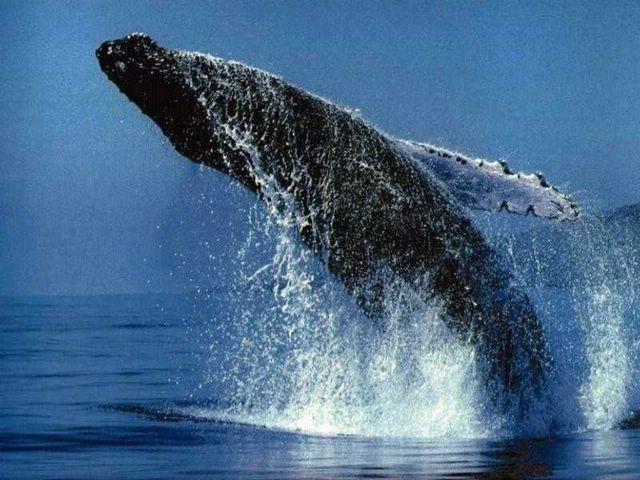
whale's tales of consciousness Posted by Hello
The Sci-Fi of Consciousness

"Much...that proves to be abysmally evil in its ultimate effects does not come from man's wickedness but from his stupidity and unconsciousness."
Jung, Psychology and Western Religion

Let me put it in these terms, which as far as I know I am making up as I go along, although it's so obvious that somebody must have thought of it this way before. There are currently two kinds of science fiction (and you can throw in two kinds of "space opera" as well, because I'm talking mostly about television and film.) There is the science fiction of consciousness. And there is the science fiction of unconsciousness.

The science fiction of unconsciousness is easier to describe. In our daily lives we proceed as if the future will be just like the present, only with new stuff. Our public lives proceed as if the future is going to be great, especially if we get another tax cut, because every new technology is great, the economy is always getting better, and our leaders are always looking out for us, they're telling us the truth and they really know what they are doing.

And our unconscious doesn't believe a word of it. Not that the emotions and anxieties we ignore, suppress and repress, are always any closer to being correct. But they are extreme, and they tend to be expressed in fantasies and stories, especially nightmarish ones, and in other ways that tend towards the extreme.

Mostly it is our repressed suspicions, our barely suppressed fears, our hatred reactions and violent responses, that get translated into stories of violent conflict. In the science fiction of unconsciousness, only technology changes, and gets more capable and complex. People don't change, or get more fully capable, or recognize their complexities; by some standards within civilized memory, they even revert.

The science fiction of consciousness also taps into the power and imagery of the unconscious, but it uses that material to produce stories that are partly, mostly or firstly about applying consciousness to situations. The story itself may demonstrate that application, or it may be something the characters themselves go through, or both.

A simple example might be: stories of space exploration are usually the science fiction of consciousness. Stories of space invaders are the science fiction of unconsciousness.

That's the idea, even if strictly speaking, it's not that simple.

But consciousness is the right word, because it's not just rationality, or the brain or the mind. It's also about emotion, but it deals with them consciously: what emotions do we value, what should we encourage? Who do we love, and why do we hate and fear? Is it unreasonable, destructive fear, or is it justified and useful fear? Is hate as a motivator ever justified? Do we value courage for its own sake over courage behind a behavior that serves a greater good even if it's not so popular, that ennobles us and shows us where we could go, what we could be?

Most of all it is about behavior, because, while we cannot always control our thoughts or emotions, we must be able to control our behavior. That's the definition of human freedom.

Right now we're falling deep into the science fiction as well as the fantasy (and the politics, the economics, the religion) of unconsciousness. Under the public cheerfulness and/or apathy, suppressed despair and repressed fears get expressed through the unconscious, telling us in coded entertainment that we are really afraid of where we're going, and what's happening around us.

Exploration stories---Star Trek stories---ask "what if" questions, they confront who we are through our reactions and our questions about what we find, and why we're going out there in the first place. So many Trek stories show humanity in the middle, with characters valuing our basic nature yet always refining our aspirations, refusing to say we cannot change for the better, individually and as a society.

Invasion movies---which almost always means we humans are being invaded--- are all visceral. You don't think about the humanity of the invader when you're trying to stay alive. That makes for a more exciting movie at a fight-or-flight level, and you must avoid dealing with those questions that slow the action down. You deal with pure push-button emotion, just like the commercials.

It's the very easiest thing to do in order to stimulate an audience, to keep their attention, because we're built to pay attention to what endangers us. So drama sets up an enemy who is all evil. This is not something we find in nature, it's all in the unconscious. Our enemies may be real. Evil may be real. But we seldom encounter enemies who are all evil...except in the fantasy of the unconscious.

Here's another example of what I mean. We've had movies (at least one famous one) and TV dramas (one particularly ridiculous recent one) that pit sharks against humans. The sharks are pure evil. They are pure unconsciousness, and they are met with pure unconsciousness. They don't behave much like real sharks, but that's not the point of these stories.

I can't think of a Star Trek story that involves sharks, but I can think of several that involve whales. A whale is among the most famous literary symbols, some would say of a relentless evil, in Melville's Moby Dick. In fact all but one of the Star Trek episodes and movies I'm thinking of don't deal with actual whales: they deal with the symbolism of Melville's singular giant white whale, and the man who hunted it. Usually an Ahab figure relentlessly pursues some being or force that caused that Ahab great harm. Khan is an Ahab figure in "Star Trek II: The Wrath of Khan." Kirk, and the white Enterprise, is his Moby Dick. Khan even had some of his lines written by Melville (although he lost screen credit in Guild arbitration.)

The symbolism of Moby Dick has been interpreted differently by different people at various times. Some have felt that Ahab's mission was divine, and the whale was the Beast (which it seemed to have been to some extent, to Ahab's deluded mind.) It is yet another version of man's dominion over the animal, even in himself. But even other characters in the novel don't believe that. They see the whale as natural. Simply by being an ambiguous "character," by being a symbol, this whale is an instrument of consciousness. You ask why.

The interpretation that Ahab is obsessively pursuing revenge is central to "Star Trek: First Contact," when Lily confronts Jean Luc Picard about his obsession with vengeance against the Borg. Picard denies it at first. (A more direct way of saying he is "in denial.") But because The Next Generation series established that Picard, while hardly perfect, does take literature very seriously, and because the series established that TNG Enterprise characters, while hardly perfect, are able to step back and evaluate their own motivations and actions (often with the help of Counselor Troi), Lily's Moby Dick references strikes a chord of memory, which strikes a nerve.

While quoting lines describing Ahab's unconscious hate poured on the wounded beast ("if his heart had been a cannon he would have shot his chest upon it"), Picard realizes what has been motivating him and telling him lies about why he is doing what he is doing (which is what the unconscious does best). And he becomes conscious. And changes his behavior.

It is possibly the clearest illustration of the science fiction of consciousness that is a constant in much of Trek, and very much in the Roddenberry vision.

Finally, we come to the Star Trek that has a real whale in it: in fact, two.

"Star Trek IV:The Voyage Home" (perhaps along with "First Contact") is the most popular of all Star Trek movies. Here the consciousness of the 23rd century and its fictional Captain Kirk and Mr. Spock, merges with the consciousness of several 20th century people, including Leonard Nimoy and William Shatner, both of whom believe passionately in the need to maintain a healthy natural environment, and respect the other creatures of the earth, recognizing that this is not without cost. That's what values are: priorities that guide choices.

Like the best of Star Trek, this movie grants other beings our conscious recognition of their consciousness, however different from ours it may be. And so the metaphorical whales which carry humans to consciousness and meaning on the voyage of exploration that is life, are joined by real whales, behaving as real whales do (except perhaps for communicating with extraterrestrial beings. But then again...) For instance, they don't eat people. It is the unconsciousness of people that threatens the whales, not just with needless death, but total extinction.

So this whales' tale is about how human unconsciousness threatens its future, and how consciousness can redeem it.

Star Trek is the richest, most accessible, and most conspicuous focus of the science fiction of consciousness we have. Let's not throw it away because it's hard to do.

As for its popularity, let's face it: except for a few times in its history, Star Trek has always a minority preoccupation. Roddenberry's Star Trek was just as out of synch with the prevailing mood of the 60s as Star Trek may be now. The difference is perhaps that a counterculture was growing more obviously then to challenge the establishment culture, which in many ways resembles today's dominant culture, except today's is more vulgar and more overtly violent, especially ideologically. But that's evidence, I believe, of the dire straits we're in. It may be evidence of how skewed the media is, in telling us about ourselves. It is certainly evidence of how much we need the science fiction of consciousness. Of how much we need the soul of Star Trek.

Monday, April 04, 2005

Star Trek and the Culture Wars

The range of writings responding to the death of Pope John Paul II demonstrates the inaccurate limitation of our "us or them" habits, particularly in evaluating the complexity of beliefs, observations and principles that any one person or group of people might have.

Was Pope John Paul a conservative or a liberal? Was he a red states' Pontiff or a blue states Prelate? Conservative talk shows in America claim him for their own, but as others have shown, they weren't so certain a few years ago, when the Pope came out strongly against the war in Iraq. Some Vatican insiders have told reporters that not being able to stop the U.S. invasion was among his greatest disappointments of his papacy.

As various writers are now noting, Pope John Paul was passionately attentive to the needs of the poor and dispossessed; he was against birth control and considered abortion to be murder; he promoted diversity and ecumenical understanding, admired the devotion to prayer of Muslims and was the first Pope to enter a mosque; he thought homosexuality was wrong and condemned gay marriage; he was against capital punishment; he was against changing Church practices so that priests could marry or women become priests; he spoke out against rampant capitalism, environmental destruction, the culture of consumption, and the rich western countries ignoring the poor countries of Africa, Asia and Latin America. So what was he?

I don't know that the late Pope ever saw Star Trek, but it's very likely he would have approved of a lot of what he saw, and would not have damned the entire vision for what he disagreed with, or thought was missing. Star Trek stood for diversity, tolerance, social justice, and a respect for spirituality, even a belief in something transcendent to human knowledge at work in the universe.

Because Gene Roddenberry is characterized as a humanist, even a secular humanist, it is often proposed that he was against religion and religious values, even that he had no spiritual life. His own statements, along with the evidence of what he wrote or approved as part of Star Trek, don't add up to so simple a characterization, so black and white (or red or blue) a picture.

By that evidence, it seems to me that Roddenberry was suspicious of organized religions, and saw that many needless wars and much suffering were caused or encouraged by conflicting religions, each certain it was justified in killing people on the other side, because they were on the side of God and the other side therefore was in league with the devil.

But also by that evidence (for instance, the interview with Terrance Sweeney at the end of David Alexander's Roddenberry biography, Star Trek Creator) he had spiritual feelings and thoughts, and a faith in the divine, though his definition of God would not satisfy some adherents of some religions.

It seems to me that if it had been possible to put Roddenberry, Pope John Paul and the Dalai Lama in a room together for an hour, they would respectfully disagree on a few things, but would quickly find they had much more in common, and moreover, they would concentrate on those common beliefs and probably would spend most of the time talking about how they could work together to further those values, so they would indeed be part of the soul of the future.

While I believe it is important to strongly oppose what I find to be dangerous, and to engage in debate and dialogue on important questions of justice, morality and governance, I find today's automatic political typecasting, and all the laundry lists of absolutist positions, to be repugnant and themselves dangerous.

Not only are these lists harmful, they are often irrelevant and inaccurate. Star Trek is a very good example. Where does Star Trek stand in the so-called Culture Wars? In most respects, with the Blue States. But consider this statement by Michael Medved, a movie reviewer who now makes his living principally from Rush Limbaugh dittoheads and Christian conservatives, who castigated Star Trek V for being anti-God: in his book, Right Turns, he criticizes how much our culture is now willing to "accept the ability to shock as a replacement for the old ability to inspire."

That seems to me to be one of the major reasons that Star Trek is so singularly valuable. Take a look down the rows of video store shelves: it's all guns, muscles, t&a. We have replaced inspiration with shock, except for Star Trek, and a minority of other movies and TV shows. That Star Trek is family friendly (including the movies, though some include mild profanity and jokes about bodies, but pushing it with certain episodes of Enterprise) has been important to its character. "Apart from perhaps the Weather Channel," Marina Sirtis said, "Star Trek is the only show on television the whole family can watch together." And, I would add, enjoy, while they quite probably learn something, and may even talk about moral and values issues in the real world that the story inspired.

So on this I agree with what Medved wrote, and I am not happy that my belief in the right of free expression is confused with my support for mindless vulgarity and, incidentally, equally mindless violence. But Star Trek V as anti-God? Come on, Michael. That's sophistry or zealotry, and I don't accept either, or the idea that fundamentalist or conservative Christians get to define my morality and spirituality. And my values tell me that however I might agree with Medved on this observation, it's not nearly enough to get me to vote for G.W. Bush, not even at gunpoint.

Even worse that the oversimplified shock and commercialized vulgarity, is the impoverishment of our political, moral and spiritual dialogue. We seem to be hypnotically locking ourselves in rigid oversimplifications, perhaps in fear of the interrelated complexity now revealing itself to us. We need to be inspired to embrace the adventure of understanding this, which Star Trek can do.