TrekCheck: All bad things?...
As the Enterprise season and officially its existence as an ongoing series come to an end, there is more than the usual conflict in Trekdom.
On the one side there are the people associated with Enterprise who speak only in terms of finality. It's striking how many of them use the same word to describe the prevailing attitude: "bittersweet." Jonathan Frakes used it, and Brannon Braga at his college speech; I heard Dan Curry at his college speech use it twice.
Within this group, though not totally unanimous, is the sentiment that the cancellation of Enterprise is a necessary thing, because Trek needs a rest, a pause, a period of "gestation" (to use Braga's word) before the next try. As noted before, Rick Berman has settled on the "franchise fatigue " description, which justifies not only the cancellation but the idea to abandon established Trek characters (and presumably actors) for the next feature.
On the other side is the Coto Counteroffensive, and the fan attempts to save Enterprise. Manny Coto hasn't backed off his belief, stated to me and anybody else who would listen before the season started, that what the world needs now is more Trek, not less, and certainly not none. He talked recently of his 5th season stories for Enterprise, though he also agreed that the next Trek series should go farther into the future, into the 25th century perhaps.
When fans showed up to demonstrate their support at Paramount, Coto and the writing team came out to greet them, as did members of the cast. While Coto doesn't say a word against Rick Berman, he is clearly on the other side of this question. Scott Bacula seems to have a foot in each camp---he says he'd like the series to continue, but he talks realistically about its chances. His pessimism sounds the most realistic, based on his knowledge of the people involved who are making these decisions. (There was also the $3 million pledged to save Enterprise, a startling but probably risk-free assertion of faith in Trek, as paying the actual money probably depends on raising the full $38 million goal, which is highly unlikely.)
So even as faint hope at least keeps our ears perked up for surprises, most fans seemed resigned to cocooning quietly one last time, to watch the farewell episode, and wave a fond goodbye.
But a new element was added last week when a couple of long-time BBS posters, believed to be close to the Enterprise production team if not part of it, went public with a scathing critique of the script of the final episode, said to be titled, "These Are the Voyages."
BBS fans going nuclear is hardly news, but these "sources" claimed that there was widespread dissatisfaction on the set with this script, which is now in production. Perhaps coincidentally, a previously scheduled press event with Berman, Coto and Scott Bacula, among others, was cancelled, and the Enterprise set was abruptly closed.
Then over the weekend, Jolene Blalock called the script "appalling." She's made negative comments about scripts before, but "appalling" is very strong language, particularly as she was praising this season's scripts.
So now should fans be expecting an even greater disappointment: not just the loss of Enterprise, and with it the loss of new TV Trek stories for the indefinite future, but a final farewell to Star Trek episode that's "appalling?"
There is a certain symmetry to the possibility. A bad end to a troubled series would not be unexpected. But a bad end to "Trek as we know it," coming to us in an interrupted but unbroken line from Roddenberry to today, especially with many of the same people involved for decades, would leave us with worse than a bittersweet taste.
It does suggest that while all good things may come to a good end, a less than happy situation sometimes cannot transcend itself, and the bad end seems inevitable.
There are conspicuous examples of both in Star Trek. The miracle and the love fest that was TNG, came to a great end with "All Good Things..." Even the ignominious cessation of the original cast's TV run was vastly overshadowed by their movies, and a magnificent Star Trek VI with a wonderful ending.
But when things don't go over well, the differences seem to matter more, and things get bent out of shape. They don't quite mesh, and bad decisions instead of magically right ones seem to emerge. It seems everyone involved was shocked, and in a way still are, by the box office failure of Star Trek Nemesis. Without analyzing details, it seems that somehow things got out of synch. The cast was clearly surprised by the ad campaign of a generation's last voyage. Perhaps the most telling detail was how the movie itself ended. The DVD contains a perfectly good Star Trek ending, full of humor and feeling, and with the kind of "conclusion" we anticipate and need: the Enterprise warping off to its next adventure.
Unfortunately that ending wasn't used. Instead the Enterprise is static, not even whole, still in drydock being repaired. That was only one aspect of an unsatisfying ending, but an important one. It's the feeling people leave the theatre with that counts. The movie felt abandoned, and perhaps so did we.
This kind of contrast of endings happens in sports sometimes as well. Remember Michael Jordan, at the apex of his fame, in the final game of his stellar career with the Chicago Bulls, hitting the shot that won Chicago's last championship? It was a perfect ending to an incredible career.
But it turned out not to be Jordan's last game. That was several years later, when he was playing for a Washington team that never even made the playoffs. Jordan had become increasingly critical of his younger teammates, and in his actual final game, they simply ignored him. The dissension was obvious, as the crowd begged for Jordan to take a final shot, but his teammates, fed up with his criticism and celebrity, showed only disdain. In exasperation, Jordan took himself out of the game. It turned out that management as well as players had enough of Jordan. He was essentially fired from the team he’d once owned.
And just a few years ago, when the Los Angeles Lakers were playing well, playing together and winning, they overcame their differences. But who knows what happened first: the egos and differences erupted, or the quality of play fell off, or the winning luck just wasn't with them for the big moments? But it all fell apart last season, and now that team doesn't even exist anymore.
What's happening with Enterprise, and what may happen with its ending, may be attributable to exactly what Rick Berman says: franchise fatigue, too many ideas used up, and not enough creative energy left. Whether or not others could have done better is debatable, given all the circumstances. If the fourth season had come in the second season? Who knows? But there was enough good coming out of this season to produce the hope that if this was going to be the end of what for almost four decades had been a very good thing, it would be a worthy ending.
Trek has been going through a stormy period, but there was---and in fact, there still is---the possibility of one last return to the qualities that made Star Trek legendary. We can still hope that this final episode will emerge as a fitting end, that down at Paramount dissatisfaction becomes creative rescue. For hope, after all, is what this franchise has always been about.
One thing for sure: we'll be looking for that last shot of one Enterprise or another heading into the stars, taking our hopes into the future.
Monday, March 07, 2005


Sunday, February 27, 2005
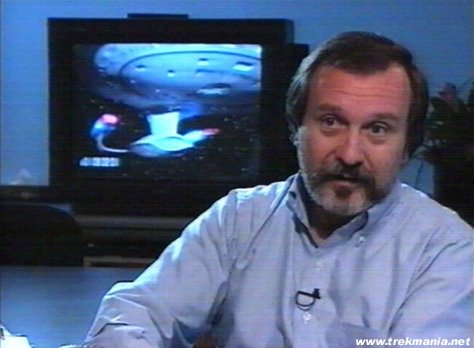

I'm Not A Hollywood Type, I Just Work There:
An Evening with Dan Curry
by William S. Kowinski
If Visual Effects Producer Dan Curry is holding out any hope of a reprieve for Star Trek:Enterprise, he was keeping it to himself when he spoke to a university audience on Friday night (February 25.)
At about the same time that its latest episode, " Divergence," was being seen locally, Curry was on a theatre stage describing how he had begun working on Star Trek's second incarnation---the pilot of "The Next Generation"-which he thought would be a four month job.
"And 18 years later, I'm working on the final episode of Star Trek," Curry said. "With the political machinations of studios and dwindling ratings, the saga of Star Trek for the moment is drawing to a close. So we're all going through a bittersweet period of facing the excitement of a new adventure, but kind of waving goodbye to a group of people that has become family for us over the years."
Later in his talk, Curry noted that the four seasons of Enterprise were "just enough to make it an attractive syndication package, so it will begin to bring negotiable currency to Paramount Pictures."
In a conversation we had after his presentation, Curry added that even though many were looking for their next jobs, they were all still determined to make the remaining episodes as good as they possibly can be.
Curry wouldn't tell me anything about the final episode, which he said was being kept super-secret, and had started shooting that day. He expected to be finished with his post-production work in late April. But he did suggest there would likely be a 40th anniversary Star Trek TV special, and perhaps another documentary that focuses on effects over the years.
As for his own feelings about Enterprise, when asked from the audience which of the Star Trek series was his favorite to work on (and he's worked on them all since TNG) he said, "I think Enterprise, for a number of reasons. It's set earlier in time so things are little more rough and tumble, it's really a fun cast to work with, and over time the relationship of the cast and the crew members has evolved to the point where we are like family. So it's the most emotionally satisfying just because of the quality of the people I work with."
[text continues after photos]
An Evening with Dan Curry
by William S. Kowinski
If Visual Effects Producer Dan Curry is holding out any hope of a reprieve for Star Trek:Enterprise, he was keeping it to himself when he spoke to a university audience on Friday night (February 25.)
At about the same time that its latest episode, " Divergence," was being seen locally, Curry was on a theatre stage describing how he had begun working on Star Trek's second incarnation---the pilot of "The Next Generation"-which he thought would be a four month job.
"And 18 years later, I'm working on the final episode of Star Trek," Curry said. "With the political machinations of studios and dwindling ratings, the saga of Star Trek for the moment is drawing to a close. So we're all going through a bittersweet period of facing the excitement of a new adventure, but kind of waving goodbye to a group of people that has become family for us over the years."
Later in his talk, Curry noted that the four seasons of Enterprise were "just enough to make it an attractive syndication package, so it will begin to bring negotiable currency to Paramount Pictures."
In a conversation we had after his presentation, Curry added that even though many were looking for their next jobs, they were all still determined to make the remaining episodes as good as they possibly can be.
Curry wouldn't tell me anything about the final episode, which he said was being kept super-secret, and had started shooting that day. He expected to be finished with his post-production work in late April. But he did suggest there would likely be a 40th anniversary Star Trek TV special, and perhaps another documentary that focuses on effects over the years.
As for his own feelings about Enterprise, when asked from the audience which of the Star Trek series was his favorite to work on (and he's worked on them all since TNG) he said, "I think Enterprise, for a number of reasons. It's set earlier in time so things are little more rough and tumble, it's really a fun cast to work with, and over time the relationship of the cast and the crew members has evolved to the point where we are like family. So it's the most emotionally satisfying just because of the quality of the people I work with."
[text continues after photos]
Curry spoke to a hundred or so students and faculty at Humboldt State University in far northern California, where he had been a graduate student and earned his Masters of Fine Arts degree in 1982. In the theatre building where he had spent many hours, he talked about his career, mostly on Star Trek but also on several features, and illustrated his stories with clips and before-and-after examples of specific visual effects.
The DVD and videotape footage projected on a screen beside him on the stage included his ten minute 2004 Emmy-winning reel from Enterprise (he's won 7 in all), a montage of Enterprise season 3 in 60 seconds, and the 18 minute profile included in the TNG season 6 DVD, which features him talking about various episodes, showing Klingon weapons he designed and their inspirations, and doing some Tai'chi on his lawn. ("They followed me around my house. After it was made and they sent me a copy, and it took me about eight months to have the courage to watch it. It's living proof why I am behind the camera.")
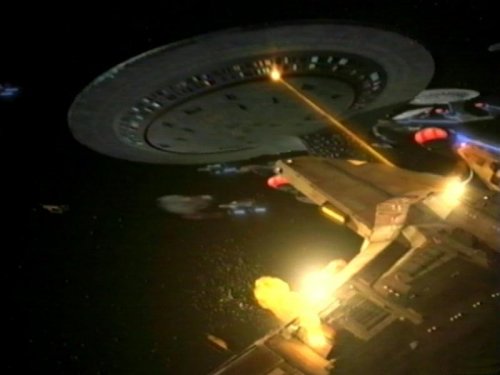
Curry began his two hour presentation with a montage of visual effects scenes from all the series he worked on, beginning it with the space battle of the Deep Space 9 finale. It looked really great projected on the big screen.
Here are some highlights from his talk, by category...
The DVD and videotape footage projected on a screen beside him on the stage included his ten minute 2004 Emmy-winning reel from Enterprise (he's won 7 in all), a montage of Enterprise season 3 in 60 seconds, and the 18 minute profile included in the TNG season 6 DVD, which features him talking about various episodes, showing Klingon weapons he designed and their inspirations, and doing some Tai'chi on his lawn. ("They followed me around my house. After it was made and they sent me a copy, and it took me about eight months to have the courage to watch it. It's living proof why I am behind the camera.")
Curry began his two hour presentation with a montage of visual effects scenes from all the series he worked on, beginning it with the space battle of the Deep Space 9 finale. It looked really great projected on the big screen.
Here are some highlights from his talk, by category...

How he got started
"My last year at HSU, my fellow students were kind enough to grant me a one man exhibition of painting, and during that time by a remarkable coincidence, Marcia Lucas, who was George Lucas' wife at the time, was visiting to give a series of talks on film editing. She happened to stroll by the little gallery and saw some of my paintings, and came and talked to me about them, and told me I should look into doing matte paintings.
So I was invited down to ILM, got a lot of advice and pointers on doing matte paintings, and they set up some meetings for me, so after school I went to Universal Studios and started on Buck Rogers and the original Battlestar Galactica"...
Then [many] features later working for various facilities, I was invited by Paramount Pictures to work on Star Trek. It sounded like a good idea, I thought it would be a four month project to help this little pilot get off the ground, and 18 years later I'm working on the final episode of Star Trek."
On the importance of the Peace Corps and his education in his work for Star Trek
After obtaining his undergraduate degree in art, Curry went into the Peace Corps. "It had a profound effect on my life. I learned something very important. In this country we say there's the First World and the Third World. But I really discovered that there is no Third World---there is only one world and we all live in it together. And that we should start making our international policies based on that fact."
"I had the rare opportunity to live in rural Thailand building small dams and bridges, but what I contributed to the people there was a small part of what they contributed to me. Since then I've become aware that everything you experience in life becomes part of your career, whether directly from the educational system or from some stuff that happens by surprise, and much of what I encountered in Thailand became part of Star Trek, especially the Klingons. They were much influenced by people in the Himalayas and Southeast Asia, and the protracted period of my misspent youth that I spent in sword schools."
After the Peace Corps and a few years teaching art at a community college on Cape Cod, Curry entered the graduate program at Humboldt State University, and "another profoundly influential period of my life." He thanked the faculty members by name (several of whom were present for his talk) and added that his relationship with fellow students were "just as influential in shaping my opinions about things, because of their dedication to the art of theatre and film, and their dedication to integrity."
"My last year at HSU, my fellow students were kind enough to grant me a one man exhibition of painting, and during that time by a remarkable coincidence, Marcia Lucas, who was George Lucas' wife at the time, was visiting to give a series of talks on film editing. She happened to stroll by the little gallery and saw some of my paintings, and came and talked to me about them, and told me I should look into doing matte paintings.
So I was invited down to ILM, got a lot of advice and pointers on doing matte paintings, and they set up some meetings for me, so after school I went to Universal Studios and started on Buck Rogers and the original Battlestar Galactica"...
Then [many] features later working for various facilities, I was invited by Paramount Pictures to work on Star Trek. It sounded like a good idea, I thought it would be a four month project to help this little pilot get off the ground, and 18 years later I'm working on the final episode of Star Trek."
On the importance of the Peace Corps and his education in his work for Star Trek
After obtaining his undergraduate degree in art, Curry went into the Peace Corps. "It had a profound effect on my life. I learned something very important. In this country we say there's the First World and the Third World. But I really discovered that there is no Third World---there is only one world and we all live in it together. And that we should start making our international policies based on that fact."
"I had the rare opportunity to live in rural Thailand building small dams and bridges, but what I contributed to the people there was a small part of what they contributed to me. Since then I've become aware that everything you experience in life becomes part of your career, whether directly from the educational system or from some stuff that happens by surprise, and much of what I encountered in Thailand became part of Star Trek, especially the Klingons. They were much influenced by people in the Himalayas and Southeast Asia, and the protracted period of my misspent youth that I spent in sword schools."
After the Peace Corps and a few years teaching art at a community college on Cape Cod, Curry entered the graduate program at Humboldt State University, and "another profoundly influential period of my life." He thanked the faculty members by name (several of whom were present for his talk) and added that his relationship with fellow students were "just as influential in shaping my opinions about things, because of their dedication to the art of theatre and film, and their dedication to integrity."

Evolution of Visual Effects
"The evolution of visual effects over my 18 years at Star Trek is really the evolution of visual effects. Because we worked in television we were able to use lower resolutions, so we pioneered a lot of things that became standard techniques in features. We were the very first visual effects show to have video tape as our final product rather than film. We started out doing 1 inch analogue and progressed to digital and now we're doing high definition digital technologies....My job has gone from director of photography and compositing supervisor, to sort of an orchestra conductor of a team of virtuoso digital artists."
Even today, Curry said, an average feature may have 200 to 500 visual effects shots, that take a year to produce. "We have 2 1/2 to 3 weeks [to do each show], and in the average television season we do 3500 visual effects shots."
Curry also explained the difference between visual and special effects.
"Visual effects basically are making a synthetic reality out of pieces that were photographed at different times and recombining them into something new, while special effects happen on the set, like making the doors open and close on the Enterprise." They often work together-for example, visual effects will enhance explosions created on the set by special effects. Visual effects also works with what the makeup and other departments do. "It's a very interactive process."
Working with Models
At first most visual effects were done with minatures. The Enterprise-D, Deep Space 9 and Voyager were 4-to-6 foot models. "Sometimes it took 60 to 80 hours a week trying to keep up with the miniature photography for the ships. Now most of it is done in the computer."
But Curry doesn't think that miniatures will completely disappear even in the digital age. He pointed out that the 2004 film "The Aviator" used airplane models. "There are certain things computers don't do very well, so I think that models will never completely go away...and with models, like with computer graphics and with actors, it's all about lighting. If you light it well it will look great. If you don't light it well, it will look artificial.
"Practical elements"
"In those [old]days, we had to use a lot of practical elements--- and I'd like to introduce you to the force field that was used on the Enterprise." Curry holds up a ball of silver tinsel.
"Sometimes we'd bounce laser beams off beer cans onto white cardboard, and depending on how we bent the beer can it would influence how the image would appear. We used these for force fields and tractor beams. It was fun--- a form of medieval alchemy."
The key to creating visual effects: "Teamwork, and the ability to perceive things not for what they are, but for what they might be."
Motion Control
"Doug Trumbull [special photographic effects pioneer on 2001,Close Encounters of the Third Kind and Star Trek: The Motion Picture among others) was visiting an airplane plant in the LA area and he saw these huge milling machines doing the same motions over and over again. [Before then] spaceship models were filmed on wires against blue screen, and with 'overcranking' (moving the ships at faster than 24 frames per second, the speed of the film).... you couldn't get any lights inside for windows or [vapor coming out]... When Doug saw the milling machines he had the inspiration that if you mounted a model in one place, and you had roll, pitch and yaw, he could build lights into it and photograph it slowly, one [frame] at a time, giving perfect exposure for each element of the shot. So Doug's great inspiration was the contribution that made visual effects possible not only for Star Trek but Blade Runner, Star Wars, all those early films---the value of his influence cannot be overstated."
Each time a motion control pass is made, new elements are added. "For the [TNG] Enterprise and Voyager fly-bys we had to do the same thing seven times. [It looks great when it's done, but] watching a motion control shot has all the visceral thrills of watching cattle graze."
Sometimes motion control is shot against an orange screen "for matte passes or silhouette passes, lighting with ultraviolet light. Orange screen gave us a very even field of light---it made it easier to pull out an accurate silhouette of a ship."
Computer Graphics
Then came computer graphic design. Curry demonstrated how computer animation shots evolve, from "a wire frame [of the object] to adjust motion, then a smooth shape that gives us a sense of the volume, then the final render[ing]. The wire frame and smooth shape are used because the final render can take a long time. For one series of shots, it was 17 hours per frame."
"The evolution of visual effects over my 18 years at Star Trek is really the evolution of visual effects. Because we worked in television we were able to use lower resolutions, so we pioneered a lot of things that became standard techniques in features. We were the very first visual effects show to have video tape as our final product rather than film. We started out doing 1 inch analogue and progressed to digital and now we're doing high definition digital technologies....My job has gone from director of photography and compositing supervisor, to sort of an orchestra conductor of a team of virtuoso digital artists."
Even today, Curry said, an average feature may have 200 to 500 visual effects shots, that take a year to produce. "We have 2 1/2 to 3 weeks [to do each show], and in the average television season we do 3500 visual effects shots."
Curry also explained the difference between visual and special effects.
"Visual effects basically are making a synthetic reality out of pieces that were photographed at different times and recombining them into something new, while special effects happen on the set, like making the doors open and close on the Enterprise." They often work together-for example, visual effects will enhance explosions created on the set by special effects. Visual effects also works with what the makeup and other departments do. "It's a very interactive process."
Working with Models
At first most visual effects were done with minatures. The Enterprise-D, Deep Space 9 and Voyager were 4-to-6 foot models. "Sometimes it took 60 to 80 hours a week trying to keep up with the miniature photography for the ships. Now most of it is done in the computer."
But Curry doesn't think that miniatures will completely disappear even in the digital age. He pointed out that the 2004 film "The Aviator" used airplane models. "There are certain things computers don't do very well, so I think that models will never completely go away...and with models, like with computer graphics and with actors, it's all about lighting. If you light it well it will look great. If you don't light it well, it will look artificial.
"Practical elements"
"In those [old]days, we had to use a lot of practical elements--- and I'd like to introduce you to the force field that was used on the Enterprise." Curry holds up a ball of silver tinsel.
"Sometimes we'd bounce laser beams off beer cans onto white cardboard, and depending on how we bent the beer can it would influence how the image would appear. We used these for force fields and tractor beams. It was fun--- a form of medieval alchemy."
The key to creating visual effects: "Teamwork, and the ability to perceive things not for what they are, but for what they might be."
Motion Control
"Doug Trumbull [special photographic effects pioneer on 2001,Close Encounters of the Third Kind and Star Trek: The Motion Picture among others) was visiting an airplane plant in the LA area and he saw these huge milling machines doing the same motions over and over again. [Before then] spaceship models were filmed on wires against blue screen, and with 'overcranking' (moving the ships at faster than 24 frames per second, the speed of the film).... you couldn't get any lights inside for windows or [vapor coming out]... When Doug saw the milling machines he had the inspiration that if you mounted a model in one place, and you had roll, pitch and yaw, he could build lights into it and photograph it slowly, one [frame] at a time, giving perfect exposure for each element of the shot. So Doug's great inspiration was the contribution that made visual effects possible not only for Star Trek but Blade Runner, Star Wars, all those early films---the value of his influence cannot be overstated."
Each time a motion control pass is made, new elements are added. "For the [TNG] Enterprise and Voyager fly-bys we had to do the same thing seven times. [It looks great when it's done, but] watching a motion control shot has all the visceral thrills of watching cattle graze."
Sometimes motion control is shot against an orange screen "for matte passes or silhouette passes, lighting with ultraviolet light. Orange screen gave us a very even field of light---it made it easier to pull out an accurate silhouette of a ship."
Computer Graphics
Then came computer graphic design. Curry demonstrated how computer animation shots evolve, from "a wire frame [of the object] to adjust motion, then a smooth shape that gives us a sense of the volume, then the final render[ing]. The wire frame and smooth shape are used because the final render can take a long time. For one series of shots, it was 17 hours per frame."


Xindi
As the audience watched his Emmy-winning reel from the Enterprise 3rd season episode, "Countdown," Curry mentioned that he had designed the Xindi acquatic species based on "a little known dinosaur, the Mososaurus." (For the uninitiated, the Xindi were aliens at the center of the year-long Enterprise 3rd season arc.)
He based the insectoid species on the fly. For the insectoid, an actor in a smooth bodysuit was photographed performing the actions, to guide the animator.
Will Actors Be Animated?
An audience question: Will there be a time that actors will be animated?
I think the technological possibility of doing that exists now, but I think audiences want to be told a story by live, living human beings. If you look at something like Final Fantasy---it looked very real , a wonderful art form, but ultimately people want to see living actors, whether on stage or on the screen.
What about bringing dead actors to life, like Humphrey Bogart?
That was done in France. Unfortunately, the Bogart estate prevented that from happening. But say you take a death mask from Abraham Lincoln and get an actor so you can do motion capture and, like Lord of the Rings or what we did with the Xindi, you have a character that's acted by an actor, [and you can use the Lincoln face.].. Ultimately it will be virtually indistinguishable, from having a computer generate an actor or having a real actor---it's probably happening in Washington now."
Effects and Story
"In Star Trek we try to recognize that story is king and that the visual effects only exist to serve the story, so when we create the shot we try to use the philosophy that if this were a real event---assuming that all Star Trek stories are based on true historical events--how would a great cinematographer photograph this event in a way that would delight and viscerally involve the audience? We try to help the audience share the experience that the characters are going through."
Curry also mentioned that "one of the most valuable courses I had here [at HSU] was a script analysis course... it enlightened me to find the medium layer in a story, because even if we're doing a space shot, it has to drive the story. Script analysis reinforces the value of interpretation of story."
As the audience watched his Emmy-winning reel from the Enterprise 3rd season episode, "Countdown," Curry mentioned that he had designed the Xindi acquatic species based on "a little known dinosaur, the Mososaurus." (For the uninitiated, the Xindi were aliens at the center of the year-long Enterprise 3rd season arc.)
He based the insectoid species on the fly. For the insectoid, an actor in a smooth bodysuit was photographed performing the actions, to guide the animator.
Will Actors Be Animated?
An audience question: Will there be a time that actors will be animated?
I think the technological possibility of doing that exists now, but I think audiences want to be told a story by live, living human beings. If you look at something like Final Fantasy---it looked very real , a wonderful art form, but ultimately people want to see living actors, whether on stage or on the screen.
What about bringing dead actors to life, like Humphrey Bogart?
That was done in France. Unfortunately, the Bogart estate prevented that from happening. But say you take a death mask from Abraham Lincoln and get an actor so you can do motion capture and, like Lord of the Rings or what we did with the Xindi, you have a character that's acted by an actor, [and you can use the Lincoln face.].. Ultimately it will be virtually indistinguishable, from having a computer generate an actor or having a real actor---it's probably happening in Washington now."
Effects and Story
"In Star Trek we try to recognize that story is king and that the visual effects only exist to serve the story, so when we create the shot we try to use the philosophy that if this were a real event---assuming that all Star Trek stories are based on true historical events--how would a great cinematographer photograph this event in a way that would delight and viscerally involve the audience? We try to help the audience share the experience that the characters are going through."
Curry also mentioned that "one of the most valuable courses I had here [at HSU] was a script analysis course... it enlightened me to find the medium layer in a story, because even if we're doing a space shot, it has to drive the story. Script analysis reinforces the value of interpretation of story."

Voyager
"Sometimes computer-generated [effects] don't look convincing." In a shot of Voyager crash-landing on an icy planet, he felt that the ship skidding through the snow didn't work. The solution: "The snow was baking soda. We painted a toy model of Voyager black, and we had a guy take the model and run as fast as he could, running it through the baking soda" on a series of long tables.
Another case was lava. "Synthetic lava never looks convincing. Normally they use Metrocil-the stuff that McDonald's uses to thicken milkshakes. Or it's computer generated, but it never looks real." His solution for a scene in Voyager: "We found some 16mm footage of actual lava" from a volcanic eruption in Hawaii, "we digitally stabilized it, and I was able to use Inferno---all the visual effects boxes have really cool names---and twist it into perspective." The shot showed lava flowing down a channel that was a real dry streambed on location, photographed with live actors in the shot.
Effects Tech
Asked what software he uses now, Curry said: "For 3-D animation we use Lightwave, sometimes we use Maya. For 2-D compositing, such as green screen, we use Inferno." "For phaser animation and frame by frame animation, we do that on a Flame. A lot of people use Studio Macs, we don't. For matte paintings that don't move much, I do those in Photoshop."
The 3-D effects on Enterprise are done by two teams at Eden Effects, while the 2-D (greenscreen, etc.) is handled mostly by two teams at Creative Services. Curry himself still does some hands-on work as needed: "...some matte painting, a lot of the conceptual design, like designing the cg creatures, or else [makeup chief] Michael Westmore does that. It depends where the greatest needs are. I like to design the bladed weapons for the show. In visual effects, the supervisors will be hands on when they can best contribute."
The two sides of Teamwork
Curry stressed several times that TV and movies require the creative teamwork of hundreds of people. When I spoke with him later, I asked him how he had gotten so involved in areas outside his job description, like designing Klingon weapons and the tai chi-like exercises. He said it was one of the great things about working at Star Trek was that your job description didn't matter as much as what you could do. "If you could do it, you did it." Because they worked so closely and across departmental lines, they learned each others' interests, and so, for example, producers knew about his fascination with martial arts and t'ai chi.
Curry has also directed some second unit dramatic scenes, as one he showed from Voyager, a bit of comic byplay between the holographic doctor and Seven-of-Nine.
"Sometimes computer-generated [effects] don't look convincing." In a shot of Voyager crash-landing on an icy planet, he felt that the ship skidding through the snow didn't work. The solution: "The snow was baking soda. We painted a toy model of Voyager black, and we had a guy take the model and run as fast as he could, running it through the baking soda" on a series of long tables.
Another case was lava. "Synthetic lava never looks convincing. Normally they use Metrocil-the stuff that McDonald's uses to thicken milkshakes. Or it's computer generated, but it never looks real." His solution for a scene in Voyager: "We found some 16mm footage of actual lava" from a volcanic eruption in Hawaii, "we digitally stabilized it, and I was able to use Inferno---all the visual effects boxes have really cool names---and twist it into perspective." The shot showed lava flowing down a channel that was a real dry streambed on location, photographed with live actors in the shot.
Effects Tech
Asked what software he uses now, Curry said: "For 3-D animation we use Lightwave, sometimes we use Maya. For 2-D compositing, such as green screen, we use Inferno." "For phaser animation and frame by frame animation, we do that on a Flame. A lot of people use Studio Macs, we don't. For matte paintings that don't move much, I do those in Photoshop."
The 3-D effects on Enterprise are done by two teams at Eden Effects, while the 2-D (greenscreen, etc.) is handled mostly by two teams at Creative Services. Curry himself still does some hands-on work as needed: "...some matte painting, a lot of the conceptual design, like designing the cg creatures, or else [makeup chief] Michael Westmore does that. It depends where the greatest needs are. I like to design the bladed weapons for the show. In visual effects, the supervisors will be hands on when they can best contribute."
The two sides of Teamwork
Curry stressed several times that TV and movies require the creative teamwork of hundreds of people. When I spoke with him later, I asked him how he had gotten so involved in areas outside his job description, like designing Klingon weapons and the tai chi-like exercises. He said it was one of the great things about working at Star Trek was that your job description didn't matter as much as what you could do. "If you could do it, you did it." Because they worked so closely and across departmental lines, they learned each others' interests, and so, for example, producers knew about his fascination with martial arts and t'ai chi.
Curry has also directed some second unit dramatic scenes, as one he showed from Voyager, a bit of comic byplay between the holographic doctor and Seven-of-Nine.
Voyager and Other Title Sequences
Dan Curry has done the title sequences for several feature films. For the Rodney Dangerfield comedy, "Back to School," Curry's task was to tell the backstory of the main character's past. He was able to blend photographs from his own family's album because, coincidentally, the character Dangerfield was playing grew up in the same New York neighborhood as Curry did.
In "Top Gun" the specific task was to create mood. Working with the music score is part of the process, and on this film Curry had the music before he started, so he could edit the images to move more slowly at first, and then with increasing speed, to both match the music's tempo and the pace of preparations for the jets' flight, and the adrenelin rush the rest of the movie would be.
For "Back to School," the music wasn't recorded, and Curry saw only the sheet music. But he used it to decide where the cuts in the film should be, and the first time that score and title sequence were played together, they matched perfectly. The credits of Indiana Jones and the Temple of Doom were a musical number, and required unusual visual effects--more glinting of the dancers' sequins.
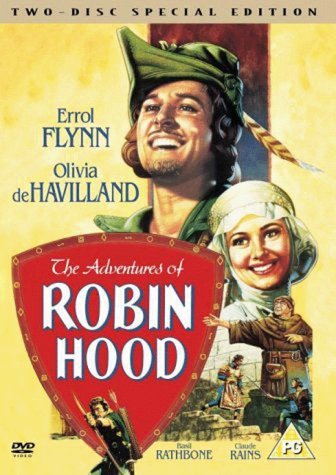
"Credits are like an overture to an opera---its purpose is to give the credit information, but also to give a promise of what the show is going to be about." As examples of great title sequences, Curry cited "Spartacus" and the 1938 "Robin Hood," which he also called "probably one of the best crafted adventure films."
One of the proudest ones for me," he added," was the title sequence for Voyager. I had the opportunity to create what my dream of space travel would be."
On Working With TV Budgets---and TV time
"Every week we go to a pre-production meeting, where everybody gets a handle on what the scope of the production is, then we [the department heads] go back and do a budget, and then each department meets with the producer and presents its budget. When the producers recover from cardiac arrest, we go back and say, we can trim this, instead of six ship shots here we can tell that story with 3, maybe we don't have to blow up a fifteen story building, we can blow up a five story building, and basically get it down to doabilty. The problem with television is that it's a sprint-we have to work really really fast, the greatest challenge we had was the finale of ds9 when we had 354 major visual effect shots, including a space battle with over 200 ships in a shot --and they gave us 3 weeks. It's about making rapid decisions. ..
So then we have a final budget meeting, and the budget is finalized. You all know that film is an uncomfortable marriage between art and business, and the business side always rules."
On politics
A faculty member asked if "you Hollywood types are like us, [faculty who are]feeling besieged by those who want to limit our freedom and install censorship."
First of all, I don't consider myself a Hollywood type," Curry said. " I just work there." But he went on to say: "If you exploit your power to demean and manipulate the other point of view rather than make an honest depiction of it, then people from another persuasion will look at you as less than honorable. There are many points of view in Hollywood. People from every part of the political spectrum work on our show, they talk about their views." The idea, he said, is to "disagree without being disagreeable."
Dan Curry has done the title sequences for several feature films. For the Rodney Dangerfield comedy, "Back to School," Curry's task was to tell the backstory of the main character's past. He was able to blend photographs from his own family's album because, coincidentally, the character Dangerfield was playing grew up in the same New York neighborhood as Curry did.
In "Top Gun" the specific task was to create mood. Working with the music score is part of the process, and on this film Curry had the music before he started, so he could edit the images to move more slowly at first, and then with increasing speed, to both match the music's tempo and the pace of preparations for the jets' flight, and the adrenelin rush the rest of the movie would be.
For "Back to School," the music wasn't recorded, and Curry saw only the sheet music. But he used it to decide where the cuts in the film should be, and the first time that score and title sequence were played together, they matched perfectly. The credits of Indiana Jones and the Temple of Doom were a musical number, and required unusual visual effects--more glinting of the dancers' sequins.
"Credits are like an overture to an opera---its purpose is to give the credit information, but also to give a promise of what the show is going to be about." As examples of great title sequences, Curry cited "Spartacus" and the 1938 "Robin Hood," which he also called "probably one of the best crafted adventure films."
One of the proudest ones for me," he added," was the title sequence for Voyager. I had the opportunity to create what my dream of space travel would be."
On Working With TV Budgets---and TV time
"Every week we go to a pre-production meeting, where everybody gets a handle on what the scope of the production is, then we [the department heads] go back and do a budget, and then each department meets with the producer and presents its budget. When the producers recover from cardiac arrest, we go back and say, we can trim this, instead of six ship shots here we can tell that story with 3, maybe we don't have to blow up a fifteen story building, we can blow up a five story building, and basically get it down to doabilty. The problem with television is that it's a sprint-we have to work really really fast, the greatest challenge we had was the finale of ds9 when we had 354 major visual effect shots, including a space battle with over 200 ships in a shot --and they gave us 3 weeks. It's about making rapid decisions. ..
So then we have a final budget meeting, and the budget is finalized. You all know that film is an uncomfortable marriage between art and business, and the business side always rules."
On politics
A faculty member asked if "you Hollywood types are like us, [faculty who are]feeling besieged by those who want to limit our freedom and install censorship."
First of all, I don't consider myself a Hollywood type," Curry said. " I just work there." But he went on to say: "If you exploit your power to demean and manipulate the other point of view rather than make an honest depiction of it, then people from another persuasion will look at you as less than honorable. There are many points of view in Hollywood. People from every part of the political spectrum work on our show, they talk about their views." The idea, he said, is to "disagree without being disagreeable."

How Do You Train for Star Trek?
There were several questions from students in the audience about career paths and preparations.
What are the best schools for visual effects? one asked. Curry named two: Expression College of the Digital Arts in San Francisco, and Gnomon [School of Visual Effects] in Los Angeles. "There are probably others. Those are the ones I'm familiar with that are really good, and people who go through those schools are sought after."
Where do you get a start? another student asked. She was a costume designer.
"It's very difficult to jump right in," Curry said. "It's hard to get into the union. The studio system is evolving differently, the political structure of the studio system is becoming very bizarre. You might find independent films, short films, high quality student films, that your work can be seen in. If you have a reel, a portfolio of beautiful designs, talent is found."
"I loved making movies [as a child.] When I saw "The Beast from 10,000 fathoms" I saw they were using some sort of projection, and I had a broken projector, and I realized that if I put a piece of trace paper up on the screen, I could make dinosaurs chase my brother.
But it was just a series of fortuitous accidents that led me to here. I came to Humboldt State with the intention of getting into production design for live theatre. The more I got involved in film, the more I wanted to pursue it."
"I was very lucky, I walked into a situation where they needed somebody with my set of skills. I went to Star Trek where I found a home, where the range of my imagination had value. If I'd had to work on a soap opera it would have been horrible."
On Education v. Job Training
"There's a big difference between job training and education. Job training gives you the skill to do one thing. Education helps you to react to whatever opportunities present themselves. It's really important for those of you who are students here to recognize that your number one job is to become an educated person. Whatever skills you learn, they change as technology evolves, but it is your education that allows you to deal with those changes. So learn everything you can about all sorts of things, and you'll find that as different opportunities present themselves during the course of your life, you can deal with them better than if you approach school as job training."
I urge all of you to support education [on all levels], for the collective good of our society... It seems our society is shifting away from giving proper value to the educational process, and in this time when our nation lives with the fear of threats that are real and imaginary, [applause]the true defense of a nation is an educated population."
After his talk, Curry went off with old friends from university days. He would hold a workshop for students in the morning, and then explore more of Redwood country with his son, sharing the sights and the memories before returning to southern California early Sunday. Among other projects, he'll be working on a new pilot for CBS.
There were several questions from students in the audience about career paths and preparations.
What are the best schools for visual effects? one asked. Curry named two: Expression College of the Digital Arts in San Francisco, and Gnomon [School of Visual Effects] in Los Angeles. "There are probably others. Those are the ones I'm familiar with that are really good, and people who go through those schools are sought after."
Where do you get a start? another student asked. She was a costume designer.
"It's very difficult to jump right in," Curry said. "It's hard to get into the union. The studio system is evolving differently, the political structure of the studio system is becoming very bizarre. You might find independent films, short films, high quality student films, that your work can be seen in. If you have a reel, a portfolio of beautiful designs, talent is found."
"I loved making movies [as a child.] When I saw "The Beast from 10,000 fathoms" I saw they were using some sort of projection, and I had a broken projector, and I realized that if I put a piece of trace paper up on the screen, I could make dinosaurs chase my brother.
But it was just a series of fortuitous accidents that led me to here. I came to Humboldt State with the intention of getting into production design for live theatre. The more I got involved in film, the more I wanted to pursue it."
"I was very lucky, I walked into a situation where they needed somebody with my set of skills. I went to Star Trek where I found a home, where the range of my imagination had value. If I'd had to work on a soap opera it would have been horrible."
On Education v. Job Training
"There's a big difference between job training and education. Job training gives you the skill to do one thing. Education helps you to react to whatever opportunities present themselves. It's really important for those of you who are students here to recognize that your number one job is to become an educated person. Whatever skills you learn, they change as technology evolves, but it is your education that allows you to deal with those changes. So learn everything you can about all sorts of things, and you'll find that as different opportunities present themselves during the course of your life, you can deal with them better than if you approach school as job training."
I urge all of you to support education [on all levels], for the collective good of our society... It seems our society is shifting away from giving proper value to the educational process, and in this time when our nation lives with the fear of threats that are real and imaginary, [applause]the true defense of a nation is an educated population."
After his talk, Curry went off with old friends from university days. He would hold a workshop for students in the morning, and then explore more of Redwood country with his son, sharing the sights and the memories before returning to southern California early Sunday. Among other projects, he'll be working on a new pilot for CBS.
Tuesday, February 22, 2005
Star Trek XI News
The trade publication Variety revealed that Rick Berman's partners in developing the next Star Trek movie are Jordan Kerner and Kerry McCluggage.
According to the Internet Movie Database, Kerner has produced "Inspector Gadget," "George of the Jungle" and "The Mighty Ducks" and their respective sequels, among other titles. He also produced the TV series "A Wrinkle in Time" in Canada. He is currently producing "Charlotte's Web."
Kerry McCluggage produced "Miami Vice" in 1984 and the TV movie "Homeland Security" in 2004. No credits for the 20 years between these are listed. But he was also president of Paramount Television, and is said to be a strong supporter of the Star Trek franchise.
Variety says that a writer has been hired, who they name as Eric Genderson. However, this name doesn't appear in the database. It's either a mistake or he's pretty unknown, which would be a stark contrast to the writer of the last film, John Logan, nominated again this year for an Academy Award.
The article also quotes Rick Berman going into more detail about "franchise fatigue" as the reason for the fall-off in Star Trek audience. By this theory, the assets of the franchise---the characters, and the Star Trek universe built over the past 38 years-are no longer considered assets. Berman calls for a "re-invention" of Star Trek, beginning with the next movie, which is why it will not have any previously established Star Trek characters. Berman repeats that he doesn't expect a new Trek TV series for at least three years.
Variety online requires a paid subscription, but a summary of the article appears on TrebWeb, and quotes from it plus background information on Berman's co-producers at Trek Today.
UPDATE: Though "Eric Genderson" remains unknown, there is an Eric (or Erik) Jendresen, the writer and producer of the TV miniseries "Band of Brothers." Jendresen is listed as writer on two current film projects, "The Hot Zone" (about an ebola virus loose in suburban Washington, from the book by Richard Preston) and "Aloft." "Aloft" is slated to be directed by Robert Redford, from the Alan Tennant book concerning the adventures of two men tracking the international flight of a North American penegrine falcon. One review described the book as "part nature study, part gonzo travelogue."
Erik Jendresen is also listed as a writer on "Fire," a Dreamworks project from a story by "Perfect Storm" author Sebastian Junger. He may also be the Erik Jendresen who is the author of children's books.
A staffer at TrekWeb apparently made the connection between Genderson and Jendresen, though there's no official word yet on whether it is Jendresen who is attached to the next Trek movie as writer.
UPDATE: TrekWeb has confirmed through Paramount from the Variety writer that the Trek XI writer's name is Erik Jendresen, and the above credits are accurate, plus he's written novels and plays. There's more at TrekWeb, with a link.
The trade publication Variety revealed that Rick Berman's partners in developing the next Star Trek movie are Jordan Kerner and Kerry McCluggage.
According to the Internet Movie Database, Kerner has produced "Inspector Gadget," "George of the Jungle" and "The Mighty Ducks" and their respective sequels, among other titles. He also produced the TV series "A Wrinkle in Time" in Canada. He is currently producing "Charlotte's Web."
Kerry McCluggage produced "Miami Vice" in 1984 and the TV movie "Homeland Security" in 2004. No credits for the 20 years between these are listed. But he was also president of Paramount Television, and is said to be a strong supporter of the Star Trek franchise.
Variety says that a writer has been hired, who they name as Eric Genderson. However, this name doesn't appear in the database. It's either a mistake or he's pretty unknown, which would be a stark contrast to the writer of the last film, John Logan, nominated again this year for an Academy Award.
The article also quotes Rick Berman going into more detail about "franchise fatigue" as the reason for the fall-off in Star Trek audience. By this theory, the assets of the franchise---the characters, and the Star Trek universe built over the past 38 years-are no longer considered assets. Berman calls for a "re-invention" of Star Trek, beginning with the next movie, which is why it will not have any previously established Star Trek characters. Berman repeats that he doesn't expect a new Trek TV series for at least three years.
Variety online requires a paid subscription, but a summary of the article appears on TrebWeb, and quotes from it plus background information on Berman's co-producers at Trek Today.
UPDATE: Though "Eric Genderson" remains unknown, there is an Eric (or Erik) Jendresen, the writer and producer of the TV miniseries "Band of Brothers." Jendresen is listed as writer on two current film projects, "The Hot Zone" (about an ebola virus loose in suburban Washington, from the book by Richard Preston) and "Aloft." "Aloft" is slated to be directed by Robert Redford, from the Alan Tennant book concerning the adventures of two men tracking the international flight of a North American penegrine falcon. One review described the book as "part nature study, part gonzo travelogue."
Erik Jendresen is also listed as a writer on "Fire," a Dreamworks project from a story by "Perfect Storm" author Sebastian Junger. He may also be the Erik Jendresen who is the author of children's books.
A staffer at TrekWeb apparently made the connection between Genderson and Jendresen, though there's no official word yet on whether it is Jendresen who is attached to the next Trek movie as writer.
UPDATE: TrekWeb has confirmed through Paramount from the Variety writer that the Trek XI writer's name is Erik Jendresen, and the above credits are accurate, plus he's written novels and plays. There's more at TrekWeb, with a link.
Wednesday, February 16, 2005

Subscribe to:
Posts (Atom)