Of Sharks and Whales: The Battle for Star Trek's Soul
by William S. Kowinski
The blood is in the water, and the sharks are circling. Star Trek:Enterprise has been ignominiously cancelled, and Star Trek has been shut down.
But Sci Fi Channel's "Battlestar Galactica" is a hit, at least in cable terms, anchoring the Friday night lineup that contributed to sinking the rescheduled "Enterprise." So it's natural that some of the sharks come from those waters. Two former DS9 writers who few seem to have heard of before, Bradley Thompson and David Weddle, now write for BSG, and gave an interview about how much they learned from working on a Trek series, and how glad they aren't doing that anymore. Because now they can "bring sci fi back into the realm of a place that might actually exist, with people like us in it."
To be fair, this is just one line in a long interview. And others are saying similar things. Even Rick Berman expressed doubts in his February interview with TV Week: "We made a great effort to keep Roddenberry's vision of the future in mind. Has that attitude played itself out? It could very well be true." And it was this BSG's creator and former Trek writer, Ronald Moore who said in the same article that Trek doesn't need to become BSG, that it can remain a hopeful vision of the future.
But we are in dangerous waters right now. Everything about Star Trek is seemingly vulnerable. So this is the time to be as clear as possible about what we believe Star Trek is, so that its next incarnation is not simply as another space-based action series trading on the Star Trek name.
The line of attack represented by the Thompson & Weedle statements is familiar, and has been uttered in various ways by other former Trek writers and producers: the people in Roddenberry's future were too "perfect." They weren't like us.
It seemed to me that a lot of DS9 reflected this view. But it always puzzled me. Especially since this complaint seemed to come from people who understood that this is precisely what Star Trek is about, and in fact wrote great scenes illustrating it: It is about how people change, not just how technology changes. And about how the future cannot be better unless we do change.
As people with an interest in the future, who perhaps have or look forward to having children and grandchildren, I assume they are interested in promoting that future. But they are also TV writers.
So let's take a closer look at that sentence, because it reflects one particularly seductive line of thinking. The writers in question have been liberated to "bring sci fi back into the realm of a place that might actually exist, with people like us in it."
Who are these "people like us?" They are people with raw passions, who kill out of fear and hatred, who betray one another from jealousy and envy and greed. They lie, double-deal and double-cross, and seem to enjoy it. No doubt there are people like that, and that these are all human emotions and human behaviors. We are probably all pretty familiar with betrayal, and have seen or experienced some dirty deeds based on any number of the seven deadly sins.
But there are several relevant points here. And the first and most obvious to me is: mostly they aren't actually talking about "people like us." Most people don't behave that way, on that scale. They are talking about people like the people you usually see on television action shows, and in action movies. They are people who act violently whenever possible. And it is usually very possible, because somebody just dripping with evil is inevitably attacking somebody who is violently good. They're involved in non-stop violence on "24." People like us don't actually kill that many people before dinner.
And even among the good guys on most TV and in movies, there are violent arguments, violent jealousies, outsized greed and incomparable betrayal. All passions are uncontrollable, and all emotions and certainly all conflicts are acted out. The truth is, we aren't any more like these people than we are like Captain Picard or Dr. Phlox.
Moreover, the basic conflict is always a fight for survival, involving a fight to the death, and it is so intense that it couldn't possibly be slowed down for much in the way of variation, and certainly not evaluation or second thoughts, except the tortured kind, under incredible pressures that are stacked so they lead to the same conclusion: us or them.
Yes, it turns out that these kind of "people like us" are a lot easier to write for. They practically write themselves.
In fact these perfectly violent, often one-dimensional characters are no more real than the "perfect" crew of the starship Enterprise (and incidentally, they weren't ever really perfect, in any century.)
But even if the characters are more complicated, more dimensional, what's the point? Every war story is basically the same. How many repetitions of it do we need? Many of the emotions of war are endemic to the situation; the challenge is to not get into the situation, or to handle it differently, to handle yourself differently.
But war and violence are gripping. They go past our thinking brains to fight-or-flight responses, to visceral reactions. Sure, that's part of life, and storytelling. But it's not all of it. And more to the point, it's the easiest to write, and the easiest to evoke a guaranteed response. People will watch, because some survival instinct has been engaged. Glands call to glands.
I am not describing characters specifically in BSG, which I haven't yet seen much of. I am drawing a contrast that may be exaggerated but is quite functional.
These writers want to "bring sci-fi back to a place that might actually exist." A very interesting proposition. First, there's the apparent contradiction of sci-fi and realism. It's not really a contradiction, but this does suggest something that is true: a lot of sci-fi creates plausible worlds in order to test a proposition, an idea. It doesn't matter if H.G. Wells' time machine could exist in 1890; what matters is the story he told about a very unlikely future that made enormously rich metaphorical sense. So a place that might actually exist is not necessarily a virtue in science fiction. If it's too close to the present, what's the point? It's just a costume drama, where the costumes excuse the implausible.
But what constitutes a future that might actually exist? Is it necessarily a future in which everything changes except us? Hasn't anything about human thought, feeling and behavior changed? To believe it hasn't is to be enormously shortsighted. We have examples within our own lifetimes. To think that people of a hundred, five hundred, a thousand years ago are pretty much just like us, may be an understandable Hollywood convention, but it's more than just unlikely. If you believe it, you probably believe that ancient Romans all had British accents.
A little study of indigenous peoples, either from anthropological work or through living descendants today, will illuminate you: "people like us" then were very different in very important ways from "people like us" now. And that's just if you mean "people like us" in urban North America, or the cities of the West.
Of course, much human behavior seems stuck in the same repeating and often self-destructive patterns. It's depressing, and it makes people cynical. But those aren't the only possible reactions.
For a much more salient point is this: if people of that recognizable future are too much "just like us," we are unlikely to have a future at all. Which a lot of people were saying in particular in the 1960s, and one of them was Gene Roddenberry.
Star Trek began in the shadow of thermonuclear holocaust, and despite more novel problems, we aren't out of that shadow yet. Some experts believe we are more in danger of accidental nuclear attack now than in the Cold War. There are STILL more than enough nuclear warheads on working missiles to destroy civilization in a matter of hours.
And that isn't even our biggest threat anymore. Assuming we manage to not set off a nuclear Armageddon, we are in the very early stages of a climate crisis which will challenge human civilization for at least the next century, and especially if we continue ignoring it, it could end life as we know it on this planet.
All we have to do is keep on being "people like us."
The people like us many of these characters are like, are soldiers, in an exceedingly artificial (though all too common) situation called modern warfare. It was a situation a lot of us were supposed to naturally become part of in the Vietnam era, because (everything told us) we had no choice. Those were enemies and they were evil. But it was a situation that people involved in Star Trek, including actual veterans like Roddenberry, wanted to portray alternatives to.
I am continually impressed and inspired by how many people articulate the basic Star Trek vision with such clarity, variety and even poetry. An amazing proportion of the people who worked on Trek can do it, even if they wrote some music once or acted in a single movie. But fans often are eloquent on the subject, too. The most appropriate statement that comes to mind right now is something Mike Malotte, Commander of Starfleet (or president of the International Star Trek Fan Association) said to me in a phone interview last summer: "Gene's Star Trek was really the first science fiction show of its time that showed a future where we actually learn from our mistakes, and we bettered ourselves, and we banded together and we headed out for the stars..."
What Star Trek is largely about---what it embodies, what it models, what it is-- is the process of how we learn, how we become better.
[more text after photo]
Monday, April 11, 2005


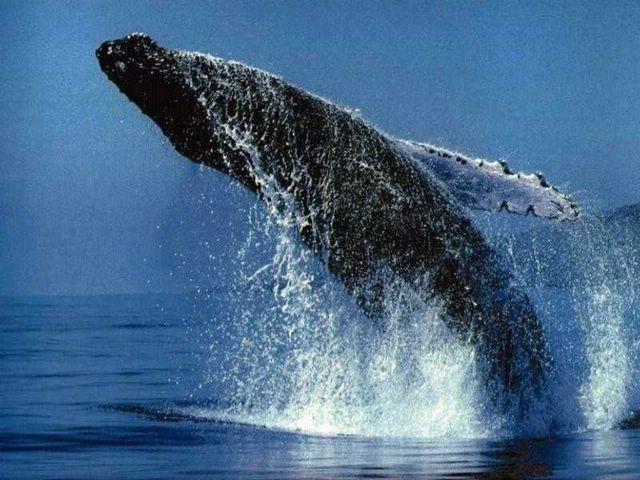

The Sci-Fi of Consciousness
"Much...that proves to be abysmally evil in its ultimate effects does not come from man's wickedness but from his stupidity and unconsciousness."
Jung, Psychology and Western Religion
Let me put it in these terms, which as far as I know I am making up as I go along, although it's so obvious that somebody must have thought of it this way before. There are currently two kinds of science fiction (and you can throw in two kinds of "space opera" as well, because I'm talking mostly about television and film.) There is the science fiction of consciousness. And there is the science fiction of unconsciousness.
The science fiction of unconsciousness is easier to describe. In our daily lives we proceed as if the future will be just like the present, only with new stuff. Our public lives proceed as if the future is going to be great, especially if we get another tax cut, because every new technology is great, the economy is always getting better, and our leaders are always looking out for us, they're telling us the truth and they really know what they are doing.
And our unconscious doesn't believe a word of it. Not that the emotions and anxieties we ignore, suppress and repress, are always any closer to being correct. But they are extreme, and they tend to be expressed in fantasies and stories, especially nightmarish ones, and in other ways that tend towards the extreme.
Mostly it is our repressed suspicions, our barely suppressed fears, our hatred reactions and violent responses, that get translated into stories of violent conflict. In the science fiction of unconsciousness, only technology changes, and gets more capable and complex. People don't change, or get more fully capable, or recognize their complexities; by some standards within civilized memory, they even revert.
The science fiction of consciousness also taps into the power and imagery of the unconscious, but it uses that material to produce stories that are partly, mostly or firstly about applying consciousness to situations. The story itself may demonstrate that application, or it may be something the characters themselves go through, or both.
A simple example might be: stories of space exploration are usually the science fiction of consciousness. Stories of space invaders are the science fiction of unconsciousness.
That's the idea, even if strictly speaking, it's not that simple.
But consciousness is the right word, because it's not just rationality, or the brain or the mind. It's also about emotion, but it deals with them consciously: what emotions do we value, what should we encourage? Who do we love, and why do we hate and fear? Is it unreasonable, destructive fear, or is it justified and useful fear? Is hate as a motivator ever justified? Do we value courage for its own sake over courage behind a behavior that serves a greater good even if it's not so popular, that ennobles us and shows us where we could go, what we could be?
Most of all it is about behavior, because, while we cannot always control our thoughts or emotions, we must be able to control our behavior. That's the definition of human freedom.
Right now we're falling deep into the science fiction as well as the fantasy (and the politics, the economics, the religion) of unconsciousness. Under the public cheerfulness and/or apathy, suppressed despair and repressed fears get expressed through the unconscious, telling us in coded entertainment that we are really afraid of where we're going, and what's happening around us.
Exploration stories---Star Trek stories---ask "what if" questions, they confront who we are through our reactions and our questions about what we find, and why we're going out there in the first place. So many Trek stories show humanity in the middle, with characters valuing our basic nature yet always refining our aspirations, refusing to say we cannot change for the better, individually and as a society.
Invasion movies---which almost always means we humans are being invaded--- are all visceral. You don't think about the humanity of the invader when you're trying to stay alive. That makes for a more exciting movie at a fight-or-flight level, and you must avoid dealing with those questions that slow the action down. You deal with pure push-button emotion, just like the commercials.
It's the very easiest thing to do in order to stimulate an audience, to keep their attention, because we're built to pay attention to what endangers us. So drama sets up an enemy who is all evil. This is not something we find in nature, it's all in the unconscious. Our enemies may be real. Evil may be real. But we seldom encounter enemies who are all evil...except in the fantasy of the unconscious.
Here's another example of what I mean. We've had movies (at least one famous one) and TV dramas (one particularly ridiculous recent one) that pit sharks against humans. The sharks are pure evil. They are pure unconsciousness, and they are met with pure unconsciousness. They don't behave much like real sharks, but that's not the point of these stories.
I can't think of a Star Trek story that involves sharks, but I can think of several that involve whales. A whale is among the most famous literary symbols, some would say of a relentless evil, in Melville's Moby Dick. In fact all but one of the Star Trek episodes and movies I'm thinking of don't deal with actual whales: they deal with the symbolism of Melville's singular giant white whale, and the man who hunted it. Usually an Ahab figure relentlessly pursues some being or force that caused that Ahab great harm. Khan is an Ahab figure in "Star Trek II: The Wrath of Khan." Kirk, and the white Enterprise, is his Moby Dick. Khan even had some of his lines written by Melville (although he lost screen credit in Guild arbitration.)
The symbolism of Moby Dick has been interpreted differently by different people at various times. Some have felt that Ahab's mission was divine, and the whale was the Beast (which it seemed to have been to some extent, to Ahab's deluded mind.) It is yet another version of man's dominion over the animal, even in himself. But even other characters in the novel don't believe that. They see the whale as natural. Simply by being an ambiguous "character," by being a symbol, this whale is an instrument of consciousness. You ask why.
The interpretation that Ahab is obsessively pursuing revenge is central to "Star Trek: First Contact," when Lily confronts Jean Luc Picard about his obsession with vengeance against the Borg. Picard denies it at first. (A more direct way of saying he is "in denial.") But because The Next Generation series established that Picard, while hardly perfect, does take literature very seriously, and because the series established that TNG Enterprise characters, while hardly perfect, are able to step back and evaluate their own motivations and actions (often with the help of Counselor Troi), Lily's Moby Dick references strikes a chord of memory, which strikes a nerve.
While quoting lines describing Ahab's unconscious hate poured on the wounded beast ("if his heart had been a cannon he would have shot his chest upon it"), Picard realizes what has been motivating him and telling him lies about why he is doing what he is doing (which is what the unconscious does best). And he becomes conscious. And changes his behavior.
It is possibly the clearest illustration of the science fiction of consciousness that is a constant in much of Trek, and very much in the Roddenberry vision.
Finally, we come to the Star Trek that has a real whale in it: in fact, two.
"Star Trek IV:The Voyage Home" (perhaps along with "First Contact") is the most popular of all Star Trek movies. Here the consciousness of the 23rd century and its fictional Captain Kirk and Mr. Spock, merges with the consciousness of several 20th century people, including Leonard Nimoy and William Shatner, both of whom believe passionately in the need to maintain a healthy natural environment, and respect the other creatures of the earth, recognizing that this is not without cost. That's what values are: priorities that guide choices.
Like the best of Star Trek, this movie grants other beings our conscious recognition of their consciousness, however different from ours it may be. And so the metaphorical whales which carry humans to consciousness and meaning on the voyage of exploration that is life, are joined by real whales, behaving as real whales do (except perhaps for communicating with extraterrestrial beings. But then again...) For instance, they don't eat people. It is the unconsciousness of people that threatens the whales, not just with needless death, but total extinction.
So this whales' tale is about how human unconsciousness threatens its future, and how consciousness can redeem it.
Star Trek is the richest, most accessible, and most conspicuous focus of the science fiction of consciousness we have. Let's not throw it away because it's hard to do.
As for its popularity, let's face it: except for a few times in its history, Star Trek has always a minority preoccupation. Roddenberry's Star Trek was just as out of synch with the prevailing mood of the 60s as Star Trek may be now. The difference is perhaps that a counterculture was growing more obviously then to challenge the establishment culture, which in many ways resembles today's dominant culture, except today's is more vulgar and more overtly violent, especially ideologically. But that's evidence, I believe, of the dire straits we're in. It may be evidence of how skewed the media is, in telling us about ourselves. It is certainly evidence of how much we need the science fiction of consciousness. Of how much we need the soul of Star Trek.
"Much...that proves to be abysmally evil in its ultimate effects does not come from man's wickedness but from his stupidity and unconsciousness."
Jung, Psychology and Western Religion
Let me put it in these terms, which as far as I know I am making up as I go along, although it's so obvious that somebody must have thought of it this way before. There are currently two kinds of science fiction (and you can throw in two kinds of "space opera" as well, because I'm talking mostly about television and film.) There is the science fiction of consciousness. And there is the science fiction of unconsciousness.
The science fiction of unconsciousness is easier to describe. In our daily lives we proceed as if the future will be just like the present, only with new stuff. Our public lives proceed as if the future is going to be great, especially if we get another tax cut, because every new technology is great, the economy is always getting better, and our leaders are always looking out for us, they're telling us the truth and they really know what they are doing.
And our unconscious doesn't believe a word of it. Not that the emotions and anxieties we ignore, suppress and repress, are always any closer to being correct. But they are extreme, and they tend to be expressed in fantasies and stories, especially nightmarish ones, and in other ways that tend towards the extreme.
Mostly it is our repressed suspicions, our barely suppressed fears, our hatred reactions and violent responses, that get translated into stories of violent conflict. In the science fiction of unconsciousness, only technology changes, and gets more capable and complex. People don't change, or get more fully capable, or recognize their complexities; by some standards within civilized memory, they even revert.
The science fiction of consciousness also taps into the power and imagery of the unconscious, but it uses that material to produce stories that are partly, mostly or firstly about applying consciousness to situations. The story itself may demonstrate that application, or it may be something the characters themselves go through, or both.
A simple example might be: stories of space exploration are usually the science fiction of consciousness. Stories of space invaders are the science fiction of unconsciousness.
That's the idea, even if strictly speaking, it's not that simple.
But consciousness is the right word, because it's not just rationality, or the brain or the mind. It's also about emotion, but it deals with them consciously: what emotions do we value, what should we encourage? Who do we love, and why do we hate and fear? Is it unreasonable, destructive fear, or is it justified and useful fear? Is hate as a motivator ever justified? Do we value courage for its own sake over courage behind a behavior that serves a greater good even if it's not so popular, that ennobles us and shows us where we could go, what we could be?
Most of all it is about behavior, because, while we cannot always control our thoughts or emotions, we must be able to control our behavior. That's the definition of human freedom.
Right now we're falling deep into the science fiction as well as the fantasy (and the politics, the economics, the religion) of unconsciousness. Under the public cheerfulness and/or apathy, suppressed despair and repressed fears get expressed through the unconscious, telling us in coded entertainment that we are really afraid of where we're going, and what's happening around us.
Exploration stories---Star Trek stories---ask "what if" questions, they confront who we are through our reactions and our questions about what we find, and why we're going out there in the first place. So many Trek stories show humanity in the middle, with characters valuing our basic nature yet always refining our aspirations, refusing to say we cannot change for the better, individually and as a society.
Invasion movies---which almost always means we humans are being invaded--- are all visceral. You don't think about the humanity of the invader when you're trying to stay alive. That makes for a more exciting movie at a fight-or-flight level, and you must avoid dealing with those questions that slow the action down. You deal with pure push-button emotion, just like the commercials.
It's the very easiest thing to do in order to stimulate an audience, to keep their attention, because we're built to pay attention to what endangers us. So drama sets up an enemy who is all evil. This is not something we find in nature, it's all in the unconscious. Our enemies may be real. Evil may be real. But we seldom encounter enemies who are all evil...except in the fantasy of the unconscious.
Here's another example of what I mean. We've had movies (at least one famous one) and TV dramas (one particularly ridiculous recent one) that pit sharks against humans. The sharks are pure evil. They are pure unconsciousness, and they are met with pure unconsciousness. They don't behave much like real sharks, but that's not the point of these stories.
I can't think of a Star Trek story that involves sharks, but I can think of several that involve whales. A whale is among the most famous literary symbols, some would say of a relentless evil, in Melville's Moby Dick. In fact all but one of the Star Trek episodes and movies I'm thinking of don't deal with actual whales: they deal with the symbolism of Melville's singular giant white whale, and the man who hunted it. Usually an Ahab figure relentlessly pursues some being or force that caused that Ahab great harm. Khan is an Ahab figure in "Star Trek II: The Wrath of Khan." Kirk, and the white Enterprise, is his Moby Dick. Khan even had some of his lines written by Melville (although he lost screen credit in Guild arbitration.)
The symbolism of Moby Dick has been interpreted differently by different people at various times. Some have felt that Ahab's mission was divine, and the whale was the Beast (which it seemed to have been to some extent, to Ahab's deluded mind.) It is yet another version of man's dominion over the animal, even in himself. But even other characters in the novel don't believe that. They see the whale as natural. Simply by being an ambiguous "character," by being a symbol, this whale is an instrument of consciousness. You ask why.
The interpretation that Ahab is obsessively pursuing revenge is central to "Star Trek: First Contact," when Lily confronts Jean Luc Picard about his obsession with vengeance against the Borg. Picard denies it at first. (A more direct way of saying he is "in denial.") But because The Next Generation series established that Picard, while hardly perfect, does take literature very seriously, and because the series established that TNG Enterprise characters, while hardly perfect, are able to step back and evaluate their own motivations and actions (often with the help of Counselor Troi), Lily's Moby Dick references strikes a chord of memory, which strikes a nerve.
While quoting lines describing Ahab's unconscious hate poured on the wounded beast ("if his heart had been a cannon he would have shot his chest upon it"), Picard realizes what has been motivating him and telling him lies about why he is doing what he is doing (which is what the unconscious does best). And he becomes conscious. And changes his behavior.
It is possibly the clearest illustration of the science fiction of consciousness that is a constant in much of Trek, and very much in the Roddenberry vision.
Finally, we come to the Star Trek that has a real whale in it: in fact, two.
"Star Trek IV:The Voyage Home" (perhaps along with "First Contact") is the most popular of all Star Trek movies. Here the consciousness of the 23rd century and its fictional Captain Kirk and Mr. Spock, merges with the consciousness of several 20th century people, including Leonard Nimoy and William Shatner, both of whom believe passionately in the need to maintain a healthy natural environment, and respect the other creatures of the earth, recognizing that this is not without cost. That's what values are: priorities that guide choices.
Like the best of Star Trek, this movie grants other beings our conscious recognition of their consciousness, however different from ours it may be. And so the metaphorical whales which carry humans to consciousness and meaning on the voyage of exploration that is life, are joined by real whales, behaving as real whales do (except perhaps for communicating with extraterrestrial beings. But then again...) For instance, they don't eat people. It is the unconsciousness of people that threatens the whales, not just with needless death, but total extinction.
So this whales' tale is about how human unconsciousness threatens its future, and how consciousness can redeem it.
Star Trek is the richest, most accessible, and most conspicuous focus of the science fiction of consciousness we have. Let's not throw it away because it's hard to do.
As for its popularity, let's face it: except for a few times in its history, Star Trek has always a minority preoccupation. Roddenberry's Star Trek was just as out of synch with the prevailing mood of the 60s as Star Trek may be now. The difference is perhaps that a counterculture was growing more obviously then to challenge the establishment culture, which in many ways resembles today's dominant culture, except today's is more vulgar and more overtly violent, especially ideologically. But that's evidence, I believe, of the dire straits we're in. It may be evidence of how skewed the media is, in telling us about ourselves. It is certainly evidence of how much we need the science fiction of consciousness. Of how much we need the soul of Star Trek.
Monday, April 04, 2005
Star Trek and the Culture Wars
The range of writings responding to the death of Pope John Paul II demonstrates the inaccurate limitation of our "us or them" habits, particularly in evaluating the complexity of beliefs, observations and principles that any one person or group of people might have.
Was Pope John Paul a conservative or a liberal? Was he a red states' Pontiff or a blue states Prelate? Conservative talk shows in America claim him for their own, but as others have shown, they weren't so certain a few years ago, when the Pope came out strongly against the war in Iraq. Some Vatican insiders have told reporters that not being able to stop the U.S. invasion was among his greatest disappointments of his papacy.
As various writers are now noting, Pope John Paul was passionately attentive to the needs of the poor and dispossessed; he was against birth control and considered abortion to be murder; he promoted diversity and ecumenical understanding, admired the devotion to prayer of Muslims and was the first Pope to enter a mosque; he thought homosexuality was wrong and condemned gay marriage; he was against capital punishment; he was against changing Church practices so that priests could marry or women become priests; he spoke out against rampant capitalism, environmental destruction, the culture of consumption, and the rich western countries ignoring the poor countries of Africa, Asia and Latin America. So what was he?
I don't know that the late Pope ever saw Star Trek, but it's very likely he would have approved of a lot of what he saw, and would not have damned the entire vision for what he disagreed with, or thought was missing. Star Trek stood for diversity, tolerance, social justice, and a respect for spirituality, even a belief in something transcendent to human knowledge at work in the universe.
Because Gene Roddenberry is characterized as a humanist, even a secular humanist, it is often proposed that he was against religion and religious values, even that he had no spiritual life. His own statements, along with the evidence of what he wrote or approved as part of Star Trek, don't add up to so simple a characterization, so black and white (or red or blue) a picture.
By that evidence, it seems to me that Roddenberry was suspicious of organized religions, and saw that many needless wars and much suffering were caused or encouraged by conflicting religions, each certain it was justified in killing people on the other side, because they were on the side of God and the other side therefore was in league with the devil.
But also by that evidence (for instance, the interview with Terrance Sweeney at the end of David Alexander's Roddenberry biography, Star Trek Creator) he had spiritual feelings and thoughts, and a faith in the divine, though his definition of God would not satisfy some adherents of some religions.
It seems to me that if it had been possible to put Roddenberry, Pope John Paul and the Dalai Lama in a room together for an hour, they would respectfully disagree on a few things, but would quickly find they had much more in common, and moreover, they would concentrate on those common beliefs and probably would spend most of the time talking about how they could work together to further those values, so they would indeed be part of the soul of the future.
While I believe it is important to strongly oppose what I find to be dangerous, and to engage in debate and dialogue on important questions of justice, morality and governance, I find today's automatic political typecasting, and all the laundry lists of absolutist positions, to be repugnant and themselves dangerous.
Not only are these lists harmful, they are often irrelevant and inaccurate. Star Trek is a very good example. Where does Star Trek stand in the so-called Culture Wars? In most respects, with the Blue States. But consider this statement by Michael Medved, a movie reviewer who now makes his living principally from Rush Limbaugh dittoheads and Christian conservatives, who castigated Star Trek V for being anti-God: in his book, Right Turns, he criticizes how much our culture is now willing to "accept the ability to shock as a replacement for the old ability to inspire."
That seems to me to be one of the major reasons that Star Trek is so singularly valuable. Take a look down the rows of video store shelves: it's all guns, muscles, t&a. We have replaced inspiration with shock, except for Star Trek, and a minority of other movies and TV shows. That Star Trek is family friendly (including the movies, though some include mild profanity and jokes about bodies, but pushing it with certain episodes of Enterprise) has been important to its character. "Apart from perhaps the Weather Channel," Marina Sirtis said, "Star Trek is the only show on television the whole family can watch together." And, I would add, enjoy, while they quite probably learn something, and may even talk about moral and values issues in the real world that the story inspired.
So on this I agree with what Medved wrote, and I am not happy that my belief in the right of free expression is confused with my support for mindless vulgarity and, incidentally, equally mindless violence. But Star Trek V as anti-God? Come on, Michael. That's sophistry or zealotry, and I don't accept either, or the idea that fundamentalist or conservative Christians get to define my morality and spirituality. And my values tell me that however I might agree with Medved on this observation, it's not nearly enough to get me to vote for G.W. Bush, not even at gunpoint.
Even worse that the oversimplified shock and commercialized vulgarity, is the impoverishment of our political, moral and spiritual dialogue. We seem to be hypnotically locking ourselves in rigid oversimplifications, perhaps in fear of the interrelated complexity now revealing itself to us. We need to be inspired to embrace the adventure of understanding this, which Star Trek can do.
The range of writings responding to the death of Pope John Paul II demonstrates the inaccurate limitation of our "us or them" habits, particularly in evaluating the complexity of beliefs, observations and principles that any one person or group of people might have.
Was Pope John Paul a conservative or a liberal? Was he a red states' Pontiff or a blue states Prelate? Conservative talk shows in America claim him for their own, but as others have shown, they weren't so certain a few years ago, when the Pope came out strongly against the war in Iraq. Some Vatican insiders have told reporters that not being able to stop the U.S. invasion was among his greatest disappointments of his papacy.
As various writers are now noting, Pope John Paul was passionately attentive to the needs of the poor and dispossessed; he was against birth control and considered abortion to be murder; he promoted diversity and ecumenical understanding, admired the devotion to prayer of Muslims and was the first Pope to enter a mosque; he thought homosexuality was wrong and condemned gay marriage; he was against capital punishment; he was against changing Church practices so that priests could marry or women become priests; he spoke out against rampant capitalism, environmental destruction, the culture of consumption, and the rich western countries ignoring the poor countries of Africa, Asia and Latin America. So what was he?
I don't know that the late Pope ever saw Star Trek, but it's very likely he would have approved of a lot of what he saw, and would not have damned the entire vision for what he disagreed with, or thought was missing. Star Trek stood for diversity, tolerance, social justice, and a respect for spirituality, even a belief in something transcendent to human knowledge at work in the universe.
Because Gene Roddenberry is characterized as a humanist, even a secular humanist, it is often proposed that he was against religion and religious values, even that he had no spiritual life. His own statements, along with the evidence of what he wrote or approved as part of Star Trek, don't add up to so simple a characterization, so black and white (or red or blue) a picture.
By that evidence, it seems to me that Roddenberry was suspicious of organized religions, and saw that many needless wars and much suffering were caused or encouraged by conflicting religions, each certain it was justified in killing people on the other side, because they were on the side of God and the other side therefore was in league with the devil.
But also by that evidence (for instance, the interview with Terrance Sweeney at the end of David Alexander's Roddenberry biography, Star Trek Creator) he had spiritual feelings and thoughts, and a faith in the divine, though his definition of God would not satisfy some adherents of some religions.
It seems to me that if it had been possible to put Roddenberry, Pope John Paul and the Dalai Lama in a room together for an hour, they would respectfully disagree on a few things, but would quickly find they had much more in common, and moreover, they would concentrate on those common beliefs and probably would spend most of the time talking about how they could work together to further those values, so they would indeed be part of the soul of the future.
While I believe it is important to strongly oppose what I find to be dangerous, and to engage in debate and dialogue on important questions of justice, morality and governance, I find today's automatic political typecasting, and all the laundry lists of absolutist positions, to be repugnant and themselves dangerous.
Not only are these lists harmful, they are often irrelevant and inaccurate. Star Trek is a very good example. Where does Star Trek stand in the so-called Culture Wars? In most respects, with the Blue States. But consider this statement by Michael Medved, a movie reviewer who now makes his living principally from Rush Limbaugh dittoheads and Christian conservatives, who castigated Star Trek V for being anti-God: in his book, Right Turns, he criticizes how much our culture is now willing to "accept the ability to shock as a replacement for the old ability to inspire."
That seems to me to be one of the major reasons that Star Trek is so singularly valuable. Take a look down the rows of video store shelves: it's all guns, muscles, t&a. We have replaced inspiration with shock, except for Star Trek, and a minority of other movies and TV shows. That Star Trek is family friendly (including the movies, though some include mild profanity and jokes about bodies, but pushing it with certain episodes of Enterprise) has been important to its character. "Apart from perhaps the Weather Channel," Marina Sirtis said, "Star Trek is the only show on television the whole family can watch together." And, I would add, enjoy, while they quite probably learn something, and may even talk about moral and values issues in the real world that the story inspired.
So on this I agree with what Medved wrote, and I am not happy that my belief in the right of free expression is confused with my support for mindless vulgarity and, incidentally, equally mindless violence. But Star Trek V as anti-God? Come on, Michael. That's sophistry or zealotry, and I don't accept either, or the idea that fundamentalist or conservative Christians get to define my morality and spirituality. And my values tell me that however I might agree with Medved on this observation, it's not nearly enough to get me to vote for G.W. Bush, not even at gunpoint.
Even worse that the oversimplified shock and commercialized vulgarity, is the impoverishment of our political, moral and spiritual dialogue. We seem to be hypnotically locking ourselves in rigid oversimplifications, perhaps in fear of the interrelated complexity now revealing itself to us. We need to be inspired to embrace the adventure of understanding this, which Star Trek can do.
Wednesday, March 16, 2005
The Heroes
They were the people who made it all work. From the producers who put in incredible hours (some of them, especially during the original series, wound up in the hospital because of it) to the effects people who made the future out of barrettes, plumbing supplies, recycled sound recordings and junk they found in the Mission Impossible dumpster next door, they made the Star Trek universe.
"I think the secret to Star Trek's success was its attention to details," said Oscar Katz, a Desilu executive as the original series was being developed. " ...its science-fiction truth not only in the big things that were spoken about, but also in the smallest details."
A lot of them worked on various Treks for decades. From the original series to Enterprise, everyone described them as a family. They were good at what they did, they were proud of it, and maybe above all, they cared about each other and they cared about Star Trek.
"I'll tell you one thing about Star Trek," Nichelle Nichols said to David Gerrold years ago. "...everyone you worked with, the prop man, the sound men, the light men, they had a very personal attitude about that show, a very personal pride, a personal sense of ownership. There were times when even a sound man wouldn't let something go by---it may not have had anything to do with sound---but he knew it didn't belong on the Enterprise, and he would speak up."
Speaking of his own fifteen years working on Star Trek, from Next Gen to directing episodes of every series since, Levar Burton observed (in an interview excerpted on the 7th TNG season 7 DVD) "Once you get past the overwhelming power of the sets, the thing that you will notice the most if you hang out for any length of time, is just how nice the people are, and how pleasant the working environment is. The amazing thing about Star Trek is, it's not just about the family of people that's on the screen. There's a family behind the scenes that is responsible on a day to day basis for getting this show done, day in, day out, these people show up every day and have done for the better part of the last fifteen years. It's extraordinary."
Last week Dan Curry spoke of Enterprise in particular as being a single family, the actors and crew and behind the scenes people. Another word that many use to describe everyone from Rick Berman to the directors of photography and Dan Curry as well-- is generosity. They were generous with their knowledge and their encouragement and their loyalty.
This, like just about everything else in Star Trek, seems to have started with Gene Roddenberry. I'm becoming convinced that even more that his visionary ideas, his genius was for people. Even the way he interviewed people for their jobs, asking more about them as people than about their experience, and talking to them about the real core of Star Trek (which it seems almost everyone who worked on it understood and remained loyal to for the rest of their lives) must have had something to do with how well this otherwise unlikely collection of talents---most of them previously obscure or untried--came together to create a storied universe unique in its impact and longevity.
Now the Enterprise set are silent, and it's likely this particular group of people will not work together again. Even if a new Star Trek series or movie begins in a few years, and possibly even if Enterprise somehow is resurrected in Vancouver before fall, many of them will no longer be part of Star Trek. Yet they are the heroes of Star Trek, and they deserve all the gratitude, admiration and honor they can receive.
They were the people who made it all work. From the producers who put in incredible hours (some of them, especially during the original series, wound up in the hospital because of it) to the effects people who made the future out of barrettes, plumbing supplies, recycled sound recordings and junk they found in the Mission Impossible dumpster next door, they made the Star Trek universe.
"I think the secret to Star Trek's success was its attention to details," said Oscar Katz, a Desilu executive as the original series was being developed. " ...its science-fiction truth not only in the big things that were spoken about, but also in the smallest details."
A lot of them worked on various Treks for decades. From the original series to Enterprise, everyone described them as a family. They were good at what they did, they were proud of it, and maybe above all, they cared about each other and they cared about Star Trek.
"I'll tell you one thing about Star Trek," Nichelle Nichols said to David Gerrold years ago. "...everyone you worked with, the prop man, the sound men, the light men, they had a very personal attitude about that show, a very personal pride, a personal sense of ownership. There were times when even a sound man wouldn't let something go by---it may not have had anything to do with sound---but he knew it didn't belong on the Enterprise, and he would speak up."
Speaking of his own fifteen years working on Star Trek, from Next Gen to directing episodes of every series since, Levar Burton observed (in an interview excerpted on the 7th TNG season 7 DVD) "Once you get past the overwhelming power of the sets, the thing that you will notice the most if you hang out for any length of time, is just how nice the people are, and how pleasant the working environment is. The amazing thing about Star Trek is, it's not just about the family of people that's on the screen. There's a family behind the scenes that is responsible on a day to day basis for getting this show done, day in, day out, these people show up every day and have done for the better part of the last fifteen years. It's extraordinary."
Last week Dan Curry spoke of Enterprise in particular as being a single family, the actors and crew and behind the scenes people. Another word that many use to describe everyone from Rick Berman to the directors of photography and Dan Curry as well-- is generosity. They were generous with their knowledge and their encouragement and their loyalty.
This, like just about everything else in Star Trek, seems to have started with Gene Roddenberry. I'm becoming convinced that even more that his visionary ideas, his genius was for people. Even the way he interviewed people for their jobs, asking more about them as people than about their experience, and talking to them about the real core of Star Trek (which it seems almost everyone who worked on it understood and remained loyal to for the rest of their lives) must have had something to do with how well this otherwise unlikely collection of talents---most of them previously obscure or untried--came together to create a storied universe unique in its impact and longevity.
Now the Enterprise set are silent, and it's likely this particular group of people will not work together again. Even if a new Star Trek series or movie begins in a few years, and possibly even if Enterprise somehow is resurrected in Vancouver before fall, many of them will no longer be part of Star Trek. Yet they are the heroes of Star Trek, and they deserve all the gratitude, admiration and honor they can receive.
Monday, March 07, 2005
TrekCheck: All bad things?...
As the Enterprise season and officially its existence as an ongoing series come to an end, there is more than the usual conflict in Trekdom.
On the one side there are the people associated with Enterprise who speak only in terms of finality. It's striking how many of them use the same word to describe the prevailing attitude: "bittersweet." Jonathan Frakes used it, and Brannon Braga at his college speech; I heard Dan Curry at his college speech use it twice.
Within this group, though not totally unanimous, is the sentiment that the cancellation of Enterprise is a necessary thing, because Trek needs a rest, a pause, a period of "gestation" (to use Braga's word) before the next try. As noted before, Rick Berman has settled on the "franchise fatigue " description, which justifies not only the cancellation but the idea to abandon established Trek characters (and presumably actors) for the next feature.
On the other side is the Coto Counteroffensive, and the fan attempts to save Enterprise. Manny Coto hasn't backed off his belief, stated to me and anybody else who would listen before the season started, that what the world needs now is more Trek, not less, and certainly not none. He talked recently of his 5th season stories for Enterprise, though he also agreed that the next Trek series should go farther into the future, into the 25th century perhaps.
When fans showed up to demonstrate their support at Paramount, Coto and the writing team came out to greet them, as did members of the cast. While Coto doesn't say a word against Rick Berman, he is clearly on the other side of this question. Scott Bacula seems to have a foot in each camp---he says he'd like the series to continue, but he talks realistically about its chances. His pessimism sounds the most realistic, based on his knowledge of the people involved who are making these decisions. (There was also the $3 million pledged to save Enterprise, a startling but probably risk-free assertion of faith in Trek, as paying the actual money probably depends on raising the full $38 million goal, which is highly unlikely.)
So even as faint hope at least keeps our ears perked up for surprises, most fans seemed resigned to cocooning quietly one last time, to watch the farewell episode, and wave a fond goodbye.
But a new element was added last week when a couple of long-time BBS posters, believed to be close to the Enterprise production team if not part of it, went public with a scathing critique of the script of the final episode, said to be titled, "These Are the Voyages."
BBS fans going nuclear is hardly news, but these "sources" claimed that there was widespread dissatisfaction on the set with this script, which is now in production. Perhaps coincidentally, a previously scheduled press event with Berman, Coto and Scott Bacula, among others, was cancelled, and the Enterprise set was abruptly closed.
Then over the weekend, Jolene Blalock called the script "appalling." She's made negative comments about scripts before, but "appalling" is very strong language, particularly as she was praising this season's scripts.
So now should fans be expecting an even greater disappointment: not just the loss of Enterprise, and with it the loss of new TV Trek stories for the indefinite future, but a final farewell to Star Trek episode that's "appalling?"
There is a certain symmetry to the possibility. A bad end to a troubled series would not be unexpected. But a bad end to "Trek as we know it," coming to us in an interrupted but unbroken line from Roddenberry to today, especially with many of the same people involved for decades, would leave us with worse than a bittersweet taste.
It does suggest that while all good things may come to a good end, a less than happy situation sometimes cannot transcend itself, and the bad end seems inevitable.
There are conspicuous examples of both in Star Trek. The miracle and the love fest that was TNG, came to a great end with "All Good Things..." Even the ignominious cessation of the original cast's TV run was vastly overshadowed by their movies, and a magnificent Star Trek VI with a wonderful ending.
But when things don't go over well, the differences seem to matter more, and things get bent out of shape. They don't quite mesh, and bad decisions instead of magically right ones seem to emerge. It seems everyone involved was shocked, and in a way still are, by the box office failure of Star Trek Nemesis. Without analyzing details, it seems that somehow things got out of synch. The cast was clearly surprised by the ad campaign of a generation's last voyage. Perhaps the most telling detail was how the movie itself ended. The DVD contains a perfectly good Star Trek ending, full of humor and feeling, and with the kind of "conclusion" we anticipate and need: the Enterprise warping off to its next adventure.
Unfortunately that ending wasn't used. Instead the Enterprise is static, not even whole, still in drydock being repaired. That was only one aspect of an unsatisfying ending, but an important one. It's the feeling people leave the theatre with that counts. The movie felt abandoned, and perhaps so did we.
This kind of contrast of endings happens in sports sometimes as well. Remember Michael Jordan, at the apex of his fame, in the final game of his stellar career with the Chicago Bulls, hitting the shot that won Chicago's last championship? It was a perfect ending to an incredible career.
But it turned out not to be Jordan's last game. That was several years later, when he was playing for a Washington team that never even made the playoffs. Jordan had become increasingly critical of his younger teammates, and in his actual final game, they simply ignored him. The dissension was obvious, as the crowd begged for Jordan to take a final shot, but his teammates, fed up with his criticism and celebrity, showed only disdain. In exasperation, Jordan took himself out of the game. It turned out that management as well as players had enough of Jordan. He was essentially fired from the team he’d once owned.
And just a few years ago, when the Los Angeles Lakers were playing well, playing together and winning, they overcame their differences. But who knows what happened first: the egos and differences erupted, or the quality of play fell off, or the winning luck just wasn't with them for the big moments? But it all fell apart last season, and now that team doesn't even exist anymore.
What's happening with Enterprise, and what may happen with its ending, may be attributable to exactly what Rick Berman says: franchise fatigue, too many ideas used up, and not enough creative energy left. Whether or not others could have done better is debatable, given all the circumstances. If the fourth season had come in the second season? Who knows? But there was enough good coming out of this season to produce the hope that if this was going to be the end of what for almost four decades had been a very good thing, it would be a worthy ending.
Trek has been going through a stormy period, but there was---and in fact, there still is---the possibility of one last return to the qualities that made Star Trek legendary. We can still hope that this final episode will emerge as a fitting end, that down at Paramount dissatisfaction becomes creative rescue. For hope, after all, is what this franchise has always been about.
One thing for sure: we'll be looking for that last shot of one Enterprise or another heading into the stars, taking our hopes into the future.
As the Enterprise season and officially its existence as an ongoing series come to an end, there is more than the usual conflict in Trekdom.
On the one side there are the people associated with Enterprise who speak only in terms of finality. It's striking how many of them use the same word to describe the prevailing attitude: "bittersweet." Jonathan Frakes used it, and Brannon Braga at his college speech; I heard Dan Curry at his college speech use it twice.
Within this group, though not totally unanimous, is the sentiment that the cancellation of Enterprise is a necessary thing, because Trek needs a rest, a pause, a period of "gestation" (to use Braga's word) before the next try. As noted before, Rick Berman has settled on the "franchise fatigue " description, which justifies not only the cancellation but the idea to abandon established Trek characters (and presumably actors) for the next feature.
On the other side is the Coto Counteroffensive, and the fan attempts to save Enterprise. Manny Coto hasn't backed off his belief, stated to me and anybody else who would listen before the season started, that what the world needs now is more Trek, not less, and certainly not none. He talked recently of his 5th season stories for Enterprise, though he also agreed that the next Trek series should go farther into the future, into the 25th century perhaps.
When fans showed up to demonstrate their support at Paramount, Coto and the writing team came out to greet them, as did members of the cast. While Coto doesn't say a word against Rick Berman, he is clearly on the other side of this question. Scott Bacula seems to have a foot in each camp---he says he'd like the series to continue, but he talks realistically about its chances. His pessimism sounds the most realistic, based on his knowledge of the people involved who are making these decisions. (There was also the $3 million pledged to save Enterprise, a startling but probably risk-free assertion of faith in Trek, as paying the actual money probably depends on raising the full $38 million goal, which is highly unlikely.)
So even as faint hope at least keeps our ears perked up for surprises, most fans seemed resigned to cocooning quietly one last time, to watch the farewell episode, and wave a fond goodbye.
But a new element was added last week when a couple of long-time BBS posters, believed to be close to the Enterprise production team if not part of it, went public with a scathing critique of the script of the final episode, said to be titled, "These Are the Voyages."
BBS fans going nuclear is hardly news, but these "sources" claimed that there was widespread dissatisfaction on the set with this script, which is now in production. Perhaps coincidentally, a previously scheduled press event with Berman, Coto and Scott Bacula, among others, was cancelled, and the Enterprise set was abruptly closed.
Then over the weekend, Jolene Blalock called the script "appalling." She's made negative comments about scripts before, but "appalling" is very strong language, particularly as she was praising this season's scripts.
So now should fans be expecting an even greater disappointment: not just the loss of Enterprise, and with it the loss of new TV Trek stories for the indefinite future, but a final farewell to Star Trek episode that's "appalling?"
There is a certain symmetry to the possibility. A bad end to a troubled series would not be unexpected. But a bad end to "Trek as we know it," coming to us in an interrupted but unbroken line from Roddenberry to today, especially with many of the same people involved for decades, would leave us with worse than a bittersweet taste.
It does suggest that while all good things may come to a good end, a less than happy situation sometimes cannot transcend itself, and the bad end seems inevitable.
There are conspicuous examples of both in Star Trek. The miracle and the love fest that was TNG, came to a great end with "All Good Things..." Even the ignominious cessation of the original cast's TV run was vastly overshadowed by their movies, and a magnificent Star Trek VI with a wonderful ending.
But when things don't go over well, the differences seem to matter more, and things get bent out of shape. They don't quite mesh, and bad decisions instead of magically right ones seem to emerge. It seems everyone involved was shocked, and in a way still are, by the box office failure of Star Trek Nemesis. Without analyzing details, it seems that somehow things got out of synch. The cast was clearly surprised by the ad campaign of a generation's last voyage. Perhaps the most telling detail was how the movie itself ended. The DVD contains a perfectly good Star Trek ending, full of humor and feeling, and with the kind of "conclusion" we anticipate and need: the Enterprise warping off to its next adventure.
Unfortunately that ending wasn't used. Instead the Enterprise is static, not even whole, still in drydock being repaired. That was only one aspect of an unsatisfying ending, but an important one. It's the feeling people leave the theatre with that counts. The movie felt abandoned, and perhaps so did we.
This kind of contrast of endings happens in sports sometimes as well. Remember Michael Jordan, at the apex of his fame, in the final game of his stellar career with the Chicago Bulls, hitting the shot that won Chicago's last championship? It was a perfect ending to an incredible career.
But it turned out not to be Jordan's last game. That was several years later, when he was playing for a Washington team that never even made the playoffs. Jordan had become increasingly critical of his younger teammates, and in his actual final game, they simply ignored him. The dissension was obvious, as the crowd begged for Jordan to take a final shot, but his teammates, fed up with his criticism and celebrity, showed only disdain. In exasperation, Jordan took himself out of the game. It turned out that management as well as players had enough of Jordan. He was essentially fired from the team he’d once owned.
And just a few years ago, when the Los Angeles Lakers were playing well, playing together and winning, they overcame their differences. But who knows what happened first: the egos and differences erupted, or the quality of play fell off, or the winning luck just wasn't with them for the big moments? But it all fell apart last season, and now that team doesn't even exist anymore.
What's happening with Enterprise, and what may happen with its ending, may be attributable to exactly what Rick Berman says: franchise fatigue, too many ideas used up, and not enough creative energy left. Whether or not others could have done better is debatable, given all the circumstances. If the fourth season had come in the second season? Who knows? But there was enough good coming out of this season to produce the hope that if this was going to be the end of what for almost four decades had been a very good thing, it would be a worthy ending.
Trek has been going through a stormy period, but there was---and in fact, there still is---the possibility of one last return to the qualities that made Star Trek legendary. We can still hope that this final episode will emerge as a fitting end, that down at Paramount dissatisfaction becomes creative rescue. For hope, after all, is what this franchise has always been about.
One thing for sure: we'll be looking for that last shot of one Enterprise or another heading into the stars, taking our hopes into the future.
Sunday, February 27, 2005
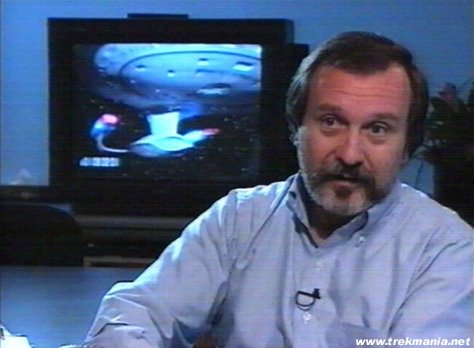
I'm Not A Hollywood Type, I Just Work There:
An Evening with Dan Curry
by William S. Kowinski
If Visual Effects Producer Dan Curry is holding out any hope of a reprieve for Star Trek:Enterprise, he was keeping it to himself when he spoke to a university audience on Friday night (February 25.)
At about the same time that its latest episode, " Divergence," was being seen locally, Curry was on a theatre stage describing how he had begun working on Star Trek's second incarnation---the pilot of "The Next Generation"-which he thought would be a four month job.
"And 18 years later, I'm working on the final episode of Star Trek," Curry said. "With the political machinations of studios and dwindling ratings, the saga of Star Trek for the moment is drawing to a close. So we're all going through a bittersweet period of facing the excitement of a new adventure, but kind of waving goodbye to a group of people that has become family for us over the years."
Later in his talk, Curry noted that the four seasons of Enterprise were "just enough to make it an attractive syndication package, so it will begin to bring negotiable currency to Paramount Pictures."
In a conversation we had after his presentation, Curry added that even though many were looking for their next jobs, they were all still determined to make the remaining episodes as good as they possibly can be.
Curry wouldn't tell me anything about the final episode, which he said was being kept super-secret, and had started shooting that day. He expected to be finished with his post-production work in late April. But he did suggest there would likely be a 40th anniversary Star Trek TV special, and perhaps another documentary that focuses on effects over the years.
As for his own feelings about Enterprise, when asked from the audience which of the Star Trek series was his favorite to work on (and he's worked on them all since TNG) he said, "I think Enterprise, for a number of reasons. It's set earlier in time so things are little more rough and tumble, it's really a fun cast to work with, and over time the relationship of the cast and the crew members has evolved to the point where we are like family. So it's the most emotionally satisfying just because of the quality of the people I work with."
[text continues after photos]
An Evening with Dan Curry
by William S. Kowinski
If Visual Effects Producer Dan Curry is holding out any hope of a reprieve for Star Trek:Enterprise, he was keeping it to himself when he spoke to a university audience on Friday night (February 25.)
At about the same time that its latest episode, " Divergence," was being seen locally, Curry was on a theatre stage describing how he had begun working on Star Trek's second incarnation---the pilot of "The Next Generation"-which he thought would be a four month job.
"And 18 years later, I'm working on the final episode of Star Trek," Curry said. "With the political machinations of studios and dwindling ratings, the saga of Star Trek for the moment is drawing to a close. So we're all going through a bittersweet period of facing the excitement of a new adventure, but kind of waving goodbye to a group of people that has become family for us over the years."
Later in his talk, Curry noted that the four seasons of Enterprise were "just enough to make it an attractive syndication package, so it will begin to bring negotiable currency to Paramount Pictures."
In a conversation we had after his presentation, Curry added that even though many were looking for their next jobs, they were all still determined to make the remaining episodes as good as they possibly can be.
Curry wouldn't tell me anything about the final episode, which he said was being kept super-secret, and had started shooting that day. He expected to be finished with his post-production work in late April. But he did suggest there would likely be a 40th anniversary Star Trek TV special, and perhaps another documentary that focuses on effects over the years.
As for his own feelings about Enterprise, when asked from the audience which of the Star Trek series was his favorite to work on (and he's worked on them all since TNG) he said, "I think Enterprise, for a number of reasons. It's set earlier in time so things are little more rough and tumble, it's really a fun cast to work with, and over time the relationship of the cast and the crew members has evolved to the point where we are like family. So it's the most emotionally satisfying just because of the quality of the people I work with."
[text continues after photos]
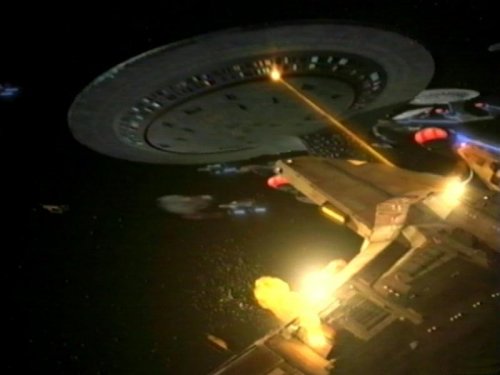
Curry spoke to a hundred or so students and faculty at Humboldt State University in far northern California, where he had been a graduate student and earned his Masters of Fine Arts degree in 1982. In the theatre building where he had spent many hours, he talked about his career, mostly on Star Trek but also on several features, and illustrated his stories with clips and before-and-after examples of specific visual effects.
The DVD and videotape footage projected on a screen beside him on the stage included his ten minute 2004 Emmy-winning reel from Enterprise (he's won 7 in all), a montage of Enterprise season 3 in 60 seconds, and the 18 minute profile included in the TNG season 6 DVD, which features him talking about various episodes, showing Klingon weapons he designed and their inspirations, and doing some Tai'chi on his lawn. ("They followed me around my house. After it was made and they sent me a copy, and it took me about eight months to have the courage to watch it. It's living proof why I am behind the camera.")
Curry began his two hour presentation with a montage of visual effects scenes from all the series he worked on, beginning it with the space battle of the Deep Space 9 finale. It looked really great projected on the big screen.
Here are some highlights from his talk, by category...
The DVD and videotape footage projected on a screen beside him on the stage included his ten minute 2004 Emmy-winning reel from Enterprise (he's won 7 in all), a montage of Enterprise season 3 in 60 seconds, and the 18 minute profile included in the TNG season 6 DVD, which features him talking about various episodes, showing Klingon weapons he designed and their inspirations, and doing some Tai'chi on his lawn. ("They followed me around my house. After it was made and they sent me a copy, and it took me about eight months to have the courage to watch it. It's living proof why I am behind the camera.")
Curry began his two hour presentation with a montage of visual effects scenes from all the series he worked on, beginning it with the space battle of the Deep Space 9 finale. It looked really great projected on the big screen.
Here are some highlights from his talk, by category...

How he got started
"My last year at HSU, my fellow students were kind enough to grant me a one man exhibition of painting, and during that time by a remarkable coincidence, Marcia Lucas, who was George Lucas' wife at the time, was visiting to give a series of talks on film editing. She happened to stroll by the little gallery and saw some of my paintings, and came and talked to me about them, and told me I should look into doing matte paintings.
So I was invited down to ILM, got a lot of advice and pointers on doing matte paintings, and they set up some meetings for me, so after school I went to Universal Studios and started on Buck Rogers and the original Battlestar Galactica"...
Then [many] features later working for various facilities, I was invited by Paramount Pictures to work on Star Trek. It sounded like a good idea, I thought it would be a four month project to help this little pilot get off the ground, and 18 years later I'm working on the final episode of Star Trek."
On the importance of the Peace Corps and his education in his work for Star Trek
After obtaining his undergraduate degree in art, Curry went into the Peace Corps. "It had a profound effect on my life. I learned something very important. In this country we say there's the First World and the Third World. But I really discovered that there is no Third World---there is only one world and we all live in it together. And that we should start making our international policies based on that fact."
"I had the rare opportunity to live in rural Thailand building small dams and bridges, but what I contributed to the people there was a small part of what they contributed to me. Since then I've become aware that everything you experience in life becomes part of your career, whether directly from the educational system or from some stuff that happens by surprise, and much of what I encountered in Thailand became part of Star Trek, especially the Klingons. They were much influenced by people in the Himalayas and Southeast Asia, and the protracted period of my misspent youth that I spent in sword schools."
After the Peace Corps and a few years teaching art at a community college on Cape Cod, Curry entered the graduate program at Humboldt State University, and "another profoundly influential period of my life." He thanked the faculty members by name (several of whom were present for his talk) and added that his relationship with fellow students were "just as influential in shaping my opinions about things, because of their dedication to the art of theatre and film, and their dedication to integrity."
"My last year at HSU, my fellow students were kind enough to grant me a one man exhibition of painting, and during that time by a remarkable coincidence, Marcia Lucas, who was George Lucas' wife at the time, was visiting to give a series of talks on film editing. She happened to stroll by the little gallery and saw some of my paintings, and came and talked to me about them, and told me I should look into doing matte paintings.
So I was invited down to ILM, got a lot of advice and pointers on doing matte paintings, and they set up some meetings for me, so after school I went to Universal Studios and started on Buck Rogers and the original Battlestar Galactica"...
Then [many] features later working for various facilities, I was invited by Paramount Pictures to work on Star Trek. It sounded like a good idea, I thought it would be a four month project to help this little pilot get off the ground, and 18 years later I'm working on the final episode of Star Trek."
On the importance of the Peace Corps and his education in his work for Star Trek
After obtaining his undergraduate degree in art, Curry went into the Peace Corps. "It had a profound effect on my life. I learned something very important. In this country we say there's the First World and the Third World. But I really discovered that there is no Third World---there is only one world and we all live in it together. And that we should start making our international policies based on that fact."
"I had the rare opportunity to live in rural Thailand building small dams and bridges, but what I contributed to the people there was a small part of what they contributed to me. Since then I've become aware that everything you experience in life becomes part of your career, whether directly from the educational system or from some stuff that happens by surprise, and much of what I encountered in Thailand became part of Star Trek, especially the Klingons. They were much influenced by people in the Himalayas and Southeast Asia, and the protracted period of my misspent youth that I spent in sword schools."
After the Peace Corps and a few years teaching art at a community college on Cape Cod, Curry entered the graduate program at Humboldt State University, and "another profoundly influential period of my life." He thanked the faculty members by name (several of whom were present for his talk) and added that his relationship with fellow students were "just as influential in shaping my opinions about things, because of their dedication to the art of theatre and film, and their dedication to integrity."

Evolution of Visual Effects
"The evolution of visual effects over my 18 years at Star Trek is really the evolution of visual effects. Because we worked in television we were able to use lower resolutions, so we pioneered a lot of things that became standard techniques in features. We were the very first visual effects show to have video tape as our final product rather than film. We started out doing 1 inch analogue and progressed to digital and now we're doing high definition digital technologies....My job has gone from director of photography and compositing supervisor, to sort of an orchestra conductor of a team of virtuoso digital artists."
Even today, Curry said, an average feature may have 200 to 500 visual effects shots, that take a year to produce. "We have 2 1/2 to 3 weeks [to do each show], and in the average television season we do 3500 visual effects shots."
Curry also explained the difference between visual and special effects.
"Visual effects basically are making a synthetic reality out of pieces that were photographed at different times and recombining them into something new, while special effects happen on the set, like making the doors open and close on the Enterprise." They often work together-for example, visual effects will enhance explosions created on the set by special effects. Visual effects also works with what the makeup and other departments do. "It's a very interactive process."
Working with Models
At first most visual effects were done with minatures. The Enterprise-D, Deep Space 9 and Voyager were 4-to-6 foot models. "Sometimes it took 60 to 80 hours a week trying to keep up with the miniature photography for the ships. Now most of it is done in the computer."
But Curry doesn't think that miniatures will completely disappear even in the digital age. He pointed out that the 2004 film "The Aviator" used airplane models. "There are certain things computers don't do very well, so I think that models will never completely go away...and with models, like with computer graphics and with actors, it's all about lighting. If you light it well it will look great. If you don't light it well, it will look artificial.
"Practical elements"
"In those [old]days, we had to use a lot of practical elements--- and I'd like to introduce you to the force field that was used on the Enterprise." Curry holds up a ball of silver tinsel.
"Sometimes we'd bounce laser beams off beer cans onto white cardboard, and depending on how we bent the beer can it would influence how the image would appear. We used these for force fields and tractor beams. It was fun--- a form of medieval alchemy."
The key to creating visual effects: "Teamwork, and the ability to perceive things not for what they are, but for what they might be."
Motion Control
"Doug Trumbull [special photographic effects pioneer on 2001,Close Encounters of the Third Kind and Star Trek: The Motion Picture among others) was visiting an airplane plant in the LA area and he saw these huge milling machines doing the same motions over and over again. [Before then] spaceship models were filmed on wires against blue screen, and with 'overcranking' (moving the ships at faster than 24 frames per second, the speed of the film).... you couldn't get any lights inside for windows or [vapor coming out]... When Doug saw the milling machines he had the inspiration that if you mounted a model in one place, and you had roll, pitch and yaw, he could build lights into it and photograph it slowly, one [frame] at a time, giving perfect exposure for each element of the shot. So Doug's great inspiration was the contribution that made visual effects possible not only for Star Trek but Blade Runner, Star Wars, all those early films---the value of his influence cannot be overstated."
Each time a motion control pass is made, new elements are added. "For the [TNG] Enterprise and Voyager fly-bys we had to do the same thing seven times. [It looks great when it's done, but] watching a motion control shot has all the visceral thrills of watching cattle graze."
Sometimes motion control is shot against an orange screen "for matte passes or silhouette passes, lighting with ultraviolet light. Orange screen gave us a very even field of light---it made it easier to pull out an accurate silhouette of a ship."
Computer Graphics
Then came computer graphic design. Curry demonstrated how computer animation shots evolve, from "a wire frame [of the object] to adjust motion, then a smooth shape that gives us a sense of the volume, then the final render[ing]. The wire frame and smooth shape are used because the final render can take a long time. For one series of shots, it was 17 hours per frame."
"The evolution of visual effects over my 18 years at Star Trek is really the evolution of visual effects. Because we worked in television we were able to use lower resolutions, so we pioneered a lot of things that became standard techniques in features. We were the very first visual effects show to have video tape as our final product rather than film. We started out doing 1 inch analogue and progressed to digital and now we're doing high definition digital technologies....My job has gone from director of photography and compositing supervisor, to sort of an orchestra conductor of a team of virtuoso digital artists."
Even today, Curry said, an average feature may have 200 to 500 visual effects shots, that take a year to produce. "We have 2 1/2 to 3 weeks [to do each show], and in the average television season we do 3500 visual effects shots."
Curry also explained the difference between visual and special effects.
"Visual effects basically are making a synthetic reality out of pieces that were photographed at different times and recombining them into something new, while special effects happen on the set, like making the doors open and close on the Enterprise." They often work together-for example, visual effects will enhance explosions created on the set by special effects. Visual effects also works with what the makeup and other departments do. "It's a very interactive process."
Working with Models
At first most visual effects were done with minatures. The Enterprise-D, Deep Space 9 and Voyager were 4-to-6 foot models. "Sometimes it took 60 to 80 hours a week trying to keep up with the miniature photography for the ships. Now most of it is done in the computer."
But Curry doesn't think that miniatures will completely disappear even in the digital age. He pointed out that the 2004 film "The Aviator" used airplane models. "There are certain things computers don't do very well, so I think that models will never completely go away...and with models, like with computer graphics and with actors, it's all about lighting. If you light it well it will look great. If you don't light it well, it will look artificial.
"Practical elements"
"In those [old]days, we had to use a lot of practical elements--- and I'd like to introduce you to the force field that was used on the Enterprise." Curry holds up a ball of silver tinsel.
"Sometimes we'd bounce laser beams off beer cans onto white cardboard, and depending on how we bent the beer can it would influence how the image would appear. We used these for force fields and tractor beams. It was fun--- a form of medieval alchemy."
The key to creating visual effects: "Teamwork, and the ability to perceive things not for what they are, but for what they might be."
Motion Control
"Doug Trumbull [special photographic effects pioneer on 2001,Close Encounters of the Third Kind and Star Trek: The Motion Picture among others) was visiting an airplane plant in the LA area and he saw these huge milling machines doing the same motions over and over again. [Before then] spaceship models were filmed on wires against blue screen, and with 'overcranking' (moving the ships at faster than 24 frames per second, the speed of the film).... you couldn't get any lights inside for windows or [vapor coming out]... When Doug saw the milling machines he had the inspiration that if you mounted a model in one place, and you had roll, pitch and yaw, he could build lights into it and photograph it slowly, one [frame] at a time, giving perfect exposure for each element of the shot. So Doug's great inspiration was the contribution that made visual effects possible not only for Star Trek but Blade Runner, Star Wars, all those early films---the value of his influence cannot be overstated."
Each time a motion control pass is made, new elements are added. "For the [TNG] Enterprise and Voyager fly-bys we had to do the same thing seven times. [It looks great when it's done, but] watching a motion control shot has all the visceral thrills of watching cattle graze."
Sometimes motion control is shot against an orange screen "for matte passes or silhouette passes, lighting with ultraviolet light. Orange screen gave us a very even field of light---it made it easier to pull out an accurate silhouette of a ship."
Computer Graphics
Then came computer graphic design. Curry demonstrated how computer animation shots evolve, from "a wire frame [of the object] to adjust motion, then a smooth shape that gives us a sense of the volume, then the final render[ing]. The wire frame and smooth shape are used because the final render can take a long time. For one series of shots, it was 17 hours per frame."


Xindi
As the audience watched his Emmy-winning reel from the Enterprise 3rd season episode, "Countdown," Curry mentioned that he had designed the Xindi acquatic species based on "a little known dinosaur, the Mososaurus." (For the uninitiated, the Xindi were aliens at the center of the year-long Enterprise 3rd season arc.)
He based the insectoid species on the fly. For the insectoid, an actor in a smooth bodysuit was photographed performing the actions, to guide the animator.
Will Actors Be Animated?
An audience question: Will there be a time that actors will be animated?
I think the technological possibility of doing that exists now, but I think audiences want to be told a story by live, living human beings. If you look at something like Final Fantasy---it looked very real , a wonderful art form, but ultimately people want to see living actors, whether on stage or on the screen.
What about bringing dead actors to life, like Humphrey Bogart?
That was done in France. Unfortunately, the Bogart estate prevented that from happening. But say you take a death mask from Abraham Lincoln and get an actor so you can do motion capture and, like Lord of the Rings or what we did with the Xindi, you have a character that's acted by an actor, [and you can use the Lincoln face.].. Ultimately it will be virtually indistinguishable, from having a computer generate an actor or having a real actor---it's probably happening in Washington now."
Effects and Story
"In Star Trek we try to recognize that story is king and that the visual effects only exist to serve the story, so when we create the shot we try to use the philosophy that if this were a real event---assuming that all Star Trek stories are based on true historical events--how would a great cinematographer photograph this event in a way that would delight and viscerally involve the audience? We try to help the audience share the experience that the characters are going through."
Curry also mentioned that "one of the most valuable courses I had here [at HSU] was a script analysis course... it enlightened me to find the medium layer in a story, because even if we're doing a space shot, it has to drive the story. Script analysis reinforces the value of interpretation of story."
As the audience watched his Emmy-winning reel from the Enterprise 3rd season episode, "Countdown," Curry mentioned that he had designed the Xindi acquatic species based on "a little known dinosaur, the Mososaurus." (For the uninitiated, the Xindi were aliens at the center of the year-long Enterprise 3rd season arc.)
He based the insectoid species on the fly. For the insectoid, an actor in a smooth bodysuit was photographed performing the actions, to guide the animator.
Will Actors Be Animated?
An audience question: Will there be a time that actors will be animated?
I think the technological possibility of doing that exists now, but I think audiences want to be told a story by live, living human beings. If you look at something like Final Fantasy---it looked very real , a wonderful art form, but ultimately people want to see living actors, whether on stage or on the screen.
What about bringing dead actors to life, like Humphrey Bogart?
That was done in France. Unfortunately, the Bogart estate prevented that from happening. But say you take a death mask from Abraham Lincoln and get an actor so you can do motion capture and, like Lord of the Rings or what we did with the Xindi, you have a character that's acted by an actor, [and you can use the Lincoln face.].. Ultimately it will be virtually indistinguishable, from having a computer generate an actor or having a real actor---it's probably happening in Washington now."
Effects and Story
"In Star Trek we try to recognize that story is king and that the visual effects only exist to serve the story, so when we create the shot we try to use the philosophy that if this were a real event---assuming that all Star Trek stories are based on true historical events--how would a great cinematographer photograph this event in a way that would delight and viscerally involve the audience? We try to help the audience share the experience that the characters are going through."
Curry also mentioned that "one of the most valuable courses I had here [at HSU] was a script analysis course... it enlightened me to find the medium layer in a story, because even if we're doing a space shot, it has to drive the story. Script analysis reinforces the value of interpretation of story."

Voyager
"Sometimes computer-generated [effects] don't look convincing." In a shot of Voyager crash-landing on an icy planet, he felt that the ship skidding through the snow didn't work. The solution: "The snow was baking soda. We painted a toy model of Voyager black, and we had a guy take the model and run as fast as he could, running it through the baking soda" on a series of long tables.
Another case was lava. "Synthetic lava never looks convincing. Normally they use Metrocil-the stuff that McDonald's uses to thicken milkshakes. Or it's computer generated, but it never looks real." His solution for a scene in Voyager: "We found some 16mm footage of actual lava" from a volcanic eruption in Hawaii, "we digitally stabilized it, and I was able to use Inferno---all the visual effects boxes have really cool names---and twist it into perspective." The shot showed lava flowing down a channel that was a real dry streambed on location, photographed with live actors in the shot.
Effects Tech
Asked what software he uses now, Curry said: "For 3-D animation we use Lightwave, sometimes we use Maya. For 2-D compositing, such as green screen, we use Inferno." "For phaser animation and frame by frame animation, we do that on a Flame. A lot of people use Studio Macs, we don't. For matte paintings that don't move much, I do those in Photoshop."
The 3-D effects on Enterprise are done by two teams at Eden Effects, while the 2-D (greenscreen, etc.) is handled mostly by two teams at Creative Services. Curry himself still does some hands-on work as needed: "...some matte painting, a lot of the conceptual design, like designing the cg creatures, or else [makeup chief] Michael Westmore does that. It depends where the greatest needs are. I like to design the bladed weapons for the show. In visual effects, the supervisors will be hands on when they can best contribute."
The two sides of Teamwork
Curry stressed several times that TV and movies require the creative teamwork of hundreds of people. When I spoke with him later, I asked him how he had gotten so involved in areas outside his job description, like designing Klingon weapons and the tai chi-like exercises. He said it was one of the great things about working at Star Trek was that your job description didn't matter as much as what you could do. "If you could do it, you did it." Because they worked so closely and across departmental lines, they learned each others' interests, and so, for example, producers knew about his fascination with martial arts and t'ai chi.
Curry has also directed some second unit dramatic scenes, as one he showed from Voyager, a bit of comic byplay between the holographic doctor and Seven-of-Nine.
"Sometimes computer-generated [effects] don't look convincing." In a shot of Voyager crash-landing on an icy planet, he felt that the ship skidding through the snow didn't work. The solution: "The snow was baking soda. We painted a toy model of Voyager black, and we had a guy take the model and run as fast as he could, running it through the baking soda" on a series of long tables.
Another case was lava. "Synthetic lava never looks convincing. Normally they use Metrocil-the stuff that McDonald's uses to thicken milkshakes. Or it's computer generated, but it never looks real." His solution for a scene in Voyager: "We found some 16mm footage of actual lava" from a volcanic eruption in Hawaii, "we digitally stabilized it, and I was able to use Inferno---all the visual effects boxes have really cool names---and twist it into perspective." The shot showed lava flowing down a channel that was a real dry streambed on location, photographed with live actors in the shot.
Effects Tech
Asked what software he uses now, Curry said: "For 3-D animation we use Lightwave, sometimes we use Maya. For 2-D compositing, such as green screen, we use Inferno." "For phaser animation and frame by frame animation, we do that on a Flame. A lot of people use Studio Macs, we don't. For matte paintings that don't move much, I do those in Photoshop."
The 3-D effects on Enterprise are done by two teams at Eden Effects, while the 2-D (greenscreen, etc.) is handled mostly by two teams at Creative Services. Curry himself still does some hands-on work as needed: "...some matte painting, a lot of the conceptual design, like designing the cg creatures, or else [makeup chief] Michael Westmore does that. It depends where the greatest needs are. I like to design the bladed weapons for the show. In visual effects, the supervisors will be hands on when they can best contribute."
The two sides of Teamwork
Curry stressed several times that TV and movies require the creative teamwork of hundreds of people. When I spoke with him later, I asked him how he had gotten so involved in areas outside his job description, like designing Klingon weapons and the tai chi-like exercises. He said it was one of the great things about working at Star Trek was that your job description didn't matter as much as what you could do. "If you could do it, you did it." Because they worked so closely and across departmental lines, they learned each others' interests, and so, for example, producers knew about his fascination with martial arts and t'ai chi.
Curry has also directed some second unit dramatic scenes, as one he showed from Voyager, a bit of comic byplay between the holographic doctor and Seven-of-Nine.
Voyager and Other Title Sequences
Dan Curry has done the title sequences for several feature films. For the Rodney Dangerfield comedy, "Back to School," Curry's task was to tell the backstory of the main character's past. He was able to blend photographs from his own family's album because, coincidentally, the character Dangerfield was playing grew up in the same New York neighborhood as Curry did.
In "Top Gun" the specific task was to create mood. Working with the music score is part of the process, and on this film Curry had the music before he started, so he could edit the images to move more slowly at first, and then with increasing speed, to both match the music's tempo and the pace of preparations for the jets' flight, and the adrenelin rush the rest of the movie would be.
For "Back to School," the music wasn't recorded, and Curry saw only the sheet music. But he used it to decide where the cuts in the film should be, and the first time that score and title sequence were played together, they matched perfectly. The credits of Indiana Jones and the Temple of Doom were a musical number, and required unusual visual effects--more glinting of the dancers' sequins.
"Credits are like an overture to an opera---its purpose is to give the credit information, but also to give a promise of what the show is going to be about." As examples of great title sequences, Curry cited "Spartacus" and the 1938 "Robin Hood," which he also called "probably one of the best crafted adventure films."
One of the proudest ones for me," he added," was the title sequence for Voyager. I had the opportunity to create what my dream of space travel would be."
On Working With TV Budgets---and TV time
"Every week we go to a pre-production meeting, where everybody gets a handle on what the scope of the production is, then we [the department heads] go back and do a budget, and then each department meets with the producer and presents its budget. When the producers recover from cardiac arrest, we go back and say, we can trim this, instead of six ship shots here we can tell that story with 3, maybe we don't have to blow up a fifteen story building, we can blow up a five story building, and basically get it down to doabilty. The problem with television is that it's a sprint-we have to work really really fast, the greatest challenge we had was the finale of ds9 when we had 354 major visual effect shots, including a space battle with over 200 ships in a shot --and they gave us 3 weeks. It's about making rapid decisions. ..
So then we have a final budget meeting, and the budget is finalized. You all know that film is an uncomfortable marriage between art and business, and the business side always rules."
On politics
A faculty member asked if "you Hollywood types are like us, [faculty who are]feeling besieged by those who want to limit our freedom and install censorship."
First of all, I don't consider myself a Hollywood type," Curry said. " I just work there." But he went on to say: "If you exploit your power to demean and manipulate the other point of view rather than make an honest depiction of it, then people from another persuasion will look at you as less than honorable. There are many points of view in Hollywood. People from every part of the political spectrum work on our show, they talk about their views." The idea, he said, is to "disagree without being disagreeable."
Dan Curry has done the title sequences for several feature films. For the Rodney Dangerfield comedy, "Back to School," Curry's task was to tell the backstory of the main character's past. He was able to blend photographs from his own family's album because, coincidentally, the character Dangerfield was playing grew up in the same New York neighborhood as Curry did.
In "Top Gun" the specific task was to create mood. Working with the music score is part of the process, and on this film Curry had the music before he started, so he could edit the images to move more slowly at first, and then with increasing speed, to both match the music's tempo and the pace of preparations for the jets' flight, and the adrenelin rush the rest of the movie would be.
For "Back to School," the music wasn't recorded, and Curry saw only the sheet music. But he used it to decide where the cuts in the film should be, and the first time that score and title sequence were played together, they matched perfectly. The credits of Indiana Jones and the Temple of Doom were a musical number, and required unusual visual effects--more glinting of the dancers' sequins.
"Credits are like an overture to an opera---its purpose is to give the credit information, but also to give a promise of what the show is going to be about." As examples of great title sequences, Curry cited "Spartacus" and the 1938 "Robin Hood," which he also called "probably one of the best crafted adventure films."
One of the proudest ones for me," he added," was the title sequence for Voyager. I had the opportunity to create what my dream of space travel would be."
On Working With TV Budgets---and TV time
"Every week we go to a pre-production meeting, where everybody gets a handle on what the scope of the production is, then we [the department heads] go back and do a budget, and then each department meets with the producer and presents its budget. When the producers recover from cardiac arrest, we go back and say, we can trim this, instead of six ship shots here we can tell that story with 3, maybe we don't have to blow up a fifteen story building, we can blow up a five story building, and basically get it down to doabilty. The problem with television is that it's a sprint-we have to work really really fast, the greatest challenge we had was the finale of ds9 when we had 354 major visual effect shots, including a space battle with over 200 ships in a shot --and they gave us 3 weeks. It's about making rapid decisions. ..
So then we have a final budget meeting, and the budget is finalized. You all know that film is an uncomfortable marriage between art and business, and the business side always rules."
On politics
A faculty member asked if "you Hollywood types are like us, [faculty who are]feeling besieged by those who want to limit our freedom and install censorship."
First of all, I don't consider myself a Hollywood type," Curry said. " I just work there." But he went on to say: "If you exploit your power to demean and manipulate the other point of view rather than make an honest depiction of it, then people from another persuasion will look at you as less than honorable. There are many points of view in Hollywood. People from every part of the political spectrum work on our show, they talk about their views." The idea, he said, is to "disagree without being disagreeable."

How Do You Train for Star Trek?
There were several questions from students in the audience about career paths and preparations.
What are the best schools for visual effects? one asked. Curry named two: Expression College of the Digital Arts in San Francisco, and Gnomon [School of Visual Effects] in Los Angeles. "There are probably others. Those are the ones I'm familiar with that are really good, and people who go through those schools are sought after."
Where do you get a start? another student asked. She was a costume designer.
"It's very difficult to jump right in," Curry said. "It's hard to get into the union. The studio system is evolving differently, the political structure of the studio system is becoming very bizarre. You might find independent films, short films, high quality student films, that your work can be seen in. If you have a reel, a portfolio of beautiful designs, talent is found."
"I loved making movies [as a child.] When I saw "The Beast from 10,000 fathoms" I saw they were using some sort of projection, and I had a broken projector, and I realized that if I put a piece of trace paper up on the screen, I could make dinosaurs chase my brother.
But it was just a series of fortuitous accidents that led me to here. I came to Humboldt State with the intention of getting into production design for live theatre. The more I got involved in film, the more I wanted to pursue it."
"I was very lucky, I walked into a situation where they needed somebody with my set of skills. I went to Star Trek where I found a home, where the range of my imagination had value. If I'd had to work on a soap opera it would have been horrible."
On Education v. Job Training
"There's a big difference between job training and education. Job training gives you the skill to do one thing. Education helps you to react to whatever opportunities present themselves. It's really important for those of you who are students here to recognize that your number one job is to become an educated person. Whatever skills you learn, they change as technology evolves, but it is your education that allows you to deal with those changes. So learn everything you can about all sorts of things, and you'll find that as different opportunities present themselves during the course of your life, you can deal with them better than if you approach school as job training."
I urge all of you to support education [on all levels], for the collective good of our society... It seems our society is shifting away from giving proper value to the educational process, and in this time when our nation lives with the fear of threats that are real and imaginary, [applause]the true defense of a nation is an educated population."
After his talk, Curry went off with old friends from university days. He would hold a workshop for students in the morning, and then explore more of Redwood country with his son, sharing the sights and the memories before returning to southern California early Sunday. Among other projects, he'll be working on a new pilot for CBS.
There were several questions from students in the audience about career paths and preparations.
What are the best schools for visual effects? one asked. Curry named two: Expression College of the Digital Arts in San Francisco, and Gnomon [School of Visual Effects] in Los Angeles. "There are probably others. Those are the ones I'm familiar with that are really good, and people who go through those schools are sought after."
Where do you get a start? another student asked. She was a costume designer.
"It's very difficult to jump right in," Curry said. "It's hard to get into the union. The studio system is evolving differently, the political structure of the studio system is becoming very bizarre. You might find independent films, short films, high quality student films, that your work can be seen in. If you have a reel, a portfolio of beautiful designs, talent is found."
"I loved making movies [as a child.] When I saw "The Beast from 10,000 fathoms" I saw they were using some sort of projection, and I had a broken projector, and I realized that if I put a piece of trace paper up on the screen, I could make dinosaurs chase my brother.
But it was just a series of fortuitous accidents that led me to here. I came to Humboldt State with the intention of getting into production design for live theatre. The more I got involved in film, the more I wanted to pursue it."
"I was very lucky, I walked into a situation where they needed somebody with my set of skills. I went to Star Trek where I found a home, where the range of my imagination had value. If I'd had to work on a soap opera it would have been horrible."
On Education v. Job Training
"There's a big difference between job training and education. Job training gives you the skill to do one thing. Education helps you to react to whatever opportunities present themselves. It's really important for those of you who are students here to recognize that your number one job is to become an educated person. Whatever skills you learn, they change as technology evolves, but it is your education that allows you to deal with those changes. So learn everything you can about all sorts of things, and you'll find that as different opportunities present themselves during the course of your life, you can deal with them better than if you approach school as job training."
I urge all of you to support education [on all levels], for the collective good of our society... It seems our society is shifting away from giving proper value to the educational process, and in this time when our nation lives with the fear of threats that are real and imaginary, [applause]the true defense of a nation is an educated population."
After his talk, Curry went off with old friends from university days. He would hold a workshop for students in the morning, and then explore more of Redwood country with his son, sharing the sights and the memories before returning to southern California early Sunday. Among other projects, he'll be working on a new pilot for CBS.
Tuesday, February 22, 2005
Star Trek XI News
The trade publication Variety revealed that Rick Berman's partners in developing the next Star Trek movie are Jordan Kerner and Kerry McCluggage.
According to the Internet Movie Database, Kerner has produced "Inspector Gadget," "George of the Jungle" and "The Mighty Ducks" and their respective sequels, among other titles. He also produced the TV series "A Wrinkle in Time" in Canada. He is currently producing "Charlotte's Web."
Kerry McCluggage produced "Miami Vice" in 1984 and the TV movie "Homeland Security" in 2004. No credits for the 20 years between these are listed. But he was also president of Paramount Television, and is said to be a strong supporter of the Star Trek franchise.
Variety says that a writer has been hired, who they name as Eric Genderson. However, this name doesn't appear in the database. It's either a mistake or he's pretty unknown, which would be a stark contrast to the writer of the last film, John Logan, nominated again this year for an Academy Award.
The article also quotes Rick Berman going into more detail about "franchise fatigue" as the reason for the fall-off in Star Trek audience. By this theory, the assets of the franchise---the characters, and the Star Trek universe built over the past 38 years-are no longer considered assets. Berman calls for a "re-invention" of Star Trek, beginning with the next movie, which is why it will not have any previously established Star Trek characters. Berman repeats that he doesn't expect a new Trek TV series for at least three years.
Variety online requires a paid subscription, but a summary of the article appears on TrebWeb, and quotes from it plus background information on Berman's co-producers at Trek Today.
UPDATE: Though "Eric Genderson" remains unknown, there is an Eric (or Erik) Jendresen, the writer and producer of the TV miniseries "Band of Brothers." Jendresen is listed as writer on two current film projects, "The Hot Zone" (about an ebola virus loose in suburban Washington, from the book by Richard Preston) and "Aloft." "Aloft" is slated to be directed by Robert Redford, from the Alan Tennant book concerning the adventures of two men tracking the international flight of a North American penegrine falcon. One review described the book as "part nature study, part gonzo travelogue."
Erik Jendresen is also listed as a writer on "Fire," a Dreamworks project from a story by "Perfect Storm" author Sebastian Junger. He may also be the Erik Jendresen who is the author of children's books.
A staffer at TrekWeb apparently made the connection between Genderson and Jendresen, though there's no official word yet on whether it is Jendresen who is attached to the next Trek movie as writer.
UPDATE: TrekWeb has confirmed through Paramount from the Variety writer that the Trek XI writer's name is Erik Jendresen, and the above credits are accurate, plus he's written novels and plays. There's more at TrekWeb, with a link.
The trade publication Variety revealed that Rick Berman's partners in developing the next Star Trek movie are Jordan Kerner and Kerry McCluggage.
According to the Internet Movie Database, Kerner has produced "Inspector Gadget," "George of the Jungle" and "The Mighty Ducks" and their respective sequels, among other titles. He also produced the TV series "A Wrinkle in Time" in Canada. He is currently producing "Charlotte's Web."
Kerry McCluggage produced "Miami Vice" in 1984 and the TV movie "Homeland Security" in 2004. No credits for the 20 years between these are listed. But he was also president of Paramount Television, and is said to be a strong supporter of the Star Trek franchise.
Variety says that a writer has been hired, who they name as Eric Genderson. However, this name doesn't appear in the database. It's either a mistake or he's pretty unknown, which would be a stark contrast to the writer of the last film, John Logan, nominated again this year for an Academy Award.
The article also quotes Rick Berman going into more detail about "franchise fatigue" as the reason for the fall-off in Star Trek audience. By this theory, the assets of the franchise---the characters, and the Star Trek universe built over the past 38 years-are no longer considered assets. Berman calls for a "re-invention" of Star Trek, beginning with the next movie, which is why it will not have any previously established Star Trek characters. Berman repeats that he doesn't expect a new Trek TV series for at least three years.
Variety online requires a paid subscription, but a summary of the article appears on TrebWeb, and quotes from it plus background information on Berman's co-producers at Trek Today.
UPDATE: Though "Eric Genderson" remains unknown, there is an Eric (or Erik) Jendresen, the writer and producer of the TV miniseries "Band of Brothers." Jendresen is listed as writer on two current film projects, "The Hot Zone" (about an ebola virus loose in suburban Washington, from the book by Richard Preston) and "Aloft." "Aloft" is slated to be directed by Robert Redford, from the Alan Tennant book concerning the adventures of two men tracking the international flight of a North American penegrine falcon. One review described the book as "part nature study, part gonzo travelogue."
Erik Jendresen is also listed as a writer on "Fire," a Dreamworks project from a story by "Perfect Storm" author Sebastian Junger. He may also be the Erik Jendresen who is the author of children's books.
A staffer at TrekWeb apparently made the connection between Genderson and Jendresen, though there's no official word yet on whether it is Jendresen who is attached to the next Trek movie as writer.
UPDATE: TrekWeb has confirmed through Paramount from the Variety writer that the Trek XI writer's name is Erik Jendresen, and the above credits are accurate, plus he's written novels and plays. There's more at TrekWeb, with a link.
Wednesday, February 16, 2005

Thank you!
Thanks to all who found their way to Soul of Star Trek over the past week or so. The site had over a thousand page loads in one day for the first time, and total visitors in the thousands as well, from Australia, Austria, Canada, France, England, Germany, Japan, Iceland, Indonesia, Ireland, Israel, Italy, Namibia, Poland, Singapore, Spain, Sweden, Switzerland, Wales and all regions of the U.S.
And special thanks to those who left such thoughtful as well as gracious comments.
Also to those who are checking out the Trek fictions at Morgan Dash.
As a special greeting to all the visitors from Italy, I'll sign my full name:
---William Severini Kowinski
UPDATE: add Costa Rica, Denmark, the Netherlands, New Zealand, Phillipines and Slovakia.
UPDATE 2: and as of March 1, add Brazil, Colombia, Croatia, Czech Republic, Finland, Thailand, and Venezuela. That makes readers from every continent except (so far) Antarctica.
Thanks to all who found their way to Soul of Star Trek over the past week or so. The site had over a thousand page loads in one day for the first time, and total visitors in the thousands as well, from Australia, Austria, Canada, France, England, Germany, Japan, Iceland, Indonesia, Ireland, Israel, Italy, Namibia, Poland, Singapore, Spain, Sweden, Switzerland, Wales and all regions of the U.S.
And special thanks to those who left such thoughtful as well as gracious comments.
Also to those who are checking out the Trek fictions at Morgan Dash.
As a special greeting to all the visitors from Italy, I'll sign my full name:
---William Severini Kowinski
UPDATE: add Costa Rica, Denmark, the Netherlands, New Zealand, Phillipines and Slovakia.
UPDATE 2: and as of March 1, add Brazil, Colombia, Croatia, Czech Republic, Finland, Thailand, and Venezuela. That makes readers from every continent except (so far) Antarctica.

Trekcheck: The Home Stretch
After two stand-alone episodes, Enterprise completed the first of its last multi-episode arcs of the season, and of its life as a series on UPN. While fan efforts to save the series accelerate, and rumors circulate about a possible new home for another season of new stories (Spike TV, with the former head of Comedy Central as its new chief, is currently the most credible possibility), those involved in making Enterprise seem less hopeful. As reported on TrekWeb and Trek Today, during his short-lived attempt to gather support for a new Trek series with himself at the helm, J. Michael Straczynski (creator of Babylon 5) got word from "a trusted source" at Paramount that any new Star Trek series wouldn't begin for a year or two. (Rick Berman had said publicly perhaps three years.)
While episodes will air into May, production on Enterprise will cease on March 8. Paramount is hosting selected national press and other guests for the last few shooting days, both recognizing the end of an era and using the occasion to celebrate Star Trek's almost four decades of success (as well as the upcoming start of Enterprise on DVD.)
Speculation now centers on the concluding episode. At a recent convention Jonathan Frakes confirmed that he and Marina Sirtis will appear in the final episode as their TNG characters, Riker and Troi, which a Paramount spokesperson isn't disputing. TV Guide is repeating the rumor, and that magazine is likely to be as close to an authorized source as there will be for future news concerning the final episodes.
But what no one is saying yet is who else might also appear. Since Rick Berman has described the last episode as "a Valentine" to Star Trek, perhaps the story will allow for appearances by other Trek characters, from other series, including the ever-elusive appearance by William Shatner. This is sheer speculation, with no inside tip or confirmation. But remember that just because negotiations seemed to go nowhere doesn't mean he won't actually appear. After all, he's the guy who hoodwinked a town into believing he was shooting a Star Trek movie when he wasn't, for a "reality" show on Spike TV. It would seem fitting that he might appear in a Star Trek episode he's hoodwinked us into thinking he won't.
After a shaky start with "Daedelus" and the brilliance of "Observer Effect," the Andorian-Tellurite arc ("Babel One," "United" and "The Aenar") gave us some connecting Trek history, some affecting moments, good acting and character development, and a lot new about an old species, the Andorians. We see a beautiful ice planet, and meet a beautiful new sub-species, the Aenar. It seems obvious that the prominence of the Andorians in Enterprise is largely due to the character of Shran created by Jeffrey Combs (and maybe to the articulated antennae, too.) But "The Aenar" in particular opened possibilities that Enterprise might have explored further in the future, but sadly won't get the chance. However, I can picture a dozen hungry Star Trek novelists devouring this arc for future books. There was even something of a science fiction premise, the linking of virtual reality with telepathy.
After the imminent Klingon arc and Mirror universe stories, the final episodes, set on and around Earth, will deal directly with xenophobia (reacting to the foreign or alien with fear and prejudice) a theme discussed here at Soul of Star Trek as central to the first half of the season as well. In fact, xenophobia is also what will divide Trek's 21st century history into the Mirror Universe opposite of the TNG timeline in the upcoming two-part arc. (This prior post also correctly predicted that the discrepancy in Klingon appearance problem would be addressed in the Klingon arc, but now I'm not sure whether this was informed intuition or something I absorbed from Manny Coto's stream of consciousness conversation on the Paramount lot last summer.)
That xenophobia is the last theme Star Trek Enterprise will address is fitting, given Star Trek's cultural history in the forefront of proposing the astonishing idea that aliens aren't necessary evil monsters automatically bent on conquest and destruction. That whole theme started in the 1890s with H.G. Wells' novel, The War of the Worlds. But Wells tale was complex and cautionary, meant to show western civilization in the inferior position it routinely inflicted on "primitive" cultures it conquered, like the Tasmanians and the American Indians. Moreover, Wells gave the Martians a reason for their attempted conquest: their planet was growing cold and would soon be unable to support life.
But the rash of space invasion stories that followed over the next half century or so---especially on screens---quickly dispensed with complexity and rationale, and space visitors were rarely anything but grotesque marauding monsters (even if they looked more like men in ape suits wearing diving helmets) who bellowed, screeched and killed, when they weren't shooting lethal rays from their foreheads. At first, humans were shown to be good-natured but naïve in trying to make friends, but that formality was soon dispensed with, and the appearance of an alien was automatically followed by concerted attempts to kill it, as sheer common sense reflex.
Star Trek fans all know the story of the Horta, and how in one episode of the original series, the stereotype was broken. A very alien species was portrayed as acting rationally based on a value shared with humans, protecting its young and the species' future. Once understanding was achieved, a mutually beneficial solution followed.
It was an approach that Star Trek cultivated in ever more complex variations in later TV and film stories, resulting eventually in examining our prejudices concerning other species on earth (the whales in Star Trek IV: The Voyage Home) and each other (the Russians, in the guise of Klingons in Star Trek VI: The Undiscovered Country.)
This helped to open up the possibilities further explored in particular by Stanley Kubrick in 2001 and Steven Speilberg in Close Encounters of the Third Kind and E.T. The monstrous aliens soon returned of course (in the Alien series, for example), occasionally balanced by other examples of foreign wonder and alien possibility (The Abyss, Contact, Mission to Mars.)
Lately it seems the alien monster has dominated, beginning even before fear became the official response to actual violation on 9-11, and Cold Warriors morphed into neocon chicken-hawks, while waves of racism returned in more elusive, coded disguises. With two new versions of Wells' War of the Worlds about to flood movie theatres this year---the more prominent being a blockbuster by Steven Speilberg-- the cycle may even reach new heights of artificial hysteria before the circle is closed.
While these new movies shouldn't be pre-judged (for they may revive and expand on Wells' themes lost in prior adaptations), it's safe to say that it's been a rather long time since anybody, in science fiction or out, has taken a popular culture stand against xenophobia. It looks like once again it's up to Star Trek, and meeting that challenge is a fitting end.
After two stand-alone episodes, Enterprise completed the first of its last multi-episode arcs of the season, and of its life as a series on UPN. While fan efforts to save the series accelerate, and rumors circulate about a possible new home for another season of new stories (Spike TV, with the former head of Comedy Central as its new chief, is currently the most credible possibility), those involved in making Enterprise seem less hopeful. As reported on TrekWeb and Trek Today, during his short-lived attempt to gather support for a new Trek series with himself at the helm, J. Michael Straczynski (creator of Babylon 5) got word from "a trusted source" at Paramount that any new Star Trek series wouldn't begin for a year or two. (Rick Berman had said publicly perhaps three years.)
While episodes will air into May, production on Enterprise will cease on March 8. Paramount is hosting selected national press and other guests for the last few shooting days, both recognizing the end of an era and using the occasion to celebrate Star Trek's almost four decades of success (as well as the upcoming start of Enterprise on DVD.)
Speculation now centers on the concluding episode. At a recent convention Jonathan Frakes confirmed that he and Marina Sirtis will appear in the final episode as their TNG characters, Riker and Troi, which a Paramount spokesperson isn't disputing. TV Guide is repeating the rumor, and that magazine is likely to be as close to an authorized source as there will be for future news concerning the final episodes.
But what no one is saying yet is who else might also appear. Since Rick Berman has described the last episode as "a Valentine" to Star Trek, perhaps the story will allow for appearances by other Trek characters, from other series, including the ever-elusive appearance by William Shatner. This is sheer speculation, with no inside tip or confirmation. But remember that just because negotiations seemed to go nowhere doesn't mean he won't actually appear. After all, he's the guy who hoodwinked a town into believing he was shooting a Star Trek movie when he wasn't, for a "reality" show on Spike TV. It would seem fitting that he might appear in a Star Trek episode he's hoodwinked us into thinking he won't.
After a shaky start with "Daedelus" and the brilliance of "Observer Effect," the Andorian-Tellurite arc ("Babel One," "United" and "The Aenar") gave us some connecting Trek history, some affecting moments, good acting and character development, and a lot new about an old species, the Andorians. We see a beautiful ice planet, and meet a beautiful new sub-species, the Aenar. It seems obvious that the prominence of the Andorians in Enterprise is largely due to the character of Shran created by Jeffrey Combs (and maybe to the articulated antennae, too.) But "The Aenar" in particular opened possibilities that Enterprise might have explored further in the future, but sadly won't get the chance. However, I can picture a dozen hungry Star Trek novelists devouring this arc for future books. There was even something of a science fiction premise, the linking of virtual reality with telepathy.
After the imminent Klingon arc and Mirror universe stories, the final episodes, set on and around Earth, will deal directly with xenophobia (reacting to the foreign or alien with fear and prejudice) a theme discussed here at Soul of Star Trek as central to the first half of the season as well. In fact, xenophobia is also what will divide Trek's 21st century history into the Mirror Universe opposite of the TNG timeline in the upcoming two-part arc. (This prior post also correctly predicted that the discrepancy in Klingon appearance problem would be addressed in the Klingon arc, but now I'm not sure whether this was informed intuition or something I absorbed from Manny Coto's stream of consciousness conversation on the Paramount lot last summer.)
That xenophobia is the last theme Star Trek Enterprise will address is fitting, given Star Trek's cultural history in the forefront of proposing the astonishing idea that aliens aren't necessary evil monsters automatically bent on conquest and destruction. That whole theme started in the 1890s with H.G. Wells' novel, The War of the Worlds. But Wells tale was complex and cautionary, meant to show western civilization in the inferior position it routinely inflicted on "primitive" cultures it conquered, like the Tasmanians and the American Indians. Moreover, Wells gave the Martians a reason for their attempted conquest: their planet was growing cold and would soon be unable to support life.
But the rash of space invasion stories that followed over the next half century or so---especially on screens---quickly dispensed with complexity and rationale, and space visitors were rarely anything but grotesque marauding monsters (even if they looked more like men in ape suits wearing diving helmets) who bellowed, screeched and killed, when they weren't shooting lethal rays from their foreheads. At first, humans were shown to be good-natured but naïve in trying to make friends, but that formality was soon dispensed with, and the appearance of an alien was automatically followed by concerted attempts to kill it, as sheer common sense reflex.
Star Trek fans all know the story of the Horta, and how in one episode of the original series, the stereotype was broken. A very alien species was portrayed as acting rationally based on a value shared with humans, protecting its young and the species' future. Once understanding was achieved, a mutually beneficial solution followed.
It was an approach that Star Trek cultivated in ever more complex variations in later TV and film stories, resulting eventually in examining our prejudices concerning other species on earth (the whales in Star Trek IV: The Voyage Home) and each other (the Russians, in the guise of Klingons in Star Trek VI: The Undiscovered Country.)
This helped to open up the possibilities further explored in particular by Stanley Kubrick in 2001 and Steven Speilberg in Close Encounters of the Third Kind and E.T. The monstrous aliens soon returned of course (in the Alien series, for example), occasionally balanced by other examples of foreign wonder and alien possibility (The Abyss, Contact, Mission to Mars.)
Lately it seems the alien monster has dominated, beginning even before fear became the official response to actual violation on 9-11, and Cold Warriors morphed into neocon chicken-hawks, while waves of racism returned in more elusive, coded disguises. With two new versions of Wells' War of the Worlds about to flood movie theatres this year---the more prominent being a blockbuster by Steven Speilberg-- the cycle may even reach new heights of artificial hysteria before the circle is closed.
While these new movies shouldn't be pre-judged (for they may revive and expand on Wells' themes lost in prior adaptations), it's safe to say that it's been a rather long time since anybody, in science fiction or out, has taken a popular culture stand against xenophobia. It looks like once again it's up to Star Trek, and meeting that challenge is a fitting end.
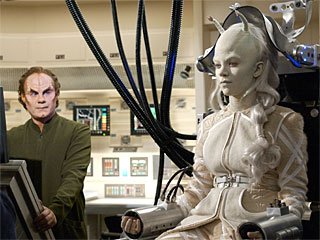
Friday, February 11, 2005

Monday, February 07, 2005
TrekCheck/ After "Enterprise": Speculations of the Week
In his generous and evocative comments prompted by the cancellation of Star Trek: Enterprise, former Star Trek writer and current producer of the Sci-Fi Channel hit Battlestar Galactica, Ronald D. Moore said a couple of things that seemed significant to me.
The first comes as a result of claimed inside knowledge. "Star Trek isn't dead and it isn't dying." "...I know first hand that Viacom considers 'the Franchise' to be one of their crown jewels and I've personally heard them refer to the 'next fifty years of Star Trek' as a corporate priority."
Moore then refers to Star Trek now entering "an interregnum, a pause in the treadmill of overlapping productions that have become the norm for the series that was once considered 'too cerebral for television.'"
These quotes come from Moore's Galactica blog, and can be found here. Battlestar Galactica Blog
So according to Moore, Viacom (now the parent of Paramount) is committed to Star Trek's future, and is planning for it. But while others refer to a "pause" (as he also does) or a rest or hiatus, Moore is unique in using the word "interregnum." It's an unusual word, which means "the interval of time between the end of a sovereign's reign and the accession of a successor."
It could simply be a metaphor for the time between "Enterprise" and the next series or other Star Trek manifestation. Or it could he be suggesting a change in leadership? As he writes so eloquently, the creative staff that has built the Star Trek universe for decades will soon disband, taking with them great talent, dedication and institutional memory. But could there be more changes in the offing? Does Moore know something else from his Viacom sources?
Leaving aside such parsing, and consideration of interpersonal politics among current and former Star Trek producers and writers (especially since the relationships of Moore, Brannon Braga and Rick Berman reportedly have a complex and not always serene history), the cancellation of Enterprise does lead to questions about the future of the current Star Trek leadership. More about that in a moment.
Implicit in my speculations is my sense that the next new Star Trek story will appear as a feature film, not a television series.
A New Launch?
If Viacom values "the franchise" so highly, and Paramount's new chief is known for risk-taking and working with high profile movie stars, then another possible future for Star Trek emerges. It would involve treating Star Trek as others are treating Batman and Superman: they use the basic character and key elements of the story, but develop new concepts and stories not bound by what's been established in previous movies or television shows.
Instead, they combine the "brand" with other attractions: the latest in special effects, for instance, plus either a well-known actor in a different kind of role (the strategy in the last series of Batman films), or introducing an unknown to become identified with the role (Christopher Reeve in the latest Superman series of films.) Now a new Batman film is forthcoming, with Superman in the wings, with no direct relationship to the previous film series.
This kind of a "relaunch" or reintroduction almost inevitably means a big budget Event movie, with high production values and stars, even bankable stars, if not as heroes then as antagonists. It would probably mean a major "A" list director, probably associated with blockbuster science fiction or fantasy. There are probably a few who would love to make a Star Trek film, if they had the freedom and the budget.
Speculating on how that strategy would be applied to Star Trek suggests many fascinating questions, including some troubling ones. Would Viacom dare to tempt fan wrath by straying too far from established Trek lore? Would Paramount attempt to re-imagine Star Trek with the classic characters of Kirk, Spock and McCoy, played by different, younger actors? This has been suggested in the past, but has always seemed to me unlikely, especially while the original series actors are alive and working.
It could be argued that Battlestar Galactica itself proves it might work, but the cast of the old TV show never achieved the iconic status of William Shatner and Leonard Nimoy. Though Batman was successfully transferred from a TV series to the big screen without Adam West, he hadn't actually created the character. I can think of one disastrous attempt: the controversy over not only bypassing Clayton Moore for a new Lone Ranger movie in the 1970s but banning him from personal appearances as the Lone Ranger, essentially sunk that movie even before it was made.
More recently the Lost in Space feature had well-known stars replacing familiar actors, but it didn't do well. But in that case, the character of the concept was changed as well as the actors. Even though it was a decent film in its own right, it apparently didn't attract fans of the comic and campy series, yet the series reputation may have kept ordinary science fiction fans away.
In any case, the only story idea for the next Star Trek movie that we know anything about, involves no previous established characters, and Rick Berman has more than hinted that it's being talked about as a big budget feature. Though some Trek observers believe Berman is being strung along, and that Paramount has no intentions of making this movie, at least with him as producer, it is intriguing to consider the possibility of a Star Trek feature with major stars playing new characters. In fact that's probably the only kind that could attract a major director. But if they are all new characters in an era not portrayed before, and especially if Berman and other current or past Star Trek people aren't involved, how will it be Star Trek?
I'd guess that Paramount wouldn't proceed without somebody associated with past Trek, unless they plan to wait ten years, but it's still worth asking the question. On the Special Edition DVD of the last original cast feature, Star Trek VI: The Undiscovered Country, William Shatner mentions that Gene Roddenberry died shortly before this film was released, and boldly says that for all intents and purposes, Star Trek died with him.
Though it's an exaggeration, there is some profound truth in that. From his own ideas and interests, and his uncanny ability to inspire and then guide the ideas of others, Gene Roddenberry provided the original, continuing and evolving vision of Star Trek. For awhile, others carried that vision forward and added their own. But while it is probably true as Brent Spiner said recently, that Rick Berman was a scrupulous caretaker of that vision as he understood it, Berman has said on several occasions that it wasn't his vision.
I don't know Rick Berman and have only spoken to him once briefly, so I don't pretend to analyze his point of view or evaluate his passion. As a writer and a producer, he added creatively to the Star Trek vision (I'm thinking particularly of "Star Trek: First Contact.") He guided Star Trek through most of its life. But he didn't appear to be as interested in science fiction as Roddenberry was, especially as a way of telling stories to illuminate contemporary issues of importance. It is inevitably a different thing to develop and express a vision, than it is to conform to someone else's. Perhaps it's time to re-discover the sources of the Roddenberry vision.
It Came From Inner Space
The original series was a product of the 1950s and 1960s. It came from Roddenberry's own life and experiences, and the experiences of his generation, particularly in World War II. Its roots were in classic science fiction from H.G. Wells through Olaf Stapledon to his contemporaries like Arthur C. Clarke, Isaac Asimov and Ray Bradbury. As a television show it owed more to The Twilight Zone than Wagon Train (as in "Wagon Train to the Stars.")
It seems to me the Roddenberry's vision was a strong presence through Star Trek: The Next Generation, but began waning after that. The experiences of writers and producers after Roddenberry were of their own time, and Star Trek as television and film had to exist and find ways to tell stories in new media environments. I don't for a moment discount the difficulties.
But I do think that looking back at the essentials of the original series, The Next Generation and the feature films, it is possible to learn the soul of Roddenberry's vision, and to take it forward. It may also take more insight into the experiences of Roddenberry's lifetime, as well as the importance of his science fiction sources, and the issues they were addressing.
Others suggest that those with the future of Star Trek in their hands should look around at other science fiction shows and movies. Certainly there are lessons in technique and budget and so on, but I would hate to see Star Trek become too generic, especially since I don't much care for much of what passes as science fiction on TV and in film. Much of it seems to me to simply be action adventure with more futuristic weaponry and faster camera cuts. The essence of Star Trek was in how humans can change, not how their technology allows them to kill more distant beings more efficiently, or how today's technology allows directors to better manipulate the glandular pulsing of the audience. If new Star Trek follows some fashionable and commercial course, empty of its key ideas, people will be pining for the good old days when Rick Berman was at least trying to preserve a Star Trek integrity.
Roddenberry's essential question, made most explicit in the character of Data was: what does it mean to be human? Not only as individuals, but as societies, and in relationships of all kind: to each other, to "alien" and other life, and to the universe. In the context of the 1960s particularly, it was a question that came naturally, as it should today.
It did not mean either some magical transformation into perfection,or that human behavior is necessarily fixed in some deterministically repeating pattern forever: patterns which happen to be the easiest to dramatize, since they are usually overtly violent and very familiar, not only from life but from past drama.
This was the challenge of Roddenberry's science fiction. It is why, contrary to Moore and others, the appearance of the Counsellor in The Next Generation wasn't some eighties therapy fad, but represented a real step forward, a necessary path to a survivable future. It formalized and socialized the self-scrutiny that was always central to Star Trek drama. (For Star Trek was always drama, story, that used the medium to best advantage, to entertain audiences partly by entertaining ideas.)
Which leads at long last to a second point Ron Moore made, that the future of Star Trek for the moment lies with its fans. He refers to the fans' creativity, and I couldn't agree more: anyone who is going to determine Star Trek's future should be looking at the stories and films being created by Star Trek fans. (The official Star Trek novels are another important source, as the Reeves-Stevens alone have more than proved with their stellar contribution to this season's Enterprise.) And for however long the pause lasts after Enterprise, Star Trek fans should seek their entertainment from each other, as well as from the old stories.
But they also should examine what binds Star Trek fans to Star Trek's most enduring representatives, the original cast members like Nichele Nichols, George Takei and Walter Koenig, as well as those they revere for their creative contributions to the Star Trek vision, like Leonard Nimoy and William Shatner, and then those that followed them, from the Next Generation cast to Enterprise. Listen to most of them and you hear how central are the ideas and ideals of Star Trek.
Star Trek is storytelling, it is an embodied vision of an exciting future, but a future we would like to live in, and a future we wish were here right now. Some Star Trek fans do more than yearn for Infinite Diversity in Infinite Combinations, or the ethics of the Prime Directive. They try to express them in their lives. Between here and that future, are many stories still to be told.
It's not going to be easy to attract new audiences while satisfying Star Trek fans who parse each story for textual references like Biblical scholars, sometimes forgetting that there were stories outside Trek, from The Heart of Darkness to Captain Video, that partly inspired original series episodes.
It's also true that some fans of this era see something else in Star Trek that would appall Roddenberry (so it isn't surprising that these days, rants demeaning Roddenberry appear with predictable frequency on Star Trek fan sites.) The vision needs revived and re-energized and expanded, but at the heart of the enterprise there must be a real vision, and an understanding of what makes Star Trek Star Trek. In other words, the soul of Star Trek.
Home
In his generous and evocative comments prompted by the cancellation of Star Trek: Enterprise, former Star Trek writer and current producer of the Sci-Fi Channel hit Battlestar Galactica, Ronald D. Moore said a couple of things that seemed significant to me.
The first comes as a result of claimed inside knowledge. "Star Trek isn't dead and it isn't dying." "...I know first hand that Viacom considers 'the Franchise' to be one of their crown jewels and I've personally heard them refer to the 'next fifty years of Star Trek' as a corporate priority."
Moore then refers to Star Trek now entering "an interregnum, a pause in the treadmill of overlapping productions that have become the norm for the series that was once considered 'too cerebral for television.'"
These quotes come from Moore's Galactica blog, and can be found here. Battlestar Galactica Blog
So according to Moore, Viacom (now the parent of Paramount) is committed to Star Trek's future, and is planning for it. But while others refer to a "pause" (as he also does) or a rest or hiatus, Moore is unique in using the word "interregnum." It's an unusual word, which means "the interval of time between the end of a sovereign's reign and the accession of a successor."
It could simply be a metaphor for the time between "Enterprise" and the next series or other Star Trek manifestation. Or it could he be suggesting a change in leadership? As he writes so eloquently, the creative staff that has built the Star Trek universe for decades will soon disband, taking with them great talent, dedication and institutional memory. But could there be more changes in the offing? Does Moore know something else from his Viacom sources?
Leaving aside such parsing, and consideration of interpersonal politics among current and former Star Trek producers and writers (especially since the relationships of Moore, Brannon Braga and Rick Berman reportedly have a complex and not always serene history), the cancellation of Enterprise does lead to questions about the future of the current Star Trek leadership. More about that in a moment.
Implicit in my speculations is my sense that the next new Star Trek story will appear as a feature film, not a television series.
A New Launch?
If Viacom values "the franchise" so highly, and Paramount's new chief is known for risk-taking and working with high profile movie stars, then another possible future for Star Trek emerges. It would involve treating Star Trek as others are treating Batman and Superman: they use the basic character and key elements of the story, but develop new concepts and stories not bound by what's been established in previous movies or television shows.
Instead, they combine the "brand" with other attractions: the latest in special effects, for instance, plus either a well-known actor in a different kind of role (the strategy in the last series of Batman films), or introducing an unknown to become identified with the role (Christopher Reeve in the latest Superman series of films.) Now a new Batman film is forthcoming, with Superman in the wings, with no direct relationship to the previous film series.
This kind of a "relaunch" or reintroduction almost inevitably means a big budget Event movie, with high production values and stars, even bankable stars, if not as heroes then as antagonists. It would probably mean a major "A" list director, probably associated with blockbuster science fiction or fantasy. There are probably a few who would love to make a Star Trek film, if they had the freedom and the budget.
Speculating on how that strategy would be applied to Star Trek suggests many fascinating questions, including some troubling ones. Would Viacom dare to tempt fan wrath by straying too far from established Trek lore? Would Paramount attempt to re-imagine Star Trek with the classic characters of Kirk, Spock and McCoy, played by different, younger actors? This has been suggested in the past, but has always seemed to me unlikely, especially while the original series actors are alive and working.
It could be argued that Battlestar Galactica itself proves it might work, but the cast of the old TV show never achieved the iconic status of William Shatner and Leonard Nimoy. Though Batman was successfully transferred from a TV series to the big screen without Adam West, he hadn't actually created the character. I can think of one disastrous attempt: the controversy over not only bypassing Clayton Moore for a new Lone Ranger movie in the 1970s but banning him from personal appearances as the Lone Ranger, essentially sunk that movie even before it was made.
More recently the Lost in Space feature had well-known stars replacing familiar actors, but it didn't do well. But in that case, the character of the concept was changed as well as the actors. Even though it was a decent film in its own right, it apparently didn't attract fans of the comic and campy series, yet the series reputation may have kept ordinary science fiction fans away.
In any case, the only story idea for the next Star Trek movie that we know anything about, involves no previous established characters, and Rick Berman has more than hinted that it's being talked about as a big budget feature. Though some Trek observers believe Berman is being strung along, and that Paramount has no intentions of making this movie, at least with him as producer, it is intriguing to consider the possibility of a Star Trek feature with major stars playing new characters. In fact that's probably the only kind that could attract a major director. But if they are all new characters in an era not portrayed before, and especially if Berman and other current or past Star Trek people aren't involved, how will it be Star Trek?
I'd guess that Paramount wouldn't proceed without somebody associated with past Trek, unless they plan to wait ten years, but it's still worth asking the question. On the Special Edition DVD of the last original cast feature, Star Trek VI: The Undiscovered Country, William Shatner mentions that Gene Roddenberry died shortly before this film was released, and boldly says that for all intents and purposes, Star Trek died with him.
Though it's an exaggeration, there is some profound truth in that. From his own ideas and interests, and his uncanny ability to inspire and then guide the ideas of others, Gene Roddenberry provided the original, continuing and evolving vision of Star Trek. For awhile, others carried that vision forward and added their own. But while it is probably true as Brent Spiner said recently, that Rick Berman was a scrupulous caretaker of that vision as he understood it, Berman has said on several occasions that it wasn't his vision.
I don't know Rick Berman and have only spoken to him once briefly, so I don't pretend to analyze his point of view or evaluate his passion. As a writer and a producer, he added creatively to the Star Trek vision (I'm thinking particularly of "Star Trek: First Contact.") He guided Star Trek through most of its life. But he didn't appear to be as interested in science fiction as Roddenberry was, especially as a way of telling stories to illuminate contemporary issues of importance. It is inevitably a different thing to develop and express a vision, than it is to conform to someone else's. Perhaps it's time to re-discover the sources of the Roddenberry vision.
It Came From Inner Space
The original series was a product of the 1950s and 1960s. It came from Roddenberry's own life and experiences, and the experiences of his generation, particularly in World War II. Its roots were in classic science fiction from H.G. Wells through Olaf Stapledon to his contemporaries like Arthur C. Clarke, Isaac Asimov and Ray Bradbury. As a television show it owed more to The Twilight Zone than Wagon Train (as in "Wagon Train to the Stars.")
It seems to me the Roddenberry's vision was a strong presence through Star Trek: The Next Generation, but began waning after that. The experiences of writers and producers after Roddenberry were of their own time, and Star Trek as television and film had to exist and find ways to tell stories in new media environments. I don't for a moment discount the difficulties.
But I do think that looking back at the essentials of the original series, The Next Generation and the feature films, it is possible to learn the soul of Roddenberry's vision, and to take it forward. It may also take more insight into the experiences of Roddenberry's lifetime, as well as the importance of his science fiction sources, and the issues they were addressing.
Others suggest that those with the future of Star Trek in their hands should look around at other science fiction shows and movies. Certainly there are lessons in technique and budget and so on, but I would hate to see Star Trek become too generic, especially since I don't much care for much of what passes as science fiction on TV and in film. Much of it seems to me to simply be action adventure with more futuristic weaponry and faster camera cuts. The essence of Star Trek was in how humans can change, not how their technology allows them to kill more distant beings more efficiently, or how today's technology allows directors to better manipulate the glandular pulsing of the audience. If new Star Trek follows some fashionable and commercial course, empty of its key ideas, people will be pining for the good old days when Rick Berman was at least trying to preserve a Star Trek integrity.
Roddenberry's essential question, made most explicit in the character of Data was: what does it mean to be human? Not only as individuals, but as societies, and in relationships of all kind: to each other, to "alien" and other life, and to the universe. In the context of the 1960s particularly, it was a question that came naturally, as it should today.
It did not mean either some magical transformation into perfection,or that human behavior is necessarily fixed in some deterministically repeating pattern forever: patterns which happen to be the easiest to dramatize, since they are usually overtly violent and very familiar, not only from life but from past drama.
This was the challenge of Roddenberry's science fiction. It is why, contrary to Moore and others, the appearance of the Counsellor in The Next Generation wasn't some eighties therapy fad, but represented a real step forward, a necessary path to a survivable future. It formalized and socialized the self-scrutiny that was always central to Star Trek drama. (For Star Trek was always drama, story, that used the medium to best advantage, to entertain audiences partly by entertaining ideas.)
Which leads at long last to a second point Ron Moore made, that the future of Star Trek for the moment lies with its fans. He refers to the fans' creativity, and I couldn't agree more: anyone who is going to determine Star Trek's future should be looking at the stories and films being created by Star Trek fans. (The official Star Trek novels are another important source, as the Reeves-Stevens alone have more than proved with their stellar contribution to this season's Enterprise.) And for however long the pause lasts after Enterprise, Star Trek fans should seek their entertainment from each other, as well as from the old stories.
But they also should examine what binds Star Trek fans to Star Trek's most enduring representatives, the original cast members like Nichele Nichols, George Takei and Walter Koenig, as well as those they revere for their creative contributions to the Star Trek vision, like Leonard Nimoy and William Shatner, and then those that followed them, from the Next Generation cast to Enterprise. Listen to most of them and you hear how central are the ideas and ideals of Star Trek.
Star Trek is storytelling, it is an embodied vision of an exciting future, but a future we would like to live in, and a future we wish were here right now. Some Star Trek fans do more than yearn for Infinite Diversity in Infinite Combinations, or the ethics of the Prime Directive. They try to express them in their lives. Between here and that future, are many stories still to be told.
It's not going to be easy to attract new audiences while satisfying Star Trek fans who parse each story for textual references like Biblical scholars, sometimes forgetting that there were stories outside Trek, from The Heart of Darkness to Captain Video, that partly inspired original series episodes.
It's also true that some fans of this era see something else in Star Trek that would appall Roddenberry (so it isn't surprising that these days, rants demeaning Roddenberry appear with predictable frequency on Star Trek fan sites.) The vision needs revived and re-energized and expanded, but at the heart of the enterprise there must be a real vision, and an understanding of what makes Star Trek Star Trek. In other words, the soul of Star Trek.
Home
Thursday, February 03, 2005
Enterprise Envoi
After this season, new episodes of Star Trek: Enterprise will not be made for UPN. Immediately after the series was cancelled on February 2, Star Trek producer Rick Berman was talking about a pause of at least three years before another Star Trek series might begin.
The ratings for Enterprise hadn't improved enough, and the new Friday lineup on the Sci-Fi channel was further draining audience away. Before cancellation was announced, syndication rights had been sold to Enterprise for next year, and its first season is to appear soon on DVD.
Cancellation of the fifth Star Trek series at the end of its fourth season came at a nadir in the fortunes of the franchise. The last two feature films have not met expectations, and sales of nearly all kinds of Star Trek merchandise are down. The original series episodes are seen in mostly off-peak time periods on the Sci Fi Channel, while The Next Generation and Deep Space Nine repeat on afternoons surrounded by auto races and wrestlers on the former TNN, now Spike TV, which may be going through yet another transformation (its prez resigned, citing disagreement with its direction.)
There seems to be more going on than changes in television, or even in the most appropriate media for the future of Star Trek, and this cancellation signals more change. Yet there is still a lot of life in Star Trek and its audience, as responses to this cancellation are already beginning to reveal.
But that is fodder for future posts. Enterprise will be in production for another month or so, and we will be seeing new episodes until May. I've posted in detail my appreciation for the first nine episodes of this season. In one of the sadder ironies, the second episode since the break, "The Observer Effect," was one of the best of the series, ranking with better episodes of any Star Trek series, even though it was also the lowest rated episode to that date.
Remaining episodes should tie Enterprise closer to the original series and other Star Trek, as producer Manny Coto promised, ending with an episode planned to be "a Valentine," according to Berman, who is writing it with Brannon Braga.
There was some rumor and remains speculation that this will include appearances by Next Generation characters, and perhaps characters of other Star Trek series. Now that there's no reason for me to wait to be asked, I may as well spring my idea: although it's been established that Zephrane Cochrane is believed dead, his younger "First Contact" assistant, Lily Sloane, could still be alive in Archer's time. That in fact is the premise of a story by compatriot Morgan Dash, which you can find here.
As for Enterprise, several fan groups are already advocating that another network continue it. (In fact, one might wonder why the Sci Fi Channel counter-programmed against Enterprise so aggressively on Friday night.) We recall that in science fiction, there are always possibilities.
But given the economics of television, it is more likely that production will shut down. With no new series in sight, it will mean that a production team that has worked together on Star Trek for decades will dissolve. That more than anything will signal the end of an era. As an admirer of their work, and as someone who will continue to enjoy its fruits, I am thinking mostly of them now.
Of them, and those who've joined Star Trek to work on Enterprise: a cast of not only fine actors but fine people, it seems, in the best Star Trek tradition. There must be a different kind of difficulty for those who ascended in the last year or so, such as Manny Coto and the Reeves-Stevens, and who made their mark in such a short time.
For the next several weeks they can concentrate on making the best episodes possible, while appreciating the privilege of working and being with each other, for as long as it lasts.
After this season, new episodes of Star Trek: Enterprise will not be made for UPN. Immediately after the series was cancelled on February 2, Star Trek producer Rick Berman was talking about a pause of at least three years before another Star Trek series might begin.
The ratings for Enterprise hadn't improved enough, and the new Friday lineup on the Sci-Fi channel was further draining audience away. Before cancellation was announced, syndication rights had been sold to Enterprise for next year, and its first season is to appear soon on DVD.
Cancellation of the fifth Star Trek series at the end of its fourth season came at a nadir in the fortunes of the franchise. The last two feature films have not met expectations, and sales of nearly all kinds of Star Trek merchandise are down. The original series episodes are seen in mostly off-peak time periods on the Sci Fi Channel, while The Next Generation and Deep Space Nine repeat on afternoons surrounded by auto races and wrestlers on the former TNN, now Spike TV, which may be going through yet another transformation (its prez resigned, citing disagreement with its direction.)
There seems to be more going on than changes in television, or even in the most appropriate media for the future of Star Trek, and this cancellation signals more change. Yet there is still a lot of life in Star Trek and its audience, as responses to this cancellation are already beginning to reveal.
But that is fodder for future posts. Enterprise will be in production for another month or so, and we will be seeing new episodes until May. I've posted in detail my appreciation for the first nine episodes of this season. In one of the sadder ironies, the second episode since the break, "The Observer Effect," was one of the best of the series, ranking with better episodes of any Star Trek series, even though it was also the lowest rated episode to that date.
Remaining episodes should tie Enterprise closer to the original series and other Star Trek, as producer Manny Coto promised, ending with an episode planned to be "a Valentine," according to Berman, who is writing it with Brannon Braga.
There was some rumor and remains speculation that this will include appearances by Next Generation characters, and perhaps characters of other Star Trek series. Now that there's no reason for me to wait to be asked, I may as well spring my idea: although it's been established that Zephrane Cochrane is believed dead, his younger "First Contact" assistant, Lily Sloane, could still be alive in Archer's time. That in fact is the premise of a story by compatriot Morgan Dash, which you can find here.
As for Enterprise, several fan groups are already advocating that another network continue it. (In fact, one might wonder why the Sci Fi Channel counter-programmed against Enterprise so aggressively on Friday night.) We recall that in science fiction, there are always possibilities.
But given the economics of television, it is more likely that production will shut down. With no new series in sight, it will mean that a production team that has worked together on Star Trek for decades will dissolve. That more than anything will signal the end of an era. As an admirer of their work, and as someone who will continue to enjoy its fruits, I am thinking mostly of them now.
Of them, and those who've joined Star Trek to work on Enterprise: a cast of not only fine actors but fine people, it seems, in the best Star Trek tradition. There must be a different kind of difficulty for those who ascended in the last year or so, such as Manny Coto and the Reeves-Stevens, and who made their mark in such a short time.
For the next several weeks they can concentrate on making the best episodes possible, while appreciating the privilege of working and being with each other, for as long as it lasts.
Friday, January 14, 2005
TrekCheck: the Star Trek Future
Tonight begins the second half of the Enterprise season. After a very good and promising beginning, it faces stronger competition from the Friday Sci-Fi Channel lineup, including the new Galactica series.
If that's not enough to warrant worry about its future, there are the unknown consequences of the new Paramount regime which will officially take over in a couple of months.
I asked a lot of people this summer their views on the future of the Star Trek franchise, and now I'm asking myself. Here's what I see at the moment:
If Paramount decides that the Star Trek franchise is worth continuing there, they will probably be very leery of too long a hiatus between new Star Trek stories, either on TV (through renewal of Enterprise, or a new series) or as a feature film. To let the franchise slide is to lose whatever advantage there is to be gained from its current assets. So I'm guessing that they will be looking at the possibility of re-investing, or selling off the franchise, or simply letting it lie fallow if they can't get the deal they want.
The use of assets, such as the brand name, the fan base, and the people associated with the franchise's success, seems to be a big consideration in today's Hollywood. We can guess a bit about how the current regime is thinking about this in the recent story that Paramount is not entirely happy with the idea for the next Trek movie, a prequel that doesn't use characters already associated with Trek.
First of all, there is a line of thought that says the problem with Enterprise is that it is a prequel. Manny Coto's mantra of making it a true prequel series is a boon to fans, and is shoring up that crucial aspect of the franchise. But the theory is that Star Trek has always been about going farther into the future with its vision. I have no idea if this point of view is prevalent or not, and of course it doesn't explain the parallel box office weakness of the last movie, set in the 24th century. But it does point to one problem: Trek seems to lack someone who has or can pull together a vision of an evolving future the way Gene Roddenberry did.
But making use of your assets is very likely to be part of the reason the concept for the next movie is on shaky ground. For it to work requires some other calculations. Do you save budget by employing unknowns as the lead actors? Or do you employ more or less bankable stars who haven't been associated with Star Trek before? This second becomes a possibility with the reputation of the new Paramount chief for taking risks with big name talent.
Yet neither approach is an obvious winner. So what other alternatives are there?
One might be animation. There are several new techniques that have been used in successful movies, that allow both more imaginative CGI effects and solve some problems regarding actors. Star Trek's assets include actors who are retired or have passed away, or would have difficulty playing their characters in their prime. Many of the Trek stars would also be expensive to hire for full acting roles in a major motion picture.
Animation in some form allows the possibility for a story involving major characters from the various Trek crews and eras. The strongest Trek assets in the marketplace are still Captain Kirk, Mr. Spock and the original crew, and the TNG crew. With lamentable exceptions, the actors who created these characters can do voices for their animated versions, thus adding the needed link to the live-action shows and films. Some Trek fans discuss digital reproductions of these characters from old films and TV, but it may be some time before this technology is truly convincing, if it ever is. But used in an animation environment and with a consistent and striking style, it seems possible.
A mixed-cast story, probably convened by the most popular Trek character not to have appeared in a feature film---namely Q---could work nicely in this format. It's probably too late to create such a film in time for the 40th anniversary of Star Trek, but it would be a fitting and exciting way to celebrate it.
This concept would also work for a live action film, of course. In any case, some form of digital storytelling is likely to be in Star Trek's future. If Paramount or some other corporate entity doesn't do it, the fans will. Fans are doing it already, and of what little I've seen, the fan films employing CGI and related imagery placing familiar characters in new situations are more interesting and exciting than the fan-made live-action attempts.
UPDATE: Star Trek chief Rick Berman is now on record disputing interpretations of earlier statements to the effect that his prequel proposal for the next movie was nixed. So, should we say Never Mind? Or This Post is no longer operative? Not exactly---we'll wait and see. Berman also suggested that if approved, this feature could be the most elaborate and expensive Trek film yet. Now speculation centers on when it might be set. Before Enterprise? Between Enterprise and the original series 23rd century? If I had to guess, I'd say the second.
Tonight begins the second half of the Enterprise season. After a very good and promising beginning, it faces stronger competition from the Friday Sci-Fi Channel lineup, including the new Galactica series.
If that's not enough to warrant worry about its future, there are the unknown consequences of the new Paramount regime which will officially take over in a couple of months.
I asked a lot of people this summer their views on the future of the Star Trek franchise, and now I'm asking myself. Here's what I see at the moment:
If Paramount decides that the Star Trek franchise is worth continuing there, they will probably be very leery of too long a hiatus between new Star Trek stories, either on TV (through renewal of Enterprise, or a new series) or as a feature film. To let the franchise slide is to lose whatever advantage there is to be gained from its current assets. So I'm guessing that they will be looking at the possibility of re-investing, or selling off the franchise, or simply letting it lie fallow if they can't get the deal they want.
The use of assets, such as the brand name, the fan base, and the people associated with the franchise's success, seems to be a big consideration in today's Hollywood. We can guess a bit about how the current regime is thinking about this in the recent story that Paramount is not entirely happy with the idea for the next Trek movie, a prequel that doesn't use characters already associated with Trek.
First of all, there is a line of thought that says the problem with Enterprise is that it is a prequel. Manny Coto's mantra of making it a true prequel series is a boon to fans, and is shoring up that crucial aspect of the franchise. But the theory is that Star Trek has always been about going farther into the future with its vision. I have no idea if this point of view is prevalent or not, and of course it doesn't explain the parallel box office weakness of the last movie, set in the 24th century. But it does point to one problem: Trek seems to lack someone who has or can pull together a vision of an evolving future the way Gene Roddenberry did.
But making use of your assets is very likely to be part of the reason the concept for the next movie is on shaky ground. For it to work requires some other calculations. Do you save budget by employing unknowns as the lead actors? Or do you employ more or less bankable stars who haven't been associated with Star Trek before? This second becomes a possibility with the reputation of the new Paramount chief for taking risks with big name talent.
Yet neither approach is an obvious winner. So what other alternatives are there?
One might be animation. There are several new techniques that have been used in successful movies, that allow both more imaginative CGI effects and solve some problems regarding actors. Star Trek's assets include actors who are retired or have passed away, or would have difficulty playing their characters in their prime. Many of the Trek stars would also be expensive to hire for full acting roles in a major motion picture.
Animation in some form allows the possibility for a story involving major characters from the various Trek crews and eras. The strongest Trek assets in the marketplace are still Captain Kirk, Mr. Spock and the original crew, and the TNG crew. With lamentable exceptions, the actors who created these characters can do voices for their animated versions, thus adding the needed link to the live-action shows and films. Some Trek fans discuss digital reproductions of these characters from old films and TV, but it may be some time before this technology is truly convincing, if it ever is. But used in an animation environment and with a consistent and striking style, it seems possible.
A mixed-cast story, probably convened by the most popular Trek character not to have appeared in a feature film---namely Q---could work nicely in this format. It's probably too late to create such a film in time for the 40th anniversary of Star Trek, but it would be a fitting and exciting way to celebrate it.
This concept would also work for a live action film, of course. In any case, some form of digital storytelling is likely to be in Star Trek's future. If Paramount or some other corporate entity doesn't do it, the fans will. Fans are doing it already, and of what little I've seen, the fan films employing CGI and related imagery placing familiar characters in new situations are more interesting and exciting than the fan-made live-action attempts.
UPDATE: Star Trek chief Rick Berman is now on record disputing interpretations of earlier statements to the effect that his prequel proposal for the next movie was nixed. So, should we say Never Mind? Or This Post is no longer operative? Not exactly---we'll wait and see. Berman also suggested that if approved, this feature could be the most elaborate and expensive Trek film yet. Now speculation centers on when it might be set. Before Enterprise? Between Enterprise and the original series 23rd century? If I had to guess, I'd say the second.
Sunday, December 19, 2004
Subscribe to:
Posts (Atom)