Wednesday, July 26, 2006


first Trek XI poster logo Posted by Picasa
News Update

Both Trek Today and TrekWeb have noted Morgan Gendel’s comments on “The Inner Light” here (see below.) Jeff Ayers, author of Voyages of Imagination: The Star Trek Fiction Companion, forthcoming in November, emailed to say he's interested in Morgan Gendel getting in touch with him for a project he's working on with Trek fiction writer Kevin Lauderdale. I’ll pass on that info through "captainfuture" at sbcglobal, dot net.

Planet Xpo has just released more information on the Star Trek 40th Anniversary Celebration and Conference, September 8 – 10 at the Science Fiction Museum and Hall of Fame in Seattle. “The weekend will feature three days of presentations and panels by actors, authors, entrepreneurs, and scientists exploring how Star Trek has changed the world over the past 40 years.”

Some of the scheduled highlights: a live presentation of a staged radio play, starring Jason Alexander as an “evil Captain Kirk,” with a cast of Star Trek alums. The play was written by Walter Koenig and Tracy Torme, both of whom will be at the convention.

Also the world premiere of "To Serve All My Days," introduced by and starring Walter Koenig; director Robert Burnett's presenting "Free Enterprise," Tim Russ' presenting "Roddenberry On Patrol" and Nichelle Nichols' presenting the trailer for her new forthcoming movie, "Lady Magdalene.”

Besides the aforementioned Walter Koenig, Nichelle Nichols, Alexander, Russ and Torme, there will be appearances by the Rikers--Jonathan Frakes and Marina Sirtis—George Takei, Majel Barrett Roddenberry, Rod Roddenberry, Gary Lockwood, Grace Lee Whitney, Garrett Wang, John Billingsley, Alan Ruck, Star Trek physicist Dr. Lawrence Krauss, science fiction authors Greg Bear, Jeff Greenwald and David Marinaccio, and others.

There are numerous panels, two evening events, dealers rooms and so on, but the number of attendees is limited, so check out planetxpo.com for details and reservations.

Monday, July 24, 2006

TrekCheck: The Latest From J.J. (and other matters)

First a bit of site news. The post on the TNG episode "Inner Light" got a long comment here from Morgan Grendel, who wrote the episode. He provides more history, confirms the title's source, and suggests a follow-up episode he pitched but which was never made. Check it out.

Also old business: I saw the rest of the 2005 Eccleston Doctor Who episodes I'd missed, and viewed several again I'd seen before. My admiration has only grown. But I also noted two Trek references. In "The Empty Child," Rose has to explain who the Doctor is to Captain Jack, and is befuddled because he doesn't give a name. Just the Doctor--"what is that about? Doctor who?" So what is the name Rose chose for the Doctor? "Mr. Spock."

So Rose is a Trek fan, which pays off in the second episode in this two-parter, "The Doctor Dances," when Rose volunteers to distract a soldier but Jack tells her he's the one to do the distracting. His any-gender sexuality, the Doctor says, is the way humans are in the 51st century, only it's also any-alien. Rose says something to the effect that is this what humans do? "Seek out new life and..." mate with it is the jist. The Doctor confirms it. So it looks like Captain Kirk had the right idea all along.

Okay, J.J. Abrams. A number of interviews have recently been published, with slightly different things to say. Some of the difference may reflect the time elapsed since the interview was given. But in what is likely to be the most recent, in TV Guide, Abrams says the writing is surprisingly far along--they must have the basic story--and he may be ready to go with the movie before Paramount is. None of the interviews deal with the rumor that Matt Damon is preferred to play the young James T. Kirk (although how much younger is Damon than Shatner was when he played Kirk? The answer: he isn't. Shatner was 35 when he started playing Kirk in 1966. At the scheduled release of Star Trek XI in 2008, Damon will be 38.)

Abrams is not confirming the Paramount announcement of a story about Kirk and Spock at the Academy, but the first poster released on startrek.com, with the original series style and the gold and blue of that series' command and science uniforms, tends to support it. But as some fans wrote on the Trekweb board, that doesn't mean we won't see a TNG-style poster added in the coming months. That would really start people talking.

In answering the all-important question of what makes Star Trek special, he told TV Guide:
"It was incredibly smart television. The original series and Next Generation were about something - human nature and the idea of coming up against the unexpected and the often terrifying. It was a good story that happened to be science fiction. When I watch episodes with my 7-year-old son and 6-year-old daughter and see them so vitally respond to a show that was made the year I was born - it's not because it takes place on a spaceship. What endures isn't a genre, it's character and emotional connection. "

This tends to support the impression that the movie is going to deal with something "unexpected and terrifying," which he's mentioned as what he liked in the original series but what he found missing in Trek movies. As he told Variety: "[Trek] was always my favorite when it was a little bit scary, when they would deal with beaming something on the ship that was an incredible mystery or there was a clear threat.

He also told Variety: Star Trek to me was always about infinite possibility and the incredible imagination that Gene Roddenberry brought to that core of characters," he says. "It was a show about purpose, about faith vs. logic, about science vs. emotion, about us vs. them. It was its own world, and yet it was our world.

The "us vs. them" concerns me. Dealing with those issues is one thing, but re-starting Star Trek with a simplistic us vs. them story would be contrary to the real achievement of the saga, the part of GR's vision most important to him, and a real disappointment. Trek began at a time that Us vs. Them was the plot of the usual science fiction film, and when it was a time of Us vs. Them conflicts in America and involving the U.S. abroad. Trek was able to create strong stories and conflicts, without resorting to the brutalizing oversimplifcations of Us vs. Them.

We're in another period like that now. We need the vision of another way reconfirmed for this generation. The diversity on the Enterprise bridge, including the "Thems" of racial, ethnic and gender stereotypes, as well as the sci-fi "Them" of the alien, was the key to Trek's soul. I'd like to see this infused with fresh meaning for our time.

Fans will be reassured that Abrams and others on his team are insisting they know the Star Trek universe and the "canon" of previous stories, and will respect them in their story. They confirm that they respect the fans as a key to their success. Abrams has apparently talked with William Shatner about the project, and he's said very laudatory things about Leonard Nimoy. He went so far as to menton that Nicholas Meyer attended his bar mitzvah.

It seems Star Trek XI will be true to Star Trek's history. I'm hoping it will also be true to its soul.

Wednesday, July 12, 2006


Walter Koenig and Alan Ruck will reprise their Enterprise B era roles (from "Generations") in "Star Trek: Of Gods and Men," shooting now. Posted by Picasa
Action!

Today in New York, shooting begins on the biggest of an accelerating series of big Star Trek "fan films," Star Trek: Of Gods and Men, produced by Sky Douglas Conway and directed by Tim Russ (of Voyager), the team that did the affectionate non-documentary, Roddenberry on Patrol. (I came in late to a screening of this at the Scotty convention, but what I saw was terrific--smart and a lot of fun.) This production is also in association with James Cawley of “New Voyages," and is making use of their sets in New York. Other filming will take place in Los Angeles

Starring in this adventure are Nichelle Nichols, Walter Koenig and Grace Lee Whitney of the original series, Alan Ruck reprising his role of the captain of the Enterprise B in Star Trek Generations, plus other Trek alumni including Chase Masterson, JG Hertsler, Gary Graham, Crystal Allen, Tim Russ and Garrett Wang (who will play a villain.)

You can read the full press release at Trebweb, but I was especially taken with this paragraph: And it’s not at all about money. What makes Star Trek: Of Gods and Men special is that all these creative talents have united because of a common vision. They all believe in a series that was created by a visionary named Gene Roddenberry and the philosophy that it promoted – that all individuals are created equal and that one day all the peoples of the Earth will unite to live, work and play in harmony.

This really is the amazing thing. It's true that although people don't generally realize it, well-known actors in Hollywood and New York, including very big stars, do spend a lot of time workng for free or very little--doing readings, plays and small films, for a varety of reasons: to encourage new writers and their work, to give back to their art form, to express skills of their craft that may not be fully used in the roles they get in TV or film (where playing cops and criminals can get old fast), or for a cause they believe in. But it is still extraordinary that so many people would contribute their time and talent to keep expressing a vision that has inspired so many, beginning forty years ago this fall.

In this case, those donating their services include writers (Sky Conway, Jack Trevino and Ethan H. Calk) and all the other creative and tech people. It is further evidence that Star Trek was always a product of a shared vision and commitment, of many hands that worked together to create this story universe.

These productions are getting so professional that there needs to be a new name for them. Fan films won't do anymore. Tim Russ calls it a "nostalgia-based production," which is closer, but nostalgia has the connotation of something that's over. Paramount may think so, but for many people and well as many fans, the human adventure continues in the Star Trek story universe.

The finished film is expected to be available in three 30 minute episodes, downloadable from the Internet, by year's end. For more information, visit Star Trek: Of Gods and Men.


Tim Russ in "Generations" Posted by Picasa

Sunday, June 25, 2006


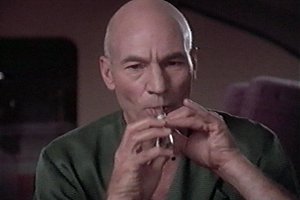
Jay Chatterly's pennywhistle flute air became one of the best remembered pieces of Trek music. Posted by Picasa
The Inner Light, The Outer Darkness

by William S. Kowinski

Update: The first and last sections that follow deal with the Climate Crisis and its outcome if we don't meet this challenge. For a practical and hopeful view of how things might be changed, there's a new Rolling Stone interview with Al Gore that makes the case better than anything I've seen.

As the first run of Star Trek: The Next Generation came to an end, fans voted for their favorite episodes. Only the two-parter about the Borg invasion, “The Best of Both Worlds,” and “Yesterday’s Enterprise” were voted ahead of “The Inner Light.” It won a 1993 Hugo Award, the first TV episode to win one since the TOS story, “City on the Edge of Forever”. In the years since, esteem for this fifth season episode has only grown. Some now consider it is the best of the Next Generation, and even the best episode of any Star Trek series.

But I’ve been thinking about it recently not because of its excellence, though I’ve always admired it since I saw it the night it first aired. I’ve been pondering it lately, and drawn to see it again on DVD, by thoughts I’ve been having about the real and fairly immediate future of the earth.

Others may be thinking about it, too, right about now. “An Inconvenient Truth,” the documentary film about the Climate Crisis featuring Al Gore, is gradually opening in more and more places. In its first week it was #11 at the box office, despite being in only four theatres. The #10 film was in 1265 theatres. A couple of weeks later, it broke into the top ten, though it was still in only 77 theatres. Its per-theatre take was higher than that of the #1 movie that week---and higher than X-Men 3. The book version is high on the best seller list. (Here's the web site.)

The future it depicts, as determined by the phenomenon known as global warming, is dire. The changes are already underway, caused by the buildup of greenhouse gases. Glaciers and icepacks in the Arctic, in Greenland, in the Antarctic are melting. They are likely to cause sea levels to rise, flooding coastal cities. They may cause shifts in major ocean currents that will in turn cause radical changes in climate. On the day I write this, a new report by the National Center for Atmospheric Research confirms that “global warming accounted for around half of the extra hurricane-fueling warmth” in 2005, so Katrina and the record hurricane year were largely a product of the Climate Crisis, and not natural variations. Storms like these are likely to increase in number and ferocity, in various parts of the world.

Heating is already changing ecologies. Various studies suggest it will bring new diseases to larger areas, change rainfall patterns and create drought in some places, if it is not doing so already. Because of time lags between cause and effect, these current effects are from greenhouse gas buildups that occurred perhaps decades ago. The planet will feel the effects of current greenhouse gas emissions in decades to come. And if greenhouse gas emissions aren’t curtailed dramatically soon (some say five years, some say twenty, but most say 10 years), the climate change may reach a “tipping point,” after which nothing can stop a phenomenon that feeds on itself until it plays itself out. The result could very well be an inexorable dying away of life on earth as we know it.

“The Inner Light” is not strictly speaking about a planet suffering from global warming. Its sun is going nova, causing a gradual global drought. The sun's flaring and dying eventually will extinguish all life. Even at worst, the actual effects of our global warming are likely to be different, especially in different places on earth. But the applicability of this story to fears for our future is inescapable.

With great and concentrated effort, humankind may be able to prevent the worst effects of global heating in the future, and create remedies for the major problems it will cause in the next few decades. It looks very much like a challenge that human civilization must meet in order to go forward.

But what if humanity doesn’t respond? What if all an individual or a family can do, perhaps living in a town outside the great places of power, is watch, measure the changes, and await the end?


The Kataan probe--yin and yang,
as above so below, the Tao of space? Posted by Picasa

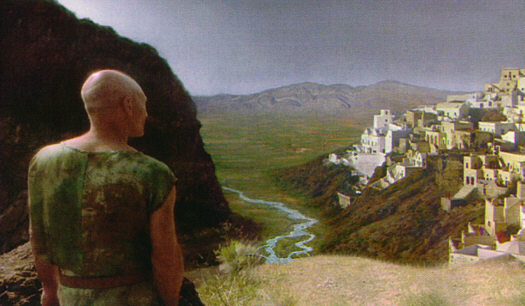
Picard gazes on the village of Ressik, paintng by Dan Curry. Posted by Picasa
The Story

On their way to report on a magnetic wave survey, the Enterprise encounters a probe of unfamiliar design that suddenly emits a nucleonic beam that knocks Captain Picard to the floor, apparently unconscious. He awakens in a strange room, wearing strange clothes, and being attended to by a strange woman, who tells him he is home.

Her name is Eline, and she insists he is Kamin, her husband, who has been ill with a high fever. Picard leaves the house and finds himself in a village square. He sees someone dedicating the planting of a tree as an “affirmation of life” during a long drought. This man is Batai, who claims to be his (Kamin’s) friend. He learns he is in the village of Ressik on a planet he’s never heard of, called Kataan.

He continues to reconnoiter, realizing he is not a prisoner of these people, but there is nowhere to go. At nightfall he returns, exhausted, to the only place he knows--the house where he woke up, and to Eline. She remains convinced he is Kamin. When he says with morbid humor that he supposes his hunger proves this isn’t a dream, she asks incredulously, “You think that this-- your life-- is a dream? “

She gives him soup, which he tastes gingerly. “This is delicious,” he says. Eline, a handsome woman in her thirties or forties, beams and says softly with delight, “You always say that.” In a look and a few words she had communicated fully her good heart, her love for Kamin, and the warmth of their relationship.

Picard gently probes for answers. He learns that Kataan is not a spacefaring planet, that Kamin is an ironweaver but prefers playing the flute. Eline shows it to him. “When did I learn to play it?” Picard asks, meaning Kamin. “I’m afraid you never did, dear,” Eline says. “You do keep trying.”

On the Enterprise, Data says that a narrow beam is now focused on the supine Captain. Picard’s vital signs are strong, and Doctor Crusher advises that the beam not be disrupted until she can figure out what it’s doing. Riker wants to identify the source of the probe.

But when we return to Kataan, five years have passed. Eline is losing patience with Kamin/Picard and his recollections of another life on a starship. “It was real,” he insists. “As real as this is. You can’t expect me to forget the lifetime I spent there.” “Yes, I can,” she says.

As real as this is—so Picard has accepted the reality of his life on Kataan, and has responded to Eline’s love. He is clearly torn by her need to have him be fully in this life, and for them to begin a family.

He also has become part of the community, and befitting his Picard personality, he has studied this planet’s drought problem and will now push for a solution. He goes with Batai to the town square to meet the regional Administrator, who is curious about the tree flourishing in the midst of drought. Batai explains that everyone contributes part of their water rations to keep it alive, as a symbol of hope. Kamin tells the administrator that their crops will die without more water, and asks for an atmospheric condenser to be built. The Administrator says it is a large undertaking, but he will take the idea to the central government. Picard/Kamin knows nothing will come of it, and tells Batai they should plan to build their own.

Later that day, hy proposes to Eline that he build a nursery. So he commits to starting a family. He has left Picard behind (even though the melody he has just been playing on his flute is Frere Jacques, which Picard sang with a group of stranded children in an earlier fifth season episode, “Disaster.”) He is Kamin now.

Kamin and son, played by Patrick Stewart and his son, Daniel. Posted by Picasa

Kamin and his doomed grandson. Posted by Picasa
On the Enterprise, Data has discovered a way to disrupt the beam. Crusher is opposed, but Riker decides to go ahead.

On the planet, seven more years have passed. With his daughter playing nearby, Kamin is presiding over the naming ceremony of his infant son by playing his flute. The melody he plays becomes the theme for the episode, and probably the best known and most fondly remembered piece of music (apart from the opening theme) in any Next Generation episode.

Kamin seems completely in this life, but as he gazes at his son (named Batai, after his friend who has died) he says words that could have come from Picard: “I’d always thought I didn’t need children to complete my life. Now I can’t imagine life without them.”

But suddenly Kamin crumples to the floor, as Picard’s life begins to ebb on the Enteprise when the beam is disrupted. Data restores it, Picard returns to normal, and Kamin’s life resumes.

On the planet, Kamin’s now-sixteen year old daughter Meribor is discussing the results of her soil samples with a now visibly older Kamin. She has concluded what he already knows: There is no bacterial life in the soil. Their planet is dying. “It saddens me to see you bear the burden of knowing things…things you can’t change,” he says. She decides that she should marry the boy who has been pursuing her “sooner rather than later.” Kamin responds with passion: “Seize the time, Meribor. Live now. Make now always the most precious time. Now will never come again.”

The Enterprise has traced the probe to its origin, to a planetary system where all life was destroyed a thousand years before, when its sun went nova.

More years pass on the planet. Kamin’s son Batai becomes a young man and wants to pursue music. Kamin blusters a bit because Batai keeps changing his mind about what he wants, but can’t deny him whatever joy he can find. “Who knows how much time he’ll have to follow any dream?”

Kamin makes one last attempt to get the now aged Administrator to listen to his findings but their scientists already know the planet is doomed, and there’s nothing they can do. Their technology is too limited for space travel. Kamin suggests sending genetic samples into space to at least preserve something of Kataan. The Administrator admits there is a plan in the works. But their conversation is interrupted by young Batai---Elise is dying. She and Kamin have a brief conversation, full of the love and domestic details of a long partnership. As a single tear escapes from the corner of her eye, she dies, and Kamin’s head bows in grief.

More years have passed. Kamin is playing with his grandson, Meribor’s child. As Meribor and Bataii try to coax Kamin into coming with them to the town square to watch the launching of a missile, Kamin confesses that seeing his grandson breaks his heart. “He deserves a rich, full life, and he’s not going to get one.”

But Kamin goes with them, and in his obstreperous old man way, demands to know what they are launching. “You know about it, father,” Meribor says, “you’ve already seen it.” It’s a probe sent out to find someone in the future who will learn about the lives on Kataan and preserve those memories.

Now in the terminally hot sun and the haze of advanced age Kamin suddenly realizes what his long-ago starship dreams were all about. “It’s me, isn’t it? I’m the someone. I’m the one it finds…That’s what this launching is—a probe that finds me, in the future.”

His friend Batai and his wife Elise, both restored to their youth as when he first saw them, explain to him the intentions of the probe. As Kamin sees the woman he loved, Picard hears her say that they have all been dead for a thousand years. “If you remember what we were, and how we lived…then we’ll have found life again… Now we live in you. Tell them of us, my darling…”

Kamin watches the rocket ascend, as Picard begins to stir on the bridge of the Enterprise. He learns that he has been unconscious for twenty-five minutes. He has lived more than thirty years of another life.

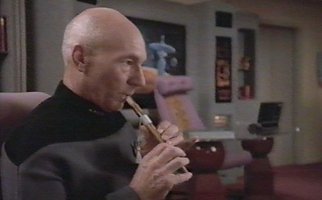
Later in his quarters, Riker tells him they have taken the probe into the shuttle bay, no longer functioning. But inside it they found a small box, which Riker gives to Picard, and quietly leaves. Inside is the Ressikan flute. Picard holds it to his heart as he takes it to face his windows into space, and begins to play the melody he composed for Kamin’s infant son’s naming ceremony.

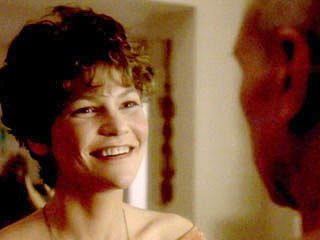
Eline, played by Margot Rose. Posted by Picasa
Inside the Magic

H.G. Wells explained how his science fiction stories worked: a plausible or at least fascinating “magic trick,” in a self-consistent world with recognizable characters. The science fiction in “The Inner Light” is a beam that causes a man to experience himself as someone else, and live more than thirty years of a life in less than a half hour in real time. This remarkable idea is both somewhat plausible (our science says that damage to the brain or electrical stimulation can alter a person’s perceptions and memories; chemicals can cause hallucinations) and intriguing, because we are all fascinated with dreams that seem to be real. We’re also especially fascinated with how we experience the passage of time, in dreams or in various circumstances in our waking life.

The “magic trick” works, Wells says, only if you don’t look too hard at it. In this case, we aren’t supposed to speculate on how a society that isn’t capable of interplanetary travel can create a device capable of projecting into an unknown being such a completely felt and experienced hallucination. Besides, in the context of a television series, we often accept any excuse to see a well-known character in an entirely different situation or life, caused by anything from fever-dreams to mirror universes.

A more serious problem would be if we didn’t believe that Picard could forget who he was, and become someone else so completely. But the careful writing and wonderful acting makes this magic trick successful---we believe it entirely. Not only was this one of Patrick Stewart’s best performances, but Margot Rose was perfect as Elise. She seldom gets the credit she deserves for the success of this episode.

In some ways, the episode harks back to the original series in its bounded simplicity. Though it is beautifully lit and photographed, and filled with scenic detail, the world we see could be physically contained on a theatre stage. There are a few rooms in a modest house, a backyard, and a town square a few yards or feet away. Except for one matte painting, that’s all we see of Ressik. So like many TOS episodes, this is more like a stage play than the usual outer space, hardware-driven science fiction.

In fact I remember being a bit bothered by this constrictedness, this seeming artificiality when it first aired. But its emotional power was always there, and the subtlety of its structure became more apparent on subsequent viewings. Like certain fables or myths, it is deft and economical in its storytelling.

As a story about Picard, it is fascinating to those who know about his past in the series, and now, to those who can see how this experience changed him, as seen in later episodes and films. The life Picard leads as Kamin is almost the opposite of his life as Picard. Instead of an explorer through space, he stays in one place, and his explorations are in time. Instead of a commander of many, with high technology at his command, he is a relatively powerless man living a modest life with very little technology. But the most important difference, of course, is that as he himself observes: Picard he had no wife or children, and felt his life could be complete without them. But as Kamin, he cannot imagine his life without his family, and the love of a partner.

That Picard experienced being a father and then a grandfather, stayed with him even after he returned to his real life. We see his longings for family recur in the feature film, “Star Trek:Generations.” There are specific echoes of Kamin’s observations in what Picard says in that film as well. When Picard learns of the death of his nephew, he mourns the loss of all the experiences the boy would have had in the same terms as Kamin mourns the lost future of his children and grandchild. And Kamin’s words to Meribor to “live now…Make now the most precious time. Now will never come again” are virtually repeated by Picard to Riker at the end of Generations.

There are echoes and references even before that, notably in the sixth season episode, “Lessons,” when Picard plays the Ressikan flute with a woman he allows himself to falls in love with, (creating a duet with her around the melody of Frere Jacques), perhaps looking for a relationship like the one he had experienced as Kamin. The realities of Starfleet and serving as officers together on a starship, however, proved too difficult to sustain that dream.

But in our time especially, more than a decade after this episode first aired, what seems most relevant about it is the situation of the planet Kataan, and Kamin/Picard’s response to it, which also involve the episode’s mysterious title: “The Inner Light.” What could it mean, and what could it mean for us now?

Kamin understands Posted by Picasa

The return: Picard and his flute from another life. Posted by Picasa
Inner Light Sources

In this episode written by Morgan Gendel and Peter Allan Fields, from a story by Morgan Gendel, there’s no internal reference to an “the inner light.” (In the shooting script, there’s some conversation before the Enterprise encounters the probe about an Admiral who liked attending the entire 9 hour “Ring” cycle by Wagner, but it has only a tenuous thematic relevance as a long story compressed into a single experience. And it doesn’t appear in the filmed story.)

The most obvious reference is to a song titled “The Inner Light,” written by George Harrison and originally released in 1968 on a 45 rpm single as the “B” side to Paul McCartney’s “Lady Madonna.” It was pretty obscure for a Beatles song--except for a mono version on a 1978 collection of “rare” tracks, it didn’t make it onto an album until 1988, and the U.S. Beatles CD “Past Masters Vol. 2” in 1990, a couple of years before this TV episode aired.

Its sound is heavily influenced by music of India, with Indian musicians and instruments recorded in Bombay (Harrison was writing in this idiom at the time for a movie soundtrack.) According to the Ultimate Beatles Encyclopedia, Harrison received a letter praising his first song influenced by Indian sitar and Eastern philosophy, “Within You, Without You” on the Beatles Sergeant Pepper album, from Juan Mascaro, a Sanskrit teacher at Cambridge University, who has translated many Eastern religious texts including the Upanishads and the Bhagavad Gita. Mascaro also sent his book, Lamps of Fire from the scriptures and wisdoms of the world, which included a translation of part of the Te Tao Ching (or Tao Te Ching) by Lao-tzu, which he apparently titled “The Inner Light.”

That particular book by Mascaro is out of print, but Verse 47 of the Tao Te Ching is the probable source for “The Inner Light” translation and Harrison’s song. Harrison uses some of the lines from this section, and adds several more verses in the same vein for his lyrics.

I always figured this song had something to do with this episode’s title, but it took a recent email from Nick Sagan to open my eyes to why. Though Nick isn’t claiming inside knowledge, he guesses this song is the source because the lyrics (“Without going out of my door/I can know all things of earth./Without looking out of my window/I could know the ways of heaven”) suggest the “ability to experience many things without actually going anywhere---and that’s what happens to Picard.”

It’s the kind of comment that has you hitting yourself in the head. Of course! While he’s lying on the floor of the Enterprise bridge, he experiences an entire lifetime on another planet.

“Arrive without traveling/See all without looking”

There’s also a melancholy comment on Picard’s life as an explorer in space:

The farther one travels/the less one knows
The less one really knows

The journey out is not complete without the journey in. But that’s just the beginning of the possible links of the title and its ultimate source (the Tao) to the content of this story. Which is not to say that the writers consciously designed this. They may or may not be surprised to learn of these connections.

For it turns out that some concept of “the inner light” recurs in many religious traditions. Quakers in particular, but other Christians as well, refer to the indwelling of the Divine as the Inner Light. When Eskimo shamans experience a feeling of oneness with the universe, it is accompanied by the flash of an “inner light.”

The Tao is considered a source for philosophies and beliefs in a number of Eastern traditions but particularly in Buddhism, and the metaphor of the inner light recurs there as well. The inner light is the experience of existence, of the is-ness of things, the Now that links the inner and the outer worlds.

I learned some of this by coincidence, for while I was preparing to write about this episode, I happened to be reading The Snow Leopard by Peter Matthiessen. Published in 1978 (and a National Book Award winner), it is his account of a physical journey across some of the Earth’s highest and most inaccessible mountains in Nepal and Tibet, which was also a spiritual journey on the Buddhist path.

Since I’d just seen “The Inner Light” episode again, I couldn’t escape being reminded of it as I read this book, especially in a passage like this: “Confronted by the uncouth specter of old age, disease, and death, we are thrown back upon the present, on this moment, here, right now, for that is all there is.”

Matthiessen expresses the Buddhist sense of the Divine in the present moment in several ways, but they eventually come down to this: “All that is or was or will ever be is right here in this moment! Now!”

To really break through to experiencing the fullness of the present moment is enlightenment in the Buddhist tradition. Picard does not quite reach such a sustained spiritual state, but at least on the level of feeling and consciousness he learns to value and cherishes the now above all else. (Picard does get closer to the Buddhist ideal of being in the moment, at least metaphorically, when he learns to “slow down time” in the film, Star Trek: Insurrection.) It is however closer to a spiritual transformation than an excuse on the level of transitory appetites and vain attempts to fill them, which is the negative meaning of living in the present.

For Picard, the solitary traveler through the outer darkness, the light of love and the inner light of living in the present moment is his enlightening experience. This willingness to live in the now also accounts for how Picard gives himself over to his new identity and life as Kamin.

He has learned as well that fulfillment does not require great achievements and honors, rank or medals, or being first in everything. He finds meaning and richness in a relatively simple life in a small village, without a lot of expensive or complicated things, among people of modesty and simple virtue. “Simplicity,” Matthiessen observes in The Snow Leopard, ”is the whole secret of well-being.”

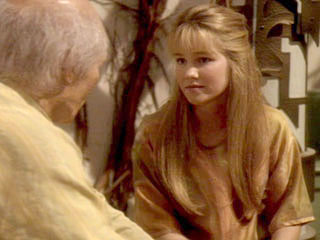
Kamin with daughter Meribor, played by
Jennifer Nash. Posted by Picasa