Monday, May 29, 2006


Leonard Nimoy joined the Mission Impossible cast for a year after Star Trek's demise. Posted by Picasa
Trekcheck: Another Impossible Mission?

by William S. Kowinski

Forty years ago a fledging “studio” formed mostly to do something with the gobs of money flowing from the most successful sitcom in television history to that point, was preparing two new drama TV series, both decidedly offbeat. One was called Star Trek (which, legend has it, Lucille Ball believed would be about the travels of celebrities) and the other was Mission Impossible.

One of them became a hit, and then was forgotten for decades. The other failed, and became a legend. The hit was Mission Impossible, and as it prospered, Star Trek’s budgets faded. The two series were filmed next door to each other, and by Star Trek’s third season, its staff was scavenging the Mission Impossible dumpster for props and material to glue together to make alien cities and starship technology. When Star Trek was finally cancelled, one of its stars got a new job immediately—on Mission Impossible.

Forty years later, the fates of the story universes these two shows spawned are again strangely related. (That actually may have begun with the second Mission Impossible movie, its story written by Ronald Moore and Brian Braga, veteran writers and producers for Star Trek: The Next Generation and subsequent series’, and writers for a couple of Trek features.)

For when it was announced that the man in charge of the next Star Trek movie was J.J. Abrams, whose first feature as a director was the as yet to be released Mission Impossible III, the fate of Star Trek became linked directly to the fate of the latest Mission Impossible sequel.

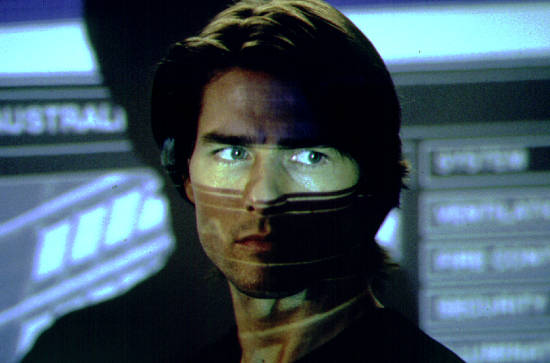
Tom Cruise in Mission Impossible 2. Was 3 not the charm? Posted by Picasa
Now MI3 has been in theatres for several weeks, and the buzz has been that it did not live up to box office expectations. Some stories, such as this one at Fox News, suggest the failure to match opening weekend expectations, and its subsequent fall-off, has induced nothing less than panic at Paramount, leading perhaps to people losing their jobs.

Other stories suggest it’s not that bad---that Paramount came close enough, and that overseas ticket sales were strong enough. Moreover, so far nobody seems to be blaming Abrams. Most fault the off-screen antics and perhaps fading box office appeal of Tom Cruise, star of all three MI features. Reviewers tended to praise the story and storytelling.

But Star Trek fans will recall the rationalizations of the disappointing opening weekend of Star Trek Nemesis, while by now the film is firmly reputed a commercial failure. While MI3 managed to stay #1 against the release of the woeful “Poisedon,” it is currently being blown out of the water by the release of X-Men 3, featuring the star of the failed previous Trek film, Patrick Stewart.

Outside of Washington, Hollywood is the prime place where perception becomes reality, however unjustified by the facts. If MI3 comes to be viewed as a commercial failure, especially within Paramount, how much money it actually makes won’t matter.

The fate of MI3 can influence the fate of Star Trek XI in several ways, but most of them wind up involving budget. Will Paramount express its confidence in Abrams and his team with the budget to do a bigger Trek film than any so far, except perhaps the first? Or is it so bad that Paramount now can’t afford such a gamble?

So did they hire a hot producer-director to do the kind of very calculated, limited budget Trek movies that previous Trek directors and producers had to make? Are they hoping he’s used to television budgets, and hasn’t been spoiled by the major money spent on MI3?

Patrick Stewart in X-Men3 Posted by Picasa
However this goes, it seems likely that the reception for MI3 has made Paramount execs a little more nervous, a little less confident, a little shakier than they might have been if it had been an unqualified hit. They can’t fail to notice that a box office record was set by a film released two weeks later ( The Da Vinci Code), a record itself broken by X-Men3. (Was there a lack of confidence already, since Paramount chose not to release MI3 on a holiday weekend, when it might go head to head with one of these blockbusters?) Even before X-Men3, MI3 had fallen behind an animated feature (with a character voiced by William Shatner---will the ironies never stop?)

It would be natural under the circumstances for Paramount to be reluctant to take chances they might have otherwise taken. While it’s pretty certain that we won’t see Tom Cruise in Star Trek XI, the perceived weakness of MI3 may have also done in Ben Affleck, if indeed he was ever in the running for a role. It’s unlikely they’ll take a chance on an actor whose previous action role (as Daredevil) was itself a perceived flop. Tobey McGuire, on the other hand, they might die for. (Star Trek does have this advantage: a lot of actors are fans.)

Casting is a big part of budgets these days, and how this film is cast may signal what Paramount is willing to spend. Assuming this is still a young Kirk and Spock at Starfleet Academy story (and recent shying away from the first press release by Abrams and others haven’t really denied this), then the star power is likely to come from actors playing the older parts: officers, teachers, mentors, etc. Though Abrams might like to field a cast of young unknowns, TV-style, this rarely works in movies, especially of this kind.

A lot will unfold in the coming months, but for now it seems like an odd kind of déjà vu in Star Trek’s 40th anniversary year: once again, Mission Impossible may be affecting Star Trek budgets, in a downward direction.

Monday, May 15, 2006


Nick Sagan's new novel concludes his triology. Posted by Picasa
Nick Sagan's new novel, everfree, has just been published--the third in a trilogy that began with idlewild and continued with edenborn. (Star Trek fans will remember Nick as a writer on TNG and Voyager.)

Nick has agreed to do an interview on this site in the near future. In the meantime, here's my review of his new novel.

Sunday, April 23, 2006


The Trek future? Posted by Picasa
The Shape of Trek to Come

by William S. Kowinski

Paramount’s announcement that they’ve hired a new production team to create the next Star Trek feature film represents the biggest change in Star Trek history of more than 40 years. With no one involved in the project as announced so far with any prior ties to Star Trek, it amounts to a revolution.

All we have so far are names: J. J. Abrams will produce and direct. Damon Lindelof and Bryan Burk, currently on Abrams’ production team for the TV series, “Lost,” will co-produce. Abrams will write the script together with Alex Kurtzman and Roberto Orci, who wrote the forthcoming Mission Impossible III with Abrams. (This Star Trek announcement seems timed for that film’s publicity.)

We are told as well that the story for the film will be set prior to the original series timeframe, about young Kirk and Spock at the Starfleet Academy and their first space mission. The movie is tentatively scheduled for release in fall of 2008. Startrek.com added rather pointedly that Rick Berman is not associated with this film in any way.

So how different is this Trek film going to be? What kind of a movie is this team likely to make? Will it have the soul of Star Trek as well as the name of the franchise?

[text continues after photo]

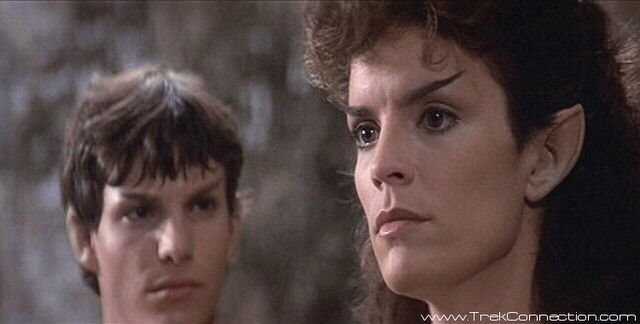
A young Spock in Star Trek III: The Search for Spock Posted by Picasa
The Revolution

Except for George Takei (who in fine Takei fashion wonders where Sulu is in this story), no one from Star Trek’s past has yet been quoted responding to this announcement. Nor have any of the new team commented on their plans (and are unlikely to, until after MI3 opens.)

But the first statement or press conference or interview from J.J. Abrams will tell a lot. Will he do or say anything that creates meaningful continuity with Star Trek past, with the Star Trek fan base? Will he hire anyone from past Star Trek productions in any meaningful positions?

He could chose not to, and risk alienating the most activist of fans--an increasingly fractious group—and relate instead to the vague fondness casual fans have for the old Star Trek, with its Tribbles and phasers, its warp speed and beaming up, its Vulcan salute, Klingons and Borg.

There’s one element of this story that perhaps does bode well for the future of this project: it was a complete surprise. There were no rumors preceding it. Arguably the many months of rumors and discussions over every element of Nemesis really harmed the prospects of Star Trek X.

But if this team does not include someone that brings continuity with past Star Trek, it will be the first such complete break in Star Trek’s history. When Star Trek went from a TV series to movies, it had Gene Roddenberry in charge (at least for the first one, and later for guidance) and the original series actors. When Star Trek added an entirely new cast in a new future, GR was the executive producer, and he created a culture of continuity that the Berman regime pretty much followed, enforced by a powerful fan base.

Now so far there’s nobody connecting Star Trek past to Star Trek future. The first press conference or interviews that the new team gives will be crucial in learning whether there will be any continuity of personnel, or how faithfully continuity will be followed, and above all the spirit, the soul of Star Trek.

Scarlett Johansson, slated to star in "Amazon" Posted by Picasa
The New Team

J.J. Abrams---producer, director, co-writer—will have more power over Star Trek’s future than anyone in its past, perhaps even including its creator, Gene Roddenberry. At least for one movie.

Who is Abrams? At 40 years old (in June), he is currently a very hot commodity. He created two hit TV series, “Lost” and “Alias,” when TV dramas are losing audiences to so-called reality shows. Paramount is apparently pleased with his work on Mission Impossible III, even though the film hasn’t yet been released.

MI3 is his first film as a director. It’s a big budget movie, with a high-powered cast. His past work as a writer for film, however, has not been especially distinguished. On the plus side, he’s been versatile: writing action, drama, comedy and romantic movies. But few of these films were successful, or critical favorites.

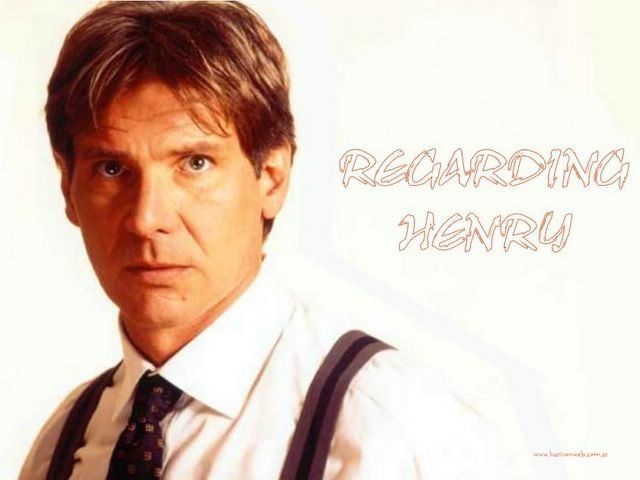
He wrote the screenplay for Armageddon (1998), generally considered the lesser of the two asteroid-threatens-earth movies of that year, starring Bruce Willis. He co-wrote a 2001 drama about a psycho killer (Joy Ride), an obscure comedy (Gone Fishin, 1997) for Danny Glover and Joe Pesci, a romantic drama (Forever Young, 1992) for Mel Gibson. Though it was not particularly successful at the box office, his one gem was Regarding Henry in 1991, which featured one of Harrison Ford’s best performances (and just guessing, I’ll bet one of his favorites.)

Abrams also created the TV series about college students, Felicity, that ran 4 years on the WB cable network, and a 2005 pilot for a series about bounty hunters (The Catch) which was not picked up.

His writing partners for Star Trek XI, Alex Kurtzman and Roberto Orci, who worked with Abrams on MI3, have worked together before. They co-wrote the sequel, The Legend of Zorro (2005), which didn’t measure up critically or at the box office to its predecessor, The Mask of Zorro. They are writing partners on two films slated for release next year, The Transformers: The Movie, and Amazon (Orci is also a producer of this film, to star Scarlett Johansson.) The actual status of these two projects is unknown.

But perhaps most interesting is their early TV work: both wrote for the Kevin Sabo Hercules series, and Orci wrote for its companion series, “Zena, the Warrior Princess.”

All in all, I find more to worry about that to celebrate in the prior work of this team. They certainly are experienced at writing sequels, and working with established characters and fictional worlds. But they’ve never worked with a fictional world as complex, and as dependent on concepts and its internal history, as Star Trek.

If you are concerned about Star Trek continuity, about its history of the future and the key concepts that are crucial to that history, you have to worry about the casual attitude towards history and continuity in the groundbreaking Hercules and Zena series. Their playful use of anachronisms—of very contemporary dialogue and character attitudes in an ancient setting, their casual mixing of periods and places, myth and history in incorporating real historical figures—was a great part of the charm of these shows, and what made them different. But though a vein of knowing humor did work well for the last 3 or 4 TOS cast features, a casual attitude towards Star Trek’s past could play havoc with the Star Trek universe, as created and preserved in 40 years of film, tape and print.

My own perhaps obsessive fear about new Star Trek---that it will use the characters and the Star Trek universe as nothing more than a setting for an action move, a feature film video-game (or video game commercial) —is not exactly assuaged by what I know about this team. Abrams is reputedly a Star Trek fan, but on what level? Treating the Star Trek universe and Trek characters apart from the soul of Star Trek instantly makes it something else. And the revolution becomes an assassination.

Maybe they have the chops to really add to Star Trek not only with good storytelling, with action and adventure, character interplay and development, but by advancing elements of the Star Trek story that articulates its ethos, its view of the future and of the human potential. Or at least, not trashing what Star Trek has come to mean to so many people about a path to a hopeful future. Regarding Henry tells me that’s possible. Armageddon and Zena make me wonder. The idea of Transformers: the Movie makes me cringe.

Harrison Ford in "Regarding Henry" Posted by Picasa
Academy Days

There’s a lot of fan debate over whether Star Trek should be going back to pre-original series days for the next film. The idea for a Starfleet Academy film featuring the young Kirk and Spock goes back to another period in which Trek’s future was in doubt after a perceived box office failure, right after Star Trek V. Harve Bennett’s initial proposal was for a story about racial prejudice against Spock but wrapped in a flashy package: the Star Trek version of Top Gun.

More recently William Shatner has pushed for such a concept, and is apparently writing a series of Star Trek novels with this theme. So far, he does not appear to be involved in this project.

According to one story, the Bennett proposal was revived a few years ago, but when it was sent to Rick Berman, he allowed it to be transformed into the Romulan War prequel that was recently axed. There was at least one other project that at least somebody was actively pursuing, a mixed-cast movie set in the 24th century, led by the Next Generation crew. Patrick Stewart was approached, and there were rumors about Shatner’s involvement in a Mirror Universe story.

I admit to a continuing desire for the 24th century story, though I see Q as the catalyst. Although not a lot of fans agree with me, the Mirror Universe concept worked only in its first original series appearance. (I really despised what Enterprise did with it.) But there’s no indication we’re ever going to see the Next Generation crew again.

So what about this Academy concept?

While fans speculate on who might be the younger Kirk and the new Spock, it’s worth remarking that an academy doesn’t have only students---it has teachers. The teachers in the Harry Potter series, for example, are nearly as important as the students in those stories. I expect that there will be at least one older character, a teacher, a mentor, who will be important, and I expect also it will be a big name star. The Harry Potter films again show this potential.

Looking at who Abrams has worked with before, several older stars could be possibilities: Tom Cruise (star of MI3 and the original Top Gun as well as Speilberg’s War of the Worlds) is an obvious choice, perhaps as a flight instructor. Bruce Willis and Mel Gibson are other stars to consider. They no longer carry movies as they once did, so being part of a Harry Potter-like ensemble, or even being the only box office star in the movie, might be attractive.

But the established actor I’d most like to see would be Harrison Ford. As mentioned above, Abrams wrote one of his best movies, Regarding Henry, though it was utterly outside the action genre. But Ford would be a perfect mentor for a young Kirk, with his borrowed flash from his Star Wars and Indiana Jones characters. There is also Spielberg’s new association with Paramount, and Ford is close to him and his associates.

Regarding Henry is an overlooked but quite good movie, interesting in Trek terms because of its theme: a greedy mover and shaker is shot in a robbery, suffers brain damage, and begins life over again as an apparently mentally impaired person, but he turns out to be more loving and more ethical, tuned into the basic values of life.

I’ve said before that while Star Trek often dealt with the perils of power, Dr. Who often dealt with the perils of greed. Star Trek did deal with greed now and again, especially TNG, but this is an opportunity to deal with it more directly. What if resurgent greed on earth threatens the Federations principles?

Or we could see a good classroom scene, in which a professor argues for the rationale of the prime directive, of reversing the history of exploration always also meaning exploitation.

I've only mentioned male stars, but there's potential for established female stars, not just as cadets but as instructors. It will be hard for any writers to resist creating yet another beautiful woman who is quite hopelessly in love with Spock. On the other hand, it might be fun to see young Kirk as a disaster with women. The series hinted he was a more of a scholar than a young Ulysses.

We might even see as an instructor, perhaps in Federation and space law, the descendent of Denny Crane, as played by William Shatner. What a moment it would be if he watches the young Kirk and observes, I don’t know why I like that kid. And another teacher offers, maybe you see in him something of yourself.

Villains? Klingons perhaps. Though something internal to the Academy would be more imaginative.

Perhaps Abrams experience with the college series, “Felicity,” will help with creating a believable Academy. I’d be surprised if we don’t see young Kirk as a solo pilot of some fast space vehicle. I’m certainly not worried that this team will shirk the action adventure. Abrams seems capable of handling character and basic storytelling. My question for them as for anyone: are they going to make a movie with Star Trek-named characters that deletes the soul of Star Trek? Are they going to keep Star Trek in the science fiction of consciousness, or toss it whole into the easy category of commercialized unconsciousness, a big budget exploitation of 40 years of meaning as well as entertainment?

Obviously we won’t know for awhile. But we may get some clues from what Abrams and company say in the coming months.

There is also a remote possibility to consider: since these guys were so good at keeping this a secret until the recent announcement, could the Starfleet Academy scenario be an elaborate deception to keep this movie a surprise, and not what they’re planning at all?

Friday, April 21, 2006

The Big Announcement

Paramount has announced its plans for the next Star Trek feature film, slated for 2008 release. It's a story that's been picked up everywhere---Google even lists Pravda. So check your favorite Trek news source for the few details available so far.

I'll post my thoughts on the news, the new team in charge, and the announced theme of the movie, within the next day or so. Probably it will be dated Sunday, though it could appear as early as Saturday morning.

Monday, April 17, 2006


The Tom Baker Dr. Who with Dalek costars Posted by Picasa
Trek Who?

by William S. Kowinski

A story at SyFy Portal last week provided a few new details about the Erik Jendresen script for Star Trek XI, and some confirmation of previous stories about its fate, namely that it has been shelved, at least for the moment.

It was indeed a prequel about the Romulan War, which Jendresen reveals was designed as the first of a trilogy, to fill in the century between Enterprise and Captain Kirk.

As much as some fans would like to see a Romulan War film, the idea of a trilogy is daunting. There is only so much you can do in a trilogy: Romulan War followed by The Romulans Strike Back and Return of the Federation? It’s a three act play basically.

Steve Krutzler at TrekWeb wrote about the SyFy Portal story, and added his own comments to the effect that a prequel is a bad idea for re-starting Star Trek, unless perhaps it’s some version of the Starfleet Academy idea with a young Kirk and Spock, first proposed by Harv Bennett, but lately the basis of a William Shatner story.

This ignited a debate at TrekWeb about the future of Star Trek---should it go back to a prequel, or forward past the events of Star Trek Nemesis, in the 24th century or beyond?
Should it involve known characters, and if so, the actors who played them? Could other actors play Kirk and Spock, like several versions of James Bond? Or should Trek be re-imagined, as Batman and Superman have, several times?

It’s a fascinating debate, and I’m not ready to come down at any point on the timeline, but I will offer these thoughts about the re-imagining option, or as some call it, the reboot.

Superman's true origins: comic books. Posted by Picasa