Saturday, December 24, 2005


Merry Christmas, Happy Holidays! Posted by Picasa

Tuesday, December 13, 2005


The unknown possibilities of existence... Posted by Picasa
Light for a Cloudy Star Trek Future?

by William S. Kowinski

It’s been an eventful couple of weeks for Star Trek news---some hopeful, some disconcerting, some just confusing. Much of it suggests more questions than answers.

Some of the news seems to come from the gradually unfolding consequences of both the end of the Star Trek franchise as we’ve known it for some 20 years, and of the latest corporate changes for Paramount. In the world of Star Trek, Decipher, the company that published the Star Trek fan magazine since 2001, announced it was closing down its publishing and the Communicator with it.

Then Paramount announced its Digital Entertainment division was also shutting down, which put the future of the official site, Startrek.com in doubt.

Both moves seemed related to the splitting of Paramount and Viacom into two separate entities. With Paramount in charge of movies and Viacom in charge of television (and books), nobody seems to know who will be in charge of Star Trek, and its future movies and television, if any. (So far, there hasn’t been a disruption at Pocket Books/Simon & Schuster, which does Star Trek books. They’re part of Viacom.)

Then came the startling news that Paramount is buying the studio Dreamworks SKG, which means among other things that Steven Speilberg will be making movies and developing projects for Paramount. His science fiction blockbuster of last summer, War of the Worlds, was a Paramount and Dreamworks co-production.

Like the rest of this news, the most that can be said now about the Paramount deal is that it could be good for Star Trek, or it could be bad. It could mean a more powerful and aggressive Paramount, with new producers and directors of some clout and taste, with experience in successful sci-fi features. Or it could mean that the Trek franchise gets lost amidst bigger deals and priorities.

There seems to be hope that the apparently bad news for the Communicator and Startrek.com will have a happier ending. Larry Nemecek, managing editor of the Communicator, is convinced his magazine will continue publishing, but is being affected by the Paramount/Viacom confusion. In the meantime, Eugene Roddenberry has indicated interest in Startrek.com.

What apparent good news there was had to do with the potential eleventh Star Trek feature film. Within a couple of days of each other, news stories quoted Patrick Stewart as revealing that he had been part of serious discussions about a new Trek film to be made a couple of years from now, and Bryan Singer (director of the first two X-Men films, and the upcoming Superman Returns) indicating his interest in directing the next Trek movie.

These two stories immediately reminded me of Leonard Nimoy saying that whenever Star Trek has looked absolutely dead, it always came back, stronger than ever. Since the hard fate and bad feelings of Star Trek Nemesis, it seemed the chances for a new movie were slipping away, and even if there was one, it certainly wouldn’t be another Next Generation film. Patrick Stewart in particular insisted that he was finished with playing Jean-Luc Picard.

So what does this mean? I don't really know, and I have no inside information. But I can tell you what my instincts suggest to me.

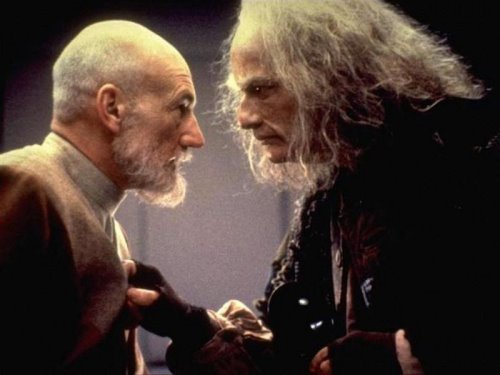
Back in the saddle again? Posted by Picasa
I ascribe a lot of credibility to Stewart’s statement. First, he seems to have said it to two reputable sources, and he was very positive and very definite about it. It also has the smell of credibility because I believe Stewart genuinely wants to make another Star Trek picture. His protestations about playing Picard again seemed like a reaction to Paramount’s evaluation of Nemesis at the box office, and probably to how he and the cast were treated. There was trouble brewing even before the picture hit the theatres, with Paramount’s surprise “A generation’s final journey begins” tag line.

And in the many months since, Stewart has spoken with affection for Star Trek and particularly his fellow cast members. He mentioned bursting into tears while rehearsing his final “farewell” scene with Jonathan Frakes as Riker, in Nemesis, and much later, crying uncontrollably when he channel surfed into a showing of Nemesis on television, because he missed his friends and their work together.

Contrary to the suggestion by some cynical fans, he wouldn’t be doing it so much for the money---or even for Star Trek---but to work with these dear friends again, in the world they created together. (Anybody who thinks Patrick Stewart works only for money might consider the 16 months he’s devoting to doing nothing much but acting for the Royal Shakespeare Company’s amazing series of the entire Shakespeare canon of plays.)

Bryan Singer’s expression of interest in directing a Trek movie, on the other hand, should be taken with a grain of salt. It could be interpreted as simply his own fantasy, and nothing new at that. Like any Trek fan, he has ideas of what he’d do with the next movie. But on the other hand it could be more than that, in which case, keep that salt to put on the popcorn.

Even though it may have been a purely speculative remark to a fan, this has to be taken a bit more seriously because of Singer’s relationship with Stewart (after Singer directed Stewart in the second X-Men film, Stewart got him a bit part in Nemesis---which Singer points out was on the Enterprise bridge during a battle---the kind of thing a fan would point out.)

But even if there’s not much chance of Singer actually making a Trek film, his interest could very well send a message to Paramount: hey, this A List director of franchise films is interested in making a Trek movie. Maybe it’s worth doing. Maybe other A List directors would be interested.

For instance, the one you just got under contract.

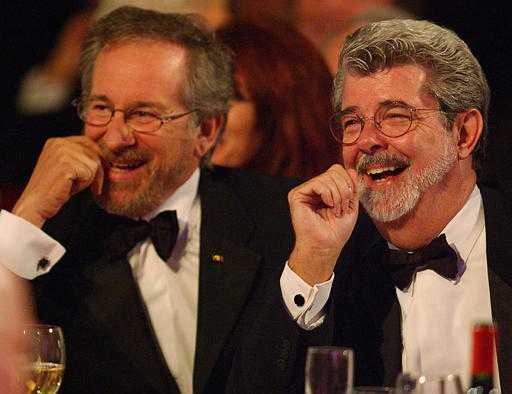
Could Spielberg at Paramount be good news for Trek XI?  Posted by Picasa
The idea of Steven Spielberg making the next Trek film may or may not be a good one for Trek, but it sure would get Paramount moving. Spielberg as producer might be even better.

And this high level interest would be welcome all around. Patrick Stewart refuses to overtly blame the director of Nemesis for its failure, but others in the cast haven’t been so shy. Several have been outspoken that director Stuart Baird didn’t compensate for his lack of knowledge of (or interest in) the Trek universe with sparkling storytelling and mesmerizing visual style. And there was the questionable selection of scenes, which Baird at least had a hand in. Even Stewart once suggested that the DVD for Nemesis should have an Actors’ rather than a Director’s Cut.

But what about the Trek XI we’ve been hearing about from Rick Berman? It’s supposed to be about the beginning of Star Trek, before the time of Enterprise, and have no one from previous casts in it. That would include, one assumes, Patrick Stewart.

Then there’s the little mystery of why Stewart decided to announce this now, when he said these meetings (with “money men” involved )took place something like four months ago. He hasn’t exactly been silent and invisible all that time.

My guess is that Berman’s Trek: the Beginning is dead. And maybe Berman and Stewart know this now, and so Stewart felt he could talk about that meeting four months ago.

I'm guessing as well that there have always been at least two approaches being discussed, though Berman and his regime may have been aware of only theirs. I recall rumors some months ago that Jonathan Frakes had met with people Paramount about the next movie. The speculation then was that he was being considered as director for Berman’s project. Maybe so. But maybe not. Maybe he was part of these other discussions.

If someone or ones with the power to push Paramount’s buttons decides that the problem with Nemesis was the director, the release date, whatever. And that Enterprise proved that a new Trek crew in a new Trek universe is riskier than using a universe and crew with proven popularity--- then this other project may be getting the upper hand.

And perhaps not only Stewart and Berman but the announced writer, Erik Jendreson, knows this now. In any event, he has recently signed on as writer and producer for a new television series, which would pretty much preclude his continuing participation in a Trek project.

My further guess is that it is not exclusively a Next Generation project, but is akin to John Logan’s idea for Trek XI that he talked about in an interview I unfortunately can no longer find, before Nemesis was released. If I recall correctly, he was proposing a lighter tone, and a story involving characters (and actors) from more than one Trek TV series. So this would involve Picard and other Next Gen characters, but not only them.

Jean Luc and Denny Crain Kirk? Posted by Picasa
Lots of people play the game of “what should the next Trek movie be?” I played it in some emails with Nick Sagan. I’m not going to tell you his ideas, because as a former Trek writer and producer, and the author of two terrific sci-fi novels and one more soon to come, he is in a much better position to actually sell his approach.

But I’ll tell you mine. It’s a premise and an approach, not yet a story. The premise is that some members of all the Enterprise crews suddenly disappear (not all of them—just the ones who agree to be in the picture.) They reappear on one of the Enterprises---perhaps Archer’s, perhaps Picard’s. They don’t know why. Until who should appear in their midst, but Q.

Next Gen movies have needed Q for some time, in my opinion, and he’s the perfect rationale for gathering available major Trek actors for this movie. (It would have been a perfect 40th anniversary premise, by the way.) Even DS9 and Voyager actors could be included---all of them have been on one Enterprise or another, even for transport or a tour.

The premise is that the universe is very confused, something major has happened to its very fabric, and even Q is confused. He tried to turn to Picard and his Enterprise to help him sort it out, but the space-time continuum is in such flux that he grabbed people from several Enterprises over several hundred years. Furthermore, he got some of them long after they retired (Captain Kirk, anyone?) and perhaps even some at a point in their lives before they served. Or, perhaps in the case of Kirk, they’re snatched from alternate timelines.

But the essence is Picard and Q solving the problem of what’s wrong with the universe, with the able assistance of Kirk, Archer and whoever. (In terms of casting, an additional beauty of this premise is that everybody doesn’t have to be in the whole movie. There could be surprises throughout.)

The approach to the story I would like to see does not involve the political emphasis of latter Trek, or big space battles that would turn Trek into another adjunct of video games, but a return to what was promised in Next Gen’s final episode.

Remember what Q said at the end? “That is the exploration that awaits you! Not mapping stars and studying nebulae, but charting the unknown possibilities of existence!”

I’m not talking about either psychobabble or technobabble. I mean an exciting, challenging story that involves concepts that arise from the latest ideas in quantum physics and related fields.

The truth is that for all its advanced technology, the Star Trek universe is basically Newtonian, with a lot of technobabble tap-dancing. Gene Roddenberry went for ideas and for nourishment to scientists as well as technicians, and it’s time that Star Trek went back to sources like that for new ideas.

So---where do I sign?

UPDATE 12/15/05: Ain't It Cool News and TrekWeb are reporting a story that apparently originated at Canmag.com that indeed the prequel story for the next film is dead, and that the new film is to feature Picard, Kirk and Archer. But the setting is to be the Mirror Universe, which is not an idea I find appealing at all. It was badly done on Enterprise and I wasn't fond of the DS9 attempts I saw either. (The original series episode worked but only as a self-contained allegory.)

Anyway, I hope this "news" didn't originate with this site, because it was all speculation and proposal here.

Wednesday, November 30, 2005


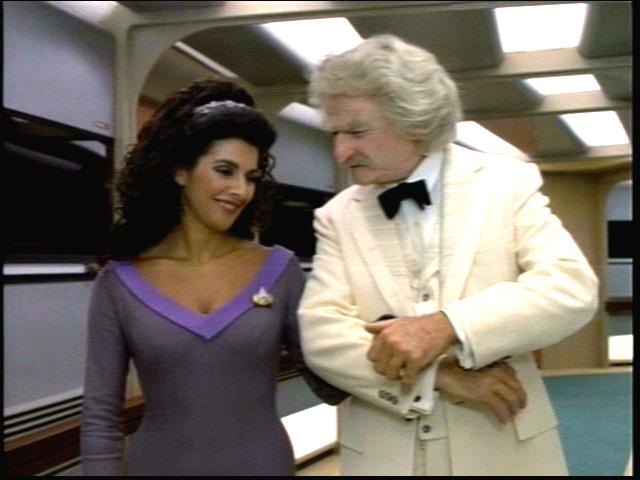
Mark Twain, whose Connecticut Yankee woke up in the future, finds himself aboard the 24th century Enterprise. "I guess the future turned out pretty well." Posted by Picasa
Looking for Star Trek, High and Low

(Along with the Beatles, Herman Melville and Harry Potter)

by William S. Kowinski

Science fiction writer Bruce Sterling has a fascinating new non-fictional but still scientific book called Shaping Things (M.I.T. Press), which should be of interest to anyone into design, the future and the interface of information technology and the stuff in our lives. Plus it’s very short.

This isn’t about Bruce Sterling, however. It’s been inspired by an “endintroduction” to his book by Peter Lunenfeld, editorial director of Mediawork, the outfit that puts out this series of little books. He starts off: “I was mulling over Shakespeare’s observation that the future is an ‘undiscovered country.’ No, that’s not true; I was watching late night cable and stumbled across one of those forgettable Star Trek films from the 1990s, with that phrase in the title.”

We’ll overlook the slight to the films, and mention that he was of course referring to Star Trek VI (which I’ve conveniently just posted an essay about, here.) Lunefeld goes on to say that then he “remembered that Shakespeare wasn’t referring to the future, he was referring to death. Actually, that’s not true either.” He looked up the phrase on the Internet, and got the “proper context from Hamlet” which he swears he actually did read, but long ago.

His conclusion, and presumably the reason for mentioning all this, was: “This mix of the high and the low, the dread and the absurd, constitutes the future, and that’s what this Mediawork pamphlet is about.”

It’s also an aspect of the future that Star Trek had a hand in creating, and that it embodies. Especially the “mix of the high and the low.” And that’s a very good and very necessary thing.

Before we go on, a brief commercial message: you'll find a Powell's Bookstore box on this page. You can use it to search for new and used books. If you order anything after linking from here, this site gets a cut. Thanks.

Now back to the show...

Star Trek VI had Chagall, Sherlock Holmes, Cold War history,
Peter Pan and of course, Shakespeare in the original Klingon. Posted by Picasa
Lunefeld felt this was worth mentioning because for awhile now there’s been a cultural separation between what is perceived as popular art or entertainment, and what is ritually considered high art. The difference between pulp science fiction and Literature, say, or rock and classical music, TV drama and Greek drama, and…Star Trek and Shakespeare.

For example, a new biography of the Beatles was just published---it’s almost a thousand pages long, with a hundred pages of footnotes, a scholarly tome and, according to the New York Times review, very well written. The review authors expressed wonder at how things had changed since the early 1960s: “Rock 'n' roll was considered marginal and disposable; the way to learn about its practitioners was to scour fan magazines or pore over sparse album liner notes. When the Beatles began, it would have been unthinkable to read a well-written biography about rock 'n' roll performers that was as serious and thoroughly researched as an important book about Faulkner or Picasso or Mao. For better and for worse, the Beatles changed all that.”

So in its way did Star Trek. It was just a television drama, just science fiction, and dangerously close to a kids show--- the combination was about the lowest you could go. Star Trek became a serious part of the culture the same way the Beatles did---by becoming very popular and making a lot of money for a long time. But like the Beatles, in other ways as well.

(Before we get too far away from the Beatles biography, it’s worth saying that I’ve thought more than once how sorely we lack a really good biography of Gene Roddenberry by a trained biographer or journalist, not either a show business friend or a show business enemy. His authorized biography is respectable, while the other more scurrilous one basically repeats every grudge anyone had against him. There are lots of points of view in lots of books, but no means to figure out what’s what. Evaluating information objectively and placing it in an historical perspective in a biography like one on Faulkner or Picasso or the Beatles has yet to be accomplished.)

In "The Naked Time," George Takei used his
fencing lessons with the man who taught
Erroll Flynn in 'Robin Hood.' Posted by Picasa
Like the Beatles, Star Trek rebelled against various high art traditions while it absorbed and used elements of that tradition. In Star Trek’s case, it was the form and content of story.

In a general way, Star Trek was part of several storytelling traditions: literary (both the supposed low form of science fiction, and the higher forms of classical literature) and dramatic. Science fiction, which began (with H.G. Wells, at least) in the late 19th century era when literature in the form of the novel was a primary popular storytelling form, was in Wells’ hands (and those who followed him) a ready-made way to bring classic literary ideas into the present, and forward to the metaphorical future.

As television drama, Star Trek was in a long line of literary and dramatic adaptation, or theft. Crucial to its creators were the movies. Everyone from GR to Leonard Nimoy and William Shatner had movie palace matinee memories. When George Takei got to display his previously nonexistent swordsmanship in “The Naked Time” episode of the original series, he was thrilled because he loved Robin Hood---not from reading the stories but from the movies. (He loved the Erroll Flynn classic version and when he sought fencing lessons, he happened to wind up learning from the man who taught Flynn for that very movie, and who did Basil Rathbone’s sword-fighting in the film itself.)

From the original series episode, "Who Mourns
for Adonais?" about Apollo as the last Greek god.
The title is that of a poem by Shelley, mourning the
death of his friend, poet John Keats. It's worth a look. Posted by Picasa
So Star Trek took plots and ideas from everywhere, from a submarine movie to Joseph Conrad, from Captain Video to Shakespeare. Viewers even got a taste of what classic Greek theatre was like, because (as William Shatner said) the budgets were so small they were essentially putting on plays, but plays with meaning, like the Greeks did. Much of the cast in both the original series and TNG were theatre trained. If a writer suggested a classical allusion, they knew how to play it.

It truly was in the 60s, with the Beatles and other popular music, with Star Trek and a few other TV shows, that popular art and entertainment reinterpreted high art forms and narratives, and made them more accessible. Like those old Classic Comics books or movie versions, they also became conduits to the classics themselves. They made them relevant and easier to approach. They provided a kind of introduction. And the classics, in turn, illuminated aspects of a Star Trek story or a Beatles tune. Bob Dylan learned from an established (if notorious) poet like Allen Ginsberg, and Ginsberg recognized in him his successor.

In fact, ideas, encounters and engagements relevant to the times were more likely to be found in pop culture than in high art, and were accessible to more people, particularly the young.

Practitioners in forms old enough to be high art forms, like the novel, also became underground and popular successes dealing with ideas and issues that seized the imaginations of a popular or cult audience. A lot of young people got turned on to mystical and Eastern religious thought by J.D. Salinger and Jack Kerouac. Joseph Heller, Kurt Vonnegut, Doris Lessing and others became both popular and cult. They also turned readers on to writers they admired and emulated.

There was so much energy in popular forms in the 60s—in music, movies and television as well as more experimental theatre, novels and poetry---that a fair number of young people who’d majored in English literature became pop culture commentators, rock critics, film and TV reviewers and pop journalists. Who also played in a band, or made super eight movies.

So the cross-fertilization became pretty natural, and pretty healthy. Thanks as well to wide availability of paperback books, old movies on TV and foreign and experimental films on campuses, people began to make their own explorations, perhaps to go where no one in their families or neighborhoods or high school had gone before.

You could start anywhere and get everywhere, as the cross-fertilization of popular and high art continued. Leading to situations like: my Moby Dick story.

Khan channelling Ahab--He tasks me, he tasks me but I will have him. Posted by Picasa
I first encountered Moby Dick in high school, in a long dense passage about whales in our American Literature anthology. All we were supposed to know about it, though, was that the white whale was a symbol. Even though I was a literature major in college, I never had to read the whole book; I just had to know a little about Melville, and generally what the established critics said about Moby Dick. There were plenty of other books I had to read. I never got around to that one.

But sometime in the mid 1980s my curiosity was piqued and I found my paperback copy (because as a lit major it was more important to have the book than to have read it) and began reading. I was astonished. The language was rich and crazy, like Shakespeare disguised as a mad sailor telling strange sea tales.

Then I came upon a passage in which Ahab talks of chasing Moby Dick “around perdition’s flames,” and then his expression, “he’s tasks me,” and then the “I spit at thee” speech, and somehow it seemed I read it all before. Or heard it. And then I realized---it was Khan.

This may not be a surprise to you, but trust me, this was an authentic personal discovery. Apart from the common theme of obsession, at that point I knew of no connection between Moby Dick and Star Trek II, which I had only seen once or maybe twice in a movie theatre. (It wasn’t until I saw it on video that I noticed the copy of Moby Dick in Khan’s empty quarters---with the same cover as my paperback.)

Of course the irony wasn’t lost on me---instead of this literature major picking up a literary allusion in a popular movie, I’d spotted Melville plagiarizing from Star Trek. (It was a couple of years later, when I was definitely on a campaign to read all the really long novels I’d always meant to read but didn’t, that I spotted the name “Yoyodyne” in a novel by Thomas Pynchon---and immediately remembered it from one of my favorite recent movies, Buckaroo Banzai.)

This reverse derivation is a somewhat surreal but quite lovely experience, showing the vitality of both the popular and classical art in a two-way relationship across time. That so many young people now may be discovering, for instance, how many classical composers have stolen from John Williams and Jerry Goldsmith and the other composers of orchestral soundtracks, is a deeply cultural experience, and a very hopeful one for holding on to the threads of the best content and practices, from past to future.

This two-way relationship is pretty widespread by now. At the memorial for GR, Patrick Stewart (who quotes---actually misquotes—lines from Moby Dick in First Contact) mentioned that someone had written to Rick Berman to point out that Captain Picard reading a copy of the Homeric Hymns (at the end of the TNG episode, "Darmok") had probably made “more people curious about that literature than at any time since their creation!”

I can recall more than one discussion of the epic of Gilgamesh in a Star Trek forum, including some very moving summaries of the story. A few months work of TNG episodes and viewers could see entire scenes from Shakespeare acted, meet Mark Twain and Jack London in 19th century San Francisco, hear discussions of Jung and Euclid, see Data reenact Sherlock Holmes in Victorian London, and watch Einstein play poker with Newton and Stephen Hawking.

Star Trek was among the first to include some of the spirit and meaning from the classics, as well as bits and pieces and allusions. Now there are other conduits for elements and values derived from “high” culture, especially for the young. Like Star Wars, and Harry Potter.

This two-way transport is even easier these days, thanks to DVD, video cassettes and the Internet---practically the whole culture, high and low, is easily available, a lot of it for cheap or for free.

But people don't have to seek Star Trek out---it remains more frequently present on TV sets all over the world. Several generations have learned from these Star Trek stories by now, have confronted the same ethical questions and choices, asked the same important questions about mortality and meaning, the past and the future, that the best literature and drama, philosophy and science also address. And come to their own conclusions.

At the same time, Star Trek put them in the context of a romantic but believable future, when confronting these issues was part of this believable journey. The application of the past to the future would run through our present as we watched. Later, curiosity about the classical roots or source of some element of the story could lead to discoveries that enriched the episode or movie on the next encounter.

Star Trek has been a bridge to these ideas and to appreciating these works, since it began. That’s become more valuable and more important as time goes on, and our culture sinks into a dull morass, where intelligence is stereotyped, and curiosity is nearly extinct. That’s why I consider Star Trek fans among the true elite.

"Star Trek appeals to a higher denominator,” Harve Bennett once said. “ It appeals to the imagination, to the mind."
Star Wars and Harry Potter may be the champs of myth
these days but Star Trek had its moments, as in
the TNG episode, "Masks." Posted by Picasa