Friday, September 02, 2005


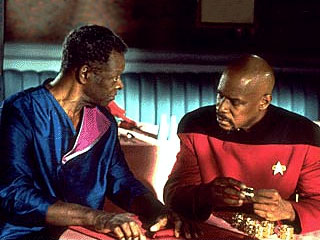
Joseph and Benjamin Sisko in Star Trek's 24th century New Orleans Posted by Picasa
Star Trek and New Orleans: What Bettering Ourselves Really Means

by William S. Kowinski

In the Star Trek universe, New Orleans is a vibrant city in the 24th century with strong ties to its past. Captain Benjamin Sisko, commander of Deep Space 9, grew up there, and for his first few weeks at Starfleet Academy, beamed back for dinner with his family there every night. Viewers saw him return there several times over the years to the Creole restaurant of his father, Joseph Sisko. The elder Sisko was a symbol not only of the continuity of family through the generations—from Joseph to Benjamin to Jake Sisko, Star Trek’s first three generation family—but his restaurant was a symbol of old values and culture that were still important, still necessary in the Star Trek future.

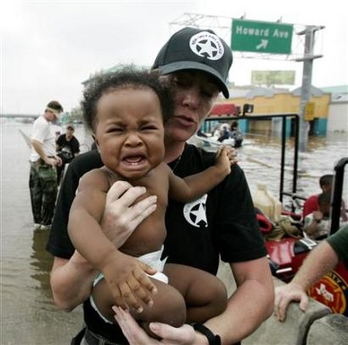
We are reminded of this not only by the recent death of Brock Peters, who played Joseph Sisko, but most of all by the incredible devastation in New Orleans during the last week of August 2005. At this moment, officials are trying to completely evacuate the city. They estimate it will be weeks or months before some of its residents can safely return (others have no homes left to return to), and years before the city can rebuild. Huge amounts of toxic industrial waste carried in the floodwaters may be very difficult and very expensive to eliminate. There is even some question whether the city will be habitable in the foreseeable future, and some have suggested it be totally abandoned.

Many people around the world are shocked by what the media is reporting about New Orleans and the other areas in several states where the powerful hurricane Katrina caused major destruction and death. The sheer power of the storm leveled entire areas of the cities it hit directly with the full force of its winds. Deaths were in the hundreds, and the counting has only begun.

For awhile, it seemed New Orleans was spared the worst because Katrina was not at its full strength and didn’t hit the whole city directly. But some of the levees gave way, that held back flood waters from the nearby lake as well as the ocean and the Mississippi river, and some 80% of the city was seriously flooded.

There had been enough warning for many people to leave the city before the hurricane struck. But many people—perhaps several hundred thousands---could not leave, because they couldn’t afford fares or didn’t have cars, and no provisions were made for evacuating them. Hospitals, nursing homes and other care facilities were not all evacuated, and there was no provision to evacuate people with physical disabilities and frail older people who lived in private homes.

By August 31 and September 1, the enormity of the catastrophe was becoming clearer. Hundreds and perhaps thousands had died in New Orleans by then. Those stranded in the city were without safe or adequate shelter, food and water. Toxic chemicals and human remains in the flood waters threatened outbreaks of serious diseases. Government response was slow, and planning had obviously been seriously inadequate. Anger, desperation, confusion and violence in New Orleans were reported and seen on television all over the world.

Many countries, and many organizations and individuals around the world offered assistance, and there are no doubt Star Trek organizations and Star Trek fans among them. The stories of individual courage, generosity and empathy are just beginning to be told. But a basic humanitarian impulse is not the only emotion likely to be evoked among Star Trek fans by this catastrophe.

text continues after photo

New Orleans 9/01/05 AP Photo Posted by Picasa
In the Star Trek future, the Federation and Starfleet recognize the common good as a guiding principle. The common good has several aspects. That which we hold in common, including our interrelationships, are part of it. We are dependent on each other, and on our community and our planet. The diners in Sisko’s restaurant eat because someone caught the fish from waters that were protected from pollution and other kinds of damage, even far away. People acting cooperatively got the fish from where it was caught eventually to the restaurant. Other food on one diner’s plate may come from many different places, and involve hundreds of people. Each process requires using infrastructure that everyone shares, like roads and water pipes. Each of those people are dependent on others for what they need---for daycare when they’re at work, for health care.

The common good is everyone’s good eventually. But the common good goes beyond interrelationships that benefit each of us directly. The common good means the good of the community, the society, the human family, and all of life. This is part of the value of Infinite Diversity in Infinite Combinations. Diversity means many talents and perspectives, many potentials and many skills, which makes us more capable and adaptable, and it makes life richer.

Diversity is a value of soul. In the Star Trek original series episode, "Is There in Truth No Beauty," Miranda’s parting words to Spock are: “The glory of creation is in its infinite diversity…” Spock completes the thought: “…and in the ways our differences combine to create meaning and beauty.”

There is no contradiction between diversity and individuality: in fact, they are the same principle. The meaning of diversity is to honor and benefit from diverse individualities, and to do so by getting beyond superficial prejudices, because of color, physical abilities and appearance, class, gender, etc. to the soul within, and the unique contributions of each.

Similarly, there is no contradiction in principle between the common good and the individual. The American Experiment has always been about valuing both, and finding ways to deal with the areas in which they might conflict, for example, through laws and the Bill of Rights.

There is no contradiction between private enterprise and government. There is only what’s appropriate for particular aspects of the common good. This was recognized in recent history in the US, although it has perhaps been forgotten here since at least the 1980s.

(The role of money in the Star Trek future is a somewhat separate question, though not in ours. But private enterprise in some sense must exist in the Star Trek 24th century, because Sisko’s restaurant appears to be much like a privately owned and operated restaurant today.)

Because the Federation values the common good in the Star Trek future, we would not expect them to provide for the privileged few but ignore the many, or especially to ignore the disadvantaged few. We would not expect them to neglect the good of the city the people hold in common. And if they did, Captain Kirk or Captain Picard or Captain Sisko would call them on it.

There are several theories being debated now concerning why planning and prevention for the New Orleans catastrophe were so poor, and why relief efforts have been so slow and meager so far. They also bear upon the Star Trek future, and what that future represents in how humans bettered themselves.

After Katrina AP Photo Posted by Picasa
There is one persistent and not very pretty theory as to why the poorer residents of New Orleans were left exposed to the catastrophic results of the hurricane, and why there was not more urgency in rescuing them. It is, the theory goes, because they are poor, and largely African-American.

In Star Trek lore, the choice of New Orleans as the home of Star Trek’s first African-American captain was probably not accidental. New Orleans is one of the greatest sources of African-American culture, and as the place where the great gumbo of jazz music was cooked up and sent to northern cities, it is a major source of American culture, as it has grown here and as it is known around the world.

The blues of New Orleans also were a major source for rock music, which itself has combined with other forms in other cultures. This connection was made more poignant when Fats Domino, one of the pioneers of rock and roll from New Orleans, was found among survivors in New Orleans several days after the hurricane.

The Mississippi River ends there, and the music of all the rivers that flow into it came to New Orleans, like Appalachian mountain music with some of its origins in the British isles. It is an ocean port, once held by the French, and a place where French Canadians from Nova Scotia came as exiles, and brought their music. Perhaps the most underrated musical influence is American Indian (the in-“jun” in Cajun) but it is clearly present in the blues as well as New Orleans jazz. And of course, the music of Africa that came with the slaves to this slave ship port.

As Michelle Erica Green points out in her column on Star Trek and New Orleans here, the ethnic mix of New Orleans includes English, Spanish and Caribbean Islanders, and there have been new immigrants in the area from various parts of Asia and the Middle East.

This was diversity that combined to make meaning and beauty for all the world. But it is also heir to a century of slavery and several centuries of racial prejudice. It wasn’t over when Louis Armstrong couldn’t play with white musicians. It wasn’t over when Nichelle Nichols, touring as a singer, was refused hotel lodgings.

All that is apparently gone in the 24th century. But even though it takes less obvious forms, it is not gone in the 21st.. Applied to the issue of New Orleans now, it is worth considering it as a component. The only way to combat unconscious racism is to raise the question, and make the possibility conscious.

Sisko's in Star Trek's 24th century New Orleans Posted by Picasa
There is another factor that seems to have contributed to the ongoing catastrophe, besides a weak sense of the public good and the role of governments in it, and perhaps a prejudice or blindness that leads to neglecting the poor and the sick and non-whites. Though it is different from them, it is related.

It is the failure to plan for the future. Star Trek fans are used to seeing Starfleet officers gather in the observation lounge or at Starfleet headquarters to describe an anticipated problem, suggest ways to solve it, debate those solutions and develop a plan. In fact, lots of science fiction films---even not very good ones---often show scientists and government leaders coming together to discuss a future threat and then devote whatever resources are necessary to combating it.

That doesn’t seem to happen often enough in our time. Scientists and engineers have known for years how vulnerable New Orleans is to hurricanes and floods. It’s been written about in the National Geographic and elsewhere. New Orleans lies below sea level; Sebastian Junger (author of “The Perfect Storm”) speaks of the sensation of looking up to see oil tankers on the river above.

The levees protecting the city were built to withstand a category 3 hurricane, when the stronger category 4s are less common but still expected, and the category 5 is always possible. The federal government under the current administration cut back funds to complete needed work on the levees. (This is one possible way the resources devoted to the war in Iraq also was a factor. Most controversial is that nearly half of Mississippi’s National Guard is in Iraq, as is more than a third of Louisiana’s, including the 3,000 member brigade with the kind of equipment most needed now in New Orleans.)

Moreover, other problems were known: for example, the city was protected by outlying wetlands, but as a result of development they have been shrinking and weakening. This exposes the city to more of a hurricane's power.

But what is most tragically apparent is lack of preparation. There apparently were no emergency plans or provisions in place for what scientists said was the most likely natural catastrophe in the US. There especially was no plan, and there were no resources provided, for evacuating New Orleans, other than telling people with the means to leave, when to leave.

Mr. Spock would find this illogical, and it’s likely that most Star Trek fans would agree. But even if a human propensity for denial, and the inefficiencies and illogic of bureaucracy are factored in, the reasons for this failure to plan for the future are still incomplete.

Planning for the future requires more than the know-how and devoting some attention to more than today. Planning for the future requires that you care about the future. It is an act of compassion, not only for people of the present and the present world, but for people in the future. That necessarily means all the people of the future.

This requires commitment to the common good, not only of now, but of the future. It requires commitment to diversity not only of the moment, but of posterity.

This basic principle does not require a leap in human evolution. It may have been the human species greatest advantage. Anticipating the future and planning for it is a chief rationale for human cultures. Even traditional cultures hand down their traditions because they fervently believe this is the way to live and approach the future.

It is, after all, one of the great traditional cultures of America that gave us a profound guide to thinking about the future, in the Great Law of the Haudenosaunee: “In every deliberation we must consider the impact on the seventh generation to come.”

Anticipating problems and preventing them almost always is less difficult and less costly than trying to rectify the damage. Yet anticipating future problems also means devoting resources in the present to something that may not happen, and therefore may not be necessary. In a present-centered culture, this is very difficult politically.

So in this sense, to go forward is to recover an aspect of cultures of the past. Even now, there may be a residual sense that our leaders and governments should take responsibility for at least preventing predictable near-future catastrophes, and certainly be prepared for emergencies that may never come. Reponse to the New Orleans catastrophe may tell us what this culture expects in its leaders and institutions, in taking responsibility for the common good, and acting responsibly for the future.

But even that is not quite enough. We need to anticipate and plan more positively, for the common good and the common future. This is an important role for Star Trek and Star Trek fans. The future depends on establishing cultures that not only consider the impact of present actions on the future, but actively believe in the future as a value and a priority.

This is a role for Star Trek viewers because they have seen this better future--that is, they have seen what it could be. They have participated in it through the imagination of those who created Star Trek and their own imaginations as viewers. This is also an important process in learning empathy, compassion and concern for the common good, as well as concern for the future. Drama makes the future real now.

If we can create a culture that cares about the future, perhaps our 24th century will also have a vibrant, diverse and connected New Orleans in it, where Starfleet officers can touch earth again, grasp the reality of the human family and the generations, while savoring some Creole cooking created before their eyes, but with an age-old recipe, and ageless care.

Wednesday, August 24, 2005


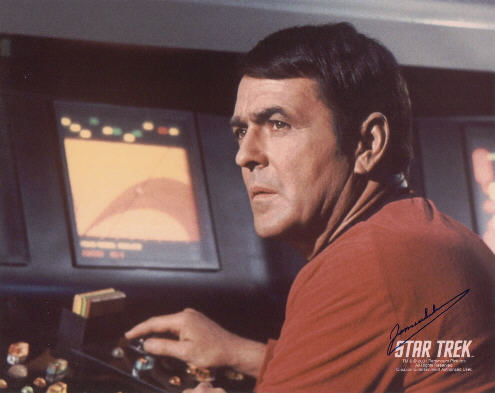
past and future hero of a present mythology of the future: James Doohan as Scotty. Posted by Picasa
Star Trek: A Mythology of the Future

by William S. Kowinski

“We’re here to remember one of the heroes of the Scottish culture,” begins Black, festooned in a red Enterprise uniform T-shirt and speaking in a Glaswegian burr, as he takes the microphone. “Cmdr. Montgomery Scott—Scotty.”

A ripple of laughter washes through the audience at the pub. Black pauses in mock ignorance.

“Why are you all laughing?” he ask mischievously.”

“Pub Pays Tribute to a True Scot—Canadian James Doohan”
by Jane Ganahl, San Francisco Chronicle, Aug 23, 2005.


Most myths are set in the past, implying that the age of heroes and defining deeds is in the remote long ago. This is especially appropriate for certain kinds of myths, such as explanations of how the world or a people came to be; the foundation stories of a culture.

But in the modern era, a belief in progress through time made myths of the future possible. There is also the sense of a challenging future shaped by changes we can’t really foresee. This is especially true about the far future and the “final frontier” of outer space, which adds the dimension of territory unknown to us, and probably filled with immense yet not completely defined dangers, as the great oceans and the lands beyond them were in the past of many cultures on earth.

The future, and outer space in particular, create conditions that encourage new mythologies---that may even call for a mythology of the future, to give us some framework for conceiving how humanity can see itself in this future.

Still, when such a mythology exists in the present, it can cause some confusion and, let’s say, temporal anomalies. When a contemporary man named James Doohan died, something of a hero in his own right as a severely wounded veteran of D-Day, the character he is best known for playing is suddenly the center of a controversy: where in Scotland will Montgomery Scott be born in several hundred years? Three cities want to claim him now, and erect a plaque in his honor. According to the SF Chronicle’s Jane Ganahl, it’s led to “quite the tempest” in Scotland’s press.

But this temporal oddity only emphasizes an important feature of mythology: whether the heroes and events described in the myth are said to be in the past or in the future, the mythology is very definitely in the now. It is the effect on the present that makes myth important.

This is especially relevant to America, where Star Trek itself was born. Native American cultures have many stories of their past. But as a nation, America has few. Because our age is characterized by looking ahead, and because the future has always been essential to the American identity, our culture is also defined by myths of the future. It may well be that our foundation mythology is the mythology of the future.

But just because the future and outer space furnish the occasion for myth, and our culture has the need, doesn’t mean such myth will emerge. If the Star Trek saga is that mythology of the future---and no other story or set of stories has a better claim---it is only because of all the things it did right. Many of these elements were carefully thought through, some the product of apparent accident, some of a special time, some of artistic responses to the times and to the exigencies of form and business, some to inspiration, talent, intelligence and soul, and much which can be essentially attributed to love.

text continues after photos

To think like a hero... Posted by Picasa
What’s Mything in the Present?

What can mythology mean when it’s applied to the future? It depends on what mythologies represent in the present.

Some believe myths are to cultures what dreams are to individuals. The literary critic Northrup Frye says this explicitly: “Ordinary life forms a community, and literature is among other things an art of communication, so it forms a community, too,” he writes in "The Educated Imagination." “In ordinary life we fall into a private and separate subconscious every night, where we reshape the world according to a private and separate imagination. Underneath literature there’s another kind of subconscious, which is social and not private, a need for forming a community around certain symbols….This is the myth-making power of the human mind, which throws up and dissolves one civilization after another.”

But if myth is a reflection, an artistic retelling of a culture’s dreams, it later functions as a kind of guide. We emulate heroes of our myths. There’s a fine example of how this works in a Star Trek novel, “Gulliver’s Fugitives” by Keith Sharee. On a world where products of the imagination are illegal because stories are not factual, a rebel group of readers and storytellers hides in caverns below the surface. But these people do more than read and memorize the old texts to preserve them, as in Ray Bradbury’s classic story, “Fahrenheit 451.” Each becomes a character, a mythic hero. Their leader is Odysseus. He takes on the characteristics of the Greek hero, and Counsellor Troi spots him going through rituals to reinforce his identity as Odysseus, though he was a minor government functionary in his previous life. (It’s title also refers to one of the mythological frameworks consciously used in Star Trek, Jonathan Swift’s “Gulliver’s Travels.” But more about that later.)

For it isn’t just Star Trek fans who emulate their heroes, who even don their costumes and speak their words. This in one way or another is how myth works in many cultures. Nor are the Star Trek fan fictions something new under the sun; ordinary Greeks told each other stories about Odysseus that Homer never wrote.

That's really what all the attention to "franchises" is eventually about, and the expectations of merchandizing and business synergy: the hope that the core story takes on a life of its own as a living mythology. As creator of "The Simpsons" and "Futurama" Matt Groening observed in an interview, "Audiences expand the mythologies of a creator's world." His first example is Star Trek.

Broadly speaking, myths are stories that help people find meaning in their day-to-day lives. It may be the arc of the story—some people believe a governing American myth is what’s called the Horatio Alger story: “Strive and Succeed.” (The H.A. stories themselves are more complicated, and more like mythic stories and fairy tales; the hero often succeeds by a fortunate encounter, with the help of a mentor, a king or a Merlin of big business.) Or it may be a figure in the story we recognize, that defines our view or relationship with, for instance, the Mother or Father, and gives a resonance, a depth it didn’t seem to have. It may simply validate what we felt but didn’t realize.

But the most familiar response is emulating the hero. It doesn’t have to be the singular or main hero, either. Lots of mythic tales are about groups of heroes, each with a special skill. There are a lot of mythic tales in various cultures that are their versions of the Fantastic Four or the crew of the Enterprise.

Mythic heroes inspire people to emulate their qualities or some aspect of their behavior in their own lives. Someone doesn’t have to dress up as Odysseus or Athena (or even in the soldier's uniform) to emulate bravery, and they don’t have to go to war or the hunt in order to be brave in their lives. Just as it’s not necessary to wear Vulcan ears to examine whether words match actions, and consequences match intentions “logically,” or to honor diversity. And no one has to wait for 24th century medicine or society to learn from watching Dr. Beverly Crusher how a woman might handle being a professional, even a doctor, while being a mother on her own.

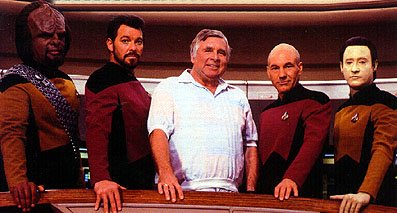
Myth provides us with archetypal characters we can use to define ourselves as our age and roles change. You can start by identifying with Harry Potter or Herminie Granger, and later identify with Dumbledore. In Star Trek, Gene Roddenberry personified aspects of himself and the idealized self in Kirk, Spock and Bones. Later he more consciously reflected on his feelings and aspiration as a boy with Wesley Crusher, and his older self in Captain Picard, a combination Hero and Wise Old Man.

In the blizzard and excessive speed of everyday life, beset by time and emotional demands, in a culture that offers only suspicious guidance, we need to find our heroes. "One must think like a hero,” wrote May Sarton, “to behave like a merely decent human being."

a mythology of change Posted by Picasa
Star Trek As Myth of Change

Myth often expresses or supports the values of a culture. That’s somewhat true of Star Trek, but as a mythology of the future, Star Trek has a very striking feature that no Star Trek in our future should neglect: it is not afraid to offer an alternative to values and resulting behaviors that predominate in the present.

For example, Star Trek challenges our culture’s assumptions about the defining role of money. It’s become almost a truism that the most vibrant myth-making in America and perhaps the western world comes from popular culture: not just the comic book superheroes, Disney revisions of old tales, or even the temporary heroes of the TV show or movie that seems to capture the spirit of the moment. The writer Ken Kesey claimed that the mythic hero of America was Superman.

But our mythology is also at least as powerfully represented in television commercials as in the programs. One of the myths of our culture is that money and consumption are the key to happiness. Star Trek provides an important alternative to this, as we’ll explore in more detail in a later installment.

But the primary alternative vision Star Trek makes into a mythology is the nature of the future itself. Star Trek presents a view of the future that opposes the apocalyptic visions that were prevalent when it began, and may still be. I’ve used part of the following quote before, but to me it’s a perfect summing up of that aspect of Star Trek’s approach.

Mike Malotte, Commander of Starfleet (or president of the International Star Trek Fan Association), was on the phone to me last summer describing the kind of visions of the future that prevailed before Star Trek. They were “about people who weren’t on earth because they were either escaping it, it was so overpopulated and polluted that people couldn’t live on it, or it was a charred cinder because we’d screwed ourselves over. Gene’s Star Trek was really the first science fiction show of its time that showed a future where, hey! We actually learn from our mistakes, and we bettered ourselves, and we banded together and we headed out for the stars.”

We would expect our myths of the future to express difference, because in our society we expect change. But most projections into the future foresee change only in technology, and not in how it might be used differently. To see humans changing themselves, and being changed by the encounter with the immensity of space and a diversity of other intelligent beings, is a rare, valuable and essential aspect of the Star Trek mythology. There will be more precise speculations about how this was accomplished in future installments.

Myths live also because they are good stories: people want to hear them, they want to know what happens next. And there’s one kind of mythic story that our age responds to best.

the human adventure on the final frontier Posted by Picasa
Whatever Comes

Missing from most discussions, scenarios, studies, predictions and even most stories concerning the future is one essential ingredient: adventure.

The word derives from the Latin, ad venio: whatever comes. Whatever the future is, it’s coming, and going out to meet it in a spirit of adventure is very human, and very attractive.

“The oldest, most widespread stories in the world are adventure stories,” writes Paul Zweig, beginning his book The Adventurer, “about human heroes who venture into the myth-countries at the risk of their lives, and bring back tales of the world beyond men.”

Right away, the adventure story recognizes a world beyond the ordinary human world, whether it is the world of nature or a supernatural world---and in many stories, it’s both at the same time.

“Our modern disregard for adventure reveals how thoroughly domesticated is the view we have come to take of our human and cultural limits,” Zweig comments a little later. “Man, we have decided, is the laboring animal whose ability to create value depends upon his infinite capacity to buy and to sell: his time, his work, his very life.”

Part of this view, Zweig says, is to consume adventure stories as nothing more than unimportant entertainment. But the soul seeks adventure, and adventure nourishes the soul.

When adventures become personally and culturally important, when the imagination goes on that journey, they become mythic. Such adventures take us out of the ordinary, even if they are inner explorations. In terms of the future, outer space is the vast unknown that symbolizes future possibility, but it is fascinating in itself: full of untold wonders.

Adventures of the past took heroes into magical forests, across oceans to strange islands, through jungles to hidden cities, atop mountains where monsters lived, and into the underworld. Where else on earth is there to go?

“We’ve now conquered the planet so there are no empty spaces for imagination to go forth,” Joseph Campbell told Bill Moyers. “One of the wonderful things I think about the adventure into space is that the narrator, the artist, the one thinking up the story, is in a field that is not covered by our own knowledge. Much of the adventure in the old stories is where they go into regions that no one’s been in before.”

Campbell, who shaped many of our current ideas about myth, may have been something of a story consultant for George Lucas and Star Wars. But when he talks about the adventure in outer space, he echoes Star Trek.

This is appropriate. Star Wars is a kind of illustrated monomyth (Campbell’s description of what hero myths of many cultures have in common). The Star Wars saga is terrific and resonant storytelling with moral application to our world and even to our future, but it does not claim to be about the human future.

While many other adventures, before and since, have used outer space as their landscape, they have not really explored that other “undiscovered country---the future.” They often place contemporary figures in space, which in the best of these stories also has resonance, meaning and application to the present, and encourages viewers to identify with the characters. They have aspects of myth. But they are not mythologies of the future.

What it means to be human...James Doohan receives his star, in the company of friends Posted by Picasa
Deep Impact

In the recent past, the word “myth” was used to denote a story that isn’t true, usually an “unscientific” superstition. But when Picasso said that “art is a lie that tells the truth,” he describes the mysterious power of imagination and story. Fiction and myth tell many truths on many levels. (And it’s now become fairly fashionable to point out instances where old stories or myths, like many American Indian stories, apparently describe actual historical events, like earthquakes and volcanic eruptions, but in metaphorical language.)

Myth uses the language of symbol and what Carl Jung called “archetypal,” or relating to deep forms in the psyche. We respond to archetypal images instinctively—“They impress, influence, and fascinate us,” Jung writes. Archetypes ”can therefore manifest itself spontaneously anywhere, at any time.”

When a particular mythology is truly alive in a culture, those symbols and archetypes are felt, not necessarily noticed. And even the storytellers are only partly aware of them. The unconscious may be less than conscious, yet provides us with intuitions and insights and information that usually escape consciousness. That’s where myth operates.

Yet myths are primarily stories, set in a particular time and place, with an audience usually of a particular culture. Those first audiences understand the nuances and details that often are lost on later audiences, or on people in different cultures. The stories we’re told in school are great myths may seem confusing, even nonsensical (so the way “myth” is used to mean something fantastically untrue). When there’s little to relate to, they even seem boring. We can’t figure out why they’re supposed to be so great.

But to understand how those first audiences responded to these stories, you only have to listen to fans talk about Star Trek. They know the meaning of the smallest references, the history of the characters and their relationships, what the technologies do and don’t do, and so on. The Star Trek universe is alive to them, just as the mythic worlds were alive to their first audiences.

The experience of early audiences to old myths was probably even richer, especially in traditional cultures that changed slowly, for their lives and ways likely weren’t very different from those in the story. They also probably understood the symbols and the meaning of behavior better, because those symbols and those clues to behavior were still alive.

Mythical stories are full of wonders, rich characters and breathtaking plots. Within them is comedy, tragedy, romantic love, melancholy, hilarity, villainy and nobility, earthy events, and mystery and magic.

They are about the great mysteries of life and death, the questions of will and freedom and fate in the lives of gods and humans, and the roles and stations in life in a given society. They may speak a rich language of suggestion, allusion, symbol, metaphor and ambiguity.

They can be about creation, destruction, the human virtues and, quite often, human weaknesses that lead to sorry ends. Through their explorations, both outer and inner, they are eventually about what it means to be human. This is another identifying feature of Star Trek. It seemed to be Gene Roddenberry’s chief obsession, and his insistence on specifically exploring this question in the early episodes of Star Trek and The Next Generation, set the template for the whole Star Trek saga.

It’s no wonder that Star Trek fascinates those who study mythology, as literature and as psychology. Myths speak to the soul about the soul, and about the soul of the world.

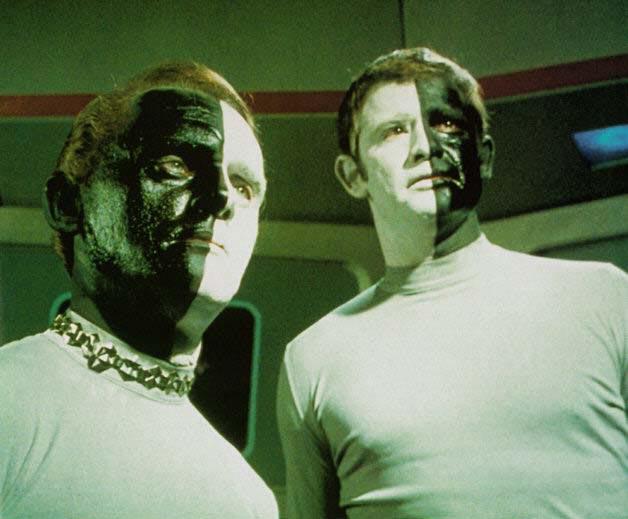
Allegory of racial prejudice and its consequences: "Let This Be Your Last Battlefield" Posted by Picasa
Where the Star Trek Myth Begins

It’s unlikely that Gene Roddenberry and the other creators of Star Trek set out to create a mythology. But they were people who wanted to say something, who wanted to live in the universe of stories, and given the requirements of our culture, who needed to make a living.

The Star Trek mythology has its own creation myth. As Gene Roddenberry told it, by early 1964 he was frustrated because the television networks wouldn’t let him openly write about contemporary issues for television series drama, specifically the series he created and produced, “The Lieutenant,” which was set in the present.

But what if he could do it through disguise? “I recalled that when Jonathan Swift was writing Gulliver’s Travels, he wanted to write satire on his time,” Roddenberry said later. By setting his adventure in Lilliput, “he could talk about insane prime ministers and crooked kings, and all of that…Children could read it as a fairy tale, an adventure, and as they got older they’d recognize it for what it really is. It seemed to me that perhaps if I wanted to talk about sex, religion, politics, make some comments against Vietnam and so on, that if I had similar situations involving these subjects, happening on other planets to little green people, indeed it might get by. And it did.”

This feature of Star Trek’s storytelling---the allegorical or metaphorical dimension—became a major part of its identity. Many years later, Roddenberry described his realization that he could do what Swift had done as a kind of religious experience.

There were many mythologies and stories that influenced the Star Trek saga. But Gulliver’s Travels was an important one in many ways. According to Desilu executive Herb Solow, he and Roddenberry worried about how to get TV viewers to believe in the reality of this strange new universe of the future. In addition to their many efforts to create and show a plausible future, Solow suggested a narrative tactic he remembered from “Gulliver’s Travels.” These experiences among fantastic societies no one had ever seen were described matter-of-factly with the vocabulary of a traveler’s report. Because Gulliver talked about them as if they had already happened, it suggested to readers that they should accept these events as having happened. Solow advised they use this approach for Star Trek. Even though the events were to take place in a future inaccessible to the viewer, they could be presented as stories or reports related by a narrator who had already experienced them. This became the subtle tactic of the “Captain’s Log” that began episodes, and also provided useful for exposition and reminding viewers what they’d seen before the commercials.

But according to Solow, he and Roddenberry talked about Swift’s book so much that for a brief moment, they were going to call this new series, “Gulliver’s Travels.” But Swift didn’t invent this kind of story, where there is a second meaning or application beyond the literal events of the tale. Allegory has a rich literary history. In medieval Europe, it was consciously used to synthesize the classical tales of Greece and Rome with Christianity, and to show connections between the Old and New Testaments of the Bible.

Allegory was used in 5th century works like “Psychomachia” (meaning “Soul War”), in which the characters were personified qualities, the virtues of Hope, Chastity and Humility in battle against the vices of Pride, Wrath and Avarice. The moral dimensions beneath the literal remains a feature of many allegories, though the literal story is likely to be told through recognizable and individual characters.

In Star Trek, allegory is most obvious in the original series, when the crew encounters beings on “the planet of the week” that create moral dilemmas or reveal aspects of humanity in contrast to the beings and situations the Enterprise encounters. Sometimes the allegory’s application to contemporary issues is overt, as in the famous episode on racial prejudice, “Let That Be Your Last Battlefield,” with Frank Gorshin as an alien whose face is half white and half black, out to kill his counterpart who he marks as evil because his face displays these colors on opposite sides. When these stories work, they are exceptionally powerful.

But most of the best Star Trek stories have an allegorical aspect, even in later series when the accumulated Star Trek universe itself became the ground of their reality. Various interpretations and applications of these “meanings” are often what Star Trek fans discuss, and argue about passionately. They, too, are essential to Star Trek’s nature, and its soul.

But allegory is not just a separate technique or a historically defined kind of story. Allegory, as C.S. Lewis noted, “belongs not to medieval man but to man, or even to mind. It is of the very nature of thought and language to represent what is immaterial in picturable terms.” Neuroscientist and literature professor Mark Turner believes that the kind of thinking exemplified by allegory, which he calls “conceptual blending,” is basic to human thought and language.

Modern allegory has less of a one-to-one correspondence, a single image or character with a single meaning, as the 5th century allegories did. But it is another aspect that allows the reader or viewer to participate in the myth, by seizing an underlying meaning or application to contemporary concerns, and by identifying with the characters and situations, however alien they are on the surface.

Roddenberry expressed his delight that network censors didn’t see this aspect of Star Trek---but from the beginning, its fans did.

GR and associates set out to create a saga of adventure stories, and allegories within them. GR in particular was consciously trying to create a plausible but alternative vision of the future. But their first task was to successfully do this according to the story genre they were using, which was science fiction, and the story-telling form: the television drama series.

Intention is one thing, execution is another. How did they get all this to work? More on that story---on Star Trek as drama, television and science fiction---next time.