Sunday, November 14, 2004


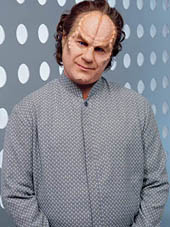
Is that a Denobulan at the coffee machine? Posted by Hello
A Visit to the Enterprise set

While I was in Los Angeles on assignment to the New York Times, to cover the Planet Xpo "Beam Me Up Scotty One Last Time" convention for a story on Star Trek's future, I visited the set of the only ongoing project in Star Trek's present: the Enterprise series.

After a morning on the phone trying to straighten out my Internet access, I arrived at Paramount lot later than I'd expected, in early afternoon. It was a bright day in late August, a bit cooler than usual for this time of year I was told, but pleasantly warm for a resident of a far northern California coastal climate. I drove through the Melrose gate, got my guest pass, and after the trunk of my rental car was inspected I found a parking space in a guest lot, which happened to be next to the Roddenberry building.

My destination was the Dietrich building, where I was to meet David Sperber, public relations for Enterprise, and John Wentworth, head of Paramount marketing and a Star Trek veteran.

For several weeks as I started this story, I had trouble getting Paramount to respond to my requests for information and interviews, and a couple of interviews I scheduled without them were cancelled (Garfield Reeves-Stevens even called me to tell me that he couldn't call me until I cleared it through Paramount.) But when John Wentworth got involved, everything went much more smoothly, and I talked to everyone I requested in the time I had remaining.

John and I had spoken a few times on the phone, and he set up several interviews. In the course of one early conversation, I mentioned that had just taken another look at a tape of the Star Trek 30th special and had seen his name in the credits, which seemed to startle him. He was with Rick Berman when I interviewed Berman by phone. When I asked Berman whether there were plans for anything relating to Star Trek's 40th anniversary ("Oh, God," was his response), John told Berman that I'd spotted his name at the end of the 30th anniversary show.
"John Wentworth was actually working on promotion in the very first year of the first series back in 1966," Berman said in his usual authoritative tone. "That is not so true," I heard Wentworth say in the background. "I don't think he was born," Berman added.

But Wentworth was in a meeting when I arrived, so David Sperber called over to the Enterprise office to see if we could go on the set. It turned out that David was new to the job, and this would also be his first visit to the set. He said we'd be meeting Donna Rooney of the Enterprise staff, who would show us around, and that Manny Coto would be joining us as well.

I'd interviewed Coto on the phone a few days earlier. I'd read his interview with TrekWeb and noted the hopeful response online to his vision of Enterprise as a true prequel series, and his enthusiasm for Star Trek in general. Since by journalistic tradition you can't quote someone from another source, I had to get him to say essentially the same thing to me, which he did. It was a short interview because Enterprise was going to be just a small part of my article, so meeting him would be a bonus.

Maybe this is where I should inject a personal note. I approached this story as a professional, with objectivity to maintain and a mandate from my editor to fulfill. My demeanor kept everyone guessing. They probably knew what I've come to know: that the world is sharply divided between Star Trek fans and people who don't get it, who have little more than contempt for Star Trek, if not all of science fiction, etc. I think the fact that I am ethical, and that I'm not interested in scoring points at anyone's expense, yet I take my professional responsibilities seriously, came through in my first contacts and interviews. But they didn't yet know that I'm a Star Trek fan.

But I also wasn't just another journalist when I visited Paramount: I was the New York Times, one of the more powerful newspapers in America. I'm freelance but I've worked for the Times before, and I knew what this meant. Usually I got more access to higher level people than I did working for other newspapers and magazines. So while I was doing this story, and especially on this day at Paramount (and later at the convention), I was treated well. Not only did I get access, information and my questions answered, but everyone was friendly, and all my jokes were funny and my insights profound.

Some of this was a little different than in other situations, so I began to see what it meant that the people who work on Star Trek are loyal to each other, even a kind of family. I did get the feeling of being accepted, and of people being interested in me personally. I attribute some of this to my intelligence and charm, and of course my modesty. But I never forgot that I was there because I was the New York Times. In other words, I was Cinderella, and midnight would come when the story was published, and my luminous New York Times halo vaporized and I became the raggedy man back in the street looking for work.

So I don't know if Manny Coto was coming along only because I was the New York Times or also because something in our interview piqued his curiosity. It didn't really matter. I was interested in meeting him, both for the story and for my own curiosity.

David Sperber commandeered one of those golf cart vehicles used on the Paramount lot and we headed for the Enterprise offices. He wasn't real experienced at this task either, and we took a circuitous route with some blind alleys and odd looks from Paramount security. But when we stopped at our destination, there standing on the corner were two men and a woman. One of the men was LeVar Burton.

Strictly speaking, this Paramount visit was more for background than an essential part of my story. But it always pays to go look at things. And ironically, this visit would provide the only hard news in my article. Minutes before, LeVar Burton had just agreed to direct the third and concluding episode in the mini-arc that featured his Next Gen colleague, Brent Spiner. So I was the first to report this.

I had interviewed Burton already. I requested an interview through his publicity agent, and one afternoon I heard the phone ring. My partner Margaret (who teaches drama at Humboldt State University) answered it and told me, "It's for you. I don't know who it is, but he has a great voice." It was LeVar Burton calling from Martha's Vineyard where he was on vacation.

Now I introduced myself in person. He remembered that I was going to the Scotty convention and said he wasn't going to be there after all. He'd been announced as a guest at the celebrity dinner honoring James Doohan. Burton's wife was having minor surgery that day. "Tell Jimmy I can't make it," he said, or ordered, or requested. I knew already that because of James Doohan's precarious health, access would be strictly limited, and I wasn't even going to attempt to get an interview. But I said I'd get the message to him, and I did (through Jimmy's son, Chris Doohan.)

I met Manny Coto and Donna Rooney, and after LeVar Burton left, the four of us set off in the cart. (There are seats in front, in back, and a jump seat area behind that.) Coto began riffing on the way over, with an irreverent sense of humor not so apparent in his interview mode.

We stopped near a small door in a large building, with several trailers semi-permanently parked nearby. The second half of the day's shooting was about to start. We walked out of the bright sunshine into a series of narrow dim corridors that surrounded some of the standing Enterprise sets. In a slightly larger area there were a series of food wagons, adding some faint florescent shimmer to the dimness, and standing near one of them was a Denobulan. Manny introduced me to John Billingsley, who was in full makeup and costume. I hadn't yet seen "Out of Time" so I couldn't compliment his terrific performance in that movie, or ask him if working with Denzel Washington was as much fun as it looked like it might be.

While the next scene was set up, Donna led us down one of the Enterprise corridors to see more sets. We paused at a doorway, where Manny discussed possible locations for the upcoming Vulcan arc with someone. I examined the set, which looked sturdy and real (except for the 21st century person sitting on the floor of an Enterprise corridor reading a book.) Most of the movie sets I've visited have been on location, and for television I'm more used to the plywood and paint flimsiness of news and talk show sets. Even the Tonight Show set is much less impressive than it appears on TV. So I was a bit surprised at how substantial the standing sets of the ship are. I understood a little better how it would become possible to feel you were coming to work on the Enterprise every day.

continued after the photo


the Captain in his chair, the crew on the bridge, all's right with the universe... Posted by Hello
Though the specific places seen on the Enterprise are much as you see them, they aren't configured in any real way. I can't remember the order of them, but the Enterprise sick bay might be right next to a bridge set used for a Klingon vessel. Donna moved us through at a good clip, but we paused at the Enterprise bridge. Most of it was covered with plastic, but they unveiled the new captain's chair. I was urged to try it out---a standard perk for guests, I gather---and who could resist sitting in the captain's chair of any Enterprise?

The bridge is the contemporary gray-and-silver you see on the screen, and I asked Manny about the difficulty of making it believable, yet not too much more sophisticated than the bridge of Kirk's Enterprise which is supposed to come later. He said that actually they were slowly moving the design in the direction of Kirk's Enterprise, at least in some of the shapes. He allowed that they probably wouldn't go so far as 60s mini-skirts and beehive hairdos. He then started riffing on how he could actually do that for an episode.

"We haven't done a comedy episode yet," he said. Everyone started riffing on the idea that this Enterprise gets thrown back to the 1960s. I suggested they could all come down with a disease that compelled them to desire beehive hair. "A virus," Manny said. "That might work." I was going to say something about "The Naked Time/Now," but didn't want to completely give myself away yet. Unfortunately it was only later that I came up with the dialogue:

Archer: A virus that makes everybody think it's the 1960s? How it that possible?

Phlox: Simple, Captain. It's a retro virus.

But soon Donna had us moving, and eventually we not only saw the standing cave set, we got lost in it. It's trickier than it looks, especially with cables on the floor. Some of the larger areas were being tinted red for Vulcan scenes.

The largest set appeared to be the engine room, and since people are often climbing and fighting and falling all over this set, it is particularly sturdy.

Donna was a great guide and we saw quite a lot before it was time to return to near our starting point, where shooting was underway. It was a relatively simple scene, a conversation between Archer and Phlox in the Enterprise mess, for "Cold Station 12," the middle episode of the Soong/Brent Spiner arc.

We were lined up against the back wall to watch. Our perspective was the camera's for most of the scene, and we could also watch on two real-time high definition tape monitors. The director (Mike Vejar) was seated in front of one of them. Even though we were close enough to see every movement, we couldn't hear the dialogue.

Edited into the show, this scene consists of a long two-shot( as Archer moves around, getting a cup of coffee, starting to leave, then coming over to the table and sitting down opposite Phlox) but also a couple of other two-shot perspectives (one from over Phlox's shoulders), a brief close-up of Archer and several of Phlox, including a couple of reaction shots. What we saw, standing there, was Scott Bakula walking exactly the same little circuit a few times, mumbling to Billingsley, in between joking and talking to people who briefly swarmed on the set, as the camera was moved.

Manny told me what the scene was about: that the two were discussing the Eugenics War, and genetic engineering, which might have saved Archer's father from a dread Alzheimers-like disease. (This took on more meaning a few nights later, at that tribute dinner, which was a benefit for the Alzheimer's Foundation. Among his current afflictions, James Doohan had started showing signs of Alzheimer's. )

Manny said he'd written the scene to give more complexity to the issue of genetic engineering, with obvious implications for the present. (Again, at the tribute dinner, several speakers---including Wil Wheaton---talked about the need for stem cell research.) Manny said he'd just written the scene, and was still amazed by the experience of writing something one day and seeing it being done the next. (The credited writer for this episode is Michael Bryant.) I asked him if he needed to trim anything to get the scene in, but he said the episode had been running a little short.

It was only when I saw this scene on television and finally heard the dialogue that I realized it not only served to give the issue of genetic manipulation the complexity it deserved, and the treatment of more than one side of a moral question that is a Star Trek tradition, but it also contained a few lines that summarized a more general observation that Gene Roddenberry would certainly have approved. Referring to the Eugenics War that he'd read about, Phlox described it as at time when "human intelligence and human instinct were out of synch." Later in the conversation, Archer observes that while the Eugenics War led earth to ban genetic engineering, Denobula had used it successfully for centuries. "Denobula perfected genetic engineering a long time ago," he said, "but you never came close to destroying yourselves."

"Perhaps we were simply fortunate," Phlox suggested.

"Or maybe your instincts had caught up with your intellect," Archer said.

Satisfied that the scene was working, Manny told us he had to get back to his office. Back out in the blinding sunshine, he talked a little more about all the opportunities the Enterprise series has, in being the prequel to a rich universe of established Star Trek history. Like all the technology-how did it come about? What about the transporter, for instance? Someone had to have invented it, what was the story behind that? He wanted to do a story featuring the inventor of the transporter. (Which sounds a lot like what evolved into the first story in January, called "Daedalus." )

In his interview with me as well as with others, Manny Coto called himself a Star Trek fan. That was a major part of his appeal to fans and their hope that Enterprise would not only continue past its fourth season, but would fulfill its promise as a Star Trek series.

Now, as we rode back to drop Manny and Donna off at their offices, I saw the opportunity to test how much of a fan he was. David was getting more confident behind the wheel of that overgrown golf cart, which is not to say he was perfect. But he was enjoying zipping around in it. So I injected a comment that could reasonably pass as the kind of banter we were all engaging in. I was in the front seat next to David, while Manny and Donna were in the seat behind us. '"I've never understood the human predilection for piloting vehicles at unsafe velocities," I said. It wasn't exact, but it was close enough---Data says something like that in Nemesis, when he is seated beside Picard who is driving his own overgrown golf cart across a desert planet.

An "ah-hah," came immediately from behind me. "You're a fan," Manny said. I doubt if David or Donna knew what he was talking about, but I did. I had to reveal myself, to test him.

After a quick lunch with David at Paramount---the very room where William Shatner and Patrick Stewart met---I finally met John Wentworth back at the Dietrich building. He gave me a breakdown of selected TV drama series that had all lost audience last year, mostly to the so-called reality shows. "Smallville" was at the top of the list, followed by "West Wing." "Law and Order: SVU" had lost almost the same percentage of audience as "Enterprise." It had been a bad year for drama shows all around, not just Enterprise.

Eventually I would write a story that quoted several people---most of them Star Trek veterans---saying that the Star Trek franchise was in trouble creatively as well with audiences. But I had confirmed my instinct that Manny Coto was bringing strong new possibilities to Enterprise, something more than the usual smoke and hope at the start of a new season. So that was part of the story, too.

I wrote the story as a journalist, even as temporarily the New York Times. But before my press credentials and visitor's pass expired, and my rental car became a pumpkin again, I chatted with John Wentworth about Star Trek past and present. After some conversation and some questions that indicated I knew a bit more about Star Trek than the average journalist, he smiled. "I knew you were a fan," he said.

But I'm a fan of something else that made this little jaunt especially enjoyable: I'm a fan of the process. I've written about actors and directors, film and TV and theatre, but I've also written for actors, film and theatre. I even acted and directed a little in college. I enjoy actors and what they do, and directors, and I enjoy hanging out with the other people who do the work that brings these shows to life. Even the occasional producer. I enjoyed talking about writing problems and delights with Manny Coto, even briefly. I just like being there on the set. As easy as it is to make fun of the excesses of "show business," I essentially admire what they all do. I love the process.

Home

Saturday, October 16, 2004

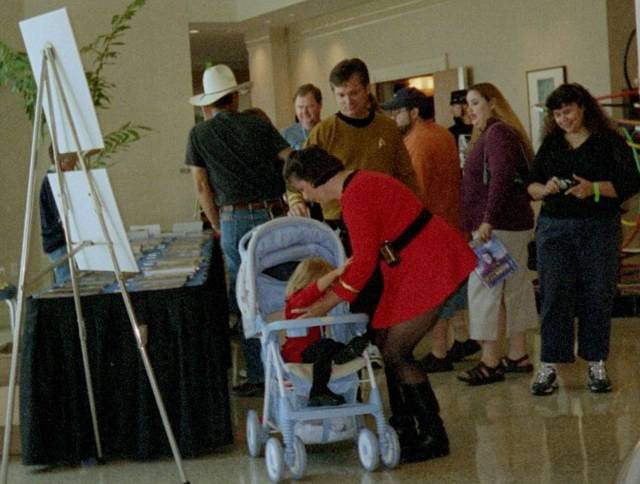
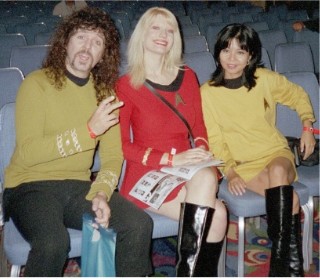
Snapshots from the Scotty Farewell

The New York Times sent a real photographer for the story, but while I was covering the "Beam Me Up, Scotty...one last time" Convention in Hollywood at the end of August, juggling notebook and tape recorder, I also occasionally pulled out a little camera for some snapshots.

Now I've finally gotten around to posting some...(an extended version of my Times story follows the photos...)

---Bill Kowinski

Star Trek conventions, the Next Generation... Posted by Hello

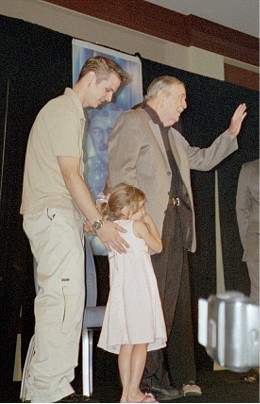
photo ops for the whole family Posted by Hello

Starfleet gathers for the stars... Posted by Hello

The comedy team of Nimoy and Shatner appeared Sunday afternoon. Posted by Hello

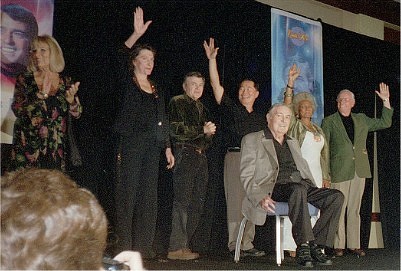
Members of the Doohan clan watch Scotty video tribute, before final appearance. Posted by Hello

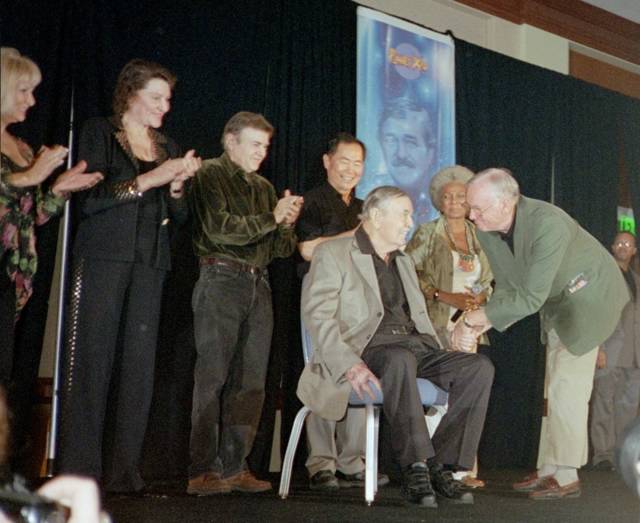
The first man to walk on the moon, astronaut Neil Armstrong, greets James Doohan onstage at the convention finale. Posted by Hello

Beam me up, Scotty... Posted by Hello

...one last time Posted by Hello

On stage with family, James Doohan rises to say farewell... Posted by Hello

Wednesday, September 01, 2004

Star Trek: The Search for Its SoulBy William S. Kowinski


This is my final draft for the article edited and published on p. 1 of the Arts Section in the New York Times on August 31, 2004. This version is longer and lacks some changes made at the Times.

Two of my favorite quotes didn’t make the published version but they're here: the second Mike Malotte quote about the initial appeal of Trek, and Nick Sagan’s quote that ends this version.


The article in the NY Times was published Tuesday morning. By 10a.m. or so in LA, during the ceremony bestowing James Doohan's star on the Hollywood Walk of Fame, Nichelle Nichols was holding up a copy of it to fans and the cameras, and (I'm told, since I wasn't there) thanking me, the Times and the media covering the convention for giving Jimmy Doohan the honor he is due.

Among the material I didn't get into the article were quotes from Jonathan Frakes, LeVar Burton and Nicholas Meyer, all of whom substantively or ( the latter two) actually said: "I love Jimmy Doohan."


Could Star Trek be dying? It's enough to make Mr. Spock laugh. "This is so funny," said Leonard Nimoy, who in addition to playing Mr. Spock, directed two Star Trek feature films and produced another. "Star Trek has died several times, and come back stronger than ever. It's hilarious."

This past weekend, Mr. Nimoy joined his Star Trek original cast crewmates at Planet Xpo convention in Los Angeles to honor the ailing James Doohan (who played Scotty, the Enterprise engineer) in his last convention appearance. Doohan, who receives his star on the Hollywood Walk of Fame today, is showing signs of Alzheimers disease, according to a family spokesperson. So with the exception of the late DeForest Kelley (Dr. McCoy), all of the world famous Enterprise crew gathered one last time on Sunday.

Over the weekend the original cast members recounted Star Trek's bumpy early history--- Created by Gene Roddenberry and first aired in 1966, cancelled after three stormy seasons, resurrected in syndication, reborn as an initially disappointing feature film in 1979, it achieved warp speed momentum with a successful second film and a hit sequel TV series, "Star Trek: The Next Generation." Now approaching its fortieth anniversary, with a total of ten movies and hundreds of hours of five TV series that are all still seen across the U.S. and around the world, (not to mention hundreds of novels and electronic games, and tons of merchandise) Star Trek is a unique popular culture phenomenon, and the earth's best known saga of the future.

At the moment Star Trek is undeniably alive. Today Paramount releases Trekkies 2, a new documentary on DVD, about Star Trek's global network of fans, and the long-awaited first season DVD set of the original Star Trek series. Still, there are reasons for questioning its continued viability. Though the feature film series has grossed more than a billion dollars for Paramount, the last two outings have sputtered at the box office. The most recent release, Star Trek Nemesis, could not hold its own against installments of the Lord of the Rings and Harry Potter film series in summer 2002. Many reviewers greeted it with condescension or scorn, suggesting that the Star Trek enterprise had run its course.

Since Star Trek: The Next Generation received an Emmy nomination as best dramatic series and left the air a legitimate hit in 1994,subsequent Star Trek TV dramas slowly lost ratings ground. Completing its third season last spring after a generally rough ratings year for TV drama, the current series, Star Trek: Enterprise, faced cancellation by the UPN network.

In an echo of the original series' fate, it was saved after a fan letter-writing campaign, but rescheduled on Friday evenings at 8 oclock for the coming season, beginning in October. Both UPN president Dawn Ostroff and Paramount TV president Garry Hart point to the example of "The X Files," a series aimed at similar viewers, that found its audience on Fridays. (They are also happy that Enterprise will no longer be competing with American Idol.) Though Mr. Hart says he is "cautiously optimistic" about the change, Friday has also been a graveyard for shows meant to appeal to young adult viewers---including the original Star Trek in 1969.

Despite his amusement, Mr. Nimoy is among those who agree there is cause for concern. He likens the current situation to the period after the first Star Trek feature film, when "I felt that Star Trek was like a beached whale. I think something similar is happening now. Star Trek is in this stranded situation. The ideas that were propelling it have run dry. It needs somebody with fresh ideas and fresh energy to come along and put it back in the water."

"I'm not saying it will happen," Mr. Nimoy added, pointing out that he hasn't been creatively involved in Star Trek since 1991. "But I think given the proper elements, it could happen. There's certainly still a core base of fans that wants it to happen."

Some observers suggest the problem is audience fatigue. Some believe it is creative exhaustion. But one solution to both, according to a number of actors, writers, producers and directors of past Star Trek incarnations, may be to stop making new Star Trek stories for awhile.

"As soon as one series ends, the next one begins right away," said Denise Crosby, actor in Star Trek: The Next Generation, as well as Executive Producer of Trekkies 2. "How can you sustain that? The bar has been raised so high with sci fi films. I'm not talking just about special effects but interesting, elaborate tales... You need to step back and refocus on what's pertinent to this moment in time."

"Star Trek's just not special enough. Not anymore," said LeVar Burton, who directed some 27 episodes of four Star Trek series, as well as starring in The Next Generation . "They need to shut the whole thing down, wait five years, create an interest, an excitement, a hunger for it again."

When he's not running a technical support team for Gateway computers, Michael W. Malotte is Commander (or president) of Starfleet (or the nonprofit organization, the International Star Trek Fan Association, Inc), with 230 chapters worldwide. It is one of the oldest and largest such umbrella groups, but hardly the only one. "If you asked our approximately 4000 members right now, they'd probably be split right down the middle," he said. "There's a large group that thinks it's time to give Trek a rest...There's another group that says, 'I enjoy Trek, I don't agree with a lot of what they're doing, but I still enjoy watching."

Those who are rooting for more new Star Trek are buzzing this summer about the new executive producer of the current series, Enterprise, which is set in the century before Captain Kirk. He is Manny Coto, a self-declared fan who is addressing a key fan complaint: that the series strays too far from the essence of Trek. "My goal is to deepen and expand its relationship to the Star Trek universe," Mr. Coto said, "to fulfill its promise as a true prequel series."

This relationship will be made visible with the appearance of Brent Spiner, The Next Generation's Mr. Data, in a story told over a three episode "mini-arc," the coming season's preferred format. Negotiations are underway for a similar appearance by William Shatner, perhaps even playing Captain Kirk. Mr. Coto added well-regarded Star Trek novelists Judith and Garfield Reeves-Stevens to the writing staff, to take advantage of their "intimate familiarity" with the Trek universe as well their fluency in imaginative science fiction. All of this, Mr. Coto believes, will attract other viewers besides declared Trek fans.

"What makes Star Trek Star Trek is its unique ability to comment on our present condition by examining it in a future context," said LeVar Burton. "Star Trek is the one aspect of the popular culture that gets us to think about our nature, and our purpose for being here." This is another elements that Star Trek advocates insist is central to the saga's identity, but has been missing lately. Mr. Coto agrees that this is "something that science fiction does best," so a planned Enterprise arc concerns civil war on Vulcan (Mr. Spock's planet) which he says will covertly examine "the war in Iraq and the direction of the country." The Brent Spiner arc deals with genetic manipulation and even suggestions of the stem cell debate, while elaborating on a premise fans will recall from the original Star Trek series. LeVar Burton is directing its third episode.

Mr. Coto doesn't believe Star Trek should shut down after Enterprise. "There can never be too much Star Trek, " he says. But even if a pause could be creatively useful, commercial calculation will likely determine Star Trek's fate, and its recent problems may not be decisive. "Movies cost so much to make that apparently the only thing that strikes the studios as worth doing is franchise-related," said Nicholas Meyer, who directed Star Trek II:The Wrath of Khan and Star Trek VI: The Undiscovered Country. "Whether it's other movies, comic books, video games, it doesn't matter, as long as there is some pre-sale. Which is not to say they can't turn out a good movie. A lot of good things are done for the wrong reasons."

Though he acknowledges that the performance of Star Trek Nemesis was disappointing, Star Trek Executive Producer Rick Berman notes that it was the tenth film in the series, "and I highly doubt it was the last." A Paramount films spokesperson agreed. Still, two years after its release, discussions for the next film are "in a very preliminary stage," and the story being considered "would not involve any of the casts that have existed in previous films and television series," Mr. Berman said.

"We hope and anticipate that Enterprise will run for a few more years," Garry Hart said, adding that while another Star Trek series isn't being planned, he doubts there will be more than a season or two pause after Enterprise before the next incarnation. "Star Trek has been the most successful franchise in the history of television. I have no doubt there will be a demand for more Star Trek on television."

There is more science fiction competition in films and especially television than in Star Trek's best days (and much of the TV sci-fi is being created by Star Trek alumni writers and producers.) Though Mr. Coto believes that Enterprise will continue to excel in television's more affordable special effects, Mr. Berman acknowledges that Star Trek features don't have the budgets of "the Lucases and the Speilbergs" but must compete with them for audience.

But Mr. Nimoy doesn't see this as the chief appeal of Star Trek anyway. "We never relied on that. We depended on story, story, story. Not image, image, image." He points out that effects usually portray violence and destruction, but in the movie he wrote and directed, Star Trek IV: The Voyage Home (known as "the whales story"), "There was not a single shot fired, nobody died... It was an entirely different sensibility. That was the high point of my experience with Star Trek. That was my Star Trek statement." It also remains the most popular Star Trek feature.

Star Trek as a cultural alternative remains central to fan loyalty. "I think the biggest appeal of Star Trek is that back in the 60s, when Gene did this," Michael Malotte said, "most science fiction was about people who weren't on earth because they were escaping it, it was so overpopulated and polluted that people couldn't live on it, or it was a charred cinder because we'd screwed ourselves over. Gene's Star Trek was really the first science fiction of its time to show a future where we actually learn from our mistakes. We bettered ourselves and we banded together, and we headed out for the stars. "

But even if Star Trek pauses or stops, most observers agree that the fan clubs and conventions will continue. In some ways, fandom has become self-sufficient. For years, fans have created and disseminated their own Star Trek stories, on mimeographed pages, then on fan fiction Internet sites, and now with increasingly accessible digital technology, they are creating their own films. "They are no longer bound by what the TV tells them to do," says Eugene Roddenberry, Gene Roddenberry's 30 year old son, who recently agreed to help produce a live action fan film. "They can go do it themselves, which I love."

Eugene Roddenberry is also working on a documentary called Trek Nation that highlights Star Trek's impact on world culture as well as its positive influence on fans in their real lives. Fan organizations typically do charity work and public service, and some require it. "Many fans live their lives by these philosophies like The Prime Directive, and IDIC (infinite diversity in infinite combinations)," said Roger Nygard, director of Trekkies 2.

This weekend the original Star Trek actors emphasized those themes to their convention audiences, as they usually do. To a degree now unusual, their lives before television stardom include experiences that bear on Star Trek's commitment to peace and equality: James Doohan was badly wounded on D-Day in 1944. George Takei (Mr. Sulu) spent part of his childhood in a Japanese internment camp, and as a singer in the early 1960s, Nichelle Nichols was refused lodging because of her race.

"Because the fans are loyal to Gene's dream, " said Ms. Nichols in an interview on Sunday, "we are loyal to the fans." Walter Koenig (Chekov), Ms. Nichols, Mr. Takei, Majel Roddenberry (who played on Star Trek and The Next Generation, and was married to Mr. Roddenberry) and before his recent illness, Mr. Doohan, have appeared most consistently at conventions and are fan favorites. The bond goes both ways. "In a society with so much violence and stupidity," Mr. Koenig said, " the conventions are an oasis, where you can find some genuinely good people who believe in humanity and respect the rights of others."

Star Trek is unique for having created its own elaborate history of the future, which together with its themes, best stories and strongest characters, makes a modern mythology. "You'd be hard pressed to find anybody who doesn't know what a Klingon is, or doesn't know what 'beam me up Scotty' is all about,'" Rick Berman said. "It is a phenomenon that will continue to exist, and whether it will continue to exist after a pause or not, probably in the long run doesn't matter."

Just one indication of its interpenetration with real life came at the convention on Saturday night when the featured speaker at the banquet honoring James Doohan was astronaut Neil Armstrong, the first human to walk on the moon. Ending a talk replete with Star Trek references (including a wish for a Federation starship for his next command), he addressed Mr. Doohan: "From one old engineer to another: thanks, mate."

But how much unoccupied room is there for new adventures in the Star Trek universe? Nick Sagan, who wrote for "The Next Generation" and Star Trek: Voyager, and whose second science fiction novel, Edenborn, was just published, thinks there's a lot. "Whichever side of the debate you're on, it's undeniable that many people feel Star Trek has grown stagnant," he said. "You can take it off the air and out of the theaters for a while to create some breathing room, or someone can step up and break away from the traditional Trek experience by taking a chance on something new. You don't have to tell stories about or even tip the hat to previous Trek characters. All you need is Gene Roddenberry's sense of hope and wonder."

Home
Wednesday, June 30, 2004

Introducing THE TREKALOG

Greetings---Thanks to a number of new features on Blogger, I've been able to reorganize this site. From here down, as the world scrolls, you'll find what I call "The Trekalog"--my essays on all ten Star Trek feature films to date.

(In addition to "log" as a Star Trek reference, there's also a pun here on The Decalogue, as the Ten Commandments are sometimes called. I hope no one is offended, but what do you expect from twelve years of Catholic schools.)

Anyway, now that Blogger allows you to pick the date on your posts, I can place these essays in order, from Star Trek The Motion Picture, to Star Trek Nemesis. (I've picked this date to start with so this will follow my New York Times piece, and because, well, it's my birth date.)

For awhile this will be a work in progress, since I haven't written all the essays yet, and I'm taking this opportunity to revise the essays I have written. But from here down---that is, from here into the past---is the place for The Trekalong.

Enjoy. And your comments are invited.

Tuesday, June 29, 2004


Ten Years after... Posted by Hello
STAR TREK: THE MOTION PICTURE

You have to understand what it was like, being in the audience for the first run of '>Star Trek: The Motion Picture.

Some in those audiences had waited ten years for this moment, from 1969, when the Star Trek series went off the air, until late 1979. They'd waited from junior high until their first child was born. Or from college when they didn't trust anyone over 30, until they were over 30.

But probably most of the audience had come to Star Trek several years later than that. The late 1960s were a pretty intense and involving time. But the country had quieted down by the mid 1970s, more exhausted than anything, it seemed. These were the years when Star Trek truly became an obsession shared by millions.

Like any other network show in the 60s, Star Trek had been on NBC once a week, fall through the spring, with reruns in the summer. There were three networks and in some places, educational TV. Daytimes were soap operas and game shows. Then the news, and then the evening programs.

By the early 1970s, there were new TV stations on the UHF band you could get with a special antenna, and some people were starting to get their TV through a cable, with better reception. The number of TV stations suddenly increased, and so did the need for programming. Some stations that didn't have their own news broadcasts showed Star Trek in the early evening. Almost all stations that syndicated Star Trek showed it every day. And that was the key.

You saw those stories at the same time every day. The stories were different, but there was a level of consistency that gave the Star Trek universe substance and made it real.

The Star Trek crew became a regular part of your world, an alternative universe you visited ritually every day. The stories were provocative, and you began to see different meanings in the episodes, and notice more about the characters even the second or third time. The characters stayed in your head from day to day, and assumed a kind of reality. The stories said something about the world you lived in, as well as perhaps the world you'd like to live in.

In the mid 1970s, Star Trek was so popular in syndication that one survey showed that more New York males between 18-49 watched Star Trek than any first run network dramatic series, or Monday Night Football. The New York figures also showed Star Trek was more popular with teens than first run episodes of the reigning teen network favorite "One Day at a Time", and with more adults 18-34 than first-run episodes of M*A*S*H.

The actors became global icons as the series was syndicated around the world. The fan base grew in numbers and fervor the entire decade, fed in part by the new phenomena of fan conventions and fan publications (both "fanzines" and fan fictions). These had been traditions in the science fiction fan world, but never before applied with such size to a single set of stories, let alone a mere TV show. The Star Trek Fleet Manual became a number one best-seller on the trade paperback lists.

In 1975, Star Trek was being seen in 148 TV markets across America, and on 54 stations outside the U.S. In some cities Star Trek was on several different stations at different times, so there were days when you could see two or three episodes. It became a heightened alternative reality, with an addictive magic. The geeks and freaks who'd discovered it in the late 1960s, and may even have watched it together in their college dorm, were joined by New York stockbrokers, NASA scientists, and Andy Warhol.

And it became a shared reality, everywhere you looked. One afternoon I was on the phone making an airline reservation. The TV was on and Star Trek was starting..."These are the voyages..." The reservation clerk must have heard it in the background. "Oh, you're watching Star Trek!" she cried. "What episode is it?"

Here's a more complicated story that might suggest how pervasive this Star Trek mania was by 1975. I was working on an alternative weekly newspaper in Washington D.C. called Newsworks. It had just started up, and a couple of old friends from different places had wound up on the first staff. I'd come to visit and write a few stories. I wound up staying and at this point I was editor of the arts section, which made me sort of second in command. That's one reason for the nickname I got. The Newsworks office---three floors of an old frame house in the then-bedraggled section of Adams-Morgan-seemed to run on adrenalin and panic. In contrast, my desk was an oasis of calm and reason. So they called me Spock.

One day I was returning to my desk on the editorial floor. As I crossed the room, ahead of me were two male staffers standing nose to nose, arguing loudly. They were in my path, and people were starting to watch from their desks as the argument got more heated. Neither of them looked at me as I approached, and I didn't look directly at them, so they probably thought I was going to just walk past them. But as I got behind them, I stopped, calmly reached forward with both hands, and silently applied the Vulcan neck pinch to both of them. They both immediately slumped to the floor.

People laughed and some cheered. And everybody knew exactly what had just happened.

Not too long after that, I covered my first Star Trek convention, at the Hilton hotel in Washington. I briefly met Gene Roddenberry, but the truth is I was so distracted by Majel Barrett Roddenberry, tanned and looking incredible in a backless sun-dress, that I couldn't think of much to ask him. But he did talk to the assembled fans, and mentioned that a Star Trek movie was about to go into production. That was probably the Philip Kaufman project, which was cancelled when Paramount decided to launch a new network with a Star Trek TV series featuring the original cast. Before that, they'd considered a small budget feature and a series of made-for-TV movies. Then came Star Wars in 1977 and Close Encounters in 1978, and so the new TV series was dropped and work began on Star Trek: The Motion Picture.

I remember a magazine article in the mid 70s that told of an avid Trek fan, a stockbroker or in some well-paid white collar position, who after a hard day on Wall Street tuned into Trek one evening, realized it was an episode he hadn't yet seen, and opened a bottle of wine to celebrate. By the mid-70s, it was a rare event to have somehow missed one of the 79 episodes. But ten years after the network run ended, there were few even moderately interested viewers who hadn't seen every show at least once. There was the short-lived animated series, and there were Star Trek novels and short stories, and fan fictions circulated on mimeograph paper. By the late 70s, fans were running up against one essential limitation more impassible than the Galactic Barrier: the 79 episodes of 1966-69. There were 79 stories, and no more. They could run them in rotation forever, but there would never be a new one.

And then, finally, and somehow suddenly, towards the end of 1979, there you were. In the movie theatre, waiting to see Star Trek come alive again.

Filled with anticipation, impatience and a little worry, you stared at a screen of blackness and moving pinpoints of white stars. There was an "overture," a throwback to the Big Event movies of the 40s through the early 60s, like "Gone With the Wind" and the Biblical epics, a tradition that borrowed its sense of grandeur from the overtures to operas and stage musicals.

Then the music came to its end, and the Paramount logo---then at last, the opening credits, and the new Star Trek theme. The theatre erupts in cheers. They cheer the titles. They cheer the cast. They cheer everything. Some have been waiting a third of their lives, even half their lives, for this.

Then a hush as the music changes and the movie begins: with a new Klingon ship...and new Klingons! There are whispers in the awestruck silence. These Klingons look really alien, and scary. They even sound scary.

If you'd followed the news and the gossip leading up to it--and you probably had---you knew that one main anxiety about this movie was whether Spock was going to be in it. For awhile, the answer was no. Leonard Nimoy was not in the cast of the new Star Trek TV series, and then he wasn't signed at first for the movie either. But even though by now you knew he was supposed to be in this movie, there was still that lingering doubt, like you couldn't quite believe it until...

There he is! Spock is on Vulcan! And the audience cheers.

Another anxiety that people had---which seems pretty funny now---was that after ten years, the Star Trek actors would look way too old to be credible. Could they still look capable of the action and adventure of exploring strange new worlds?

So when Captain Kirk and then Scotty appeared, both slim and fit, there was a grin of relief on some fans' faces.

But the moment that fans had probably been waiting for the most was just ahead. They had watched Star Trek on television over and over. They loved the Enterprise and even grew to have affection for the cheap costumed monsters and credible (great for TV) but not spectacular special effects. Then they saw "Star Wars" and "Close Encounters of the Third Kind," or even before that, "2001: A Space Odyssey," and they fantasized about what Star Trek would be like as a motion picture: the effects, the aliens, and above all, the Enterprise.

The Enterprise on television was mostly a few exteriors (some of which were more convincing as models and only suggested a starship) and a few interiors (which except for the bridge, grew to seem both cramped and bare.) That was enough to stimulate imaginations. But now there could be so much more to actually see...if Star Trek could be a movie!

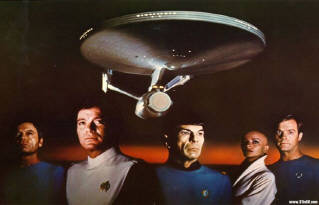
Now it is a movie, and now is the moment of finally seeing: the Enterprise. Those who watch the movie today, especially on small screens at home, may not quite understand why the scene of Kirk and Scotty in a shuttle, flying to, around and then directly toward the Enterprise, is so long. This was the reason: because it was one of the moments that Star Trek fans had dreamed about and talked about for five years, or seven years, or ten years. Gene Roddenberry said more than once that the real star of Star Trek is the Enterprise, and Robert Wise, director of this movie, seemed to feel as well that the Enterprise was itself a major character. So even in the Director's Cut DVD, this scene remains just as long, matched to a wonderful piece of music by Jerry Goldsmith.

This magic continued in the new interior of the Enterprise, and in seeing the rest of the old crew, looking good. If the movie bogged down later, with a story that seemed as muddled as the dark interior of the alien object that threatened earth, this first half hour or so was almost pure joy for the first Star Trek audiences when this movie first opened in theatres.

"'>So that's what it's about!" Posted by Hello
Fast-forward: The Director's Cut

It took 75 years for American audiences to see a version of Fritz Lang's classic 1927 science fiction film '>Metropolis that told a coherent story with restored and visually stunning scenes. After a 2002 screening of the new version I attended, I heard somebody say, "So that's what it's about!"

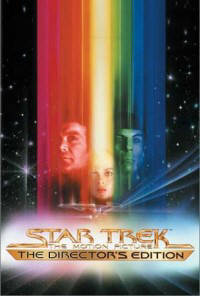
It didn't take quite that long to get the '>Director's Cut of Star Trek: The Motion Picture, but it has been almost a quarter century. The film was rushed into release in December 1979 to fulfill commitments to exhibitors that were secured to get the picture financed. It had to be in the theatres by a certain date, and it had to be no more than 130 minutes long. The problem was that it wasn't finished.

The script wasn't done when filming began, and major elements of the story emerged or were changed as the movie was shot. In an even more expensive echo of something that happened with the original series, the first special effects house failed to deliver quality images on time, so a lot of time and money went into a rush to create these images. Many effects came in at the last minute and were cut into the live action footage-and if there wasn't room, the live action and dialogue was cut. Some visual effects were never finished, some planned scenes were scrapped, and the sound effects were never properly mixed.

Over the years there have been two other versions with some footage more or less randomly added: one for the first network television showings, and another for video cassette. But it wasn't until other DVD releases showed there was a market for restored and enhanced versions with lots of extras that Paramount Pictures consented to the request of director Robert Wise to essentially finish the film he started.

So the DVD "Director's Cut" version of Star Trek The Motion Picture is the definitive one, completely re-edited, with digital sound and completed sound effects, and some new computer-generated visual effects carefully matched to the pre-computerized effects of the original, largely based on storyboards and designs created but never fully realized for the original movie.

As a result of being able to re-edit and sometimes replace visual effects sequences, and without the same time constraint, director Robert Wise was able to restore dialogue scenes cut from one or another or all of the previous versions he thought were essential to the story. The result is a visually beautiful movie with---at last---a coherent story, masterfully told. So this is what it's about!

Gene Roddenberry had produced the movie, using the script for the proposed series pilot as the basis of the story. Director Robert Wise was a veteran---some 30 films---in a variety of genres, including one of the best science fiction films of any era ("'>The Day The Earth Stood Still") and a less well known but solid version of Michael Crichton's "'>The Andromeda Strain".

After the first effects company failed to deliver, Paramount hired the two effects producers who were responsible for virtually all of the major science fiction movie special effects of the era. Douglas Trumbull was the visual effects supervisor for 2001, did the special effects for Close Encounters and Wise's Andromeda Strain, and directed the excellent but neglected sci-fi film, '>Silent Running.

John Dykstra worked on Star Wars and the Battlestar Galactica TV series. Because time was impossibly short, Paramount gave them budgets that allowed them to hire just about everyone in Hollywood capable of doing the work. The entertaining commentaries by Wise and Trumbull on the DVD indicate it was a still a miracle the movie made it into the theatres on time, but because so much was left unfinished, all the money Paramount spent and all the creativity and skill of everyone concerned did not fully pay off until this DVD version.

In contrast to how later Star Trek films were handled, this movie was a major release on the Paramount schedule---in some ways, the biggest movie the studio had produced. Star Trek had already set several precedents: the first science fiction drama series with continuing characters on network television, the first series to become more popular in syndication than in its network run. Now Paramount was gambling that Star Trek would be the first television series to be transformed into a successful big screen motion picture.

But the rush to get it in theatres showed. Some effects were awkward, and some that were unfinished made the story confusing. The story also suffered from scenes that had to be cut because of time or because of problems with effects. The pace seemed off, with overlong effects sequences.

The film opened to large audiences and mixed reviews. The science fiction writers F & F Pohl summed up a widespread impression: "What appeared on the screen was little more than a rescue operation...And yet---what a pleasure to see them all together again!"

The difference between the special effects of the series and a late 1970s feature would be immense, but fans also expected a story as proportionately grand as that difference. And there were problems with both the effects and especially the story, remedied in the DVD Director's Cut.

As I post this, it's less than 2 years until the 40th anniversary. Re-releasing this cut of Star Trek: The Motion Pictures to theatres would be a fitting and exciting way to celebrate.