Wednesday, September 14, 2005


The Enterprise inspires fantasy because it feels real Posted by Picasa
Believing in the Enterprise

Still, GR was not just making story---he was making drama. Drama is from a Greek word that means "action." In our terms, it basically means action you can see and hear. It means action that imitates the look and sound of the reality it is pretending to be, according to the conventions of the medium.

You believe (or suspend your disbelief) in the reality of a city street, for instance, according to the medium. If it's a stage play, an obviously fake streetlamp, a few facades of buildings will be enough---you know the reality is only suggested. If it's a TV show, there has to be more detail. If it's a movie, even more detail. A TV show might get away with a realistic looking street with a few buildings and some people, but no real sense there is a city around it. A movie has to give you the sense that the street is a real street in a real city, fully functioning and populated, with streets that lead to other streets, to the rest of the world.

A television series exists in a particular world, but that world has to be complete within itself. A series set in contemporary times just has to select from what exists: the kinds of clothes, tables, forks, lamps, cars, telephones and toothbrushes that are sold in one store or another. Westerns and other historical dramas can raid museums, old photographs and traditional conceptions to make their worlds.

But the future has to be invented, and built pretty much from scratch. Wherever the idea came from to take this really seriously, as an opportunity to build a plausible future, GR gave it life with a stubborn and ultimately creative consistency.

It makes sense on lots of levels to really think it through, and keep it consistent. First, it helps to counter one of the big objections to science fiction-that it's all fanciful and can't be taken seriously. For the fact that the clothes, tables, forks, lamps and communicators of the future don't yet exist is in a dramatic sense irrelevant. By creating those things, you create that future, and you have to create them, because this is drama. You have real people as actors, playing characters who need ways to keep warm and dry, and ways to ingest nourishment, get around and communicate. Once you build and show your future, and it works for those characters, that future becomes real.

From watching and reading science fiction, Roddenberry said years later, he had figured out what he would do if he ever got the chance to write it. "I'm going to try to make it as scientifically accurate as possible and write [these scripts] the way we wrote the old Playhouse 90." He wanted to treat the fantastic as if it were real, hoping that the double message of a wondrous reality would act like a magnet for the eyes and hearts of viewers.

For example, the space ship. "My feeling was that if you didn't believe in the spaceship," Roddenberry said,"---if you didn't believe you were in a vehicle traveling through space, a vehicle that made sense, whose layout and design made sense...then you wouldn't believe in the series."

For scientific accuracy, the Trek team consulted with scientists at RAND and the Jet Propulsion Laboratory, involving technical matters at high and rarified levels, such as whether faster-than-light travel was possible, and if so, what principles might be involved in powering a craft through the immense distances between the stars.

But Roddenberry and other armed services veterans could bring their own experience with large ships and large aircraft in World War II to the concept of a large starship and crew. The Trek team thought carefully about how many people would be aboard, where they would sleep and how they would eat. They thought about how the bridge would work best, and who would be on it. Where would the ideal place for the captain to be?

All of this was fairly deep thinking for science fiction on film. But this was not a single movie, nor a before-the-feature movie serial or one-time television drama. This was a network dramatic series, and Roddenberry had been writing for those long enough to understand their basic requirements.

This basis of workable, recognizable reality that made sense had to extend to the people aboard the ship. The Trek team thought about the kind of people who would make it to the most important vessel in a future fleet. Roddenberry remembered the rigors of flight school in World War II-the many who washed out at each step in the process. Some anomalies of behavior were inevitable, but certain kinds of excesses or deficiencies just weren't credible-you wouldn't get to serve on a starship if you had them. So while certain character flaws might make dramatic conflict easier, relying on them might sink the sense of reality.

To further establish that sense of familiarity and continuity with the present, Roddenberry wanted to give the starship a name with a pedigree: first it was the Yorktown, and then the Enterprise. The various other naval analogies would further ground the series in reality, and besides personal experiences of the veterans on the team, Roddenberry had several years researching leadership and training while writing for the West Point TV series.

Some of the future technology could be extrapolated from the most advanced ideas of today. Roddenberry looked at instruments at North American's Advanced Space Research Center to get ideas, not only of what the Enterprise instruments might look like, but what they wouldn't be like, what would be obsolete. There would be some sort of "computer," which barely existed in the mid 1960s. What would computers be like-what would they do-- in 400 years?

Sometimes the answer would lie partly in science and partly in behavior: what would people in the future want their technology to do? In considering what a 23rd century sick bay would look like, you might start by thinking about what current technology medicine would want to improve. Assuming advanced ability to monitor an array of physical functions, what would be the most efficient way to do that, for both the patient and the physicians? The answer was the bio-bed with its clearly visible electronic monitors of heartrate and other basic functions., which didn't wait until the 23rd century to become a hospital commonplace.

That Star Trek took such pains to extrapolate from existing science and especially from the speculations at the far edge of certain sciences, is probably a factor in its longevity, as well as partially accounting for its fans among scientists, engineers and the technologically inclined.

Scientific plausibility is a slightly different thing, and here the instincts of a science fiction fan, as GR had been since childhood, combine with the prejudices of the age. The science fiction fan is interested in the science as part of the adventure. But the network executives and perhaps the skeptical viewer are more reassured than excited by scientific plausibility. Science has changed reality so thoroughly and so often, that anything that seems "scientific" is granted a certain (perhaps grudging) suspension of disbelief.

The basics of the Star Trek universe were created according to need and opportunity. Some were brilliant ideas that happened to work very well within the TV budget, and some---like the transporter, which negated the need for expensive shots of the spaceship landing on a different planet every week---were actually economical.

While GR got interested in what future technology might be, he also approached the future as a storyteller. So the future technology had to be plausible, even if no one really knew if it was possible, or how it could actually work. It's the difference between Dick Tracy's wrist radio, which was plausible even in the 1940s, and his invisible airplane, which wasn't.

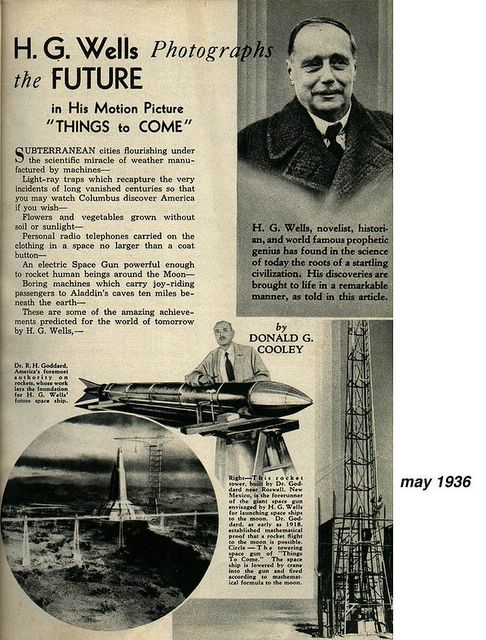
It is this application of the imagination of a storyteller as well as a scientific imagination that made H.G. Wells' visions of the future much more wondrous and (as it turned out) much more accurate than that of so-called experts. It's the same combination that GR infused in Star Trek.

Plausible technology used consistently (warp ten is always warp ten, phasers do what it is established that they do) adds up to a believable future. The rule applies beyond technology, to the other elements of a complete future.

Thinking about the future that way wasn't just smart, it was almost mandatory. Because this is drama-a future that has to be shown, and the characters have to been seen living in it. Because this is television drama ---and it has to be the same future next week and the week after.

But at a certain point, or maybe it just happened gradually, GR must have realized that in creating a universe for his TV series, he was creating a future. Making it a better future only made sense---since it seemed clear that unless humanity improved, it was going to destroy itself and any future with it. But it was also an opportunity, to create a future worth living in.

Creating a universe for Star Trek’s stories turned out so well, that it became the basis for the evolving mythology of the future, which is Star Trek, and all that Star Trek has influenced in how people envision the future.

"Gene [Roddenberry] created a totally new universe," said Gene Coon who joined Star Trek as a writer and producer midway through the first year, and who himself came up with important elaborations on that universe. " He invented a starship, which works, by the way, and is a logical progression from what we know today. He created customs, morals, modes of speaking, a complete technology. We have a very rigid technology on the show. We know how fast we can go. We know what we use for fuel. We know what our weapons will do...He didn't create a show, he created a universe, and it works..."

Star Trek eventually became so well known for its self-consistent universe--- not only with technology but planets and societies, interplanetary institutions with their laws, rules and directives, alien races with histories and mythologies and even languages---that fans debate the fine points of violations, decry lack of "continuity," and speak like ecclesiastical scholars of what is "canon" law and what is not.

H.G. Wells, futurist and creator of the sci-fi rules. Posted by Picasa
The Magic Trick

GR not only was smart at re-creating the Wells approach to the future, he re-instituted the Wells rules of science fiction. Though he seems to have felt embattled about insisting on them, he did insist.

GR had probably first read Wells when he discovered the early s/f pulp magazines, like Amazing and Astounding and Science Wonder Stories in the 1930s, when they reprinted a lot of Wells. By the time he was working on Star Trek, he probably wasn't conscious of what he'd absorbed from Wells. But he could have just as easily absorbed Wells' approach through the other writers, and through the osmosis of reading and the practical feedback of writing.

But Wells articulated these rules with great clarity. Many of the strategies of what Roddenberry would later call the Believability Factor could be found in Wells. When seven of his science fiction novels were published together in a 1934 American edition, Wells wrote a preface explaining his method. Variations or different expressions of them were promulgated by contemporary s/f writers like Theodore Sturgeon.

First, there was the new fantastic element the story introduces, like a time machine, or invaders from Mars. Wells called it "the magic trick." The trick itself has to be at least plausible, and science provided the rationale. Wells called it "an ingenuous use of scientific patter...as near actual theory as possible."

It also helped if this element could be "explained in commonplace terms." So Wells could suggest that the time machine moves you through time like a railroad train moves you through space, or a balloon moves against gravitation and takes you into the air. He could describe what it looked like in familiar terms---nickel bars, quartz rods, ivory and brass--without needing to really say how a time machine would actually work.

But in addition to some intrinsic plausibility, the trick worked best if it is surrounded by other elements of the ordinary---by the familiar. You must "domesticate the impossible hypothesis," Wells wrote. It was also important to limit the number of magic tricks, Wells warned, or the whole reality would be called into question. "Nothing remains interesting when anything may happen."

Part of creating a credible world was also a key to science fiction's function: integrating the human into the science and the fiction by placing believable people in plausible if unprecedented circumstances.

"Then it becomes human," Wells wrote. "'How would you feel and what might not happen to you' is the typical question, if for instance...you became invisible?"

The intent finally is "to keep everything human and real...the whole interest becomes the interest of looking at human feelings and human ways, from the new angle that has been acquired."

This is crucial to a successful "Wagon Train to the Stars." But it is also a key to the function of a Gulliver's Travels in space---to creating the context for allegory and comment. Examining the human feelings is crucial to using the science fiction form to examine "contemporary political and social discussions," in the manner (writes Wells) of Jonathan Swift.

These principles had become integral to science fiction since Wells, and Roddenberry emphasized some of them in his initial proposal. There was the fantastic ("Space is a place of infinite variety and danger") but also the realism (the stories would "feature highly dramatic variations on recognizable things and themes.")

The Star Trek universe was self-consistent: that was a rule. It also became a vital element in how Star Trek grew into a mythology by accumulating so many different stories told by so many different storytellers. No one person could have created it, yet the mythology would not exist without the original design and intent, the rules that resulted from a vision and the limitations and opportunities of form, in a certain time and place. In a sense it was a self-organizing universe, but it also depended on being nourished from the outside by new knowledge and new talent.

But it wasn't simply the nature of science fiction that was Roddenberry's concern. He was making a television drama series. "Drama is people," he said. "Too much of science fiction is about gadgets and not about people."

Imagining the two together---the gadgets and the people-was the province of the best science fiction. Not everyone agrees that science fiction has anything useful to say about the future.. "From the point of view of futures studies, sc-fi is of little, or no, value," says the preface of What Futurists Believe published by the World Future Society.

But one of the futurists published in that book disagrees. In the introduction to his book, Profiles of the Future (read and admired by Gene Roddenberry while developing Star Trek), Arthur C. Clarke writes: "...I would now go so far as to claim that only readers or writers of science-fiction are really competent to discuss the possibilities of the future...A critical-the adjective is important-reading of science-fiction is essential training for anyone wishing to look more than ten years ahead. The facts of the future can hardly be imagined ab initio by those who are unfamiliar with the fantasies of the past."

The passion for the future, the curiosity about how humans fit into the universe, and about the relationships of humanity and technology, all would be important to Star Trek's stories and their continuing vitality and growth in ideas. The intent that became a tradition of absorbing stories into the integrity of the Star Trek universe, to inspire and nourish new stories, therefore also grew a mythology: a universe of stories.

The earliest TV s/f: Captain Video on the Dumont network. Posted by Picasa
From Captain Video to Captain Kirk

Science fiction had been part of television from the beginning: one of the very first successful series' was Captain Video, the 15-minute a day adventures of the intrepid Captain, his young Video Ranger and his spaceship.

When Saturday morning TV began programming for baby boomer kids, there was a parade of science fiction shows in the mid 1950s. But all the live-action s/f adventures with continuing characters were made principally for young viewers, like the early western shows.

Adults got anthology shows---early ones like Science Fiction Theater, and in the early 60s, The Twilight Zone and The Outer Limits. Neither of these was pure s/f, and though many of the stories (especially the better ones) commented on contemporary issues, most were like O Henry short stories, exploring a single premise with a twist at the end. When Star Trek started, no one had yet done for s/f what the adult westerns did for that genre---presented continuing characters and a continuing premise, with the more complex stories and more believable characters intended to attract the adult audience.

There's a lot more to be said about Star Trek as science fiction TV, but there's one feature that science fiction and television drama share in common that became important to Star Trek's storytelling.

Both science fiction and television drama were relatively new kinds of storytelling, but they both grew out of a rich tradition and earlier forms. Science fiction emerged as a genre of the novel in the mid to late nineteenth century-the newest of the fiction genres for popular audiences. Television as well was the new kid in drama. Partly because they were both the newest form, but also because of their natures, they were able to absorb, adapt, and reconstitute many of the kinds of stories that came before---in fact, many of the actual stories.

Star Trek obviously could absorb a lot from prior science fiction in every medium. Just as certain of its props were reconstituted leftovers from the movie "Forbidden Planet," so warp drive was much like that movie's "hyperdrive" (though like everything else in this list, there are multiple possible sources.)

Something like the transporter had appeared in Buck Rogers. There was a police arm of an otherwise peaceful federation of interstellar governments, United Planets, on the 1950s Saturday morning serial, Space Patrol, which was one of the first TV shows to originate in GR's LA.

GR drew ideas from Arthur C. Clarke's nonfiction and fiction. Besides raking through his magazine collection, Gene borrowed books from Sam Peebles by Isaac Asimov and the English science fiction author, Olaf Stapledon, who was the first to explore the story form of future history.

Peeples recalled that Roddenberry was particular taken with Heinlein's novel for young readers, Space Cadet. Late in his life, Roddenberry would recall it as a story of bonding among explorers, and he remembered its core ethic. "It deals with not only the problems of science---about space travel and technology and so on---but of the need we have to act in a conscious responsible manner with all this technology... It made a great impression on me."

Even the 1950s Saturday morning TV version appears to have been influential. "Tom Corbett, Space Cadet," had the distinction of appearing on all four broadcast TV networks (including the defunct Dumont) at one time or another, and for awhile appeared simultaneously on two. It also tried to create a self-consistent universe, with the help of a science advisor, the eminent rocket expert Willy Ley. The series pioneered special effects techniques, despite the fact that like most of these early sci fi shows, it was done live.

There were some similar results: Tom Corbett was a graduate of the "best school in the universe-Space Academy," who took an oath to "safeguard the freedom of space, protect the liberties of the planets and defend the cause of peace throughout the universe." It sounds a lot like Star Trek's Starfleet Academy.

Corbett served aboard the spaceship Polaris with a crew that---like the first crew of the Enterprise to hit the screen-- included a woman and an alien (the Venusian cadet, Astro). It was the 24th century, when all nations formed the Commonwealth of Earth, which had eliminated warfare and banned deadly weapons.

Then at the end of the last episode aired, the Polaris was ready to head off into space. "Where are we going?" a crewman asked. "Out," Tom Corbett replied. "Further than we've ever gone before!"

Stories breed stories: Space Seed inspired by Captain Video Posted by Picasa
Stories of Stories

Star Trek took inspiration and stories not just from science fiction, but from everywhere. Even when H.G. Wells was writing his breakthrough s/f novels, he was using elements of the Gothic tale (which we'd now classify as Horror), the romance (he called his novels "scientific romances"), the exotic adventure story of Jules Verne and later H. Rider Haggard and Edgar Rice Burroughs, as well as the detective genre that Edgar Allen Poe had pioneered and Wells' friend, Arthur Conan Doyle, would make internationally popular.

Wells used techniques of the literary novel of his day so well that The Time Machine and his other early s/f novels won him the praise of literary greats like Henry James and Joseph Conrad. But he used even earlier forms, too; as a Russian contemporary and s/f writer noted, his stories had a lot in common with folk tales, complete with humble characters and something like magic. They also resembled fables and aspects of myth and history.

So by the time of Star Trek, part of s/f tradition was re-telling other kinds of stories in this new language and new form. This flexibility gave Star Trek's s/f great energy and possibility. It also came naturally to television writers, who were used to taking plots and characters from one kind of story and transposing them in another.

It wasn't just a matter of Star Trek's "planet of the week" re-imaginings of Greek gods and ancient Rome, Nazi Germany and Capone's Chicago. Even in the Next Generation era, there were re-tellings, adaptations and absorptions of everything from Shakespeare's Henry V, Tristan and Isolde and Conrad's The Heart of Darkness, to movies like The Manchurian Candidate, The Maltese Falcon and Robin Hood, The Invasion of the Body Snatchers, Key Largo and Auntie Mame. In its various incarnations, Star Trek has made at least 5 different versions of Moby Dick. In one of the classic original series episodes, which further inspired one of Star Trek's most popular features, Star Trek reworked an episode of Captain Video (both by the same writer)---in "Space Seed."

These forms---science fiction and television drama---were particularly good at adapting and synthesizing, to create new stories, to add to the universe of stories. But this is a natural part of storytelling, not only for writers but for actors and other co-creators. It was important for Brent Spiner to see the arc of Data as a Pinocchio story, a puppet becoming a boy, but he also looked to men who told stories through small physical gestures, like Charlie Chaplin and Stan Laurel, for how he would play Data in a given action in a particular scene.

It is part of the wonder of story for the audience as well that they are experiencing something new, something unexpected, yet some part of it, some undercurrent of story, is familiar, reassuring. Stories are made from other stories, storytelling builds on storytelling. Something new, something of the future is added. But something recognizably human is always there.

It is this very feature of science fiction stories that helps make them more powerful, and in the largest sense, more accurate, in their visions of the future.

Art, science, everything: it's all made by choosing and synthesizing, and structuring the combination. Something new is made from many familiar elements, as well as the discoveries which are often re-discoveries. Storytelling is partly a product of its own rich history, and while that history may or may not be known consciously, it is often felt. We each have our own dreams, but we all know what dreaming is, and we can recognize ourselves in the dreams of others. We are each unique combinations, and we are all human.

The actor as storyteller: Nimoy added to the Star Trek mythology with this gesture. Posted by Picasa
Turning on to the universe of stories

There are two other features of television drama that eventually became very important in how Star Trek became a mythology. The first is in how the audience experiences television drama.

Television is the most widely shared medium for stories in its time, as the novel was in the nineteenth century. Like reading, watching television can be a solitary experience. But like watching a play or a movie in a theatre, it can also be personal, but experienced in a group. Like stories on the radio, many people in a very large area typically experienced the same story at the same time. (This was before VCRs and cable TV, of course. There were just three commercial broadcast networks in the U.S.) So TV drama is a potent combination of all these storytelling media.

Then there is the special nature of the television drama series. The series presents different stories about the same characters in the same "world" every week. This creates a cumulative power and effect. Since a show was usually on at the same hour of the same day of the week, there was even an element of ritual involved in watching it.

I don't think it's appreciated enough how big a change it has been in human culture for such a quantity and variety of dramas-of acted-out stories-to be available in one's own home. A series of stories about the same characters and world available at the same time every week (and as evidenced first with Star Trek, when it went into syndication, by being able to inhabit that story world every day) is very powerful. The only historical analogies are to myth and religion, but even when they were numinous in daily lives, the gods and heroes were not acting out their adventures in the living room.

Then again, maybe they were. The gods and heroes of the past were as real to people of the past as any movie stars or TV heroes are today, and probably even more deeply felt as real and essential. But even these figures were creatures of story. They existed in story, and in the drama of ritual.

The television drama series is unique historically also in how it is created. All drama is collaborative: it simply takes people working together to put on a show, with a script, actors, costumes, sets, etc.

But the drama series presents different stories about mostly the same characters, over months and even years. The actors who play those characters are therefore very powerful creatively. Their power is made even greater by how a TV series is typically organized: directors, who are very powerful in single dramatic presentations in theatre and movies, are journeymen in TV. Producers stay with shows longer than directors and writers, but the lead actors are the most consistent element, and therefore they become the caretakers of consistency and integrity.

The integrity of Star Trek is one of its greatest characteristics. GR seemed to have communicated his vision so well to so many dedicated people, and he got them to believe in it so much that they became the caretakers of the integrity he established.

This seems to be partly because of the power and attractiveness of the vision. So many people involved in Star Trek over the years can articulate that vision so beautifully, from the well-known actors who played now-legendary characters to little-known film editors or musical composers for a TV episode, to a guest actor in a Star Trek movie.

But it also seems to be partly due to how GR related to people. Actors who went for what they thought was an audition found a man interested in their dreams and hopes, their life experiences, rather than their acting credits. He talked to them about his hopes for the series, and what the Star Trek future meant to him. He made them co-creators on the spot, and many have maintained and represented that vision.

By the nature of drama, actors make the characters partly their own, because they literally embody them. This is even more so in a weekly television drama series, when over time, and because of the relentless speed of production, the character takes on more of the actor's personality and characteristics. Even how the actor and the character blend varies from actor to actor.

William Shatner became Captain Kirk, partly from his conscious choices and conception of the role, and partly from his energy and personality, and (as Shatner has said) partly out of sheer fatigue: he couldn't spare the energy to pretend to be anyone else.

Leonard Nimoy became Mr. Spock by creating a character, beginning with a conception and some physical ideas, and refining and adding to them over the years (Nimoy invented the Vulcan neck pinch, and chose the gesture for the Vulcan hand greeting, as well as contributing many other nuances and Vulcan characteristics.) He also developed the character through playing scenes with the specific actors who played other key characters like Kirk and McCoy. He so intently inhabited the character,that Spock began to affect Nimoy. (His two books even contain dialogues between Spock and Nimoy.)

The actors talked with GR about their characters, some of them (like Nimoy and Nichelle Nichols) in great detail, helping to create a depth of "backstory" and understanding that the actor could bring to each moment on the screen. The actor's portrayal in turn influenced and inspired subsequent writers, so that the character and the actor become even more melded together.

Being co-creators and caretakers of the Star Trek vision was expressed in many ways, large and small. One of my favorites is the story about George Takei, when he was instructed by a new director in the third season to push a certain button. He refused: it was the wrong button for what he was supposed to be doing. The director thought he was being silly---he had the lighting set up, it looked good, just press the damn button!

"I can't," Takei said. "If I do that, I'll destroy the Enterprise!"

rituals in the theatre of the Star Trek convention.
Kowinski photo. Posted by Picasa
Back to the Future

In terms of time, science fiction takes us as far as we can imagine in one direction of human experience: the unknown future. But drama takes us back far into our past, farther than we can really imagine. We pretend we know what we were like in the past, but our imaginings are paltry: we envision our pre-history as the Flintstones, just the Honeymooners (or perhaps the Simpsons) with stone-wheeled cars. It isn't in our dramas we connect with the past, but in drama itself.

Drama---or theatre, performance---is our lifeline back to our earliest selves and societies, to religious ritual and frenzied festival, to mesmerizing storytellers and singers, dancers and shamans, back even to the stories we told each other of the hunt-and how we told them, with gestures and laughter, making faces and mimicking sounds--- as we walked across continents.

Star Trek has a peculiar relationship to this tradition. Actors learn their craft in various media, but it is particularly interesting how many Star Trek actors were trained for the stage, and had their formative experience in theatre. That Patrick Stewart was a Shakespearian actor first is well known, but so was William Shatner. James Doohan was an acclaimed acting teacher at Manhattan's prestigious Neighborhood Playhouse; Gates McFadden was accomplished in physical theatre. And as I write this, the actor who played Catherine Janeway is playing Katharine Hepburn on the stage, and the actor who was Captain Sisko is playing Othello.

Theatre training turned out to be very useful for bringing a sense of truth to strange characters: to grown men and women running around in pajamas and boots and waving ray guns, or aliens with lobsters on their foreheads. It helped them find the Shakespearian king in a starship Captain, or an Odysseus on the bridge of the Enterprise.

William Shatner has said that doing the original series was like mounting a Greek play every week, partly because of the nature of the stories, and partly because of the skimpy television budget: the sets got to be little more than stage sets for live theatre. There were a few props, a bit of scenery, and a lot of words, emotions, ideas and drama. It was always life and death, with the nature of humanity in question and the survival of a human soul---or the human soul---in the balance.

So we come full circle, back to drama, as a key element in Star Trek's mythological feel and presence. Only television series actors could accumulate such reality, give us so many colors in so many different stories, and thanks to the continuation of the original series and the Next Generation in the movies, a mythology over time, about time, in time. But because Star Trek could not afford to be typical television as much as other worldly theatre, it established a kind of storytelling that survived when the sets were more lavish and the effects more visual and special.

Now it is a mythology of three generations in three different centuries. It has been experienced by at least three generations of viewers; sometimes three generations of a single family experience it together.

They gather around the glow of the screen. But they could be gathering around the glow of an ancient fire, where the flickering shadows seem to dance the story the teller is singing. Soon some will all go to the sacred place and put on their robes and masks, their regalia. They will sing our songs, dance our dances, and tell our stories of the wondrous future.

Friday, September 02, 2005


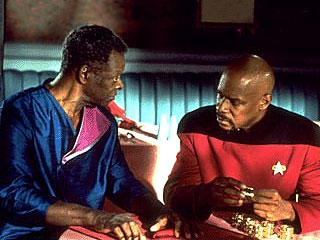
Joseph and Benjamin Sisko in Star Trek's 24th century New Orleans Posted by Picasa
Star Trek and New Orleans: What Bettering Ourselves Really Means

by William S. Kowinski

In the Star Trek universe, New Orleans is a vibrant city in the 24th century with strong ties to its past. Captain Benjamin Sisko, commander of Deep Space 9, grew up there, and for his first few weeks at Starfleet Academy, beamed back for dinner with his family there every night. Viewers saw him return there several times over the years to the Creole restaurant of his father, Joseph Sisko. The elder Sisko was a symbol not only of the continuity of family through the generations—from Joseph to Benjamin to Jake Sisko, Star Trek’s first three generation family—but his restaurant was a symbol of old values and culture that were still important, still necessary in the Star Trek future.

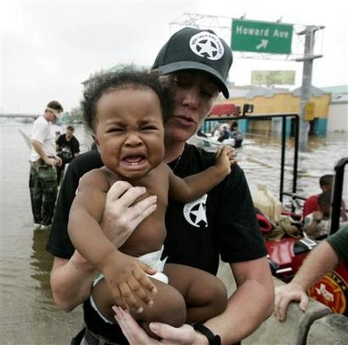
We are reminded of this not only by the recent death of Brock Peters, who played Joseph Sisko, but most of all by the incredible devastation in New Orleans during the last week of August 2005. At this moment, officials are trying to completely evacuate the city. They estimate it will be weeks or months before some of its residents can safely return (others have no homes left to return to), and years before the city can rebuild. Huge amounts of toxic industrial waste carried in the floodwaters may be very difficult and very expensive to eliminate. There is even some question whether the city will be habitable in the foreseeable future, and some have suggested it be totally abandoned.

Many people around the world are shocked by what the media is reporting about New Orleans and the other areas in several states where the powerful hurricane Katrina caused major destruction and death. The sheer power of the storm leveled entire areas of the cities it hit directly with the full force of its winds. Deaths were in the hundreds, and the counting has only begun.

For awhile, it seemed New Orleans was spared the worst because Katrina was not at its full strength and didn’t hit the whole city directly. But some of the levees gave way, that held back flood waters from the nearby lake as well as the ocean and the Mississippi river, and some 80% of the city was seriously flooded.

There had been enough warning for many people to leave the city before the hurricane struck. But many people—perhaps several hundred thousands---could not leave, because they couldn’t afford fares or didn’t have cars, and no provisions were made for evacuating them. Hospitals, nursing homes and other care facilities were not all evacuated, and there was no provision to evacuate people with physical disabilities and frail older people who lived in private homes.

By August 31 and September 1, the enormity of the catastrophe was becoming clearer. Hundreds and perhaps thousands had died in New Orleans by then. Those stranded in the city were without safe or adequate shelter, food and water. Toxic chemicals and human remains in the flood waters threatened outbreaks of serious diseases. Government response was slow, and planning had obviously been seriously inadequate. Anger, desperation, confusion and violence in New Orleans were reported and seen on television all over the world.

Many countries, and many organizations and individuals around the world offered assistance, and there are no doubt Star Trek organizations and Star Trek fans among them. The stories of individual courage, generosity and empathy are just beginning to be told. But a basic humanitarian impulse is not the only emotion likely to be evoked among Star Trek fans by this catastrophe.

text continues after photo

New Orleans 9/01/05 AP Photo Posted by Picasa
In the Star Trek future, the Federation and Starfleet recognize the common good as a guiding principle. The common good has several aspects. That which we hold in common, including our interrelationships, are part of it. We are dependent on each other, and on our community and our planet. The diners in Sisko’s restaurant eat because someone caught the fish from waters that were protected from pollution and other kinds of damage, even far away. People acting cooperatively got the fish from where it was caught eventually to the restaurant. Other food on one diner’s plate may come from many different places, and involve hundreds of people. Each process requires using infrastructure that everyone shares, like roads and water pipes. Each of those people are dependent on others for what they need---for daycare when they’re at work, for health care.

The common good is everyone’s good eventually. But the common good goes beyond interrelationships that benefit each of us directly. The common good means the good of the community, the society, the human family, and all of life. This is part of the value of Infinite Diversity in Infinite Combinations. Diversity means many talents and perspectives, many potentials and many skills, which makes us more capable and adaptable, and it makes life richer.

Diversity is a value of soul. In the Star Trek original series episode, "Is There in Truth No Beauty," Miranda’s parting words to Spock are: “The glory of creation is in its infinite diversity…” Spock completes the thought: “…and in the ways our differences combine to create meaning and beauty.”

There is no contradiction between diversity and individuality: in fact, they are the same principle. The meaning of diversity is to honor and benefit from diverse individualities, and to do so by getting beyond superficial prejudices, because of color, physical abilities and appearance, class, gender, etc. to the soul within, and the unique contributions of each.

Similarly, there is no contradiction in principle between the common good and the individual. The American Experiment has always been about valuing both, and finding ways to deal with the areas in which they might conflict, for example, through laws and the Bill of Rights.

There is no contradiction between private enterprise and government. There is only what’s appropriate for particular aspects of the common good. This was recognized in recent history in the US, although it has perhaps been forgotten here since at least the 1980s.

(The role of money in the Star Trek future is a somewhat separate question, though not in ours. But private enterprise in some sense must exist in the Star Trek 24th century, because Sisko’s restaurant appears to be much like a privately owned and operated restaurant today.)

Because the Federation values the common good in the Star Trek future, we would not expect them to provide for the privileged few but ignore the many, or especially to ignore the disadvantaged few. We would not expect them to neglect the good of the city the people hold in common. And if they did, Captain Kirk or Captain Picard or Captain Sisko would call them on it.

There are several theories being debated now concerning why planning and prevention for the New Orleans catastrophe were so poor, and why relief efforts have been so slow and meager so far. They also bear upon the Star Trek future, and what that future represents in how humans bettered themselves.

After Katrina AP Photo Posted by Picasa
There is one persistent and not very pretty theory as to why the poorer residents of New Orleans were left exposed to the catastrophic results of the hurricane, and why there was not more urgency in rescuing them. It is, the theory goes, because they are poor, and largely African-American.

In Star Trek lore, the choice of New Orleans as the home of Star Trek’s first African-American captain was probably not accidental. New Orleans is one of the greatest sources of African-American culture, and as the place where the great gumbo of jazz music was cooked up and sent to northern cities, it is a major source of American culture, as it has grown here and as it is known around the world.

The blues of New Orleans also were a major source for rock music, which itself has combined with other forms in other cultures. This connection was made more poignant when Fats Domino, one of the pioneers of rock and roll from New Orleans, was found among survivors in New Orleans several days after the hurricane.

The Mississippi River ends there, and the music of all the rivers that flow into it came to New Orleans, like Appalachian mountain music with some of its origins in the British isles. It is an ocean port, once held by the French, and a place where French Canadians from Nova Scotia came as exiles, and brought their music. Perhaps the most underrated musical influence is American Indian (the in-“jun” in Cajun) but it is clearly present in the blues as well as New Orleans jazz. And of course, the music of Africa that came with the slaves to this slave ship port.

As Michelle Erica Green points out in her column on Star Trek and New Orleans here, the ethnic mix of New Orleans includes English, Spanish and Caribbean Islanders, and there have been new immigrants in the area from various parts of Asia and the Middle East.

This was diversity that combined to make meaning and beauty for all the world. But it is also heir to a century of slavery and several centuries of racial prejudice. It wasn’t over when Louis Armstrong couldn’t play with white musicians. It wasn’t over when Nichelle Nichols, touring as a singer, was refused hotel lodgings.

All that is apparently gone in the 24th century. But even though it takes less obvious forms, it is not gone in the 21st.. Applied to the issue of New Orleans now, it is worth considering it as a component. The only way to combat unconscious racism is to raise the question, and make the possibility conscious.

Sisko's in Star Trek's 24th century New Orleans Posted by Picasa
There is another factor that seems to have contributed to the ongoing catastrophe, besides a weak sense of the public good and the role of governments in it, and perhaps a prejudice or blindness that leads to neglecting the poor and the sick and non-whites. Though it is different from them, it is related.

It is the failure to plan for the future. Star Trek fans are used to seeing Starfleet officers gather in the observation lounge or at Starfleet headquarters to describe an anticipated problem, suggest ways to solve it, debate those solutions and develop a plan. In fact, lots of science fiction films---even not very good ones---often show scientists and government leaders coming together to discuss a future threat and then devote whatever resources are necessary to combating it.

That doesn’t seem to happen often enough in our time. Scientists and engineers have known for years how vulnerable New Orleans is to hurricanes and floods. It’s been written about in the National Geographic and elsewhere. New Orleans lies below sea level; Sebastian Junger (author of “The Perfect Storm”) speaks of the sensation of looking up to see oil tankers on the river above.

The levees protecting the city were built to withstand a category 3 hurricane, when the stronger category 4s are less common but still expected, and the category 5 is always possible. The federal government under the current administration cut back funds to complete needed work on the levees. (This is one possible way the resources devoted to the war in Iraq also was a factor. Most controversial is that nearly half of Mississippi’s National Guard is in Iraq, as is more than a third of Louisiana’s, including the 3,000 member brigade with the kind of equipment most needed now in New Orleans.)

Moreover, other problems were known: for example, the city was protected by outlying wetlands, but as a result of development they have been shrinking and weakening. This exposes the city to more of a hurricane's power.

But what is most tragically apparent is lack of preparation. There apparently were no emergency plans or provisions in place for what scientists said was the most likely natural catastrophe in the US. There especially was no plan, and there were no resources provided, for evacuating New Orleans, other than telling people with the means to leave, when to leave.

Mr. Spock would find this illogical, and it’s likely that most Star Trek fans would agree. But even if a human propensity for denial, and the inefficiencies and illogic of bureaucracy are factored in, the reasons for this failure to plan for the future are still incomplete.

Planning for the future requires more than the know-how and devoting some attention to more than today. Planning for the future requires that you care about the future. It is an act of compassion, not only for people of the present and the present world, but for people in the future. That necessarily means all the people of the future.

This requires commitment to the common good, not only of now, but of the future. It requires commitment to diversity not only of the moment, but of posterity.

This basic principle does not require a leap in human evolution. It may have been the human species greatest advantage. Anticipating the future and planning for it is a chief rationale for human cultures. Even traditional cultures hand down their traditions because they fervently believe this is the way to live and approach the future.

It is, after all, one of the great traditional cultures of America that gave us a profound guide to thinking about the future, in the Great Law of the Haudenosaunee: “In every deliberation we must consider the impact on the seventh generation to come.”

Anticipating problems and preventing them almost always is less difficult and less costly than trying to rectify the damage. Yet anticipating future problems also means devoting resources in the present to something that may not happen, and therefore may not be necessary. In a present-centered culture, this is very difficult politically.

So in this sense, to go forward is to recover an aspect of cultures of the past. Even now, there may be a residual sense that our leaders and governments should take responsibility for at least preventing predictable near-future catastrophes, and certainly be prepared for emergencies that may never come. Reponse to the New Orleans catastrophe may tell us what this culture expects in its leaders and institutions, in taking responsibility for the common good, and acting responsibly for the future.

But even that is not quite enough. We need to anticipate and plan more positively, for the common good and the common future. This is an important role for Star Trek and Star Trek fans. The future depends on establishing cultures that not only consider the impact of present actions on the future, but actively believe in the future as a value and a priority.

This is a role for Star Trek viewers because they have seen this better future--that is, they have seen what it could be. They have participated in it through the imagination of those who created Star Trek and their own imaginations as viewers. This is also an important process in learning empathy, compassion and concern for the common good, as well as concern for the future. Drama makes the future real now.

If we can create a culture that cares about the future, perhaps our 24th century will also have a vibrant, diverse and connected New Orleans in it, where Starfleet officers can touch earth again, grasp the reality of the human family and the generations, while savoring some Creole cooking created before their eyes, but with an age-old recipe, and ageless care.