Adventures in the Fantastic
The TV westerns that appealed to children prepared the way for the adult western, and in a way, the same process was repeated in sci-fi. The difference was that sci-fi adventures weren’t set in a recognizable reality as the westerns were, and low budget sets and effects weren’t that convincing. With weird aliens and talking robots, sci-fi adventures seemed too much like fantasy for the buttoned-down 50s and early 60s.
But the fantastic was part of the sci-fi adventure from the very beginning. Both new technologies and new lands expanded public notions of what was possible, which encouraged what writer Italo Calvino called "one of the most characteristic products of nineteenth century narrative:" tales of the fantastic.
These included tales of the uncanny and the mysterious. Though these were ancient themes, technology and the change it created encouraged an openness to the fantastic. Dickens described his railroad and mechanized boat trip across the English channel as "realizing the Arabian Nights in these prose days." Such experiences naturally suggested more wonders to come, and if the limits of what had previously been thought possible was violated, who knew what other limits would fall? In a world where suddenly you were able to speak directly to a relative living many miles away and who you haven't seen for twenty years, who is to say that tomorrow you won't be able to speak to a relative who has been dead for that long?
This infusion of the magical into everyday life countered almost ironically the rationalist assumptions—and rationalist propaganda—of industrial science. This experience of the marvelous sent people back to stories of other ages, to folk tales, ghost stories, fairy tales and myth— and to the superstitions that science was supposedly eradicating. So through tales of the fantastic, old stories were assuming new guises, and the continuity of story in all its dimensions was still alive.
One popular writer who combined adventure and the fantastic was H. Rider Haggard, who began with an African adventure in King Solomon's Mine and extended his imaginative speculation to include elements of the mystical and philosophical in She and its sequel. His explorers were romantic heroes (prototypes of the Speilberg and Lucas film character, Indiana Jones) but part of the adventure was also the search for philosophical truth in the underlying mystery of things. Such an exploration is the often unacknowledged but irresistible purpose of scientific inquiry, as well as the perennial attempt to illuminate the human soul. (The phrase, “the heart of darkness,” appears in She, years before Joseph Conrad’s famous story of a journey up an African river.)
Like the adult westerns that kept the basic horse opera situations and action, Star Trek built on a sense of the adventure of exploring the strange new worlds of outer space—in fact, the culminating adventure of humanity, facing its final frontier—a theme that would be expanded and deepened to include many other explorations necessitated by this one, as the saga developed.
Saturday, September 02, 2006



Ready for Vega
So Star Trek had an adventure story hero in Captain Kirk, based largely on the hero of C. S. Forrester’s naval adventures, Horatio Hornblower. The conventions of fictional shipboard adventures were observed in characters like Scotty, the constantly-in-crisis, miracle-working engineer. The crusty, skeptical doctor with a heart of gold was familiar from westerns as well. The element of the fantastic was represented, of course, in the mysterious, otherworldly Mr. Spock.
The adventure is an aspect or a “level” of more sophisticated sci-fi: and the romance of the strange and unknown, as well as the attraction of heroes who use their minds and hearts as well as their brawn, is part of the best science fiction of all eras. It has been important in inspiring young readers and viewers, including those who would continue and expand the literature, as well as those who would become doctors and engineers, scientists and astronauts.
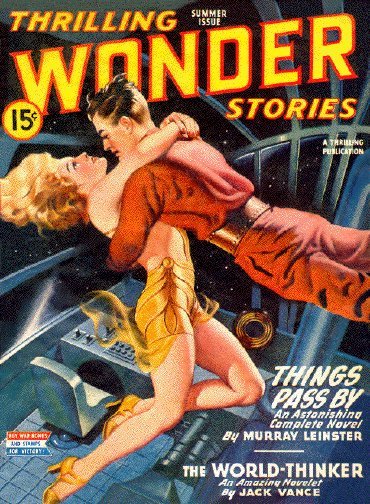
The adventure that combines the apparent magic of technology with the bright and mystical appeal of strange new worlds, carrying along with it so many other perennial fantasies and yearnings, sparks the imagination, particularly of the young. For instance, twelve year old Ursula LeGuin, who found a little leather bound copy of Lord Dusany’s A Dreamer’s Tale in the living room bookcase one boring evening. Later she and her brother shared copies of Thrilling Wonder Magazine, making favorite phrases from the stories a part of their secret language.
Or young Margaret Atwood, hiding from homework in the basement by reading H. Rider Haggard and H.G. Wells in old volumes forgotten by her father. Or young Issac Asimov, devouring the new issues of the sci-fi pulp magazines, reading in "vivid and agonizing transport because I wanted to be part of the story and couldn't…" These science fiction stories "ravished my soul and opened it to a music of the spheres that few can hear…"
Or young Henry Miller poring over Rider Haggard's tales in a secret hillside cave with his blood brothers—"these books were part of our Spartan discipline, our spiritual training…..Our grown-up boys, the scientists, prate about the imminent conquest of the moon” (he wrote in the 1960s); “our children have already voyaged far beyond the moon. They are ready, at a moment's notice, to take off for Vega—and beyond. They beg our supposedly superior intellects to furnish them with a new cosmogony and a new cosmology. They have grown intolerant of our naïve, limited, antiquated theories of the universe."
Or young Jose Luis Borges, exploring strange new worlds through the words of Jules Verne and H.G. Wells. “Wells’ fictions were the first books I read,” he would later recall; “perhaps they will be the last.”
“Something so absurd as a boyhood book momentarily captures the mind and never quite releases it,” a character muses in a novel by Jim Harrison. The “childishness” in sci-fi adventure continues to speak to the child’s sense of possibility and yearning for purposeful action. It’s a chord that Star Trek continues to strike, forty years later.
So Star Trek had an adventure story hero in Captain Kirk, based largely on the hero of C. S. Forrester’s naval adventures, Horatio Hornblower. The conventions of fictional shipboard adventures were observed in characters like Scotty, the constantly-in-crisis, miracle-working engineer. The crusty, skeptical doctor with a heart of gold was familiar from westerns as well. The element of the fantastic was represented, of course, in the mysterious, otherworldly Mr. Spock.
The adventure is an aspect or a “level” of more sophisticated sci-fi: and the romance of the strange and unknown, as well as the attraction of heroes who use their minds and hearts as well as their brawn, is part of the best science fiction of all eras. It has been important in inspiring young readers and viewers, including those who would continue and expand the literature, as well as those who would become doctors and engineers, scientists and astronauts.
The adventure that combines the apparent magic of technology with the bright and mystical appeal of strange new worlds, carrying along with it so many other perennial fantasies and yearnings, sparks the imagination, particularly of the young. For instance, twelve year old Ursula LeGuin, who found a little leather bound copy of Lord Dusany’s A Dreamer’s Tale in the living room bookcase one boring evening. Later she and her brother shared copies of Thrilling Wonder Magazine, making favorite phrases from the stories a part of their secret language.
Or young Margaret Atwood, hiding from homework in the basement by reading H. Rider Haggard and H.G. Wells in old volumes forgotten by her father. Or young Issac Asimov, devouring the new issues of the sci-fi pulp magazines, reading in "vivid and agonizing transport because I wanted to be part of the story and couldn't…" These science fiction stories "ravished my soul and opened it to a music of the spheres that few can hear…"
Or young Henry Miller poring over Rider Haggard's tales in a secret hillside cave with his blood brothers—"these books were part of our Spartan discipline, our spiritual training…..Our grown-up boys, the scientists, prate about the imminent conquest of the moon” (he wrote in the 1960s); “our children have already voyaged far beyond the moon. They are ready, at a moment's notice, to take off for Vega—and beyond. They beg our supposedly superior intellects to furnish them with a new cosmogony and a new cosmology. They have grown intolerant of our naïve, limited, antiquated theories of the universe."
Or young Jose Luis Borges, exploring strange new worlds through the words of Jules Verne and H.G. Wells. “Wells’ fictions were the first books I read,” he would later recall; “perhaps they will be the last.”
“Something so absurd as a boyhood book momentarily captures the mind and never quite releases it,” a character muses in a novel by Jim Harrison. The “childishness” in sci-fi adventure continues to speak to the child’s sense of possibility and yearning for purposeful action. It’s a chord that Star Trek continues to strike, forty years later.

Machine Dreams
Asimov’s second phase of sci-fi centered on science and technology themselves. The machinery imagined in the 30s and 40s—much of which became part of our lives in the 60s and since—took center stage as objects of fear and wonder, determining the future.
For some, future technologies were the essence of science fiction (some Star Trek commentators still stress this.) While these stories deal with dangers and misapplied technologies, they also suggest the wonder of what these technologies could do and how they expand the human presence and power in the universe.
Machine-centered sci-fi sought to convince readers these technologies were possible if not probable, and time was spent explaining how the technologies worked. The best authors created believability by showing how recognizable humans interact with these machines (to my mind, exemplified by the Russian sci-fi author Stanislaw Lem in Pirx the Pilot and other fictions.) At times, the technologies—particularly robots and space ships-- evinced personalities, and were often treated as characters.
Science was a basis for storytelling in other ways as well. A newly discovered or poorly understood scientific phenomenon could center a story, and scientifically-minded sci-fi heroes saved the day by applying their knowledge in large ways or small (as in the clever solutions used by the TV series hero, McGuyver.) Stories often offered a scientific basis for alien life on other planets, in general or in relation to a planet’s physical characteristics, or in explaining radically different forms of intelligent life.
Taking imaginary technology and the scientific possibilities of alien life so seriously became the defining characteristics of sci-fi fans in the public mind, and a source of ridicule. A divide arose between those who believed in the plausibility of these technologies and stories—for whom they were in that sense “real”—and those who reacted with alarm and contempt against fictional technologies or aliens as too strange and “unreal” began to define the sci-fi genre as outside the mainstream.
For their part, alienated fans and devotees of sci-fi pulps and novels began meeting in conventions and creating their own fan publications. It was this era of sci-fi that solidified the separation of science fiction from mainstream storytelling, and mainstream life. The characteristics of this era’s fiction, as well as the reaction to it, would become important in the development of the Star Trek universe, and in Star Trek’s history and fate.
Being grounded in science and reality was important especially in the conception of Star Trek’s universe in which all stories would take place. It not only honored an important element of sci-fi history (as “Tom Corbett” had done by hiring the eminent rocket expert Willy Ley as its science advisor) but it was also extremely important for television, for telling many stories over time.
For scientific accuracy, the Trek team consulted with scientists at RAND and the Jet Propulsion Laboratory, involving technical matters at high and rarified levels, such as whether faster-than-light travel was possible, and if so, what principles might be involved in powering a craft through the immense distances between the stars.
But Roddenberry and other veterans could bring their own experience with large ships and large aircraft in World War II to the concept of a large starship and crew. The Trek team thought carefully about how many people would be aboard, where they would sleep and how they would eat. They thought about how the bridge would work best, and who would be on it. Where would the ideal place for the captain to be?
“My feeling was that if you didn’t believe in the spaceship,” Roddenberry said,”---if you didn’t believe you were in a vehicle traveling through space, a vehicle that made sense, whose layout and design made sense…then you wouldn’t believe in the series.”
As in many sci-fi stories, the ship—the Enterprise—was a major character. But this Enterprise was going to be seen, week after week, and most importantly, it had to be built. Star Trek created a believable, self-consistent technology, and believable, self-consistent universe.
But of course it didn’t sacrifice wonder. It was set in the future, so there was plenty of speculation and invention, generating ideas that forty years later is still generating actual new technologies.
Asimov’s second phase of sci-fi centered on science and technology themselves. The machinery imagined in the 30s and 40s—much of which became part of our lives in the 60s and since—took center stage as objects of fear and wonder, determining the future.
For some, future technologies were the essence of science fiction (some Star Trek commentators still stress this.) While these stories deal with dangers and misapplied technologies, they also suggest the wonder of what these technologies could do and how they expand the human presence and power in the universe.
Machine-centered sci-fi sought to convince readers these technologies were possible if not probable, and time was spent explaining how the technologies worked. The best authors created believability by showing how recognizable humans interact with these machines (to my mind, exemplified by the Russian sci-fi author Stanislaw Lem in Pirx the Pilot and other fictions.) At times, the technologies—particularly robots and space ships-- evinced personalities, and were often treated as characters.
Science was a basis for storytelling in other ways as well. A newly discovered or poorly understood scientific phenomenon could center a story, and scientifically-minded sci-fi heroes saved the day by applying their knowledge in large ways or small (as in the clever solutions used by the TV series hero, McGuyver.) Stories often offered a scientific basis for alien life on other planets, in general or in relation to a planet’s physical characteristics, or in explaining radically different forms of intelligent life.
Taking imaginary technology and the scientific possibilities of alien life so seriously became the defining characteristics of sci-fi fans in the public mind, and a source of ridicule. A divide arose between those who believed in the plausibility of these technologies and stories—for whom they were in that sense “real”—and those who reacted with alarm and contempt against fictional technologies or aliens as too strange and “unreal” began to define the sci-fi genre as outside the mainstream.
For their part, alienated fans and devotees of sci-fi pulps and novels began meeting in conventions and creating their own fan publications. It was this era of sci-fi that solidified the separation of science fiction from mainstream storytelling, and mainstream life. The characteristics of this era’s fiction, as well as the reaction to it, would become important in the development of the Star Trek universe, and in Star Trek’s history and fate.
Being grounded in science and reality was important especially in the conception of Star Trek’s universe in which all stories would take place. It not only honored an important element of sci-fi history (as “Tom Corbett” had done by hiring the eminent rocket expert Willy Ley as its science advisor) but it was also extremely important for television, for telling many stories over time.
For scientific accuracy, the Trek team consulted with scientists at RAND and the Jet Propulsion Laboratory, involving technical matters at high and rarified levels, such as whether faster-than-light travel was possible, and if so, what principles might be involved in powering a craft through the immense distances between the stars.
But Roddenberry and other veterans could bring their own experience with large ships and large aircraft in World War II to the concept of a large starship and crew. The Trek team thought carefully about how many people would be aboard, where they would sleep and how they would eat. They thought about how the bridge would work best, and who would be on it. Where would the ideal place for the captain to be?
“My feeling was that if you didn’t believe in the spaceship,” Roddenberry said,”---if you didn’t believe you were in a vehicle traveling through space, a vehicle that made sense, whose layout and design made sense…then you wouldn’t believe in the series.”
As in many sci-fi stories, the ship—the Enterprise—was a major character. But this Enterprise was going to be seen, week after week, and most importantly, it had to be built. Star Trek created a believable, self-consistent technology, and believable, self-consistent universe.
But of course it didn’t sacrifice wonder. It was set in the future, so there was plenty of speculation and invention, generating ideas that forty years later is still generating actual new technologies.
The Wells Rules
While Star Trek took its technology seriously, it did not allow technology to be its master, or the master of its future. Apart from what this said about the future, it was essential to dramatic television . “Drama is people,” GR said. “Too much of science fiction is about gadgets and not about people…. I’m going to try to make it as scientifically accurate as possible and write [these scripts] the way we wrote the old Playhouse 90.”
But this is also a description of the best science fiction, using rules described by H.G. Wells in a preface to his collected science fiction novels in 1934. First, there was the new fantastic element the story introduces, like a time machine, or invaders from Mars. Wells called it “the magic trick.” The trick itself has to be at least plausible, and science provided the rationale. Wells called it “an ingenuous use of scientific patter…as near actual theory as possible.”
It also helped if this element could be “explained in commonplace terms.” So Wells could suggest that the time machine moves you through time like a railroad train moves you through space, or a balloon moves against gravitation and takes you into the air. He could describe what it looked like in familiar terms---nickel bars, quartz rods, ivory and brass--without needing to really say how a time machine would actually work.
But in addition to some intrinsic plausibility, the trick worked best if it is surrounded by other elements of the ordinary---by the familiar. You must “domesticate the impossible hypothesis,” Wells wrote. It was also important to limit the number of magic tricks, Wells warned, or the whole reality would be called into question. “Nothing remains interesting when anything may happen.”
Part of creating a credible world was also a key to science fiction’s function: integrating the human into the science and the fiction by placing believable people in plausible if unprecedented circumstances. “Then it becomes human,” Wells wrote. “’How would you feel and what might not happen to you’ is the typical question, if for instance…you became invisible?”
The intent finally is “to keep everything human and real…the whole interest becomes the interest of looking at human feelings and human ways, from the new angle that has been acquired.”
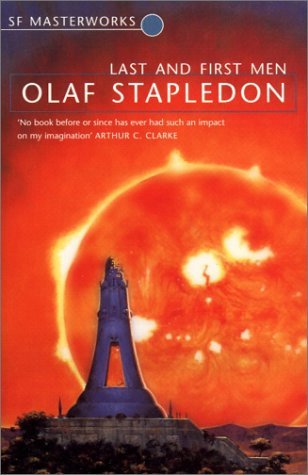
The fantastic would at times be the magic trick, and at other times part of the reality. Although not as well known a name as Wells, another British science fiction author (and Wells devotee) was Olaf Stapledon. While Wells originated most of the basic ideas sci-fi authors would use forever after, Stapledon contributed one powerful and lasting one: the galactic history, following species and civilizations across eons of time. Most sci-fi writers have read Stapledon with awe, and that includes Roddenberry, who specifically read his work while he prepared Star Trek, and then again as he was preparing Star Trek: The Next Generation. Here’s what Stapledon wrote about the place of the fantastic in tales of space and time:
“Had I chosen matter in which there was nothing whatever of the fantastic, its very plausibility would have rendered it implausible,” Stapledon wrote in his preface to Last and First Men (one of the novels Roddenberry read). “For one thing at least is almost certain about the future, namely, that very much of it will be such as we should call incredible.”
While Star Trek took its technology seriously, it did not allow technology to be its master, or the master of its future. Apart from what this said about the future, it was essential to dramatic television . “Drama is people,” GR said. “Too much of science fiction is about gadgets and not about people…. I’m going to try to make it as scientifically accurate as possible and write [these scripts] the way we wrote the old Playhouse 90.”
But this is also a description of the best science fiction, using rules described by H.G. Wells in a preface to his collected science fiction novels in 1934. First, there was the new fantastic element the story introduces, like a time machine, or invaders from Mars. Wells called it “the magic trick.” The trick itself has to be at least plausible, and science provided the rationale. Wells called it “an ingenuous use of scientific patter…as near actual theory as possible.”
It also helped if this element could be “explained in commonplace terms.” So Wells could suggest that the time machine moves you through time like a railroad train moves you through space, or a balloon moves against gravitation and takes you into the air. He could describe what it looked like in familiar terms---nickel bars, quartz rods, ivory and brass--without needing to really say how a time machine would actually work.
But in addition to some intrinsic plausibility, the trick worked best if it is surrounded by other elements of the ordinary---by the familiar. You must “domesticate the impossible hypothesis,” Wells wrote. It was also important to limit the number of magic tricks, Wells warned, or the whole reality would be called into question. “Nothing remains interesting when anything may happen.”
Part of creating a credible world was also a key to science fiction’s function: integrating the human into the science and the fiction by placing believable people in plausible if unprecedented circumstances. “Then it becomes human,” Wells wrote. “’How would you feel and what might not happen to you’ is the typical question, if for instance…you became invisible?”
The intent finally is “to keep everything human and real…the whole interest becomes the interest of looking at human feelings and human ways, from the new angle that has been acquired.”
The fantastic would at times be the magic trick, and at other times part of the reality. Although not as well known a name as Wells, another British science fiction author (and Wells devotee) was Olaf Stapledon. While Wells originated most of the basic ideas sci-fi authors would use forever after, Stapledon contributed one powerful and lasting one: the galactic history, following species and civilizations across eons of time. Most sci-fi writers have read Stapledon with awe, and that includes Roddenberry, who specifically read his work while he prepared Star Trek, and then again as he was preparing Star Trek: The Next Generation. Here’s what Stapledon wrote about the place of the fantastic in tales of space and time:
“Had I chosen matter in which there was nothing whatever of the fantastic, its very plausibility would have rendered it implausible,” Stapledon wrote in his preface to Last and First Men (one of the novels Roddenberry read). “For one thing at least is almost certain about the future, namely, that very much of it will be such as we should call incredible.”
The Gulliver Factor
The third period Asimov identified was dominated by what he called “sociology.” It shifted attention away from technology itself to its effects on people and society. It flourished in the 1950s after the atom bomb and as awareness of environmental damage and anxieties over the possible coming dominance of “thinking machines” permeated all arts and culture.
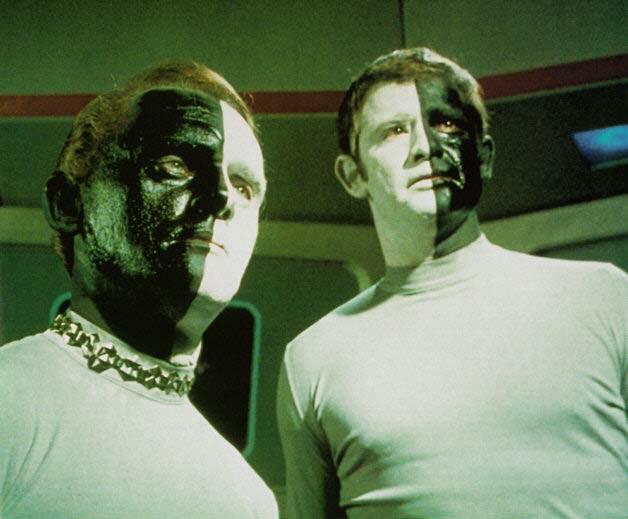
There is a definite strain of this in Star Trek, especially in the consistent humanizing of technology through the characters’ relationship to the Enterprise, and the explorations of the proper uses of technology. But looked at more broadly, this might include other levels of story that were present in the best science fiction from the beginning—from before there was a sci-fi genre. It’s the level of metaphor and allegory—what might be called the Gulliver Factor.
By 1964 Roddenberry was meeting regularly with Herb Solow to flesh out the Star Trek premise. To reinforce believability, Solow suggested a narrative tactic he remembered from Jonathan Swift’s Gulliver’s Travels.” These experiences among fantastic societies no one had ever seen were described matter-of-factly with the vocabulary of a traveler’s report. Because Gulliver talked about them as if they had already happened, it suggested to readers that they should accept these events as having happened. Solow advised they use this approach for Star Trek. Even though the events were to take place in a future inaccessible to the viewer, they could be presented as stories or reports related by a narrator who had already experienced them. This became the subtle tactic of the “Captain’s Log” that began episodes, and also provided useful for exposition and reminding viewers what they’d seen before the commercials.
But Gulliver’s Travels suggested that other possibility. “I recalled that when Jonathan Swift was writing Gulliver’s Travels, he wanted to write satire on his time,” Roddenberry said later. By setting his adventure in Lilliput, “he could talk about insane prime ministers and crooked kings, and all of that…Children could read it as a fairy tale, an adventure, and as they got older they’d recognize it for what it really is. It seemed to me that perhaps if I wanted to talk about sex, religion, politics, make some comments against Vietnam and so on, that if I had similar situations involving these subjects, happening on other planets to little green people, indeed it might get by. And it did.”
This feature of Star Trek’s storytelling---the allegorical or metaphorical dimension—became a major part of its identity. Many years later, when he recalled realizing that he could do what Swift had done, Roddenberry described it as a kind of religious experience.
Of course, contemporary commentaries disguised as science fiction had a pedigree going back to George Orwell and beyond; they’d even been done on television very recently. The Twilight Zone told stories concerning fallout shelters and nuclear holocaust that became the topic of conversations across America the next day, but everything was located in an imaginary realm. Stories on The Outer Limits dealt with Presidential assassination and electronic surveillance.
But the Gulliver difference was in the possibility of a continuing exploration by a central character or set of characters, one of which Roddenberry always intended would be the Enterprise itself. In fact, Solow and GR were so enamoured with the Jonathan Swift model that for a brief moment they were going to rename the series “Gulliver’s Travels.”
Besides the believable universe for telling allegorical tales, Star Trek provided an additional dimension. Building a universe from nothing was a difficult task, but it also was a remarkable opportunity. Perhaps it happened intuitively or incrementally over the years, but eventually Roddenberry saw his chance to embody a vision of a better future. For after all, if you have to build a universe from scratch, why not build one you’d like to live in? Not only would that be satisfying and even edifying on many levels, it might turn out to be the kind of universe that viewers will want to live in, too, at least for sixty minutes a week.
For one thing, envisioning this as a better future simply made sense. Humanity would have to improve itself as well as its technology simply to survive into the future. As some people who thought seriously about the future were already pointing out, a number of serious problems will need to be addressed if humanity was going to continue in the general direction of its development. There would have to be societies capable of supporting these imagined technological developments, which would mean, for instance, avoiding one catastrophic war too many, and dealing with the limitations of environmental resources.
Envisioning a better future was a philosophical task, and one that at least some science fiction had taken on. It was present in Roddenberry’s thinking about the crew of the Enterprise, and it would grow to become another essential and defining characteristic of Star Trek.
Stories are by their nature explorations. Science fiction stories simultaneously explore the future and the present. They use the future and imagined other worlds and beings to reflect on humanity now. In Star Trek, those reflections become purposeful guides to the future: morality plays or simply probes exploring possibilities that suggest how we need to be and to become in order to get to that better future of humanity fulfilled.
The adventure, the possibilities and the unintended effects of science and technology, the particular allegorical and metaphorical possibilities of science fiction storytelling, and the exploration of soul as well as machinery, are all essential to imagining a better future, and all are part of Star Trek’s science fiction storytelling.
In the introduction to his book, Profiles of the Future (which GR read and admired while developing Star Trek), Arthur C. Clarke writes: "…I would now go so far as to claim that only readers or writers of science-fiction are really competent to discuss the possibilities of the future…A critical—the adjective is important—reading of science-fiction is essential training for anyone wishing to look more than ten years ahead. The facts of the future can hardly be imagined ab initio by those who are unfamiliar with the fantasies of the past."
In another essay, Clarke quotes from a 1957 article by Hermann J. Muller, discoverer of the genetic effects of radiation: "If our art…does not explore the relations and contingencies implicit in the greater world into which we are forcing our way, and does not reflect the hopes and fears based on these appraisals, then the art is a dead pretense…But man will not live without art. In a scientific age he will therefore have science fiction."
The third period Asimov identified was dominated by what he called “sociology.” It shifted attention away from technology itself to its effects on people and society. It flourished in the 1950s after the atom bomb and as awareness of environmental damage and anxieties over the possible coming dominance of “thinking machines” permeated all arts and culture.
There is a definite strain of this in Star Trek, especially in the consistent humanizing of technology through the characters’ relationship to the Enterprise, and the explorations of the proper uses of technology. But looked at more broadly, this might include other levels of story that were present in the best science fiction from the beginning—from before there was a sci-fi genre. It’s the level of metaphor and allegory—what might be called the Gulliver Factor.
By 1964 Roddenberry was meeting regularly with Herb Solow to flesh out the Star Trek premise. To reinforce believability, Solow suggested a narrative tactic he remembered from Jonathan Swift’s Gulliver’s Travels.” These experiences among fantastic societies no one had ever seen were described matter-of-factly with the vocabulary of a traveler’s report. Because Gulliver talked about them as if they had already happened, it suggested to readers that they should accept these events as having happened. Solow advised they use this approach for Star Trek. Even though the events were to take place in a future inaccessible to the viewer, they could be presented as stories or reports related by a narrator who had already experienced them. This became the subtle tactic of the “Captain’s Log” that began episodes, and also provided useful for exposition and reminding viewers what they’d seen before the commercials.
But Gulliver’s Travels suggested that other possibility. “I recalled that when Jonathan Swift was writing Gulliver’s Travels, he wanted to write satire on his time,” Roddenberry said later. By setting his adventure in Lilliput, “he could talk about insane prime ministers and crooked kings, and all of that…Children could read it as a fairy tale, an adventure, and as they got older they’d recognize it for what it really is. It seemed to me that perhaps if I wanted to talk about sex, religion, politics, make some comments against Vietnam and so on, that if I had similar situations involving these subjects, happening on other planets to little green people, indeed it might get by. And it did.”
This feature of Star Trek’s storytelling---the allegorical or metaphorical dimension—became a major part of its identity. Many years later, when he recalled realizing that he could do what Swift had done, Roddenberry described it as a kind of religious experience.
Of course, contemporary commentaries disguised as science fiction had a pedigree going back to George Orwell and beyond; they’d even been done on television very recently. The Twilight Zone told stories concerning fallout shelters and nuclear holocaust that became the topic of conversations across America the next day, but everything was located in an imaginary realm. Stories on The Outer Limits dealt with Presidential assassination and electronic surveillance.
But the Gulliver difference was in the possibility of a continuing exploration by a central character or set of characters, one of which Roddenberry always intended would be the Enterprise itself. In fact, Solow and GR were so enamoured with the Jonathan Swift model that for a brief moment they were going to rename the series “Gulliver’s Travels.”
Besides the believable universe for telling allegorical tales, Star Trek provided an additional dimension. Building a universe from nothing was a difficult task, but it also was a remarkable opportunity. Perhaps it happened intuitively or incrementally over the years, but eventually Roddenberry saw his chance to embody a vision of a better future. For after all, if you have to build a universe from scratch, why not build one you’d like to live in? Not only would that be satisfying and even edifying on many levels, it might turn out to be the kind of universe that viewers will want to live in, too, at least for sixty minutes a week.
For one thing, envisioning this as a better future simply made sense. Humanity would have to improve itself as well as its technology simply to survive into the future. As some people who thought seriously about the future were already pointing out, a number of serious problems will need to be addressed if humanity was going to continue in the general direction of its development. There would have to be societies capable of supporting these imagined technological developments, which would mean, for instance, avoiding one catastrophic war too many, and dealing with the limitations of environmental resources.
Envisioning a better future was a philosophical task, and one that at least some science fiction had taken on. It was present in Roddenberry’s thinking about the crew of the Enterprise, and it would grow to become another essential and defining characteristic of Star Trek.
Stories are by their nature explorations. Science fiction stories simultaneously explore the future and the present. They use the future and imagined other worlds and beings to reflect on humanity now. In Star Trek, those reflections become purposeful guides to the future: morality plays or simply probes exploring possibilities that suggest how we need to be and to become in order to get to that better future of humanity fulfilled.
The adventure, the possibilities and the unintended effects of science and technology, the particular allegorical and metaphorical possibilities of science fiction storytelling, and the exploration of soul as well as machinery, are all essential to imagining a better future, and all are part of Star Trek’s science fiction storytelling.
In the introduction to his book, Profiles of the Future (which GR read and admired while developing Star Trek), Arthur C. Clarke writes: "…I would now go so far as to claim that only readers or writers of science-fiction are really competent to discuss the possibilities of the future…A critical—the adjective is important—reading of science-fiction is essential training for anyone wishing to look more than ten years ahead. The facts of the future can hardly be imagined ab initio by those who are unfamiliar with the fantasies of the past."
In another essay, Clarke quotes from a 1957 article by Hermann J. Muller, discoverer of the genetic effects of radiation: "If our art…does not explore the relations and contingencies implicit in the greater world into which we are forcing our way, and does not reflect the hopes and fears based on these appraisals, then the art is a dead pretense…But man will not live without art. In a scientific age he will therefore have science fiction."
Saturday, August 26, 2006

Trekcheck: Of Rumor, Roast and SOST in Seattle
SOST in Seattle
It’s confirmed. I will be moderating a panel called “The Soul of Star Trek: The Prime Directive and Beyond” at the Planet Xpo Star Trek 40th Anniversary Gala Celebration in Seattle. As of now it’s scheduled for Friday, September 8 at 3:30 p in the main auditorium at the Science Fiction Museum. Also on the panel will be screenwriter (and TNG writer) Tracy Torme, and authors Jeff Greenwald (Future Perfect) and Dave Marinaccio (All I Really Need to Know I Learned From Star Trek.) So if you’re going to be in Seattle, come on by where no blog has gone before, and engage.
Rumor
Several sites have repeated this bombshell of a story, all using the same source—a post at the Omega Sector. The post reports on an article in Star Trek Magazine, presumably the Brit magazine, that purportedly quotes a producer of Star Trek XI as denying the rumors that the movie will recast the roles of Kirk and Spock. Since that’s only been the major assumption everyone has made about the movie, it’s pretty significant. But isn’t there somebody else with a copy of the magazine who can confirm it?
Roast
I found to my relief that at least the first several comments on the William Shatner site share my view of the Roast on Comedy Central: For the most part it was sordid, dismaying and not funny. There was little humor and less wit on display; the so-called jokes about age were very old and tired, showing that these younger “comedians” have shriveled imaginations; and the jokes about race were not only hoary, they were the kind of jokes that were exhibit A in cultural racism as widely discussed in the 1960s, when Star Trek broke racial barriers on television. The gay jokes were obscene, one-dimensional and ugly. One or two or even a half-dozen might have approached being funny or at least tolerable, but getting continually hit over the head with an infected sledgehammer is not my idea of hilarity.
The level of so-called humor may be familiar and comfortable to those who watch Comedy Central shows, and who count themselves fans of South Park, or even those who like the milder forms of loud, rude, crude, hostile and self-loathing toilet humor that characterizes many of today’s comic films. But for viewers who have seen only The Daily Show and The Colbert Report on that channel, or who tuned in because of Captain Kirk, it must have been profoundly shocking and disillusioning.
Even many of the higher wattage invited guests (including Star Trek actors like Brent Spiner and Rene Auberjonois; I think I spotted Rodger Corman in the crowd) appeared appalled. There was some poor woman in the front, apparently the date or wife of somebody who appeared with Shatner in his police series, who looked aghast and confused from the outset, as well as deeply humiliated.
It was a depressing and humiliating experience watching it. It was all most unfortunate because Captain Kirk is a hero to children, and I’ll bet many badgered their parents into letting them see this. Teenagers who see Shatner as Denny Crain as well as Captain Kirk can now believe that hate humor is acceptable and funny. Well done all.
I probably wouldn’t even have watched it except for the piece in Trek Today that quoted George Takei being very articulate on political matters that relate to his view of what Star Trek means. It also presented some of his lines from the roast, some of which were pretty daring but also witty, and so I thought it might be worth seeing. But not only did his best lines never make it on the air, most of his presentation was more of the same sordid and moronic fratboy obscenities as vomited up by the stage full of surly no-talents around him. This outspoken opponent of stereotypes felt compelled to stereotype and demean himself. I wonder if the others had made the same sort of cracks about his Japanese ancestry as they made about his homosexuality, if he would have joined in those as well. I may have lost some respect for him, especially because he didn’t show much for himself.
As for his attitude toward Shatner, there was so much obvious hostility and vengefulness that it really wasn’t at all funny—it was embarassing psychodrama. I suppose the built-up pressure of all the years of public pretense about his feelings concerning Shatner just got loose, but it sure didn’t look like it was all in good fun.
If you’ve ever seen Nichelle Nichols in person, you know that she is a true lady: regal in bearing, generous and courteous, but she takes no nonsense. Of course there’s nothing wrong in her showing an earthy side in public, and perhaps it was because she didn’t share sufficiently in the ugliness otherwise on display that her part of the roast was cut to a minute or so for the show that aired, and shoved in just before a commercial. But she was a target of jokes that to me demeaned her and Star Trek’s legacy in maters of race and the Other. I’m guessing that she regrets participating.
As for Shatner, this was hardly the affirmation of his status in popular culture—it was a humiliating mistake. Not that he came off so badly himself, but that he participated in this catastrophe in the first place. The only person who came off well was Leonard Nimoy, by refusing to participate but doing an actually funny little preliminary filmed skit with Shatner. (Note the prominent statue of the Buddha in the background at Nimoy’s, very droll).
I’m not against Star Trek stars making fun of themselves, or coming down to earth with their humor (You Tube has a funny piece with Patrick Stewart pretending to talk with another actor about the screenplay he’s writing, which consists of one scene after another of women suddenly getting their clothes blown off “and you can see everything.” It’s especially witty if you know anything about actor lore.) I don’t even care if they make fools of themselves. But I do object to them undermining everything Star Trek stood for, including notions of quality. That roast is worth forgetting as soon and as completely as possible. Maybe an Emmy or two for Shatner on Sunday will help... Now Boston Legal--that's funny.
Now if all goes well, the next installment of the Countdown to 40…
SOST in Seattle
It’s confirmed. I will be moderating a panel called “The Soul of Star Trek: The Prime Directive and Beyond” at the Planet Xpo Star Trek 40th Anniversary Gala Celebration in Seattle. As of now it’s scheduled for Friday, September 8 at 3:30 p in the main auditorium at the Science Fiction Museum. Also on the panel will be screenwriter (and TNG writer) Tracy Torme, and authors Jeff Greenwald (Future Perfect) and Dave Marinaccio (All I Really Need to Know I Learned From Star Trek.) So if you’re going to be in Seattle, come on by where no blog has gone before, and engage.
Rumor
Several sites have repeated this bombshell of a story, all using the same source—a post at the Omega Sector. The post reports on an article in Star Trek Magazine, presumably the Brit magazine, that purportedly quotes a producer of Star Trek XI as denying the rumors that the movie will recast the roles of Kirk and Spock. Since that’s only been the major assumption everyone has made about the movie, it’s pretty significant. But isn’t there somebody else with a copy of the magazine who can confirm it?
Roast
I found to my relief that at least the first several comments on the William Shatner site share my view of the Roast on Comedy Central: For the most part it was sordid, dismaying and not funny. There was little humor and less wit on display; the so-called jokes about age were very old and tired, showing that these younger “comedians” have shriveled imaginations; and the jokes about race were not only hoary, they were the kind of jokes that were exhibit A in cultural racism as widely discussed in the 1960s, when Star Trek broke racial barriers on television. The gay jokes were obscene, one-dimensional and ugly. One or two or even a half-dozen might have approached being funny or at least tolerable, but getting continually hit over the head with an infected sledgehammer is not my idea of hilarity.
The level of so-called humor may be familiar and comfortable to those who watch Comedy Central shows, and who count themselves fans of South Park, or even those who like the milder forms of loud, rude, crude, hostile and self-loathing toilet humor that characterizes many of today’s comic films. But for viewers who have seen only The Daily Show and The Colbert Report on that channel, or who tuned in because of Captain Kirk, it must have been profoundly shocking and disillusioning.
Even many of the higher wattage invited guests (including Star Trek actors like Brent Spiner and Rene Auberjonois; I think I spotted Rodger Corman in the crowd) appeared appalled. There was some poor woman in the front, apparently the date or wife of somebody who appeared with Shatner in his police series, who looked aghast and confused from the outset, as well as deeply humiliated.
It was a depressing and humiliating experience watching it. It was all most unfortunate because Captain Kirk is a hero to children, and I’ll bet many badgered their parents into letting them see this. Teenagers who see Shatner as Denny Crain as well as Captain Kirk can now believe that hate humor is acceptable and funny. Well done all.
I probably wouldn’t even have watched it except for the piece in Trek Today that quoted George Takei being very articulate on political matters that relate to his view of what Star Trek means. It also presented some of his lines from the roast, some of which were pretty daring but also witty, and so I thought it might be worth seeing. But not only did his best lines never make it on the air, most of his presentation was more of the same sordid and moronic fratboy obscenities as vomited up by the stage full of surly no-talents around him. This outspoken opponent of stereotypes felt compelled to stereotype and demean himself. I wonder if the others had made the same sort of cracks about his Japanese ancestry as they made about his homosexuality, if he would have joined in those as well. I may have lost some respect for him, especially because he didn’t show much for himself.
As for his attitude toward Shatner, there was so much obvious hostility and vengefulness that it really wasn’t at all funny—it was embarassing psychodrama. I suppose the built-up pressure of all the years of public pretense about his feelings concerning Shatner just got loose, but it sure didn’t look like it was all in good fun.
If you’ve ever seen Nichelle Nichols in person, you know that she is a true lady: regal in bearing, generous and courteous, but she takes no nonsense. Of course there’s nothing wrong in her showing an earthy side in public, and perhaps it was because she didn’t share sufficiently in the ugliness otherwise on display that her part of the roast was cut to a minute or so for the show that aired, and shoved in just before a commercial. But she was a target of jokes that to me demeaned her and Star Trek’s legacy in maters of race and the Other. I’m guessing that she regrets participating.
As for Shatner, this was hardly the affirmation of his status in popular culture—it was a humiliating mistake. Not that he came off so badly himself, but that he participated in this catastrophe in the first place. The only person who came off well was Leonard Nimoy, by refusing to participate but doing an actually funny little preliminary filmed skit with Shatner. (Note the prominent statue of the Buddha in the background at Nimoy’s, very droll).
I’m not against Star Trek stars making fun of themselves, or coming down to earth with their humor (You Tube has a funny piece with Patrick Stewart pretending to talk with another actor about the screenplay he’s writing, which consists of one scene after another of women suddenly getting their clothes blown off “and you can see everything.” It’s especially witty if you know anything about actor lore.) I don’t even care if they make fools of themselves. But I do object to them undermining everything Star Trek stood for, including notions of quality. That roast is worth forgetting as soon and as completely as possible. Maybe an Emmy or two for Shatner on Sunday will help... Now Boston Legal--that's funny.
Now if all goes well, the next installment of the Countdown to 40…
Countdown to 40: From the New to the Final Fronter
by William S. Kowinski
1960 was the first time the Democratic National Convention would be held in Los Angeles. The party and the city had been preparing for many months (including the Los Angeles Police Department, where Gene Roddenberry used to work, and where his father and other family and friends still did. ) Not only would there be thousands of delegates, politicians and reporters, but by then the television networks had learned how to cover a convention.
This one was shaping up to be especially dramatic, perfect for the TV cameras. Television was an especially effective medium for the young Senator from Massachusetts and front-running candidate for the presidential nomination, John F. Kennedy.
Gene Roddenberry had been raised a Democrat---his father was uncompromising on the matter. But GR had another reason to be watching closely. Some 17 years before, Navy Lieutenant John Kennedy had also served in the South Pacific. In 1943, just a few hundred miles from where GR was stationed, Kennedy’s PT boat had been cut in half by a Japanese destroyer. Planes from Roddenberry's base joined the search and rescue, and if GR hadn’t been involved in an accident that disabled his plane, he might well have been in the air looking for Kennedy and his men that day.
After six days, Kennedy was found. He swam three miles to a small island, leading two of his men, and towing an injured man with a rope held in his teeth. He kept them alive until they were rescued. After recovering from his back injuries, Kennedy ran for Congress and then became a Senator from Massachusetts. After nearly being nominated for vice-president in 1956, Kennedy entered presidential primaries in 1960 and became the first candidate to earn his way to the national convention through votes rather than the approval of party bosses.
by William S. Kowinski
1960 was the first time the Democratic National Convention would be held in Los Angeles. The party and the city had been preparing for many months (including the Los Angeles Police Department, where Gene Roddenberry used to work, and where his father and other family and friends still did. ) Not only would there be thousands of delegates, politicians and reporters, but by then the television networks had learned how to cover a convention.
This one was shaping up to be especially dramatic, perfect for the TV cameras. Television was an especially effective medium for the young Senator from Massachusetts and front-running candidate for the presidential nomination, John F. Kennedy.
Gene Roddenberry had been raised a Democrat---his father was uncompromising on the matter. But GR had another reason to be watching closely. Some 17 years before, Navy Lieutenant John Kennedy had also served in the South Pacific. In 1943, just a few hundred miles from where GR was stationed, Kennedy’s PT boat had been cut in half by a Japanese destroyer. Planes from Roddenberry's base joined the search and rescue, and if GR hadn’t been involved in an accident that disabled his plane, he might well have been in the air looking for Kennedy and his men that day.
After six days, Kennedy was found. He swam three miles to a small island, leading two of his men, and towing an injured man with a rope held in his teeth. He kept them alive until they were rescued. After recovering from his back injuries, Kennedy ran for Congress and then became a Senator from Massachusetts. After nearly being nominated for vice-president in 1956, Kennedy entered presidential primaries in 1960 and became the first candidate to earn his way to the national convention through votes rather than the approval of party bosses.

JFK to GR:Challenges for the Future
When the convention gathered at the LA Memorial Sports Arena, the struggle was shaping up to be between Kennedy and the older powers of the party, and his nomination was not certain. But after a dramatic week, he won on the first ballot.
Kennedy's official acceptance speech came a day later, on the evening of July 15. He addressed 80,000 delegates and spectators outdoors at the Los Angeles Coliseum, and millions more in the national TV audience. After the expected political remarks, Kennedy talked about the future. If he had been addressing Gene Roddenberry’s future, he couldn’t have been more direct.
"I stand tonight facing west on what was once the last frontier,” Kennedy said, softening and slowing his delivery, and then gradually building to a pulsing series of dramatic statements. “From the lands that stretch 3000 miles behind me, the pioneers of old gave up their safety, their comfort and sometimes their lives to build a new world here in the West….Their motto was not 'Every man for himself,' but 'All for the common cause.'"
"…we stand today on the edge of a new frontier—the frontier of the 1960s, a frontier of unknown opportunities and paths, a frontier of unfulfilled hopes and threats…"
"The new frontier of which I speak is not a set of promises—it is a set of challenges…Beyond that frontier are uncharted areas of science and space, unsolved problems of peace and war, unconquered pockets of ignorance and prejudice, unanswered questions of poverty and surplus."
"…I believe the times demand invention, innovation, imagination, decision. I am asking each of you to be new pioneers on that new frontier."
Kennedy’s Republican opponent was Vice-President Richard Nixon, nominated without real opposition several weeks later, Both candidates were World War II veterans and comparatively young, with young children. In addition to the usual rallies and speeches, they engaged in a series of three televised debates, the first in history. Nixon was a serious debater, but Kennedy was calm, incisive, forceful and witty, with a dazzling smile. Both spoke knowledgably on a range of subjects, but Nixon was a know quantity—it was Kennedy’s assured erudition, his command of detail that made an impression, and defused the charges of inexperience.
GR must have viewed the televised debates—and noted their huge audiences and wide discussion of them-- with something close to joy. Earlier in the year he had proposed a series idea to the British media impresario, Lew Grade, called Controversy. It was about public issues, and in a followup letter in August, GR used the example of the televised success of a “debate” between Nixon and Soviet Premier Khrushchev, an informal discussion that had occurred on Khrushchev’s visit to America. (In that same letter, he proposed a series based on H.G. Wells’ Outline of History.)
In October, Kennedy was drawing enthusiastic crowds, inspiring a kind of friendly frenzy among the young that used to be reserved for a few pop stars, like Elvis and the young Sinatra. Then there seemed to be a lull, and Nixon was catching up. Historian and Kennedy partisan Arthur Schlesinger wondered whether it was because the electorate was “having sudden doubts whether it really wanted so intense a leader, so disturbing a challenge to the certitudes of their existence; it was as if the American people commenced to think that the adventure of Kennedy might be too much…”
It was a pattern repeated on election night. At first Kennedy surged ahead, and then very close to victory, his vote count stalled, while Nixon's grew. Eventually it all came down to California, in the final time zone to close the polls and start the counting. The presidency was not decided until the following morning, and Kennedy was the President-Elect.
When the convention gathered at the LA Memorial Sports Arena, the struggle was shaping up to be between Kennedy and the older powers of the party, and his nomination was not certain. But after a dramatic week, he won on the first ballot.
Kennedy's official acceptance speech came a day later, on the evening of July 15. He addressed 80,000 delegates and spectators outdoors at the Los Angeles Coliseum, and millions more in the national TV audience. After the expected political remarks, Kennedy talked about the future. If he had been addressing Gene Roddenberry’s future, he couldn’t have been more direct.
"I stand tonight facing west on what was once the last frontier,” Kennedy said, softening and slowing his delivery, and then gradually building to a pulsing series of dramatic statements. “From the lands that stretch 3000 miles behind me, the pioneers of old gave up their safety, their comfort and sometimes their lives to build a new world here in the West….Their motto was not 'Every man for himself,' but 'All for the common cause.'"
"…we stand today on the edge of a new frontier—the frontier of the 1960s, a frontier of unknown opportunities and paths, a frontier of unfulfilled hopes and threats…"
"The new frontier of which I speak is not a set of promises—it is a set of challenges…Beyond that frontier are uncharted areas of science and space, unsolved problems of peace and war, unconquered pockets of ignorance and prejudice, unanswered questions of poverty and surplus."
"…I believe the times demand invention, innovation, imagination, decision. I am asking each of you to be new pioneers on that new frontier."
Kennedy’s Republican opponent was Vice-President Richard Nixon, nominated without real opposition several weeks later, Both candidates were World War II veterans and comparatively young, with young children. In addition to the usual rallies and speeches, they engaged in a series of three televised debates, the first in history. Nixon was a serious debater, but Kennedy was calm, incisive, forceful and witty, with a dazzling smile. Both spoke knowledgably on a range of subjects, but Nixon was a know quantity—it was Kennedy’s assured erudition, his command of detail that made an impression, and defused the charges of inexperience.
GR must have viewed the televised debates—and noted their huge audiences and wide discussion of them-- with something close to joy. Earlier in the year he had proposed a series idea to the British media impresario, Lew Grade, called Controversy. It was about public issues, and in a followup letter in August, GR used the example of the televised success of a “debate” between Nixon and Soviet Premier Khrushchev, an informal discussion that had occurred on Khrushchev’s visit to America. (In that same letter, he proposed a series based on H.G. Wells’ Outline of History.)
In October, Kennedy was drawing enthusiastic crowds, inspiring a kind of friendly frenzy among the young that used to be reserved for a few pop stars, like Elvis and the young Sinatra. Then there seemed to be a lull, and Nixon was catching up. Historian and Kennedy partisan Arthur Schlesinger wondered whether it was because the electorate was “having sudden doubts whether it really wanted so intense a leader, so disturbing a challenge to the certitudes of their existence; it was as if the American people commenced to think that the adventure of Kennedy might be too much…”
It was a pattern repeated on election night. At first Kennedy surged ahead, and then very close to victory, his vote count stalled, while Nixon's grew. Eventually it all came down to California, in the final time zone to close the polls and start the counting. The presidency was not decided until the following morning, and Kennedy was the President-Elect.
From New to Next Generation
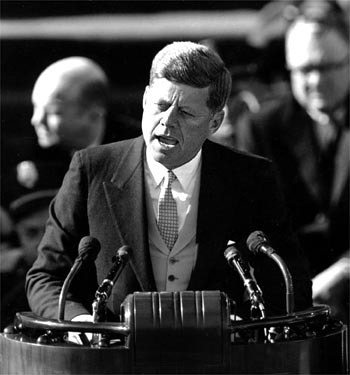
Then on a frigid January day in Washington, he delivered his inaugural address. It was instantly impressive, and has grown in fame since. But by the 1990s, all that was ever heard of it was one sentence: “Ask not what your country can do for you—ask what you can do for your country.” By the early 21st century, that was reduced to an iconic soundbite of two words: Ask not.
But that was only one sentence among many heard that day, and talked about and quoted for days and months to come. There was the call, early in the speech, to fulfill the postwar hopes of those who had fought World War II. It was a call to action to Kennedy’s generation, and to Roddenberry’s :
“Let the word go forth from this time and place, to friend and foe alike, that the torch has been passed to a new generation of Americans--- born in this century, tempered by war, disciplined by a hard and bitter peace..”
While Kennedy signaled his determination to remain firm against any aggression (and these words are often quoted to define him as a Cold War president) he also called for cooperation, for both sides to “explore what problems unite us instead of belaboring those problems that divide us,” and to end the arms race and control nuclear weapons. He pledged support for international agreements and institutions such as the United Nations-- “our last best hope in an age where the instruments of war have far outpaced the instruments of peace…”As events would finally prove, these were heartfelt and serious statements, and they would become more so as time went on.
He also signaled that his new frontier would include creative and positive uses of science and technology:
“Let both sides seek to invoke the wonders of science instead of its terrors. Together let us explore the stars, conquer the deserts, eradicate disease, tap the ocean depths, and encourage the arts and commerce.”
He linked progress in science and technology, as well as in economics and international institutions, to a moral purpose grounded in our common humanity. To the world’s poor he pledged help, “not because the Communists may be doing it, not because we seek their votes, but because it is right. If a free society cannot help the many who are poor, it cannot save the few who are rich.” He asked his fellow citizens to join him in “a struggle against the common enemies of man: tyranny, poverty, disease, and war itself.”
As he had in Los Angeles, he challenged Americans to do the difficult, with energy and realism but with purpose.
All this will not be finished in the first 100 days,” he concluded, and more than prophesized, “ Nor will it be finished in the first 1,000 days, nor in the life of this administration, nor even perhaps in our lifetime on this planet. But let us begin.”
Then on a frigid January day in Washington, he delivered his inaugural address. It was instantly impressive, and has grown in fame since. But by the 1990s, all that was ever heard of it was one sentence: “Ask not what your country can do for you—ask what you can do for your country.” By the early 21st century, that was reduced to an iconic soundbite of two words: Ask not.
But that was only one sentence among many heard that day, and talked about and quoted for days and months to come. There was the call, early in the speech, to fulfill the postwar hopes of those who had fought World War II. It was a call to action to Kennedy’s generation, and to Roddenberry’s :
“Let the word go forth from this time and place, to friend and foe alike, that the torch has been passed to a new generation of Americans--- born in this century, tempered by war, disciplined by a hard and bitter peace..”
While Kennedy signaled his determination to remain firm against any aggression (and these words are often quoted to define him as a Cold War president) he also called for cooperation, for both sides to “explore what problems unite us instead of belaboring those problems that divide us,” and to end the arms race and control nuclear weapons. He pledged support for international agreements and institutions such as the United Nations-- “our last best hope in an age where the instruments of war have far outpaced the instruments of peace…”As events would finally prove, these were heartfelt and serious statements, and they would become more so as time went on.
He also signaled that his new frontier would include creative and positive uses of science and technology:
“Let both sides seek to invoke the wonders of science instead of its terrors. Together let us explore the stars, conquer the deserts, eradicate disease, tap the ocean depths, and encourage the arts and commerce.”
He linked progress in science and technology, as well as in economics and international institutions, to a moral purpose grounded in our common humanity. To the world’s poor he pledged help, “not because the Communists may be doing it, not because we seek their votes, but because it is right. If a free society cannot help the many who are poor, it cannot save the few who are rich.” He asked his fellow citizens to join him in “a struggle against the common enemies of man: tyranny, poverty, disease, and war itself.”
As he had in Los Angeles, he challenged Americans to do the difficult, with energy and realism but with purpose.
All this will not be finished in the first 100 days,” he concluded, and more than prophesized, “ Nor will it be finished in the first 1,000 days, nor in the life of this administration, nor even perhaps in our lifetime on this planet. But let us begin.”

Roots of Starfleet
And so it did begin. Kennedy’s first official act was to increase the amount and upgrade the quality of surplus food for the poor and unemployed. He challenged Congress to pass a higher minimum wage, and a system of medical care for the aged (which became Medicare.) He began the Alliance for Progress, a partnership with Latin America to address the root causes of social unrest, such as poverty and inequality.
He began the Peace Corps, the program that best symbolized his intentions and the Kennedy style—pragmatic compassion, active participation, youth and enthusiasm. The Peace Corps caught the national imagination, and Gene Roddenberry was proposing a “youth corps” TV series, saying in a memo, “Unlike shows which are offered purely as escape entertainment, this one involves certain moral and philosophical issues on which I have strong feelings.”
What Kennedy represented, or even personified, could be defined as what Arthur Schlesinger called the Politics of Hope. Schlesinger noted Emerson’s division of “the party of the past and the party of the future, between the party of memory and the party of hope.” Though this essay predates the Kennedy years, Schlesinger was a White House advisor when he published in his book with that title in 1962. He was redefining American liberalism for the 1960s as the belief “that society can and should be improved, and that the way to improve it is to apply human intelligence to social and economic problems.”
Kennedy advocated a future that included an independent role for the imagination and the arts. The arts also were an outlet for the Kennedy glamour and mystique, especially when the President and his beautiful First Lady, Jacqueline, hosted artists and writers at the White House. “…the highest duty of the writer, the composer, the artist is to remain true to himself and to let the chips fall where they may,” Kennedy proclaimed. “In serving his vision of the truth, the artist best serves his nation.”
But Kennedy’s enthusiasm for the future was best symbolized in America’s suddenly vibrant leap into space. The shock of Sputnik led to humiliation in 1957, when the first U.S. space rocket staggered up before crashing back and exploding on the launch pad, in full view of the world’s television sets. The Eisenhower administration finally devoted funds and priority to a program some prominent members had previously and publicly mocked. The forsaken Orbiter program devised by Werner von Braun was suddenly revived, and resulted in the first American satellite launched in early 1958.
And so it did begin. Kennedy’s first official act was to increase the amount and upgrade the quality of surplus food for the poor and unemployed. He challenged Congress to pass a higher minimum wage, and a system of medical care for the aged (which became Medicare.) He began the Alliance for Progress, a partnership with Latin America to address the root causes of social unrest, such as poverty and inequality.
He began the Peace Corps, the program that best symbolized his intentions and the Kennedy style—pragmatic compassion, active participation, youth and enthusiasm. The Peace Corps caught the national imagination, and Gene Roddenberry was proposing a “youth corps” TV series, saying in a memo, “Unlike shows which are offered purely as escape entertainment, this one involves certain moral and philosophical issues on which I have strong feelings.”
What Kennedy represented, or even personified, could be defined as what Arthur Schlesinger called the Politics of Hope. Schlesinger noted Emerson’s division of “the party of the past and the party of the future, between the party of memory and the party of hope.” Though this essay predates the Kennedy years, Schlesinger was a White House advisor when he published in his book with that title in 1962. He was redefining American liberalism for the 1960s as the belief “that society can and should be improved, and that the way to improve it is to apply human intelligence to social and economic problems.”
Kennedy advocated a future that included an independent role for the imagination and the arts. The arts also were an outlet for the Kennedy glamour and mystique, especially when the President and his beautiful First Lady, Jacqueline, hosted artists and writers at the White House. “…the highest duty of the writer, the composer, the artist is to remain true to himself and to let the chips fall where they may,” Kennedy proclaimed. “In serving his vision of the truth, the artist best serves his nation.”
But Kennedy’s enthusiasm for the future was best symbolized in America’s suddenly vibrant leap into space. The shock of Sputnik led to humiliation in 1957, when the first U.S. space rocket staggered up before crashing back and exploding on the launch pad, in full view of the world’s television sets. The Eisenhower administration finally devoted funds and priority to a program some prominent members had previously and publicly mocked. The forsaken Orbiter program devised by Werner von Braun was suddenly revived, and resulted in the first American satellite launched in early 1958.

Launching the Enterprise
Though the National Aeronautics and Space Administration and the Mercury astronaut program were created in the final Eisenhower years, the efforts to send a man into space didn’t reach fruition until Kennedy was in office. Both the Russians and Americans conducted numerous launchings and tests of vehicles, sending up animals and instruments, trying to return and recover them on earth. Then in April 1961, the first human to orbit the earth was the Soviet cosmonaut, Yuri Gagarin. His vehicle weighed five tons—twice as heavy as the planned Mercury capsules.
But in early May, Mercury astronaut Alan Shepard became the first American in space. It was a short, sub-orbital flight, but every aspect of it was televised, and the adventure galvanized the country. Shepard received Manhattan’s largest ticker-tape parade to date, and met the President and First Lady at the White House.
Then in late May, Kennedy went to Congress with an astounding proposal: he dedicated the U.S. to land a man on the moon and bring him safely back to earth, by the end of the 1960s. The American space program hadn’t yet placed a human or even a large payload into orbit. Yet though Congress was skeptical, the country was excited. They were even more thrilled when, after Virgil Grissom’s sub-orbital flight in July, the following February John Glenn orbited the earth three times, again with full television coverage. His parade broke Shepard’s record. He was the first American hero of the space age. President Kennedy welcomed him to the White House, referring to space as “the new ocean…and I believe the United States must sail on it…”
While there was no longer an immediate military reason for an expanded space program (the U.S. had missiles that could carry the now compact hydrogen bombs to distant targets), there was national prestige involved. In his remarks to Congress proposing what would become the Apollo program, Kennedy spoke of the space efforts of both the U.S. and U.S.S.R. and “the impact of this adventure on the minds of men everywhere” as a challenge to prove that a free people could achieve great ends. “But this is not merely a race, “ he said. “Space is open to us now; and our eagerness to share its meaning is not governed by the efforts of others. We go into space because whatever mankind must undertake, free men must fully share.”
While he praised recent U.S. efforts, he asserted: “Now it is time to take longer strides--time for a great new American enterprise--time for this nation to take a clearly leading role in space achievement, which in many ways may hold the key to our future on Earth.”
But just spending more money on space technology wasn’t going to be enough. He said this commitment required an unprecedented “degree of dedication, organization and discipline.” of selflessness and working together. It could not be accomplished “unless every scientist, every engineer, every serviceman, every technician, contractor, and civil servant gives his personal pledge that this nation will move forward, with the full speed of freedom, in the exciting adventure of space.”
But the real key to the Kennedy years was in the shift of mood and expectation in feeling and attitude, hopes and expectations about the future. Since at least the end of the 19th century, when H.G. Wells was creating both science fiction and futurism, and when people in general were getting used to the idea of large-scale change, the stories about the future gravitated towards one extreme or the other: towards new heavens or new hells, dreams or nightmares, utopia or oblivion.
Though the National Aeronautics and Space Administration and the Mercury astronaut program were created in the final Eisenhower years, the efforts to send a man into space didn’t reach fruition until Kennedy was in office. Both the Russians and Americans conducted numerous launchings and tests of vehicles, sending up animals and instruments, trying to return and recover them on earth. Then in April 1961, the first human to orbit the earth was the Soviet cosmonaut, Yuri Gagarin. His vehicle weighed five tons—twice as heavy as the planned Mercury capsules.
But in early May, Mercury astronaut Alan Shepard became the first American in space. It was a short, sub-orbital flight, but every aspect of it was televised, and the adventure galvanized the country. Shepard received Manhattan’s largest ticker-tape parade to date, and met the President and First Lady at the White House.
Then in late May, Kennedy went to Congress with an astounding proposal: he dedicated the U.S. to land a man on the moon and bring him safely back to earth, by the end of the 1960s. The American space program hadn’t yet placed a human or even a large payload into orbit. Yet though Congress was skeptical, the country was excited. They were even more thrilled when, after Virgil Grissom’s sub-orbital flight in July, the following February John Glenn orbited the earth three times, again with full television coverage. His parade broke Shepard’s record. He was the first American hero of the space age. President Kennedy welcomed him to the White House, referring to space as “the new ocean…and I believe the United States must sail on it…”
While there was no longer an immediate military reason for an expanded space program (the U.S. had missiles that could carry the now compact hydrogen bombs to distant targets), there was national prestige involved. In his remarks to Congress proposing what would become the Apollo program, Kennedy spoke of the space efforts of both the U.S. and U.S.S.R. and “the impact of this adventure on the minds of men everywhere” as a challenge to prove that a free people could achieve great ends. “But this is not merely a race, “ he said. “Space is open to us now; and our eagerness to share its meaning is not governed by the efforts of others. We go into space because whatever mankind must undertake, free men must fully share.”
While he praised recent U.S. efforts, he asserted: “Now it is time to take longer strides--time for a great new American enterprise--time for this nation to take a clearly leading role in space achievement, which in many ways may hold the key to our future on Earth.”
But just spending more money on space technology wasn’t going to be enough. He said this commitment required an unprecedented “degree of dedication, organization and discipline.” of selflessness and working together. It could not be accomplished “unless every scientist, every engineer, every serviceman, every technician, contractor, and civil servant gives his personal pledge that this nation will move forward, with the full speed of freedom, in the exciting adventure of space.”
But the real key to the Kennedy years was in the shift of mood and expectation in feeling and attitude, hopes and expectations about the future. Since at least the end of the 19th century, when H.G. Wells was creating both science fiction and futurism, and when people in general were getting used to the idea of large-scale change, the stories about the future gravitated towards one extreme or the other: towards new heavens or new hells, dreams or nightmares, utopia or oblivion.

Visions of the Future: Fear and Hope
America had been industrializing throughout the 20th century, and as waves of new immigrant workers joined those who had come to America for a better life on the land and in the cities in earlier generations, the future became the national faith. When Gene Roddenberry was growing up during the crisis of the Great Depression, that faith was fierce. "Then and now, you have to wonder what really held it all together," said a character in The American Clock, a play by Arthur Miller about the Depression, "and maybe it was simply the Future: the people were still not ready to give it up.”
By 1939, some Americans got to see what that future might look like, at the New York World’s Fair. Its theme was “The World of Tomorrow,” and it purported to portray the coming utopia of 1960. There was the gleaming white Trylon, the shimmering Glass Center, the Perisphere that contained the model city of the future: “Democricity,” with its white houses on pure paved streets, surrounded by trees and grass. At the General Motors "Futurama" chairs moved along a conveyor belt past screens showing what life would be like in this utopia: happy, healthy people driving air conditioned cars (that cost only $200), across vast distances on wide superhighways.
According to the guide’s recorded voice, many people would live in houses made of special materials, so if you didn't like how your house looked you could simply throw it away. They would live in small villages where they could grow their own food, and they would work in clean modern factories, or skyscrapers in the city, 1500 feet high. Fourteen-lane turnpikes would connect everything. Cars would speed along them safely, because the cars drove in separate lanes protected by high curbs, and automatic radio control would keep each car a safe distance from the ones behind and in front of it. Because of technology and efficiency, the voice said, most of America would be forest again. Everyone would be well educated, there would be little disease, and the average lifespan would be seventy-five years.
At the Westinghouse display, a woman called Mrs. Drudge washed dishes in her sink while Mrs. Modern used an electric dishwasher. Mrs. Modern got done first, and was always clean and smiling. At the RCA display, a couple of puppets named Kukla and Ollie demonstrated another new feature for the home, called television.
But if they yearned for such a utopia, Americans also harbored a fear of oblivion, as was illustrated in 1938, on Halloween. Radio was the major entertainment medium for the country as a whole, but also the major news medium. The young director the Mercury Theatre of the Air, Orson Welles, got the idea of combining them, and gave a copy of H.G. Wells’ The War of the Worlds to writer Howard Koch, and told him to write the story in the form of news bulletins.
Those who tuned in the night of October 31 were told in the first minute of the broadcast that it would be a dramatization of the Wells’ story. Orson Welles intoned the introduction, using phrases from the novel, but also described the story as beginning on October 30, 1939—a year into the future—when “business was better. The war scare was over…”
Business wasn’t much better in the ninth year of the Depression, but it was the war scare of 1938 that probably inspired the panic that ensued when at least some listeners (how many is disputed) believed they were hearing an actual invasion in progress. By 1938, the duly elected leader of Germany, Adolf Hitler, had declared himself War Minister, and marched his armies into Austria. German planes had committed the first bombing of a European city from the air, destroying the Spanish town of Guernica, an act rendered in black and white horror by Pablo Picasso. Japan had invaded and occupied areas of China.
Koch rewrote Wells’ war to take place in the United States, starting near Princeton, New Jersey, the new home of Albert Einstein. Listeners who tuned in late heard unfamiliar voices who nevertheless sounded like real radio news reporters talking about Martians in their invincible fighting machines as they advanced on major cities across America. There was enough of a reaction that newspapers such as the New York Times reported on the panic the next day.
It was this fear of oblivion that seemed proven first. The hope for utopia was soon dashed as war exploded across Europe during the run of the 1939 World’s Fair. When Japanese planes attacked Pearl Harbor, some Americans refused to believe the radio news reports, having been fooled once already by phony Martians. President Roosevelt blamed Orson Welles.
But five years later, even after the Allies triumphed over the mortal threats of the Nazis and Imperial Japan, the atomic bomb quickly dropped a pall over many utopian hopes. By the time the real 1960 came around many of the utopian dreams of the 1939 Fair had ironically come true (though not always with wholly utopian results), but oblivion seemed closer than ever, and the more likely fate.
Then the Kennedy years changed the balance, tipping it towards the politics of hope, especially for Gene Roddenberry’s generation, apparently taking over the country, beginning with the White House. Kennedy was 43 when he became President; GR was 39 then. It was their time to transform the country and build the future, and like GR, many of the people around Kennedy, or who Kennedy inspired, had lots of ideas on what ought to be done, and how.
But just as importantly, Kennedy redefined the terms of utopia and oblivion, not as two possible fates, but as a choice. He stated it most succinctly at the beginning of his Inaugural Address: “The world is very different now,” he said. “For man holds in his mortal hands the power to abolish all forms of human poverty and all forms of human life.”
They could choose utopia or they could choose oblivion. There would be considerable drama concerning these choices in the Kennedy years. In the Berlin crisis of 1961, and most especially in the Cuban Missile Crisis of 1962, the world came as close to nuclear oblivion as it ever knowingly had.
For a tense week in October, the United States and the Soviet Union were on the brink of nuclear war, with the world watching. World power politics became human beings confronting fatal choices and imagining consequences of actually employing the technology of mutual self-destruction. Oblivion was an emotion, a mistake, a decision away. When the Soviets agreed to withdraw their missiles from Cuba and the crisis ended, Kennedy committed himself to changing the terms of international politics.
The first step was a nuclear test ban treaty. But when negotiations with the Soviets stalled, Kennedy used his commencement address at American University in June 1963 to not only press for an agreement, but to move the world away from the risk of instant oblivion and towards a transformation. It was the kind of world statesmanship and advocacy for the future that was H.G. Wells’ repeated dream.
America had been industrializing throughout the 20th century, and as waves of new immigrant workers joined those who had come to America for a better life on the land and in the cities in earlier generations, the future became the national faith. When Gene Roddenberry was growing up during the crisis of the Great Depression, that faith was fierce. "Then and now, you have to wonder what really held it all together," said a character in The American Clock, a play by Arthur Miller about the Depression, "and maybe it was simply the Future: the people were still not ready to give it up.”
By 1939, some Americans got to see what that future might look like, at the New York World’s Fair. Its theme was “The World of Tomorrow,” and it purported to portray the coming utopia of 1960. There was the gleaming white Trylon, the shimmering Glass Center, the Perisphere that contained the model city of the future: “Democricity,” with its white houses on pure paved streets, surrounded by trees and grass. At the General Motors "Futurama" chairs moved along a conveyor belt past screens showing what life would be like in this utopia: happy, healthy people driving air conditioned cars (that cost only $200), across vast distances on wide superhighways.
According to the guide’s recorded voice, many people would live in houses made of special materials, so if you didn't like how your house looked you could simply throw it away. They would live in small villages where they could grow their own food, and they would work in clean modern factories, or skyscrapers in the city, 1500 feet high. Fourteen-lane turnpikes would connect everything. Cars would speed along them safely, because the cars drove in separate lanes protected by high curbs, and automatic radio control would keep each car a safe distance from the ones behind and in front of it. Because of technology and efficiency, the voice said, most of America would be forest again. Everyone would be well educated, there would be little disease, and the average lifespan would be seventy-five years.
At the Westinghouse display, a woman called Mrs. Drudge washed dishes in her sink while Mrs. Modern used an electric dishwasher. Mrs. Modern got done first, and was always clean and smiling. At the RCA display, a couple of puppets named Kukla and Ollie demonstrated another new feature for the home, called television.
But if they yearned for such a utopia, Americans also harbored a fear of oblivion, as was illustrated in 1938, on Halloween. Radio was the major entertainment medium for the country as a whole, but also the major news medium. The young director the Mercury Theatre of the Air, Orson Welles, got the idea of combining them, and gave a copy of H.G. Wells’ The War of the Worlds to writer Howard Koch, and told him to write the story in the form of news bulletins.
Those who tuned in the night of October 31 were told in the first minute of the broadcast that it would be a dramatization of the Wells’ story. Orson Welles intoned the introduction, using phrases from the novel, but also described the story as beginning on October 30, 1939—a year into the future—when “business was better. The war scare was over…”
Business wasn’t much better in the ninth year of the Depression, but it was the war scare of 1938 that probably inspired the panic that ensued when at least some listeners (how many is disputed) believed they were hearing an actual invasion in progress. By 1938, the duly elected leader of Germany, Adolf Hitler, had declared himself War Minister, and marched his armies into Austria. German planes had committed the first bombing of a European city from the air, destroying the Spanish town of Guernica, an act rendered in black and white horror by Pablo Picasso. Japan had invaded and occupied areas of China.
Koch rewrote Wells’ war to take place in the United States, starting near Princeton, New Jersey, the new home of Albert Einstein. Listeners who tuned in late heard unfamiliar voices who nevertheless sounded like real radio news reporters talking about Martians in their invincible fighting machines as they advanced on major cities across America. There was enough of a reaction that newspapers such as the New York Times reported on the panic the next day.
It was this fear of oblivion that seemed proven first. The hope for utopia was soon dashed as war exploded across Europe during the run of the 1939 World’s Fair. When Japanese planes attacked Pearl Harbor, some Americans refused to believe the radio news reports, having been fooled once already by phony Martians. President Roosevelt blamed Orson Welles.
But five years later, even after the Allies triumphed over the mortal threats of the Nazis and Imperial Japan, the atomic bomb quickly dropped a pall over many utopian hopes. By the time the real 1960 came around many of the utopian dreams of the 1939 Fair had ironically come true (though not always with wholly utopian results), but oblivion seemed closer than ever, and the more likely fate.
Then the Kennedy years changed the balance, tipping it towards the politics of hope, especially for Gene Roddenberry’s generation, apparently taking over the country, beginning with the White House. Kennedy was 43 when he became President; GR was 39 then. It was their time to transform the country and build the future, and like GR, many of the people around Kennedy, or who Kennedy inspired, had lots of ideas on what ought to be done, and how.
But just as importantly, Kennedy redefined the terms of utopia and oblivion, not as two possible fates, but as a choice. He stated it most succinctly at the beginning of his Inaugural Address: “The world is very different now,” he said. “For man holds in his mortal hands the power to abolish all forms of human poverty and all forms of human life.”
They could choose utopia or they could choose oblivion. There would be considerable drama concerning these choices in the Kennedy years. In the Berlin crisis of 1961, and most especially in the Cuban Missile Crisis of 1962, the world came as close to nuclear oblivion as it ever knowingly had.
For a tense week in October, the United States and the Soviet Union were on the brink of nuclear war, with the world watching. World power politics became human beings confronting fatal choices and imagining consequences of actually employing the technology of mutual self-destruction. Oblivion was an emotion, a mistake, a decision away. When the Soviets agreed to withdraw their missiles from Cuba and the crisis ended, Kennedy committed himself to changing the terms of international politics.
The first step was a nuclear test ban treaty. But when negotiations with the Soviets stalled, Kennedy used his commencement address at American University in June 1963 to not only press for an agreement, but to move the world away from the risk of instant oblivion and towards a transformation. It was the kind of world statesmanship and advocacy for the future that was H.G. Wells’ repeated dream.
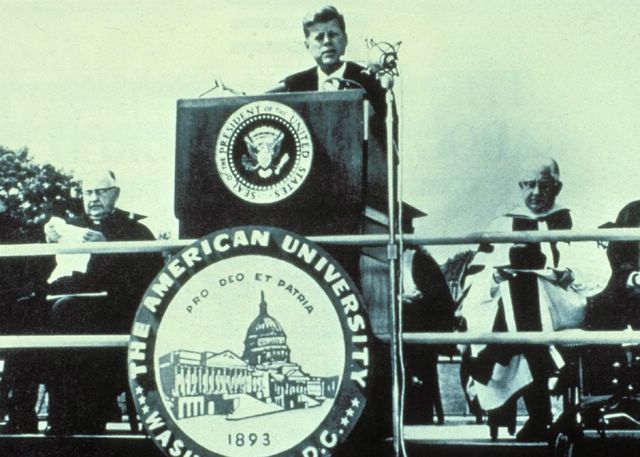
Speaking to the Trek Future
Listen carefully to what JFK said that day, and see in your mind's eye how these words were played out in the Star Trek saga...
In calling for peace, Kennedy quickly set new terms, both realistic and bold. “What kind of peace do I mean?” Not a Pax Americana enforced on the world by American weapons of war…I am talking about genuine peace, the kind of peace that makes life on earth worth living, the kind that enables men and nations to grow and to hope and to build a better life for their children…“Not merely peace for Americans, but peace for all men and women; not merely peace in our time, but peace for all time.”
“Total war makes no sense,” Kennedy said, repeating the phrase several times, emphasizing devastation so extensive it would be visited on “generations yet unborn.” “I speak of peace, therefore, as the necessary rational end of rational men.”
“I realize that the pursuit of peace is not as dramatic as the pursuit of war. But we have no more urgent task.”
Some opponents regarded negotiating arms agreements as a sign of weakness—to them, the test ban efforts were “defeatist.” Kennedy deftly reversed the charge. He said believing peace is impossible is defeatist, because it means “that mankind is doomed, that we are gripped by forces we cannot control. We need not accept that view. ” Then he used the phrase that more than any other sums up the Kennedy faith: “Our problems are man-made; therefore they can be solved by man.”
Though he acknowledged the value of dreams and hopes, he advocated an attainable peace “based not on a sudden revolution in human nature but on a gradual evolution in human institutions…Genuine peace must be the product of many nations, the sum of many acts…For peace is a process, a way of solving problems.”
Kennedy called for cooperation based on a certain historical objectivity that has since been borne out more dramatically than he could have dreamed. “However fixed our likes and dislikes may seem,” he said, “the tide of time and events will often bring surprising changes in the relations between nations and neighbors.”
For many Americans at the time, Soviet Communists were incomprehensible and threatening. But Kennedy suggested that, just as the Soviets misunderstood America, Americans had a distorted view of them. “No government or social system is so evil that its people must be considered as lacking in virtue.”
Kennedy acknowledged the evils of Communism, but also complimented the Soviets on their achievements in science and culture. In speaking of the abhorrence of war that the two nations had in common he eulogized Soviet suffering in World War II. No act of honoring could have meant more to the Russian people.
The speech subtly linked this theme of suffering with an assertion of mutual interest in ending the arms race itself. Kennedy pointed out that both nations are “devoting massive sums of money to weapons that could be better devoted to combating ignorance, poverty and disease.”
Kennedy added the “ironical but accurate fact that the two strongest powers are the two in the most danger of devastation. All we have built, all we have worked for, would be destroyed in the first twenty-four hours.”
Peace, he concludes, is a primary interest for both nations---indeed for all nations. In the most quoted phrases of the speech, Kennedy said: “For in the final analysis our most basic common link is that we all inhabit this planet. We all breathe the same air. We all cherish our children’s future. And we are all mortal.”
The American University speech became instantly famous around the world. In England, the Manchester Guardian called it “one of the great state papers of American history.” Most importantly, the full text was printed in the Russian press, and its Russian language broadcast by the Voice of America was the first western program in fifteen years the Soviets did not attempt to jam. Khrushchev told Averell Harriman, in Moscow to negotiate the test ban, that it was the best speech by an American president since Roosevelt. Negotiations moved swiftly forward. Some six weeks after the American University address, the nuclear test ban treaty was signed.
It was, Kennedy told the nation on July 26, “an important first step---a step toward peace, a step toward reason, a step away from war.” But the treaty required Senate confirmation, and conservatives as well as prominent military figures were decrying it as a threat to national security. Kennedy invited public debate, “for the treaty is for all of us. It is particularly for our children and our grandchildren, who have no lobby here in Washington.”
While it became clear by the fall that the test ban treaty and Kennedy’s advocacy were enormously popular with the American people, it was not so easy a victory that summer. The treaty had to be ratified by the U.S. Senate, and there was substantial opposition. Even Kennedy’s speech did not have the same impact within the U.S. as outside it, partly because the nation was gripped by its major internal issue of moral and political consequence, and Kennedy made a groundbreaking speech on that subject the very next day.
Listen carefully to what JFK said that day, and see in your mind's eye how these words were played out in the Star Trek saga...
In calling for peace, Kennedy quickly set new terms, both realistic and bold. “What kind of peace do I mean?” Not a Pax Americana enforced on the world by American weapons of war…I am talking about genuine peace, the kind of peace that makes life on earth worth living, the kind that enables men and nations to grow and to hope and to build a better life for their children…“Not merely peace for Americans, but peace for all men and women; not merely peace in our time, but peace for all time.”
“Total war makes no sense,” Kennedy said, repeating the phrase several times, emphasizing devastation so extensive it would be visited on “generations yet unborn.” “I speak of peace, therefore, as the necessary rational end of rational men.”
“I realize that the pursuit of peace is not as dramatic as the pursuit of war. But we have no more urgent task.”
Some opponents regarded negotiating arms agreements as a sign of weakness—to them, the test ban efforts were “defeatist.” Kennedy deftly reversed the charge. He said believing peace is impossible is defeatist, because it means “that mankind is doomed, that we are gripped by forces we cannot control. We need not accept that view. ” Then he used the phrase that more than any other sums up the Kennedy faith: “Our problems are man-made; therefore they can be solved by man.”
Though he acknowledged the value of dreams and hopes, he advocated an attainable peace “based not on a sudden revolution in human nature but on a gradual evolution in human institutions…Genuine peace must be the product of many nations, the sum of many acts…For peace is a process, a way of solving problems.”
Kennedy called for cooperation based on a certain historical objectivity that has since been borne out more dramatically than he could have dreamed. “However fixed our likes and dislikes may seem,” he said, “the tide of time and events will often bring surprising changes in the relations between nations and neighbors.”
For many Americans at the time, Soviet Communists were incomprehensible and threatening. But Kennedy suggested that, just as the Soviets misunderstood America, Americans had a distorted view of them. “No government or social system is so evil that its people must be considered as lacking in virtue.”
Kennedy acknowledged the evils of Communism, but also complimented the Soviets on their achievements in science and culture. In speaking of the abhorrence of war that the two nations had in common he eulogized Soviet suffering in World War II. No act of honoring could have meant more to the Russian people.
The speech subtly linked this theme of suffering with an assertion of mutual interest in ending the arms race itself. Kennedy pointed out that both nations are “devoting massive sums of money to weapons that could be better devoted to combating ignorance, poverty and disease.”
Kennedy added the “ironical but accurate fact that the two strongest powers are the two in the most danger of devastation. All we have built, all we have worked for, would be destroyed in the first twenty-four hours.”
Peace, he concludes, is a primary interest for both nations---indeed for all nations. In the most quoted phrases of the speech, Kennedy said: “For in the final analysis our most basic common link is that we all inhabit this planet. We all breathe the same air. We all cherish our children’s future. And we are all mortal.”
The American University speech became instantly famous around the world. In England, the Manchester Guardian called it “one of the great state papers of American history.” Most importantly, the full text was printed in the Russian press, and its Russian language broadcast by the Voice of America was the first western program in fifteen years the Soviets did not attempt to jam. Khrushchev told Averell Harriman, in Moscow to negotiate the test ban, that it was the best speech by an American president since Roosevelt. Negotiations moved swiftly forward. Some six weeks after the American University address, the nuclear test ban treaty was signed.
It was, Kennedy told the nation on July 26, “an important first step---a step toward peace, a step toward reason, a step away from war.” But the treaty required Senate confirmation, and conservatives as well as prominent military figures were decrying it as a threat to national security. Kennedy invited public debate, “for the treaty is for all of us. It is particularly for our children and our grandchildren, who have no lobby here in Washington.”
While it became clear by the fall that the test ban treaty and Kennedy’s advocacy were enormously popular with the American people, it was not so easy a victory that summer. The treaty had to be ratified by the U.S. Senate, and there was substantial opposition. Even Kennedy’s speech did not have the same impact within the U.S. as outside it, partly because the nation was gripped by its major internal issue of moral and political consequence, and Kennedy made a groundbreaking speech on that subject the very next day.
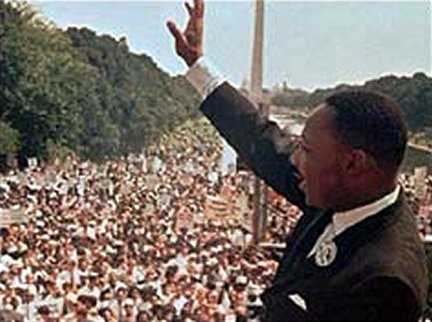
Calling Uhura to the Bridge
The issue of civil rights for African Americans had been steadily growing in prominence, punctuated by episodes of conflict and violence, since the mid 1950s. In 1963 police violence against non-violent demonstrators and white rioting and firebombing in black neighborhoods of Birmingham, Alabama, pushed the civil rights struggle to a new level. Then Alabama Governor George Wallace announced he would personally bar the admission of the first two black students to be enrolled at the University of Alabama under federal court order.
The drama, which turned out to be little more than a ceremony of defiance for cameras, played the day after JFK’s American University speech. Kennedy spontaneously decided to speak to the nation that night. With little in the way of prepared text, he delivered a speech on civil rights as perfectly timed and morally clear as he had the day before on world peace. Equality is a moral issue “as old as the scriptures and…as clear as the American Constitution, he said “In short, every American ought to have the right to be treated as he would wish to be treated…” The day before he had urged empathy for the Soviet people; now he asked white Americans to imagine themselves in the place of black Americans. “Who among us then would be content with the counsels of patience and delay?”
He announced the voting rights legislation that would become landmark law under Lyndon Johnson. He had also advocated new help and new recognition for the poor in America (motivated in part by the new book, The Other America, that detailed the shocking poverty most Americans didn’t see, written by Michael Harrington, one of the chief demonstrators outside the Democratic Convention in Los Angeles that nominated him for President.) This became the core of Johnson’s War on Poverty; other Kennedy initiatives inspired elements of LBJ’s Great Society.
On August 28, between a quarter of a million and half a million people created the March on Washington for Jobs and Freedom. It was an overwhelmingly peaceful event, the largest demonstration in the nation’s history. U.S. television networks preempted much of their programming to broadcast it, and thanks to the new Telstar communication satellite, it was one of the first events to be televised live around the world.
Instead of “As the World Turns” and “Art Linkletter’s House Party,” U.S. viewers saw this massive crowd gathered in front of the Lincoln Memorial, and they heard Bob Dylan sing “When the Ship Comes In,” as well as songs by Miriam Anderson, Peter, Paul & Mary, Odetta and others. They heard white labor leader Walter Reuther speak; rabbis, preachers and priests pray. And they saw and hear Martin Luther King make his famous “I have a dream” address.
Kennedy met with leaders of the march in the White House. Kennedy knew (as LBJ did later) that such forthright and principled support for civil rights would doom the Democratic party in the previously solid South, perhaps for a long time. But the march signaled the possibility of a new political coalition that meant this step towards the future might be sustained. Kennedy described himself privately as “an idealist without illusions.”
Though he accepted the possibility that his stand on the test ban treaty might lead to his defeat for reelection, Kennedy believed the opposition was not as strong among voters as rising conservatives claimed. By September, it was clear that he was right. Overwhelming public sentiment in favor of the treaty led to Senate confirmation.
As Kennedy traveled across America in late fall, he spoke often about the issue of peace, to increasingly enthusiastic response. This was the last image, and the lasting image of Kennedy, held by many Americans and certainly many people around the world.
The issue of civil rights for African Americans had been steadily growing in prominence, punctuated by episodes of conflict and violence, since the mid 1950s. In 1963 police violence against non-violent demonstrators and white rioting and firebombing in black neighborhoods of Birmingham, Alabama, pushed the civil rights struggle to a new level. Then Alabama Governor George Wallace announced he would personally bar the admission of the first two black students to be enrolled at the University of Alabama under federal court order.
The drama, which turned out to be little more than a ceremony of defiance for cameras, played the day after JFK’s American University speech. Kennedy spontaneously decided to speak to the nation that night. With little in the way of prepared text, he delivered a speech on civil rights as perfectly timed and morally clear as he had the day before on world peace. Equality is a moral issue “as old as the scriptures and…as clear as the American Constitution, he said “In short, every American ought to have the right to be treated as he would wish to be treated…” The day before he had urged empathy for the Soviet people; now he asked white Americans to imagine themselves in the place of black Americans. “Who among us then would be content with the counsels of patience and delay?”
He announced the voting rights legislation that would become landmark law under Lyndon Johnson. He had also advocated new help and new recognition for the poor in America (motivated in part by the new book, The Other America, that detailed the shocking poverty most Americans didn’t see, written by Michael Harrington, one of the chief demonstrators outside the Democratic Convention in Los Angeles that nominated him for President.) This became the core of Johnson’s War on Poverty; other Kennedy initiatives inspired elements of LBJ’s Great Society.
On August 28, between a quarter of a million and half a million people created the March on Washington for Jobs and Freedom. It was an overwhelmingly peaceful event, the largest demonstration in the nation’s history. U.S. television networks preempted much of their programming to broadcast it, and thanks to the new Telstar communication satellite, it was one of the first events to be televised live around the world.
Instead of “As the World Turns” and “Art Linkletter’s House Party,” U.S. viewers saw this massive crowd gathered in front of the Lincoln Memorial, and they heard Bob Dylan sing “When the Ship Comes In,” as well as songs by Miriam Anderson, Peter, Paul & Mary, Odetta and others. They heard white labor leader Walter Reuther speak; rabbis, preachers and priests pray. And they saw and hear Martin Luther King make his famous “I have a dream” address.
Kennedy met with leaders of the march in the White House. Kennedy knew (as LBJ did later) that such forthright and principled support for civil rights would doom the Democratic party in the previously solid South, perhaps for a long time. But the march signaled the possibility of a new political coalition that meant this step towards the future might be sustained. Kennedy described himself privately as “an idealist without illusions.”
Though he accepted the possibility that his stand on the test ban treaty might lead to his defeat for reelection, Kennedy believed the opposition was not as strong among voters as rising conservatives claimed. By September, it was clear that he was right. Overwhelming public sentiment in favor of the treaty led to Senate confirmation.
As Kennedy traveled across America in late fall, he spoke often about the issue of peace, to increasingly enthusiastic response. This was the last image, and the lasting image of Kennedy, held by many Americans and certainly many people around the world.

From the New to the Final Frontier...
So much had happened, so much had changed in the thousand days of the Kennedy administration. What Kennedy contributed to the soul of the future went beyond these great issues. He brought imagination and intelligence into the public arena, and suddenly it was stylish to be smart. Kennedy was intensely curious and persistently ironic, with an educated judgment, a respect for complexity and a need for large ideas. Kennedy’s press conferences were a revelation of erudition and wit. The emphasis on intelligence in the Kennedy government provided a new legitimacy to the life of the mind. Suddenly the egghead was in, and the intellectual was sexy.
Kennedy was also the first President since Teddy Roosevelt to promote physical fitness, and though a sudden fad for the “fifty mile hike” died quickly, the general idea of fitness and “vigor” became part of the Kennedy image. The Kennedys were often photographed sailing, and the Kennedy clans’ touch football games became legendary.
“Jack” and the beautiful Jackie Kennedy, their children Caroline and John-John: they were in every sense the First Family. How Jackie dressed changed how women looked, and connected a larger portion of America to European fashion, as well as making European style more acceptable across an increasingly affluent but still provincial America.
Above all there was a sense of youthfulness—of “the young in spirit, regardless of age,” as he said in his call for explorers of the New Frontier.
This was the coming of age for Gene Roddenberry’s generation. I could find nothing on the record about GR’s views on JFK, but it’s not hard to figure out what they might be. Apart from the general attitudes they shared with others in their generation (and the recreation of sailing, which became GR’s replacement for flying), there is ample evidence in GR’s later work of a convergence with Kennedy’s views, particularly the ones from 1963 detailed above. From the New Frontier and the space program, to Civil Rights, efforts to address poverty and disease, and the attitudes towards peace outlined in the American University address, to more subtle thoughts about such matters as exploration without exploitation tucked into other speeches---it all could be considered part of the blueprints for the Star Trek future.
There has never been, and they may never be again, a national trauma as intense and lingering as the sudden taking away by assassination of this young President in November 1963. From the first news reports on Friday to after the state funeral on Monday, America stopped. Stores were shuttered, and storefronts draped in black, all product images replaced by wreathed portraits of the fallen President. By 1963 almost every home in the U.S. had at least one TV set, and there was nothing else broadcast that weekend but related news, including the responses of people around the world, interspersed with Kennedy speeches and interviews. 95% of the American audience watched the funeral.
The sadness, the attempts to cope and accommodate what had happened, went on for months and years. Arguably the effects of Kennedy’s assassination never ended. But at the time, those who admired Kennedy, his words and his public persona, had to find ways to honor and absorb them in their own lives and work.
It was about four months after President Kennedy’s life was erased that Gene Roddenberry had roughed out in some sixteen pages his idea for a television series about the future, called Star Trek.
So much had happened, so much had changed in the thousand days of the Kennedy administration. What Kennedy contributed to the soul of the future went beyond these great issues. He brought imagination and intelligence into the public arena, and suddenly it was stylish to be smart. Kennedy was intensely curious and persistently ironic, with an educated judgment, a respect for complexity and a need for large ideas. Kennedy’s press conferences were a revelation of erudition and wit. The emphasis on intelligence in the Kennedy government provided a new legitimacy to the life of the mind. Suddenly the egghead was in, and the intellectual was sexy.
Kennedy was also the first President since Teddy Roosevelt to promote physical fitness, and though a sudden fad for the “fifty mile hike” died quickly, the general idea of fitness and “vigor” became part of the Kennedy image. The Kennedys were often photographed sailing, and the Kennedy clans’ touch football games became legendary.
“Jack” and the beautiful Jackie Kennedy, their children Caroline and John-John: they were in every sense the First Family. How Jackie dressed changed how women looked, and connected a larger portion of America to European fashion, as well as making European style more acceptable across an increasingly affluent but still provincial America.
Above all there was a sense of youthfulness—of “the young in spirit, regardless of age,” as he said in his call for explorers of the New Frontier.
This was the coming of age for Gene Roddenberry’s generation. I could find nothing on the record about GR’s views on JFK, but it’s not hard to figure out what they might be. Apart from the general attitudes they shared with others in their generation (and the recreation of sailing, which became GR’s replacement for flying), there is ample evidence in GR’s later work of a convergence with Kennedy’s views, particularly the ones from 1963 detailed above. From the New Frontier and the space program, to Civil Rights, efforts to address poverty and disease, and the attitudes towards peace outlined in the American University address, to more subtle thoughts about such matters as exploration without exploitation tucked into other speeches---it all could be considered part of the blueprints for the Star Trek future.
There has never been, and they may never be again, a national trauma as intense and lingering as the sudden taking away by assassination of this young President in November 1963. From the first news reports on Friday to after the state funeral on Monday, America stopped. Stores were shuttered, and storefronts draped in black, all product images replaced by wreathed portraits of the fallen President. By 1963 almost every home in the U.S. had at least one TV set, and there was nothing else broadcast that weekend but related news, including the responses of people around the world, interspersed with Kennedy speeches and interviews. 95% of the American audience watched the funeral.
The sadness, the attempts to cope and accommodate what had happened, went on for months and years. Arguably the effects of Kennedy’s assassination never ended. But at the time, those who admired Kennedy, his words and his public persona, had to find ways to honor and absorb them in their own lives and work.
It was about four months after President Kennedy’s life was erased that Gene Roddenberry had roughed out in some sixteen pages his idea for a television series about the future, called Star Trek.
Saturday, August 19, 2006
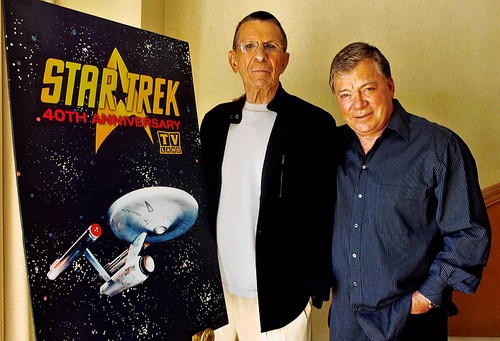
News Update
I've been invited to participate on a panel at the 40th anniversary Star Trek convention in Seattle. I'm hoping to be able to make arrangements to do so. It's a pretty exciting prospect.
UPDATE on the update: I will be moderating the panel on Soul of Star Trek: The Prime Directive and Beyond, probably on THE anniversary, Friday, September 8.
You may have read the depressing quotes purported to come from a Paramount executive, pretty much dissing Star Trek fans for abandoning "Enterprise" and "Nemesis," and stating that the new Trek movie will be a complete reboot of the original series. If fans like it, fine, but basically they're going for a totally new audience, the kind that watches "Lost."
I can't imagine J.J. Abrams could be happy about such a statement. I haven't seen it denied yet, but I expect it will be, though it remains to be seen how truthful it really is. It does remind me of at least one prior instance, when the people who decided to "reboot" the Lone Ranger went out of their way to distance their project from the original series, to the point of denying its star, Clayton Moore, the right to wear his trademark mask at personal appearances. When I read this statement from a supposed Paramount source, I suddenly remembered an odd detail--that Paramount had refused William Shatner the right to use "Captain Kirk" in the title of the special he did for the History Channel. This supposed source was openly contemptuous of Shatner's statement that he'd been happy to appear in Star Trek XI. Is it possible they are trying to distance Shatner from the character he created?
It's hard to believe they could be that obtuse, but then a certain executive broke up the championship Chicago Bulls with Michael Jordan, and so that team became the NBA punching bag for a decade. For Trek, it goes beyond diehard fans. At a time in the 1990s when it was said that half the world's population had never used a telephone, a quarter of it could recognize the face of William Shatner as Captain Kirk. I think that demands a little respect.
Anyway, that Lone Ranger movie failed dismally, and destroyed its own future. How many "reboots" or remakes (as the first story is as a feature film) were really better than the original? I just saw part of Peter Jackson's "King Kong" and it's not even as good as the De Laurentis version, let alone the original.
Does Paramount want a war between the old fans and the new (assuming there are any)? Do they think it will come out like the TOS v. TNG wars, in a story marriage? It's quite a risk. Conflict could stimulate publicity, but how bad blood and wars turn out is anything but certain.
Some Star Trek fans active on Internet discussion boards have been pretty negative and even toxic in the recent past. But that's not the majority. If Paramount succeeds in alienating traditional fans, it may get itself a hit movie anyway. But only one. The whole thing could end up being such a debacle that there will be no Trek XII. They risk the end of Star Trek, except for what fans create.
What follows here is the first in a series creating the context of Star Trek's debut in 1966, and then examining aspects of its legacy and meaning for us now. We begin with the dawn of the space age, which was both exciting and frightening--both aspects important to what Star Trek was and what it is today.
I've been invited to participate on a panel at the 40th anniversary Star Trek convention in Seattle. I'm hoping to be able to make arrangements to do so. It's a pretty exciting prospect.
UPDATE on the update: I will be moderating the panel on Soul of Star Trek: The Prime Directive and Beyond, probably on THE anniversary, Friday, September 8.
You may have read the depressing quotes purported to come from a Paramount executive, pretty much dissing Star Trek fans for abandoning "Enterprise" and "Nemesis," and stating that the new Trek movie will be a complete reboot of the original series. If fans like it, fine, but basically they're going for a totally new audience, the kind that watches "Lost."
I can't imagine J.J. Abrams could be happy about such a statement. I haven't seen it denied yet, but I expect it will be, though it remains to be seen how truthful it really is. It does remind me of at least one prior instance, when the people who decided to "reboot" the Lone Ranger went out of their way to distance their project from the original series, to the point of denying its star, Clayton Moore, the right to wear his trademark mask at personal appearances. When I read this statement from a supposed Paramount source, I suddenly remembered an odd detail--that Paramount had refused William Shatner the right to use "Captain Kirk" in the title of the special he did for the History Channel. This supposed source was openly contemptuous of Shatner's statement that he'd been happy to appear in Star Trek XI. Is it possible they are trying to distance Shatner from the character he created?
It's hard to believe they could be that obtuse, but then a certain executive broke up the championship Chicago Bulls with Michael Jordan, and so that team became the NBA punching bag for a decade. For Trek, it goes beyond diehard fans. At a time in the 1990s when it was said that half the world's population had never used a telephone, a quarter of it could recognize the face of William Shatner as Captain Kirk. I think that demands a little respect.
Anyway, that Lone Ranger movie failed dismally, and destroyed its own future. How many "reboots" or remakes (as the first story is as a feature film) were really better than the original? I just saw part of Peter Jackson's "King Kong" and it's not even as good as the De Laurentis version, let alone the original.
Does Paramount want a war between the old fans and the new (assuming there are any)? Do they think it will come out like the TOS v. TNG wars, in a story marriage? It's quite a risk. Conflict could stimulate publicity, but how bad blood and wars turn out is anything but certain.
Some Star Trek fans active on Internet discussion boards have been pretty negative and even toxic in the recent past. But that's not the majority. If Paramount succeeds in alienating traditional fans, it may get itself a hit movie anyway. But only one. The whole thing could end up being such a debacle that there will be no Trek XII. They risk the end of Star Trek, except for what fans create.
What follows here is the first in a series creating the context of Star Trek's debut in 1966, and then examining aspects of its legacy and meaning for us now. We begin with the dawn of the space age, which was both exciting and frightening--both aspects important to what Star Trek was and what it is today.

Countdown to 40: On the Final Frontier
by William S. Kowinski
First in a brief series leading up to the 40th anniversary of the first Star Trek episode to air in the U.S.
On a Friday afternoon in October 1957, Gene Roddenberry could have been among commuters driving on the freeways of Los Angeles, with their radios playing. He was 36 years old, and finally and officially living in a world of stories, and now some of them were his.
His script, “The Great Mohave Chase,” had been filmed for the third episode of the new adult western series, “Have Gun, Will Travel,” which aired the previous Saturday. “West Point Story,” the first series he’d written for regularly, would have been on tonight except that a month ago it switched networks, and was broadcast on Tuesdays now. Tonight “Court of Last Resort,” would be broadcast on NBC, a drama about crime experts who reviewed cases in which convicted criminals might be innocent. Gene’s friend and mentor, the mystery writer Eric Stanley Gardner, had started this panel in the real world. An actor was portraying him on the series. Perhaps GR was planning to tune into that. In the east, where it was already 8 p.m., people were already watching it.
But a few hours before, news of an astonishing event began to spread quickly in government and scientific circles. At about 6:30 pm on the east coast, President Eisenhower had been alerted at Camp David.
Commuters in LA might be listening to Jimmie Rodgers sing “Honeycomb,” the current number one hit, or the song it dethroned, “That’ll Be the Day” by Buddy Holly and the Crickets. But a few minutes after 8 p.m in New York, NBC technicians recorded something completely unpredicted, shocking and alarming. Soon everyone would hear it. An NBC announcer broke into programming coast to coast.
“Listen now for the sound,” the announcer said, “which forevermore separates the old from the new.”
I don’t know when Gene Roddenberry heard this sound. I know when I did.
by William S. Kowinski
First in a brief series leading up to the 40th anniversary of the first Star Trek episode to air in the U.S.
On a Friday afternoon in October 1957, Gene Roddenberry could have been among commuters driving on the freeways of Los Angeles, with their radios playing. He was 36 years old, and finally and officially living in a world of stories, and now some of them were his.
His script, “The Great Mohave Chase,” had been filmed for the third episode of the new adult western series, “Have Gun, Will Travel,” which aired the previous Saturday. “West Point Story,” the first series he’d written for regularly, would have been on tonight except that a month ago it switched networks, and was broadcast on Tuesdays now. Tonight “Court of Last Resort,” would be broadcast on NBC, a drama about crime experts who reviewed cases in which convicted criminals might be innocent. Gene’s friend and mentor, the mystery writer Eric Stanley Gardner, had started this panel in the real world. An actor was portraying him on the series. Perhaps GR was planning to tune into that. In the east, where it was already 8 p.m., people were already watching it.
But a few hours before, news of an astonishing event began to spread quickly in government and scientific circles. At about 6:30 pm on the east coast, President Eisenhower had been alerted at Camp David.
Commuters in LA might be listening to Jimmie Rodgers sing “Honeycomb,” the current number one hit, or the song it dethroned, “That’ll Be the Day” by Buddy Holly and the Crickets. But a few minutes after 8 p.m in New York, NBC technicians recorded something completely unpredicted, shocking and alarming. Soon everyone would hear it. An NBC announcer broke into programming coast to coast.
“Listen now for the sound,” the announcer said, “which forevermore separates the old from the new.”
I don’t know when Gene Roddenberry heard this sound. I know when I did.

I was 11 years old. (So was Bill Clinton and George W. Bush. Steven Speilberg would turn 11 in a couple of months. George Lucas was 13. ) I was at home, just outside a small town in western Pennsylvania. I was in my room, sitting at the heavy, dark-grained hand-me-down wooden desk that was surely older than I was. I had set aside the brown notebook in which I was writing a story about an alien invasion called “The Desert Menace,” to concentrate on my homework. It was already dark outside, and most of the room was dark as well, except for a circle of bright light from the lamp hovering over the desk, a green-shaded bulb at the end of a long, multi-jointed arm. It was quiet, and I didn’t even notice the muffled sound of the television set beyond the far wall behind my bed.
My door opened suddenly and startled me. It was my father, who seldom knocked. He and my mother were watching TV in the living room. I knew it wasn’t time yet for “The Life of Riley,” which our family often watched together on Friday nights, sharing a bowl of popcorn. My father asked if I’d been listening to the radio. I glanced up at it—a supposed “short wave” radio he’d assembled from a kit, but despite its impressive dials, slate gray face in front of exposed glowing tubes, transistors and resistors, it seldom pulled in more than the local AM station. It sat on the bookshelf just above my desk, next to the globe. I answered, “no,” defensively, thinking he was checking on my attention to my homework. But that wasn’t it. He told me that they’d just said on television that the Russians had launched a satellite into space, and it was in orbit around the earth at that very moment. They’d broadcast the actual sound of the signal coming from the satellite, called Sputnik.
I was too amazed to move. Nothing like this had ever happened before. After my father returned to the living room I turned on my radio, and eventually I did hear the eerie, even-toned beeping sound from space. Even though many people—even other kids—made fun of the whole idea of spaceships, I was already fascinated by anything to do with rockets and outer space. Besides Saturday morning science fiction on TV and Saturday matinees at the movies, I’d seen the “Tomorrowland” program on Disneyland with Werner von Braun, that went step by step through the history of rocketry, the problems that had to be solved in order to get into space, ending with an animated dramatization of the first manned space shot.
In school I read about the International Geophysical Year going on this year, and I was always looking for news about the satellite the U.S. hoped to rocket into orbit as part of it. I’d even heard one of the smartest men in America, the quiz show champion Charles van Doren, talk about it on a television documentary about the IGY. The newsman asked him if the Russians might orbit a satellite first. He just chuckled.
But now the Russians had. I had absorbed enough of the Cold War mentality to be alerted and perhaps a little afraid. I couldn’t think of anything to do but record my thoughts that moment in my brown school notebook:
"The Russians, Conquerors of Space. Oct.4, 1957. I have just heard some news which will affect my whole future. Russia has just successfully launched the first man-made satellite into space…How did the Russians do it? Out of their own ingenuity? Did they get information from a spy in America? A traitor? All the work our scientists and top brains did, what for? Will the Russians take advantage of this and use it to start a war?"
The technical achievement of humans sending a rocket into space to deliver an artificial satellite into orbit around the earth marked a monumental moment. For some, this very fact was profoundly shocking. “It is hard for people now to realize how stubbornly the idea of any form of space travel was opposed before that date," wrote Brian Aldiss, “and not only by the supposedly ignorant.”
But besides boys with stars in their eyes, many of those who had flown sophisticated aircraft high into the darkening sky, and those who had read and written science fiction, must have felt some universal thrill at the news. Gene Roddenberry of course had done all of those things (his proposal for a Science Fiction Theater episode the year before had been turned down, but the basic idea would someday recur in the holodeck of the Starship Enterprise-D.) He may well have noted that an important threshold had been crossed, from science fiction into reality that would transform the future.
My door opened suddenly and startled me. It was my father, who seldom knocked. He and my mother were watching TV in the living room. I knew it wasn’t time yet for “The Life of Riley,” which our family often watched together on Friday nights, sharing a bowl of popcorn. My father asked if I’d been listening to the radio. I glanced up at it—a supposed “short wave” radio he’d assembled from a kit, but despite its impressive dials, slate gray face in front of exposed glowing tubes, transistors and resistors, it seldom pulled in more than the local AM station. It sat on the bookshelf just above my desk, next to the globe. I answered, “no,” defensively, thinking he was checking on my attention to my homework. But that wasn’t it. He told me that they’d just said on television that the Russians had launched a satellite into space, and it was in orbit around the earth at that very moment. They’d broadcast the actual sound of the signal coming from the satellite, called Sputnik.
I was too amazed to move. Nothing like this had ever happened before. After my father returned to the living room I turned on my radio, and eventually I did hear the eerie, even-toned beeping sound from space. Even though many people—even other kids—made fun of the whole idea of spaceships, I was already fascinated by anything to do with rockets and outer space. Besides Saturday morning science fiction on TV and Saturday matinees at the movies, I’d seen the “Tomorrowland” program on Disneyland with Werner von Braun, that went step by step through the history of rocketry, the problems that had to be solved in order to get into space, ending with an animated dramatization of the first manned space shot.
In school I read about the International Geophysical Year going on this year, and I was always looking for news about the satellite the U.S. hoped to rocket into orbit as part of it. I’d even heard one of the smartest men in America, the quiz show champion Charles van Doren, talk about it on a television documentary about the IGY. The newsman asked him if the Russians might orbit a satellite first. He just chuckled.
But now the Russians had. I had absorbed enough of the Cold War mentality to be alerted and perhaps a little afraid. I couldn’t think of anything to do but record my thoughts that moment in my brown school notebook:
"The Russians, Conquerors of Space. Oct.4, 1957. I have just heard some news which will affect my whole future. Russia has just successfully launched the first man-made satellite into space…How did the Russians do it? Out of their own ingenuity? Did they get information from a spy in America? A traitor? All the work our scientists and top brains did, what for? Will the Russians take advantage of this and use it to start a war?"
The technical achievement of humans sending a rocket into space to deliver an artificial satellite into orbit around the earth marked a monumental moment. For some, this very fact was profoundly shocking. “It is hard for people now to realize how stubbornly the idea of any form of space travel was opposed before that date," wrote Brian Aldiss, “and not only by the supposedly ignorant.”
But besides boys with stars in their eyes, many of those who had flown sophisticated aircraft high into the darkening sky, and those who had read and written science fiction, must have felt some universal thrill at the news. Gene Roddenberry of course had done all of those things (his proposal for a Science Fiction Theater episode the year before had been turned down, but the basic idea would someday recur in the holodeck of the Starship Enterprise-D.) He may well have noted that an important threshold had been crossed, from science fiction into reality that would transform the future.

I know I was thrilled to imagine it, but my eleven year old mind had also seized on what would be the predominant message in America, and would in fact affect my future. Men of Roddenberry’s age and military experience must have grasped its importance immediately.
They would have understood especially what the next Sputnik launch meant, just a month later. Sputnik II not only carried a live being into space—a dog—but the orbiting satellite weighed over 1100 pounds. No U.S. missile even on the drawing board could carry an object that heavy, let alone send it into orbit. The military significance was enormous.
Although the U.S. had exploded the first true hydrogen bomb, it was too large and fragile for a weapon. The bomb the Soviets designed and exploded the next year was not as powerful, but it was already a weapon. The U.S. soon had created useable hydrogen bombs, but the Soviets had a brief advantage which had shaken the military establishment.
Now it seemed the Soviets had leapt ahead and were a much greater threat. Until then, an attack on the U.S. or Russia could be conducted only by using bombers. Although the U.S. was rapidly developing guided missiles, Sputnik proved the Soviets had built missiles capable of reaching the U.S. and delivering atomic bombs. Sputnik itself was beeping over America to remind them.
Missiles were much faster than bombers and harder to detect. Airplanes could be shot down, but not guided missiles. Hydrogen bombs didn’t have to be delivered to precise targets. To destroy New York or Moscow might require as many as 24 atomic bombs. The first hydrogen bombs were each as powerful as a thousand Hiroshima bombs. New York could be destroyed by one of them, which would also produce radiation lethal to the population of Washington, D.C., and would contaminate most of the Northeast, into Canada. The "lethal zone" in H-bomb tests in the Pacific after the Bravo test proved so powerful was equal to 20% of the continental United States.
It would take a few years for both sides to make the transition to missiles. But the Early Warning System in Canada and the Ground Observer Corps of volunteers in cities and towns would rapidly become obsolete. (I joined the Ground Observer Corps at the Civil Defense office at the courthouse when I was 12. Volunteers stood on the roof of the county hospital and scanned the horizon for unauthorized airplanes, even though we were many hundreds of miles from an ocean or an international border. I was too young to be a scanner, so I was designated a Messenger. I was never called to do anything, and the organization quietly melted away.)
For Gene Roddenberry’s generation (which was my parents’ generation) the missile threat evoked images of the sneak attack, the bolt from the blue that brought America into World War II. Only now, everywhere was Pearl Harbor. Now the sudden flash of light that preceded nuclear fire could come at any moment, with little or no warning. We were potentially fifteen minutes from the end of the world, every day.
My generation had been schooled on filmstrips projected in our classrooms that showed a huge white cloud suddenly blooming, then ferocious wind, buildings bursting and flying apart, before the cartoon Bert the Turtle told us how to protect our little heads against atomic bombs. We’d dutifully practiced our "duck and cover" techniques under the old desks bolted to the floor at Sacred Heart School, perhaps glancing up at the initials scratched on the hidden wood by former students who were probably deep into the lives we might never have. We didn’t do that as much after Sputnik. Thermonuclear apocalypse became a daily possibility that we were now supposed to forget. Nevertheless, some children had recurring nightmares about nuclear attacks. Writer Landon Jones described it as “a vague, ceaseless anxiety…The doomsday dread was pervasive in the baby boom generation.”
They would have understood especially what the next Sputnik launch meant, just a month later. Sputnik II not only carried a live being into space—a dog—but the orbiting satellite weighed over 1100 pounds. No U.S. missile even on the drawing board could carry an object that heavy, let alone send it into orbit. The military significance was enormous.
Although the U.S. had exploded the first true hydrogen bomb, it was too large and fragile for a weapon. The bomb the Soviets designed and exploded the next year was not as powerful, but it was already a weapon. The U.S. soon had created useable hydrogen bombs, but the Soviets had a brief advantage which had shaken the military establishment.
Now it seemed the Soviets had leapt ahead and were a much greater threat. Until then, an attack on the U.S. or Russia could be conducted only by using bombers. Although the U.S. was rapidly developing guided missiles, Sputnik proved the Soviets had built missiles capable of reaching the U.S. and delivering atomic bombs. Sputnik itself was beeping over America to remind them.
Missiles were much faster than bombers and harder to detect. Airplanes could be shot down, but not guided missiles. Hydrogen bombs didn’t have to be delivered to precise targets. To destroy New York or Moscow might require as many as 24 atomic bombs. The first hydrogen bombs were each as powerful as a thousand Hiroshima bombs. New York could be destroyed by one of them, which would also produce radiation lethal to the population of Washington, D.C., and would contaminate most of the Northeast, into Canada. The "lethal zone" in H-bomb tests in the Pacific after the Bravo test proved so powerful was equal to 20% of the continental United States.
It would take a few years for both sides to make the transition to missiles. But the Early Warning System in Canada and the Ground Observer Corps of volunteers in cities and towns would rapidly become obsolete. (I joined the Ground Observer Corps at the Civil Defense office at the courthouse when I was 12. Volunteers stood on the roof of the county hospital and scanned the horizon for unauthorized airplanes, even though we were many hundreds of miles from an ocean or an international border. I was too young to be a scanner, so I was designated a Messenger. I was never called to do anything, and the organization quietly melted away.)
For Gene Roddenberry’s generation (which was my parents’ generation) the missile threat evoked images of the sneak attack, the bolt from the blue that brought America into World War II. Only now, everywhere was Pearl Harbor. Now the sudden flash of light that preceded nuclear fire could come at any moment, with little or no warning. We were potentially fifteen minutes from the end of the world, every day.
My generation had been schooled on filmstrips projected in our classrooms that showed a huge white cloud suddenly blooming, then ferocious wind, buildings bursting and flying apart, before the cartoon Bert the Turtle told us how to protect our little heads against atomic bombs. We’d dutifully practiced our "duck and cover" techniques under the old desks bolted to the floor at Sacred Heart School, perhaps glancing up at the initials scratched on the hidden wood by former students who were probably deep into the lives we might never have. We didn’t do that as much after Sputnik. Thermonuclear apocalypse became a daily possibility that we were now supposed to forget. Nevertheless, some children had recurring nightmares about nuclear attacks. Writer Landon Jones described it as “a vague, ceaseless anxiety…The doomsday dread was pervasive in the baby boom generation.”
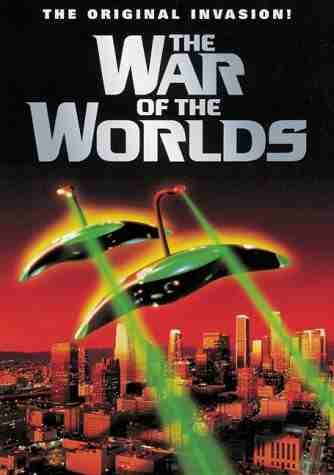
But this was also the era of big, colorful cars with enormous tail fins, situation comedies and growing prosperity, ever-bigger houses in the suburbs, and rock & roll on the transistor radio. There were few psychological studies of public feelings about nuclear war. Eventually, the government quietly sponsored research into why the public wasn't reacting. The theories ranged from "cognitive dissonance" to a kind of apathy later identified as "learned helplessness," to the simple but powerful psychological defense mechanism known as denial.
But the Cold War had clearly intensified, and along with Sputnik, provided new nuclear themes for the drive-in and Saturday matinee outlets for suppressed anxieties. Besides the mutation monsters (a number of them hitting the screens in 1957), the instantly deadly bolt from the blue came in the form of invasion from outer space, usually by technologically superior aliens with no conscience or aim other than destruction.
Many of these films predated Sputnik, for the fear of the Soviet threat was cultivated from the beginning of the atomic era. "In order to make the country bear the burden, " said President Eisenhower's Secretary of State, John Foster Dulles, referring to the arms race of the Cold War, "we have to create an emotional atmosphere akin to a wartime psychology. We must create the idea of a threat from without." But the fear that had been subsumed in early alien invasion films became more potent when that satellite beeping overhead added its alarm.
The aliens were technologically superior but otherwise mindless and implacable: instead of monsters created by radiation, they were monsters with ray guns and death rays as radiation weapons. Most rose or fell on how convincing their effects were, while their plots were all in their titles: Earth v. the Flying Saucers, Phantom from Space, Invaders from Mars, Killers from Space, Target Earth, It Conquered the World, It! The Terror From Beyond Space.
The best of the alien invasion films, and the one with the most visceral Cold War themes, was producer George Pal’s 1953 “War of the Worlds,” adapted from the H.G. Wells story. Set this time in contemporary California, it updates the technology and Americanizes the characters, and the protagonist is a credentialed scientist—a physicist, like the fearsome geniuses behind the Bomb.
It remains a remarkable film for its bright technicolor humbling of humanity. Neither our technology, our innocence (up to and including the atomic bomb) nor our religious faith could stop the mute Martian invaders and their death machines that floated in the air. The first victims of the Martian death ray were turned into piles of cinders on the ground with human outline, a clear reference to Hiroshima. The scientists who in most alien invasion and monster movies would figure out the enemy’s weakness, are in this film savagely beaten by a mob on their way to their laboratory with promising research. There is heroism, love and a happy ending, but once again this story has the power to tap into the solemn fears of the moment.
Some movies showed the aliens invading not by overwhelming force but by stealth; not by killing humans but by inhabiting them, “taking them over.” “Red Planet Mars” (1952) and “I Married a Monster from Outer Space” (1958), for example, were fairly explicit parables of alien subversion. The classic of the genre, Jack Arnold’s “Invasion of the Body Snatchers” (1955), showed the slow horror of alien plants turning a town’s population into pod people. The danger of being “taken over” by Communist subversion was a relentless theme of FBI chief J. Edgar Hoover, who was an important public figure in the 1950s.
But the Cold War had clearly intensified, and along with Sputnik, provided new nuclear themes for the drive-in and Saturday matinee outlets for suppressed anxieties. Besides the mutation monsters (a number of them hitting the screens in 1957), the instantly deadly bolt from the blue came in the form of invasion from outer space, usually by technologically superior aliens with no conscience or aim other than destruction.
Many of these films predated Sputnik, for the fear of the Soviet threat was cultivated from the beginning of the atomic era. "In order to make the country bear the burden, " said President Eisenhower's Secretary of State, John Foster Dulles, referring to the arms race of the Cold War, "we have to create an emotional atmosphere akin to a wartime psychology. We must create the idea of a threat from without." But the fear that had been subsumed in early alien invasion films became more potent when that satellite beeping overhead added its alarm.
The aliens were technologically superior but otherwise mindless and implacable: instead of monsters created by radiation, they were monsters with ray guns and death rays as radiation weapons. Most rose or fell on how convincing their effects were, while their plots were all in their titles: Earth v. the Flying Saucers, Phantom from Space, Invaders from Mars, Killers from Space, Target Earth, It Conquered the World, It! The Terror From Beyond Space.
The best of the alien invasion films, and the one with the most visceral Cold War themes, was producer George Pal’s 1953 “War of the Worlds,” adapted from the H.G. Wells story. Set this time in contemporary California, it updates the technology and Americanizes the characters, and the protagonist is a credentialed scientist—a physicist, like the fearsome geniuses behind the Bomb.
It remains a remarkable film for its bright technicolor humbling of humanity. Neither our technology, our innocence (up to and including the atomic bomb) nor our religious faith could stop the mute Martian invaders and their death machines that floated in the air. The first victims of the Martian death ray were turned into piles of cinders on the ground with human outline, a clear reference to Hiroshima. The scientists who in most alien invasion and monster movies would figure out the enemy’s weakness, are in this film savagely beaten by a mob on their way to their laboratory with promising research. There is heroism, love and a happy ending, but once again this story has the power to tap into the solemn fears of the moment.
Some movies showed the aliens invading not by overwhelming force but by stealth; not by killing humans but by inhabiting them, “taking them over.” “Red Planet Mars” (1952) and “I Married a Monster from Outer Space” (1958), for example, were fairly explicit parables of alien subversion. The classic of the genre, Jack Arnold’s “Invasion of the Body Snatchers” (1955), showed the slow horror of alien plants turning a town’s population into pod people. The danger of being “taken over” by Communist subversion was a relentless theme of FBI chief J. Edgar Hoover, who was an important public figure in the 1950s.

Moviemakers were not alone in expressing these anxieties. A steady flow of novels and short stories dealt with these themes, including best-sellers. They envisioned a future of technological oppression, as in Orwell’s Nineteen Eighty-Four (1948) and Ray Bradbury’s Fahrenheit 451 (1953.) Orwell’s message according to one critic “is simply that our industrial machine civilization is tending to deracinate and debilitate us, and will finally destroy us…”
Some writers tried to imagine the nuclear apocalypse itself, and its aftermath. As early as 1950, Judith Merril examined the impact of nuclear war on a single American home in Shadow On the Hearth. In The Last Day (1959), Helen Clarkson wrote about the immediate aftermath of a thermonuclear attack on a family and relatively isolated community (the 1983 film Testament had a similar story.)
Science fiction authors and magazines were particular obsessed with the ramifications of nuclear apocalypse. Poul Anderson wrote one apocalyptic fiction after another, with titles that told his attitude: Un-Man, Cold Victory and After Doomsday among them. As he emphasized in his non-fiction book, Thermonuclear War (1961), these times were “the most dangerous in the history of mankind.”
“Astounding after the war was a very black magazine,” science fiction chronicler Brian Aldiss writes of the premier sci-fi pulp. “Many stories were of Earth destroyed, culture doomed, humanity dying, and of the horrific effects of radiation, which brought mutation or insidious death.” He cites titles like “Dawn of Nothing,” “And Then There Were None,” “There Is No Defence” (by Theodore Sturgeon.) So pervasive were these themes that even in a science fiction novel for juvenile readers, a teenager’s adventures with an expedition on the moon turned suddenly somber when nuclear war erupts on Earth.
In the movies nuclear problems were beginning to come out from behind the monster and alien metaphors by the end of the decade. There had been several films attempting to portray the immediate aftermath of nuclear war in the early 1950s, but a new level of realism, at least in terms of human reaction, made On the Beach (1959) a major popular and critical hit. With current and upcoming movie stars (Gregory Peck, Ava Gardner, Fred Astaire, Anthony Perkins) and an A List director in Stanley Kramer, it is credited with bringing a new sobriety and engagement among a broader range of the public.
By the end of the decade, the nuclear cloud blotting out the future became more and more explicit. Working steadily at his expanding career, GR may not have been paying a lot of attention to this yet. But he could hardly fail to absorb it, for it was just about everywhere.
But then, something changed. While this mood continued into the 1960s, there were other events, and a sudden new atmosphere, that inspired a more hopeful vision. Many became convinced again that this bold and human future, this electrifying adventure, could happen-- and even that it was happening, and they were making it happen. The mood and many of the events were centered on a member of Gene Roddenberry’s generation---in fact, another a veteran of the war in the South Pacific--- who came to Los Angeles to talk of a new frontier.
Some writers tried to imagine the nuclear apocalypse itself, and its aftermath. As early as 1950, Judith Merril examined the impact of nuclear war on a single American home in Shadow On the Hearth. In The Last Day (1959), Helen Clarkson wrote about the immediate aftermath of a thermonuclear attack on a family and relatively isolated community (the 1983 film Testament had a similar story.)
Science fiction authors and magazines were particular obsessed with the ramifications of nuclear apocalypse. Poul Anderson wrote one apocalyptic fiction after another, with titles that told his attitude: Un-Man, Cold Victory and After Doomsday among them. As he emphasized in his non-fiction book, Thermonuclear War (1961), these times were “the most dangerous in the history of mankind.”
“Astounding after the war was a very black magazine,” science fiction chronicler Brian Aldiss writes of the premier sci-fi pulp. “Many stories were of Earth destroyed, culture doomed, humanity dying, and of the horrific effects of radiation, which brought mutation or insidious death.” He cites titles like “Dawn of Nothing,” “And Then There Were None,” “There Is No Defence” (by Theodore Sturgeon.) So pervasive were these themes that even in a science fiction novel for juvenile readers, a teenager’s adventures with an expedition on the moon turned suddenly somber when nuclear war erupts on Earth.
In the movies nuclear problems were beginning to come out from behind the monster and alien metaphors by the end of the decade. There had been several films attempting to portray the immediate aftermath of nuclear war in the early 1950s, but a new level of realism, at least in terms of human reaction, made On the Beach (1959) a major popular and critical hit. With current and upcoming movie stars (Gregory Peck, Ava Gardner, Fred Astaire, Anthony Perkins) and an A List director in Stanley Kramer, it is credited with bringing a new sobriety and engagement among a broader range of the public.
By the end of the decade, the nuclear cloud blotting out the future became more and more explicit. Working steadily at his expanding career, GR may not have been paying a lot of attention to this yet. But he could hardly fail to absorb it, for it was just about everywhere.
But then, something changed. While this mood continued into the 1960s, there were other events, and a sudden new atmosphere, that inspired a more hopeful vision. Many became convinced again that this bold and human future, this electrifying adventure, could happen-- and even that it was happening, and they were making it happen. The mood and many of the events were centered on a member of Gene Roddenberry’s generation---in fact, another a veteran of the war in the South Pacific--- who came to Los Angeles to talk of a new frontier.
Subscribe to:
Posts (Atom)