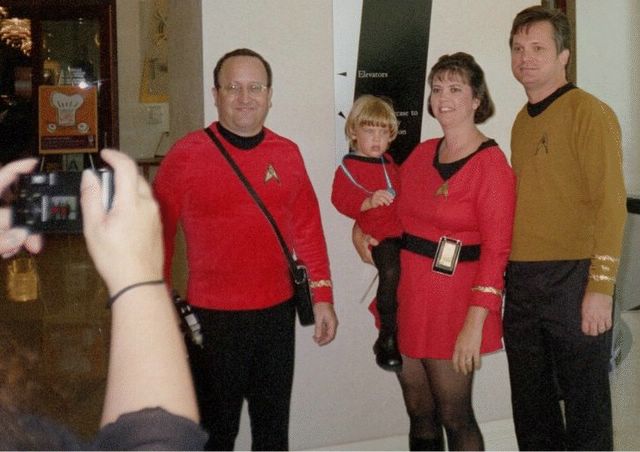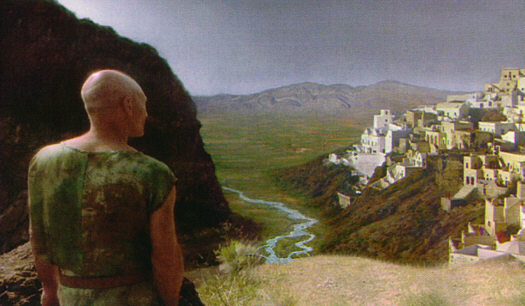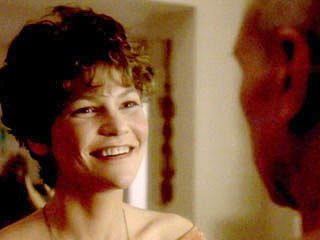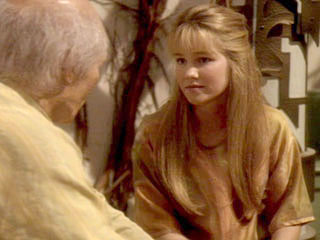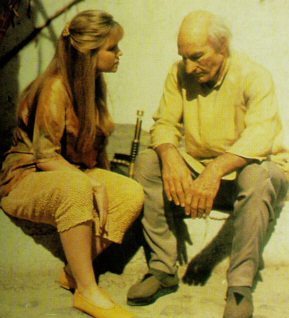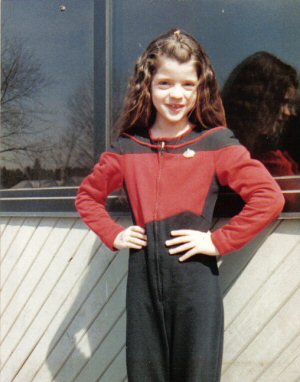
Someone posted this on a blog, from her childhood. I've lost the exact information, but its the kind of scene that's likely to be repeated this month and next.

This really is the amazing thing. It's true that although people don't generally realize it, well-known actors in Hollywood and New York, including very big stars, do spend a lot of time workng for free or very little--doing readings, plays and small films, for a varety of reasons: to encourage new writers and their work, to give back to their art form, to express skills of their craft that may not be fully used in the roles they get in TV or film (where playing cops and criminals can get old fast), or for a cause they believe in. But it is still extraordinary that so many people would contribute their time and talent to keep expressing a vision that has inspired so many, beginning forty years ago this fall.
In this case, those donating their services include writers (Sky Conway, Jack Trevino and Ethan H. Calk) and all the other creative and tech people. It is further evidence that Star Trek was always a product of a shared vision and commitment, of many hands that worked together to create this story universe.
These productions are getting so professional that there needs to be a new name for them. Fan films won't do anymore. Tim Russ calls it a "nostalgia-based production," which is closer, but nostalgia has the connotation of something that's over. Paramount may think so, but for many people and well as many fans, the human adventure continues in the Star Trek story universe.
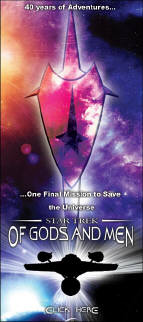
The finished film is expected to be available in three 30 minute episodes, downloadable from the Internet, by year's end. For more information, visit Star Trek: Of Gods and Men.
Update: The first and last sections that follow deal with the Climate Crisis and its outcome if we don't meet this challenge. For a practical and hopeful view of how things might be changed, there's a new Rolling Stone interview with Al Gore that makes the case better than anything I've seen.
As the first run of Star Trek: The Next Generation came to an end, fans voted for their favorite episodes. Only the two-parter about the Borg invasion, “The Best of Both Worlds,” and “Yesterday’s Enterprise” were voted ahead of “The Inner Light.” It won a 1993 Hugo Award, the first TV episode to win one since the TOS story, “City on the Edge of Forever”. In the years since, esteem for this fifth season episode has only grown. Some now consider it is the best of the Next Generation, and even the best episode of any Star Trek series.
But I’ve been thinking about it recently not because of its excellence, though I’ve always admired it since I saw it the night it first aired. I’ve been pondering it lately, and drawn to see it again on DVD, by thoughts I’ve been having about the real and fairly immediate future of the earth.
Others may be thinking about it, too, right about now. “An Inconvenient Truth,” the documentary film about the Climate Crisis featuring Al Gore, is gradually opening in more and more places. In its first week it was #11 at the box office, despite being in only four theatres. The #10 film was in 1265 theatres. A couple of weeks later, it broke into the top ten, though it was still in only 77 theatres. Its per-theatre take was higher than that of the #1 movie that week---and higher than X-Men 3. The book version is high on the best seller list. (Here's the web site.)
The future it depicts, as determined by the phenomenon known as global warming, is dire. The changes are already underway, caused by the buildup of greenhouse gases. Glaciers and icepacks in the Arctic, in Greenland, in the Antarctic are melting. They are likely to cause sea levels to rise, flooding coastal cities. They may cause shifts in major ocean currents that will in turn cause radical changes in climate. On the day I write this, a new report by the National Center for Atmospheric Research confirms that “global warming accounted for around half of the extra hurricane-fueling warmth” in 2005, so Katrina and the record hurricane year were largely a product of the Climate Crisis, and not natural variations. Storms like these are likely to increase in number and ferocity, in various parts of the world.
Heating is already changing ecologies. Various studies suggest it will bring new diseases to larger areas, change rainfall patterns and create drought in some places, if it is not doing so already. Because of time lags between cause and effect, these current effects are from greenhouse gas buildups that occurred perhaps decades ago. The planet will feel the effects of current greenhouse gas emissions in decades to come. And if greenhouse gas emissions aren’t curtailed dramatically soon (some say five years, some say twenty, but most say 10 years), the climate change may reach a “tipping point,” after which nothing can stop a phenomenon that feeds on itself until it plays itself out. The result could very well be an inexorable dying away of life on earth as we know it.
“The Inner Light” is not strictly speaking about a planet suffering from global warming. Its sun is going nova, causing a gradual global drought. The sun's flaring and dying eventually will extinguish all life. Even at worst, the actual effects of our global warming are likely to be different, especially in different places on earth. But the applicability of this story to fears for our future is inescapable.
With great and concentrated effort, humankind may be able to prevent the worst effects of global heating in the future, and create remedies for the major problems it will cause in the next few decades. It looks very much like a challenge that human civilization must meet in order to go forward.
But what if humanity doesn’t respond? What if all an individual or a family can do, perhaps living in a town outside the great places of power, is watch, measure the changes, and await the end?