The New Team
J.J. Abrams---producer, director, co-writer—will have more power over Star Trek’s future than anyone in its past, perhaps even including its creator, Gene Roddenberry. At least for one movie.
Who is Abrams? At 40 years old (in June), he is currently a very hot commodity. He created two hit TV series, “Lost” and “Alias,” when TV dramas are losing audiences to so-called reality shows. Paramount is apparently pleased with his work on Mission Impossible III, even though the film hasn’t yet been released.
MI3 is his first film as a director. It’s a big budget movie, with a high-powered cast. His past work as a writer for film, however, has not been especially distinguished. On the plus side, he’s been versatile: writing action, drama, comedy and romantic movies. But few of these films were successful, or critical favorites.
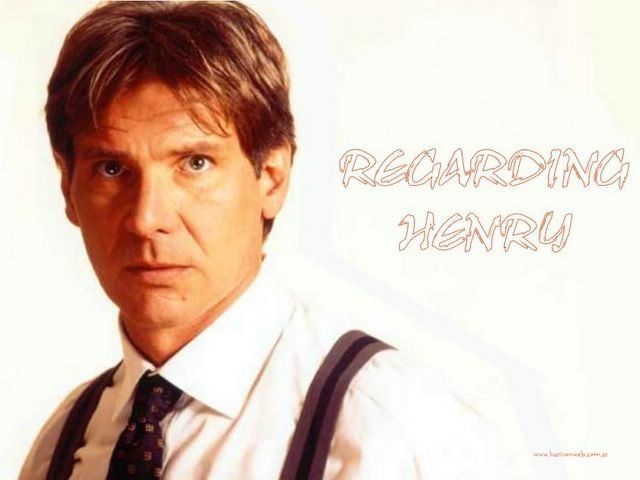
He wrote the screenplay for Armageddon (1998), generally considered the lesser of the two asteroid-threatens-earth movies of that year, starring Bruce Willis. He co-wrote a 2001 drama about a psycho killer (Joy Ride), an obscure comedy (Gone Fishin, 1997) for Danny Glover and Joe Pesci, a romantic drama (Forever Young, 1992) for Mel Gibson. Though it was not particularly successful at the box office, his one gem was Regarding Henry in 1991, which featured one of Harrison Ford’s best performances (and just guessing, I’ll bet one of his favorites.)
Abrams also created the TV series about college students, Felicity, that ran 4 years on the WB cable network, and a 2005 pilot for a series about bounty hunters (The Catch) which was not picked up.
His writing partners for Star Trek XI, Alex Kurtzman and Roberto Orci, who worked with Abrams on MI3, have worked together before. They co-wrote the sequel, The Legend of Zorro (2005), which didn’t measure up critically or at the box office to its predecessor, The Mask of Zorro. They are writing partners on two films slated for release next year, The Transformers: The Movie, and Amazon (Orci is also a producer of this film, to star Scarlett Johansson.) The actual status of these two projects is unknown.
But perhaps most interesting is their early TV work: both wrote for the Kevin Sabo Hercules series, and Orci wrote for its companion series, “Zena, the Warrior Princess.”
All in all, I find more to worry about that to celebrate in the prior work of this team. They certainly are experienced at writing sequels, and working with established characters and fictional worlds. But they’ve never worked with a fictional world as complex, and as dependent on concepts and its internal history, as Star Trek.
If you are concerned about Star Trek continuity, about its history of the future and the key concepts that are crucial to that history, you have to worry about the casual attitude towards history and continuity in the groundbreaking Hercules and Zena series. Their playful use of anachronisms—of very contemporary dialogue and character attitudes in an ancient setting, their casual mixing of periods and places, myth and history in incorporating real historical figures—was a great part of the charm of these shows, and what made them different. But though a vein of knowing humor did work well for the last 3 or 4 TOS cast features, a casual attitude towards Star Trek’s past could play havoc with the Star Trek universe, as created and preserved in 40 years of film, tape and print.
My own perhaps obsessive fear about new Star Trek---that it will use the characters and the Star Trek universe as nothing more than a setting for an action move, a feature film video-game (or video game commercial) —is not exactly assuaged by what I know about this team. Abrams is reputedly a Star Trek fan, but on what level? Treating the Star Trek universe and Trek characters apart from the soul of Star Trek instantly makes it something else. And the revolution becomes an assassination.
Maybe they have the chops to really add to Star Trek not only with good storytelling, with action and adventure, character interplay and development, but by advancing elements of the Star Trek story that articulates its ethos, its view of the future and of the human potential. Or at least, not trashing what Star Trek has come to mean to so many people about a path to a hopeful future. Regarding Henry tells me that’s possible. Armageddon and Zena make me wonder. The idea of Transformers: the Movie makes me cringe.
Sunday, April 23, 2006



Academy Days
There’s a lot of fan debate over whether Star Trek should be going back to pre-original series days for the next film. The idea for a Starfleet Academy film featuring the young Kirk and Spock goes back to another period in which Trek’s future was in doubt after a perceived box office failure, right after Star Trek V. Harve Bennett’s initial proposal was for a story about racial prejudice against Spock but wrapped in a flashy package: the Star Trek version of Top Gun.
More recently William Shatner has pushed for such a concept, and is apparently writing a series of Star Trek novels with this theme. So far, he does not appear to be involved in this project.
According to one story, the Bennett proposal was revived a few years ago, but when it was sent to Rick Berman, he allowed it to be transformed into the Romulan War prequel that was recently axed. There was at least one other project that at least somebody was actively pursuing, a mixed-cast movie set in the 24th century, led by the Next Generation crew. Patrick Stewart was approached, and there were rumors about Shatner’s involvement in a Mirror Universe story.
I admit to a continuing desire for the 24th century story, though I see Q as the catalyst. Although not a lot of fans agree with me, the Mirror Universe concept worked only in its first original series appearance. (I really despised what Enterprise did with it.) But there’s no indication we’re ever going to see the Next Generation crew again.
So what about this Academy concept?
While fans speculate on who might be the younger Kirk and the new Spock, it’s worth remarking that an academy doesn’t have only students---it has teachers. The teachers in the Harry Potter series, for example, are nearly as important as the students in those stories. I expect that there will be at least one older character, a teacher, a mentor, who will be important, and I expect also it will be a big name star. The Harry Potter films again show this potential.
Looking at who Abrams has worked with before, several older stars could be possibilities: Tom Cruise (star of MI3 and the original Top Gun as well as Speilberg’s War of the Worlds) is an obvious choice, perhaps as a flight instructor. Bruce Willis and Mel Gibson are other stars to consider. They no longer carry movies as they once did, so being part of a Harry Potter-like ensemble, or even being the only box office star in the movie, might be attractive.
But the established actor I’d most like to see would be Harrison Ford. As mentioned above, Abrams wrote one of his best movies, Regarding Henry, though it was utterly outside the action genre. But Ford would be a perfect mentor for a young Kirk, with his borrowed flash from his Star Wars and Indiana Jones characters. There is also Spielberg’s new association with Paramount, and Ford is close to him and his associates.
Regarding Henry is an overlooked but quite good movie, interesting in Trek terms because of its theme: a greedy mover and shaker is shot in a robbery, suffers brain damage, and begins life over again as an apparently mentally impaired person, but he turns out to be more loving and more ethical, tuned into the basic values of life.
I’ve said before that while Star Trek often dealt with the perils of power, Dr. Who often dealt with the perils of greed. Star Trek did deal with greed now and again, especially TNG, but this is an opportunity to deal with it more directly. What if resurgent greed on earth threatens the Federations principles?
Or we could see a good classroom scene, in which a professor argues for the rationale of the prime directive, of reversing the history of exploration always also meaning exploitation.
I've only mentioned male stars, but there's potential for established female stars, not just as cadets but as instructors. It will be hard for any writers to resist creating yet another beautiful woman who is quite hopelessly in love with Spock. On the other hand, it might be fun to see young Kirk as a disaster with women. The series hinted he was a more of a scholar than a young Ulysses.
We might even see as an instructor, perhaps in Federation and space law, the descendent of Denny Crane, as played by William Shatner. What a moment it would be if he watches the young Kirk and observes, I don’t know why I like that kid. And another teacher offers, maybe you see in him something of yourself.
Villains? Klingons perhaps. Though something internal to the Academy would be more imaginative.
Perhaps Abrams experience with the college series, “Felicity,” will help with creating a believable Academy. I’d be surprised if we don’t see young Kirk as a solo pilot of some fast space vehicle. I’m certainly not worried that this team will shirk the action adventure. Abrams seems capable of handling character and basic storytelling. My question for them as for anyone: are they going to make a movie with Star Trek-named characters that deletes the soul of Star Trek? Are they going to keep Star Trek in the science fiction of consciousness, or toss it whole into the easy category of commercialized unconsciousness, a big budget exploitation of 40 years of meaning as well as entertainment?
Obviously we won’t know for awhile. But we may get some clues from what Abrams and company say in the coming months.
There is also a remote possibility to consider: since these guys were so good at keeping this a secret until the recent announcement, could the Starfleet Academy scenario be an elaborate deception to keep this movie a surprise, and not what they’re planning at all?
There’s a lot of fan debate over whether Star Trek should be going back to pre-original series days for the next film. The idea for a Starfleet Academy film featuring the young Kirk and Spock goes back to another period in which Trek’s future was in doubt after a perceived box office failure, right after Star Trek V. Harve Bennett’s initial proposal was for a story about racial prejudice against Spock but wrapped in a flashy package: the Star Trek version of Top Gun.
More recently William Shatner has pushed for such a concept, and is apparently writing a series of Star Trek novels with this theme. So far, he does not appear to be involved in this project.
According to one story, the Bennett proposal was revived a few years ago, but when it was sent to Rick Berman, he allowed it to be transformed into the Romulan War prequel that was recently axed. There was at least one other project that at least somebody was actively pursuing, a mixed-cast movie set in the 24th century, led by the Next Generation crew. Patrick Stewart was approached, and there were rumors about Shatner’s involvement in a Mirror Universe story.
I admit to a continuing desire for the 24th century story, though I see Q as the catalyst. Although not a lot of fans agree with me, the Mirror Universe concept worked only in its first original series appearance. (I really despised what Enterprise did with it.) But there’s no indication we’re ever going to see the Next Generation crew again.
So what about this Academy concept?
While fans speculate on who might be the younger Kirk and the new Spock, it’s worth remarking that an academy doesn’t have only students---it has teachers. The teachers in the Harry Potter series, for example, are nearly as important as the students in those stories. I expect that there will be at least one older character, a teacher, a mentor, who will be important, and I expect also it will be a big name star. The Harry Potter films again show this potential.
Looking at who Abrams has worked with before, several older stars could be possibilities: Tom Cruise (star of MI3 and the original Top Gun as well as Speilberg’s War of the Worlds) is an obvious choice, perhaps as a flight instructor. Bruce Willis and Mel Gibson are other stars to consider. They no longer carry movies as they once did, so being part of a Harry Potter-like ensemble, or even being the only box office star in the movie, might be attractive.
But the established actor I’d most like to see would be Harrison Ford. As mentioned above, Abrams wrote one of his best movies, Regarding Henry, though it was utterly outside the action genre. But Ford would be a perfect mentor for a young Kirk, with his borrowed flash from his Star Wars and Indiana Jones characters. There is also Spielberg’s new association with Paramount, and Ford is close to him and his associates.
Regarding Henry is an overlooked but quite good movie, interesting in Trek terms because of its theme: a greedy mover and shaker is shot in a robbery, suffers brain damage, and begins life over again as an apparently mentally impaired person, but he turns out to be more loving and more ethical, tuned into the basic values of life.
I’ve said before that while Star Trek often dealt with the perils of power, Dr. Who often dealt with the perils of greed. Star Trek did deal with greed now and again, especially TNG, but this is an opportunity to deal with it more directly. What if resurgent greed on earth threatens the Federations principles?
Or we could see a good classroom scene, in which a professor argues for the rationale of the prime directive, of reversing the history of exploration always also meaning exploitation.
I've only mentioned male stars, but there's potential for established female stars, not just as cadets but as instructors. It will be hard for any writers to resist creating yet another beautiful woman who is quite hopelessly in love with Spock. On the other hand, it might be fun to see young Kirk as a disaster with women. The series hinted he was a more of a scholar than a young Ulysses.
We might even see as an instructor, perhaps in Federation and space law, the descendent of Denny Crane, as played by William Shatner. What a moment it would be if he watches the young Kirk and observes, I don’t know why I like that kid. And another teacher offers, maybe you see in him something of yourself.
Villains? Klingons perhaps. Though something internal to the Academy would be more imaginative.
Perhaps Abrams experience with the college series, “Felicity,” will help with creating a believable Academy. I’d be surprised if we don’t see young Kirk as a solo pilot of some fast space vehicle. I’m certainly not worried that this team will shirk the action adventure. Abrams seems capable of handling character and basic storytelling. My question for them as for anyone: are they going to make a movie with Star Trek-named characters that deletes the soul of Star Trek? Are they going to keep Star Trek in the science fiction of consciousness, or toss it whole into the easy category of commercialized unconsciousness, a big budget exploitation of 40 years of meaning as well as entertainment?
Obviously we won’t know for awhile. But we may get some clues from what Abrams and company say in the coming months.
There is also a remote possibility to consider: since these guys were so good at keeping this a secret until the recent announcement, could the Starfleet Academy scenario be an elaborate deception to keep this movie a surprise, and not what they’re planning at all?
Friday, April 21, 2006
The Big Announcement
Paramount has announced its plans for the next Star Trek feature film, slated for 2008 release. It's a story that's been picked up everywhere---Google even lists Pravda. So check your favorite Trek news source for the few details available so far.
I'll post my thoughts on the news, the new team in charge, and the announced theme of the movie, within the next day or so. Probably it will be dated Sunday, though it could appear as early as Saturday morning.
Paramount has announced its plans for the next Star Trek feature film, slated for 2008 release. It's a story that's been picked up everywhere---Google even lists Pravda. So check your favorite Trek news source for the few details available so far.
I'll post my thoughts on the news, the new team in charge, and the announced theme of the movie, within the next day or so. Probably it will be dated Sunday, though it could appear as early as Saturday morning.
Monday, April 17, 2006

Trek Who?
by William S. Kowinski
A story at SyFy Portal last week provided a few new details about the Erik Jendresen script for Star Trek XI, and some confirmation of previous stories about its fate, namely that it has been shelved, at least for the moment.
It was indeed a prequel about the Romulan War, which Jendresen reveals was designed as the first of a trilogy, to fill in the century between Enterprise and Captain Kirk.
As much as some fans would like to see a Romulan War film, the idea of a trilogy is daunting. There is only so much you can do in a trilogy: Romulan War followed by The Romulans Strike Back and Return of the Federation? It’s a three act play basically.
Steve Krutzler at TrekWeb wrote about the SyFy Portal story, and added his own comments to the effect that a prequel is a bad idea for re-starting Star Trek, unless perhaps it’s some version of the Starfleet Academy idea with a young Kirk and Spock, first proposed by Harv Bennett, but lately the basis of a William Shatner story.
This ignited a debate at TrekWeb about the future of Star Trek---should it go back to a prequel, or forward past the events of Star Trek Nemesis, in the 24th century or beyond?
Should it involve known characters, and if so, the actors who played them? Could other actors play Kirk and Spock, like several versions of James Bond? Or should Trek be re-imagined, as Batman and Superman have, several times?
It’s a fascinating debate, and I’m not ready to come down at any point on the timeline, but I will offer these thoughts about the re-imagining option, or as some call it, the reboot.
by William S. Kowinski
A story at SyFy Portal last week provided a few new details about the Erik Jendresen script for Star Trek XI, and some confirmation of previous stories about its fate, namely that it has been shelved, at least for the moment.
It was indeed a prequel about the Romulan War, which Jendresen reveals was designed as the first of a trilogy, to fill in the century between Enterprise and Captain Kirk.
As much as some fans would like to see a Romulan War film, the idea of a trilogy is daunting. There is only so much you can do in a trilogy: Romulan War followed by The Romulans Strike Back and Return of the Federation? It’s a three act play basically.
Steve Krutzler at TrekWeb wrote about the SyFy Portal story, and added his own comments to the effect that a prequel is a bad idea for re-starting Star Trek, unless perhaps it’s some version of the Starfleet Academy idea with a young Kirk and Spock, first proposed by Harv Bennett, but lately the basis of a William Shatner story.
This ignited a debate at TrekWeb about the future of Star Trek---should it go back to a prequel, or forward past the events of Star Trek Nemesis, in the 24th century or beyond?
Should it involve known characters, and if so, the actors who played them? Could other actors play Kirk and Spock, like several versions of James Bond? Or should Trek be re-imagined, as Batman and Superman have, several times?
It’s a fascinating debate, and I’m not ready to come down at any point on the timeline, but I will offer these thoughts about the re-imagining option, or as some call it, the reboot.

First, in terms of precedent, the superheroes that have been successfully reconceived all began their lives as comic book characters. Sketched and inked figures leave a lot to the imagination, and the Superman or Spiderman in peoples’ heads could vary. Kirk and Spock are Shatner and Nimoy, through almost 40 years. It’s hard to see anyone else playing those characters.
The older characters of successful reboots, Superman and Batman, had several iterations in radio, animated cartoons, movie serials and television series before they became big screen franchises. Superman is a fascinating case to trace. There are elements of the comics that went to radio, elements of the radio shows that were preserved in the animated movie cartoons, and elements of those—including the images and the kind of music in the opening---that became identified with the George Reeves TV series.
Then came the Christopher Reeves movies. The first was one of the great movies of the era. In its first part, the hero/savior myth merged with the American Dream, within the existing sketch of the Superman origin story. Then the Metropolis section brought new visual effects to enchant, a love story, a crisis with big stakes, and the comic panache of Gene Hackman's nevertheless deadly Lex Luthor.
But by the last of this series of films, the audience and the special effects budget had dwindled disastrously. It was some years before the character was revived and redefined for TV, in “Lois and Clark,” the Superboy series and “Smallville.” Another movie was always in the works, and Superman Returns is still slated for this year, with many of the usual characters (including some of the 50s TV cast once again in cameos.) How much the character is reimagined remains to be seen.
The wrinkle in the Batman story was the 1960s TV series, which saw the whole comic book thing as campy, self-consciously played for laughs. The Michael Keaton Batman films had to reestablish Batman as having some serious adventure quality, but there was a residue from the TV series that kept it from taking itself seriously enough to be more than special effects melodrama with laughs. It benefited most from Jack Nicholson’s performance, though I’ve always like Michael Keaton. The movie series, later with Val Kilmer and George Clooney, never got over the distasteful second Tim Burton film, Batman Returns. They seemed to play with combining elements of Superman and James Bond films with TV Batman humor.
So personally I wasn’t expecting much when Batman Begins was announced. I'd heard about the new, darker Batman, and that didn't appeal to me. I didn’t even see it until it was on video, but I must admit I was pretty impressed. It retold the origin story for about the fourth time, but in the most convincing way. (Unlike the first Christopher Reeves’ Superman, the Batman origin had never been told very well or as iconically.) It actually found a way to make Batman impressive and a bit scary, mostly by the “whoosh” effects of his speedy, phantom movements. (And at last, Lian Neesen got to show his physical moves, that he must have gotten all prepared to do in the prequel Star Wars trilogy.)
There was no self-conscious irony or self-parody. An unknown in the lead probably helped. There was some sophistication in the ideas the movie played with---a little confusion, but at least some ambition. It made me rethink the possibilities for a Star Trek reboot. And then something else did as well.
The older characters of successful reboots, Superman and Batman, had several iterations in radio, animated cartoons, movie serials and television series before they became big screen franchises. Superman is a fascinating case to trace. There are elements of the comics that went to radio, elements of the radio shows that were preserved in the animated movie cartoons, and elements of those—including the images and the kind of music in the opening---that became identified with the George Reeves TV series.
Then came the Christopher Reeves movies. The first was one of the great movies of the era. In its first part, the hero/savior myth merged with the American Dream, within the existing sketch of the Superman origin story. Then the Metropolis section brought new visual effects to enchant, a love story, a crisis with big stakes, and the comic panache of Gene Hackman's nevertheless deadly Lex Luthor.
But by the last of this series of films, the audience and the special effects budget had dwindled disastrously. It was some years before the character was revived and redefined for TV, in “Lois and Clark,” the Superboy series and “Smallville.” Another movie was always in the works, and Superman Returns is still slated for this year, with many of the usual characters (including some of the 50s TV cast once again in cameos.) How much the character is reimagined remains to be seen.
The wrinkle in the Batman story was the 1960s TV series, which saw the whole comic book thing as campy, self-consciously played for laughs. The Michael Keaton Batman films had to reestablish Batman as having some serious adventure quality, but there was a residue from the TV series that kept it from taking itself seriously enough to be more than special effects melodrama with laughs. It benefited most from Jack Nicholson’s performance, though I’ve always like Michael Keaton. The movie series, later with Val Kilmer and George Clooney, never got over the distasteful second Tim Burton film, Batman Returns. They seemed to play with combining elements of Superman and James Bond films with TV Batman humor.
So personally I wasn’t expecting much when Batman Begins was announced. I'd heard about the new, darker Batman, and that didn't appeal to me. I didn’t even see it until it was on video, but I must admit I was pretty impressed. It retold the origin story for about the fourth time, but in the most convincing way. (Unlike the first Christopher Reeves’ Superman, the Batman origin had never been told very well or as iconically.) It actually found a way to make Batman impressive and a bit scary, mostly by the “whoosh” effects of his speedy, phantom movements. (And at last, Lian Neesen got to show his physical moves, that he must have gotten all prepared to do in the prequel Star Wars trilogy.)
There was no self-conscious irony or self-parody. An unknown in the lead probably helped. There was some sophistication in the ideas the movie played with---a little confusion, but at least some ambition. It made me rethink the possibilities for a Star Trek reboot. And then something else did as well.

The idea that Star Trek could be reconceived has pretty much filled me with horror for one basic reason: I don’t see anyone who can do it. There’s a lack of understanding, even a lack of sympathy, for the essence, the soul of Star Trek, even among many of the Trek alums.
While I deeply admire much of the work writer/producer Ron Moore did at Star Trek, and I recognize the creativity and achievement of his re-imagining of Battlestar Galactica, I don’t want to see Star Trek turned into a so-called “realistic” war series with futuristic/sci-fi twists. Especially since what “gritty” and “realistic” seems to mean to that generation of writers is all based on movie versions of World War II. I’ve found it more than a little ironic that they denigrate the view of war and peace in Star Trek, which was created by actual veterans of World War II.
I’m not saying Ron Moore would do that. But I fear a lot of other writer/producers would. The Berman & Braga regime of the past decade seems to have soured people on the idea that the Star Trek universe and ethos can still generate creative ideas. But I sure don’t want to see what seems to be the alternative: some combination of Star Trek aliens and technology with war and espionage video games. I don’t want to see Star Trek as a futuristic “24.”
The post-9-11 emphasis on terrorism and war, while it was never as dangerous to most of us as World War II was to our parents and grandparents, seems to have captivated the imagination of a generation of writers. I don’t even much like the Dominion novels in the Star Trek series, nor was a fan of the Dominion war episodes of DS9, which too often centered on war stories that were clichés that even the Horatio Hornblower novels avoided.
This even makes me fearful of a Romulan War movie, let alone a trilogy. There are possibilities for fascinating untold stories about how earth really got itself together, and how earthlings confronted their history of exploiting along with exploring, as well as how the attitude of peaceful exploration and the Prime Directive came to be such an important tenet of that future. And then how all these ideals were tested and evolved in conflict with Romulus. But I have no confidence that anyone in Hollywood would tell those stories. It would be all visual effects explosions and cliché conflicts and cliché heroics. The drama would be of personalities and not about the consciousness required by the future, in the hearts and minds and actions of people.
So that’s one reason I am all for a waiting period, before Trek begins again, unless it continues with the Next Generation crew at its center. As I’ve said before, I could see a mixed generations movie with the Next Generation in the lead for Star Trek XI. But the time for that may be escaping. We’ll see.
But getting back to the reboot, my confidence in anyone being able to re-imagine Star Trek now is not high, but it has just gotten a bit of a boost, from England.
Like Michelle at Trek Today, I’m quite taken with what I’ve seen of the new Doctor Who---the first season episodes airing on the Sci-Fi Channel. I’ve only seen two, but I must agree that they’re really good, and “Dalek” was really excellent (it even addressed the old joke about the wheeled Daleks being made helpless by stairs.)
But unlike Michelle, I do know the series. Back when I lived in Pittsburgh, there was a new public TV channel on cable and UHF, channel 16. They called themselves “sweet little 16,” because their programming was very modest. They did show a lot of old series’ from England, and their first hit was “Dr. Who.”
It was such a big hit for them, in fact, that they had a Dr. Who convention, and after airing all of the Tom Baker episodes (the Fourth and most famous Doctor, who reigned the longest, 7 years in the 70s and 80s) they started right at the beginning. So I saw at least some of the episodes of the first 7 doctors, (Hartnell, Troughton, Pertwee, Tom Baker, Peter Davidson, Colin Baker and Sylvester McCoy.)
I’ve seen all of the Tom Baker episodes, which remain my favorites. This was also the Douglas Adams era, who was a writer and producer for Dr. Who while he was creating The Hitchhiker’s Guide to the Galaxy. And to show how small a place and yet fascinating a time it was: Lalla Ward was Baker’s costar and also his wife. She divorced him and married Richard Dawkins, the eminent writer on genetics. How is this possible? The connecting link was Douglas Adams, who was friends with them all. He also got one member of Monty Python and a costar in a Beatles movie to appear in an episode of Dr. Who.
While I deeply admire much of the work writer/producer Ron Moore did at Star Trek, and I recognize the creativity and achievement of his re-imagining of Battlestar Galactica, I don’t want to see Star Trek turned into a so-called “realistic” war series with futuristic/sci-fi twists. Especially since what “gritty” and “realistic” seems to mean to that generation of writers is all based on movie versions of World War II. I’ve found it more than a little ironic that they denigrate the view of war and peace in Star Trek, which was created by actual veterans of World War II.
I’m not saying Ron Moore would do that. But I fear a lot of other writer/producers would. The Berman & Braga regime of the past decade seems to have soured people on the idea that the Star Trek universe and ethos can still generate creative ideas. But I sure don’t want to see what seems to be the alternative: some combination of Star Trek aliens and technology with war and espionage video games. I don’t want to see Star Trek as a futuristic “24.”
The post-9-11 emphasis on terrorism and war, while it was never as dangerous to most of us as World War II was to our parents and grandparents, seems to have captivated the imagination of a generation of writers. I don’t even much like the Dominion novels in the Star Trek series, nor was a fan of the Dominion war episodes of DS9, which too often centered on war stories that were clichés that even the Horatio Hornblower novels avoided.
This even makes me fearful of a Romulan War movie, let alone a trilogy. There are possibilities for fascinating untold stories about how earth really got itself together, and how earthlings confronted their history of exploiting along with exploring, as well as how the attitude of peaceful exploration and the Prime Directive came to be such an important tenet of that future. And then how all these ideals were tested and evolved in conflict with Romulus. But I have no confidence that anyone in Hollywood would tell those stories. It would be all visual effects explosions and cliché conflicts and cliché heroics. The drama would be of personalities and not about the consciousness required by the future, in the hearts and minds and actions of people.
So that’s one reason I am all for a waiting period, before Trek begins again, unless it continues with the Next Generation crew at its center. As I’ve said before, I could see a mixed generations movie with the Next Generation in the lead for Star Trek XI. But the time for that may be escaping. We’ll see.
But getting back to the reboot, my confidence in anyone being able to re-imagine Star Trek now is not high, but it has just gotten a bit of a boost, from England.
Like Michelle at Trek Today, I’m quite taken with what I’ve seen of the new Doctor Who---the first season episodes airing on the Sci-Fi Channel. I’ve only seen two, but I must agree that they’re really good, and “Dalek” was really excellent (it even addressed the old joke about the wheeled Daleks being made helpless by stairs.)
But unlike Michelle, I do know the series. Back when I lived in Pittsburgh, there was a new public TV channel on cable and UHF, channel 16. They called themselves “sweet little 16,” because their programming was very modest. They did show a lot of old series’ from England, and their first hit was “Dr. Who.”
It was such a big hit for them, in fact, that they had a Dr. Who convention, and after airing all of the Tom Baker episodes (the Fourth and most famous Doctor, who reigned the longest, 7 years in the 70s and 80s) they started right at the beginning. So I saw at least some of the episodes of the first 7 doctors, (Hartnell, Troughton, Pertwee, Tom Baker, Peter Davidson, Colin Baker and Sylvester McCoy.)
I’ve seen all of the Tom Baker episodes, which remain my favorites. This was also the Douglas Adams era, who was a writer and producer for Dr. Who while he was creating The Hitchhiker’s Guide to the Galaxy. And to show how small a place and yet fascinating a time it was: Lalla Ward was Baker’s costar and also his wife. She divorced him and married Richard Dawkins, the eminent writer on genetics. How is this possible? The connecting link was Douglas Adams, who was friends with them all. He also got one member of Monty Python and a costar in a Beatles movie to appear in an episode of Dr. Who.

Tom Baker was the quintessential Dr. Who, and everyone who played the part afterwards had to decide how much to be like him and how much to be different. Dr. Who on Channel 16 faded away with Sylvester McCoy, and it soon left the air in England altogether.
It was revived last year with much better visual effects and much less of a direct link to its origin as a childrens’ show. But it is also well acted and especially the writing is better than I could have hoped or even imagined.
The first episode I saw was the second part of “World War III,” and the beginning wasn’t terribly promising. It took a few minutes for me to warm up to Christopher Eccelston’s Doctor--- a working class bloke in a leather jacket, close cropped hair whose dopey manner (though very Doctorish) didn’t seem to fit. But it didn’t take long for him to win me over. And in “Dalek” his portrayal of a Doctor who is deeply angry, even bitter and hardened, was riveting. There already seems to be more of an apocalyptic edge to this edition of Doctor Who, though the sense of hope, if not confidence, is also there.
Eccelston played the Doctor for only the first season. He’s been replaced by David Tennant. But the production team is intact, and they’re planning on returning some old characters (liked the beloved Sarah Jane Smith of the Tom Baker era), deliberately modeled on what The Next Generation did in bringing back elements of original Trek, including some major characters.
In only the two episodes I’ve seen, I’ve been impressed that Doctor Who could be reconceived, including not only effects but lessons learned from plays and television in England that dealt with social history as well as science fiction from elsewhere. But then, Doctor Who always had that tradition of quality drama nearby. Not only did its monsters speak with impeccable stage English accents, but they sometimes were positively Shakespearian.
Does any of this transfer to Star Trek? Admittedly, not a lot. The idea of new Doctors was built into the series since the elderly actor playing the first doctor became too ill to continue. (The Doctor occasionally “regenerates” his form.) So it doesn’t say much about replacing actors who established the characters of Star Trek.
As for whether a similar strength of imagination and quality of writing and production is possible, there are major differences. British TV, with its access to theatre and intelligent television, as well as to the dramatic and comedic traditions of Oxford and Cambridge, is very different from the hermetic hothouse of Los Angeles TV. Of course, that does happen to be where Star Trek started, so it's hardly impossible.
Still, the fact that this imagination and creativity exists anywhere is heartening. Maybe there is a future for a reimagined Star Trek. As long as they don’t forget its soul.
It was revived last year with much better visual effects and much less of a direct link to its origin as a childrens’ show. But it is also well acted and especially the writing is better than I could have hoped or even imagined.
The first episode I saw was the second part of “World War III,” and the beginning wasn’t terribly promising. It took a few minutes for me to warm up to Christopher Eccelston’s Doctor--- a working class bloke in a leather jacket, close cropped hair whose dopey manner (though very Doctorish) didn’t seem to fit. But it didn’t take long for him to win me over. And in “Dalek” his portrayal of a Doctor who is deeply angry, even bitter and hardened, was riveting. There already seems to be more of an apocalyptic edge to this edition of Doctor Who, though the sense of hope, if not confidence, is also there.
Eccelston played the Doctor for only the first season. He’s been replaced by David Tennant. But the production team is intact, and they’re planning on returning some old characters (liked the beloved Sarah Jane Smith of the Tom Baker era), deliberately modeled on what The Next Generation did in bringing back elements of original Trek, including some major characters.
In only the two episodes I’ve seen, I’ve been impressed that Doctor Who could be reconceived, including not only effects but lessons learned from plays and television in England that dealt with social history as well as science fiction from elsewhere. But then, Doctor Who always had that tradition of quality drama nearby. Not only did its monsters speak with impeccable stage English accents, but they sometimes were positively Shakespearian.
Does any of this transfer to Star Trek? Admittedly, not a lot. The idea of new Doctors was built into the series since the elderly actor playing the first doctor became too ill to continue. (The Doctor occasionally “regenerates” his form.) So it doesn’t say much about replacing actors who established the characters of Star Trek.
As for whether a similar strength of imagination and quality of writing and production is possible, there are major differences. British TV, with its access to theatre and intelligent television, as well as to the dramatic and comedic traditions of Oxford and Cambridge, is very different from the hermetic hothouse of Los Angeles TV. Of course, that does happen to be where Star Trek started, so it's hardly impossible.
Still, the fact that this imagination and creativity exists anywhere is heartening. Maybe there is a future for a reimagined Star Trek. As long as they don’t forget its soul.
Monday, March 13, 2006
Star Trek: Armageddon Now
by William S. Kowinski
This two-parter at Soul of Star Trek is exploring issues of evil, the cycle of war and the role of choice. Evil from the outside was explored through the 1968 third season original series episode, Day of the Dove. A different source of evil is up next, as portrayed in the first season story, A Taste of Armageddon.
This episode is also directly related to issues of the time, though in a more complex way than might be obvious to those who see it today. And today’s viewers may see related issues relevant to the warfare of this time.
Let’s jump right into the episode now, and suggest some of its specific influences and ideas afterwards...
The Enterprise is approaching the system in Star Cluster NGC321 with Ambassador Robert Fox aboard, who is intent on opening diplomatic relations the planet Eminiar VII. Spock informs Kirk that the only information on the planet came from the U.S.S. Valiant fifty years earlier, which reported a technologically advanced civilization that had not ventured outside its solar system, and was then at war with a another planet in the system. But the Valiant then disappeared here, and was declared missing in space.
Enterprise hails are finally answered with Code 710, meaning that under no circumstances is the ship to approach the planet. Ambassador Fox insists they ignore it. “It’s their planet,” Captain Kirk says, but Fox orders him to proceed. (The vaguely stated reason is that thousands of lives have been lost in the vicinity and the Federation needs reliable relations in the system.)
So Kirk, Spock, an ensign and a security detail beam down to a matte painting, representing an advanced city. They are greeted by a small delegation, led by radiant blond Mea 349, played by Barbara Babcock (later of Hill Street Blues fame, who did voices on several early TOS episodes, and appeared again in “The Tholian Web.” ) Kirk and Spock are surprised there is no hostility, though Mea tells them there is danger. They don’t see any. The danger exists, she warns, but “it would be morally incorrect to do less than extend our hospitality.”
The people of Eminiar, who tend to accessorize their futuristically form-fitting body suits with colorful draped fabric, are shown with the trappings of a highly civilized society. This is especially true of the leader of their Council, Anan 7 (David Opatoshu), with his goatee, cultured language, and pants with legs of different colors.
Anan informs Kirk and Spock that Eminiar has been at war for 500 years. “You conceal it very well,” Kirk observes. Spock sees no evidence of warfare. The planet is prosperous, peaceful, advanced. Yet Anan tells them that they suffer losses of one to three million dead a year from direct enemy attack from Vendikar, the “third planet in our system,” originally settled by them, but now an advanced, ruthless enemy. (Earth is of course the third planet in our system, and America was settled by Europeans and people of other continents as well.)
Their conversation is interrupted by an attack. Though they hear nothing, Kirk asks why the Eminiarians don’t take shelter. “There is no shelter,” they are told.
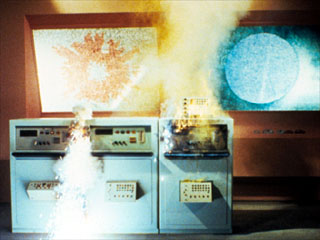
A room with computers and a large display opens up and there is much activity, Mea is horrified that there has been a hit in the city, but the landing party can’t detect any falling bombs, etc. Kirk contacts the Enterprise and Scotty reports all is quiet on the planet. But at the computers, Anan and a military aide note a hit ---“just as it happened, 50 years ago.”
Kirk suggests it is all a game. “This is no game,” Anan says. “Half a million people have just been killed.” He orders a counter-attack.
“Computers, Captain,” Spock realizes. “They fight their wars by computers, totally.”
“Of course,” Anan says.
“Computers don’t kill people,” Kirk exclaims.
“Their deaths have been registered. Of course they have 24 hours to report to our disintegration machines,” Anan says calmly. “You must understand, Captain, we have been at war for 500 years. Under ordinary conditions, no civilization could withstand that. But we have reached a solution.”
Spock suggests the attack was theoretical, but Anan insists, “Oh no, quite real. An attack is mathematically launched… I lost my wife in the last attack. Our civilization lives, but people die. Our culture goes on.”
“You mean your people just walk into a disintegration machine when told to?” Kirk says.
“We have a high consciousness of duty, Captain.”
“There is a certain scientific logic about it,” Spock observes.
“I’m glad you approve,” Anan says.
“I do not approve,” Spock corrects him. “I understand.”
Anan then tells Kirk the Enterprise has been classified destroyed. All persons aboard must report to the surface to be disintegrated. The landing party will be held until they surrender. (They aren’t among the casualties.) “If possible we will spare your ship, Captain,” Anan says. “But its passengers and crew are already dead.”
So at this point in the story the build-up--the mystery of what’s really going on—is over. Now the question is what is Kirk going to do about it.
by William S. Kowinski
This two-parter at Soul of Star Trek is exploring issues of evil, the cycle of war and the role of choice. Evil from the outside was explored through the 1968 third season original series episode, Day of the Dove. A different source of evil is up next, as portrayed in the first season story, A Taste of Armageddon.
This episode is also directly related to issues of the time, though in a more complex way than might be obvious to those who see it today. And today’s viewers may see related issues relevant to the warfare of this time.
Let’s jump right into the episode now, and suggest some of its specific influences and ideas afterwards...
The Enterprise is approaching the system in Star Cluster NGC321 with Ambassador Robert Fox aboard, who is intent on opening diplomatic relations the planet Eminiar VII. Spock informs Kirk that the only information on the planet came from the U.S.S. Valiant fifty years earlier, which reported a technologically advanced civilization that had not ventured outside its solar system, and was then at war with a another planet in the system. But the Valiant then disappeared here, and was declared missing in space.
Enterprise hails are finally answered with Code 710, meaning that under no circumstances is the ship to approach the planet. Ambassador Fox insists they ignore it. “It’s their planet,” Captain Kirk says, but Fox orders him to proceed. (The vaguely stated reason is that thousands of lives have been lost in the vicinity and the Federation needs reliable relations in the system.)
So Kirk, Spock, an ensign and a security detail beam down to a matte painting, representing an advanced city. They are greeted by a small delegation, led by radiant blond Mea 349, played by Barbara Babcock (later of Hill Street Blues fame, who did voices on several early TOS episodes, and appeared again in “The Tholian Web.” ) Kirk and Spock are surprised there is no hostility, though Mea tells them there is danger. They don’t see any. The danger exists, she warns, but “it would be morally incorrect to do less than extend our hospitality.”
The people of Eminiar, who tend to accessorize their futuristically form-fitting body suits with colorful draped fabric, are shown with the trappings of a highly civilized society. This is especially true of the leader of their Council, Anan 7 (David Opatoshu), with his goatee, cultured language, and pants with legs of different colors.
Anan informs Kirk and Spock that Eminiar has been at war for 500 years. “You conceal it very well,” Kirk observes. Spock sees no evidence of warfare. The planet is prosperous, peaceful, advanced. Yet Anan tells them that they suffer losses of one to three million dead a year from direct enemy attack from Vendikar, the “third planet in our system,” originally settled by them, but now an advanced, ruthless enemy. (Earth is of course the third planet in our system, and America was settled by Europeans and people of other continents as well.)
Their conversation is interrupted by an attack. Though they hear nothing, Kirk asks why the Eminiarians don’t take shelter. “There is no shelter,” they are told.
A room with computers and a large display opens up and there is much activity, Mea is horrified that there has been a hit in the city, but the landing party can’t detect any falling bombs, etc. Kirk contacts the Enterprise and Scotty reports all is quiet on the planet. But at the computers, Anan and a military aide note a hit ---“just as it happened, 50 years ago.”
Kirk suggests it is all a game. “This is no game,” Anan says. “Half a million people have just been killed.” He orders a counter-attack.
“Computers, Captain,” Spock realizes. “They fight their wars by computers, totally.”
“Of course,” Anan says.
“Computers don’t kill people,” Kirk exclaims.
“Their deaths have been registered. Of course they have 24 hours to report to our disintegration machines,” Anan says calmly. “You must understand, Captain, we have been at war for 500 years. Under ordinary conditions, no civilization could withstand that. But we have reached a solution.”
Spock suggests the attack was theoretical, but Anan insists, “Oh no, quite real. An attack is mathematically launched… I lost my wife in the last attack. Our civilization lives, but people die. Our culture goes on.”
“You mean your people just walk into a disintegration machine when told to?” Kirk says.
“We have a high consciousness of duty, Captain.”
“There is a certain scientific logic about it,” Spock observes.
“I’m glad you approve,” Anan says.
“I do not approve,” Spock corrects him. “I understand.”
Anan then tells Kirk the Enterprise has been classified destroyed. All persons aboard must report to the surface to be disintegrated. The landing party will be held until they surrender. (They aren’t among the casualties.) “If possible we will spare your ship, Captain,” Anan says. “But its passengers and crew are already dead.”
So at this point in the story the build-up--the mystery of what’s really going on—is over. Now the question is what is Kirk going to do about it.
Now we have the basic theme: the abstract nature of a war, but with real consequences in death, if not destruction. Part of that theme is what is does to individuals, to individuality and individual rights. This element has been prepared for with the people of Eminiar having names but also numbers. And though the Trek reference books spell the leader’s name “Anan,” in the show it sounds like it’s being pronounced “Anon,” as in “anonymous.”
Kirk expressed disbelief that individuals would simply walk into disintegration chambers when told. He raises this objection again to Mea, who herself has been declared a casualty of the latest attack. “Is that all life means to you?” She insists her life is precious to her, but if she refuses, others will, the treaty will be broken and both sides will begin using real weapons. “More than people will die. A whole civilization will be destroyed. Surely you can see that this is the better way.”
She means this, as Anan does: they are quite sure that any rational, intelligent and civilized being would come to this same conclusion. They are sure of it.
Kirk isn’t. “No, I don’t see that at all.”
“It’s been our way for 500 years.”
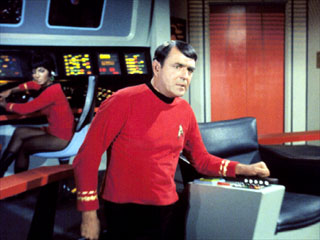
Meanwhile, Anan is exhibiting one of his extra little talents, the ability to mime Captain Kirk’s voice (perhaps assisted by an unseen “voice duplicator.”) As Kirk, he orders the crew down for shore leave, but the always skeptical Scotty doesn’t buy it. A computer analysis confirms the deception.
Kirk and the landing party are locked up and guarded, and so they must escape. Getting captured and escaping is always good for some action and suspense—it wasn’t rare for Doctor Who and his companion to go through this two or three times in a single story. Spock uses “Vulcanian telepathy” ---of the type later used by Obi Wan and Luke Skywalker---to confuse a weak-minded guard to fall prey to Kirk’s karate chop.
Out in the corridor they observe people going into a disintegration chamber. Kirk destroys it. He says he is “throwing a monkey wrench in the machinery.”
Anan learns of their escape over an intercom (fans will note the voice is the same as Balok in “The Corbomite Maneuver.”) He orders that the Enterprise be attacked (They use sonic vibration weapons.) Scotty raises screens but Ambassador Fox is sure it must be a misunderstanding. But the Enterprise sensors can’t find the landing party.
While Kirk tells Mea “we’re going to try to stop the killing,” Anan confesses he is at a loss how to proceed, when the call comes through from Fox (who is played by Gene Lyons; if I’m not mistaken, he voiced a lot of commercials. I seem to remember some for cigarettes.) Anan invites Fox down, intending to attack when the Enterprise screens are down. But Scotty refuses Fox’s order to lower them.
Kirk expressed disbelief that individuals would simply walk into disintegration chambers when told. He raises this objection again to Mea, who herself has been declared a casualty of the latest attack. “Is that all life means to you?” She insists her life is precious to her, but if she refuses, others will, the treaty will be broken and both sides will begin using real weapons. “More than people will die. A whole civilization will be destroyed. Surely you can see that this is the better way.”
She means this, as Anan does: they are quite sure that any rational, intelligent and civilized being would come to this same conclusion. They are sure of it.
Kirk isn’t. “No, I don’t see that at all.”
“It’s been our way for 500 years.”
Meanwhile, Anan is exhibiting one of his extra little talents, the ability to mime Captain Kirk’s voice (perhaps assisted by an unseen “voice duplicator.”) As Kirk, he orders the crew down for shore leave, but the always skeptical Scotty doesn’t buy it. A computer analysis confirms the deception.
Kirk and the landing party are locked up and guarded, and so they must escape. Getting captured and escaping is always good for some action and suspense—it wasn’t rare for Doctor Who and his companion to go through this two or three times in a single story. Spock uses “Vulcanian telepathy” ---of the type later used by Obi Wan and Luke Skywalker---to confuse a weak-minded guard to fall prey to Kirk’s karate chop.
Out in the corridor they observe people going into a disintegration chamber. Kirk destroys it. He says he is “throwing a monkey wrench in the machinery.”
Anan learns of their escape over an intercom (fans will note the voice is the same as Balok in “The Corbomite Maneuver.”) He orders that the Enterprise be attacked (They use sonic vibration weapons.) Scotty raises screens but Ambassador Fox is sure it must be a misunderstanding. But the Enterprise sensors can’t find the landing party.
While Kirk tells Mea “we’re going to try to stop the killing,” Anan confesses he is at a loss how to proceed, when the call comes through from Fox (who is played by Gene Lyons; if I’m not mistaken, he voiced a lot of commercials. I seem to remember some for cigarettes.) Anan invites Fox down, intending to attack when the Enterprise screens are down. But Scotty refuses Fox’s order to lower them.
Anan is having a quiet drink alone when Kirk approaches from behind him. Anan reveals another talent—he greets Kirk by name without seeing him. “My first impression of you was correct,” Anan says, on Kirk’s approach, weapon in hand. “You are a barbarian. Don’t look so incredulous, Captain. Of course you are---we all are! A killer first, a builder second. A hunter, a warrior, and let’s be honest, a murderer. That is our joint heritage, is it not?”
“We’re a little less cold-blooded about it than you are,” Kirk says. Then adds: “You don’t seem to realize the risk you’re taking. We don’t make war with computers and herd people into suicide stations. We make the real thing. I could destroy this planet.” Kirk says he can do it alone.
Anan mocks him. “I had no idea you were so formidable.”
“You seem to think I’m joking,” Kirk says, smiling. He then again demands his communicator and phaser. Anan directs him, pushes a button alerting guards, Kirk pushes him into the corridor first, which deters the first wave of guards, but after putting up a valiant hand to hand battle (while Anan looks on, apparently disgusted by the physical violence), Kirk is subdued and taken to the council chamber.
In the meantime, Spock has rigged the Eminiarian communicator to talk to the Enterprise. He orders Scotty to take the ship to a safe distance, and tells the young ensign to “prevent this young lady [Mea] from immolating herself.”
Fox has meanwhile beamed down (if something changed about the shields, I didn’t catch it), was captured and is being marched to a “suicide station,” when Spock rescues him, and destroys another chamber. Fox tells him that Kirk is being held in the council room. Spock tells Fox that normal diplomacy is not going to work here. Fox says, “I’ve never been a soldier, but I learn quickly.”
Anan and Kirk in the council room are having another thematic dialogue. If the Enteprise crew doesn’t beam down and give themselves up, Anan pleads, “You will be responsible for an escalation that will destroy everything. Millions of people horribly killed, complete destruction of the culture here, and yes, the culture on Vendikar. Disaster, disease, starvation—horrible, lingering death, pain and anguish!”
Kirk has been playing the wily Ulysses all along, never more so than in this scene.
“That seems to frighten you,” he retorts, in a cool, calm voice.
“It would frighten any sane man!” Anan exclaims, as if Kirk still doesn’t get it.
“You’re quite right,” is all Kirk says.
Anan is so convinced he’s right, he continues to try to get Kirk to comprehend the obvious. “And you understand, Captain, we have done away with all that. Now you are threatening to bring it down on us again. Are those 500 people of yours more important than the hundreds of millions of people on E and Vendikar? What kind of monster are you?”
“I’m a barbarian---you said it yourself.”
“I had hoped I’d spoken only figuratively,” Anan says, pronouncing every syllable.
“Oh, no, you were quite accurate. I plan to prove it to you.”
Ana turns away, and orders that a channel to the Enterprise be opened. “You give me no choice, Captain,” he turns back to Kirk. “We are not bandits. You force us to act as bandits.”
But once Scotty answers, Kirk shouts an order—General Order 24 in two hours.
With Kirk restrained, Anan tells Scotty, he has 30 minutes or the Captain and the Ambassador and landing party will be killed until crew transport begins. He turns to Kirk.
“I mean it, Captain.”
“All it means is I won’t be around for the destruction.” He explains that General Order 24 is to destroy the planet. Anan is aghast. It would mean the deaths of hundreds of millions of people. And then word comes in that Vendicar is complaining that they aren’t keeping up with their casualties.
Anan is again fixated on their war. If Vendikar decides they are violating the treaty, it will certainly mean real war. “I can’t stop it—escalation is automatic!” Anan cries. “You can stop it!”
“Stop it?” Kirk says, this time with attitude. “I’m counting on it.”
Scotty contacts the council to report that the targeting of the planet is complete. Suddenly Kirk overcomes the guards and orders them and Anan to the other side of the room. Meanwhile, Spock and his group break in. Spock, sizing up the situation, utters a classic Spock line:
“I assumed you needed help. I see I’m in error.”
“We’re a little less cold-blooded about it than you are,” Kirk says. Then adds: “You don’t seem to realize the risk you’re taking. We don’t make war with computers and herd people into suicide stations. We make the real thing. I could destroy this planet.” Kirk says he can do it alone.
Anan mocks him. “I had no idea you were so formidable.”
“You seem to think I’m joking,” Kirk says, smiling. He then again demands his communicator and phaser. Anan directs him, pushes a button alerting guards, Kirk pushes him into the corridor first, which deters the first wave of guards, but after putting up a valiant hand to hand battle (while Anan looks on, apparently disgusted by the physical violence), Kirk is subdued and taken to the council chamber.
In the meantime, Spock has rigged the Eminiarian communicator to talk to the Enterprise. He orders Scotty to take the ship to a safe distance, and tells the young ensign to “prevent this young lady [Mea] from immolating herself.”
Fox has meanwhile beamed down (if something changed about the shields, I didn’t catch it), was captured and is being marched to a “suicide station,” when Spock rescues him, and destroys another chamber. Fox tells him that Kirk is being held in the council room. Spock tells Fox that normal diplomacy is not going to work here. Fox says, “I’ve never been a soldier, but I learn quickly.”
Anan and Kirk in the council room are having another thematic dialogue. If the Enteprise crew doesn’t beam down and give themselves up, Anan pleads, “You will be responsible for an escalation that will destroy everything. Millions of people horribly killed, complete destruction of the culture here, and yes, the culture on Vendikar. Disaster, disease, starvation—horrible, lingering death, pain and anguish!”
Kirk has been playing the wily Ulysses all along, never more so than in this scene.
“That seems to frighten you,” he retorts, in a cool, calm voice.
“It would frighten any sane man!” Anan exclaims, as if Kirk still doesn’t get it.
“You’re quite right,” is all Kirk says.
Anan is so convinced he’s right, he continues to try to get Kirk to comprehend the obvious. “And you understand, Captain, we have done away with all that. Now you are threatening to bring it down on us again. Are those 500 people of yours more important than the hundreds of millions of people on E and Vendikar? What kind of monster are you?”
“I’m a barbarian---you said it yourself.”
“I had hoped I’d spoken only figuratively,” Anan says, pronouncing every syllable.
“Oh, no, you were quite accurate. I plan to prove it to you.”
Ana turns away, and orders that a channel to the Enterprise be opened. “You give me no choice, Captain,” he turns back to Kirk. “We are not bandits. You force us to act as bandits.”
But once Scotty answers, Kirk shouts an order—General Order 24 in two hours.
With Kirk restrained, Anan tells Scotty, he has 30 minutes or the Captain and the Ambassador and landing party will be killed until crew transport begins. He turns to Kirk.
“I mean it, Captain.”
“All it means is I won’t be around for the destruction.” He explains that General Order 24 is to destroy the planet. Anan is aghast. It would mean the deaths of hundreds of millions of people. And then word comes in that Vendicar is complaining that they aren’t keeping up with their casualties.
Anan is again fixated on their war. If Vendikar decides they are violating the treaty, it will certainly mean real war. “I can’t stop it—escalation is automatic!” Anan cries. “You can stop it!”
“Stop it?” Kirk says, this time with attitude. “I’m counting on it.”
Scotty contacts the council to report that the targeting of the planet is complete. Suddenly Kirk overcomes the guards and orders them and Anan to the other side of the room. Meanwhile, Spock and his group break in. Spock, sizing up the situation, utters a classic Spock line:
“I assumed you needed help. I see I’m in error.”

The clock is ticking, and the climax is at hand when the landing crew reclaims their communicators and phasers, and Spock begins figuring out how the Emimiar computers work. Anan watches them, still in disbelief. How can Kirk not understand what he is doing? But he does understand, and explains.
“Death, destruction, disease, horror---that’s what war is all about, Anan,” Kirk says. “That’s what makes it a thing to be avoided. You’ve made it neat and painless. So neat and painless, you’ve had no reason to stop it. And you had it for 500 years. Since it seems to be the only way I can save my crew and my ship” (though by now, this doesn’t seem to be true anymore) “I’m going to end it for you, one way or another.”
As Anan looks on in anguish, Kirk and Spock destroy the computers linked to the computers on Vendikar.
“Do you realize what you’ve done?” Anan says.
“Yes, I do,” Kirk replies. “I’ve given you back the horrors of war. The Vendikar will assume you’ve broken your agreement, and that you’re preparing to wage real war with real weapons. They will want to do the same. Only the next attack they launch will do more than just count up numbers on a computer. They’ll destroy your cities, devastate your planet. You, of course, will want to retaliate. If I were you, I would start making bombs. Yes, Anan, you have a real war on your hands. You can either wage it with real weapons, or you might consider an alternative. Put an end to it. Make peace.”
“There can be no peace,” Anan answers. “Don’t you see, we’ve admitted it to ourselves! We’re a killer species, it’s instinctive. It’s the same with you.”
And now comes one of Kirk’s most famous speeches. “All right, it’s instinctive,” he says. “We’re human beings with the blood of a million savage years, but we can stop it. We can admit that we’re killers, but we’re not going to kill today. That’s all it takes. Knowing that we’re not going to kill---today. Contact Vendikar. I think you’ll find they are just as terrified, appalled, horrified as you, that they’ll do anything to avoid the alternative I’ve given you. Peace, or utter destruction. It’s up to you.”
Anan acknowledges there might be a chance. There is a direct communications link that hasn’t been used in centuries. Ambassador Fox offers his assistance. Kirk cancels General Order 24, and after some repartee on the bridge (during which Captain Kirk points out that had the war been real fewer people would have died, and it would have been over long ago), the Enterprise warps to its next mission.
“Death, destruction, disease, horror---that’s what war is all about, Anan,” Kirk says. “That’s what makes it a thing to be avoided. You’ve made it neat and painless. So neat and painless, you’ve had no reason to stop it. And you had it for 500 years. Since it seems to be the only way I can save my crew and my ship” (though by now, this doesn’t seem to be true anymore) “I’m going to end it for you, one way or another.”
As Anan looks on in anguish, Kirk and Spock destroy the computers linked to the computers on Vendikar.
“Do you realize what you’ve done?” Anan says.
“Yes, I do,” Kirk replies. “I’ve given you back the horrors of war. The Vendikar will assume you’ve broken your agreement, and that you’re preparing to wage real war with real weapons. They will want to do the same. Only the next attack they launch will do more than just count up numbers on a computer. They’ll destroy your cities, devastate your planet. You, of course, will want to retaliate. If I were you, I would start making bombs. Yes, Anan, you have a real war on your hands. You can either wage it with real weapons, or you might consider an alternative. Put an end to it. Make peace.”
“There can be no peace,” Anan answers. “Don’t you see, we’ve admitted it to ourselves! We’re a killer species, it’s instinctive. It’s the same with you.”
And now comes one of Kirk’s most famous speeches. “All right, it’s instinctive,” he says. “We’re human beings with the blood of a million savage years, but we can stop it. We can admit that we’re killers, but we’re not going to kill today. That’s all it takes. Knowing that we’re not going to kill---today. Contact Vendikar. I think you’ll find they are just as terrified, appalled, horrified as you, that they’ll do anything to avoid the alternative I’ve given you. Peace, or utter destruction. It’s up to you.”
Anan acknowledges there might be a chance. There is a direct communications link that hasn’t been used in centuries. Ambassador Fox offers his assistance. Kirk cancels General Order 24, and after some repartee on the bridge (during which Captain Kirk points out that had the war been real fewer people would have died, and it would have been over long ago), the Enterprise warps to its next mission.
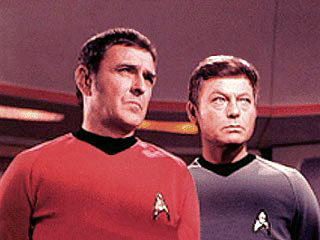
This has become one of the signal stories of Star Trek. If you had 15 episodes, maybe even 10, from all of Star Trek to introduce someone to what Star Trek means, this could very well be included. Gene Coon was producing and writing by this time, and not only were issued joined with sharper writing, but the characters were becoming clearly defined, especially Captain Kirk. The repartee between Kirk and Spock, and Spock and McCoy, was also becoming better and more defining.
But more than producers and writers defined Star Trek stories. We understand these episodes in our context, but our understanding increases when we consider the context in which they were created.
A Taste of Armageddon first aired on February 23, 1967. There were some 338,000 American troops in Vietnam. Close to 7,000 Americans had died in the war so far, with some 40,000 injured. The largest air battle of the war occurred over North Vietnam in January. Extensive damage to North Vietnam from American bombing, including civilian deaths, was documented.
This script is full of this war’s vocabulary. “Escalation” was a relatively new term, widely used for the first time concerning Vietnam. Even Spock’s apparently offhand comment about Mea not “immolating” herself suggests the Buddhist monks in Saigon immolating themselves in protest of the war. And Kirk’s phrase, “throwing a monkey wrench into the machinery” was a metaphor used by young dissidents in the U.S. and Europe, sometimes applied to the “war machine,” sometimes to the larger mechanisms that support war and injustice. The line about the people of Eminiar VII having a sense of duty, and walking into suicide machines, reflects the Vietnam era debate about patriotism versus refusing to participate in the war.
But in its emphasis on total war, the script also speaks to the continuing threat of thermonuclear war. Because missiles could be on their way to their targets before definitely detected, and possibly could destroy the enemy’s bomb-tipped missiles before they could be fired, there was increasing talk of putting computers in control. This led to many films of accidental warfare caused by screw-ups in command-and-control mechanisms, like Fail-Safe (1964) and Dr. Strangelove (1964). Or all-powerful supercomputers launching a war that humans couldn’t stop (War Games in 1983) or simply holding humankind hostage by controlling nuclear weapons (Colossus: The Forbin Project in 1970, directed by Trek director Joseph Sargent.)
This script weds the computerized warfare idea from nuclear war scenarios (the very idea of “scenarios”, projections and using computers to study the future came from attempts to predict nuclear war casualties and effects) with a particular aspect of the Vietnam war: its visibility, yet its abstraction.
In 1967, there were daily body counts reported on the evening news, night after night. The dead were categorized as American, South Vietnamese, and Viet Cong/North Vietnamese. The American casualties were the most accurate, and the enemy casualties the most obviously inflated.
But the war was far away, and Americans were largely unaffected. No bombs fell in American cities, no buildings were destroyed. In 1967 the largest draft calls of the war were still ahead, and not so many families were directly affected by the war as eventually would be. Americans were otherwise pretty prosperous. Until early 1967, they weren’t even feeling an extra tax bite to pay for the war. It was still pretty abstract.
In some ways, Vietnam was an anomaly. It was “the television war,” seen every night on newscasts. The U.S. still honored the rights of news media to cover a war (which they’d done in World War II) so those images were seen every day, eventually dominating the news. As the war went on, the images became more graphic. Bombs fell, napalm flared, soldiers and civilians died onscreen. The TV showed a Vietnam prisoner being suddenly shot, and American soldiers setting fire to a village with cigarette lighters, and the villagers running away, screaming. There were pictures of the wounded in pain, and pictures of body bags, and flag-draped coffins. It was all so real, and yet it was all a TV show. It was all very strange.
But in 1967, that kind of coverage was just beginning. The war was big news, but the news always ended with the body count. It could seem as if soldiers far away walked unseen into disintegration chambers, so that life could go on as usual in the U.S.
But more than producers and writers defined Star Trek stories. We understand these episodes in our context, but our understanding increases when we consider the context in which they were created.
A Taste of Armageddon first aired on February 23, 1967. There were some 338,000 American troops in Vietnam. Close to 7,000 Americans had died in the war so far, with some 40,000 injured. The largest air battle of the war occurred over North Vietnam in January. Extensive damage to North Vietnam from American bombing, including civilian deaths, was documented.
This script is full of this war’s vocabulary. “Escalation” was a relatively new term, widely used for the first time concerning Vietnam. Even Spock’s apparently offhand comment about Mea not “immolating” herself suggests the Buddhist monks in Saigon immolating themselves in protest of the war. And Kirk’s phrase, “throwing a monkey wrench into the machinery” was a metaphor used by young dissidents in the U.S. and Europe, sometimes applied to the “war machine,” sometimes to the larger mechanisms that support war and injustice. The line about the people of Eminiar VII having a sense of duty, and walking into suicide machines, reflects the Vietnam era debate about patriotism versus refusing to participate in the war.
But in its emphasis on total war, the script also speaks to the continuing threat of thermonuclear war. Because missiles could be on their way to their targets before definitely detected, and possibly could destroy the enemy’s bomb-tipped missiles before they could be fired, there was increasing talk of putting computers in control. This led to many films of accidental warfare caused by screw-ups in command-and-control mechanisms, like Fail-Safe (1964) and Dr. Strangelove (1964). Or all-powerful supercomputers launching a war that humans couldn’t stop (War Games in 1983) or simply holding humankind hostage by controlling nuclear weapons (Colossus: The Forbin Project in 1970, directed by Trek director Joseph Sargent.)
This script weds the computerized warfare idea from nuclear war scenarios (the very idea of “scenarios”, projections and using computers to study the future came from attempts to predict nuclear war casualties and effects) with a particular aspect of the Vietnam war: its visibility, yet its abstraction.
In 1967, there were daily body counts reported on the evening news, night after night. The dead were categorized as American, South Vietnamese, and Viet Cong/North Vietnamese. The American casualties were the most accurate, and the enemy casualties the most obviously inflated.
But the war was far away, and Americans were largely unaffected. No bombs fell in American cities, no buildings were destroyed. In 1967 the largest draft calls of the war were still ahead, and not so many families were directly affected by the war as eventually would be. Americans were otherwise pretty prosperous. Until early 1967, they weren’t even feeling an extra tax bite to pay for the war. It was still pretty abstract.
In some ways, Vietnam was an anomaly. It was “the television war,” seen every night on newscasts. The U.S. still honored the rights of news media to cover a war (which they’d done in World War II) so those images were seen every day, eventually dominating the news. As the war went on, the images became more graphic. Bombs fell, napalm flared, soldiers and civilians died onscreen. The TV showed a Vietnam prisoner being suddenly shot, and American soldiers setting fire to a village with cigarette lighters, and the villagers running away, screaming. There were pictures of the wounded in pain, and pictures of body bags, and flag-draped coffins. It was all so real, and yet it was all a TV show. It was all very strange.
But in 1967, that kind of coverage was just beginning. The war was big news, but the news always ended with the body count. It could seem as if soldiers far away walked unseen into disintegration chambers, so that life could go on as usual in the U.S.

The story for “A Taste of Armaggedon” was written by Robert Hamner, but the script was largely Gene Coon’s. He’d recently become Star Trek’s producer, with Gene Roddenberry now as Executive Producer. Coon worked on stories and scripts within the universe Roddenberry created, and told the stories that defined Gene Roddenberry’s Star Trek for all time.
Star Trek’s approach to war itself helped to define what Star Trek has always meant since. There was not always, strictly speaking, an anti-war message or theme, yet the very strongly articulated point of view in this story was and is essential to Star Trek, and its unique approach to conflict and war.
And that point of view was knowledgeable and earned. Gene Coon had been in the Marines for four years in World War II and after. He saw combat in the Pacific, and served in occupied Japan and in China. Recently I happened on a paperback copy of The Short End, one of his two novels, this one published in 1964. It’s about the Korean war, and pulls no punches. There is violence of all kinds in it, including soldiers brutally fighting among themselves.
Gene Roddenberry also served in the Pacific, going on bombing raids as a pilot in B-17s, without fighter escort, under fire from the ground and from enemy planes. In the air he also battled weather (flying once into a typhoon, with his plane facing the trough of a giant wave), and he saw military bureaucracy and the stupidity of some commanders cost the lives of men he knew.
Their beliefs about war came from experiencing and knowing war, as well as considering the alternatives. Though we today are nearly 40 years distant from when this Star Trek episode was written and filmed, Gene Coon and Gene Roddenberry were little more than 20 years from their wartime experiences. Both continued to use those experiences in their work for the rest of their lives (which for Gene Coon, was not long. He died of lung cancer in 1973.)
If they had wanted to write “gritty” war stories, they could have done so from their experience of the real thing, not from watching war movies or imagining how it works. But at least in Star Trek, they chose to make this statement about the essential issues. Most of the literature examining the nature of war, including anti-war novels and movies of the 1960s, were created by World War II combat veterans, like Joseph Heller and Kurt Vonnegut, Jr., or were war correspondents, like Stanley Kubrick. They knew what they were talking about.
And that is a major point of this episode: experiencing the reality of war is the best deterrent to war. This is also the message of other anti-war novels and poems from World War I (All Quiet on the Western Front being among the most eloquent) and before. But of course, these authors didn't mean people had to experience war in order to try to prevent future wars. They didn't write of the horrors of war so that people would start new wars. We can experience those horrors by reading their words, or inhabiting their images.
In this episode, Gene Coon is saying very clearly that the violence and madness of war is very different from anything abstract that can be said about why it is fought. It becomes its own evidence and argument.
In this story, Eminiar VII has found a very intelligent and logical solution to being unable to settle their differences without war. The reason stated in the story is because people cannot rise above their enmities, or resolve their differences without violence. The history of humankind would tend to support this idea. But Star Trek is about learning, including learning from mistakes. It's about starting over, consciously, and creating a new history, with new self-knowledge and a new realization of human potential.
We’ll get back to that point in a moment. But I want to add one more thing about the situation on Eminiar. We see that its leaders value the continuity of their culture over the lives of individuals. They are amazed that the Enterprise people can’t see the wisdom of this. By some premises, it is logical, even scientific. There’s a sense that tradition is preserved, and that artistic and intellectual advances continue---perhaps even evolutionary ones.
This is the kind of thinking that many people do associate with science and logic, and there was a sense during Vietnam that the “best and the brightest” always had logical, even scientific reasons for continuing the slaughter (in the sense that geopolitics, or military science are scientific.)
But the graphic images of the television war, along with the reporting from Vietnam in magazines and books, brought the reality of war---and the feelings generated by imagining that reality—into the public debate. This led to a different kind of logic---more like Mr. Spock’s than Anan 7’s---that destroying countries in order to save them was illogical, and morally wrong.
Television coverage of our most recent wars, including the current one, has been more carefully managed. No flag-draped coffins or body bags are permitted to be shown, and few images of civilians wounded or killed. Much of the imagery we’ve seen is of computer-guided bombs, and computer simulations. War as most Americans experience it has become a computer game. War has become abstract.
Another point to touch on briefly: Star Trek often champions the individual, very important when dealing with sweeping changes or differences in how societies are organized. In this context, it touches upon two widely debated issues in 1967. One was the role of individual citizens in deciding whether their country's war was legitimate. Many people felt even questioning the Vietnam War was unpatriotic, that we had to support and trust our leaders, that they knew things we didn't. The role of individual decisions was even more acute when it came to the draft. Was obeying the draft a civic duty, or did individuals have the right and the duty to refuse to participate in a war they felt deeply was illegitimate and immoral? Draft resistance would become even more of an issue in the next few years, but it was already being raised in the public arena in 1967. The spectre of people voluntarily marching into disintegration chamber cast this issue in a disturbing light.
Beyond the points made in this episode, there is something else to consider about the continuity on Eminiar VII. That means of waging war preserved not only the culture but the power structure. Perhaps Anan faced voters irate about the bad math the computer used in its attacks and defense, but it’s unlikely. The people with real power were secure in an abstract war.
Star Trek’s approach to war itself helped to define what Star Trek has always meant since. There was not always, strictly speaking, an anti-war message or theme, yet the very strongly articulated point of view in this story was and is essential to Star Trek, and its unique approach to conflict and war.
And that point of view was knowledgeable and earned. Gene Coon had been in the Marines for four years in World War II and after. He saw combat in the Pacific, and served in occupied Japan and in China. Recently I happened on a paperback copy of The Short End, one of his two novels, this one published in 1964. It’s about the Korean war, and pulls no punches. There is violence of all kinds in it, including soldiers brutally fighting among themselves.
Gene Roddenberry also served in the Pacific, going on bombing raids as a pilot in B-17s, without fighter escort, under fire from the ground and from enemy planes. In the air he also battled weather (flying once into a typhoon, with his plane facing the trough of a giant wave), and he saw military bureaucracy and the stupidity of some commanders cost the lives of men he knew.
Their beliefs about war came from experiencing and knowing war, as well as considering the alternatives. Though we today are nearly 40 years distant from when this Star Trek episode was written and filmed, Gene Coon and Gene Roddenberry were little more than 20 years from their wartime experiences. Both continued to use those experiences in their work for the rest of their lives (which for Gene Coon, was not long. He died of lung cancer in 1973.)
If they had wanted to write “gritty” war stories, they could have done so from their experience of the real thing, not from watching war movies or imagining how it works. But at least in Star Trek, they chose to make this statement about the essential issues. Most of the literature examining the nature of war, including anti-war novels and movies of the 1960s, were created by World War II combat veterans, like Joseph Heller and Kurt Vonnegut, Jr., or were war correspondents, like Stanley Kubrick. They knew what they were talking about.
And that is a major point of this episode: experiencing the reality of war is the best deterrent to war. This is also the message of other anti-war novels and poems from World War I (All Quiet on the Western Front being among the most eloquent) and before. But of course, these authors didn't mean people had to experience war in order to try to prevent future wars. They didn't write of the horrors of war so that people would start new wars. We can experience those horrors by reading their words, or inhabiting their images.
In this episode, Gene Coon is saying very clearly that the violence and madness of war is very different from anything abstract that can be said about why it is fought. It becomes its own evidence and argument.
In this story, Eminiar VII has found a very intelligent and logical solution to being unable to settle their differences without war. The reason stated in the story is because people cannot rise above their enmities, or resolve their differences without violence. The history of humankind would tend to support this idea. But Star Trek is about learning, including learning from mistakes. It's about starting over, consciously, and creating a new history, with new self-knowledge and a new realization of human potential.
We’ll get back to that point in a moment. But I want to add one more thing about the situation on Eminiar. We see that its leaders value the continuity of their culture over the lives of individuals. They are amazed that the Enterprise people can’t see the wisdom of this. By some premises, it is logical, even scientific. There’s a sense that tradition is preserved, and that artistic and intellectual advances continue---perhaps even evolutionary ones.
This is the kind of thinking that many people do associate with science and logic, and there was a sense during Vietnam that the “best and the brightest” always had logical, even scientific reasons for continuing the slaughter (in the sense that geopolitics, or military science are scientific.)
But the graphic images of the television war, along with the reporting from Vietnam in magazines and books, brought the reality of war---and the feelings generated by imagining that reality—into the public debate. This led to a different kind of logic---more like Mr. Spock’s than Anan 7’s---that destroying countries in order to save them was illogical, and morally wrong.
Television coverage of our most recent wars, including the current one, has been more carefully managed. No flag-draped coffins or body bags are permitted to be shown, and few images of civilians wounded or killed. Much of the imagery we’ve seen is of computer-guided bombs, and computer simulations. War as most Americans experience it has become a computer game. War has become abstract.
Another point to touch on briefly: Star Trek often champions the individual, very important when dealing with sweeping changes or differences in how societies are organized. In this context, it touches upon two widely debated issues in 1967. One was the role of individual citizens in deciding whether their country's war was legitimate. Many people felt even questioning the Vietnam War was unpatriotic, that we had to support and trust our leaders, that they knew things we didn't. The role of individual decisions was even more acute when it came to the draft. Was obeying the draft a civic duty, or did individuals have the right and the duty to refuse to participate in a war they felt deeply was illegitimate and immoral? Draft resistance would become even more of an issue in the next few years, but it was already being raised in the public arena in 1967. The spectre of people voluntarily marching into disintegration chamber cast this issue in a disturbing light.
Beyond the points made in this episode, there is something else to consider about the continuity on Eminiar VII. That means of waging war preserved not only the culture but the power structure. Perhaps Anan faced voters irate about the bad math the computer used in its attacks and defense, but it’s unlikely. The people with real power were secure in an abstract war.

The most famous element of this episode is Kirk’s line “We’re killers—but we’re not going to kill today.” It’s a bit reminiscent of the Alcoholics Anonymous approach of controlling addictions one day at a time (though “twelve-step programs” didn’t become common knowledge until the 1980s, AA has been widely active since the 1940s.) It’s also a bit reminiscent of the time Traveller in H.G. Wells’ The Time Machine, who when he realizes the Morlocks are helpless, drops his weapon and controls his frenzy of killing. “I struck them no more.”
But the essence of his statement is choice. By exercising choice, even once (“today”), it suggests that choice is possible. Becoming conscious is part of choice: conscious not only of possibility and capability, but of what drives you in your choices. Consciousness itself becomes an important drive: the will to understand your unconscious drives and expressions, and the will to make conscious decisions.
Anan’s argument is an old one, yet it comes in a contemporary guise. Anan talks about the “instinct” to kill; today we might talk about this in terms of genes, or natural selection. But it amounts to the same argument, which is both based on a false premise of human nature, and on a false and defeatist sense of human capability.
Although Kirk agrees with Anan’s premise, that we are killers “with the blood of a million savage years,” he didn’t need to, because in a meaningful way, it’s a false premise.
First of all, we’ve been becoming human for more like two million years. It is of course true that humans, like every other living species, live directly or indirectly from the death of other life. Like most creatures, we kill to live. (Even vegetarians do.)
But we ought to be careful about what we assume or extrapolate. We can look at animals, and see how they hunt and savagely kill. We can look at our history of organized slaughter of other animals and of each other in warfare. And we can devise theories about how all this must be so: it’s in our genes. Survival of the fittest. Every human---every individual and his genes--for himself.
But it’s all pretty oversimplified. Humans, like many other animal species, live by killing but also by cooperation. Individuals in social species don’t survive without each other, and humans are the primate species most dependent on each other to survive. This simple fact flummoxes a great deal of otherwise scientific theory.
There are scholars---the human ecologist Paul Shepard being the one I know best---who tell a much different story of “primitive” or primal humanity in pre-history than we’ll find in our caveman clichés. It is our image of our ancestry that is primitive, as further evidenced by existing Indigenous peoples and their knowledge and traditions. Primal peoples hunt animals, but they feel deeply related to them. They feel fear and awe and gratitude. Humans living in the same environment as animals learn from them. Their attitude about killing them is much more complex than we generally suppose.
We basically extrapolate the origins of our “instincts” and what they mean in terms of behavior from historical time: from our few thousand years of so-called civilization. We certainly have instincts, and our survival often does depend on knowing friend from foe. But how that plays out may have much more to do with our particular civilizations, religions, technologies, and particularly our power structures than with our genes or instincts.
Instincts--and genes--operate correctly when they switch on in correct contexts. But they often are summoned falsely, in inappropriate contexts. And as our lives and relationships with the world and each other get more complex, the inappropriate release of behavior motivated by "instinct" or the unconscious becomes more common, and more of a deadly problem.
But even if you accept Anan’s “we are killers,” as Kirk does, you can still come to same basic human fact of choice. So again, it does not matter if the evil comes from demons outside (as it did in Day of the Dove), or if it comes from instincts inside (as posited in this story.) The essence of human freedom is choice.
That choice can be very basic---“we aren’t going to kill today—“ and knowing that can be liberating. But that doesn’t mean it will be simple or easy, or without cost. We still must know about the real enemies from outside, whether they threaten our lives or our freedom, or they distort reality and deceive us, by pushing our unconscious buttons for their own purposes.
We need to become more conscious of what those buttons are and how they are pushed, and how our unconscious can trick us into believing we’re acting rationally when we’re not. We do that individually, and we do that together (and speaking of primitives and killers, it’s in Indigenous and tribal societies we find the deepest traditions and commitment to talking through problems until a peaceful solution is reached.) We also need to be a little smarter about the people we follow, and whose interests are served when they push our buttons.
Star Trek is basically adventure, and in some ways it is melodrama, because it often pits a hero against obstacles or villains, and usually the hero triumphs and virtue is rewarded. But Star Trek is also an internal adventure, about the human heart and the human soul, and beyond that, the heart and soul of things, of the universe. It is about the mysteries inside as well as out there. I’ve called it the science fiction of consciousness, and these two episodes represent this well.
But the essence of his statement is choice. By exercising choice, even once (“today”), it suggests that choice is possible. Becoming conscious is part of choice: conscious not only of possibility and capability, but of what drives you in your choices. Consciousness itself becomes an important drive: the will to understand your unconscious drives and expressions, and the will to make conscious decisions.
Anan’s argument is an old one, yet it comes in a contemporary guise. Anan talks about the “instinct” to kill; today we might talk about this in terms of genes, or natural selection. But it amounts to the same argument, which is both based on a false premise of human nature, and on a false and defeatist sense of human capability.
Although Kirk agrees with Anan’s premise, that we are killers “with the blood of a million savage years,” he didn’t need to, because in a meaningful way, it’s a false premise.
First of all, we’ve been becoming human for more like two million years. It is of course true that humans, like every other living species, live directly or indirectly from the death of other life. Like most creatures, we kill to live. (Even vegetarians do.)
But we ought to be careful about what we assume or extrapolate. We can look at animals, and see how they hunt and savagely kill. We can look at our history of organized slaughter of other animals and of each other in warfare. And we can devise theories about how all this must be so: it’s in our genes. Survival of the fittest. Every human---every individual and his genes--for himself.
But it’s all pretty oversimplified. Humans, like many other animal species, live by killing but also by cooperation. Individuals in social species don’t survive without each other, and humans are the primate species most dependent on each other to survive. This simple fact flummoxes a great deal of otherwise scientific theory.
There are scholars---the human ecologist Paul Shepard being the one I know best---who tell a much different story of “primitive” or primal humanity in pre-history than we’ll find in our caveman clichés. It is our image of our ancestry that is primitive, as further evidenced by existing Indigenous peoples and their knowledge and traditions. Primal peoples hunt animals, but they feel deeply related to them. They feel fear and awe and gratitude. Humans living in the same environment as animals learn from them. Their attitude about killing them is much more complex than we generally suppose.
We basically extrapolate the origins of our “instincts” and what they mean in terms of behavior from historical time: from our few thousand years of so-called civilization. We certainly have instincts, and our survival often does depend on knowing friend from foe. But how that plays out may have much more to do with our particular civilizations, religions, technologies, and particularly our power structures than with our genes or instincts.
Instincts--and genes--operate correctly when they switch on in correct contexts. But they often are summoned falsely, in inappropriate contexts. And as our lives and relationships with the world and each other get more complex, the inappropriate release of behavior motivated by "instinct" or the unconscious becomes more common, and more of a deadly problem.
But even if you accept Anan’s “we are killers,” as Kirk does, you can still come to same basic human fact of choice. So again, it does not matter if the evil comes from demons outside (as it did in Day of the Dove), or if it comes from instincts inside (as posited in this story.) The essence of human freedom is choice.
That choice can be very basic---“we aren’t going to kill today—“ and knowing that can be liberating. But that doesn’t mean it will be simple or easy, or without cost. We still must know about the real enemies from outside, whether they threaten our lives or our freedom, or they distort reality and deceive us, by pushing our unconscious buttons for their own purposes.
We need to become more conscious of what those buttons are and how they are pushed, and how our unconscious can trick us into believing we’re acting rationally when we’re not. We do that individually, and we do that together (and speaking of primitives and killers, it’s in Indigenous and tribal societies we find the deepest traditions and commitment to talking through problems until a peaceful solution is reached.) We also need to be a little smarter about the people we follow, and whose interests are served when they push our buttons.
Star Trek is basically adventure, and in some ways it is melodrama, because it often pits a hero against obstacles or villains, and usually the hero triumphs and virtue is rewarded. But Star Trek is also an internal adventure, about the human heart and the human soul, and beyond that, the heart and soul of things, of the universe. It is about the mysteries inside as well as out there. I’ve called it the science fiction of consciousness, and these two episodes represent this well.
Sunday, March 05, 2006

Another Oscar Snub for Star Trek
In their annual tribute to important figures in motion pictures who passed away the previous year, the Oscars failed to mention James Doohan, despite his 7 Star Trek films and appearances in (by my count) some 19 other movies in a nearly 50 year career.
This was an unpleasant echo of the snubbing of DeForest Kelley in the Oscar tribute for 1999. Kelley's movie career began in 1947, and his last film appearance (voice) was in 1998. Kelley's pre-Trek appearances in many westerns alone merited a mention.
Hollywood awards--especially the Oscars and Emmys--have a long record of ignoring Star Trek except for effects and technical categories. This is especially true of actors, who have never won a major award for their work on a Star Trek series or movie. That for example Patrick Stewart never got an Emmy nomination (even the year that Star Trek: The Next Generation became the only Star Trek to be nominated as Best Drama Series) remains both a mystery and a very sore point with Star Trek fans.
Michelle at Trek Today lists Star Trek alums among the nominated and the winners, noting that Marina Sirtis appears in Crash, which was awarded Best Picture. Actor Brock Peters (Star Trek VI, as well as Deep Space 9) and director Robert Wise (Star Trek: The Motion Picture) were mentioned in the memorial montage, though their Star Trek films were not referenced.
Nor was any shot from any of the ten Star Trek films included in the several minutes of montage of scenes in "epic" films of the past, though there were several from the first 3 Star Wars movies, as well as shots from ET, Back to the Future, Close Encounters, 2001, and Apollo 13.
Those who were mentioned in Sunday's Oscar tribute to those who died in 2005 included several producers, a makeup artist, a production designer and a re-recording mixer. But not the man who created a character known around the world: Scotty in Star Trek. Though the fate of his ashes going or not going into space creates headlines, James Doohan's contributions to Hollywood did not receive the respect he was due from the Academy of Motion Pictures Arts and Sciences.
In their annual tribute to important figures in motion pictures who passed away the previous year, the Oscars failed to mention James Doohan, despite his 7 Star Trek films and appearances in (by my count) some 19 other movies in a nearly 50 year career.
This was an unpleasant echo of the snubbing of DeForest Kelley in the Oscar tribute for 1999. Kelley's movie career began in 1947, and his last film appearance (voice) was in 1998. Kelley's pre-Trek appearances in many westerns alone merited a mention.
Hollywood awards--especially the Oscars and Emmys--have a long record of ignoring Star Trek except for effects and technical categories. This is especially true of actors, who have never won a major award for their work on a Star Trek series or movie. That for example Patrick Stewart never got an Emmy nomination (even the year that Star Trek: The Next Generation became the only Star Trek to be nominated as Best Drama Series) remains both a mystery and a very sore point with Star Trek fans.
Michelle at Trek Today lists Star Trek alums among the nominated and the winners, noting that Marina Sirtis appears in Crash, which was awarded Best Picture. Actor Brock Peters (Star Trek VI, as well as Deep Space 9) and director Robert Wise (Star Trek: The Motion Picture) were mentioned in the memorial montage, though their Star Trek films were not referenced.
Nor was any shot from any of the ten Star Trek films included in the several minutes of montage of scenes in "epic" films of the past, though there were several from the first 3 Star Wars movies, as well as shots from ET, Back to the Future, Close Encounters, 2001, and Apollo 13.
Those who were mentioned in Sunday's Oscar tribute to those who died in 2005 included several producers, a makeup artist, a production designer and a re-recording mixer. But not the man who created a character known around the world: Scotty in Star Trek. Though the fate of his ashes going or not going into space creates headlines, James Doohan's contributions to Hollywood did not receive the respect he was due from the Academy of Motion Pictures Arts and Sciences.
Monday, February 27, 2006
Trek XI Latest
You've probably seen the story--that Doug Mirabello, identified as Rick Berman's assistant, posted on the Internet concerning the next Trek feature. We'll see if there is any confirmation or denial coming, but for now we can speculate.
He's quoted as saying that the Erik Jendresen script for the next Trek film---the prequel "Star Trek: The Beginning" idea--has been scrapped. This sounds likely. It makes sense if you find Patrick Stewart's quoted comments credible, about being asked to be in the next movie, which I do. Also the fact that Jendresen has signed on to a tv series project, which doesn't prevent him from working on an ongoing movie script, but makes it less likely.
Mirabello is also quoted doubting that there are any plans for Patrick Stewart to be in the next film, as Stewart said a month or so ago. He said maybe Stewart had "a casual conversation" with a Paramount exec concerning "hypotheticals," and then Stewart "ran with" that when talking to a reporter.
This does not sound likely. Stewart described a meeting with people he found credible, people with money and the power to make the movie. I think we can assume he knows the difference.
Berman's assistant offers another possibility, that "there's a chance that someone else at Paramount is planning something huge and keeping us out of the loop." Ya think? While "planning" might be a bit premature, this sounds more likely.
But one thing just about everyone seems to agree on--anything new from official Trekdom is three years away, at best.
Neverthless, fan films are going great. More Star Trek stars in front of and behind the camera are joining in. The latest being visual effects supervisor Ronald B. Moore joining up with Star Trek New Voyages.
If official Star Trek isn't going to be making anything new for awhile, they really should license some fan films, so these folks can make a few bucks. They could devise some sort of non-competitive clause for whenever they decide to make an official new movie or TV show.
Still, it shows how important Star Trek is to the people who've been part of it, as well as to its core of loyal fans. Star Trek has explored so many new frontiers, and this is one more: what other series can say its most precious people believe in it so much they will create more Star Trek for free?
You've probably seen the story--that Doug Mirabello, identified as Rick Berman's assistant, posted on the Internet concerning the next Trek feature. We'll see if there is any confirmation or denial coming, but for now we can speculate.
He's quoted as saying that the Erik Jendresen script for the next Trek film---the prequel "Star Trek: The Beginning" idea--has been scrapped. This sounds likely. It makes sense if you find Patrick Stewart's quoted comments credible, about being asked to be in the next movie, which I do. Also the fact that Jendresen has signed on to a tv series project, which doesn't prevent him from working on an ongoing movie script, but makes it less likely.
Mirabello is also quoted doubting that there are any plans for Patrick Stewart to be in the next film, as Stewart said a month or so ago. He said maybe Stewart had "a casual conversation" with a Paramount exec concerning "hypotheticals," and then Stewart "ran with" that when talking to a reporter.
This does not sound likely. Stewart described a meeting with people he found credible, people with money and the power to make the movie. I think we can assume he knows the difference.
Berman's assistant offers another possibility, that "there's a chance that someone else at Paramount is planning something huge and keeping us out of the loop." Ya think? While "planning" might be a bit premature, this sounds more likely.
But one thing just about everyone seems to agree on--anything new from official Trekdom is three years away, at best.
Neverthless, fan films are going great. More Star Trek stars in front of and behind the camera are joining in. The latest being visual effects supervisor Ronald B. Moore joining up with Star Trek New Voyages.
If official Star Trek isn't going to be making anything new for awhile, they really should license some fan films, so these folks can make a few bucks. They could devise some sort of non-competitive clause for whenever they decide to make an official new movie or TV show.
Still, it shows how important Star Trek is to the people who've been part of it, as well as to its core of loyal fans. Star Trek has explored so many new frontiers, and this is one more: what other series can say its most precious people believe in it so much they will create more Star Trek for free?

Star Trek: the Nature of Evil
by William S. Kowinski
Star Trek is an adventure about exploring the future. But on television, it was also a weekly drama series that often came down to a sophisticated form of cops and robbers—good guys versus bad guys. It was an adult drama series, so the good guys weren’t all good, and the bad guys weren’t always all bad. But however Star Trek played with the basic expectation---often in a very meaningful and revelatory way-- some sense of good versus evil was nearly always present.
But in those stories, from the Original Series on, Star Trek questioned the very nature of good and evil. More than adult drama, this was drama exploring a very basic human question---and one that challenged and often flummoxed philosophers through the ages.
The nature of evil has been a knotty religious and philosophical problem for centuries, and in more recent decades, has become a psychological, biological. sociological and political conundrum as well.
Some of the oldest debates are over whether evil exists as something autonomous and powerful, something outside that affects the world, and humans in particular. Or is it human behavior with its source inside?
And if evil is within human beings, it is an inborn part of human nature? Some religions believe humans are born in a “fallen” state of “original sin.” Others believe humans are genetically “programmed” or “hard-wired” with evil instincts as a survival advantage.
Or is evil not separate, but the absence of good, or a shadow on the soul?
Early Christianity believed in both the external and internal evil: the Devil and original sin. Evil existed as a thing in itself; yet the absence of good was also involved.
To even begin to catalogue how Star Trek treated the question of evil would take a dissertation. But it’s worth looking at how evil was approached in two episodes of the original series, both dealing with the evils of war.
by William S. Kowinski
Star Trek is an adventure about exploring the future. But on television, it was also a weekly drama series that often came down to a sophisticated form of cops and robbers—good guys versus bad guys. It was an adult drama series, so the good guys weren’t all good, and the bad guys weren’t always all bad. But however Star Trek played with the basic expectation---often in a very meaningful and revelatory way-- some sense of good versus evil was nearly always present.
But in those stories, from the Original Series on, Star Trek questioned the very nature of good and evil. More than adult drama, this was drama exploring a very basic human question---and one that challenged and often flummoxed philosophers through the ages.
The nature of evil has been a knotty religious and philosophical problem for centuries, and in more recent decades, has become a psychological, biological. sociological and political conundrum as well.
Some of the oldest debates are over whether evil exists as something autonomous and powerful, something outside that affects the world, and humans in particular. Or is it human behavior with its source inside?
And if evil is within human beings, it is an inborn part of human nature? Some religions believe humans are born in a “fallen” state of “original sin.” Others believe humans are genetically “programmed” or “hard-wired” with evil instincts as a survival advantage.
Or is evil not separate, but the absence of good, or a shadow on the soul?
Early Christianity believed in both the external and internal evil: the Devil and original sin. Evil existed as a thing in itself; yet the absence of good was also involved.
To even begin to catalogue how Star Trek treated the question of evil would take a dissertation. But it’s worth looking at how evil was approached in two episodes of the original series, both dealing with the evils of war.
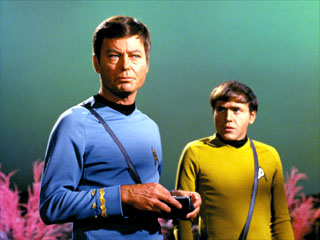
Even though “Day of the Dove” was a third season episode, I begin with it because seeing it recently on DVD prompted this post. I will shortly discuss its story in historical context, but my own recent response to it had more to do with the present. The basic premise of this story is the existence of an alien entity that feeds on the energies of violent emotions---on hatred, vengeance, racial bigotry. But the entity does more than that---it creates the conditions that prompt those emotions by manipulating both matter and mind. In essence, it creates evil, and feeds on the emotions evil produces.
This sense of evil as an alien force that creates a self-perpetuating, self-renewing closed loop of evil energies was suddenly frightening, because it made me wonder if this was the explanation for what was happening around me today. The troubles of this world seem distorted to enormous proportions, overpowering what would seem to be the normal agencies of control.
It is this sense of an uncontrollable force that generates evil, violence, hatred and vengeance, and makes them seem justified and proper, even reasonable and certainly necessary, and even, eventually, normal—that suddenly caused me to wonder if this indeed was the reason: That from somewhere has come an alien power called evil, and it is in control of this time.
Many may identify with this feeling or this perception, from quite different points of view. Some may see simply the extreme polarizations, the political discourse overcome with extremes of anger, contempt and self-righteousness, and the justification of slander, lies and threats visited upon opponents.
Or some may see only the hatred they identify with terrorists, or a particular race and religion. Or some may see mostly the violence perpetrated under false pretenses by the Bush government, and its apparent attempts to create a perpetual warfare authoritarian state, while sacrificing the earth’s future by ignoring the true clear and present dangers to its most vulnerable citizens as well as to the planet’s ability to sustain life as we know it. Or they may see both terrorists and “insurgents,” locked in the same cycle with “warmongers” and war profiteers in the ruling class of the U.S.
In fact, they may agree on only the feeling---that evil is out there, and has us in its grip.
I’m not saying I believe this, just that this episode made me wonder for a moment if evil was a force from outside, affecting everyone and everything. And so I intend to explore where that feeling leads by examining this episode.
This sense of evil as an alien force that creates a self-perpetuating, self-renewing closed loop of evil energies was suddenly frightening, because it made me wonder if this was the explanation for what was happening around me today. The troubles of this world seem distorted to enormous proportions, overpowering what would seem to be the normal agencies of control.
It is this sense of an uncontrollable force that generates evil, violence, hatred and vengeance, and makes them seem justified and proper, even reasonable and certainly necessary, and even, eventually, normal—that suddenly caused me to wonder if this indeed was the reason: That from somewhere has come an alien power called evil, and it is in control of this time.
Many may identify with this feeling or this perception, from quite different points of view. Some may see simply the extreme polarizations, the political discourse overcome with extremes of anger, contempt and self-righteousness, and the justification of slander, lies and threats visited upon opponents.
Or some may see only the hatred they identify with terrorists, or a particular race and religion. Or some may see mostly the violence perpetrated under false pretenses by the Bush government, and its apparent attempts to create a perpetual warfare authoritarian state, while sacrificing the earth’s future by ignoring the true clear and present dangers to its most vulnerable citizens as well as to the planet’s ability to sustain life as we know it. Or they may see both terrorists and “insurgents,” locked in the same cycle with “warmongers” and war profiteers in the ruling class of the U.S.
In fact, they may agree on only the feeling---that evil is out there, and has us in its grip.
I’m not saying I believe this, just that this episode made me wonder for a moment if evil was a force from outside, affecting everyone and everything. And so I intend to explore where that feeling leads by examining this episode.
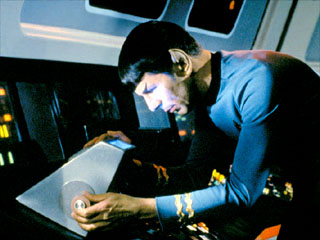
“Day of the Dove” begins with a landing party on a barren planet, investigating a distress signal from a Federation colony that now seems to have completely vanished. Meanwhile, the Enterprise detects a Klingon vessel heading their way, and the landing party quickly concludes the colony had been destroyed by Klingons.
But after responding to a distress call the Klingon ship has been attacked and disabled, with heavy loss of life, and its armed landing party suddenly appears on the planet to take the Enterprise crew hostage. The Klingon captain Kang (Michael Ansara) accuses Kirk of attacking him with a new Federation weapon, and claims the Enterprise in compensation for his disabled ship.
“Go to the devil,” Kirk says.
“We have no devil, Kirk, “Kang responds. “But we understand the habits of yours.”
Chekhov suddenly goes berserk (not for the last time), desiring to avenge the death of his brother, killed by Klingons. Kang uses a device to torture him until Kirk relents (with Chekhov screaming, ”Don’t let these animals have the ship!”) and arranges to have them all beamed aboard the Enterprise. But he secretly signals Spock, and the landing party is beamed aboard, while the Klingons are kept in the pattern buffer until Security is ready.
But also aboard the ship is the Alien Entity, defined so far only as a shimmer of light.
Because the Klingon ship is spewing radiation, the Enterprise beams its remaining crew over, so a total of 38 Klingons are aboard. At this point, the apparent coincidences accelerate---along with the Enterprise, which is suddenly bolting for the edge of the galaxy at warp 9. It is also attacked from nowhere, trapping 400 crew members beyond sealed bulkheads. Now there are also 38 on the Starfleet side.
When both sides confront each other, their modern weapons disappear and are replaced by swords. The alien light appears pleased when they fight.
But there’s another clue to the accelerating blood lust and racial slurs when Chekhov runs from the bridge still intent on avenging his brother, but Sulu tells Kirk that Chekhov doesn’t have a brother.
Spock locates the alien force. “We must contact it,” Kirk says. “See what it wants.” Spock theorizes that it can manipulate both matter and mind. But to what end?
Kirk decides to defuse the hostilities with Kang, to “bury the hatchet,” which Spock points out is an apt phrase given the circumstances.
But there’s another burst of war fever and racism on the bridge. Scotty calls Spock “ a green-blooded half-breed freak” among other things, and McCoy joins in. Spock says he’s not so pleased about being around humans either.
“What are we saying?” Kirk says. “What are we doing to each other?”
“This is war!” Scott cries.
“There—is—no—war,” Kirk says. “We’ve been trained to think in other terms, to fight the causes of war if necessary. Has the war been staged for us—complete with weapons, ideologies, patriotic drum-beating, even race hatred?”
Spock agrees, and hypothesizes that basic hostilities between humans and Klingons have been magnified---that they are to fight apparently by design.
Meanwhile, a rampaging Chekhov has trapped Kang’s wife (who is also his science officer) and is in the act of trying to rape her when Kirk intervenes. “Is this what’s in store for us? Violence? Hatred?”
Dr. McCoy—who has been railing against Klingons as butchers—reports that everyone’s wounds are healing. It appears that the entity will heal them so they can continue fighting, perhaps forever.
McCoy then apologizes to Spock for his racist outburst earlier.
“I, too, felt a brief surge of racial bigotry,” Spock says. “Most distasteful.”
But after responding to a distress call the Klingon ship has been attacked and disabled, with heavy loss of life, and its armed landing party suddenly appears on the planet to take the Enterprise crew hostage. The Klingon captain Kang (Michael Ansara) accuses Kirk of attacking him with a new Federation weapon, and claims the Enterprise in compensation for his disabled ship.
“Go to the devil,” Kirk says.
“We have no devil, Kirk, “Kang responds. “But we understand the habits of yours.”
Chekhov suddenly goes berserk (not for the last time), desiring to avenge the death of his brother, killed by Klingons. Kang uses a device to torture him until Kirk relents (with Chekhov screaming, ”Don’t let these animals have the ship!”) and arranges to have them all beamed aboard the Enterprise. But he secretly signals Spock, and the landing party is beamed aboard, while the Klingons are kept in the pattern buffer until Security is ready.
But also aboard the ship is the Alien Entity, defined so far only as a shimmer of light.
Because the Klingon ship is spewing radiation, the Enterprise beams its remaining crew over, so a total of 38 Klingons are aboard. At this point, the apparent coincidences accelerate---along with the Enterprise, which is suddenly bolting for the edge of the galaxy at warp 9. It is also attacked from nowhere, trapping 400 crew members beyond sealed bulkheads. Now there are also 38 on the Starfleet side.
When both sides confront each other, their modern weapons disappear and are replaced by swords. The alien light appears pleased when they fight.
But there’s another clue to the accelerating blood lust and racial slurs when Chekhov runs from the bridge still intent on avenging his brother, but Sulu tells Kirk that Chekhov doesn’t have a brother.
Spock locates the alien force. “We must contact it,” Kirk says. “See what it wants.” Spock theorizes that it can manipulate both matter and mind. But to what end?
Kirk decides to defuse the hostilities with Kang, to “bury the hatchet,” which Spock points out is an apt phrase given the circumstances.
But there’s another burst of war fever and racism on the bridge. Scotty calls Spock “ a green-blooded half-breed freak” among other things, and McCoy joins in. Spock says he’s not so pleased about being around humans either.
“What are we saying?” Kirk says. “What are we doing to each other?”
“This is war!” Scott cries.
“There—is—no—war,” Kirk says. “We’ve been trained to think in other terms, to fight the causes of war if necessary. Has the war been staged for us—complete with weapons, ideologies, patriotic drum-beating, even race hatred?”
Spock agrees, and hypothesizes that basic hostilities between humans and Klingons have been magnified---that they are to fight apparently by design.
Meanwhile, a rampaging Chekhov has trapped Kang’s wife (who is also his science officer) and is in the act of trying to rape her when Kirk intervenes. “Is this what’s in store for us? Violence? Hatred?”
Dr. McCoy—who has been railing against Klingons as butchers—reports that everyone’s wounds are healing. It appears that the entity will heal them so they can continue fighting, perhaps forever.
McCoy then apologizes to Spock for his racist outburst earlier.
“I, too, felt a brief surge of racial bigotry,” Spock says. “Most distasteful.”
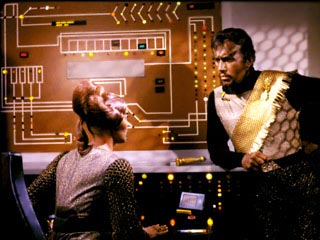
A wounded crewman, now healed, appears with his sword, crazed to kill Klingons and “even the score” (even though he is no longer hurt.) Kirk and Spock observe the alien hovering above---they note that it grew more vibrant when the crewman expressed a lust for vengeance and violence.
“It exists on the hate of others,” Kirk concludes.
“It has acted as a catalyst to that violence,” Spock adds, and suggests that to defeat it “all hostile emotions must cease.”
At this point the Enterprise has only a short time before its dilithium crystals fail and the ship will be helpless far from Federation space. With the help of Kang’s wife, Kirk meets with him, but Kang won’t buy it. “We are hunters,” he says. “We take what we want.”
“There’s another way to survive,” Kirk says. “Mutual trust and help.”
There’s some swordplay and a vintage Captain Kirk speech, aggressively delivered as counterpoint to its meaning. “The good old game of war—pawn against pawn---stopping the bad guys, where somewhere something sits back and laughs---and starts it all over again.”
“Those who hate and fight must stop themselves,” Spock says, “otherwise it is not stopped.”
“Be a pawn, be a toy, be a good soldier who never questions orders,” Kirk taunts Kang.
Kang sees the entity, finally believes it is manipulating them, and throws down his sword. “Klingons fight for their own purposes,” he says.
“Cessation of hostilities have weakened it,” Spock observes. He suggests good spirits might do it in.
Kirk tells the entity to go away. “We don’t want to play. We know about you. Maybe there are others like you around, maybe you’ve caused a lot of suffering, a lot of history, but that’s all over. We’ll be on our guard now. We’ll be ready for you.”
“Only a fool fights in a burning house,” Kang cries, and joins in the general laughter, and even slaps Kirk on the back. (If you take a look at this episode, don’t miss Spock’s expression in the background after Kang’s back-slap.)
Notably, the episode ends here---there is no coda or final scene of the Enterprise bridge crew discussing the mission and joking around.
“It exists on the hate of others,” Kirk concludes.
“It has acted as a catalyst to that violence,” Spock adds, and suggests that to defeat it “all hostile emotions must cease.”
At this point the Enterprise has only a short time before its dilithium crystals fail and the ship will be helpless far from Federation space. With the help of Kang’s wife, Kirk meets with him, but Kang won’t buy it. “We are hunters,” he says. “We take what we want.”
“There’s another way to survive,” Kirk says. “Mutual trust and help.”
There’s some swordplay and a vintage Captain Kirk speech, aggressively delivered as counterpoint to its meaning. “The good old game of war—pawn against pawn---stopping the bad guys, where somewhere something sits back and laughs---and starts it all over again.”
“Those who hate and fight must stop themselves,” Spock says, “otherwise it is not stopped.”
“Be a pawn, be a toy, be a good soldier who never questions orders,” Kirk taunts Kang.
Kang sees the entity, finally believes it is manipulating them, and throws down his sword. “Klingons fight for their own purposes,” he says.
“Cessation of hostilities have weakened it,” Spock observes. He suggests good spirits might do it in.
Kirk tells the entity to go away. “We don’t want to play. We know about you. Maybe there are others like you around, maybe you’ve caused a lot of suffering, a lot of history, but that’s all over. We’ll be on our guard now. We’ll be ready for you.”
“Only a fool fights in a burning house,” Kang cries, and joins in the general laughter, and even slaps Kirk on the back. (If you take a look at this episode, don’t miss Spock’s expression in the background after Kang’s back-slap.)
Notably, the episode ends here---there is no coda or final scene of the Enterprise bridge crew discussing the mission and joking around.

“I know there is evil in the world---essential evil, not the opposite of good but something in which good itself is an irrelevance---a fantasy.”
These words are quoted by Bob Dylan in his autobiographical account, Chronicles: Volume One, which he says are spoken by Scratch (the Devil) in a play by Archibald MacLeish. (I couldn’t find them in the published version of the play, so perhaps they were in an earlier version that Dylan got when MacLeish wanted him to write music for it.) I just happened to read this after I started this essay. When something like that happens, you pay attention. You’re probably on to something.
One contemporary definition of evil comes from Scott Peck in his book People of the Lie. (Peck, a practicing psychiatrist and author of best-sellers such as The Road Less Traveled, died last year. He held his own set of beliefs based on various religions, including Islam and Buddhism, when he wrote this book. But immediately afterwards, he became a committed Christian, and announced this in the book’s introduction.)
Peck argued that evil is a disease, and its chief characteristic or manifestation is deception, the lie. But not simply people lying to others; it’s people lying to themselves: self-deception.
Part of that self-deception could be the refusal to face the possibility of being in error---even of not being conscious of one’s motivations or emotions that could be distorting one’s evaluation of what’s really going on, both in the outside world and inside oneself.
That is in a sense what the entity does in “Day of the Dove” when it manipulates minds. It creates internal fantasies that are as much “lies” as the reality it changes by breaking the laws of causality.
Much of what people believe in this episode is not true. The Federation didn’t lure the Klingon ship with a false distress call and then attack it with a secret weapon; the Klingons didn’t destroy a defenseless Federation colony, any more than the Klingons killed a brother Chekhov never had.
Yet their belief sparks their emotions, and their emotions lead them to leap to all kinds of conclusions, including about the character of their adversaries. They are butchers, animals, freaks. And it gives them the fever to fight. That, in this story, is the goal of evil.
It’s important to note that for those in the grip of this fever, any idea that the other side is justified, or that the facts may be other than believed, or may mean something different that our side or our leader say, seem fantastic. People who believe otherwise are either crazy or cowards or enemy sympathizers.
Peck asserts that people may deceive themselves because of the evil within them, or because they are enthralled by an evil person they serve: a leader, a spouse, a parent. In a sense, this includes being enthralled by a belief, a cause, if it leads to deception and self-deception, and to the refusal to take responsibility for one’s actions, feelings and experiences. The evil person may engender the evil acts, but the enthralled person cooperates and enables them. In the end, what counts are the evil acts, and for those, leaders and followers are both responsible.
These words are quoted by Bob Dylan in his autobiographical account, Chronicles: Volume One, which he says are spoken by Scratch (the Devil) in a play by Archibald MacLeish. (I couldn’t find them in the published version of the play, so perhaps they were in an earlier version that Dylan got when MacLeish wanted him to write music for it.) I just happened to read this after I started this essay. When something like that happens, you pay attention. You’re probably on to something.
One contemporary definition of evil comes from Scott Peck in his book People of the Lie. (Peck, a practicing psychiatrist and author of best-sellers such as The Road Less Traveled, died last year. He held his own set of beliefs based on various religions, including Islam and Buddhism, when he wrote this book. But immediately afterwards, he became a committed Christian, and announced this in the book’s introduction.)
Peck argued that evil is a disease, and its chief characteristic or manifestation is deception, the lie. But not simply people lying to others; it’s people lying to themselves: self-deception.
Part of that self-deception could be the refusal to face the possibility of being in error---even of not being conscious of one’s motivations or emotions that could be distorting one’s evaluation of what’s really going on, both in the outside world and inside oneself.
That is in a sense what the entity does in “Day of the Dove” when it manipulates minds. It creates internal fantasies that are as much “lies” as the reality it changes by breaking the laws of causality.
Much of what people believe in this episode is not true. The Federation didn’t lure the Klingon ship with a false distress call and then attack it with a secret weapon; the Klingons didn’t destroy a defenseless Federation colony, any more than the Klingons killed a brother Chekhov never had.
Yet their belief sparks their emotions, and their emotions lead them to leap to all kinds of conclusions, including about the character of their adversaries. They are butchers, animals, freaks. And it gives them the fever to fight. That, in this story, is the goal of evil.
It’s important to note that for those in the grip of this fever, any idea that the other side is justified, or that the facts may be other than believed, or may mean something different that our side or our leader say, seem fantastic. People who believe otherwise are either crazy or cowards or enemy sympathizers.
Peck asserts that people may deceive themselves because of the evil within them, or because they are enthralled by an evil person they serve: a leader, a spouse, a parent. In a sense, this includes being enthralled by a belief, a cause, if it leads to deception and self-deception, and to the refusal to take responsibility for one’s actions, feelings and experiences. The evil person may engender the evil acts, but the enthralled person cooperates and enables them. In the end, what counts are the evil acts, and for those, leaders and followers are both responsible.

“Day of the Dove” was written by accomplished science fiction writer Jerome Bixby, who wrote several other episodes including the classic “Mirror, Mirror” in the second season. It aired for the first time on November 1, 1968 (between Halloween and the Catholic “All Soul’s Day” or Day of the Dead.)
1968 was a year of death and violence, and deep emotional divisions. The war in Vietnam was raging, both with U.S. bombing in both South and North Vietnam, and the ground war in South Vietnam. In a two-week period in May, more than 1,100 U.S. soldiers were killed.
In early April, Martin Luther King was assassinated, setting off destructive rioting in many U.S. cities. Troops had to be sent to Chicago, Boston, Detroit, Washington and Baltimore.
There were student revolts in the U.S. and Europe. In early June, Robert Kennedy was assassinated, just as he appeared on his way to the Democratic nomination for President on an anti-war platform. There were massive demonstrations in Chicago at the Democratic convention that summer, with nightly violence broadcast coast to coast, caused by what a presidential commission would later call “a police riot.”
The war had divided the country in many ways and in the deepest ways probably since the Civil War, for longstanding alliances and friendships were fractured and families were split—brother against brother, husbands against wives, and most of all, parents against children.
The 60s were a time of great change happening very fast: in everything from sexual mores and relationships, to racial and gender stereotypes. The truthfulness as well as the judgment of leaders was called into question, as well as the rightness of actions and goals. Was war necessary to achieve these goals, and were they worthy goals in the first place?
So much of what nearly everyone had simply accepted as good and true was questioned. Were all our comfortable homes, vibrant industries and wonderful consumer products not so innocent after all—were they the result of processes that were poisoning the air and water, and destroying the planet? Was our prosperity based in part on exploiting others? These questions had not been raised in so many American homes before. This caused great distress, terrible tensions and intimate conflict.
At the same time, the U.S. and Soviet Union were separately sending manned spacecraft into orbit. In the month before this episode aired, Apollo 7 hosted the first live television broadcast from space, during an 11 day mission orbiting the earth 163 times. And during a four-day mission, a manned Soviet craft practiced approach maneuvers with an unmanned craft, a prelude to docking.
People were seeing what the future could be, and they were seeing the present in a kind of self-destruction, threatening that future.
For many, space exploration represented what science and rational thinking could do. On the other hand (some believed) the violence that seemed to have the world in its grip seemed evidence of the damage fiery emotions could cause. This way of looking at what was happening in the late 60s was part of the appeal of Mr. Spock.
Sock represented “logic,” which meant not only science, but what philosophers had called “reason.” The Founding Fathers considered themselves men of reason; they thought of the Declaration of Independence and the Bill of Rights as reasoned and reasonable documents, that brought principles to bear on evidence; that brought the logic of those principles to bear on current situations. Those principles were themselves a combination of ideals and pragmatism, a set of logical rules based at least in part on hopes and aspirations.
At the same time, those who were against the Vietnam war claimed that the so-called logic of its proponents was too narrow. It left out too many facts that called these rigid conclusions into question. And it left out human consequences and their importance, which transcended the logic of numbers and had devastating effects on human lives and the physical environment. In order to gauge the importance of lives, and the suffering caused by violence and warfare, perhaps took feelings: the exercise of empathy. But they did not see this as irrational (though many pro-war advocates did.) They saw this as reason---as factoring in human suffering and destruction as well as history, geopolitical realities and the quantitative measurements of weapons and warfare.
Only with the candidacy of Eugene McCarthy and Robert Kennedy in the spring 1968 primaries did opposition to the war gain some legitimacy, and even a lot of that was withdrawn due to later violence. Many people continued to believe that anti-war demonstrators were traitors to their country. They reacted with violent emotion, and at times with real violence.
One of those actively opposing the war was Leonard Nimoy, who was active in support of Eugene McCarthy, as well as for civil rights, civil liberties and social justice causes. In 1968, Mr. Spock met Dr. Spock at a political event. (Dr. Benjamin Spock, world famous as the baby doctor, but also a peace activist who’d been arrested protesting the draft. As Nimoy recounts in his books, he introduced himself as the man who played Spock. Dr. Spock said only, “I know. Have you been indicted yet?”)
Though Star Trek stories did not always carry a blatant anti-war message, Bixby admitted this was his intent with “Day of the Dove” (as the title itself gives away. It was during Vietnam that the terms, “hawks” for pro-war and “doves” for pro-peace, became well known. I believe the terms originated in a magazine article about the White House deliberations during the Cuban Missile Crisis in 1962.)
1968 was a year of death and violence, and deep emotional divisions. The war in Vietnam was raging, both with U.S. bombing in both South and North Vietnam, and the ground war in South Vietnam. In a two-week period in May, more than 1,100 U.S. soldiers were killed.
In early April, Martin Luther King was assassinated, setting off destructive rioting in many U.S. cities. Troops had to be sent to Chicago, Boston, Detroit, Washington and Baltimore.
There were student revolts in the U.S. and Europe. In early June, Robert Kennedy was assassinated, just as he appeared on his way to the Democratic nomination for President on an anti-war platform. There were massive demonstrations in Chicago at the Democratic convention that summer, with nightly violence broadcast coast to coast, caused by what a presidential commission would later call “a police riot.”
The war had divided the country in many ways and in the deepest ways probably since the Civil War, for longstanding alliances and friendships were fractured and families were split—brother against brother, husbands against wives, and most of all, parents against children.
The 60s were a time of great change happening very fast: in everything from sexual mores and relationships, to racial and gender stereotypes. The truthfulness as well as the judgment of leaders was called into question, as well as the rightness of actions and goals. Was war necessary to achieve these goals, and were they worthy goals in the first place?
So much of what nearly everyone had simply accepted as good and true was questioned. Were all our comfortable homes, vibrant industries and wonderful consumer products not so innocent after all—were they the result of processes that were poisoning the air and water, and destroying the planet? Was our prosperity based in part on exploiting others? These questions had not been raised in so many American homes before. This caused great distress, terrible tensions and intimate conflict.
At the same time, the U.S. and Soviet Union were separately sending manned spacecraft into orbit. In the month before this episode aired, Apollo 7 hosted the first live television broadcast from space, during an 11 day mission orbiting the earth 163 times. And during a four-day mission, a manned Soviet craft practiced approach maneuvers with an unmanned craft, a prelude to docking.
People were seeing what the future could be, and they were seeing the present in a kind of self-destruction, threatening that future.
For many, space exploration represented what science and rational thinking could do. On the other hand (some believed) the violence that seemed to have the world in its grip seemed evidence of the damage fiery emotions could cause. This way of looking at what was happening in the late 60s was part of the appeal of Mr. Spock.
Sock represented “logic,” which meant not only science, but what philosophers had called “reason.” The Founding Fathers considered themselves men of reason; they thought of the Declaration of Independence and the Bill of Rights as reasoned and reasonable documents, that brought principles to bear on evidence; that brought the logic of those principles to bear on current situations. Those principles were themselves a combination of ideals and pragmatism, a set of logical rules based at least in part on hopes and aspirations.
At the same time, those who were against the Vietnam war claimed that the so-called logic of its proponents was too narrow. It left out too many facts that called these rigid conclusions into question. And it left out human consequences and their importance, which transcended the logic of numbers and had devastating effects on human lives and the physical environment. In order to gauge the importance of lives, and the suffering caused by violence and warfare, perhaps took feelings: the exercise of empathy. But they did not see this as irrational (though many pro-war advocates did.) They saw this as reason---as factoring in human suffering and destruction as well as history, geopolitical realities and the quantitative measurements of weapons and warfare.
Only with the candidacy of Eugene McCarthy and Robert Kennedy in the spring 1968 primaries did opposition to the war gain some legitimacy, and even a lot of that was withdrawn due to later violence. Many people continued to believe that anti-war demonstrators were traitors to their country. They reacted with violent emotion, and at times with real violence.
One of those actively opposing the war was Leonard Nimoy, who was active in support of Eugene McCarthy, as well as for civil rights, civil liberties and social justice causes. In 1968, Mr. Spock met Dr. Spock at a political event. (Dr. Benjamin Spock, world famous as the baby doctor, but also a peace activist who’d been arrested protesting the draft. As Nimoy recounts in his books, he introduced himself as the man who played Spock. Dr. Spock said only, “I know. Have you been indicted yet?”)
Though Star Trek stories did not always carry a blatant anti-war message, Bixby admitted this was his intent with “Day of the Dove” (as the title itself gives away. It was during Vietnam that the terms, “hawks” for pro-war and “doves” for pro-peace, became well known. I believe the terms originated in a magazine article about the White House deliberations during the Cuban Missile Crisis in 1962.)
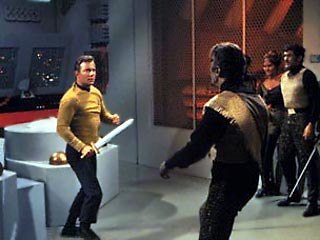
So what does this episode say about evil? It suggests that it comes from outside, yet its effects are expressed by human (or Klingon) behavior. In a sense, where evil is located doesn’t matter: it’s the resulting behavior that counts. Because people, at least theoretically, have control over their behavior.
Psychologists and mythologists such as Carl Jung, Joseph Campbell and James Hillman, have emphasized the power of certain forces and ideas that most human cultures---and most humans---have in common. In other times and places, cultures gave these forces names, and represented them as beings---gods, demons, heroes. These are also called “archetypes.” And they are real, whether or not one believes that Zeus or Saturn, Satan or the Raven spirit exist in the world, separate from the human soul or psyche.
They are real because they are part of us and can captivate us, motivate us, inhabit us at various times, and may even in a sense possess us. We may think we are acting with total control, that we have sound reasons for what we do, but we’re mistaken.
These archetypes may not be entirely evil; they may even be mostly good, or have good and evil qualities, as humans do. But they are powerful, just as our instincts are---instincts our species developed to survive, but which aren’t always appropriate to situations that evoke them. That’s when they can become destructive, and indulging them becomes evil.
In this Star Trek episode, you might say that the men and women are possessed by the devil, or more specifically, by Mars. They believe they were unjustly attacked and violently injured, and challenged to respond in kind. The term “war fever” is very accurate. It may even be understated. People are possessed by it. When war kicks in, it takes over---and we don’t have to think back more than a few years to see that as plain as day.
In this episode, “the dogs of war” are loosed, and they are like wild animals within people. We see and hear the outrage at injury become the lust for violence. The adversary becomes the enemy, and is immediately demonized---they are inhuman butchers: therefore violence is justified not only to repel aggression but in revenge.
War sparks the Us Versus Them fire within us, and when adversaries become enemies, there can be nothing good about them. Every act (even if it is the mirror image of our own acts) is evil; all differences between Us and Them, especially visible and racial differences, become part of our rationale for hatred.
We see all of this happen in this story, but we also see that it is based on illusions and delusions. Kirk and Spock see this almost immediately. They apply consciousness to the workings of unconsciousness, whether the automatic reactions are thoughts or feelings. They see there is no basis for these feelings, and they see they are being manipulated.
Is it manipulation from the outside? Yes, in this story, it is an alien entity. But Star Trek stories are also symbolic, and allegorical. The alien may be the devil, or even if we “have no devil” we know how one behaves.
If you believe with Scott Peck that evil is the lie, then there are two expressions of evil in this episode. The people in this story are deceived, and deception is evil. If they refuse to listen to consciousness, to consider that their feelings may not be justified by reality, they are engaging in self-deception, and that is evil.
In Scott Peck’s terms, even if the alien entity is the originator of evil, those that are “enthralled” and follow the leader are also guilty of evil.
This sense of group responsibility, or the responsibility of the follower, is made specific when Kirk says: “Be a pawn, be a toy, be a good soldier who never questions orders.” “Never questions orders” has a specific historical echo—which William Shatner, for one, could not fail to catch.
When Nazis were put on trial for war crimes and crimes against humanity at Nuremberg and elsewhere, they tried to excuse their conduct in the death camps as “only following orders.” These tribunals specifically denied this claim as valid—these soldiers and underlings were personally responsible for what they did, no matter what their orders.
Though the Nuremberg trials were in 1948, Americans were newly aware of them from the 1961 Hollywood movie, Judgment at Nuremberg, starring Spencer Tracy, and featuring William Shatner.
Individual responsibility was also an issue in the Vietnam war, partly because of the draft. Some believed draft resistance was a moral imperative, a way to refuse to cooperate with evil. The moral responsibility of individual soldiers was the theme of a song by Buffy Sainte Marie, made popular by Donovan, called “The Universal Soldier” (It had nothing to do with the later movie of that title.)
The issue came to worldwide public attention again when American soldiers slaughtered 400 to 500 unarmed Vietnamese civilians in what became known as the MyLai Massacre. (Scott Peck devotes a long chapter to it in People of the Lie.) Although it didn’t hit the news for over a year, it actually occurred in 1968, several months before this episode aired.
In the final analysis, evil is as evil does. People can have all kinds of thoughts and feelings, but how do they behave? In this story, the emphasis is on the cause of war---especially of what Vietnam became, a war that fed on itself. (Robert MacNamara, who was Secretary of Defense at the time, now says that he had long concluded that the Vietnam war couldn’t be won and probably should not have been fought; nevertheless, it continued, and he helped continue it.) The solution is recognizing the realities, including the fever that deceives us.
In terms of behavior, an alternative to war is presented: cooperation and mutual aid. Many Star Trek stories would dramatize this, and show that while it is difficult, it is not impossible. But this story is about group and individual behavior. “Those who hate and fight must stop themselves,” Spock says, “otherwise it is not stopped.” But how do you do that?
In this story, Bixby presents the problem finally as a choice---much as he did in Mirror, Mirror when Kirk presents the mirror universe Spock with the choice of steering his Enterprise towards a better, more ethical future. But how do you make the choice?
The simple answer is consciousness---not lying to yourself-- and taking responsibility. Of course it's easier said than done, but it can be done, and there are ways of doing it. A big step is simply being aware of the possibility of self-deception, and of the habits of self-deception and evil such as projecting evil unfairly or inaccurately on others, and scapegoating (blaming someone else, usually weaker).
"Our burgeoning interest in the existence and source of our prejudices, hidden hostilities, irrational fears, perceptual blind spots, mental ruts, and resistance to growth is the start of an evolutionary leap," Scott Peck writes. Of course, sometimes we are confronted with real evil and real danger. But knowing the difference between reality and illusion, wherever it comes from, helps us act more effectively.
How else is it done? There’s a more specific answer in a first season Star Trek episode, “ A Taste of Armageddon.” I’ll take a look at that, and what it says about dealing with evil within and without, next time. With any luck, next week: same time, same station.
Psychologists and mythologists such as Carl Jung, Joseph Campbell and James Hillman, have emphasized the power of certain forces and ideas that most human cultures---and most humans---have in common. In other times and places, cultures gave these forces names, and represented them as beings---gods, demons, heroes. These are also called “archetypes.” And they are real, whether or not one believes that Zeus or Saturn, Satan or the Raven spirit exist in the world, separate from the human soul or psyche.
They are real because they are part of us and can captivate us, motivate us, inhabit us at various times, and may even in a sense possess us. We may think we are acting with total control, that we have sound reasons for what we do, but we’re mistaken.
These archetypes may not be entirely evil; they may even be mostly good, or have good and evil qualities, as humans do. But they are powerful, just as our instincts are---instincts our species developed to survive, but which aren’t always appropriate to situations that evoke them. That’s when they can become destructive, and indulging them becomes evil.
In this Star Trek episode, you might say that the men and women are possessed by the devil, or more specifically, by Mars. They believe they were unjustly attacked and violently injured, and challenged to respond in kind. The term “war fever” is very accurate. It may even be understated. People are possessed by it. When war kicks in, it takes over---and we don’t have to think back more than a few years to see that as plain as day.
In this episode, “the dogs of war” are loosed, and they are like wild animals within people. We see and hear the outrage at injury become the lust for violence. The adversary becomes the enemy, and is immediately demonized---they are inhuman butchers: therefore violence is justified not only to repel aggression but in revenge.
War sparks the Us Versus Them fire within us, and when adversaries become enemies, there can be nothing good about them. Every act (even if it is the mirror image of our own acts) is evil; all differences between Us and Them, especially visible and racial differences, become part of our rationale for hatred.
We see all of this happen in this story, but we also see that it is based on illusions and delusions. Kirk and Spock see this almost immediately. They apply consciousness to the workings of unconsciousness, whether the automatic reactions are thoughts or feelings. They see there is no basis for these feelings, and they see they are being manipulated.
Is it manipulation from the outside? Yes, in this story, it is an alien entity. But Star Trek stories are also symbolic, and allegorical. The alien may be the devil, or even if we “have no devil” we know how one behaves.
If you believe with Scott Peck that evil is the lie, then there are two expressions of evil in this episode. The people in this story are deceived, and deception is evil. If they refuse to listen to consciousness, to consider that their feelings may not be justified by reality, they are engaging in self-deception, and that is evil.
In Scott Peck’s terms, even if the alien entity is the originator of evil, those that are “enthralled” and follow the leader are also guilty of evil.
This sense of group responsibility, or the responsibility of the follower, is made specific when Kirk says: “Be a pawn, be a toy, be a good soldier who never questions orders.” “Never questions orders” has a specific historical echo—which William Shatner, for one, could not fail to catch.
When Nazis were put on trial for war crimes and crimes against humanity at Nuremberg and elsewhere, they tried to excuse their conduct in the death camps as “only following orders.” These tribunals specifically denied this claim as valid—these soldiers and underlings were personally responsible for what they did, no matter what their orders.
Though the Nuremberg trials were in 1948, Americans were newly aware of them from the 1961 Hollywood movie, Judgment at Nuremberg, starring Spencer Tracy, and featuring William Shatner.
Individual responsibility was also an issue in the Vietnam war, partly because of the draft. Some believed draft resistance was a moral imperative, a way to refuse to cooperate with evil. The moral responsibility of individual soldiers was the theme of a song by Buffy Sainte Marie, made popular by Donovan, called “The Universal Soldier” (It had nothing to do with the later movie of that title.)
The issue came to worldwide public attention again when American soldiers slaughtered 400 to 500 unarmed Vietnamese civilians in what became known as the MyLai Massacre. (Scott Peck devotes a long chapter to it in People of the Lie.) Although it didn’t hit the news for over a year, it actually occurred in 1968, several months before this episode aired.
In the final analysis, evil is as evil does. People can have all kinds of thoughts and feelings, but how do they behave? In this story, the emphasis is on the cause of war---especially of what Vietnam became, a war that fed on itself. (Robert MacNamara, who was Secretary of Defense at the time, now says that he had long concluded that the Vietnam war couldn’t be won and probably should not have been fought; nevertheless, it continued, and he helped continue it.) The solution is recognizing the realities, including the fever that deceives us.
In terms of behavior, an alternative to war is presented: cooperation and mutual aid. Many Star Trek stories would dramatize this, and show that while it is difficult, it is not impossible. But this story is about group and individual behavior. “Those who hate and fight must stop themselves,” Spock says, “otherwise it is not stopped.” But how do you do that?
In this story, Bixby presents the problem finally as a choice---much as he did in Mirror, Mirror when Kirk presents the mirror universe Spock with the choice of steering his Enterprise towards a better, more ethical future. But how do you make the choice?
The simple answer is consciousness---not lying to yourself-- and taking responsibility. Of course it's easier said than done, but it can be done, and there are ways of doing it. A big step is simply being aware of the possibility of self-deception, and of the habits of self-deception and evil such as projecting evil unfairly or inaccurately on others, and scapegoating (blaming someone else, usually weaker).
"Our burgeoning interest in the existence and source of our prejudices, hidden hostilities, irrational fears, perceptual blind spots, mental ruts, and resistance to growth is the start of an evolutionary leap," Scott Peck writes. Of course, sometimes we are confronted with real evil and real danger. But knowing the difference between reality and illusion, wherever it comes from, helps us act more effectively.
How else is it done? There’s a more specific answer in a first season Star Trek episode, “ A Taste of Armageddon.” I’ll take a look at that, and what it says about dealing with evil within and without, next time. With any luck, next week: same time, same station.
Subscribe to:
Posts (Atom)