Monday, February 27, 2006


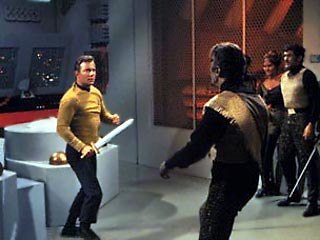
Kirk finds Kang takes some convincing. Posted by Picasa
So what does this episode say about evil? It suggests that it comes from outside, yet its effects are expressed by human (or Klingon) behavior. In a sense, where evil is located doesn’t matter: it’s the resulting behavior that counts. Because people, at least theoretically, have control over their behavior.

Psychologists and mythologists such as Carl Jung, Joseph Campbell and James Hillman, have emphasized the power of certain forces and ideas that most human cultures---and most humans---have in common. In other times and places, cultures gave these forces names, and represented them as beings---gods, demons, heroes. These are also called “archetypes.” And they are real, whether or not one believes that Zeus or Saturn, Satan or the Raven spirit exist in the world, separate from the human soul or psyche.

They are real because they are part of us and can captivate us, motivate us, inhabit us at various times, and may even in a sense possess us. We may think we are acting with total control, that we have sound reasons for what we do, but we’re mistaken.

These archetypes may not be entirely evil; they may even be mostly good, or have good and evil qualities, as humans do. But they are powerful, just as our instincts are---instincts our species developed to survive, but which aren’t always appropriate to situations that evoke them. That’s when they can become destructive, and indulging them becomes evil.

In this Star Trek episode, you might say that the men and women are possessed by the devil, or more specifically, by Mars. They believe they were unjustly attacked and violently injured, and challenged to respond in kind. The term “war fever” is very accurate. It may even be understated. People are possessed by it. When war kicks in, it takes over---and we don’t have to think back more than a few years to see that as plain as day.

In this episode, “the dogs of war” are loosed, and they are like wild animals within people. We see and hear the outrage at injury become the lust for violence. The adversary becomes the enemy, and is immediately demonized---they are inhuman butchers: therefore violence is justified not only to repel aggression but in revenge.

War sparks the Us Versus Them fire within us, and when adversaries become enemies, there can be nothing good about them. Every act (even if it is the mirror image of our own acts) is evil; all differences between Us and Them, especially visible and racial differences, become part of our rationale for hatred.

We see all of this happen in this story, but we also see that it is based on illusions and delusions. Kirk and Spock see this almost immediately. They apply consciousness to the workings of unconsciousness, whether the automatic reactions are thoughts or feelings. They see there is no basis for these feelings, and they see they are being manipulated.

Is it manipulation from the outside? Yes, in this story, it is an alien entity. But Star Trek stories are also symbolic, and allegorical. The alien may be the devil, or even if we “have no devil” we know how one behaves.

If you believe with Scott Peck that evil is the lie, then there are two expressions of evil in this episode. The people in this story are deceived, and deception is evil. If they refuse to listen to consciousness, to consider that their feelings may not be justified by reality, they are engaging in self-deception, and that is evil.

In Scott Peck’s terms, even if the alien entity is the originator of evil, those that are “enthralled” and follow the leader are also guilty of evil.

This sense of group responsibility, or the responsibility of the follower, is made specific when Kirk says: “Be a pawn, be a toy, be a good soldier who never questions orders.” “Never questions orders” has a specific historical echo—which William Shatner, for one, could not fail to catch.

When Nazis were put on trial for war crimes and crimes against humanity at Nuremberg and elsewhere, they tried to excuse their conduct in the death camps as “only following orders.” These tribunals specifically denied this claim as valid—these soldiers and underlings were personally responsible for what they did, no matter what their orders.

Though the Nuremberg trials were in 1948, Americans were newly aware of them from the 1961 Hollywood movie, Judgment at Nuremberg, starring Spencer Tracy, and featuring William Shatner.

Individual responsibility was also an issue in the Vietnam war, partly because of the draft. Some believed draft resistance was a moral imperative, a way to refuse to cooperate with evil. The moral responsibility of individual soldiers was the theme of a song by Buffy Sainte Marie, made popular by Donovan, called “The Universal Soldier” (It had nothing to do with the later movie of that title.)

The issue came to worldwide public attention again when American soldiers slaughtered 400 to 500 unarmed Vietnamese civilians in what became known as the MyLai Massacre. (Scott Peck devotes a long chapter to it in People of the Lie.) Although it didn’t hit the news for over a year, it actually occurred in 1968, several months before this episode aired.

In the final analysis, evil is as evil does. People can have all kinds of thoughts and feelings, but how do they behave? In this story, the emphasis is on the cause of war---especially of what Vietnam became, a war that fed on itself. (Robert MacNamara, who was Secretary of Defense at the time, now says that he had long concluded that the Vietnam war couldn’t be won and probably should not have been fought; nevertheless, it continued, and he helped continue it.) The solution is recognizing the realities, including the fever that deceives us.

In terms of behavior, an alternative to war is presented: cooperation and mutual aid. Many Star Trek stories would dramatize this, and show that while it is difficult, it is not impossible. But this story is about group and individual behavior. “Those who hate and fight must stop themselves,” Spock says, “otherwise it is not stopped.” But how do you do that?

In this story, Bixby presents the problem finally as a choice---much as he did in Mirror, Mirror when Kirk presents the mirror universe Spock with the choice of steering his Enterprise towards a better, more ethical future. But how do you make the choice?

The simple answer is consciousness---not lying to yourself-- and taking responsibility. Of course it's easier said than done, but it can be done, and there are ways of doing it. A big step is simply being aware of the possibility of self-deception, and of the habits of self-deception and evil such as projecting evil unfairly or inaccurately on others, and scapegoating (blaming someone else, usually weaker).

"Our burgeoning interest in the existence and source of our prejudices, hidden hostilities, irrational fears, perceptual blind spots, mental ruts, and resistance to growth is the start of an evolutionary leap," Scott Peck writes. Of course, sometimes we are confronted with real evil and real danger. But knowing the difference between reality and illusion, wherever it comes from, helps us act more effectively.

How else is it done? There’s a more specific answer in a first season Star Trek episode, “ A Taste of Armageddon.” I’ll take a look at that, and what it says about dealing with evil within and without, next time. With any luck, next week: same time, same station.
Sunday, January 29, 2006


Now what? A Mind Meld with a Tuna? Posted by Picasa
How To Know When You've Maybe Seen Too Much Star Trek

When people are talking about the latest developments in the Middle East and you think the solution is a Romulan warbird in orbit around the earth. Differences below might get settled very quickly.

When someone mentions seeing Charlie Rose interview American diplomat and Middle East expert Dennis Ross, and you remember him from his interview on the DVD of Star Trek VI: The Undiscovered Country.

When you're at a Mozart 250th birthday commemoration concert, and the quartet they are playing sounds like the same one a delusional crewman thinks he's playing in the TNG episode, "Where No One Has Gone Before."

When you see the Montery Bay Acquarium on a PBS special and recognize it as the Cetacean Institute in Star Trek IV: The Voyage Home.

When this all happens the same evening.

Yes. Way too much.

However:

Because you heard him on the Trek DVD, you listen to what Dennis Ross has to say about the Middle East on Charlie Rose.

Because the Traveler has such admiration for Mozart, you probably paid a little more attention to his music back when that show was first on the air, and maybe that's one reason you went to the 250th birthday concert, and had that joyous experience.

Because you recognize Montery Acquarium, you watch a few minutes of the PBS show and get interested, and watch the whole thing: it's fascinating. Did you know that great white sharks can sense the electrical impulses in your heart, if you happen to be in the water? Or that tuna swim amazingly fast, and migrate over thousands of miles of ocean, returning to precise locations, and scientists don't have a clue how they do it? That some jellyfish can be seven feet across, with tentacles a hundred feet long, and they may be direct descendants of the first ocean creatures? That certain plain old fish live to be a hundred years old? Or that great white sharks and tuna are endangered?

And you thought Star Trek aliens were alien? They're nowhere near as weird and wondrous as our fellow creatures on earth. Why---

There I go. Star Trek again.

Think I have a problem? Do you?

Sunday, January 15, 2006


Just where have we been warping to? Posted by Picasa
Star Trek: The Accidental Arcs

by William S. Kowinski

Star Trek as a saga is largely improvised. The original series concentrated on making the elements of the Star Trek universe consistent, to produce plausibility. Eventually stories began to build on characters and events of past stories. One Klingon encounter led to another.

Then came the accidental arc of “the trilogy”—the second, third and fourth Star Trek feature films. They weren’t planned as a continuous story, occurring sequentially in time. If Star Trek II: The Wrath of Khan had not been such a creative and commercial success, it may well have been the last of Star Trek.

Star Trek: The Next Generation began on television with certain commitments and hopes, and before it began Gene Roddenberry, other producers and writers had well over a decade of musing on what the original series had established and what was left within that to explore---which, as it turned out, was a lot.

In the formal sense of “story arc” in episodic TV—a continuous story over several or many episodes—TNG didn’t go much past the two-parter (although it could be argued that the return to earth of the Enterprise-D in “Family” was the third episode in the “Best of Both Worlds” confrontation with the Borg arc.) It wasn’t until TNG has solidified Star Trek’s prominence at Paramount that longer arcs were explored in “Deep Space Nine” and “Voyager.” “Enterprise” had something akin to a season-long arc and then in the first half of its last season produced several “mini-arcs” of three episodes, reminiscent of how the British “Doctor Who” series was long organized.

But there are other ways of looking at Star Trek in terms of arcs, at least metaphorically. Such as the accidental arcs of major characters, and the improvised arc of the entire saga.

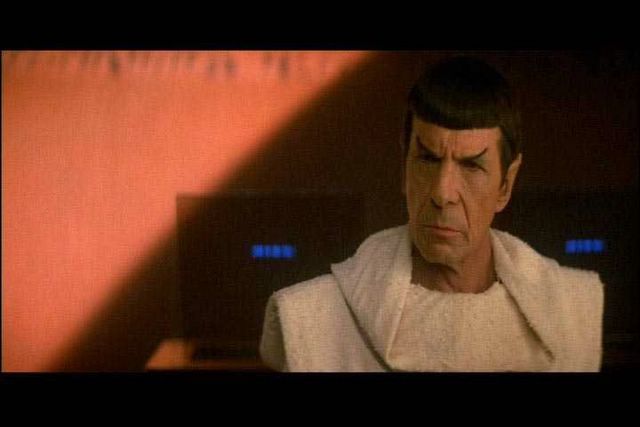
Spock: his arc was unification of opposites: logic and feeling,
light and shadow, human and alien. Posted by Picasa
Character and the Arc for Spock

Character arcs add up to our sense of the character’s essence, of what makes Kirk Kirk or Picard Picard, based on how they responded to a variety of situations depicted over time. But the character arc basically shows us how the character changed over time.

As far as I know, the only character arc that was planned from the beginning was Data, and that was a very basic plan. Brent Spiner has said that GR told him that Data would start out being quite different from the humans around him, but his eagerness to learn and his involvement in the lives of the crew and of the Enterprise, including his relationships, would mean that Data would gradually become more “human” in speech and behavior. In other words, the puppet Pinocchio would become a boy.

At some point, the TNG producers must have realized that they had a similar opportunity with Worf, though the changes in him would be more dynamic: how could he become more comfortable as a member of the Enterprise crew, and assimilate (it’s hard to use that word in a non-Borgian sense, but it’s the correct one) the best of what humanity had to offer, without losing his Klingon identity---in fact, while he strengthened it? That became the Worf arc, and it continued in Deep Space Nine.

By then, Star Trek producers had the example of the character arc of Spock. Due at least in part to the involvement and prodding of Leonard Nimoy, Spock began to change with the very first Star Trek feature. Nimoy managed the change somewhat in the same way as he managed the establishing of the basic Spock character in TOS: by using the particular script or story he was confronted with, and finding a way to do something interesting with Spock that would support the story, but also grow the character.

So in the chaos of Star Trek: The Motion Picture, Nimoy (with Shatner) apparently cooked up a few moments that clarified what had been implied from the beginning: that Vger’s journey to the point of needing human feeling was parallel to Spock’s journey of trying to purge himself of everything human, failing, and then learning from his mind-meld with Vger the value of those human aspects, to himself as well as to Vger.

Spock’s arc seemed to be over in Star Trek II. He seemed warmer with Kirk and others than in the first film, and older than in the series, which fit well into one of “Khan”'s general themes: the relativity of youth and aging. But then, Spock died.

The movie was a major hit and so the arc was not complete. Spock returned at the end of Trek III, and in IV was a new Spock, with a different air of innocence. He had knowledge but incomplete access to personal memories: he was, in his own way, Data-like.

By Star Trek VI the arc was more or less complete, though Spock had personal lessons to learn in the course of the film. He had come to one conclusion that seemed to merge Vulcan logic with what a commander of Star Fleet in an earlier film called “Vulcan mysticism.” Spock told Valeris to have faith that the universe unfolds as it should. But his other insight, communicated in this same scene, was a summation of his personal journey, of Spock’s basic arc: “Logic is the beginning, not the end of wisdom.” But within the film, Spock also learns about human weakness (anger), and perhaps even Vulcan weakness (arrogance), and again the theme of aging emerges, culminating when the original crew refuses to stand down, and warps into legend.

Spock makes one more appearance, more than 80 years later, when he meets Picard and Data, and learns of the recent death of his father, in a TNG two-parter. While it was a decent story, and continued Spock’ occupational evolution as a kind of diplomat and mentor, it contributed little to the character arc. This story ended with Spock underground on Romulus, working for the reunification of Romulans and Vulcans (which unites this last story with one in the first season of TOS), an apt correspondence to Spock’s character arc of personal unification.

Carl Jung believed, as others have, that we have several “personalities,” several contending voices within us. The process of becoming more conscious, of knowing ourselves, over a lifetime is partly a process of recognizing those voices and getting them to work together. Nimoy believed that adolescents in particular were drawn to Spock because they were realizing their own internal conflicts for the first time. So in this sense at least, Spock’s arc is a template for all of us.

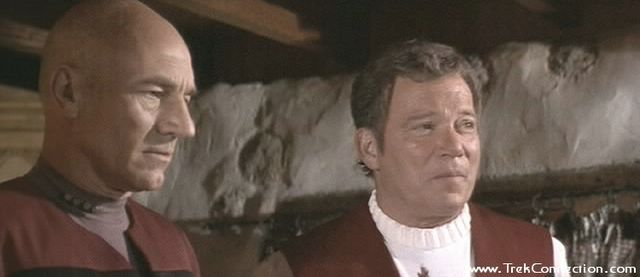
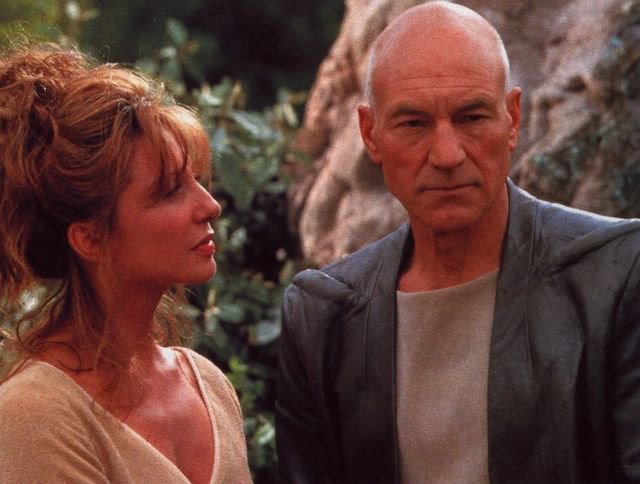
Home Bittersweet Home:Picard and Kirk in the Nexus Posted by Picasa
Captains of Soul

Captain Kirk’s character arc was perhaps less dramatic, if it’s possible to say that anything Shatner played was “less dramatic.” Mostly it seemed to be a kind of mellowing, of gaining complexity and self-knowledge through experience and the insults of aging, manifesting as a world-weary humor, the distinct irony that characterizes the latter movies, without completely losing the exuberance that was always the anchor of Kirk’s character. He dies trying to make a difference, doing so partly because "it was fun." (So maybe it could be summed up with the Shatner joke that didn't make it into Generations---from Captain on the bridge, to the bridge on the Captain.)

Captain Picard’s arc was probably also partly planned from the beginning, in the somewhat superficial way of his being a bit remote and uncomfortable with informal personal contact (especially children) in the beginning, and gradually warming and loosening up. This apparently mirrored Patrick Stewart’s attitude as an actor, when his British discipline and reserve met with the rest of the riot-prone cast. However, Stewart’s attitude changed perhaps even faster than Picard’s.

But when I think of Picard’s character arc, I think immediately of the impact on him of events in stories that, not just coincidentally, are among the best TNG episodes.

Throughout Star Trek and other TV and film science fiction, earthlings are forever being “taken over” by aliens, and when the alien influence is purged, they go back to normal as if nothing had happened to them. At least in the case of Picard, this doesn’t happen. The effects of his assimilation by the Borg are explored immediately in “Family.” In that story, he is humbled (“or humiliated” as his brother says) and hurt. In this story his youth is established as demonstrating a will to excel, and he did excel. But it was a lonely struggle---his father opposed his dreams of a Starfleet career, and his older brother resented and bullied him. (Patrick Stewart’s relationship with his own father was reputedly difficult.)

The effect of assimilation arises in a different way in the TNG feature “First Contact.” There we see the buried anger, the cold drive for vengeance, with its thinly veiled component of fear. Again, Picard is trying to impose his will---as he willed himself to win the Starfleet Academy marathon, he wills himself to defeat the Borg, no matter the cost to others.

Between the two Borg encounters, he had passed up on the opportunity to end the Borg threat by using the rescued Borg Hugh to infect the collective with a destructive virus. After being upbraided for this by an Admiral, he begins to doubt this decision. His dogged obsession with the Borg, and especially his residual contact with the collective, allows him to defeat a Borg incursion in the 24th century, and eventually to save the future by defeating the Borg in the 21st century. But other aspects of his character and its arc come into play when he is reminded of an archetype he is unconsciously acting out: that of Ahab, the whaling ship captain obsessed with revenge in Melville’s Moby Dick.

By now we know from earlier in his history that he is particularly aware of literary and historical precedents and meaning. Partly through that, and partly through his tutelage by Counsellor Troi, he has learned the benefits of being conscious of his own motivations, and in this case, of his own “shadow,” or the unconscious motives that masquerade as perfectly reasonable, leading to deliberately chosen behavior. All that makes his instant recognition of the truth of this archetype, and his instant change of behavior, very plausible for the Captain Picard we have come to know.

From TNG "The Inner Light" Posted by Picasa
Picard's Archetypal Arcs

Within the series, Picard had at least two powerful experiences that changed his character, but in ways that are hard to pin down, though I believe they are real, and do affect subsequent stories. They were his encounter with Dathon, the captain of the Tamarians, in “Darmok,” and the experience of living an entire lifetime on an alien planet in a few minutes, in “The Inner Light.”

“Darmok” is rightly hailed as one of the most imaginative science fiction stories ever, and one of the most daring, since it relies on the idea that these aliens think and communicate in such an alien way. But while Troi and Data back on the ship begin to piece together the meaning of a key phrase, it is Picard, with his understanding of literature and ancient civilizations, who realizes the Tamarians communicate by metaphor, and moreover, he is able to tell an appropriate story from earth’s mythology to seal the beginning of mutual understanding with Dathon.

Picard had watched Dathon perform his rituals, and he returned Dathon’s artifacts to the Tamarians. But he did two things after the Tamarians left. He began reading the Homeric Hymns, because he felt the power of “our own root metaphors.” And in a very powerful last moment as he looked through his cabin window into space, he performed part of Dathon’s ritual.

It is this sense of primal cultures that our acts are related to the archetypal, and recognition of what exists as sacred in sacramental acts and rituals. Picard was profoundly affected by this, and I believe it contributes to such later developments as his attempted defense of the Native Americans on Dorvan V in “Journey’s End,” (which in turn may have made him more certain of his actions defending the Ba’ku in “Insurrection.”)

He was even more profoundly affected by living an entire lifetime on the dying planet of Kataan, although he never left the Enterprise bridge. It had been well established that Picard never had a family, and apparently never even a committed relationship. It was living the life he never had---as a husband, a father and a grandfather---that affected him even more than living in the Kataan culture, in its poignant final days (something which is more apt to affect us, as we consider our greenhouse future.)

Again, the key moment after his return is at his cabin window, when he gazes into space and plays the Ressican flute, and the song he had composed in that other life. Just as Kataan has lost all life, he has lost the life he’d had, yet just as his memories preserve the story of Kataan, his experiences as Kamin become part of his reality as Picard.

There’s at least one later episode that refers directly to this, when Picard plays the flute again, and falls in love, perhaps to begin building that life he’d never had. But the realities of Starfleet intervene again, because the Captain must make life and death decisions without fear or favor, even involving his beloved. But you get the sense that Picard has been permanently changed, with a deeper sense of mortality, a greater appreciation of the moment and for his Enterprise family. And in the feature “Generations,” when he is propelled into the Nexus where his greatest fantasy can come true, it is the fantasy of a family, a home with a wife and children. (Interestingly, it is akin to Kirk’s fantasy in the Nexus, of a home with the woman he loves.)

Close observers of others series can probably produce character arcs for their characters--perhaps Captain Sisko's journey towards the Prophets, Captain Janeway's journey to a more complex humanity, Captain Archer's seasoning from eager enthusiast to desperate and focused warrior to statesman, and the changes he goes through that convinces him that the Federation is necessary. But let's move on to the saga itself.

Keeper of the flame? Posted by Picasa
The Saga's Sagging Arc

But what of the grand arc of the Star Trek saga? That’s the most accidental arc of all, as the saga went on, at first in fits and starts, always threatening to end, and then in a great rush of many stories told at once (more than a decade with new episodes of two series on TV and new movies in the theatres), and then the slow fade to a sudden stop with the cancellation of Enterprise.

As a prequel series, Enterprise of course complicated the arc by giving it a new beginning. Fans were disturbed by some of the failures of “continuity” with later Trek they thought they saw, but it may also be argued that Enterprise tried too hard to accommodate familiar “races”—even the Borg, not encountered again until the 24th century.

But in its simplest sense, the Star Trek saga arc might go like this: after terrible warfare and the reversion to post-apocalyptic nightmare of violence and superstition, a scientific breakthrough---the discovery of warp drive—changes everything, when it attracts a passing science vessel of Vulcans, and humans learn they are not alone in the universe they now have the power to explore.

The earth unites and banishes poverty and war. Starfleet is formed. But after a century humans are chafing at their limitations, and at the Vulcans’ insistence they are not ready for true interstellar exploration. But Captain Archer and the first Enterprise begin that process. This leads to the founding of the Federation.

In an as yet undramatized period---possibly the subject of the proposed “Star Trek: The Beginning” movie---earth is at war with the Romulan Empire. It ends and the neutral zone is established. By the 23rd century, Captain Kirk’s Enterprise is exploring farther, by now governed by the Prime Directive. It is also exploring the nature of humanity, through contrast with the civilizations of other worlds it encounters.

Human progress continues in the 24th century, not simply in new technologies but in better understanding of humanity, a greater commitment to self-knowledge, and a richer sense of the ethical behavior necessary for relationships with beings different from themselves.

But new enemies test both the inventiveness and will of the Federation, and the depth of its ethical understanding. In encounters with the Borg and the Dominion, once again humans must face their inner demons as well as their outer enemies, and deal with feelings of anger and vengeance, and the self-perpetuating emotions of war. Some falter but recover, stronger in soul than before (Picard.) Others fall into the sentimentality and shadow emotions of earlier eras (or of earlier war movies.)

Under this pressure, the Federation falters in its principles. Evils of the past return---political expediency over practical principle, shady deals, violation of the Constitution---I mean, the Prime Directive, secret police, licensed murderers for the state, the use and (if novels are included that take the narrative past the "canon") defense of torture. It seems that only Jean-Luc Picard is left to defend the Vision of GR, I mean the Federation, and that’s before Picard’s story is taken over by novels.

Obviously, the arc was influenced by 9-11 and current warfare (although it reverted to recycling old war movie drama and cliches long before that), but that's hardly an excuse: the arc started in the midst of Vietnam, Civil Rights, government provocateurs in anti-war groups and spying on individuals, a presidential Enemy's List, subversion of the Constiution, etc. Star Trek provided both rational and idealistic alternatives, and convincingly dramatized them.

In short, the arc of the Star Trek saga has left its reason for being in question, with a deeply conflicted Federation and a compromised Starfleet. Not a pretty picture. A new movie might help. If it’s the right new movie.

Monday, December 26, 2005


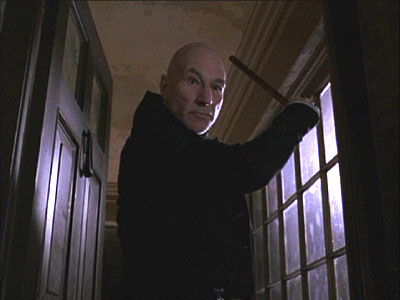
What would Picard do? Not go after a child singing Christmas carols with a stick, that's for sure. Posted by Picasa
A Star Trek Carol

by William S. Kowinski

As far as I recall (and fans of the various series’ can correct me on this), Christmas figured in a Star Trek story only once: in the feature film, Star Trek: Generations. When he arrives in the Nexus, Jean Luc Picard immediately begins to live a fantasy of family life. With the look of the house and how everyone in his family is dressed, it is an idealized Victorian England Christmas. I always thought this came directly from the fact that during TNG’s first run, Patrick Stewart was appearing now and again in a one-man show of Charles Dickens’ A Christmas Carol, set in pretty much the same Victorian era.

He hasn’t done it in recent years, but this December Patrick Stewart performed it again in London. Though he performed it off and on since 1988, including runs in the United States during his Jean Luc Picard 1990s, I’ve never seen it.

But some years ago I received the audio cassettes as a Christmas gift, and the coincidence of learning he was doing it again in London, watching the Peter Ackroyd bio of Dickens on PBS, and spending extra time in bed due to a cold, all conspired in inspiring me to listen to it again.

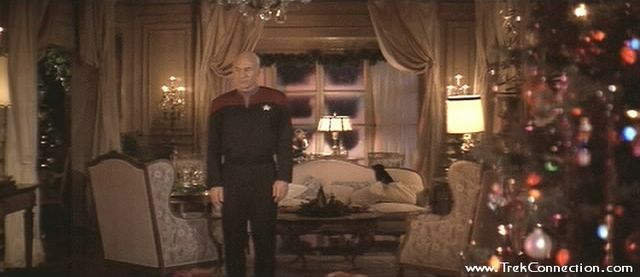
Picard's Dickens-era Christmas in the Nexus in the feature, "Generations." Posted by Picasa
Listening to the audio tapes then inspired me to dig up my taped-from-TV video of his 1999 TV movie version, a full production with other actors, movie sets and visual effects. I watched it on Christmas day.

With its sequences of the ghosts taking Scrooge on a tour of Christmas past, present and future, it is not far in form from a holodeck story on TNG. In fact, the episode “Tapestry,” in which Q takes Picard back to his Academy days to change one fateful day, and then forward to the consequences of the change, evolved from a story idea called “Q Carol,” a direct reference to the Dickens’ story. (So writes Larry Nemecek in the STNG Companion.)

Both Stewart’s stage version and the film version ( with music by Stephen Warbuck, who would win the Academy Award for Shakespeare in Love released the previous year) adhere very closely to Dickens’ book. So the Dickens’ point of view, often obscured in other productions, is very clear in this one. It conveys a very Star Trek-compatible message.

For instance, the first ghost to visit Scrooge is that of his dead partner in the counting-house, Jacob Marley. Marley must drag heavy chains of regret because of his misspent life. He cries out:

Not to know that no space of regret can make amends for one life's opportunity misused! Yet such was I! Oh! such was I!"

"But you were always a good man of business, Jacob," faltered Scrooge, who now began to apply this to himself.

"Business!" cried the Ghost, wringing its hands again. "Mankind was my business. The common welfare was my business; charity, mercy, forbearance, and benevolence, were, all, my business. The dealings of my trade were but a drop of water in the comprehensive ocean of my business!"

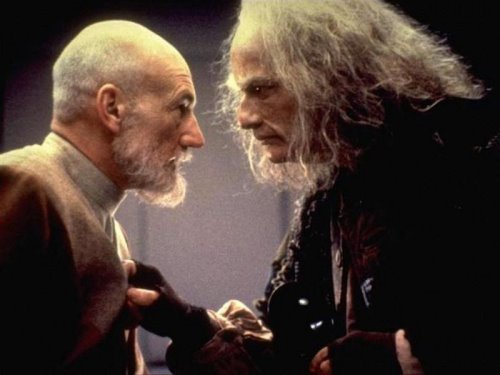
Joel Grey as the Ghost of Christmas Past in the 1999 Patrick Stewart "A Christmas Carol" Posted by Picasa
The common welfare was my business” is the essence of Dickens’ message to his fellow Londoners, where many lived in unspeakable poverty in a heavily polluted city (in Dickens, the London fog was not romantic—it was more like smog laden with disease.)

But since Scrooge is such a monster at the beginning of the story, Stewart got the opportunity to play a person behaving badly that he didn’t get on Star Trek. It is also a full part (even when he’s restricted to playing only Scrooge in the film) that showed Scrooge as sullen and mean, then frightened, humbled but still trying to retain control in his encounters with the ghosts, and then his second chance transformation and its aftermath. Stewart is more than adequate to the challenge each step of the way. His performance is a triumph.

More than a decade earlier, George C. Scott did a TV movie version of the story, and put his stamp on Scrooge’s transformation upon waking up on Christmas morning with his sudden, gleeful jumping up and down on his bed, when he realizes he has been given the chance to redeem himself. Stewart managed an even better effect in this crucial scene: he begins to choke, the choking sounds accelerate, and suddenly it turn into laughter. Scrooge had not laughed in so long it was physically wrenching to get one out. It’s not only an inspired idea, Stewart made it work beautifully.

But equally impressive is his attitude when he shows up for Christmas dinner at his nephew’s house, after this transformation. Though he’s been ebullient in the street, wishing a Merry Christmas to everyone he passes, when he gets to his nephew’s house he is suddenly shy and embarrassed. He slides into the dining room as if expecting to be rejected. It’s a terrific moment.

Dickens may seem a bit simplistic to us now, or even not realistic, because his selfish rich are mean and penny-pinching, whereas the rich of our era go in for conspicuous consumption and high times. But in linking virtue with healthy high spirits and family affections, Christmas charity with making merry on Christmas, Dickens is making a case for a good society in which social responsibility and the pursuit of happiness go hand in hand. It is a general theory of love. And not so different from Jean-Luc Picard’s Star Trek century.

Saturday, December 24, 2005


Merry Christmas, Happy Holidays! Posted by Picasa

Tuesday, December 13, 2005


The unknown possibilities of existence... Posted by Picasa
Light for a Cloudy Star Trek Future?

by William S. Kowinski

It’s been an eventful couple of weeks for Star Trek news---some hopeful, some disconcerting, some just confusing. Much of it suggests more questions than answers.

Some of the news seems to come from the gradually unfolding consequences of both the end of the Star Trek franchise as we’ve known it for some 20 years, and of the latest corporate changes for Paramount. In the world of Star Trek, Decipher, the company that published the Star Trek fan magazine since 2001, announced it was closing down its publishing and the Communicator with it.

Then Paramount announced its Digital Entertainment division was also shutting down, which put the future of the official site, Startrek.com in doubt.

Both moves seemed related to the splitting of Paramount and Viacom into two separate entities. With Paramount in charge of movies and Viacom in charge of television (and books), nobody seems to know who will be in charge of Star Trek, and its future movies and television, if any. (So far, there hasn’t been a disruption at Pocket Books/Simon & Schuster, which does Star Trek books. They’re part of Viacom.)

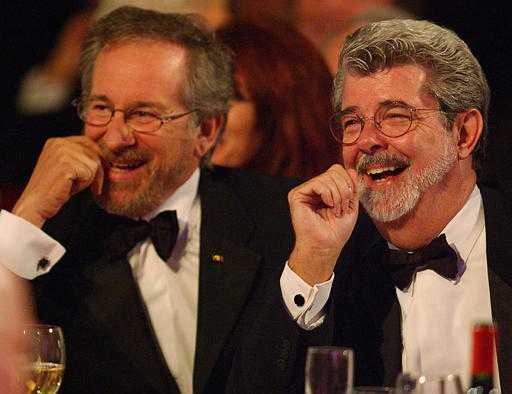
Then came the startling news that Paramount is buying the studio Dreamworks SKG, which means among other things that Steven Speilberg will be making movies and developing projects for Paramount. His science fiction blockbuster of last summer, War of the Worlds, was a Paramount and Dreamworks co-production.

Like the rest of this news, the most that can be said now about the Paramount deal is that it could be good for Star Trek, or it could be bad. It could mean a more powerful and aggressive Paramount, with new producers and directors of some clout and taste, with experience in successful sci-fi features. Or it could mean that the Trek franchise gets lost amidst bigger deals and priorities.

There seems to be hope that the apparently bad news for the Communicator and Startrek.com will have a happier ending. Larry Nemecek, managing editor of the Communicator, is convinced his magazine will continue publishing, but is being affected by the Paramount/Viacom confusion. In the meantime, Eugene Roddenberry has indicated interest in Startrek.com.

What apparent good news there was had to do with the potential eleventh Star Trek feature film. Within a couple of days of each other, news stories quoted Patrick Stewart as revealing that he had been part of serious discussions about a new Trek film to be made a couple of years from now, and Bryan Singer (director of the first two X-Men films, and the upcoming Superman Returns) indicating his interest in directing the next Trek movie.

These two stories immediately reminded me of Leonard Nimoy saying that whenever Star Trek has looked absolutely dead, it always came back, stronger than ever. Since the hard fate and bad feelings of Star Trek Nemesis, it seemed the chances for a new movie were slipping away, and even if there was one, it certainly wouldn’t be another Next Generation film. Patrick Stewart in particular insisted that he was finished with playing Jean-Luc Picard.

So what does this mean? I don't really know, and I have no inside information. But I can tell you what my instincts suggest to me.

Back in the saddle again? Posted by Picasa
I ascribe a lot of credibility to Stewart’s statement. First, he seems to have said it to two reputable sources, and he was very positive and very definite about it. It also has the smell of credibility because I believe Stewart genuinely wants to make another Star Trek picture. His protestations about playing Picard again seemed like a reaction to Paramount’s evaluation of Nemesis at the box office, and probably to how he and the cast were treated. There was trouble brewing even before the picture hit the theatres, with Paramount’s surprise “A generation’s final journey begins” tag line.

And in the many months since, Stewart has spoken with affection for Star Trek and particularly his fellow cast members. He mentioned bursting into tears while rehearsing his final “farewell” scene with Jonathan Frakes as Riker, in Nemesis, and much later, crying uncontrollably when he channel surfed into a showing of Nemesis on television, because he missed his friends and their work together.

Contrary to the suggestion by some cynical fans, he wouldn’t be doing it so much for the money---or even for Star Trek---but to work with these dear friends again, in the world they created together. (Anybody who thinks Patrick Stewart works only for money might consider the 16 months he’s devoting to doing nothing much but acting for the Royal Shakespeare Company’s amazing series of the entire Shakespeare canon of plays.)

Bryan Singer’s expression of interest in directing a Trek movie, on the other hand, should be taken with a grain of salt. It could be interpreted as simply his own fantasy, and nothing new at that. Like any Trek fan, he has ideas of what he’d do with the next movie. But on the other hand it could be more than that, in which case, keep that salt to put on the popcorn.

Even though it may have been a purely speculative remark to a fan, this has to be taken a bit more seriously because of Singer’s relationship with Stewart (after Singer directed Stewart in the second X-Men film, Stewart got him a bit part in Nemesis---which Singer points out was on the Enterprise bridge during a battle---the kind of thing a fan would point out.)

But even if there’s not much chance of Singer actually making a Trek film, his interest could very well send a message to Paramount: hey, this A List director of franchise films is interested in making a Trek movie. Maybe it’s worth doing. Maybe other A List directors would be interested.

For instance, the one you just got under contract.

Could Spielberg at Paramount be good news for Trek XI?  Posted by Picasa
The idea of Steven Spielberg making the next Trek film may or may not be a good one for Trek, but it sure would get Paramount moving. Spielberg as producer might be even better.

And this high level interest would be welcome all around. Patrick Stewart refuses to overtly blame the director of Nemesis for its failure, but others in the cast haven’t been so shy. Several have been outspoken that director Stuart Baird didn’t compensate for his lack of knowledge of (or interest in) the Trek universe with sparkling storytelling and mesmerizing visual style. And there was the questionable selection of scenes, which Baird at least had a hand in. Even Stewart once suggested that the DVD for Nemesis should have an Actors’ rather than a Director’s Cut.

But what about the Trek XI we’ve been hearing about from Rick Berman? It’s supposed to be about the beginning of Star Trek, before the time of Enterprise, and have no one from previous casts in it. That would include, one assumes, Patrick Stewart.

Then there’s the little mystery of why Stewart decided to announce this now, when he said these meetings (with “money men” involved )took place something like four months ago. He hasn’t exactly been silent and invisible all that time.

My guess is that Berman’s Trek: the Beginning is dead. And maybe Berman and Stewart know this now, and so Stewart felt he could talk about that meeting four months ago.

I'm guessing as well that there have always been at least two approaches being discussed, though Berman and his regime may have been aware of only theirs. I recall rumors some months ago that Jonathan Frakes had met with people Paramount about the next movie. The speculation then was that he was being considered as director for Berman’s project. Maybe so. But maybe not. Maybe he was part of these other discussions.

If someone or ones with the power to push Paramount’s buttons decides that the problem with Nemesis was the director, the release date, whatever. And that Enterprise proved that a new Trek crew in a new Trek universe is riskier than using a universe and crew with proven popularity--- then this other project may be getting the upper hand.

And perhaps not only Stewart and Berman but the announced writer, Erik Jendreson, knows this now. In any event, he has recently signed on as writer and producer for a new television series, which would pretty much preclude his continuing participation in a Trek project.

My further guess is that it is not exclusively a Next Generation project, but is akin to John Logan’s idea for Trek XI that he talked about in an interview I unfortunately can no longer find, before Nemesis was released. If I recall correctly, he was proposing a lighter tone, and a story involving characters (and actors) from more than one Trek TV series. So this would involve Picard and other Next Gen characters, but not only them.

Jean Luc and Denny Crain Kirk? Posted by Picasa
Lots of people play the game of “what should the next Trek movie be?” I played it in some emails with Nick Sagan. I’m not going to tell you his ideas, because as a former Trek writer and producer, and the author of two terrific sci-fi novels and one more soon to come, he is in a much better position to actually sell his approach.

But I’ll tell you mine. It’s a premise and an approach, not yet a story. The premise is that some members of all the Enterprise crews suddenly disappear (not all of them—just the ones who agree to be in the picture.) They reappear on one of the Enterprises---perhaps Archer’s, perhaps Picard’s. They don’t know why. Until who should appear in their midst, but Q.

Next Gen movies have needed Q for some time, in my opinion, and he’s the perfect rationale for gathering available major Trek actors for this movie. (It would have been a perfect 40th anniversary premise, by the way.) Even DS9 and Voyager actors could be included---all of them have been on one Enterprise or another, even for transport or a tour.

The premise is that the universe is very confused, something major has happened to its very fabric, and even Q is confused. He tried to turn to Picard and his Enterprise to help him sort it out, but the space-time continuum is in such flux that he grabbed people from several Enterprises over several hundred years. Furthermore, he got some of them long after they retired (Captain Kirk, anyone?) and perhaps even some at a point in their lives before they served. Or, perhaps in the case of Kirk, they’re snatched from alternate timelines.

But the essence is Picard and Q solving the problem of what’s wrong with the universe, with the able assistance of Kirk, Archer and whoever. (In terms of casting, an additional beauty of this premise is that everybody doesn’t have to be in the whole movie. There could be surprises throughout.)

The approach to the story I would like to see does not involve the political emphasis of latter Trek, or big space battles that would turn Trek into another adjunct of video games, but a return to what was promised in Next Gen’s final episode.

Remember what Q said at the end? “That is the exploration that awaits you! Not mapping stars and studying nebulae, but charting the unknown possibilities of existence!”

I’m not talking about either psychobabble or technobabble. I mean an exciting, challenging story that involves concepts that arise from the latest ideas in quantum physics and related fields.

The truth is that for all its advanced technology, the Star Trek universe is basically Newtonian, with a lot of technobabble tap-dancing. Gene Roddenberry went for ideas and for nourishment to scientists as well as technicians, and it’s time that Star Trek went back to sources like that for new ideas.

So---where do I sign?

UPDATE 12/15/05: Ain't It Cool News and TrekWeb are reporting a story that apparently originated at Canmag.com that indeed the prequel story for the next film is dead, and that the new film is to feature Picard, Kirk and Archer. But the setting is to be the Mirror Universe, which is not an idea I find appealing at all. It was badly done on Enterprise and I wasn't fond of the DS9 attempts I saw either. (The original series episode worked but only as a self-contained allegory.)

Anyway, I hope this "news" didn't originate with this site, because it was all speculation and proposal here.

Wednesday, November 30, 2005


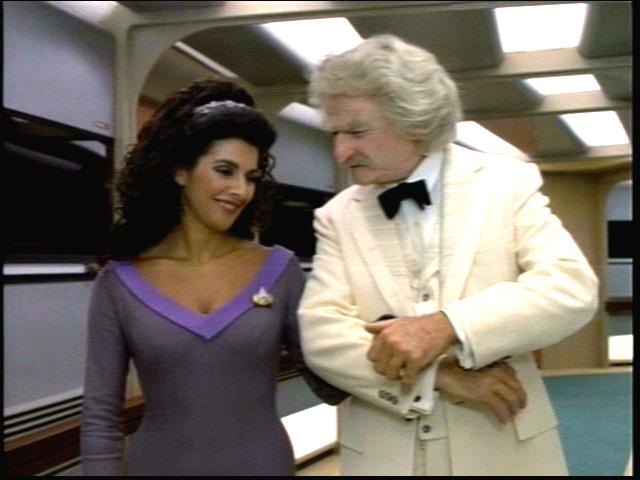
Mark Twain, whose Connecticut Yankee woke up in the future, finds himself aboard the 24th century Enterprise. "I guess the future turned out pretty well." Posted by Picasa
Looking for Star Trek, High and Low

(Along with the Beatles, Herman Melville and Harry Potter)

by William S. Kowinski

Science fiction writer Bruce Sterling has a fascinating new non-fictional but still scientific book called Shaping Things (M.I.T. Press), which should be of interest to anyone into design, the future and the interface of information technology and the stuff in our lives. Plus it’s very short.

This isn’t about Bruce Sterling, however. It’s been inspired by an “endintroduction” to his book by Peter Lunenfeld, editorial director of Mediawork, the outfit that puts out this series of little books. He starts off: “I was mulling over Shakespeare’s observation that the future is an ‘undiscovered country.’ No, that’s not true; I was watching late night cable and stumbled across one of those forgettable Star Trek films from the 1990s, with that phrase in the title.”

We’ll overlook the slight to the films, and mention that he was of course referring to Star Trek VI (which I’ve conveniently just posted an essay about, here.) Lunefeld goes on to say that then he “remembered that Shakespeare wasn’t referring to the future, he was referring to death. Actually, that’s not true either.” He looked up the phrase on the Internet, and got the “proper context from Hamlet” which he swears he actually did read, but long ago.

His conclusion, and presumably the reason for mentioning all this, was: “This mix of the high and the low, the dread and the absurd, constitutes the future, and that’s what this Mediawork pamphlet is about.”

It’s also an aspect of the future that Star Trek had a hand in creating, and that it embodies. Especially the “mix of the high and the low.” And that’s a very good and very necessary thing.

Before we go on, a brief commercial message: you'll find a Powell's Bookstore box on this page. You can use it to search for new and used books. If you order anything after linking from here, this site gets a cut. Thanks.

Now back to the show...

Star Trek VI had Chagall, Sherlock Holmes, Cold War history,
Peter Pan and of course, Shakespeare in the original Klingon. Posted by Picasa
Lunefeld felt this was worth mentioning because for awhile now there’s been a cultural separation between what is perceived as popular art or entertainment, and what is ritually considered high art. The difference between pulp science fiction and Literature, say, or rock and classical music, TV drama and Greek drama, and…Star Trek and Shakespeare.

For example, a new biography of the Beatles was just published---it’s almost a thousand pages long, with a hundred pages of footnotes, a scholarly tome and, according to the New York Times review, very well written. The review authors expressed wonder at how things had changed since the early 1960s: “Rock 'n' roll was considered marginal and disposable; the way to learn about its practitioners was to scour fan magazines or pore over sparse album liner notes. When the Beatles began, it would have been unthinkable to read a well-written biography about rock 'n' roll performers that was as serious and thoroughly researched as an important book about Faulkner or Picasso or Mao. For better and for worse, the Beatles changed all that.”

So in its way did Star Trek. It was just a television drama, just science fiction, and dangerously close to a kids show--- the combination was about the lowest you could go. Star Trek became a serious part of the culture the same way the Beatles did---by becoming very popular and making a lot of money for a long time. But like the Beatles, in other ways as well.

(Before we get too far away from the Beatles biography, it’s worth saying that I’ve thought more than once how sorely we lack a really good biography of Gene Roddenberry by a trained biographer or journalist, not either a show business friend or a show business enemy. His authorized biography is respectable, while the other more scurrilous one basically repeats every grudge anyone had against him. There are lots of points of view in lots of books, but no means to figure out what’s what. Evaluating information objectively and placing it in an historical perspective in a biography like one on Faulkner or Picasso or the Beatles has yet to be accomplished.)

In "The Naked Time," George Takei used his
fencing lessons with the man who taught
Erroll Flynn in 'Robin Hood.' Posted by Picasa
Like the Beatles, Star Trek rebelled against various high art traditions while it absorbed and used elements of that tradition. In Star Trek’s case, it was the form and content of story.

In a general way, Star Trek was part of several storytelling traditions: literary (both the supposed low form of science fiction, and the higher forms of classical literature) and dramatic. Science fiction, which began (with H.G. Wells, at least) in the late 19th century era when literature in the form of the novel was a primary popular storytelling form, was in Wells’ hands (and those who followed him) a ready-made way to bring classic literary ideas into the present, and forward to the metaphorical future.

As television drama, Star Trek was in a long line of literary and dramatic adaptation, or theft. Crucial to its creators were the movies. Everyone from GR to Leonard Nimoy and William Shatner had movie palace matinee memories. When George Takei got to display his previously nonexistent swordsmanship in “The Naked Time” episode of the original series, he was thrilled because he loved Robin Hood---not from reading the stories but from the movies. (He loved the Erroll Flynn classic version and when he sought fencing lessons, he happened to wind up learning from the man who taught Flynn for that very movie, and who did Basil Rathbone’s sword-fighting in the film itself.)

From the original series episode, "Who Mourns
for Adonais?" about Apollo as the last Greek god.
The title is that of a poem by Shelley, mourning the
death of his friend, poet John Keats. It's worth a look. Posted by Picasa
So Star Trek took plots and ideas from everywhere, from a submarine movie to Joseph Conrad, from Captain Video to Shakespeare. Viewers even got a taste of what classic Greek theatre was like, because (as William Shatner said) the budgets were so small they were essentially putting on plays, but plays with meaning, like the Greeks did. Much of the cast in both the original series and TNG were theatre trained. If a writer suggested a classical allusion, they knew how to play it.

It truly was in the 60s, with the Beatles and other popular music, with Star Trek and a few other TV shows, that popular art and entertainment reinterpreted high art forms and narratives, and made them more accessible. Like those old Classic Comics books or movie versions, they also became conduits to the classics themselves. They made them relevant and easier to approach. They provided a kind of introduction. And the classics, in turn, illuminated aspects of a Star Trek story or a Beatles tune. Bob Dylan learned from an established (if notorious) poet like Allen Ginsberg, and Ginsberg recognized in him his successor.

In fact, ideas, encounters and engagements relevant to the times were more likely to be found in pop culture than in high art, and were accessible to more people, particularly the young.

Practitioners in forms old enough to be high art forms, like the novel, also became underground and popular successes dealing with ideas and issues that seized the imaginations of a popular or cult audience. A lot of young people got turned on to mystical and Eastern religious thought by J.D. Salinger and Jack Kerouac. Joseph Heller, Kurt Vonnegut, Doris Lessing and others became both popular and cult. They also turned readers on to writers they admired and emulated.

There was so much energy in popular forms in the 60s—in music, movies and television as well as more experimental theatre, novels and poetry---that a fair number of young people who’d majored in English literature became pop culture commentators, rock critics, film and TV reviewers and pop journalists. Who also played in a band, or made super eight movies.

So the cross-fertilization became pretty natural, and pretty healthy. Thanks as well to wide availability of paperback books, old movies on TV and foreign and experimental films on campuses, people began to make their own explorations, perhaps to go where no one in their families or neighborhoods or high school had gone before.

You could start anywhere and get everywhere, as the cross-fertilization of popular and high art continued. Leading to situations like: my Moby Dick story.

Khan channelling Ahab--He tasks me, he tasks me but I will have him. Posted by Picasa
I first encountered Moby Dick in high school, in a long dense passage about whales in our American Literature anthology. All we were supposed to know about it, though, was that the white whale was a symbol. Even though I was a literature major in college, I never had to read the whole book; I just had to know a little about Melville, and generally what the established critics said about Moby Dick. There were plenty of other books I had to read. I never got around to that one.

But sometime in the mid 1980s my curiosity was piqued and I found my paperback copy (because as a lit major it was more important to have the book than to have read it) and began reading. I was astonished. The language was rich and crazy, like Shakespeare disguised as a mad sailor telling strange sea tales.

Then I came upon a passage in which Ahab talks of chasing Moby Dick “around perdition’s flames,” and then his expression, “he’s tasks me,” and then the “I spit at thee” speech, and somehow it seemed I read it all before. Or heard it. And then I realized---it was Khan.

This may not be a surprise to you, but trust me, this was an authentic personal discovery. Apart from the common theme of obsession, at that point I knew of no connection between Moby Dick and Star Trek II, which I had only seen once or maybe twice in a movie theatre. (It wasn’t until I saw it on video that I noticed the copy of Moby Dick in Khan’s empty quarters---with the same cover as my paperback.)

Of course the irony wasn’t lost on me---instead of this literature major picking up a literary allusion in a popular movie, I’d spotted Melville plagiarizing from Star Trek. (It was a couple of years later, when I was definitely on a campaign to read all the really long novels I’d always meant to read but didn’t, that I spotted the name “Yoyodyne” in a novel by Thomas Pynchon---and immediately remembered it from one of my favorite recent movies, Buckaroo Banzai.)

This reverse derivation is a somewhat surreal but quite lovely experience, showing the vitality of both the popular and classical art in a two-way relationship across time. That so many young people now may be discovering, for instance, how many classical composers have stolen from John Williams and Jerry Goldsmith and the other composers of orchestral soundtracks, is a deeply cultural experience, and a very hopeful one for holding on to the threads of the best content and practices, from past to future.

This two-way relationship is pretty widespread by now. At the memorial for GR, Patrick Stewart (who quotes---actually misquotes—lines from Moby Dick in First Contact) mentioned that someone had written to Rick Berman to point out that Captain Picard reading a copy of the Homeric Hymns (at the end of the TNG episode, "Darmok") had probably made “more people curious about that literature than at any time since their creation!”

I can recall more than one discussion of the epic of Gilgamesh in a Star Trek forum, including some very moving summaries of the story. A few months work of TNG episodes and viewers could see entire scenes from Shakespeare acted, meet Mark Twain and Jack London in 19th century San Francisco, hear discussions of Jung and Euclid, see Data reenact Sherlock Holmes in Victorian London, and watch Einstein play poker with Newton and Stephen Hawking.

Star Trek was among the first to include some of the spirit and meaning from the classics, as well as bits and pieces and allusions. Now there are other conduits for elements and values derived from “high” culture, especially for the young. Like Star Wars, and Harry Potter.

This two-way transport is even easier these days, thanks to DVD, video cassettes and the Internet---practically the whole culture, high and low, is easily available, a lot of it for cheap or for free.

But people don't have to seek Star Trek out---it remains more frequently present on TV sets all over the world. Several generations have learned from these Star Trek stories by now, have confronted the same ethical questions and choices, asked the same important questions about mortality and meaning, the past and the future, that the best literature and drama, philosophy and science also address. And come to their own conclusions.

At the same time, Star Trek put them in the context of a romantic but believable future, when confronting these issues was part of this believable journey. The application of the past to the future would run through our present as we watched. Later, curiosity about the classical roots or source of some element of the story could lead to discoveries that enriched the episode or movie on the next encounter.

Star Trek has been a bridge to these ideas and to appreciating these works, since it began. That’s become more valuable and more important as time goes on, and our culture sinks into a dull morass, where intelligence is stereotyped, and curiosity is nearly extinct. That’s why I consider Star Trek fans among the true elite.

"Star Trek appeals to a higher denominator,” Harve Bennett once said. “ It appeals to the imagination, to the mind."

Star Wars and Harry Potter may be the champs of myth
these days but Star Trek had its moments, as in
the TNG episode, "Masks." Posted by Picasa
Distinctions between high and low cultural expressions have existed at various times and places in history, though not everywhere and not always. There’s a fascinating book by Lawrence W. Levine called Highbrow Lowbrow which details how there was little difference in much of the 18th and all of the 19th century, particularly in America, where Shakespeare and Dickens (writing in that new “popular” form called the novel) and Verdi’s and Mozart’s operas were as much a part of mass culture as jugglers, banjo players and music hall comedy.

When there is a distinction, it is usually based on money and social class, and sometimes on education. There remained some mixing in the 20th century, particularly based on tastes brought over by European immigrants: Italian peasants who loved opera, for instance, and Russians who worshipped ballet. But in some ways, the distinctions certainly became more rigid.

By now, however, in a way they’ve also reversed. Rich people are still more or less in charge of high art, like the symphonies their money partly supports, or the painting and sculpture only they can afford to buy (if only for the investment.) Yet anybody can tune into a classical radio station or get some idea of great paintings from reproductions, and the literary classics are among the cheapest paperbacks you can find. Thanks to DVDs, video stores, downloadable music, etc.--even literary classics online for free--a larger chunk of cultural expression is more easily accessible than ever before.

The problem isn’t so much access to high art, it’s the lack of respect for it. There’s less looking down on the low tastes for popular entertainment. Instead there’s more looking askance at what’s defined as high art. Popular culture is the culture. So it’s become up to popular culture to keep the best of great art alive.

The distinction between high and low has seldom been made by artists themselves. The great composers took liberally from folk melodies, classical artists stole from jazz, jazz artists stole from classical, and the Beatles absorbed from everybody. The same is true in all the arts. But these days, the balance has been distorted—high art absorbs low, but popular arts and entertainment, and even their audiences, keep their distance from the forms and content of high art.

Why is that? Money mostly, but this time not concentrated in the wealthy. The big bucks are in what’s defined as commercial entertainment, which is itself so closely allied to advertising that it is as much a form of advertising as it is a form of music, drama or literature. There is little to distinguish most television from the commercials.

The success of advertising and commercial culture depends on ignorance. Few products are sold anymore on the basis of meeting a need or because they’re good quality and value. Most advertising creates a phony need and suggests, falsely, that its product will meet it. Advertising depends on people falling for it. The dumber the customers are, the easier it is. By and large, television has to be as least as dumb as the commercials if the commercials are to look smart. And sooner or later, everything becomes television, just as every business becomes Hollywood.

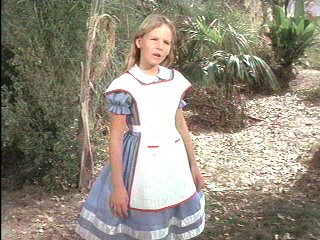
Alice in Wonderland's guest appearance in "Shore Leave,"
Ted Sturgeon's story. Posted by Picasa
But the future depends on other qualities besides gullibility, short attention spans, jaded brains and senses, and psychological enslavement to what’s popular at the current moment---all of which are essential to the triumph of the will of advertising.

The future will only exist for individuals and for society if people are curious and adventurous in their minds and hearts, and if they esteem learning, knowledge, openness to the best new and old ideas and expressions, and above all to making up their own minds based on quality and quantity of information.

People who deride Star Trek fans as losers (because they are different) and conformists (because they are all the same) and especially as shallow people who pour way too much interest and faith in a relatively silly television show, just don’t get it. Star Trek fans often exercise more intellectual curiosity and openness, as well as sincere need to understand the larger contexts of their lives, and a heartfelt desire to live a good life, than many of their jaded critics do.

As someone from the lower middle class who was lucky to be born in a time and place where I could go to a college and study literature and philosophy and theatre, while being part of a new culture of movies and popular music and writing, I don’t dismiss any avenue of exploration that leads to great insights, expanded consciousness and the oceanic and subtle complexities of feeling inspired by great art, high and low.

What does it matter really if a Harvard professor or Star Trek II leads you to Moby Dick, as long as you get there? And why would anyone object to the shared memory of Moby Dick informing a psychological insight particularly instructive to us in our time, in the guise of Jean Luc Picard in the 24th century, being consumed by vengeance against the Borg?

It’s win-win, as far as I can see.

We need people with depth and character, if we’re to have any sort of future. And if we don’t get there, then we need a present where we reach with our hands and hearts and minds to the extent of our potential, so we at least live full lives. We must try our best not only to create a better world, but to be the kind of people who make it better right now, so we at least deserve a future.

Anyway, according to the big thinkers at MIT, Star Trek fans are way ahead.

Thursday, November 17, 2005

NEW! Latest Entry in the Trekalog: Star Trek VI posted HERE
On the Lost Star Trek 40th Anniversary Book

I’ve just posted an essay on Star Trek VI, the latest in my “Trekalog” series on all ten films. It’s quite long, so I’ll keep this short.

I’ve decided to go public about some discussions I’ve had concerning Star Trek’s 40th anniversary. As most readers here know, I wrote an article for the New York Times published in August 2004, concerning prospects for Star Trek’s future. It had been edited for space, and I posted the full text here, which got this blog going.

At about the same time I started putting out feelers about writing a book for Star Trek's 40th anniversary in 2006. At first everyone was encouraging, including several people at Paramount, and Star Trek figures like Leonard Nimoy and (more recently) Eugene Roddenberry.

A few weeks after my Times piece appeared, Marco Palmieri at Pocket Books expressed interest, and I had a meeting with him and other editors there by telephone. They asked me to write up some ideas for such a book. Several seemed enthusiastic.

They cautioned me, however, that they weren’t sure Pocket Books/Simon & Schuster would okay any new nonfiction book on Star Trek, because nonfiction Trek books hadn’t been selling well recently.

I didn’t hear from them for awhile, but eventually I had one more phone conversation with Marco Palmieri. He told me that they had liked my ideas, and they wanted me to write the book. But as they feared, Pocket Books was saying no to publishing any such nonfiction Trek book. The only possibility then was if Paramount got interested enough to “support” the book by guaranteeing some of the cost.

That’s how things stood earlier this year: if a 40th anniversary book was to be published, I would be writing it. But unfortunately, there isn’t going to be one. I’ve sent a few emails since, but haven’t heard back, but I assume nothing has changed.

Of course, this is very disappointing. I was especially looking forward to working with the editors and others to put together a book of text and visuals to celebrate Star Trek by taking a step back and looking at it in a larger historical context than has been explored before. To celebrate its significance in its time, and for our time, and especially for the future.

Much of what I’ve written for this blog has been written with that book—or a book-- in mind. Response to what I’ve posted here has helped me define what I want to do and how best to do it.

At this point I still intend to write a book for the 40th anniversary, though it’s likely I’ll have to publish it myself, probably through one of the print-on-demand services (I reprinted my book originally published by Morrow, The Malling of America, through Xlibris). That way it would be available through all the major online booksellers.

But that will depend on how much time I can devote to it without outside resources. And it will be a different book. In some ways, more limited, because I won't have access or rights to Star Trek photos. But in other ways, I probably have more freedom in an unofficial book. You know, "freedom's just another word for nothing left to lose"?

In the meantime, I’ll keep posting here when I can, and I’ll be looking for your responses to what I’m trying to do. I’ve been heartened and inspired by some of the generous comments I’ve received. (I’ve passed a bunch of them on to Pocket Books!) I hope you’ll support this 40th anniversary book project.

Wednesday, November 02, 2005


Michael Piller in 2000, receiving the
Gene Roddenberrry Award from
actor Anne Lockhart. Star Trek.com photo. Posted by Picasa
Keeper of the Flame
R.I.P. Michael Piller (1948-2005)

Riker and Shelby in Piller's famous third season
TNG episode, "The Best of Both Worlds I" Posted by Picasa
by William S. Kowinski

Legacy (Part One)

Michael Piller was an important creative force in TV and movie storytelling of 24th century Star Trek, and in many ways he was a conscience of Star Trek after Gene Roddenberry’s death. Judging from the testimonials from people who knew him that are appearing on TrekWeb and elsewhere, he also had GR’s dedication to story and his affinity for people. Michael Piller seemed to have been a great student and a great teacher and mentor.

Certainly his remarkable innovation of an open door policy for scripts added energy and years of creativity to The Next Generation.

But in reviewing the richness in his commentaries and interviews I’ve sampled today, I wonder how much more there is that we can learn from him, and others. In a commentary for Star Trek: Insurrection, he mentioned compiling all the script versions of that film, intending to publish them. To my knowledge, he never did.

It is unlikely that such a volume would be published commercially today. Paramount and Simon & Schuster (Pocket Books) have determined that non-fiction Star Trek isn’t profitable. (I’ll have more to say about that in a different connection soon.) With the ten “special edition” DVDs of Star Trek features complete, and the DVDs of all the 23rd and 24th century Star Trek television episodes issued, Paramount is unlikely to release any more filmed or taped material relating to them.

So perhaps it is time for a different kind of memorial to Michael Piller and the growing number of creative contributors to Star Trek who have passed away.

I would like to see some kind of public archive created of all the Star Trek material that hasn’t been released, and will never be released commercially. There must be many hours of interviews with Piller and others, perhaps filmed for various DVDs but not included. And for example, the commentaries that William Shatner and Leonard Nimoy did for original series episodes when they premiered on the Sci-Fi Channel, some of which have never been seen or heard.

There must be volumes of scripts and other writings done by those associated creatively with Star Trek, that will never be commercially published. Not to mention drawings, models and so on, as well as deleted scenes, alternate takes on tape and film.

The Internet offers new possibilities for providing access to people around the world. Probably there is no money to be made in all this, but there should be a method of ensuring access to scholars and fans.

Star Trek made a number of institutions and people a lot of money, and it became important to people who have made fortunes in different fields. They might be willing and even eager to create a Star Trek endowment, and help fund a nonprofit Star Trek foundation;to talk about a Star Trek museum, a Star Trek library and on-line archives, either as an independent entity or affiliated with another institution, such as the Museum of Broadcasting.

Maybe it’s time to talk about Star Trek fellowships, for people with the skills, talent and interest to research and prepare appropriate packages of visual, audio and print material. And interviewers to capture more memories and contributions from remaining Star Trek creators.

Perhaps this is the discussion that should be happening as Star Trek approaches its 40th anniversary. For it’s clear that whatever Star Trek becomes in the future, its past is becoming a closed book.

This proposal I believe is in the spirit of Michael Piller. He is one of the Star Trek creators in whose memory this could be done. Star Trek has an important legacy, and it can be kept alive.

Star Trek: Insurrection: Piller's script, trying to keep GR's vision alive Posted by Picasa
Legacy (Part II)

In his commentaries and interviews, Michael Piller talked often of what he learned from Gene Roddenberry, in his first year as a writer and producer for The Next Generation, and Roddenberry’s last year as an active executive producer.

Piller said that in particular his goal in writing the script for Star Trek: Insurrection was to return Star Trek to the Roddenberry approach to the future. He felt he was “the keeper of the flame.”

Of those who came after Roddenberry, Piller often seemed to best understand GR’s Star Trek. Already that Star Trek is being forgotten and dismissed, yet the flame is still alive.

The advent of new “grittier” science fiction series and especially the three alien-threat shows now on the major broadcast networks have generated a lot of “we’re not Star Trek and boy are we glad” chatter.

It’s interesting how many feel they have to say they aren’t Star Trek. But in their attempts to separate themselves from the most successful science fiction saga in history, they wind up protesting too much.

They talk about how times have changed---how this is a more fearful time, people are more threatened, and it’s not an optimistic period as it was in Trek’s heyday. Either these people didn’t live through the Star Trek 1960s, or they did a little too much LDS. In 1966 and 1967 there was a war and a draft killing thousands; there were confrontations between police and students and other demonstrators both frequently and in huge numbers. There were riots in black ghettos each summer from 1964, in a dozen cities. Then they really exploded in 1968.

In 1968, there was more of everything, plus a Nobel Peace Prize winner and moral leader not only of African Americans and their allies but of the world, and the man who was on the way to becoming President, ending the war and reuniting the factions at each other’s throats not only in the streets but in American homes, both gunned down and killed within six weeks of each other.

Star Trek’s revival began as the trauma of Watergate was sinking into the background, but suspicion and cynicism were rising. The threat of nuclear war, of instant Armageddon with little or no warning, was always there, flaring into consciousness in the Cuban Missile crisis and again in the arms buildup of the Reagan (and Next Generation) 1980s. By the late 60s, and through the 70s and 80s, grave environmental threats and prospects of a polluted and ruined world were also known and had become part of everyday consciousness.

The spirit of hope that was expressed in Star Trek lived despite the times, not as some comfortable expression of them. True, there were more visionary and utopian ideas and fervent feeling than is evident today, and perhaps more innocence. There was the Apollo program, and the stunning view of the earth from the moon. But when Edward Kennedy spoke to the Democratic Convention after his brother Robert’s death, as Robert had after President Kennedy’s assassination, he asserted, “the hope still lives, and the dream will never die.” Not everyone believed him.

The truth is that while new shows may very well be creative, well-crafted and a contrast in style, their vision of the future (or of aliens) is less sophisticated than Star Trek’s. It is basically a vision of the past---both the past of science fiction/fantasy, the past of war movies and tales of intrigue, and the past of humankind.

The whole premise of GR’s Star Trek is that we had to outgrow this past if we were going to have an immediate future.

Few understood this better than Michael Piller, especially as he is quoted in his section of The Great Birds of the Galaxy:

“I think Gene’s view of the future serves an important purpose in a very difficult time of our lives and history. When our daily lives are filled with smog, gangs and drugs, it’s important to see that there is hope, that there are ways to solve our problems, that there is a future we can look forward to.”

“I’m sure there is a fine, wonderful series to be made out of Blade Runner, but I wouldn’t want to live there. I think it is terribly important on television that you provide an environment that people want to stay in.

“There are those who would violently disagree with me, but I would love to live in the 24th century that Gene Roddenberry has created. I also think it’s terribly important that family values on television come through, and that [our characters] represent the working environment, the family environment and living environment that we wish we would have. In a way it sets a role model for things we can accomplish.

“ I endorse it, I enjoy writing it, writers who have a difficult time with it complain that it’s hard to find conflict in characters who are perfect, who live in a perfect world. All I can say is that it is harder in that you can’t just drop back and say, ‘Okay, let’s do a drug story this week,’ but these are different people from different places. They approach problems in different ways.”

“We’re dealing with better humans here. We’ve evolved a little bit over the centuries, and so you’re not going to have a lot of pettiness. But I do think there’s room for genuine, honest conflict. For two people who like each other, who come from legitimate backgrounds and are honorable people, you still can have conflict.

“ There is room for conflict and there are ways to find it. It’s a little harder, but I also think it’s very important that we endorse this. It’s certainly the life I want to have.”